Skip to Content

Analytics

Analytics is an international, peer-reviewed, open access journal on methodologies, technologies, and applications of analytics, published quarterly online by MDPI.

Get Alerted

Add your email address to receive forthcoming issues of this journal.

All Articles (162)

Insurance inclusion remains low across emerging markets; Uzbekistan, with penetration below 1% of GDP, is one example. The main goal of this study is to identify the behavioural determinants of insurance inclusion by testing an integrated moderated-mediation model, grounded in the Theory of Reasoned Action and the attitude–intention–behaviour logic of the Theory of Planned Behaviour, in which financial and insurance literacy operate through trust, perceived benefit, and attitude, with perceived risk and digital literacy as boundary conditions. Survey data from 353 respondents in Uzbekistan’s Syrdarya region were analysed using partial least squares structural equation modelling. Insurance literacy strongly shaped trust in insurers and perceived benefit, whereas general financial literacy exerted only a weak indirect influence; these beliefs formed favourable attitudes associated with purchase intention and, ultimately, with self-reported insurance inclusion. All direct and mediating paths were supported, and the model explained 59% of the variance in inclusion. Perceived risk played a dual role, directly motivating purchase intention while weakening the attitude–intention link; digital literacy did not moderate the intention–inclusion relationship. Multi-group analysis showed the model largely invariant across demographic subgroups. Insurance literacy and the beliefs it fosters emerge as the strongest behavioural correlates of insurance inclusion in this regional setting.

Analytics

16 September 2026
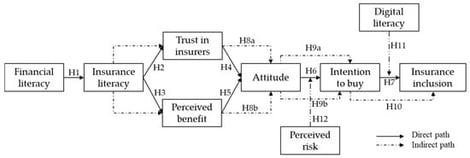
Research Framework. Source: Authors’ creation.

Standard ensemble classifiers assign weights based on performance over a single feature space, leaving multi-scale fractional representations unexplored as a tabular augmentation strategy. This study proposes the FRAE (Fractional-order Recalibrated Adaptive Ensemble) framework, which applies Grünwald–Letnikov (GL) derivatives at four memory orders as tabular feature augmentation and couples each view’s memory order to its ensemble weight via an α-specific power exponent. FRAE was evaluated on three open-access cancer datasets—WAW-TACE HCC (n = 198), Ye Prostate Cancer (C1 n = 298; C2 n = 300, external), and HANCOCK HNSCC (n = 763)—against nine baselines under 5-fold stratified cross-validation, with ablation across ten configurations. FRAE ranks first by MCC in D2 (0.587 vs. CAWPE 0.563) and second in D1 and D3, with the highest sensitivity in D3 (0.766). Ablation confirms that GL feature augmentation, not weight allocation, is the primary performance driver, contributing a directionally consistent AUC increment of 0.82–1.41 percentage points across all three tasks. On the external cohort, FRAE achieves AUC = 0.8305 [95% CI: 0.7772, 0.8739], ranking first by F1 and NPV, and tied for first by MCC among ten models, though confidence intervals overlap across all model pairs. Multi-institutional prospective validation remains the necessary next step.

Analytics

10 September 2026

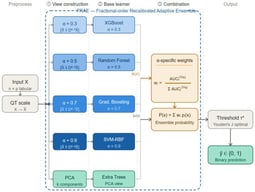
FRAE architecture (dashed border). Blue gradient encodes GL memory order: light (α = 0.3, long memory) → dark (α = 0.9, near-integer derivative). Learner box colors match the corresponding GL view. AUCi feeds α-specific weight computation; pi(x) feeds ensemble probability aggregation. Binary prediction ŷ is obtained via Youden’s J-optimal threshold τ*. Preprocessing (QT scale) is applied prior to the three core FRAE stages.

Class imbalance and class cardinality both affect multiclass classification, but their influence on probabilistic estimation has been less explored. This study examines these impacts using an e-commerce dataset. The study follows a four-stage methodology comprising classifier comparative evaluation, controlled class-cardinality analysis, validation using real categorical variables, and class-imbalance evaluation. Multiclass classification tasks are evaluated using Support Vector Machine, Gaussian Naive Bayes, Logistic Regression, Random Forest, and Decision Tree classifiers. Under five-fold cross-validation, performance is assessed using the macro-F1 score, log loss, and accuracy. Results show that macro-F1 score and accuracy decrease as class cardinality increases, causing greater classification difficulty. Tree-based models like Random Forest exhibit more balanced performance across classes. Gaussian Naive Bayes obtains the lowest log loss, indicating more accurate probability estimations. Class cardinality effects are isolated by varying the number of classes while keeping the features and classifier fixed. Increasing class cardinality reduced posterior confidence and increased entropy and log loss. Using real-time categorical variables, these trends are confirmed. Class imbalance primarily affects minority class performance, whereas class cardinality exerts a broader influence on probabilistic confidence and prediction uncertainty. The findings emphasize the necessity to consider class cardinality, class imbalance, and probabilistic metrics when evaluating multiclass classification models.

Analytics

8 September 2026

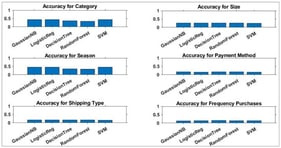
Comparison of classification accuracy across six multiclass ecommerce prediction tasks.

Bio-inspired optimization algorithms have become an effective class of techniques for addressing challenging continuous optimization problems. In this work, we introduce the Parallel Enzyme Action Optimization (PEAO) algorithm, a parallel bio-inspired optimization approach that incorporates a multi-strategy communication mechanism among cooperative subpopulations. The population is partitioned into multiple subpopulations that evolve concurrently, promoting a more effective exploration of the search space. Furthermore, PEAO integrates adaptive search factors, local search procedure and communication strategies to improve solution quality while reducing the risk of premature convergence. In addition, a K-means-based population initialization procedure and a convergence-driven stopping criterion based on successive improvements in the best objective-function value are incorporated to reduce unnecessary objective-function evaluations and improve the overall efficiency of the optimization process.

Analytics

3 September 2026

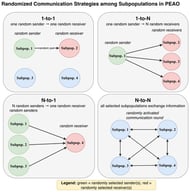
Communication and propagation strategies among subpopulations.

Featured Articles of Last Quarter

Highly Accessed Articles

News & Conferences

Latest Issues

Open for Submission

Journal Sections

XFacebookLinkedIn
Analytics - ISSN 2813-2203