
Skip Content
You are currently on the new version of our website. Access the old version .
  • Indexed in
    Scopus
  • 21 days
    Time to First Decision

Aquaculture Journal

Aquaculture Journal is an international, peer-reviewed, open access journal on aquaculture-related aquatic science published quarterly online by MDPI.

All Articles (98)

Tenacibaculosis is a major bacterial disease in aquaculture, with Tenacibaculum discolor being characterized as one of the causative agents. This study evaluated the antimicrobial and antibiofilm potential of three isolated Pseudoalteromonas strains—Pseudoalteromonas sp. GY795-2 (deep-sea), Pseudoalteromonas spongiae MB2 (aquaculture installation), and Pseudoalteromonas tetraodonis SAE 20 (kelps)—against T. discolor strain FMCC B487. Cell-free supernatants (SNs) from each Pseudoalteromonas culture were tested in microtiter assays, assessing planktonic growth measured by OD600 and biofilm biomass quantified by crystal violet (CV) staining. The addition of the Pseudoalteromonas SNs affected both growth and biofilm development of T. discolor strain FMCC B487. A significant decrease in T. discolor strain FMCC B487 growth and biofilm was observed in the presence of P. spongiae MB2 SN, whereas the SN of Pseudoalteromonas sp. GY795-2 promoted both growth and biofilm development of T. discolor strain FMCC B487. To assess whole-cell activity, dual-species biofilms were formed on plastic surfaces. After 24 h, all three Pseudoalteromonas strains reduced the viable T. discolor strain FMCC B487 population while maintaining their own cell numbers comparable to single-culture controls, suggesting an inhibitory interaction. These results demonstrate that these Pseudoalteromonas strains’ metabolites and cells can modulate T. discolor growth and biofilm development, highlighting their potential as biocontrol agents in aquaculture.

5 February 2026
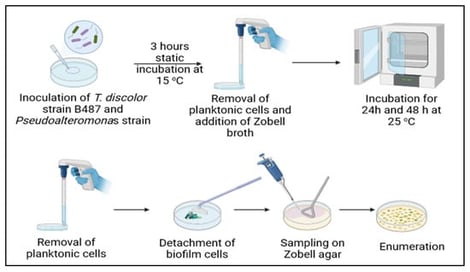
Graphic procedure for mono- and dual-species biofilm experiments. Biofilm cells were enumerated on Zobell agar plates (Lower part). Image created in Created in BioRender. SCHOINA, E. (2026) https://BioRender.com/mj23ujj, accessed on 28 December 2025.

Antimicrobial use (AMU) in finfish aquaculture production raises concerns about the link between AMU and the development of antimicrobial resistance (AMR) in bacteria found in aquatic organisms and potential transmission to humans and the environment. The objective of this study was to describe the antimicrobial susceptibilities of a historical collection of bacterial isolates from diagnostic submissions from farmed finfish in British Columbia (BC), Canada. Antimicrobial susceptibility data were obtained from the BC Ministry of Agriculture via submissions to the Animal Health Centre for 2007 to 2018 for florfenicol (FLOR), oxytetracycline (OXY), trimethoprim-sulfadiazine (SXT), and triple-sulfa compound (TRI). There were 1237 unique isolates from all finfish species (68 unique bacterial species), of which 1042 were from Atlantic salmon. For all fish species, the most common bacterial species isolated were Aeromonas salmonicida (n = 174), Aliivibrio wodanis (n = 84), and Yersinia ruckeri (n = 79). Resistance was detected to most antimicrobials tested, but levels were generally low. Resistance to FLOR was only detected in A. salmonicida. Low annual isolate numbers precluded genera-specific annual comparisons for all pathogens. Multi-drug resistance was detected, but at low levels. These results provide an important baseline for antimicrobial susceptibility data from bacterial isolates that may cause disease in finfish aquaculture in BC, Canada that will support future Canadian AMR surveillance in farmed aquaculture.

4 February 2026

Fish is highly prone to spoilage due to a combination of intrinsic biochemical processes and microbial proliferation, which together drive rapid quality deterioration during post-harvest handling and storage. These processes are further accelerated by factors such as elevated temperatures, mechanical damage, and suboptimal handling. In Mediterranean aquaculture, ice slurry is the standard harvesting method. This study aimed to characterize the initial post-harvest enzymatic activity of key proteolytic enzymes, calpain, collagenase, cathepsin B (CTSB), and cathepsin L (CTSL), in the white muscle of three commercially important species (Sparus aurata, Dicentrarchus labrax, and Pagrus major) harvested under standard practices across three seawater harvest temperatures (low, medium, and high). Muscle samples were collected over a 13-day chilled storage period post-harvest, and enzymatic activity was assessed using standardized fluorometric assays. Our findings establish the basal post-mortem proteolytic profiles for each species and reveal marked species-specific differences in enzyme activity patterns. Calpain and collagenase exhibited early and parallel activation, while CTSB and CTSL showed a coordinated increase during storage. Harvest temperature emerged as a critical factor, with the highest enzymatic activities consistently observed during the moderate temperature period. These results underscore the importance of species-specific physiology and seasonal conditions in shaping post-harvest filet degradation, offering a basis for refining harvest strategies to enhance quality management in Mediterranean aquaculture.

28 January 2026

Inefficient management of dissolved oxygen (DO) in intensive aquaculture systems limits fish welfare and productivity by creating oxygen-deficient zones and promoting hydrodynamic conditions that hinder their dispersion. Because water movement directly influences how oxygen is transported and mixed within the culture unit, inadequate flow management can allow localized hypoxia to persist even when total oxygen input appears sufficient. To address this issue, this study proposes an integrated methodology that combines in situ respirometry measurements with Computational Fluid Dynamics (CFD) simulations to evaluate the spatial distribution of DO and diagnose the operational performance of aquaculture systems. The methodology quantifies oxygen consumption using intermittent-flow respirometry, applies a three-dimensional two-phase CFD model (water–oxygen) incorporating experimental oxygen consumption rates as boundary conditions, and validates the model under real operating conditions, focusing on active metabolism as the most demanding physiological state. The model generates a spatial distribution of DO patterns that are significantly modified by pond geometry, water flow characteristics, the metabolism of the fish and fish positioning. The differences between experimental and simulated values ranged from 7.8% to 10.7%, confirming the accuracy of the proposed method. The integration of in situ metabolic measurements with CFD modeling provides a realistic representation of DO dynamics, enabling system optimization and promoting more efficient and sustainable aquaculture.

19 December 2025

News & Conferences

Issues

Open for Submission

Editor's Choice

Get Alerted

Add your email address to receive forthcoming issues of this journal.

XFacebookLinkedIn
Aquac. J. - ISSN 2673-9496