



Journal Menu
► ▼ Journal Menu-
- Biomolecules Home
- Aims & Scope
- Editorial Board
- Reviewer Board
- Topical Advisory Panel
- Early Career Editorial Board
- Instructions for Authors
- Special Issues
- Topics
- Sections & Collections
- Article Processing Charge
- Indexing & Archiving
- Editor’s Choice Articles
- Most Cited & Viewed
- Journal Statistics
- Journal History
- Journal Awards
- Conferences
- Editorial Office
Journal Browser
► ▼ Journal BrowserNeed Help?
Announcements
29 January 2024
Interview with Ms. Elizabeth Hill—Winner of the Best Young Academic Talk Award at Prion 2023 Sponsored by Biomolecules
|
|
Ms. Elizabeth (Lizzie) Hill is the winner of the Best Young Academic Talk Award at Prion 2023, which was sponsored by Biomolecules (ISSN: 2218-273X), and she is a final year Ph.D. student at the MRC Prion Unit at UCL in London, UK. She is particularly interested in the mechanisms underlying neurodegeneration with a long-term goal of being involved in facilitating disease-modifying therapies. Ms. Hill has also been involved in long-standing volunteer and public engagement work related to prion diseases and Parkinson’s disease. |
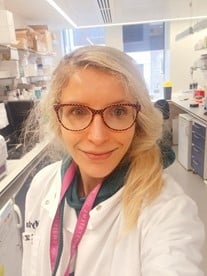
The following is an interview with Ms. Elizabeth Hill:
1. Could you provide an overview of the research project that led to the award?
I am investigating the role of a recently identified genetic risk factor, syntaxin-6 (STX6), in prion diseases and related tauopathies. Using a functional genetics approach, I have generated both cellular and mouse models with manipulated syntaxin-6 expression for thorough characterization of both prion and tau phenotypes to further our knowledge of the molecular mechanisms through which syntaxin-6 affects disease susceptibility.
2. How did you come to choose this particular field of research?
Due to being personally touched by dementia in my family, I became incredibly motivated to contribute to research into neurodegeneration. I was fascinated by the concept of prions and how prion-like mechanisms are increasingly being unraveled in the more common neurodegenerative diseases.
3. Can you describe a specific challenge you have faced/are facing while conducting research and how you have overcome/are overcoming it?
When I started my Ph.D., I found public speaking extremely anxiety-provoking. However, by consistently putting myself in that uncomfortable position through institute-wide presentations, public engagement events, and also attending public speaking training, I have greatly improved.
4. How do you envision the impact of your research on the broader community or society?
My research informs on the mechanisms underlying disease susceptibility and the pathogenesis of prion diseases and tauopathies. I hope that this will provide another puzzle piece to further our understanding of these complex diseases, eventually aiding the development of disease-modifying treatments.
5. What is your impression of Biomolecules and open access publishing?
It allows research to reach a broader audience, allowing more people to access science from non-academic or low- and middle-income settings. Ultimately, I believe this results in scientific progress being maximized.
6. What are your overall thoughts about the conference, and besides winning the award, is there a moment that you particularly cherish from Prion 2023?
It was a wonderful conference with lots of exciting talks and insightful conversations. The moment I cherish the most is the overwhelming level of support I got from my work colleagues prior to presenting, who went over and above what I would have expected.
7. How did you celebrate winning the award, and do you have rituals to mark your accomplishments?
I shared my success with friends and family, and the accomplishment was warmly recognized by my institute.
8. What advice would you give to young researchers who are just starting their careers?
Take every opportunity to talk to people about your research and gain useful insights and expertise. Find good mentors. Take time to celebrate both the little and big successes.
