Skip Content
You are currently on the new version of our website. Access the old version .

Ceramics

Ceramics is an international, peer-reviewed, open access journal of ceramics science and engineering, published monthly online by MDPI.

Quartile Ranking JCR - Q2 (Materials Science, Ceramics)

All Articles (705)

Valorizing construction and demolition waste (CDW) via alkaline activation enables low-carbon binders. This study assesses binary geopolymers formulated with recycled brick powder (PLR) and recycled concrete powder (PCR) in seven precursor ratios (0–100% PCR), activated with a ternary NaOH/Na2SiO3/KOH solution (silicate modulus Ms ≈ 3.2) at L/B = 0.15, and cured for 7, 14, and 28 days. Compressive strength (fc), X-ray diffraction (XRD), Fourier transform infrared spectroscopy (FTIR), and scanning electron microscopy with energy-dispersive X-ray spectroscopy (SEM-EDS) were used to link microstructure–phases–properties. A local maximum in fc at ~30% PCR (16.2 MPa at 28 d) was observed versus 0% PCR (14.2 MPa) and ≥50% PCR (13.8 → 10.1 MPa at 28 d). XRD indicated a reduction in inherited crystalline phases and an increased amorphous fraction at ~30% PCR; FTIR (normalized peak position and FWHM of the T–O–Si band, not absolute intensity) suggested higher network extension; SEM-EDS (local/semiquantitative) showed a moderate rise in Ca that supports C-A-S-H domains bridging the N-A-S-H network. At a high PCR, excess Ca simplified mineralogy (quartz/portlandite dominance), promoted competitive routes (C-S-H/carbonation), reintroduced microdefects, and reduced fc. A theoretical oxide balance per mix identified a compositional window where Ca/(Si + Al) ≈ 0.35–0.45 coincides with the mechanical optimum and with XRD/FTIR tracers. Overall, a ~30% PCR window maximizes co-reticulation of N-A-S-H/C-A-S-H and densification without compromising aluminosilicate continuity, providing transferrable design and process-control criteria for CDW-based geopolymer binders.

5 February 2026
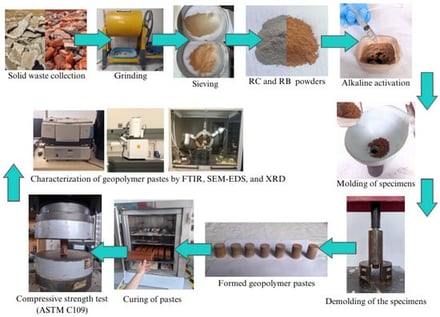
Experimental procedure workflow: conditioning of PCRs/PLRs → activator preparation → mixing → molding/compaction → pre-curing at 40 °C for 72 h → curing to 7/14/28 days → characterization (fc, XRD, FTIR, SEM–EDS).

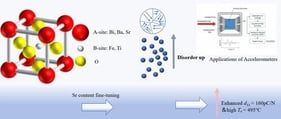
As the operational demands on piezoelectric devices grow increasingly stringent, there is an urgent need for materials capable of delivering stable performance at elevated temperatures. BiFeO3 (BF), a lead-free piezoelectric oxide with high-temperature resilience, is characterized by its notably high Curie temperature (Tc ∼ 835 °C), rendering it a promising candidate for high-temperature applications. However, its piezoelectric coefficients remain inadequate to satisfy practical requirements. The 0.7BiFeO3-0.3Ba(1-x) SrxTiO3 system (abbreviated as BF-BSxT) was designed to elucidate the roles of chemical disorder and local structural heterogeneities in the enhancement of functional properties through fine-tuning of the Sr content. The phase structure of the samples was carefully examined by X-ray diffraction. Rietveld refinement of the XRD data revealed that all BF-BSxT ceramics consist of coexisting R and PC phases. Optimized compositional disorder and local heterogeneities led to a moderate enhancement in the piezoelectric coefficient d33 value of 160 pC/N, a high Tc of 495 °C, and a remanent polarization Pr ≈ 22.1 μC/cm2 -were achieved in the BF-BSxT system at x = 0.06. These results indicate that BF-BSxT ceramics hold good potential for use in high-temperature piezoelectric devices.

3 February 2026

The X-ray diffraction patterns of BF-BSxT ceramics were selected in the range of (a) 20–80°, (b) 30.5–32.5°, (c) 38–40°.

Valorization of Industrial Waste in Monoporosa Ceramic Tile Production

  • Caterina Sgarlata,
  • Luciana Cupertino and
  • Cristina Siligardi
  • + 1 author

The ceramics industry has long embraced the principles of the circular economy, with a strong focus on the reuse and recovery of raw materials essential to the production cycle. This approach reduces costs by reintroducing secondary raw materials—such as production scraps and recycled materials—into the manufacturing process after appropriate recovery treatments. This study aims to contribute to the transition of the ceramic industry toward a circular economy by incorporating industrial by-products into monoporosa ceramic bodies, thereby transforming waste materials into valuable resources. Monoporosa is a porous, single-fired ceramic wall tile characterized by a high carbonate content and low bulk density. However, the role of secondary raw materials in monoporosa formulations, as well as their influence on processing behavior (e.g., during sintering) and on key technological properties, is not yet fully understood. This work investigates a standard monoporosa formulation based on conventional raw materials (sand, calcite, feldspars, and clays) and compares it with new formulations in which industrial waste materials from local and national sources—originating from other industrial processes—are used as partial or total substitutes for some of the traditional raw materials, particularly sand and calcite. The industrial by-products examined include biomass bottom ash, foundry sand, and marble cutting and processing sludge. All materials were characterized using chemical–mineralogical, thermal, and morphological analyses and were incorporated into the ceramic bodies at different substitution levels (10%, 50%, and 100%) to replace natural raw materials. Their behavior within the mixtures was evaluated to determine ceramic suitability and acceptable replacement ratios. Furthermore, the effects of these additions on water absorption, thermal expansion coefficient, and microstructural characteristics were assessed. Based on the positive results obtained, this study demonstrates the feasibility of using, in particular, two secondary raw materials—foundry sand and marble sludge—in monoporosa body formulations, allowing for the complete replacement of the original raw materials and thereby contributing to the development of more sustainable ceramic compositions.

28 January 2026

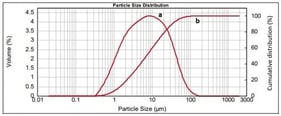
Particle volume distribution (a) and cumulative distribution (b) curves of monoporosa STD mixture.

Additive Manufacturing of Ceramic Materials via Direct Ink Writing (DIW): A Review

  • Edwin Francis Cárdenas Correa,
  • Edgar Absalón Torres Barahona and
  • Juan Bautista Carda Castelló

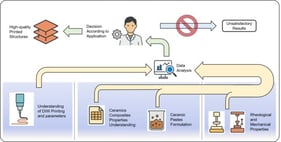
In additive manufacturing technologies, the use of pastes and inks based on materials such as clay to create three-dimensional objects layer by layer has opened new possibilities in fields such as engineering and biomedicine. This review article aims to provide a comprehensive understanding of 3D printing of ceramic pastes through Direct Ink Writing (DIW), also referred to as Robocasting. DIW offers specific advantages for ceramic 3D printing, including the ability to extrude highly loaded pastes with customized rheological properties to accommodate a broad spectrum of ceramic compositions, varying from conventional clays to advanced ceramics. It is characterized by filament deposition control, which facilitates the fabrication of complex, porous, or customized architectures while simultaneously minimizing material waste. Through a bibliometric analysis of the literature published between 2020 and 2024, the most relevant studies regarding printing system architectures, ceramic paste formulations, and adjustment of parameters to obtain high-quality parts were identified. This work presents relevant and accurate explanations of the DIW technology, supporting researchers and industry professionals seeking to initiate or improve ceramic 3D printing processes for a wide range of applications.

28 January 2026

Keyword analysis of co-occurring works relating to DIW technology.

News & Conferences

Issues

Open for Submission

Editor's Choice

Reprints of Collections

Transparent Ceramics
Reprint

Transparent Ceramics

a Theme Issue in Honor of Dr. Adrian Goldstein
Editors: Yiquan Wu
Innovative Manufacturing Processes of Silicate Materials
Reprint

Innovative Manufacturing Processes of Silicate Materials

Editors: Maurice Gonon, Sandra Abdelouhab, Gisèle Laure Lecomte-Nana

Get Alerted

Add your email address to receive forthcoming issues of this journal.

XFacebookLinkedIn
Ceramics - ISSN 2571-6131