


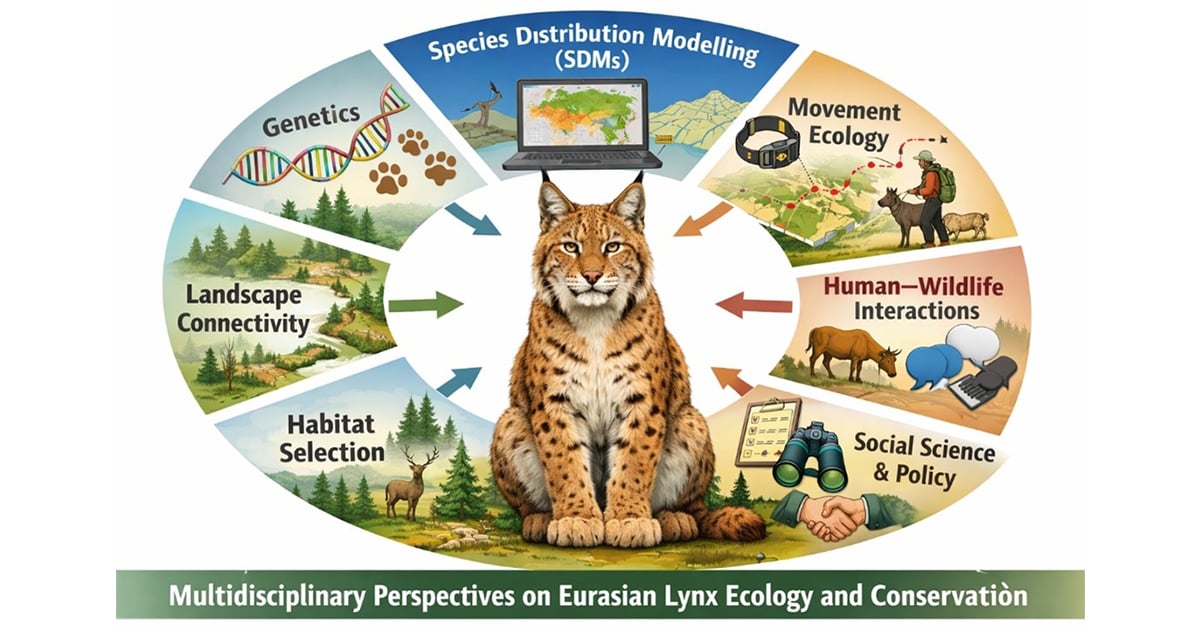
Multidisciplinary Perspectives on Eurasian Lynx Ecology and Conservation
This special issue belongs to the section "Animal Conservation".
Special Issue Information
Dear Colleagues,
The Special Issue on the Eurasian lynx (Lynx lynx) is rooted in the rapidly expanding body of scientific knowledge and applied experience shared by ecologists, conservation biologists, geneticists, wildlife managers, and policy-makers working across the species’ vast range of distribution.
The lynx is an apex predator specialized in hunting wild ungulates and is widely regarded as a species of conservation concern in Europe. While large, autochthonous populations persist in parts of Northern and Eastern Europe, lynx were exterminated from much of Western and Central Europe by the early twentieth century. Since the 1970s, several reintroduction programs have successfully restored the species to portions of its former range; however, these reintroduced populations remain small, geographically isolated, and vulnerable. Many of them face ongoing threats such as inbreeding depression and illegal killing, often linked to low tolerance or conflict with certain hunting sectors, as well as broader socio-cultural factors shaping human attitudes toward large carnivores. Over recent decades, research and practice have increasingly highlighted how the conservation of wide-ranging carnivores requires the integration of diverse disciplines, from population genetics, social sciences and spatial ecology to human–wildlife coexistence and protected area governance.
This Special Issue seeks to reflect and advance this integrative perspective by critically re-examining concepts, tools, and management strategies related to lynx conservation in the light of continuously evolving scientific evidence. Our aim is to promote frameworks that enable society to respond effectively to global environmental change, habitat fragmentation, biodiversity decline, and emerging socio-ecological challenges, while safeguarding the ecological roles and long-term viability of Eurasian lynx populations across both European and Asian landscapes.
Across the Palearctic, the Eurasian lynx occupies a mosaic of ecological contexts—from boreal forests and alpine landscapes to fragmented agro-forested gradients—and is subject to a range of spatial, genetic, and anthropogenic pressures. Existing research has greatly expanded our understanding of lynx biology over recent decades, yet critical gaps remain in integrating cross-scale processes that shape population persistence, adaptive potential, and long-term viability.
At the genetic level, populations exhibit signatures of historical isolation, founder effects, and variable gene flow, with consequences for adaptive potential under ongoing environmental change and management actions such as reintroduction and translocation. At landscape and movement scales, lynx spatial ecology has revealed the importance of habitat configuration, human disturbance, and connectivity corridors for dispersal and mating dynamics. Additionally, advances in species distribution models (SDMs), habitat suitability frameworks, and connectivity modeling have contributed to a better understanding of lynx habitat use and movements, yet these tools require further integration with empirical behavior and population responses.
Conservation practice for Eurasian lynx increasingly confronts multidimensional challenges: balancing conflict mitigation and coexistence, designing networks of protected and connected landscapes, accounting for climate and land-use change, and reconciling genetic, demographic, and spatial data into robust decision frameworks. Bringing together these themes reflects the complexity of conservation science today, where isolated approaches are insufficient to address mounting pressures on wide-ranging carnivores.
This Special Issue, Multidisciplinary Perspectives on Eurasian Lynx Ecology and Conservation, aims to provide a comprehensive forum for the latest scientific advances that bridge genetics, ecology, spatial modeling, social sciences, conservation governance, and applied conservation. It seeks to highlight the power of integrative research in advancing both fundamental understanding and effective management strategies for Lynx lynx populations across their broad geographic range.
We invite contributions that explicitly link diverse disciplinary insights—including but not limited to population genetics, habitat selection, connectivity modeling, SDMs, movement ecology, behavioral ecology, human–wildlife interactions, social sciences, conservation governance, and applied conservation applications—to inform evidence-based decisions. This aligns with the journal’s scope by emphasizing ecological processes, biodiversity conservation, and the application of quantitative and conceptual tools to pressing conservation issues.
The overarching aim is to collect research that not only advances scientific knowledge but also supports policy, management, and conservation practice in a rapidly changing environmental and socio-political context. The Special Issue particularly encourages contributions that link science and practice and provide practical insights for conservation planning, policy development, and management implementation.
Submissions should contribute to the development of generalizable frameworks, comparative insights, and actionable recommendations relevant to the broader fields of ecology, conservation biology, and landscape management.
In this Special Issue, original research articles and reviews are welcome. Research areas may include (but are not limited to) the following:
Population Genetics and Genomics
- Spatial structure and demographic history of L. lynx populations
- Gene flow, inbreeding, and adaptive potential under fragmentation
- Genomic tools for conservation planning and management
- Genetic impacts of translocations and reintroduction programs
Habitat Selection, Resource Use, and Spatial Ecology
- Multi-scale habitat preferences and behavioral ecology
- Seasonal variation in habitat use
- Influence of human activities and land-use patterns
- Comparative analyses across biogeographic regions
Species Distribution and Habitat Suitability Modeling
- Advances in SDMs incorporating climate and land-use change
- Novel approaches for bias correction in occurrence data
- Ensemble modeling and predictive uncertainty
- Mechanistic or hybrid distribution models linking behavior and environment
Connectivity, Movement Ecology, and Landscape Linkages
- Functional and structural connectivity for dispersal
- Resistance surfaces, circuit theory, and movement corridors
- Empirical movement data informing connectivity planning
- Barriers to connectivity: anthropogenic and natural
Monitoring Techniques and Data Integration
- Camera trapping, telemetry, and acoustic monitoring innovations
- AI and machine learning for individual identification and detection
- Citizen science and participatory monitoring networks
- Integrated data frameworks and reproducible workflows
Applied Conservation and Policy
- Evaluation of conservation strategies and effectiveness
- Conflict mitigation and human–carnivore coexistence
- Protected area design and landscape planning
- Policy frameworks across political jurisdictions
- Stakeholder engagement and participatory approaches in lynx conservation
Cross-Regional and Comparative Perspectives
- Contrasting dynamics from Western Europe to Central Asia
- Lessons from isolated versus connected populations
- Socio-ecological systems and cultural dimensions of lynx conservation
- Perspectives from underrepresented and data-deficient regions
- Comparative perspectives on institutional coordination, legal frameworks, and management systems
We look forward to receiving your contributions.
Dr. Davide Serva
Dr. Igor Trbojević
Guest Editors
Manuscript Submission Information
Manuscripts should be submitted online at www.mdpi.com by registering and logging in to this website. Once you are registered, click here to go to the submission form. Manuscripts can be submitted until the deadline. All submissions that pass pre-check are peer-reviewed. Accepted papers will be published continuously in the journal (as soon as accepted) and will be listed together on the Special Issue website. Research articles, review articles as well as short communications are invited. For planned papers, a title and short abstract (about 250 words) can be sent to the Editorial Office for assessment.
Submitted manuscripts should not have been published previously, nor be under consideration for publication elsewhere (except conference proceedings papers). All manuscripts are thoroughly refereed through a single-anonymized peer-review process. A guide for authors and other relevant information for submission of manuscripts is available on the Instructions for Authors page. Conservation is an international peer-reviewed open access quarterly journal published by MDPI.
Please visit the Instructions for Authors page before submitting a manuscript. The Article Processing Charge (APC) for publication in this open access journal is 1200 CHF (Swiss Francs). Submitted papers should be well formatted and use good English. Authors may use MDPI's English editing service prior to publication or during author revisions.
Keywords
- Eurasian lynx (Lynx lynx)
- conservation biology
- population genetics
- spatial ecology
- habitat suitability and species distribution modelling
- landscape connectivity
- human–wildlife interactions
- large carnivore conservation
Benefits of Publishing in a Special Issue
- Ease of navigation: Grouping papers by topic helps scholars navigate broad scope journals more efficiently.
- Greater discoverability: Special Issues support the reach and impact of scientific research. Articles in Special Issues are more discoverable and cited more frequently.
- Expansion of research network: Special Issues facilitate connections among authors, fostering scientific collaborations.
- External promotion: Articles in Special Issues are often promoted through the journal's social media, increasing their visibility.
- Reprint: MDPI Books provides the opportunity to republish successful Special Issues in book format, both online and in print.
Published Papers


Conservation - ISSN 2673-7159