

Journal Menu
► ▼ Journal Menu-
- Future Internet Home
- Aims & Scope
- Editorial Board
- Reviewer Board
- Topical Advisory Panel
- Instructions for Authors
- Special Issues
- Topics
- Sections & Collections
- Article Processing Charge
- Indexing & Archiving
- Editor’s Choice Articles
- Most Cited & Viewed
- Journal Statistics
- Journal History
- Journal Awards
- Conferences
- Editorial Office
Journal Browser
► ▼ Journal BrowserNeed Help?
Announcements
19 November 2025
Meet Us Virtually at the 1st International Online Conference on Sensor and Actuator Networks (CSAN 2026), 9–10 July 2026
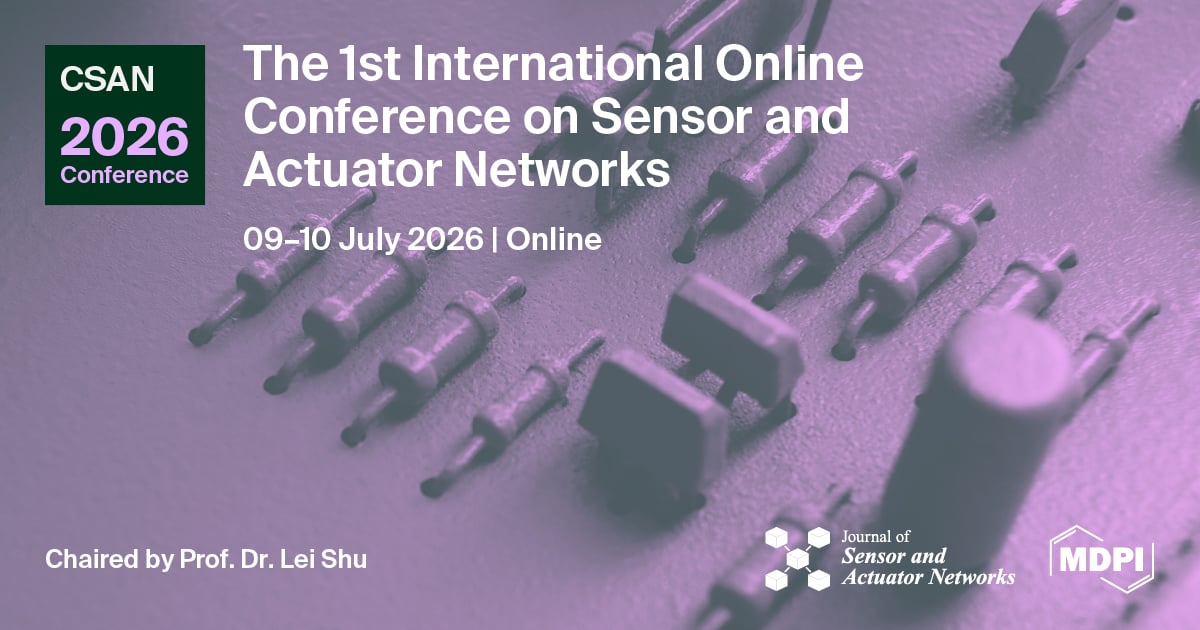
We are pleased to announce that the 1st International Online Conference on Sensor and Actuator Networks (CSAN 2026) will be held online from 9 to 10 July 2026. The conference is organized by MDPI’s Journal of Sensor and Actuator Networks (JSAN, ISSN: 2224-2708, Impact Factor: 3.3).
CSAN 2026 will present the latest studies in sensor and actuator network-related research in the fields of healthcare, smart agriculture, industry, mobile systems, intelligent transportation, manufacturing, smart cities, and engineering.
We welcome all past authors to speak at CSAN2026. All invited speakers will get the award.
Conference Chair:
- Prof. Dr. Lei Shu, 1 Nanjing Agricultural University, Nanjing, China; 2 University of Lincoln, Lincoln, UK.
Session topics:
S1. Industry 4.0 and embedded wireless sensor/actuator systems;
- Session Chair: Prof. Adnan M. Abu-Mahfouz, Council for Scientific and Industrial Research (CSIR), South Africa.
S2. Blockchain technologies and Internet-of-Things-based WSAN;
- Session Chair: Prof. Pascal Lorenz, University of Haute-Alsace, France.
S3. WSAN and next-generation networks (5G, 6G, etc.);
- Session Chair: Prof. Jordi Mongay Batalla, Warsaw University of Technology, Poland.
S4. Applications of WSAN in agriculture, vehicles, wearable sensors, smart cities, manufacturing, mobile systems, and health and medical care;
- Session Chair: Prof. Sye-Loong Keoh, University of Glasgow, UK.
S5. Big data, computing and artificial intelligence.
- Session Chair: Prof. Jianwei Niu, Bei hang University, China.
Conference awards:
- The Best Oral Presentation Award is given to the invited speakers; we appreciate your contribution and time at CSAN2026;
- The Best Video Presentation Award is given to the submission judged to make the most significant and interesting video presentation for the conference.
Guide for Authors:
Abstracts written for CSAN 2026 will be directly submitted to the Topic “The 1st International Online Conference on Sensor and Actuator Networks (CSAN 2026)” within the “Special Issue” section of JSAN with a 15% discount on the publication fee.

Submit your abstract before 9 March 2026!

Register before 6 July 2026!

Register for Early Bird by 6 June 2026. The registration fee includes attendance costs for all conference sessions.
For detailed information, please visit https://sciforum.net/event/CSAN2026.
For any enquiries regarding the event, please contact csan2026@mdpi.com.
We look forward to seeing you at CSAN 2026.
6 November 2025
MDPI Launches the Michele Parrinello Award for Pioneering Contributions in Computational Physical Science
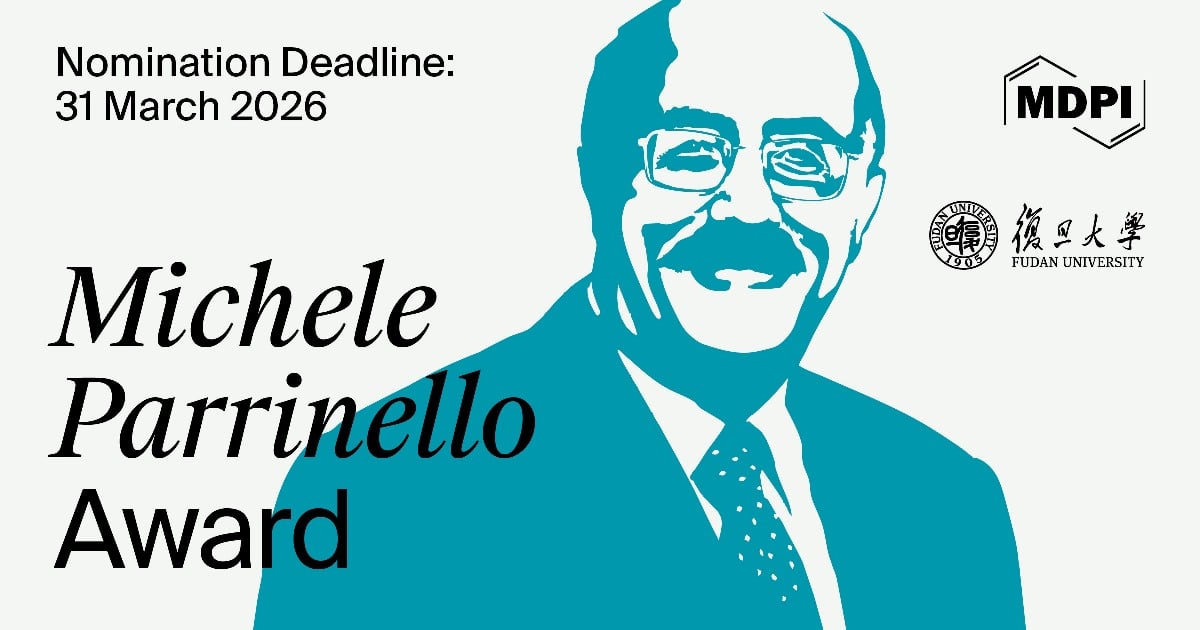
MDPI is delighted to announce the establishment of the Michele Parrinello Award. Named in honor of Professor Michele Parrinello, the award celebrates his exceptional contributions and his profound impact on the field of computational physical science research.
The award will be presented biennially to distinguished scientists who have made outstanding achievements and contributions in the field of computational physical science—spanning physics, chemistry, and materials science.
About Professor Michele Parrinello
"Do not be afraid of new things. I see it many times when we discuss a new thing that young people are scared to go against the mainstream a little bit, thinking what is going to happen to me and so on. Be confident that what you do is meaningful, and do not be afraid, do not listen too much to what other people have to say.”
——Professor Michele Parrinello
 |
Born in Messina in 1945, he received his degree from the University of Bologna and is currently affiliated with the Italian Institute of Technology. Professor Parrinello is known for his many technical innovations in the field of atomistic simulations and for a wealth of interdisciplinary applications ranging from materials science to chemistry and biology. Together with Roberto Car, he introduced ab initio molecular dynamics, also known as the Car–Parrinello method, marking the beginning of a new era both in the area of electronic structure calculations and in molecular dynamics simulations. He is also known for the Parrinello–Rahman method, which allows crystalline phase transitions to be studied by molecular dynamics. More recently, he has introduced metadynamics for the study of rare events and the calculation of free energies. |
For his work, he has been awarded many prizes and honorary degrees. He is a member of numerous academies and learned societies, including the German Berlin-Brandenburgische Akademie der Wissenschaften, the British Royal Society, and the Italian Accademia Nazionale dei Lincei, which is the major academy in his home country of Italy.
Award Committee
 |
The award committee will be chaired by Professor Xin-Gao Gong, a computational condensed matter physicist, academician of the Chinese Academy of Sciences, and professor at the Department of Physics, Fudan University. Professor Xin-Gao Gong will lead a panel of several senior experts in the field to oversee the evaluation and selection process. The Institute for Computational Physical Sciences at Fudan University (Shanghai, China), led by Professor Xin-Gao Gong, will serve as the supporting institute for the award. |
"We hope the Michele Parrinello Award will recognize scientists who have made significant contributions to the field of computational condensed matter physics and at the same time set a benchmark for the younger generation, providing clear direction for their pursuit—this is precisely the original intention behind establishing the award."
——Professor Xin-Gao Gong
The first edition of the award was officially launched on 1 November 2025. Nominations will be accepted before the end of March 2026. For further details, please visit mparrinelloaward.org.
About the MDPI Sustainability Foundation and MDPI Awards 
The Michele Parrinello Award is part of the MDPI Sustainability Foundation, which is dedicated to advancing sustainable development through scientific progress and global collaboration. The foundation also oversees the World Sustainability Award, the Emerging Sustainability Leader Award, and the Tu Youyou Award. The establishment of the Michele Parrinello Award will further enrich the existing award portfolio, providing continued and diversified financial support to outstanding professionals across various fields.
In addition to these foundation-level awards, MDPI journals also recognize outstanding contributions through a range of honors, including Best Paper Awards, Outstanding Reviewer Awards, Young Investigator Awards, Travel Awards, Best PhD Thesis Awards, Editor of Distinction Awards, and others. These initiatives aim to recognize excellence across disciplines and career stages, contributing to the long-term vitality and sustainability of scientific research.
Find more information on awards here.
9 October 2025
Meet Us at the 3rd International Conference on AI Sensors and Transducers, 2–7 August 2026, Jeju, South Korea

Following from our two previous successful editions, we invite you to submit your abstracts and participate in the 3rd International Conference on AI Sensors and Transducers, taking place from 2 to 7 August 2026 in Jeju, South Korea.
Organized by MDPI and the open access journals Sensors, Micromachines, AI Sensors, Micro and Remote Sensing, this in-person conference will once again bring together experts and participating researchers who will share insights and innovations in sensors, sensing technology, transducers and artificial intelligence.
Start preparing your abstracts:
Don’t miss this opportunity to showcase your work to peers and leading experts in AI-enhanced sensing systems and transducers. We will be announcing the session topics at AIS 2026 soon.
Find out more about the instructions for authors: https://sciforum.net/event/AIS2026?section=#instructions.
Find out more about the publication opportunities available for authors: https://sciforum.net/event/AIS2026?section=#Publicationopportunities.
Please feel free to share the information about this conference to your colleagues and students.
We look forward to welcoming you in Jeju!
The organizing committee of the 3rd International Conference on AI Sensors and Transducers (AIS 2026).
3 February 2026
Acknowledgment to the Reviewers of Future Internet in 2025

The editorial office of Future Internet would like to extend its sincere gratitude to all reviewers who contributed to the improvement of the journal quality by providing their expert opinion and evaluation of the submitted research.
We appreciate that thorough peer review demands considerable time and intellectual investment from our reviewers. In 2025, Future Internet received 3287 review reports from contributors across 75 countries and territories, demonstrating the breadth of international expertise and scholarly engagement that has strengthened our publication standards.
The reviewers who agreed to have their names published this year are listed below in alphabetical order by first name. The editorial team acknowledges with gratitude all reviewers, named and anonymous alike, for their vital role in maintaining the scholarly standards of Future Internet.
| Abbas Rohani | Héctor Migallón | Panagiotis Kourtesis |
| Abbas Yazdinejad | Hemalatha Gunasekaran | Paolo Pagliuca |
| Abdessamad Imine | Henrique São Mamede | Paria Sadeghian |
| Abdul Ahad | Higinio Mora | Paris Mastorocostas |
| Abdulbast A. Abushgra | Hongjun Xing | Paulius Skačkauskas |
| Abhik Banerjee | Hsing-Wen Wang | Pavel Lafata |
| Abhishek Gupta | Hsin-Yuan (Junan) Jade Chen | Pavel Starovoitov |
| Adam Idzkowski | Hubert Szczepaniuk | Pedro Filipe Lopes |
| Adam Krechowicz | Hugo Jimenez Hernandez | Pei-Chun Lin |
| Adamantia Stamou | Hui Cui | Peiying Zhang |
| Adeb Ali Mohammed Salh | Huiqin Wang | Peng Ye |
| Adrian Kampa | Hyun Kwon | Pengcheng Cao |
| Adriana Berdich | Ievgeniia Kuzminykh | Peter Kokol |
| Agbotiname Lucky Imoize | Igor Vujović | Peter Trim |
| Agnius Liutkevičius | Imad Saleh | Philip Branch |
| Ahmadreza Montazerolghaem | Iñigo Cuiñas | Pilar Herrero-Martín |
| Ahmed K. Jameil | Ioan Susnea | Piotr Korbel |
| Aitor Oyarbide-Zubillaga | Ioannis Athanasios Bartsiokas | Prashant Hari Narayan Rajput |
| Alaa Fouad Momena | Ioannis Tsoulos | Pravin Sankhwar |
| Alba Amato | Ionut Nica | Przemysław Kowalik |
| Alberto Carelli | Iqra Hameed | Qasem Abu Al-Haija |
| Aleksandar Stanimirovic | Irena Jekova | Qian Xiang |
| Alena Buchalcevova | Ishtiaq Hussain | Qiang Duan |
| Alessandro Gabrielli | Ivan Nedyalkov | Qibiao Zhu |
| Alex Butean | Ivana Marenzi | Qihang Li |
| Alexander Barkalov | Ivanna Dronyuk | Qixia Zhang |
| Alexander Kocian | Jaehyun Nam | Qi-Xian Huang |
| Alexander Wöhrer | Jalaluddin Khan | Quang Hao Nguyen |
| Algirdas Laukaitis | Jamal Riffi | Radoslava Stankova Kraleva |
| Ali Al-Allawee | Jan Chudzikiewicz | Radoslaw Klimek |
| Ali Gohar | Jan Lacko | Radu Nicolae Pietraru |
| Alireza Shirmarz | Janis Arents | Rafal Wojszczyk |
| Amir Sharif | János Botzheim | Rajendran Shobha Ajin |
| Amro Al-Said Ahmad | Janusz Furtak | Rajkumar Singh Rathore |
| Analúcia Schiaffino Morales | Jehad M. Hamamreh | Ramón Alcarria |
| Anam Nawaz Khan | Jevgenijus Toldinas | Rana Albelaihi |
| Anas Mohammad Ramadan Alsobeh | Jhansi Bharathi Madavarapu | Rastislav Róka |
| Andrea Petroni | Jia Mao | Ravi Raj |
| Andreas Kanavos | Jia-Lang Xu | Raza Hasan |
| Andreas Papadakis | Jiazhen Zhao | Richard Segall |
| Andrei Dumitrescu | Jie Zhang | Rindone Corrado |
| Andrzej Przybył | Jim Prentzas | Robert Farrow |
| Angelo Lorusso | Jing Chen | Robert Ryszard Chodorek |
| Angelos Rouskas | Jing Jiang | Roman Gumzej |
| Aniruddha Bhattacharjya | Jing Liu | Ron Fisher |
| Anna Jodejko-Pietruczuk | Jinhua Guo | Rui Tang |
| Ansel Yoan Rodríguez González | Jinjun Rao | Runyuan Guo |
| Anton Iliev | João Carlos N. Bittencourt | Ruslan Shevchuk |
| Antonio Salis | Joao da Silva Pereira | Ruy Oliveira |
| Antonio Valente | João Henriques | Sabina Szymoniak |
| Aparajithan Sivanathan | Joel Weijia Lai | Sakib Shahriar |
| Aristeidis Karras | John Adebisi | Saloni Jain |
| Arkadiusz Biernacki | John Le | Saqib Qamar |
| Asad Ullah Khan | Jörg Keller | Saravanan Krishnan |
| Asimina Dimara | Jorge Calvillo-Arbizu | Sarfraz Brohi |
| Athanasios G. Lazaropoulos | Jorge de Andrés-Sánchez | Sarod Yatawatta |
| Athanasios Tsipis | Jorge E. Lopez de Vergara | Sarunas Grigaliunas |
| Ayman Diyab | José Antonio Montenegro Montes | Šarūnas Paulikas |
| Aziida Nanyonga | José Duarte Santos | Sen Lin |
| Bader Alsharif | José Marinho | Serban Georgica Obreja |
| Balu Bhasuran | José R. García-Martínez | Sergiu Nimara |
| Barbara Strug | José Ramón Trillo | Seshathiri Dhanasekaran |
| Barry Irwin | Joshua Teddy Ibibo | Shamim H. Ripon |
| Bin Li | Joshua White | Shane N. Hall |
| Bin Yan | Juan Carlos Martínez | Shaymaa E. Sorour |
| Biswaranjan Senapati | Juan Pascual Garcia | Sheng Hong |
| Bo Wang | Juan Peña-Martínez | Sheng Liu |
| Bogdan Cristian Florea | Junkai Wang | Shih-Lin Lin |
| Bogdan Oancea | Jusak Jusak | Shih-Sung Lin |
| Bogdan-Iulian Ciubotaru | Kai Huang | Shiva Shankar Reddy |
| Boris Aberšek | Karthik Meduri | Shohin Aheleroff |
| Boris Milasinovic | Kasem Khalil | Shruti Rajendra Kshirsagar |
| Borja Peleato | Katsumi Sakakibara | Shuja Ansari |
| Bożena Woźna-Szcześniak | Ken Nah | Shungeng Zhang |
| Brett Bligh | Kenneth Y. T. Lim | Sihai Tang |
| Can Cui | Khalid El Makkaoui | Silvia Elaluf Calderwood |
| Canek Portillo | Krassie Petrova | Silvia Parusheva |
| Carlos Alberto Paredes Orta | Krešimir Grgić | Silvia Schiaffino |
| Carlos Serodio | Krzysztof Wołk | Sorin Soviany |
| Carmen Balan | Lahsen Abouenour | Spyros T. Halkidis |
| Carson Leung | Lara Mauri | Stan Andrei |
| Cătălin Barbu | Laszlo Barna Iantovics | Stavros Koubias |
| Catalin Popescu | Laura Blaso | Stefan Fischer |
| Cheng Fang | Laura-Diana Radu | Stefano Filippi |
| Cheng-Kai Yao | Lei Shi | Stylianos Mystakidis |
| Chenliang Wang | Lenka Lhotska | Subhankar Das |
| Cheonshik Kim | Leonidas Akritidis | Suchuan Xing |
| Chia Hung Kao | Liu Jianhua | Sujan Ray |
| Chih-Yu Lin | Livinus Obiora Nweke | Sushank Chaudhary |
| Chuan-Min Lee | Long Zhang | Takashi Kusaka |
| Chunning Wang | Longjun Dong | Takis John Varelas |
| Chun-Wei Yang | Lu Liu | Tao Ni |
| Claudio Delrieux | Luca Davoli | Tareq Khan |
| Constancio Miguel Arizmendi | Lucian-Mihai Cosovanu | Thair Al-Dalain |
| Constantin Daniel Oancea | Luciano Alessandro Ipsaro Palesi | Theoklitos S Karakatsanis |
| Constantinos Angelis | Lucija Brezočnik | Thomas Derya Kocar |
| Cosmin Striletchi | Luis Martín Sánchez-Adame | Tianqi Chen |
| Costas Chaikalis | Luis Miguel Pires | Tim Man Ho Li |
| Cristian Anghel | Łukasz Knypiński | Tina Tomazic |
| Cristian Randieri | Łukasz Więcław | Todor Tagarev |
| Dan Pescaru | Luping Xiang | Todorka Glushkova |
| Daniel Jancarczyk | Mădălin-Dorin Pop | Tomáš Tichý |
| Danuta Szpilko | Maidul Islam | Tomyslav Sledevic |
| David R. Green | Majid H. Alsulami | Tony Ni |
| Dax Enshan Koh | Maksims Ivanovs | Touhid Bhuiyan |
| Debashis Das | Manish Sharma | Tufisi Cristian |
| Deepak Dhungana | Manuel Fernández-Veiga | Uranchimeg Tudevdagva |
| Dejan Drajic | Maram Bani Younes | Utkarsh Chadha |
| Dilli P. Sharma | Marek Góźdź | Uwe M. Borghoff |
| Dimitrios Kotsifakos | Maria Nisheva | Vacius Jusas |
| Dimitriosdalaklis Dalaklis | Maria Teresa Gonzalez-Aparicio | Valmik Tilwari |
| Dong Min Kim | Maria Valtcheva Nenova | Vasileios Cheimaras |
| Dong Pan | Mariana Cernicova-Buca | Vicente González-Prida |
| Ehab Alkhateeb | Mário Antunes | Victor Fernandez Pallarés |
| Eisuke Hanada | Marjan Mernik | Victor-Alexandru Briciu |
| Ekaterina Glebova | Marko Mišić | Vladimir Estivill-Castro |
| Eleftherios Tiakas | Martin Fleury | Volodymyr O. Artemchuk |
| Elena Kakoulli | Martin Kenyeres | Vyron Kampourakis |
| Elochukwu Ukwandu | Martina Radilova | Wei Feng |
| Elvis Hozdić | Massimiliano Chillemi | Wei Li |
| Ernesto Cadena Muñoz | Massimo Pacella | Wei Wang |
| Erwin Kristen | Mateen Ashraf | Wei Xu |
| Esraa Elhariri | Meisam Abdollahi | Weidong Fang |
| Eunchan Kim | Michał Tomaszewski | Weike Wang |
| Everardo Efren Granda-Gutierrez | Michele Ianni | Weisi Chen |
| Francisco W. S. Lima | Mihai Caramihai | Weixu Liu |
| Fabio Corti | Mihai Zaharia | Wenchen Han |
| Fabio Maggio | Miloš Dobrojević | Wojciech Zabierowski |
| Fan Zhao | Milos Seda | Wolfgang Leister |
| Faroq Awin | Ming Bao Huang | Xavier Fernando |
| Federico Luis del Blanco García | Ming Wu | Xiao Qin |
| Fei Han | Mircea Fulea | Xiaoding Wang |
| Fernando Almeida | Miriam Catalina González-Afonso | Xiaojun Fu |
| Filipe Pereira | Miroslava Mĺkva | Xiaojun Mei |
| Flavio Bertini | Mohamed Baqer | Xiaokai Liu |
| Florin Girbacia | Mohamed Chahine Ghanem | Xiaoxi Hu |
| Fnu Neha | Mohamed Farag Ali Taha | Xin Zhang |
| Francesco Di Nocera | Mohammad Afhamisis | Xing Yang |
| Francesco Giacinto Lavacca | Mohammad Mukhtaruzzaman | Xunyu Pan |
| Franklin Parrales Bravo | Mohit Tiwari | Yao Ge |
| Frano Škopljanac-Mačina | Mohsen Hatami | Yaqeen Sabah Mezaal |
| Frederico Branco | Monir Abdullah | Yebin Chen |
| Fuyan Ma | Mouncef Filali-Bouami | Yi-Horng Lai |
| Gabriel Lobo | Mpyana Mwamba Merlec | Yiming Li |
| Gabriel Marín Díaz | Muhammad Imran Tariq | Yinlong Liu |
| Gaetano Zazzaro | Muhammad Miftahul Amri | Yitao Li |
| Gang Wu | Muhammad Rameez Ur Rahman | Yongchao Martin Ma |
| Geeta Sandeep Nadella | Mujiangshan Wang | Young Im Cho |
| George Routis | Musa Hussain | Yubo Song |
| George S. Maraslidis | Nalin Kant Mohanty | Yuri Demchenko |
| George Vlahavas | Namal Rathnayake | Yutong Zhao |
| Georgios E. Karpetas | Nane Kratzke | Yuyan Pan |
| Georgios Spanos | Naresh Kshetri | Yuyang Zhou |
| Ghanshyam Singh | Nastooh Taheri Javan | Zbigniew Zakrzewski |
| Gia Khanh Tran | Nataša Tošanović | Zhe Liu |
| Giacomo Bergami | Neda Asgarkhani | Zhen Sun |
| Giovanni Battista Gaggero | Niranjanamurthy M. | Zhiqiang Tong |
| Gloria Cerasela Crisan | Nuno Cruz | Zhiwei Wan |
| Grindei Violeta Laura | Oded Margalit | Zhiyuan Ma |
| Grzegorz Ćwikła | Oleg Illiashenko | Zhiyuan Yu |
| Grzegorz Peruń | Oliverio Cruz-Mejía | Zhongyuan Qin |
| Guillermo del Campo | Omer Mermer | Zhou Xu |
| Guna Sekhar Sajja | Orlando Sousa | Zhuqing Xu |
| Haihua Wang | Osslan Osiris Vergara Villegas | Zlatan Moric |
| Haitham Abu Ghazaleh | Pablo Alejandro Quezada-Sarmiento | Zoltan Nochta |
| Hakilo Sabit | Pablo Palacios Játiva | Zoltán Nyikes |
| Hanbai Park | Panagiotis D. Michailidis | Zonghua Gu |
| Hanyuan Zhang | Pavle Dakić |
2 February 2026
MDPI INSIGHTS: The CEO's Letter #31 - MDPI 30 Years, 500 Journals, UK Summit, Z-Forum Conference, APE

Welcome to the MDPI Insights: The CEO's Letter.
In these monthly letters, I will showcase two key aspects of our work at MDPI: our commitment to empowering researchers and our determination to facilitating open scientific exchange.
Opening Thoughts

MDPI at 30: Three Decades of Open Science, Built Together
As we begin 2026, we approach a meaningful milestone in MDPI’s history: 30 years of advancing Open Science.
What began in 1996 as a small, researcher-driven initiative has grown into a global open-access publisher, supporting hundreds of journals, millions of researchers, and a shared belief that scientific knowledge should be openly available to all. Over these three decades, Open Access has moved from the margins to the mainstream, and MDPI has been proud to help shape that transformation.
To mark this anniversary year, we are pleased to share our MDPI 30th Anniversary logo.
The Anniversary logo is intentionally simple, confident, and enduring, designed to work across cultures, disciplines, and digital environments. It reflects both continuity and progress, honouring MDPI’s established identity while representing the company we are today. The green accent symbolizes our connection to the research communities we serve and the collaborative nature of Open Science itself.
Alongside the visual identity, we are also introducing our 30th Anniversary tagline:
30 Years of Open Science, Built Together.

This phrase captures what has always defined MDPI. Open Science is not the work of a single organization: it is a collective effort shaped by researchers, editors, reviewers, institutions, and the many teams who support the publishing process every day. MDPI’s role has been to provide the infrastructure and commitment that allow this collaboration to thrive.
Throughout 2026, we will mark this anniversary through regional events, global conversations, and editorial initiatives that reflect on MDPI’s evolution, its impact across disciplines, and the communities that make this work possible.
“Open Science is a collective effort”
Whether you have been part of MDPI’s journey for decades or are engaging with us for the first time this year, this milestone belongs to all of us. The past 30 years have shown what is possible when openness, trust, and collaboration are placed at the centre of scholarly communication.
As we look ahead, our focus remains clear: continuing to strengthen quality, integrity, and partnership – so that Open Science can keep moving forward, together.
Impactful Research

A Shared Milestone: MDPI’s Journal Portfolio Reaches 500 Titles
MDPI has reached an important milestone: our journal portfolio grew to more than 500 academic journals last year, spanning the fields of chemistry, engineering, biology, medicine, environmental sciences, the social sciences, and beyond.
The number itself is significant, but what matters more is what supports it: hundreds of scholarly communities that have chosen to collaborate, grow, and publish with MDPI.
From our beginnings nearly 30 years ago with a single Open Access journal (Molecules), MDPI has been guided by a simple aim: advancing Open Science. Reaching 500 journals is not an endpoint. It reflects the diversity of disciplines, ideas, and research cultures that now form part of our shared ecosystem.
Growth with Purpose
Every journal exists because a specific community believes there is a need for focus, visibility, and dialogue in a particular field. As our portfolio has expanded, so has our responsibility to ensure that scale is matched with strong editorial standards, robust research integrity practices, and meaningful academic leadership.
This milestone comes as we enter MDPI’s 30th anniversary year, a fitting moment to reflect on what scale in scholarly publishing truly requires: not only reach, but also dedicated long-term stewardship.
New Journals, New Communities
In December 2025 alone, MDPI welcomed eight newly launched journals and three journal transfers (details below), all of which published their inaugural issues by year-end.

Each of these journals is shaped by its Editors-in-Chief, Associate Editors, and Editorial Board Members, who define its scope, standards, and direction. We are grateful for the time, expertise, and commitment they bring to building these new communities.
Welcoming Transferred and Acquired Journals
We were pleased to publish the first MDPI issues of three recently transferred or acquired journals:
- Cardiovascular Medicine – advancing research on the prevention, diagnosis, and treatment of cardiovascular disease
- Germs – addressing infectious diseases through clinical, public health, and translational perspectives
- Romanian Journal of Preventive Medicine (RJPM) – supporting population health, early detection, and preventive care in collaboration with the Romanian Society of Preventive Medicine
Each of these journals brings an established identity and legacy. Our role is to support their continued development with the same editorial rigor, transparency, and Open Access principles that guide our broader portfolio.
A Collective Achievement
Reaching more than 500 journals is not the achievement of any single team or individual. It is the result of collaboration across the entire scholarly ecosystem. As such, I would like to thank our authors, reviewers, academic editors, and Editorial Board Members, as well as our colleagues across MDPI, who support these communities every day.
As we look ahead, we will continue to expand the breadth and depth of our publishing activities while remaining attentive to the evolving expectations of Open Science, research integrity, and responsible growth.
This milestone is a reminder that Open Access publishing is not only about making research available. It is about building platforms where knowledge can be shared, challenged, improved, and trusted, at scale, and with care.
Inside Research

MDPI UK Summit 2026 in Manchester (21–22 January)
On 21–22 January, we had the pleasure of hosting the MDPI UK Summit 2026 in Manchester. Over two days, we welcomed more than 20 Editors-in-Chief (EiC), Section Editors-in-Chief (SEiC), and Associate Editors for an open, in-depth conversations about how MDPI supports Open Science, editorial independence, and research standards across our journals.
What stood out most was not just the quality of the discussions, but the openness, curiosity, and mutual respect that shaped every session.
|
|
|
|
|
|
|
|


What We Covered
The programme was designed to give insight into how MDPI works behind the scenes and how different teams collaborate to support our journals and editors. Topics included:
- MDPI overview and the evolving Open Access market
- MDPI–UK collaboration and local engagement
- Editorial and peer-review processes
- Research integrity and publication ethics
- Institutional partnerships
- Indexing, journal development, and academic community engagement
Sessions were led by MDPI colleagues across editorial, research integrity, indexing, partnerships, and UK operations, showing how cross-functional our work truly is.
What We Heard
The feedback from editors was both encouraging and grounding:
- 92% rated the Summit Excellent (8% Good)
- 100% said their understanding of MDPI’s values, editorial processes, and local collaborations had significantly improved
- 69% attended primarily to stay informed about academic publishing and research integrity
- 85% felt fully heard and engaged
A few comments that stayed with me:
- “Today’s event truly gave me the opportunity to see the heart of MDPI UK.”
- “The summit was very informative – I really enjoyed seeing the behind-the-scenes operations.”
- “Keep being open to discussions and making editors feel part of the MDPI family.”
These reflections remind us that transparency, listening, and dialogue are not nice-to-haves: they are foundational to trust.
|
|
|
|


Looking Ahead
The UK Summit is one of more than 10 MDPI Summits we are organizing this year across North America, Europe, and APAC. Each one is an investment in relationships, shared understanding, and improvement.
Thank you to the MDPI UK team and supporting colleagues across departments who made this event possible. This was a positive step in strengthening our editorial engagement and kicking off a year of MDPI Summits.
Coming Together for Science

Recapping the Z-Forum 2026 Conference on Sustainability and Innovation (15–16 January 2026)
In January, MDPI supported and participated in the Z-Forum on Sustainability and Innovation, held across Zurich (ETH Zurich) and the city of Baden. With 96 participants and more than 30 speakers and panellists, the forum brought together leaders from government, academia, industry, and innovation ecosystems to explore how sustainability, Open Science, and innovation intersect in practice.
Why this mattered for MDPI
As a Swiss-based publisher with global reach, our investment in Z-Forum reflects a strategic intent: to anchor MDPI more deeply within Swiss research networks while contributing to national and international conversations on sustainability and innovation.
This was not only about visibility; it was also about relationship-building and long-term engagement with institutions shaping research policy and practice in Switzerland.
|
|
|
|
|
|
|
|
|
|


High-level participation and credibility
The forum was supported and sponsored by several key Swiss institutions, including:
- The Swiss National Science Foundation (SNSF) – Switzerland’s central research funding body
- ETH Zurich
- The University of Zurich
- The University of Basel
- Swiss Innovation Park Central
The sponsorship of SNSF lent the forum strong institutional credibility and signalled the relevance of the themes discussed, especially around sustainability, innovation frameworks, and responsible research practices.
|
|
|


Beyond the Room: Extending the Conversation
While attendance was intentionally focused to encourage dialogue, the forum’s reach extended well beyond the venue. Multiple LinkedIn posts before and during the event (e.g., Link 1, Link 2, Link 3, and more) built on the discussions and helped position MDPI as an active and credible contributor within Switzerland’s research and innovation landscape.
A Broader Strategic Signal
Z-Forum is part of a wider effort to:
- Build on MDPI’s Swiss institutional relationships
- Reinforce our leadership in Open Science and sustainability
- Engage proactively with funders, universities, and innovation bodies
- Ensure MDPI remains a visible and constructive partner in the ecosystems where research policy and practice are shaped
Thank you to our Conference team and everyone involved in supporting this event, both behind the scenes and on the ground. These moments of engagement may be small in scale, but they are foundational in impact.

Closing Thoughts

Reflections from the Academic Publishing in Europe Conference
During 13-14 January, I attended the Academic Publishing in Europe (APE) Conference in Berlin, a long-standing forum for discussing scholarly publishing and the deeper principles that support it.

MDPI was proud to be a Gold Sponsor of the 20th Anniversary of the APE conference, reflecting our continued commitment to supporting the scholarly community to engage in critical industry discussions.
This year’s program covered a range of topics, from AI and research integrity to policy, infrastructure, and trust, but one theme stood out clearly for me: academic freedom, and what it means to protect the conditions under which knowledge can be produced, evaluated, and shared responsibly.
Before turning to that, I would like to highlight the opening keynote by Carolin Sutton (CEO, STM), which helped set the tone for the conference.
An Independent Publishing Industry: The Case for Checks and Balances
In her opening remarks, Carolin focused on the importance of continually evolving systems of checks and balances, both operationally and at the marketplace level, to prevent any single actor from dominating knowledge production. Her framing emphasized shared responsibility across publishers, institutions, and research communities, rather than placing the burden on any one group.
As part of this, she revisited the work of sociologist Robert K. Merton, and his CUDOS norms of scientific ethos, first articulated in his 1942 work, The Normative Structure of Science.

Merton outlined four ideals that support healthy scientific systems:
- Communalism – knowledge as a public good
- Universalism – evaluation based on merit, not status or identity
- Disinterestedness – orientation toward truth over personal or financial gain
- Organized Skepticism – systematic, critical scrutiny of claims
While these are ideals, and not guarantees that are perfectly lived up to, they remain powerful reference points today for research systems and organizations as they aim to grow and scale.
It was interesting to see how closely these norms align with foundational principles of Open Access. For example, making research openly available supports communalism. Transparent peer review and editorial processes reinforce universalism and organized skepticism. Strong ethics frameworks and governance help counter conflicts of interest and support disinterestedness.
“Merton’s ideals remain powerful reference points today”
Safeguarding Research: Academic Freedom
Several of the conference sessions touched on the pressures faced by researchers, editors, and institutions: geopolitical tensions, online harassment, misinformation, reputational risk, shrinking resources, and politicized narratives around science.

“Integrity is not static. It must be actively maintained as systems grow.”
A particularly timely presentation came from Ilyas Saliba, who talked about academic freedom. His remarks resonated strongly and underlined the fact that safety in academia is not only physical or digital, but also intellectual.
Academic freedom means safeguarding the ability to ask difficult questions, challenge consensus, publish negative or unexpected results, and participate in scholarly debate without fear of undue personal, political, or commercial consequences. These discussions were a reminder that publishers play an important role in supporting the integrity, accessibility, and credibility of scholarly knowledge, particularly as researchers and institutions face mounting external pressures.
Looking Ahead
The discussions at APE reminded me that integrity is not static. It must be actively maintained as systems grow, expectations evolve, and pressures increase. This applies equally to research integrity, academic freedom, and the broader trust placed in scholarly communication.
I left APE encouraged by the openness of the dialogue and the willingness across publishers, institutions, and communities to engage with difficult questions rather than avoid them. Forums like this play a pivotal role in helping our industry pause, reflect, and recalibrate.
As MDPI continues to grow and as we enter our 30th anniversary, these conversations remind me of the core purpose of science: advancing knowledge for the benefit of society.
Chief Executive Officer
MDPI AG
9 January 2026
MDPI’s Newly Launched Journals in December 2025
We have expanded our open access portfolio with eight new journals publishing their inaugural issues in December 2025, as well as three journal transfers. These additions span physical sciences, social sciences, arts and humanities, environmental and Earth sciences, medicine and pharmacology, and public health and healthcare. We extend our sincere thanks to the Editors-in-Chief, Associate Editors, and Editorial Board Members who are shaping these journals’ direction. All journals uphold strong editorial standards through a thorough peer review process, ensuring impactful open access scholarship.
Please feel free to browse and discover more about the new journals below.
|
New Journals |
Founding Editor-in-Chief(s) |
Journal Topics (Selected) |
|
|
Dr. Elisa Felicitas Arias, Université PSL, France |
atomic clocks; time and frequency metrology; GNSS systems; relativity and relativistic timekeeping; fundamental physics in space | |
|
|
Prof. Dr. José F.F. Mendes, University of Aveiro, Portugal |
complex systems; network science; nonlinear dynamics and chaotic behaviour; information theory and complexity; computational complexity | |
|
|
Prof. Dr. Roberto Morandotti, Institut National de la Recherche Scientifique—Énergie, Matériaux et Télécommunications (INRS), Canada |
light generation; light sources and applications; light control and measurement; human responses to light; lighting design | |
|
|
Prof. Dr. Savvas A. Chatzichristofis, Neapolis University Pafos, Cyprus |
generative AI and large language models in education; multimodal and embodied AI; personalization and adaptive systems; assessment, feedback, and academic integrity; learning analytics | |
|
|
Prof. Dr. Jon Andoni Duñabeitia, Universidad Nebrija, Spain |
cognitive psychology; cognitive neuroscience; psycholinguistics; applied linguistics; experimental psychology | |
|
|
Prof. Dr. Caiwu Fu, Wuhan University, China; Prof. Dr. Longxi Zhang, Peking University, China |
cultural practices; cultural theory; cultural policy; cultural heritage; transregional and transnational cultural flows| |
|
|
Dr. Ghassem R. Asrar, iCREST Environmental Education Foundation, USA |
biosphere interactions, processes, and sustainability; ecosystem science and dynamics; biodiversity conservation; global change and environmental adaptation; biogeochemical cycles | |
|
|
Dr. Giuseppe Mulè, University of Palermo, Italy |
cardiorenal syndromes; chronic heart failure and chronic kidney disease; cardiorenalmetabolic syndrome; hypertension and diabetes in relation to the abovementioned syndromes; diagnostic techniques | |








|
Transferred Journals |
Editor-in-Chief |
Journal Topics (Selected) |
|
|
Prof. Dr. Peter Matt, Lucerne Cantonal Hospital (LUKS), Switzerland |
cardiology; cardiovascular and aortic surgery; cardiovascular anatomy, physiology and pathophysiology; congenital heart disease and pediatric cardiology; cardiovascular regenerative and reparative medicine | |
|
|
Prof. Dr. Oana Săndulescu, Carol Davila University of Medicine and Pharmacy, Romania; National Institute for Infectious Diseases “Prof. Dr. Matei Bals”, Romania |
infectious diseases across clinical and public health domains; epidemiology of communicable diseases; clinical microbiology and applied virology; vaccinology and immunization; host–pathogen interactions and immunity | |
|
|
Dr. Roxana Elena Bohiltea, “Carol Davila” University of Medicine and Pharmacy, Romania |
public health; disease prevention; screening and early detection; lifestyle interventions and health education; digital and innovative prevention | |



We would like to thank everyone who has supported the development of open access publishing. If you would like to create more new journals, you are welcome to send an application here, or contact the New Journal Committee (newjournal-committee@mdpi.com).
31 December 2025
MDPI INSIGHTS: The CEO's Letter #30 - Scaling with Integrity, Highly Cited Researchers, KEMÖ Consortium, Michele Parrinello, and Best PhD Thesis Awards
Welcome to the MDPI Insights: The CEO's Letter.
In these monthly letters, I will showcase two key aspects of our work at MDPI: our commitment to empowering researchers and our determination to facilitating open scientific exchange.
Opening Thoughts

With colleagues at MDPI headquarters in Basel, representing the people behind our global growth and shared commitment to integrity.
Scaling with Integrity: A Year of Growth, Responsibility, and Trust
When I look back on 2025, one phrase seems to sum up the year: “Scaling with integrity.” That was our watchword for 2025, and it will remain so as we move forward in to 2026.
Our journal portfolio continued to grow in 2025, reflecting the trust of a widening proportion of the scholarly community.
Today, MDPI has 355 journals indexed in Scopus and 330 in Web of Science – a testimonial to the scale at which our journals meet established external quality criteria. During the year, 45 of our journals were newly accepted into Scopus and 29 into Web of Science (this excludes transferred journals to our portfolio that were already indexed), following rigorous, independent evaluation by the world’s leading indexing bodies
Meeting external quality benchmarks
These results underline the fact that scaling responsibly is not only about expanding our catalogue, but also about meeting external quality benchmarks consistently, transparently, and at scale. Our indexing performance remains one of the strongest independent validations of MDPI’s commitment to rigor, trust, and long-term sustainability.
Over the course of 2025, we made targeted investments to ensure that the integrity of our editorial process scaled to keep pace with our growth. We strengthened our editorial governance by doubling down on our dedicated Publication Ethics department, appointing a Head of Ethics, and expanding our research integrity team by the addition of new specialists plus the creation of embedded editorial ethics roles across key journals. We also introduced new internal ethics guidelines, pre-review integrity checks, and monitoring dashboards to help teams identify potential issues and apply consistent standards across our portfolio.
Besides investing in systems and tools, we of course also invested heavily in our people and culture, delivering organisation-wide training on topics such as image integrity, AI use in publishing, and ethical oversight, while actively engaging with the wider publishing community through COPE and STM forums.
All these efforts reflect a simple principle: growth only matters if it is matched by rigor, responsibility, and trust.
Technology and AI: Supporting the editorial decision-making process
At MDPI, AI is designed to assist, not replace, editorial decision-making. It is one element in a broader system that combines people, technology, and processes to support scale responsibly.
In 2025, we continued to invest heavily in technology that supports quality rather than shortcuts. Our AI team doubled in size, ensuring that increased automation goes hand-in-hand with expertise and oversight. Proprietary AI tools such as Scholar Finder have significantly improved the precision of reviewer matching, while Ethicality has been widely adopted across editorial workflows to identify contextual signals, such as scope alignment and citation behaviour, so that human judgment can be applied where it matters most.
Partnerships: Institutional Open Access Program (IOAP) agreements and Societies
Our recent growth is also reflected in the strength of our partnerships. In 2025, we entered into more than 150 new IOAP agreements, bringing our total to 975 active agreements worldwide. This activity included the signing of our first-ever consortium agreements in North America, renewals of all major national consortia in the UK, Switzerland, Sweden, Norway, Austria, and Croatia, and the conclusion of several flat-fee agreements. At the same time, we concluded a total of 30 agreements, encompassing 24 new Society affiliations, four strategic publishing partnerships, and two journal acquisitions.
In 2025, we opened MDPI USA in Philadelphia – our latest global office, which complements our Toronto office in representing North America. MDPI USA is responsible for accelerating Open Access in the US through ongoing support of our scholars and for expanding our institutional and society partnerships.
On the other side of the globe, meanwhile, we signed an IOAP agreement in India, allowing researchers discounted Article Processing Charges (APCs), streamlined APC management for universities, and visibility into submissions, supporting India’s push for wider Open Access by offering flexible models and helping institutions meet national mandates such as Plan S.
Sustainability, sponsorships and awards
We continued to expand our sustainability efforts during 2025, hosting the 11th World Sustainability Forum, awarding CHF 125,000 in sustainability-related funding, and launching the Z-Forum on Sustainability and Innovation conference, which will officially take place in January 2026.
We also saw a record year for conference sponsorships and awards (while establishing new awards such as the Michele Parrinello Award), recognising scholars across disciplines and reinforcing our commitment to supporting the global research community at every stage of the academic journey.
Deepening our relationships
In 2025, I had the opportunity to travel more widely than ever before on MDPI business, meeting many of our stakeholders face to face and relishing the opportunity to gain a deeper understanding of their science communication needs. It was also excellent to visit a large number of MDPI offices and witness the commitment and service orientation of so many of our colleagues around the world. I shall resume my itinerary in the new year, and I look forward to many more such interactions.
Looking ahead to 2026, we will be celebrating a very significant milestone: 30 years of MDPI. From our foundation as a single Open Access journal in 1996 to the global publishing organisation we are today, our mission has remained consistent: advancing Open Access through rigorous and trustworthy scientific communication.
I would like to take this opportunity to thank all our stakeholders – authors, Editors-in-Chief, Editorial Board members, and reviewers – who have placed their trust in us during 2025. On behalf of the entire MDPI team, I look forward to deepening our relationships yet further in 2026 and celebrating 30 Years of Open Science at MDPI, something we’ve built together.

Basel, Switzerland, where MDPI was founded in 1996.
Impactful Research

621 MDPI Editors Named Highly Cited Researchers in 2025
I am pleased to share an important milestone for our editorial community and for MDPI. In late November, Clarivate announced the 2025 Highly Cited Researchers, and 621 MDPI Editorial Board Members were included among the most influential scientific contributors over the past decade!
The 621 editors come from 33 countries, representing 21 scientific disciplines, and account for nearly one in every ten Highly Cited Researchers globally. This recognition speaks to the depth of expertise across our Editorial Boards and the strength of the scientific communities that choose to collaborate with MDPI. It is important to note that while citation metrics are not in themselves a proxy for quality, they do offer one lens on sustained scientific influence.
“Our strength comes from the scientific communities who choose to work with us”
Why this is important
Having more than 600 editors recognized on this list highlights:
- The high level of expertise guiding peer review across our journals
- The global and disciplinary diversity within our Editorial Boards
- Our commitment to maintaining strong, knowledgeable, and engaged editorial oversight
Impactful science is of course shaped by broad, diverse research communities, and no single metric captures the full picture of research quality. However, this recognition does serve as meaningful, independent affirmation of the calibre of many editors who contribute to MDPI’s work.
A closer look at the recognition
Clarivate’s methodology highlights researchers whose publications rank in the top one per cent by citation count, reflecting consistent influence over the past decade. The process includes:
- Evaluation of c. 200,000 highly cited papers
- Removal of retracted publications
- Filtering of papers with unusually large authorship groups to focus on clear contributions
That so many of our editors meet these thresholds reflects the impact of the communities behind our journals.
What this means going forward
This recognition underlines the fact that our strength comes from the scientific communities who choose to work with us.
For authors, partners, and readers, it confirms that:
- MDPI journals benefit from editorial guidance grounded in active, high-impact research
- Our Editorial boards include leaders who are helping shape the future direction of their fields
- MDPI continues to attract experts who value openness, efficiency, and scientific integrity
For our internal teams, it is a reminder that the work we do every day (supporting editors, refining workflows, and improving systems) directly contributes to the trust placed in MDPI by researchers worldwide.
Thank you to all our editorial teams, publishing staff, and journal relationship specialists, and to everyone who collaborates with our Editorial Boards. Achievements like this are only possible because of your ongoing hard work, dedication, and collaboration.

From our first annual MDPI UK Summit in Manchester, bringing together over 30 Chief Editors and Editorial Board Members to discuss MDPI’s mission, achievements, and collaborations in the UK.
Inside MDPI

MDPI Launches the Michele Parrinello Award for Computational Physical Science
In case you missed it, in November, we announced the launch of the Michele Parrinello Award. This new biennial international award will recognize pioneering contributions in computational physical science. The award honours Michele Parrinello, one of the most influential scientists of the past half-century in atomistic simulations and computational materials research.
This award reflects MDPI’s long-standing commitment to recognizing scientific excellence, supporting foundational research, and inspiring the next generation of scholars across disciplines.
“Be confident that what you do is meaningful”
Honouring a transformative scientific legacy
Professor Parrinello’s work has fundamentally reshaped how scientists model matter at the atomic scale. Together with Roberto Car, he introduced ab initio molecular dynamics, widely known as the Car–Parrinello method, opening new pathways in electronic structure calculations and molecular simulations. His subsequent contributions, including the Parrinello–Rahman method and metadynamics, have become core tools across physics, chemistry, materials science, and increasingly biology.

“Do not be afraid of new things. I see it many times when we discuss a new thing that young people are scared to go against the mainstream a little bit, thinking, ‘What is going to happen to me?’ and so on. Be confident that what you do is meaningful, and do not be afraid, do not listen too much to what other people have to say.”
– Professor Michele Parrinello
A global, community-led award

The award committee is chaired by Xin-Gao Gong, Professor of Physics at Fudan University and academician of the Chinese Academy of Sciences.
The Institute for Computational Physical Sciences at Fudan University will serve as the supporting institute, reinforcing the award’s international and cross-cultural foundation.
Nominations for the first edition of the Michele Parrinello Award opened on 1 November 2025, with submissions accepted until March 2026. The award will recognize scientists whose work has advanced computational physical science across physics, chemistry, and materials research – fields increasingly central to energy, sustainability, advanced manufacturing, and technological innovation.
Why this matters for MDPI
The Michele Parrinello Award is part of the MDPI Sustainability Foundation, which supports science as a driver of long-term societal progress.

Alongside other foundation-level honours, including the World Sustainability Award, the Emerging Sustainability Leader Award, and the Tu Youyou Award, this new prize builds on our role in supporting excellence across career stages and disciplines.
MDPI journals and programs continue to recognize researchers through Best Paper Awards, Young Investigator Awards, Travel Awards, Best PhD Thesis Awards, and Outstanding Reviewer Awards. Together, these initiatives reflect a simple belief: strong scientific communities are built through recognition, trust, and sustained support.
As MDPI approaches its 30th anniversary, the launch of the Michele Parrinello Award highlights our commitment not only to publishing research but also to helping shape the future of science by celebrating those who expand its boundaries.
Coming Together for Science

KEMÖ Consortium (Austria) Extends Open Access Agreement with MDPI until 2027
I’m pleased to share that MDPI has renewed its Institutional Open Access Program (IOAP) agreement with the Austrian library consortium KEMÖ, extending our partnership through 2027.
The renewed agreement now includes 23 Austrian institutions, with the Medical University of Vienna and the University of Natural Resources and Life Sciences (BOKU) joining the partnership. Participating institutions benefit from APC discounts across MDPI’s more than 495 journals, with centralized funding options further reducing the administrative burden for researchers and libraries.
“This renewal reflects shared commitment to advancing Open Access publishing in Europe”
Austria continues to be an important and engaged research community for MDPI, with 525+ Austrian Editorial Board Members, eight Editors-in-Chief, and 15 Section Editors-in-Chief contributing to our journals.
This renewal reflects long-term trust and shared commitment to advancing Open Access publishing in Europe, and improves MDPI’s collaboration with national OA infrastructures such as the Open Access Monitor Austria. Such long-term agreements show how MDPI’s growth is increasingly built on institutional trust, collaboration, and shared commitment to Open Access.
A big thank-you to the IOAP team and everyone involved in supporting this partnership.
Closing Thoughts

Celebrating the Next Generation of Scholars: MDPI’s 2024 Best PhD Thesis Awards
One of the privileges of working in scholarly publishing is supporting the beginning of new scientific journeys. We recently announced the recipients of MDPI’s 2024 Best PhD Thesis Awards, recognizing some of the most promising emerging researchers across disciplines.
These awards do more than celebrate academic excellence. They reflect something deeper about our mission: supporting the next generation of authors and the future of Open Science.
Recognition of Excellence
This year, we made awards to 55 early-career researchers across seven fields:
- Biology and Life Sciences
- Chemistry and Materials Science
- Computer Science and Mathematics
- Engineering
- Environmental and Earth Sciences
- Medicine and Pharmacology
- Interdisciplinary ‘Other’ fields
For those of you who have completed a PhD, you’ll know first-hand that behind each number is a story of perseverance, curiosity, and sustained effort. These researchers represent institutions around the world, with thesis topics spanning:
- Brain–machine interfaces and neural engineering
- Sustainable materials and next-generation batteries
- Cancer genomics, tumour microenvironments, and immunotherapy
- AI-driven image analysis, robotics, and computational models
- Climate change monitoring and environmental risk assessment
- Regenerative medicine, biomaterials, and drug development
These dissertations are early signs of the scientific directions that will shape the coming decade.
“Our mission is about building a global community of authors”
Why this is important
Every year, millions of scholars begin their research careers with limited visibility and few platforms for sharing their work. By recognizing outstanding PhD theses, we elevate authors early in their academic journeys, build MDPI’s connection to the global research community, reinforce our commitment to quality and rigor, and highlight the depth and breadth of scholarship published across our portfolio (from biology to materials science to mathematics).

A foretaste of the future
These 55 awardees represent the next generation of researchers whose work will influence science, policy, and society in the years ahead. What we support today helps shape the scientific ecosystem of tomorrow. Our mission goes beyond publishing papers. It is about building a global community of authors who will define the next era of scientific discovery.
To explore more about MDPI Awards, including current and upcoming Best PhD Thesis Awards, please click here.
Thank you to the editors, reviewers, and teams across MDPI who make these awards possible each year.
Everything we achieved this year was made possible by the collective effort of our global teams and the trust placed in us by the scholarly community. Thank you again, and here’s to the successful continuation of our collaboration in 2026!
Chief Executive Officer
MDPI AG
12 December 2025
Future Internet | Selected Editor’s Choice Articles Published in the Fourth Quarter of 2024
1. “Advanced Hybrid Transformer-CNN Deep Learning Model for Effective Intrusion Detection Systems with Class Imbalance Mitigation Using Resampling Techniques”
by Hesham Kamal and Maggie Mashaly
Future Internet 2024, 16(12), 481; https://doi.org/10.3390/fi16120481
Available online: https://www.mdpi.com/1999-5903/16/12/481
2. “A Survey of the Real-Time Metaverse: Challenges and Opportunities”
by Mohsen Hatami, Qian Qu, Yu Chen, Hisham Kholidy, Erik Blasch and Erika Ardiles-Cruz
Future Internet 2024, 16(10), 379; https://doi.org/10.3390/fi16100379
Available online: https://www.mdpi.com/1999-5903/16/10/379
3. “Machine Learning and IoT-Based Solutions in Industrial Applications for Smart Manufacturing: A Critical Review”
by Paolo Visconti, Giuseppe Rausa, Carolina Del-Valle-Soto, Ramiro Velázquez, Donato Cafagna and Roberto De Fazio
Future Internet 2024, 16(11), 394; https://doi.org/10.3390/fi16110394
Available online: https://www.mdpi.com/1999-5903/16/11/394
4. “Advanced Optimization Techniques for Federated Learning on Non-IID Data”
by Filippos Efthymiadis, Aristeidis Karras, Christos Karras and Spyros Sioutas
Future Internet 2024, 16(10), 370; https://doi.org/10.3390/fi16100370
Available online: https://www.mdpi.com/1999-5903/16/10/370
5. “Flexible Hyper-Distributed IoT–Edge–Cloud Platform for Real-Time Digital Twin Applications on 6G-Intended Testbeds for Logistics and Industry”
by Maria Crespo-Aguado, Raul Lozano, Fernando Hernandez-Gobertti, Nuria Molner and David Gomez-Barquero
Future Internet 2024, 16(11), 431; https://doi.org/10.3390/fi16110431
Available online: https://www.mdpi.com/1999-5903/16/11/431
6. “Large Language Models Meet Next-Generation Networking Technologies: A Review”
by Ching-Nam Hang, Pei-Duo Yu, Roberto Morabito and Chee-Wei Tan
Future Internet 2024, 16(10), 365; https://doi.org/10.3390/fi16100365
Available online: https://www.mdpi.com/1999-5903/16/10/365
7. “A Survey of Security Strategies in Federated Learning: Defending Models, Data, and Privacy”
by Habib Ullah Manzoor, Attia Shabbir, Ao Chen, David Flynn and Ahmed Zoha
Future Internet 2024, 16(10), 374; https://doi.org/10.3390/fi16100374
Available online: https://www.mdpi.com/1999-5903/16/10/374
8. “Recent Advancements in Federated Learning: State of the Art, Fundamentals, Principles, IoT Applications and Future Trends”
by Christos Papadopoulos, Konstantinos-Filippos Kollias and George F. Fragulis
Future Internet 2024, 16(11), 415; https://doi.org/10.3390/fi16110415
Available online: https://www.mdpi.com/1999-5903/16/11/415
9. “Health IoT Threats: Survey of Risks and Vulnerabilities”
by Samaneh Madanian, Tserendorj Chinbat, Maduka Subasinghage, David Airehrour, Farkhondeh Hassandoust and Sira Yongchareon
Future Internet 2024, 16(11), 389; https://doi.org/10.3390/fi16110389
Available online: https://www.mdpi.com/1999-5903/16/11/389
10. “Enhancing Heart Disease Prediction with Federated Learning and Blockchain Integration”
by Yazan Otoum, Chaosheng Hu, Eyad Haj Said and Amiya Nayak
Future Internet 2024, 16(10), 372; https://doi.org/10.3390/fi16100372
Available online: https://www.mdpi.com/1999-5903/16/10/372
11 December 2025
Article Layout and Template Revised for Future Volumes

We are pleased to announce updates to our article template, aimed at improving the readability and visual appeal of our publications. The following updates will be applied to articles published in volumes in 2026, starting from 19 December 2025.
Left information bar:
- Updated the logo and URL for “Check for updates”;
- Removed the “Citation” section (Note: Citation details remain accessible via “Cite” in the online article version);
- Changed the link in “Copyright” to a hyperlink format.
Footer:
- Added a DOI link at the bottom-right corner of each page.
The updated template is now available for download from the Instructions for Authors page of each journal.
We hope that the new version of the template will provide users with better experience and make the process more convenient.
For any questions or suggestions, please contact our production team at production@mdpi.com.
1 December 2025
Meet Us at the Entropy 2026: Exploring Complexity and Information in Science, 1–3 July 2026, Barcelona, Spain

We are pleased to announce that Entropy 2026: Exploring Complexity and Information in Science will be held in Barcelona, Spain, from 1 to 3 July 2026.
This conference, organized by MDPI's open access journal Entropy (ISSN: 1099-4300; IF: 2.0), offers an exciting opportunity to explore cutting-edge advances and foster collaboration in the rapidly evolving fields of fundamental and applied physics, information theory, mathematics, and complex systems. We anticipate that Entropy 2026 will bring together more than 200 participants from around the world.
Topics of interest:
S1. Complex systems and network science;
S2. Information theory, data science, and artificial intelligence;
S3. Quantum information and quantum computing;
S4. Thermodynamics and energy systems;
S5. Non-equilibrium systems and entropy production;
S6. Statistical physics and stochastic processes;
S7. Soft and living matter;
S8. Applications of entropy in science and engineering.
Conference Chairs:
- Prof. Dr. Miguel Rubi, University of Barcelona, Spain;
- Prof. Dr. Kevin H. Knuth, University at Albany, USA.
Important dates:
- Abstract submission deadline: 1 March 2026;
- Acceptance notification deadline: 30 March 2026;
- Early bird registration deadline: 31 March 2026;
- Registration: 15 June 2026.
For any enquiries regarding the event, please contact entropy2026@mdpi.com. We look forward to seeing you at Entropy 2026.