ijms-logo

Journal Browser

Journal Browser

Latest Review Papers in Molecular Genetics and Genomics

A topical collection in International Journal of Molecular Sciences (ISSN 1422-0067). This collection belongs to the section "Molecular Genetics and Genomics".

Viewed by 2453

Editor


E-Mail Website
Collection Editor
Department of Biological, Geological and Environmental Sciences, University of Catania, 95124 Catania, Italy
Interests: genetics; genomics; molecular cytogenetics; chromosomes; nuclear chromatin organization; evolutionary genetics; developmental genetics; forensic genetics; environmental mutagenesis; epigenetics; neurodevelopmental diseases
Special Issues, Collections and Topics in MDPI journals

Topical Collection Information

Dear Colleagues,

Recent advances in high-throughput sequencing, genome editing, and integrative omics approaches have profoundly reshaped our understanding of molecular genetics and genomics. This Topical Collection aims to assemble high-quality review articles that offer critical, up-to-date syntheses of progress across diverse fields within molecular genetics and genomics. The objective is to provide a curated platform for authoritative discussions on emerging trends, technological innovations, and conceptual breakthroughs.

This collection welcomes contributions that span basic molecular mechanisms to translational applications, with a focus on areas in which genetics and genomics intersect with medicine, biotechnology, evolution, and forensic science. We are particularly interested in reviews that not only summarize current knowledge, but also propose future directions and identify unanswered questions.

We encourage the Editorial Board Members of the Molecular Genetics and Genomics Section of the International Journal of Molecular Sciences to contribute review articles that reflect recent advances in their respective areas of expertise. Editorial Board Members are also welcome to invite qualified colleagues and leading experts in the field to submit contributions.

We also welcome the submission of articles from the broader scientific community, as well as those with recognized expertise in molecular genetics and genomics.

The scope of this Special Issue includes, but is not limited to, the following topics:

  • Gene regulation and chromatin architecture: transcriptional control, enhancer-promoter communication, 3D genome organisation, and noncoding RNAs
  • Epigenetics and epitranscriptomics: heritable regulation of gene expression, RNA modifications, and their role in development and disease
  • Functional and comparative genomics: gene function annotation, pathway analysis, and comparative studies across species
  • Single-cell and spatial omics: applications in developmental biology, cancer, and tissue heterogeneity
  • Genome editing and synthetic biology: CRISPR-based technologies, base editing, gene drives, and synthetic genome design
  • Genomic medicine and diagnostics: rare genetic disorders, cancer genomics, pharmacogenomics, and precision medicine strategies
  • Population genomics and human evolution: demographic inference, adaptation, ancient DNA, and evolutionary constraints
  • Systems biology and integrative multi-omics: transcriptomics, proteomics, metabolomics, and integrated pathway and network analysis
  • Long-read sequencing and structural variation: emerging methods for characterising complex genomic regions
  • Forensic genetics and genomics: advanced DNA typing, ancestry inference, molecular phenotyping, and challenges in interpretation and ethics
  • Ethical, legal and social implications (ELSI): of emerging genetic and genomic technologies, particularly their impact on healthcare, identity, and society

This Topical Collection aims to serve as a dynamic reference for molecular biologists, geneticists, clinical researchers, and students, promoting critical reflection and guiding future research in molecular genetics and genomics.

Prof. Dr. Salvatore Saccone
Collection Editor

Manuscript Submission Information

Manuscripts should be submitted online at www.mdpi.com by registering and logging in to this website. Once you are registered, click here to go to the submission form. All submissions that pass pre-check are peer-reviewed. Accepted papers will be published continuously in the journal (as soon as accepted) and will be listed together on the collection website. Research articles, review articles as well as short communications are invited. For planned papers, a title and short abstract (about 250 words) can be sent to the Editorial Office for assessment.

Submitted manuscripts should not have been published previously, nor be under consideration for publication elsewhere (except conference proceedings papers). All manuscripts are thoroughly refereed through a single-blind peer-review process. A guide for authors and other relevant information for submission of manuscripts is available on the Instructions for Authors page. International Journal of Molecular Sciences is an international peer-reviewed open access semimonthly journal published by MDPI.

Please visit the Instructions for Authors page before submitting a manuscript. There is an Article Processing Charge (APC) for publication in this open access journal. For details about the APC please see here. Submitted papers should be well formatted and use good English. Authors may use MDPI's English editing service prior to publication or during author revisions.

Keywords

  • functional genomics
  • genome editing
  • single-cell omics
  • long-read sequencing
  • spatial transcriptomics
  • genomic medicine
  • structural variation
  • forensic genomics
  • evolutionary genomics
  • multi-omics integration

Published Papers (3 papers)

2026

23 pages, 1268 KB  
Review
The Mediator Complex: From Transcriptional Regulation to Disease Pathogenesis
by Sailakshmi Iyer, Takashi Ito, Takeya Nakagawa and Naoko Hattori
Int. J. Mol. Sci. 2026, 27(5), 2221; https://doi.org/10.3390/ijms27052221 - 26 Feb 2026
Viewed by 620
Abstract
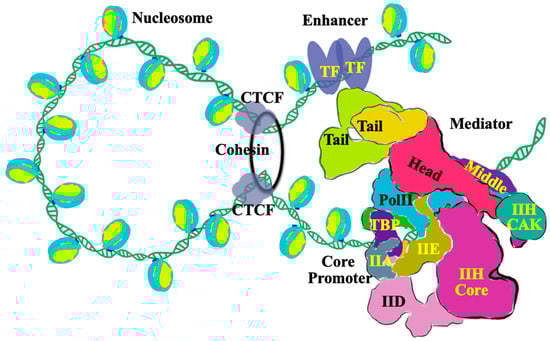
The Mediator complex is a central regulator of eukaryotic transcription, functioning as a dynamic molecular interface between gene-specific transcription factors and RNA polymerase II (Pol II). Although its overall architecture and general role in transcription have been extensively reviewed, accumulating genetic, genomic, and [...] Read more.
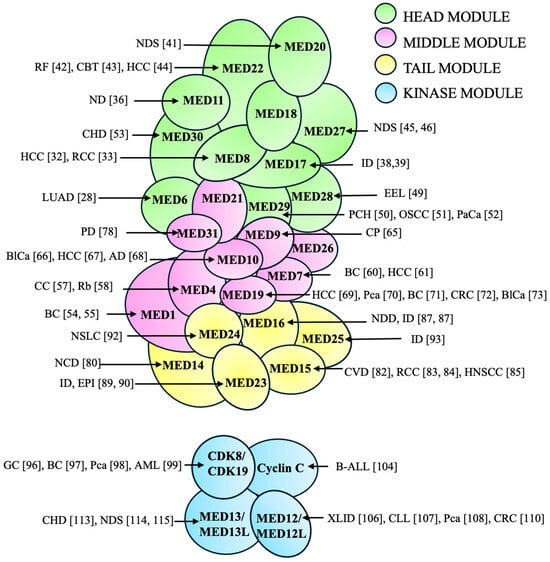
The Mediator complex is a central regulator of eukaryotic transcription, functioning as a dynamic molecular interface between gene-specific transcription factors and RNA polymerase II (Pol II). Although its overall architecture and general role in transcription have been extensively reviewed, accumulating genetic, genomic, and clinical evidence indicates that individual Mediator subunits make distinct and non-redundant contributions to human physiology and disease. In this review, we move beyond a generic description of Mediator function and present a subunit-resolved synthesis of Mediator biology with an emphasis on disease pathogenesis. A key feature of this review is a comprehensive table integrating disease associations and molecular functions of individual human Mediator subunits, enabling rapid assessment of functional specialization across the complex. We further discuss chromatin-based mechanisms of Mediator action, including cooperation with cohesin and architectural factors to regulate enhancer-promoter communication and higher-order genome organization. By organizing recent structural, mechanistic, and pathological findings into a unified framework, this review highlights how disruption of specific Mediator subunits contributes to cancer, developmental disorders, and metabolic disease, and outlines emerging opportunities for therapeutic intervention. Full article
Show Figures

Figure 1

29 pages, 1126 KB  
Review
The Multi-Target lncRNA–miRNA–mRNA TRIAD in Pancreatic Cancer Diagnosis and Therapy
by Hyeon-su Jeong, Yun Ju Lee, Du Hyeong Lee, Hyun-Young Roh, Ga-ram Jeong and Heui-Soo Kim
Int. J. Mol. Sci. 2026, 27(3), 1400; https://doi.org/10.3390/ijms27031400 - 30 Jan 2026
Cited by 1 | Viewed by 514
Abstract
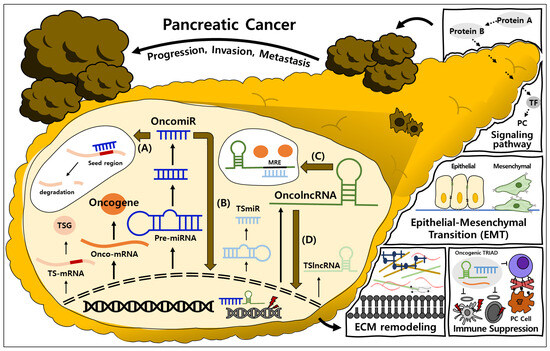
Pancreatic cancer (PC) is one of the most lethal malignancies worldwide, characterized by late diagnosis, aggressive progression, and limited responsiveness to current therapeutic strategies. Although extensive genomic analyses have identified key driver protein-coding genes (PCGs), therapeutic approaches targeting individual genes have shown limited [...] Read more.
Pancreatic cancer (PC) is one of the most lethal malignancies worldwide, characterized by late diagnosis, aggressive progression, and limited responsiveness to current therapeutic strategies. Although extensive genomic analyses have identified key driver protein-coding genes (PCGs), therapeutic approaches targeting individual genes have shown limited clinical benefit. This limitation highlights the molecular complexity of PC, where tumor progression is governed by regulatory networks that extend beyond genetic alterations. Non-coding RNAs (ncRNAs), which constitute nearly 98% of the human genome, have emerged as regulators of gene expression in cancer. Among them, microRNAs (miRNAs) and long non-coding RNAs (lncRNAs) regulate oncogenic processes, including aberrant signaling activation, tumor microenvironment remodeling, epithelial–mesenchymal transition, immune evasion, and resistance. Beyond their independent functions, lncRNAs, miRNAs, and mRNAs form an integrated regulatory network known as the lncRNA–miRNA–mRNA TRIAD, enabling control of gene expression. Such network-based regulation provides a framework for multi-target therapeutic strategies. Moreover, the rapid responsiveness and disease-specific expression patterns of ncRNAs suggest strong potential as diagnostic and prognostic biomarkers in PC, where early detection remains challenging. This review summarizes the regulatory roles of PCGs, miRNAs, and lncRNAs in PC and highlights the lncRNA–miRNA–mRNA TRIAD as a framework for understanding gene regulatory networks. Full article
Show Figures

Figure 1

33 pages, 1331 KB  
Review
MicroRNAs in Esophageal Cancer: Implications for Diagnosis, Progression, Prognosis and Chemoresistance
by Erica Cataldi-Stagetti, Giulia Governatori, Arianna Orsini, Bianca De Nicolo, Rocco Maurizio Zagari and Elena Bonora
Int. J. Mol. Sci. 2026, 27(2), 878; https://doi.org/10.3390/ijms27020878 - 15 Jan 2026
Cited by 1 | Viewed by 657
Abstract
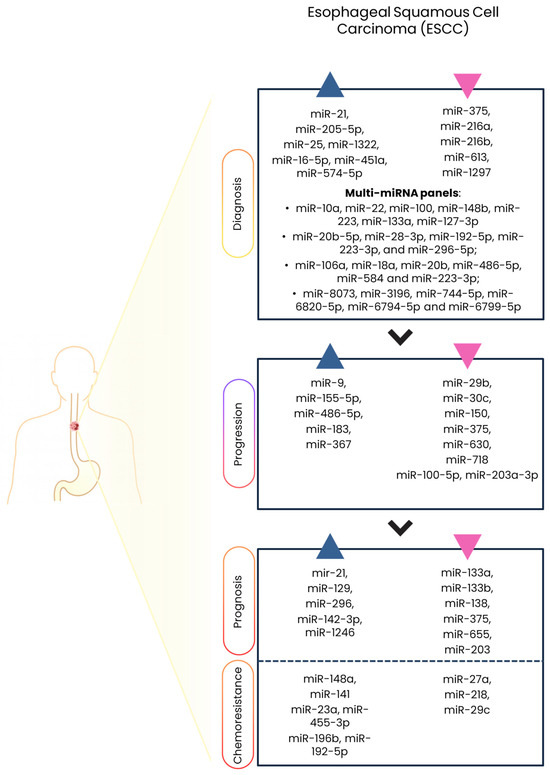
Esophageal cancer (EC), including esophageal squamous cell carcinoma (ESCC) and esophageal adenocarcinoma (EAC), remains a highly lethal disease because of its late diagnosis, significant biological heterogeneity, and frequent resistance to therapy. Growing evidence indicates that microRNAs (miRNAs) are key posttranscriptional regulators involved in [...] Read more.
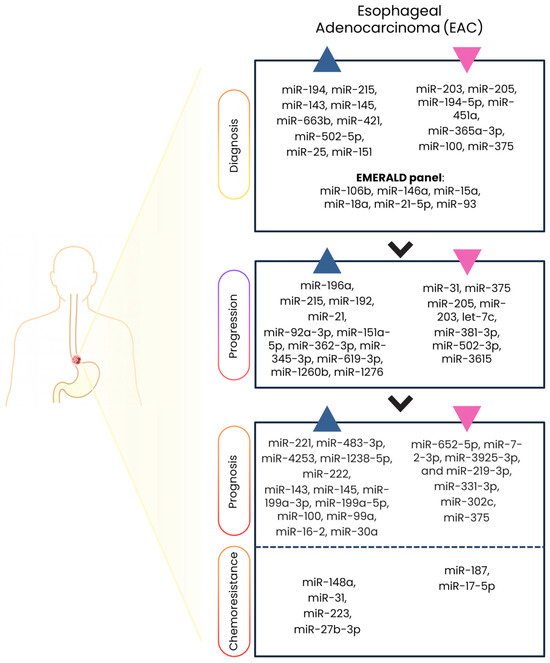
Esophageal cancer (EC), including esophageal squamous cell carcinoma (ESCC) and esophageal adenocarcinoma (EAC), remains a highly lethal disease because of its late diagnosis, significant biological heterogeneity, and frequent resistance to therapy. Growing evidence indicates that microRNAs (miRNAs) are key posttranscriptional regulators involved in tumor initiation, progression, metastasis, and response to treatment. This review provides a comprehensive and updated overview of miRNA dysregulation in both ESCC and EAC, with a specific focus on its emerging clinical relevance in early detection, prognostic assessment, and prediction of therapeutic response. Multiple tissue-based and circulating miRNA signatures, some capable of distinguishing between Barrett’s esophagus (BE), dysplasia, and EAC, demonstrate promising diagnostic performance. In parallel, several miRNAs, including miR-21, miR-23a, miR-455-3p, and miR-196b, have been consistently associated with chemoresistance and radioresistance. Moreover, distinct miRNA expression patterns are correlated with tumor aggressiveness, metastatic potential, and the risk of recurrence, supporting their integration with conventional histopathological and molecular parameters for improved patient stratification. Overall, miRNAs represent a powerful class of biomarkers and potential therapeutic targets in EC, with increasing translational relevance in precision oncology. Full article
Show Figures

Figure 1

Back to TopTop