Skip Content
You are currently on the new version of our website. Access the old version .

Journal of Imaging

Journal of Imaging is an international, multi/interdisciplinary, peer-reviewed, open access journal of imaging techniques, published online monthly by MDPI.

Indexed in PubMed | Quartile Ranking JCR - Q2 (Imaging Science and Photographic Technology)

All Articles (2,248)

Breast ultrasound imaging is widely used for the detection and characterization of breast abnormalities; however, generating detailed and consistent radiological reports remains a labor-intensive and subjective process. Recent advances in deep learning have demonstrated the potential of automated report generation systems to support clinical workflows, yet most existing approaches focus on chest X-ray imaging and rely on convolutional–recurrent architectures with limited capacity to model long-range dependencies and complex clinical semantics. In this work, we propose a multimodal Transformer-based framework for automatic breast ultrasound report generation that integrates visual and textual information through cross-attention mechanisms. The proposed architecture employs a Vision Transformer (ViT) to extract rich spatial and morphological features from ultrasound images. For textual embedding, pretrained language models (BERT, BioBERT, and GPT-2) are implemented in various encoder–decoder configurations to leverage both general linguistic knowledge and domain-specific biomedical semantics. A multimodal Transformer decoder is implemented to autoregressively generate diagnostic reports by jointly attending to visual features and contextualized textual embeddings. We conducted an extensive quantitative evaluation using standard report generation metrics, including BLEU, ROUGE-L, METEOR, and CIDEr, to assess lexical accuracy, semantic alignment, and clinical relevance. Experimental results demonstrate that BioBERT-based models consistently outperform general domain counterparts in clinical specificity, while GPT-2-based decoders improve linguistic fluency.

6 February 2026
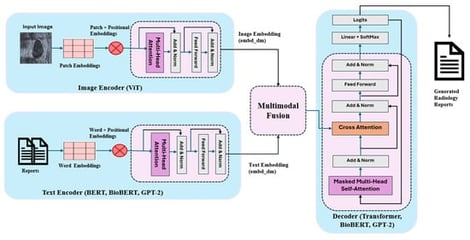
Abstract architecture of the proposed system.

Major crops worldwide are affected by various diseases yearly, leading to crop losses in different regions. The primary methods for addressing crop disease losses include manual inspection and chemical control. However, traditional manual inspection methods are time-consuming, labor-intensive, and require specialized knowledge. The preemptive use of chemicals also poses a risk of soil pollution, which may cause irreversible damage. With the advancement of computer hardware, photographic technology, and artificial intelligence, crop disease recognition methods based on spectral and red–green–blue (RGB) images not only recognize diseases without damaging the crops but also offer high accuracy and speed of recognition, essentially solving the problems associated with manual inspection and chemical control. This paper summarizes the research on disease recognition methods based on spectral and RGB images, with the literature spanning from 2020 through early 2025. Unlike previous surveys, this paper reviews recent advances involving emerging paradigms such as State Space Models (e.g., Mamba) and Generative AI in the context of crop disease recognition. In addition, it introduces public datasets and commonly used evaluation metrics for crop disease identification. Finally, the paper discusses potential issues and solutions encountered during research, including the use of diffusion models for data augmentation. Hopefully, this survey will help readers understand the current methods and effectiveness of crop disease detection, inspiring the development of more effective methods to assist farmers in identifying crop diseases.

5 February 2026

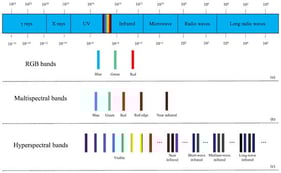
(a) RGB bands, (b) multispectral bands, (c) hyperspectral bands.

Grayscale-based Encryption-then-Compression (EtC) systems transform RGB images into the YCbCr color space, concatenate the components into a single grayscale image, and apply block permutation, block rotation/flipping, and block-wise negative–positive inversion. Because this pipeline separates color components and disrupts inter-channel statistics, existing extended jigsaw puzzle solvers (JPSs) have been regarded as ineffective, and grayscale-based EtC systems have been considered resistant to ciphertext-only visual reconstruction. In this paper, we present a practical ciphertext-only attack against grayscale-based EtC. The proposed attack introduces three key components: (i) Texture-Based Component Classification (TBCC) to distinguish luminance (Y) and chrominance (Cb/Cr) blocks and focus reconstruction on structure-rich regions; (ii) Regularized Single-Channel Edge Compatibility (R-SCEC), which applies Tikhonov regularization to a single-channel variant of the Mahalanobis Gradient Compatibility (MGC) measure to alleviate covariance rank-deficiency while maintaining robustness under inversion and geometric transforms; and (iii) Adaptive Pruning based on the TBCC-reduced search space that skips redundant boundary matching computations to further improve reconstruction efficiency. Experiments show that, in settings where existing extended JPS solvers fail, our method can still recover visually recognizable semantic content, revealing a potential vulnerability in grayscale-based EtC and calling for a re-evaluation of its security.

5 February 2026

Schematic diagram of the block scrambling-based image encryption system for RGB images.

Deep learning models for three-dimensional (3D) data are increasingly used in domains such as medical imaging, object recognition, and robotics. At the same time, the use of AI in these domains is increasing, while, due to their black-box nature, the need for explainability has grown significantly. However, the lack of standardized and quantitative benchmarks for explainable artificial intelligence (XAI) in 3D data limits the reliable comparison of explanation quality. In this paper, we present a unified benchmarking framework to evaluate both intrinsic and post hoc XAI methods across three representative 3D datasets: volumetric CT scans (MosMed), voxelized CAD models (ModelNet40), and real-world point clouds (ScanObjectNN). The evaluated methods include Grad-CAM, Integrated Gradients, Saliency, Occlusion, and the intrinsic ResAttNet-3D model. We quantitatively assess explanations using the Correctness (AOPC), Completeness (AUPC), and Compactness metrics, consistently applied across all datasets. Our results show that explanation quality significantly varies across methods and domains, demonstrating that Grad-CAM and intrinsic attention performed best on medical CT scans, while gradient-based methods excelled on voxelized and point-based data. Statistical tests (Kruskal–Wallis and Mann–Whitney U) confirmed significant performance differences between methods. No single approach achieved superior results across all domains, highlighting the importance of multi-metric evaluation. This work provides a reproducible framework for standardized assessment of 3D explainability and comparative insights to guide future XAI method selection.

30 January 2026

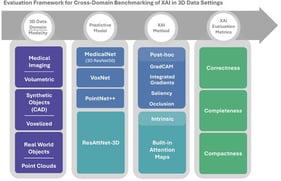
Overview of the cross-domain 3D XAI benchmarking framework.

News & Conferences

Issues

Open for Submission

Editor's Choice

Reprints of Collections

Advances in Retinal Image Processing
Reprint

Advances in Retinal Image Processing

Editors: P. Jidesh, Vasudevan (Vengu) Lakshminarayanan

Get Alerted

Add your email address to receive forthcoming issues of this journal.

XFacebookLinkedIn
J. Imaging - ISSN 2313-433X