Skip to Content

Languages

Languages is an international, multidisciplinary, peer-reviewed, open access journal on interdisciplinary studies of languages published monthly online by MDPI. The European Society for Transcultural and Interdisciplinary Dialogue (ESTIDIA) is affiliated with Languages and its members receive discounts on the article processing charges.

Get Alerted

Add your email address to receive forthcoming issues of this journal.

All Articles (1,964)

  • Article
  • Open Access

Not-at-Issue Proposals

  • Jan Köpping and
  • Eleonora Zani

This paper argues that not-at-issue contents are best analyzed as proposals—similarly, but not identical to, assertions of at-issue contents. This view is justified on theoretical as well as empirical grounds. From a theoretical perspective, we argue that standard accounts of how not-at-issue contents relate to the common ground give rise to significant problems. Empirically, we show that discourse particles such as the German unstressed doch and Italian mica can be used to reject both at-issue and not-at-issue information. Furthermore, Bavarian fei is specialized for challenging not-at-issue material. To account for data like this, we develop a Split Table model that represents at-issue and not-at-issue contents as distinct proposal types with similar yet different properties. This directly derives the differences in the challengeability of at-issue and not-at-issue contents: standard response particles access only at-issue; discourse particles like doch and mica can target both; and fei operates exclusively on not-at-issue proposals. Our analysis thus provides a unified account of how different content types are proposed, negotiated, and accommodated in conversation.

Languages

24 September 2026
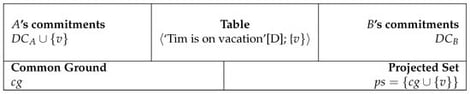
A proposal is put on the Table.
  • Article
  • Open Access

Lexical inferencing (LIF) draws on multiple knowledge sources (KSs), but little is known about how the same multilingual readers report using these sources across different reading tasks. This exploratory study examined 31 Chinese–English–Japanese trilinguals who completed think-aloud inferencing tasks in three language-and-material conditions. Nine KS Types were coded, and trial-level ordinal mixed-effects models related KS use to rater-coded LIF success and participant-selected immediate Vocabulary Knowledge Scale (VKS) categories. Sentence Meaning was the most frequently reported KS Type in all three conditions, while several word-level KS Types and co-occurrence patterns varied across conditions. KS Amount was not associated with LIF success. The joint KS Type test produced weak, threshold-sensitive evidence, and no individual KS Type contrast survived multiplicity correction. VKS categories differed across conditions but were not consistently associated with LIF success, KS Amount, KS Type, or exploratory co-occurrence measures. Because language was confounded with texts, target sets, target status, proficiency, and language experience, between-condition contrasts are descriptive and cannot isolate language or transfer effects. The findings question a simple ‘more is better’ account of reported KS use and identify descriptive patterns for testing in future matched-material studies.

Languages

23 September 2026

  • Article
  • Open Access

When speakers encounter errors or misunderstandings in others’ talk, how they respond carries both pragmatic and interpersonal consequences that vary systematically across languages and cultures, yet this area remains underexplored in cross-cultural pragmatic research. This study examines how native speakers of English, Spanish, and Chinese respond to communication trouble across comparable sociopragmatic situations, and how social distance and social status shape these responses. Data were elicited from 124 L1 speakers of English, Spanish, and Chinese using an online Discourse Completion Task (DCT) and analysed using a pragmatics-oriented framework distinguishing three main types of responses: remediation, trouble-signalling, and let-it-pass. Results show that all three groups preferred remediation, particularly indirect remediation, reflecting a shared concern for managing the face-threatening potential of addressing others’ problems. The groups diverged most sharply in their use of let-it-pass, with Chinese and English speakers leaving trouble unaddressed far more often than Spanish speakers. Social status emerged as a more robust and cross-linguistically consistent factor than social distance, with remediation more frequently selected in high-status contexts across all three groups. These findings provide a cross-cultural reference point for L2 pragmatic instruction, particularly for learners whose L1 norms diverge most sharply from the target language in managing communicative trouble.

Languages

22 September 2026

  • Article
  • Open Access

This article presents a longitudinal case study of want-constructions in an English–Russian bilingual child whose early language was characterized by prolonged pronoun reversal (i.e., using you for self-reference). The analysis focuses on want-constructions used during a period in which canonical English imperatives were not documented (e.g., want tear it). Drawing on detailed diary records (ages 2;8–5;5), the study examines the morphosyntactic forms of these constructions and their discourse–pragmatic functions. The findings show that the child used want-constructions to express a range of directive meanings, including requests, prohibitions, and counterfactual wishes. Their morphosyntax became increasingly complex over time, with the emergence of overt matrix subjects, infinitival marking, and verbal morphology. However, greater morphosyntactic complexity did not automatically trigger adult-like subject-control relations in complements of want; the interpretation of null embedded subjects often remained dependent on discourse context. The study argues that volitional want-predicates served as a lexically anchored alternative to canonical imperatives during a period of pronoun reversal. Their development may reflect the interaction of discourse-functional, usage-based, and crosslinguistic factors. The findings highlight the need to investigate the development of directive strategies in both bilingual and monolingual children with pronoun reversals.

Languages

21 September 2026

Highly Accessed Articles

News & Conferences

Latest Issues

Open for Submission

Journal Sections

Language Processing in Spanish Heritage Speakers
Reprint

Language Processing in Spanish Heritage Speakers

Editors: Óscar Loureda, Olga Ivanova
Current Issues in Vietnamese Linguistics
Reprint

Current Issues in Vietnamese Linguistics

Editors: Trang Phan, Nigel Duffield, Tim Chou
XFacebookLinkedIn
Languages - ISSN 2226-471X