Non-convex stochastic optimization presents fundamental mathematical challenges across machine learning, wireless networks, data center resource allocation, and optical wireless communication systems, where complex loss landscapes with multiple local minima and saddle points impede classical variational inference methods. This paper introduces the Quantum-Inspired Variational
[...] Read more.
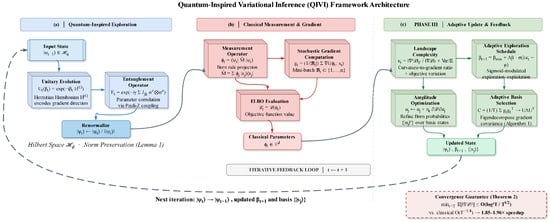
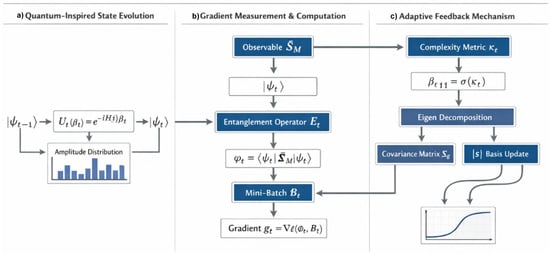
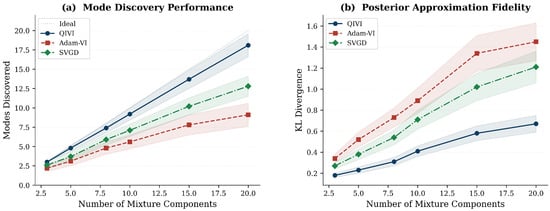
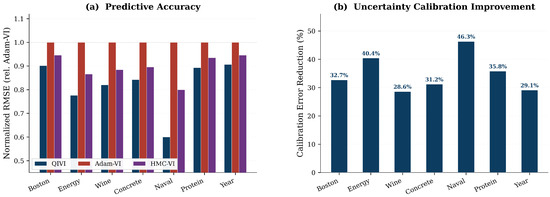
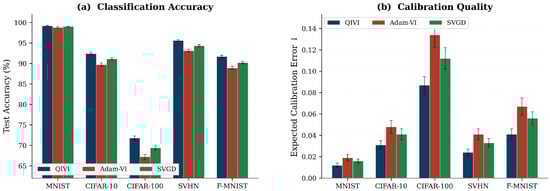
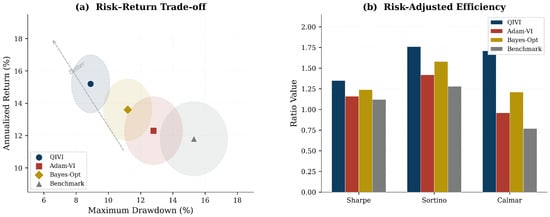
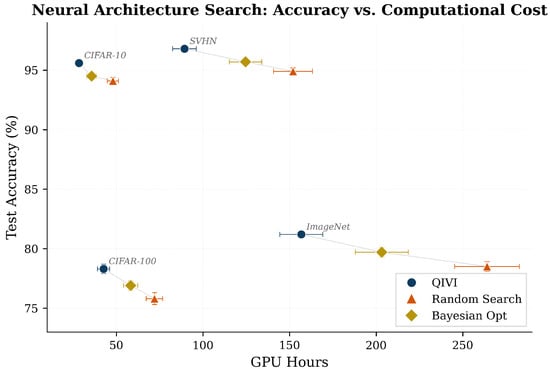
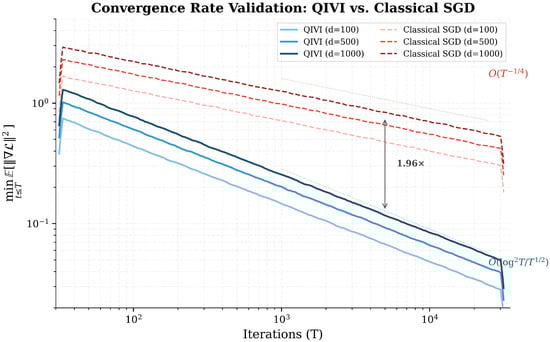
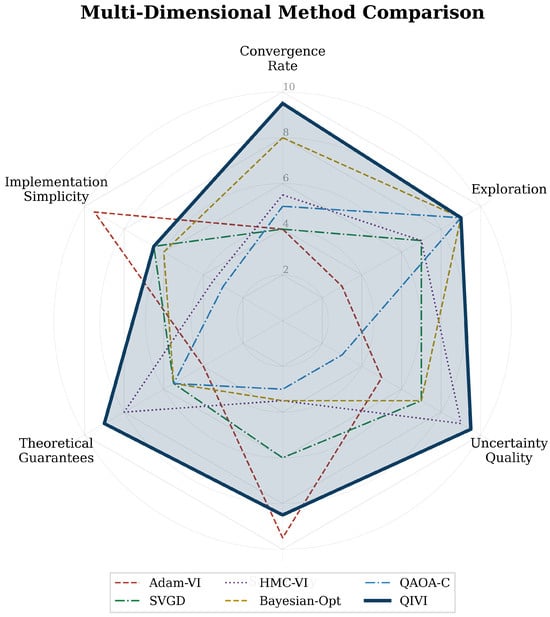
Non-convex stochastic optimization presents fundamental mathematical challenges across machine learning, wireless networks, data center resource allocation, and optical wireless communication systems, where complex loss landscapes with multiple local minima and saddle points impede classical variational inference methods. This paper introduces the Quantum-Inspired Variational Inference (QIVI) framework, which systematically integrates quantum mechanical principles (superposition, entanglement, and measurement operators) into classical variational inference through rigorous mathematical formulations grounded in Hilbert space theory and operator algebras. We develop a unified optimization framework that encodes classical parameters as quantum-inspired states within finite-dimensional complex Hilbert spaces, employing unitary evolution operators and adaptive basis selection governed by gradient covariance eigendecomposition. The core mathematical contribution establishes that QIVI achieves a convergence rate of
for
-strongly non-convex functions, provably improving upon the classical
rate, yielding a theoretical speedup factor of
–
. Comprehensive experiments across synthetic benchmarks, Bayesian neural networks, and real-world applications in network optimization and financial portfolio management demonstrate 23–
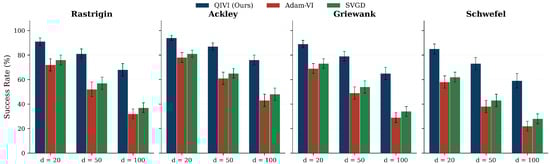
faster convergence, 15–
superior objective values, and 28–
improved uncertainty calibration. The principal contributions include: (i) a rigorous Hilbert space-based mathematical framework for quantum-inspired variational inference grounded in operator algebras, (ii) a novel hybrid quantum–classical algorithm (QIVI) with adaptive basis selection via gradient covariance eigendecomposition, (iii) formal convergence proofs establishing provable improvement over classical methods, (iv) comprehensive empirical validation across diverse problem domains relevant to machine learning and network optimization, and (v) demonstration of the framework’s applicability to optimization problems arising in wireless networks, data center resource allocation, and network system design. Statistical validation using the Friedman test (
,
) and post hoc Wilcoxon signed-rank tests with Holm–Bonferroni correction confirm that QIVI’s improvements over all baseline methods are statistically significant at the
level across all benchmark categories. The framework discovers
out of 20 true modes in multimodal distributions versus
for classical methods, demonstrating the potential of quantum-inspired optimization approaches for challenging stochastic problems arising in machine learning, wireless communication, and network optimization.
Full article