Skip Content
You are currently on the new version of our website. Access the old version .

Medical Sciences

Medical Sciences is an international, peer-reviewed, open access journal, providing a platform for advances in basic, translational and clinical research, published quarterly online by MDPI.
The Korean Society of Physical Medicine (KSPM) is affiliated with Medical Sciences and its members receive discounts on the article processing charges.
Indexed in PubMed | Quartile Ranking JCR - Q1 (Medicine, General and Internal)

All Articles (1,060)

Sociodemographic and Clinical Predictors of Chronic Disease Outcomes in a Colombian Population: A Cross-Sectional Analysis of 2495 Patients

  • Adriana Guzmán Sánchez,
  • Lilibeth Sánchez-Guette and
  • Carlos Andrés Collazos Morales
  • + 3 authors

Objectives: This study sought to identify sociodemographic and clinical predictors associated with the absence versus presence of alterations in mental, neurological, cardiovascular, osteomuscular, and pulmonary conditions, to provide information towards targeted interventions for non-communicable diseases (NCDs) in urban Colombian populations. Methods: A cross-sectional analysis was performed on 2495 patients (70.1% women) from public health facilities in Bogotá, using the Colombia Open Data “Enfermedades Crónicas” dataset collected between January and December 2023. Associations between sociodemographic variables (sex, age groups, education, and ethnicity) and clinical variables (BMI, type of disability, COVID-19 vaccination status, psychiatric risk, and the modified Medical Research Council dyspnea scale) were examined in relation to health outcomes. Data cleaning involved the exclusion of 107 outliers identified by z-scores >|3| using Microsoft Excel 365. Categorical variables were summarized using frequencies and proportions, and Pearson’s chi-square tests were applied to assess bivariate associations (e.g., BMI–health conditions, and sex–disability associations). Multivariable Firth’s penalized logistic regression models (implemented in Python 3.14 and Jamovi 2.3) were used to predict the absence of alteration (reference category: presence), adjusting for multicollinearity (variable inflation factor, VIF) and events-per-variable ratios. Odds ratios (ORs), 95% confidence intervals (CIs), and two-tailed p-values were estimated, with statistical significance set at p < 0.05. Results: Women predominated in obesity (81% vs. 19% in men, p < 0.001) and in unaltered conditions (e.g., 71% of cases without pulmonary alterations) but exhibited a lower crude prevalence of disability (6% vs. 16% in men, p < 0.001). Men represented higher proportions of alterations (e.g., 53.8% of pulmonary cases vs. 46.2%, p = 0.006) and mental disabilities (70%, p < 0.001). Firth regression models identified the following predictors: for mental alteration, a single COVID-19 vaccine dose (OR = 2.39, 95% CI 1.12–5.09, p = 0.024), occupation (OR = 1.07, 95% CI 1.05–1.10, p < 0.001), BMI (OR = 0.96, 95% CI 0.93–0.98, p < 0.001), and disability (inverted OR = 4.35, 95% CI 2.56–7.69, p < 0.001); for neurological alteration, occupation (OR = 1.15, 95% CI 1.10–1.21, p < 0.001) and disability (inverted OR = 3.45, 95% CI 1.43–8.33, p = 0.006); for cardiovascular alteration, BMI (OR = 1.02, 95% CI 1.00–1.03, p = 0.042); for osteomuscular alteration, occupation (OR = 1.03, 95% CI 1.01–1.06, p = 0.011); and for pulmonary alteration, occupation (OR = 1.07, 95% CI 1.03–1.11, p = 0.001). The models demonstrated a moderate to excellent goodness-of-fit (R2 = 0.25–0.72). Conclusions: Sex, BMI, disability status, occupation, and COVID-19 vaccination status emerged as key predictors of NCD-related alterations, highlighting specific vulnerabilities such as partial immunization for mental health risk, and disability for mental and neurological outcomes. Targeted interventions, including completion of vaccination schedules, mitigation of occupational exposure, BMI management, and disability-inclusive care, may reduce health disparities and support PAHO/WHO 2025 targets. Longitudinal studies are recommended to establish causal relationships in the context of Colombia’s fragmented subnational NCD evidence base.

7 February 2026
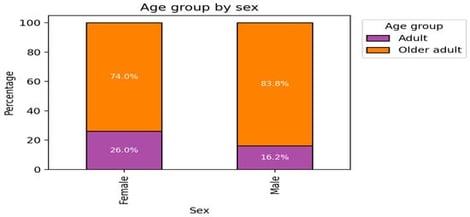
Distribution of Age Groups by Sex.

Breaking Barriers: Advancements in CNS Drug Delivery for Glioblastoma

  • Nicole Al Fidawi,
  • Cecile Z. Attieh and
  • Frederic Harb
  • + 7 authors

Glioblastoma is known as the most aggressive primary brain tumor in adults, and it is still largely not curable, with a median survival of approximately 15 months when standard multimodal therapy is applied. The standard treatment nowadays is maximal safe surgical resection, associated with radiotherapy and temozolomide. Treatment effectiveness is limited not only by an impassable blood–brain barrier (BBB) to drug delivery to the brain, but also by the heterogeneity of the tumors and intrinsic or acquired drug resistance, resulting in a certain and inescapable tumor relapse. Therefore, novel drug delivery systems are being designed to overcome the BBB and improve therapeutic efficacy. These approaches include nanoparticle-mediated delivery systems, convection-enhanced intra-tumoral infusion, implantable drug-releasing devices, and noninvasive focused ultrasound technology, which induced transient disruption of the BBB. These approaches are designed to enhance local drug exposure and reduce systemic toxicity with promising preclinical and early clinical results. However, many clinical and technical challenges remain, especially the need for safety, homogeneous drug delivery, and translation of these advances into effective clinical therapies. Current glioblastoma treatment landscape and opportunities include maturing delivery systems, novel therapeutic approaches, including targeted molecular therapies and immunotherapy, as well as personalized regimens. This multidisciplinary modality may have the capacity to help not only patients with GBM but others as well through a multimodal approach of targeted drug delivery and innovative therapy in the long run to improve clinical outcomes of GBM in patients.

5 February 2026

Parkinson’s disease (PD) is a progressive and heterogeneous neurodegenerative disorder and one of the fastest-growing causes of neurological disability worldwide. Although historically defined by motor manifestations resulting from nigrostriatal dopaminergic degeneration, PD is now recognized as a multisystem disorder. Non-motor features—including autonomic dysfunction, neuropsychiatric symptoms, cognitive impairment, and sleep-related disorders—frequently precede motor onset by years or even decades, delineating a clinically meaningful prodromal phase. The aetiology of PD reflects a complex interplay between genetic susceptibility and environmental exposures. Approximately 20% of cases are linked to identifiable pathogenic variants, most commonly in LRRK2, GBA1, and SNCA, whereas the majority arise from cumulative interactions among environmental factors, lifestyle determinants, and common genetic risk variants rather than from single causal mechanisms. Despite substantial advances in understanding disease biology, current therapies remain fundamentally symptomatic. Dopaminergic pharmacotherapy and device-aided interventions improve motor function and, in selected contexts, functional outcomes, but they do not modify disease progression. Non-motor symptoms remain a dominant driver of disability and reduced quality of life. Recent conceptual frameworks propose redefining PD as a biologically defined α-synucleinopathy. Emerging biomarkers, including α-synuclein seed amplification assays in cerebrospinal fluid and peripheral tissues, offer unprecedented opportunities to define biological disease, enable early detection, and stratify patients. However, biomarker positivity currently informs diagnosis and classification rather than prognostication or therapeutic selection, and validated intermediate endpoints linking biomarker change to sustained functional benefit remain lacking. Consequently, translation into disease-modifying therapies has been constrained by late-stage intervention, reliance on clinically defined populations, limited trial generalizability, and marked global inequities in access to advanced diagnostics and treatments. This narrative review synthesizes current evidence on PD epidemiology, diagnosis, aetiology, progression, and treatment, emphasizing gene–environment interactions, convergence on shared pathogenic pathways, limitations of existing therapeutic paradigms, and the as-yet unrealized potential of biologically informed precision care.

5 February 2026

Background/Objectives: Home Enteral Nutrition Therapy (HENT) is widely used for patients with preserved gastrointestinal function who cannot maintain adequate oral intake. It can be administered through commercial formulas (CF) or artisanal preparation (AP). Methods: This was a cross-sectional, descriptive, observational study with a quantitative and qualitative approach, conducted through semi-structured interviews by the researcher herself. Patients using HENT were evaluated for nutritional status using a 24 h dietary recall, and their quality of life was assessed using a questionnaire administered during an interview with the patient and/or caregiver. Microbial characteristics of the diets were evaluated by collecting samples and performing microbiological analyses according to standard methods. Results: 22 patients participated, mostly elderly, bedridden, and dependent, with gastrostomy as the primary method of administration (72.7%) and CF as the most commonly used (54.5%). AP consisted of cooked vegetables, legumes, milk, oil, and salt, and showed low nutritional diversity and a high risk of microbiological contamination due to manual handling. Frequent complications included diarrhea (72.7%) and mechanical complications (77.7%). Despite these issues, 91% of participants rated their quality of life as acceptable. Conclusions: HENT posed significant challenges to nutritional adequacy and microbiological safety, particularly among patients using artisanal preparations. These findings highlight the need for systematic monitoring and individualized adjustments by a multidisciplinary team, along with structured caregiver training, to optimize intake, reduce complications, and improve the quality and safety of home-based enteral therapy.

4 February 2026

News & Conferences

Issues

Open for Submission

Editor's Choice

Get Alerted

Add your email address to receive forthcoming issues of this journal.

XFacebookLinkedIn
Med. Sci. - ISSN 2076-3271