Skip Content
You are currently on the new version of our website. Access the old version .
  • Tracked for
    Impact Factor
  • 9.0
    CiteScore
  • 16 days
    Time to First Decision

Nanoenergy Advances

Nanoenergy Advances is an international, peer-reviewed, open access journal on all aspects of nanoenergy published quarterly online by MDPI.

All Articles (96)

The increasing global energy demand and its negative environmental impact created the need for substantial changes in the energy infrastructure. A hydrogen-based infrastructure appears to be the most promising way to secure a clean and safe energy future. Water electrolysis is a method that can be used to generate green hydrogen, but suitable electrocatalysts are required for large-scale applications. This work investigates the electrocatalytic activity of electrodes modified with novel TiO2 nanotube-based electrocatalysts for water electrolysis. The focus was on the hydrogen evolution reaction (HER), and the electrodes that displayed the highest activity were the ones obtained with the procedure consisting of the growth of TiO2 nanotubes on a Ti plate by anodization, the subsequent deposition of MoO2 and Ni(OH)2, and a thermal treatment performed under different conditions. The results of the HER experiments performed in a strong alkaline environment showed that the electrode obtained via vacuum heat treatment exhibited the lowest overpotential value, of 238 mV at i = −10 mA/cm2. Furthermore, the electrode was electrochemically stable, and inter-electrode reproducibility tests revealed only a small variation of the HER overpotential.

12 January 2026
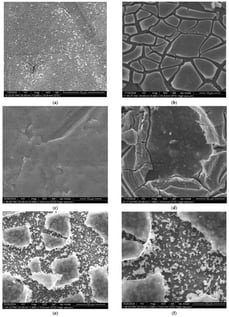
SEM images obtained on TiO2 nanotube-based samples. (a) TiO2 nanotubes grown on titanium substrate. (b) MoO2 electrodeposited on TiO2 nanotubes grown on titanium substrate. (c) MoO2 electrodeposited on TiO2 nanotubes grown on titanium substrate, followed by immersion in Ni solution and exposure to NH3 vapors. (d) MoO2 electrodeposited on TiO2 nanotubes grown on titanium substrate, followed by immersion in Ni solution, exposure to NH3 vapors and thermal treatment in air atmosphere (E7). (e,f) MoO2 electrodeposited on TiO2 nanotubes grown on titanium substrate, followed by immersion in Ni solution, exposure to NH3 vapors and thermal treatment under vacuum (E8).

Nano-Enhanced Binary Eutectic PCM with SiC for Solar HDH Desalination Systems

  • Rahul Agrawal,
  • Kashif Mushtaq and
  • Breogán Pato-Doldán
  • + 2 authors

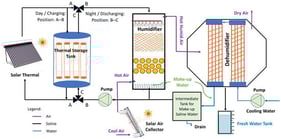
Freshwater scarcity is increasing day by day and has already reached a threatening level, especially in remotely populated areas. One of the technological solutions to this rising concern could be the use of the solar-based humidification–dehumidification (SHDH) method for water desalination. This technology is a promising solution but has challenges such as solar intermittency. This challenge can be solved by integrating SHDH with the phase change material as a solar energy storage medium. Therefore, a novel nano-enhanced binary eutectic phase change material (NEPCM) was developed in this project. PCM consisting of 70 wt.% stearic acid (ST) and 30 wt.% suberic acid (SBU) with a varying concentration of silicon carbide (SiC) nanoparticles (NPs) (0.1 to 3 wt.%) was synthesized specifically considering the need of SHDH application. The systematic thermophysical characterization was conducted to investigate their energy storage capacity, thermal durability, and performance consistency over repeated cycles. DSC analysis revealed that the addition of SiC NPs preserved the thermal stability of the NEPCM, while the phase transition temperature remained nearly unchanged with a variation of less than 0.74%. The value of latent heat is inversely related to the nanoparticle concentration, i.e., from 142.75 kJ/kg for the base PCM to 131.24 kJ/kg at 3 wt.% loading. This corresponds to reductions in latent heat ranging between 0.98% and 8.06%. The FTIR measurement confirms that no chemical reactions or no new functional groups were formed. All original functional groups of ST and SBU remained intact, showing that incorporating the SiC NP to the PCM lead to physical interactions (e.g., hydrogen bonding or surface adsorption). The TGA analysis showed that the SiC NPs in the NEPCM act as supporting material, and its nano-doping enhanced the final degradation temperature and thermal stability. There was negligible change in thermal conductivity for nanoparticle loadings of 0.1% and 0.4%; however, it increased progressively by 5.2%, 10.8%, 23.12%, and 25.8% at nanoparticle loadings of 0.7%, 1%, 2%, and 3%, respectively, at 25 °C. Thermal reliability was analyzed through a DSC thermal cycling test which confirmed the suitability of the material for the desired applications.

9 January 2026

Integration of TES systems into SHDH desalination system.

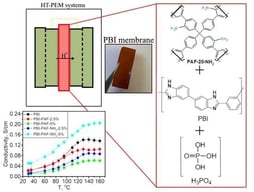
High-temperature proton exchange membrane systems (HT-PEM) based on polybenzimidazole (PBI) membranes are a promising technology offering significant advantages over their low-temperature counterparts. A key challenge limiting its long-term durability is the leaching of phosphoric acid (PA) from the membrane during operation. This work introduces, for the first time, the strategy of modifying polybenzimidazole (PBI) membranes with amino-functionalized porous aromatic frameworks (PAF-20-NH2) to fundamentally enhance their PA retention and operational stability, a critical challenge for high-temperature PEM technologies. We propose that the synergistic combination of the framework’s nanoscale porosity and the specific interaction of its amino groups create an unprecedented network for acid immobilization via reinforced hydrogen bonding. A comprehensive study of the membranes’ physicochemical and structural properties reveals that PAF-20-NH2 modification results in a significant and quantitatively demonstrated improvement in acid retention capacity, directly translating into a notable increase in proton conductivity compared to both pristine PBI and membranes modified with the non-functionalized PAF-20. These findings establish a new, highly effective pathway for the rational design of next-generation high-performance PBI-based membranes.

8 January 2026

Synthesis of PAF-20 and PAF-20-NH2 materials.

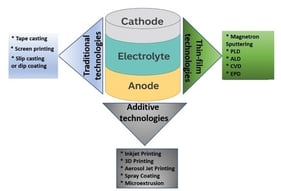
This review examines modern approaches to layer formation in solid oxide fuel cells (SOFCs), focusing on traditional, thin-film, and additive manufacturing methods. A systematic comparison of technologies, including slip casting, screen printing, CVD, PLD, ALD, HiPIMS, inkjet, aerosol, and microextrusion printing, is provided. It is shown that traditional methods remain technologically robust but are limited in their capabilities for miniaturization and interfacial architecture design. Modern thin-film and additive approaches provide high spatial accuracy, improved ion-electron characteristics, and flexibility in the design of multilayer structures; however, they require addressing issues related to scalability, ink stability, interfacial compatibility, and reproducibility. Particular attention is paid to interfacial engineering methods, such as functionally graded layers, nanostructured infiltration, and temperature-controlled 3D printing. Key challenges are discussed, including thermal instability of materials, the limited gas impermeability of ultra-thin electrolytes, and degradation during long-term operation. Development prospects lie in the integration of hybrid methods, the digitalization of deposition processes, and the implementation of intelligent control of printing parameters. The presented analysis forms the basis for further research into the scalable and highly efficient production of next-generation SOFCs designed for low-temperature operation and long-term operation in future energy systems.

25 December 2025

Schematic representation of the tape casting method (this is an original figure created by the authors).

News & Conferences

Issues

Open for Submission

Editor's Choice

Reprints of Collections

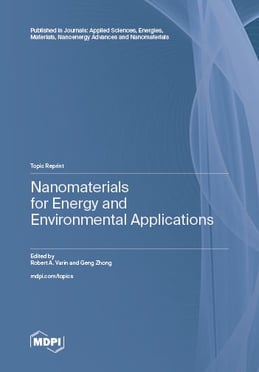
Nanomaterials for Energy and Environmental Applications
Reprint

Nanomaterials for Energy and Environmental Applications

Editors: Robert A. Varin, Geng Zhong
Applications of Nanomaterials in Energy Systems
Reprint

Applications of Nanomaterials in Energy Systems

Editors: Eleftheria C. Pyrgioti, Ioannis F. Gonos, Diaa-Eldin A. Mansour

Get Alerted

Add your email address to receive forthcoming issues of this journal.

XFacebookLinkedIn
Nanoenergy Adv. - ISSN 2673-706X