Skip Content
You are currently on the new version of our website. Access the old version .
  • Tracked for
    Impact Factor
  • Indexed in
    Scopus
  • 22 days
    Time to First Decision

Pharmacoepidemiology

Pharmacoepidemiology is an international, peer-reviewed, open access journal on high-quality epidemiological, clinical research across the fields of clinical pharmacology and epidemiology, published quarterly online by MDPI.

All Articles (102)

  • Systematic Review
  • Open Access

Intraocular Inflammation Following Intravitreal Faricimab: A Systematic Review and Meta-Analysis

  • Jumanah Qedair,
  • Asmaa A. Youssif and
  • Hashem Abu Serhan
  • + 1 author

Background/Objectives: To evaluate the incidence, characteristics, and clinical outcomes of intraocular inflammation (IOI) associated with intravitreal faricimab (IVF) in patients with neovascular age-related macular degeneration (nAMD) and diabetic macular edema (DME). Methods: Following PRISMA guidelines, a comprehensive search of PubMed, Web of Science, Scopus, Embase, and CENTRAL databases was performed from their inception to February 2025. Using the random-effects model, weighted proportions, standardized mean differences, and weighted log odds ratios (OR) were pooled and calculated. A two-tailed p-value of <0.05 was considered statistically significant. The χ2 (z) test and the Higgins I2 test were used to assess studies heterogeneity. Results: We conducted a systematic review and meta-analysis of 24 studies (4761 patients; 5652 eyes). The most common diagnoses were nAMD (n = 4782, 94.6%) and DME (n = 845, 37.1%). The pooled proportion for IOI incidence in eyes receiving IVF was 3.0% (95% CI: 1.0–6.0). The odds of developing IOI did not differ significantly between the DME and nAMD groups (OR: 1.13, p = 0.78). Unspecified IOI was the most common sign (n = 210, 2.9% [95% CI: 1.2–7.3]), followed by anterior uveitis (n = 80, 1.9% [95% CI: 0.1–34.8]), vitritis (n = 63, 2.9% [95% CI: 0.2–32.1]), retinal hemorrhage (n = 27, 0.7% [95% CI: 0.0–15.3]), and endophthalmitis (n = 8, 0.5% [95% CI: 0.3–1.1]). Conclusions: While IVF demonstrates therapeutic efficacy, our findings highlight a clinically relevant risk of IOI. We, therefore, recommend vigilant clinical monitoring in patients receiving this therapy.

26 January 2026
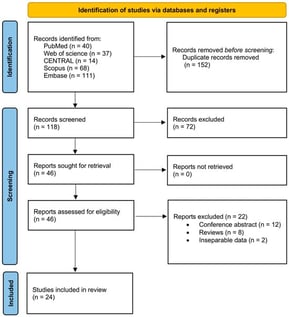
PRISMA flowchart illustrating the systematic literature search, screening process, and study selection based on the inclusion and exclusion criteria.

Background: Pharmacovigilance is a critical component of patient safety, particularly among older adults with chronic diseases who are frequently exposed to polypharmacy. In Kosovo, adverse drug reactions (ADRs) reported by patients remain insufficiently recognized within the healthcare system. Polypharmacy, limited access to pharmaceutical counseling, and self-medication practices may contribute to increased medication-related harm. Capturing ADRs directly from patients provides valuable insight into medication safety challenges and communication gaps in clinical care. Objective: To assess the frequency, characteristics, and reporting behavior of adverse drug reactions among adults aged 60–75 years with chronic diseases in Kosovo, and to identify factors associated with awareness and reporting practices. Methods: A multicenter cross-sectional study was conducted between January and September 2025 in four major cities in Kosovo (Prishtina, Prizren, Peja, and Gjilan). A total of 1024 patients receiving continuous therapy for at least one chronic condition were surveyed using a structured questionnaire covering demographic characteristics, drug exposure, ADR experience, and reporting behavior. Statistical analyses included descriptive statistics, chi-square testing, and multivariable logistic regression to identify predictors of ADR reporting. Results: Overall, 47.3% of participants reported experiencing at least one ADR in the preceding 12 months. Among those, 39.5% reported the event to a healthcare professional, whereas 60.5% did not seek professional advice. The most frequently implicated drug classes were antihypertensives (32.8%), analgesics and non-steroidal anti-inflammatory drugs (27.4%), and antirheumatic agents (14.6%), with mainly gastrointestinal (24.1%) and cardiovascular (18.9%) manifestations. Approximately 19.8% of participants reported discontinuing medication due to adverse effects. Female patients were more likely to report ADRs compared to males (p < 0.01). Lack of prior counseling about potential side effects was independently associated with lower reporting (OR = 2.17; 95% CI: 1.41–3.33). Patients using more than six medications had a higher prevalence of ADRs (61.2%). Conclusion: Adverse drug reactions were frequently reported by older patients, while formal reporting to healthcare professionals remained limited. Strengthening patient education, improving patient–provider communication, and integrating clinical pharmacists into primary care may enhance pharmacovigilance practices and medication safety.

30 January 2026

Background: According to the literature, adverse drug reactions (ADRs) account for 5–10% of hospital admissions and affect 25–30% of hospitalized patients, but no data are available for Gabon. Objectives: To estimate the incidence of ADRs among hospitalized patients at the Libreville University Hospital Center (CHUL) and to classify them according to their frequency, severity, mechanism and preventability, while proposing appropriate risk minimization strategies. Patients and Methods: A 14-month, single-center, prospective study included all patients experiencing ADRs, excluding those without ADRs or with intentional overdoses. ADRs were analyzed using the World Health Organization (WHO) causality assessment, the ATC classification, and Rawlins and Thompson criteria. Data were actively collected from patients and hospital records. Results: Among 4999 patients, 105 experienced 177 adverse events (incidence: 3.5%, 95% CI: 1.7–2.5%). Among the identified ADRs, 42% were serious. Nausea and vomiting were the most frequent ADRs, mainly caused by analgesics (nefopam, tramadol) and antibiotics (amoxicillin–clavulanic acid). The gastrointestinal and nervous systems were the most affected. According to the Rawlins and Thompson classification, 90% of ADRs were type A, 8% type B, and 2% type E (withdrawal syndrome). Overall, 90% of ADRs were preventable. Conclusions: This study highlights the importance of pharmacovigilance at CHUL, Gabon, and emphasizes the role of healthcare professionals in ADR reporting and risk minimization.

16 January 2026

Probiotics and microbiome-based therapeutics are increasingly used to prevent antibiotic-associated diarrhea (AAD) and support gut microbiota health across children, adults, and elderly populations. Evidence synthesized in this narrative review from randomized controlled trials and meta-analyses (>20,000 participants) suggests that early probiotic administration, particularly Lactobacillus rhamnosus GG, Bifidobacterium species, multistrain formulations, and Saccharomyces boulardii, is associated with a 30–40% relative reduction in AAD incidence across heterogeneous studies, with absolute risk reductions of approximately 5–12% depending on baseline risk, strain, dose, and timing. Probiotics are generally well tolerated, with mild gastrointestinal adverse effects reported in 3–5% of users and rare serious events mainly in immunocompromised individuals. However, heterogeneity in formulations, populations, and limited long-term real-world data underscores the need for further pharmacoepidemiological studies, microbiome surveillance, and evaluation of antimicrobial resistance implications.

15 January 2026

News & Conferences

Issues

Open for Submission

Editor's Choice

Get Alerted

Add your email address to receive forthcoming issues of this journal.

XFacebookLinkedIn
Pharmacoepidemiology - ISSN 2813-0618