You are currently viewing a new version of our website. To view the old version click .

Phycology

Phycology is an international, peer-reviewed, open access journal on phycology published quarterly online by MDPI. 

Quartile Ranking JCR - Q1 (Marine and Freshwater Biology)

All Articles (194)

  • Communication
  • Open Access

Microalgae have garnered increasing attention as promising sources of diverse natural anti-inflammatory compounds, including carotenoids, phenolics, and unsaturated fatty acids. In this study, we aimed to examine the anti-inflammatory properties of the methanol extract of Nannochloropsis sp. G1-5 (NG15), a strain of marine microalgae isolated from the southern West Sea of the Republic of Korea. Pigment and metabolite analyses revealed that the extract contained various carotenoids and polyunsaturated fatty acids alongside significant quantities of phenolic and flavonoid compounds, which are known to have anti-inflammatory activities. Cytotoxicity assays confirmed that the extract was non-toxic to RAW 264.7 macrophage cells at concentrations up to 1 mg/mL. Upon lipopolysaccharide (LPS) stimulation of the macrophage cells, the NG15 extract significantly inhibited nitric oxide (NO) production in a dose-dependent manner up to 81%. In addition, the NG15 extract reduced the expression of iNOS, COX-2, TNF-α, and IL-6 in the LPS-stimulated cells. These findings suggest that NG15 methanol extract exerts anti-inflammatory effects primarily through the suppression of NO generation without inducing cytotoxicity. Overall, these results underscore NG15 as a promising natural resource for the development of non-toxic and effective anti-inflammatory agents with potential applications in the biomedical and cosmeceutical industries.

30 December 2025

Pigment content of the NG15 methanol extract. (a) The content of major carotenoids in the NG15 methanol extract. (b) HPLC chromatogram of carotenoids in the NG15 methanol extract. (c) Total phenolic and flavonoid content of the NG15 methanol extract. Data and error bars are mean ± SD (n = 3).

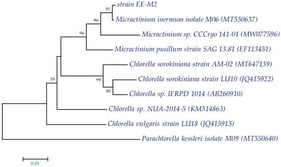
Incorporating microalgae into integrated biotechnologies facilitates rational resource management. Cultivation of microalgae in various types of wastewater offers a number of advantages: safe disposal of liquid waste, restoration of water resources, and the production of valuable products. This study presents a comparative analysis of the growth and biomass productivity of various algal strains in an unsterilized fish processing plant wastewater. Desmodesmus sp. EE-M8 demonstrated the most efficient growth, with a biomass yield of 2.21 ± 0.09 g L−1. The average biomass yield obtained during the growth of Chlorella vulgaris SB-M4, Chlorella sp. EE-P5, Micractinium inermum EE-M2, and Tetradesmus obliquus EZ-B11 ranged from 1.42 to 1.96 g L−1. Ammonium, phosphate, and sulfate ions were completely utilized from the wastewater during algal growth. In addition, the bacterial community structure of wastewater was found to change drastically toward the dominance of Alphaproteobacteria during the microalgal growth. The algal strains (in combination with bacterial partners) used to determine their biostimulant potential demonstrated a positive effect on the germination of garden cress seeds. These findings demonstrate that incorporating algae into the wastewater purification process will reduce the negative impact on the environment and produce valuable biomass for various purposes.

26 December 2025

Final concentration of chlorophylls a, b and total carotenoids obtained during the growth of different algal cultures in wastewater. Means that do not share a letter are significantly different (Tukey method and 95% confidence; green letters refer to chlorophyll a concentration, black letters—chlorophyll b concentration, and red letters—carotenoid concentration).

Microalgae are increasingly recognized as promising biostimulants for sustainable agriculture, yet their potential remains underexplored due to the complexity of biostimulant activity and the vast diversity of species. Efficient standardized screening approaches are therefore needed. In this study, a high-throughput screening platform assessed the biostimulant activity of five microalgal species (Limnospira platensis, Chlorella vulgaris, Dunaliella salina, Microchloropsis gaditana, and Isochrysis galbana) in Arabidopsis thaliana. The system enabled full life-cycle assessment of A. thaliana under optimal and drought stress conditions, incorporating three application methods (soil amendment, irrigation, foliar spray) and a wide concentration range of 0.01–0.5 g/L. Biostimulant efficacy depended strongly on concentration and application method. Irrigation-based applications generally enhanced drought tolerance but delayed bolting and flowering. The highest concentration inhibited germination and root elongation, likely due to bioactive compound toxicity rather than salinity or pH. L. platensis exhibited broad activity across environmental conditions, while I. galbana likewise showed wide-ranging effects, including enhanced generative growth. In contrast, D. salina and M. gaditana primarily improved drought tolerance, and C. vulgaris acted mainly under optimal conditions. These findings highlight the value of A. thaliana to accommodate rapid biostimulant screening and identify both novel and established microalgae for further validation in crops.

19 December 2025

Schematic overview of treatment combinations in potting soil assays, considering different concentrations of all five microalgal species, under optimal and drought conditions, and during vegetative and generative growth. (Created with BioRender).
  • Communication
  • Open Access

Alaska’s kelp farming industry is expanding, with Alaria marginata (ribbon kelp) emerging as a promising crop. This species is valued for its food-grade applications, yet little is known about its cultivation performance. We tested the effects of five line-spacing treatments (0.31–1.83 m) on blade phenotype and yield under farmed conditions. Wider spacings produced longer, wider, and thicker blades. Sporophytes at 1.23 m and 1.83 m spacings were most likely to exceed 200 cm in length, while most blades were half that length for treatments closely spaced. Yield per meter was lowest at 0.31 m spacing (~2 kg m−1) but exceeded 3 kg m−1 in all wider treatments, with 1.23 m and 1.83 m spacings showing a probability of producing 6 kg or more. Results aligned with those of other kelp studies assessing line spacing on kelp performance. This work highlights the importance of aligning cultivation practices with market demands for either biomass or blade quality. The study was limited to one site and one growing season. Nonetheless, findings provide an initial framework for optimizing A. marginata cultivation in Alaska.

18 December 2025

(A) Birds-eye-view schematic of the three-spreader bar array deployed at Kalsin Bay, Alaska. Each array holds one of the line spacing treatments (i.e., 1 ft (0.31 m), 2 ft (0.61 m), 3 ft (0.91 m), 4 ft (1.23 m), and 6 ft (1.83 m). (B) Side view schematic of a spreader bar array showing its placement with respect to the benthos and surface of the ocean.

News & Conferences

Issues

Open for Submission

Editor's Choice

Get Alerted

Add your email address to receive forthcoming issues of this journal.

XFacebookLinkedIn
Phycology - ISSN 2673-9410