Skip Content
You are currently on the new version of our website. Access the old version .

Urban Science

Urban Science is an international, scientific, peer-reviewed, open access journal of urban and regional studies, published monthly online by MDPI.
The Urban Land Institute (ULI) is affiliated with the journal.
Quartile Ranking JCR - Q1 (Geography | Urban Studies)

All Articles (1,583)

Peri-urbanization is one of the most complex and rapidly territorial phenomena in African metropolitan areas, including Morocco. This dynamic, characterized by unplanned urban growth, presents significant challenges in terms of land management and sustainable territorial planning. In this context, this work proposes a methodology for detecting and analyzing peri-urban areas using a deep learning model based on the Global Human Settlement Layer and Global Land Analysis and Discovery Land Cover data. The Multi-Layer Perceptron model was trained on a manually annotated dataset covering the Casablanca metropolitan region and then used to classify the area into four categories: urban, peri-urban, rural, and water. Model interpretability was ensured through the Shapley Additive Explanations method, and a diachronic analysis was conducted from 2005 to 2025. The model achieved high accuracy (90.6%), with strong performance in identifying urban (F1 ≈ 0.996) and rural (F1 ≈ 0.94) areas. However, peri-urban areas represent some challenges, which result in a lower F1-score of about 0.63 due to transitional land patterns. The results reveal a significant expansion of peri-urban areas (+28,000 ha) at the expense of rural lands. These findings offer valuable insights for policymakers to develop sustainable land-use planning strategies and to anticipate urban sprawl dynamics.

5 February 2026

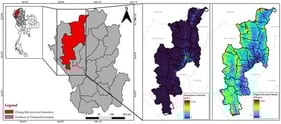
Study area [44].

Open biomass burning (OBB) adversely affects air quality, climate systems, and public health. Large-scale OBB, including forest fires and crop residue burning, is prevalent in Southeast Asia (SEA), a region with agrarian countries. The characteristics of OBB have been widely studied in SEA; however, the understanding of daytime and nighttime variations in fire activity and the effects of fire production remains limited. A significant amount of particulate matter (PM) is released into the atmosphere during OBB episodes. This study employs the Visible Infrared Imaging Radiometer Suite (VIIRS) to detect active fires during daytime and nighttime from OBB in Chiang Mai, Thailand, during March–April 2020, and investigates the mass concentration of size-specific PM down to PM0.1. The results showed that hotspots occur more often at night than during the day. The VIIRS fire detection data provided a better response to small fires and improved mapping of extensive fire perimeters. PM0.5–1.0 showed the highest mass concentration among particle sizes. Moreover, fire hotpots show the highest correlations with PM0.1–0.5 during the daytime and PM0.5–1.0 during the nighttime, and the large OBB in Chiang Mai significantly contributes to ambient PM. Overall, this study offers crucial insights into particulate pollution from biomass burning.

5 February 2026

The density distribution of the population and elevation location in Chiang Mai province.

Promoting and increasing sustainable mobility has become more of a focus in transport and mobility policies and plans. However, challenges remain in its implementation in low-density urban areas, which are usually highly dependent on private motorised transport. This study investigates how local actors and citizens in a low-density suburban area perceive the main mobility challenges and opportunities, contributing empirical evidence on how collaborative planning operationalises accessibility-oriented mobility models in low-density suburban territories, an under-researched context in sustainable mobility. It also examines how co-creation processes contribute to identifying barriers and priorities and to what extent proximity-based concepts such as the 15-Minute City, Transit-Oriented Development (TOD), and Mobility as a Service (MaaS) can be reinterpreted for low-density suburban realities. The methodological approach involved three focus groups with local actors and citizens to identify barriers, priorities, and strategies through collective discussion and co-creation. This process resulted in an agreement on eight (8) co-created strategies, revealing convergence towards promoting active modes and public transport and emphasising that accessibility depends on territorial redesign, digital integration, and inclusive governance. The findings contribute to the empirical evidence that participatory and context-sensitive approaches can enable sustainable mobility transitions in suburban areas by efficiently meeting people’s needs and aspirations.

5 February 2026

Methodological diagram of the research process and analytical sequence.

Urban Adaptation to Climate Change: Climate Refuge Networks as a Strategy to Mitigate Thermal Stress

  • Carmen Díaz-López,
  • Rubén Mora-Esteban and
  • Juan Marcos Castro-Bonaño
  • + 1 author

Urban areas face rising risks from extreme heat due to climate change, intensifying thermal stress and exacerbating social inequalities. Urban climate refuges—cool, accessible indoor and outdoor public spaces that maintain their ordinary functions—are increasingly adopted as a local adaptation measure to protect vulnerable populations during heat events. This study aims to develop and test a SWOT–CAME analytical framework to evaluate and compare the maturity, equity, and implementation logic of urban climate refuge networks in three European cities with contrasting climates and governance traditions: Barcelona, Amsterdam, and Copenhagen. A qualitative multiple-case design is combined with a transparent indicator set (coverage, accessibility, and typology mix) derived from official municipal sources and planning documents. Results show differentiated pathways: Barcelona represents an institutionalized network model; Amsterdam illustrates an emerging coordinated public-health approach; and Copenhagen reflects an ecosystem-based orientation where green–blue infrastructure provides substantial passive cooling capacity but requires clearer heat-specific operational protocols. The discussion highlights the need for hybrid adaptation strategies that combine nature-based solutions with operational governance and targeted support for vulnerable groups. The paper concludes with a transferable framework for cities seeking to integrate climate refuges into resilience and climate-justice agendas.

4 February 2026

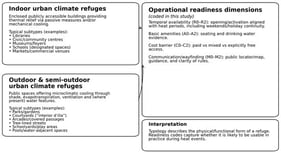
Synthetic typology schema linking the main urban climate refuge typologies (indoor vs. outdoor/semi-outdoor, with indicative subtypes) to the operational readiness dimensions coded in this study: temporal availability (R0–R2), basic amenities (A0–A2), cost barrier (C0–C2), and communication/wayfinding (M0–M2) (see Table 3).

News & Conferences

Issues

Open for Submission

Editor's Choice

Reprints of Collections

The Study of Urban Geography and City Planning
Reprint

The Study of Urban Geography and City Planning

Editors: Rubén Camilo Lois González, Luis Alfonso Escudero Gómez, Daniel Barreiro Quintáns
Smart Cities
Reprint

Smart Cities

Infrastructure, Innovation, Technology, Governance and Citizenship Volume II
Editors: Luis Hernández-Callejo, Sergio Nesmachnow, Pedro Moreno-Bernal

Get Alerted

Add your email address to receive forthcoming issues of this journal.

XFacebookLinkedIn
Urban Sci. - ISSN 2413-8851