
Skip to Content
  • 3.2
    Impact Factor
  • 5.5
    CiteScore
  • 20 days
    Submission to First Decision
  • 4 days
    Acceptance to Publication

Vehicles

Vehicles is an international, peer-reviewed, open access journal on transportation science and engineering published monthly online by MDPI.
  • Open Access— free for readers, with article processing charges (APC) paid by authors or their institutions.
  • High Visibility: indexed within Scopus, ESCI (Web of Science), Ei Compendex, and other databases.
  • Journal Rank: JCR - Q2 (Engineering, Mechanical) / CiteScore - Q1 (Automotive Engineering).
  • Rapid Publication: manuscripts are peer-reviewed and a first decision is provided to authors approximately 19.7 days after submission; acceptance to publication is undertaken in 3.8 days (median values for papers published in this journal in the first half of 2026).
  • Recognition of Reviewers: Reviewers whose reports are timely and of high quality receive an APC discount voucher for a future publication in an MDPI journal. Become a reviewer.

Get Alerted

Add your email address to receive forthcoming issues of this journal.

All Articles (857)

  • Article
  • Open Access

Multi-agent reinforcement learning for traffic signal control commonly assumes fully observable intersection states. In real-world deployments, sensor faults and communication breakdowns produce missing observation data, which triggers severe policy oscillation and degrades control performance; existing methods cannot simultaneously achieve high-precision state imputation and low-latency edge deployment. This paper proposes DiffusionLight, a high-precision imputation framework that couples a gated-recurrent-unit state-evaluation module with shortcut-diffusion interpolation, and its lightweight variant DMLight. DiffusionLight estimates a missing state from a neighbourhood prior and the recent observation trajectory, starts the reverse diffusion chain from a learned latent point instead of pure noise, and is trained jointly with the multi-agent policy under a single composite loss; DMLight shares the interpolation parameters across intersections and replaces the dual-critic soft-actor-critic value network with single-branch Q-learning. Experiments on a 6 × 1 arterial corridor, a 4 × 4 Hangzhou grid, a 16 × 3 New York network and a 4 × 4 synthetic grid within the CityFlow (version 0.1)–LibSignal (DaRL Lab, Arizona State University (ASU)) platform show that, at 5–30% signal-missing ratios, DiffusionLight reduces average travel time (ATT) by 0.3–2.2% relative to DiffLight and by 32.7–40.3% relative to fixed-time control, while over the 6.25–25% equipment-fault range DMLight improves ATT by 0.1–19.2% over DiffLight and shortens the end-to-end run time by 35–81% relative to diffusion-based baselines. These simulation results provide a practical basis for deploying imputation-based signal control on edge devices and for subsequent field validation, offering an integrated route from simulation-grade accuracy to edge-oriented deployment.

Vehicles

20 November 2026

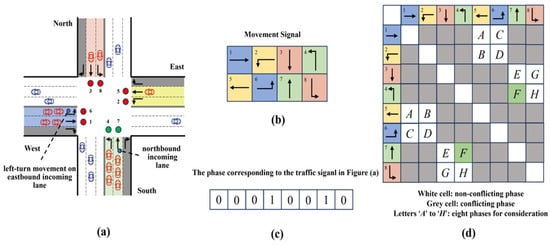
Basic theory of transportation. (a) Intersection layout, where the red dots denote the signal heads, the dashed black lines the lane markings and the dashed arrows the turning trajectories of the vehicles, and the numbers 1–8 label the eight through, left-turn and right-turn movements; (b) movement-signal panel, where the coloured cells group the movements that can be released together and the arrows inside each cell give the direction of that movement; (c) phase vector corresponding to the traffic signal in (a), where 1 and 0 denote a released and a non-released movement, respectively; (d) conflict matrix, where the white cells indicate non-conflicting and the grey cells conflicting movement pairs, and the letters A–H label the eight phases.
  • Article
  • Open Access

Advanced driver assistance systems, such as variations of Cruise Control (XCC) and Lane Keep Assist (LKA), are increasingly present in vehicles, raising questions about their effects on road safety and driver behavior. By partially taking over vehicle control, these functions may affect driver gaze behavior and the distance to traffic objects. Therefore, both effects need to be evaluated jointly for a controllability-related assessment. This work investigates driver behavior and vehicle guidance performance in cross-cultural naturalistic driving studies in China, Europe, and the USA. We analyze on- and off-road gaze patterns, surrounding traffic-object observation, and their relation to traffic-scene perception during manual and partially automated driving. Automatic video processing and vehicle surrounding models derive controllability-related indicators from visual perception gaps, traffic conditions, and predicted vehicle movements. XCC and LKA show small effects on off-road gaze behavior, while on-road gaze durations show stronger regional differences. XCC improves controllability-related indicators by increasing time headway and collision-related time reserves rather than by changing gaze behavior. As an example of scenario-specific effects, lane-change analyses show that XCC(+LKA) increase attention toward adjacent-lane traffic without adversely affecting controllability-related indicators in car-following situations. The combined evaluation supports the assessment of automated driving functions under real-world traffic conditions.

Vehicles

20 November 2026

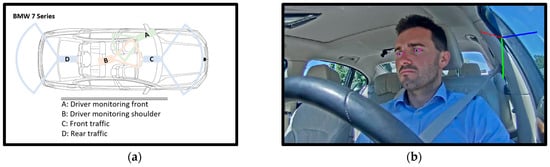
Illustration of the camera setup. (a) Cameras are installed at the A-pillar (A, green) and behind the right shoulder (B, red) to record the driver and the front (C, blue) and rear traffic (D, blue); (b) driver head pose and eye landmarks are derived from the A-pillar-mounted driver-monitoring camera.
  • Article
  • Open Access

Weather-adaptive speed assistance requires forecasts informed by road demand and individual characteristics. This framework links vehicle-state prediction, spatial applicability, personal speed margins and prescribed environmental paths. Analyses used 403 simulator runs from 29 drivers. A shared residual predictor developed on 20 drivers used three completed one-second history bins to forecast mean speed and mean projected road station in three full one-second future bins. Retrospective evaluation covered 20,766 origins from 79 runs of nine drivers. Weather-dependent personal parameters calibrated on Road T remained frozen for Road V; both roads supplied clear/dry cruising baselines. Speed and station mean absolute error (MAE) point estimates improved over the development-selected kinematic reference for every driver and bin. Exploratory paired 95% intervals lay below zero throughout bins two and three; three first-bin driver–output intervals included zero. Predicted station reduced applicability mismatches and located forthcoming curve demand. Margin intervals and categories distinguished uncertainty from proximity to individual references. Brake-active third-bin speed MAE was 7.345–18.640 km/h; third-bin near-boundary recall was 18.6–46.1%. Constant held-out minimum boundaries yielded equal speed and margin MAE. Fixed-station within-family weather paths changed complete minimum sets on 568 of 1566 paths. These findings support research on anticipation, individual interpretation and environmental sensitivity.

Vehicles

20 November 2026

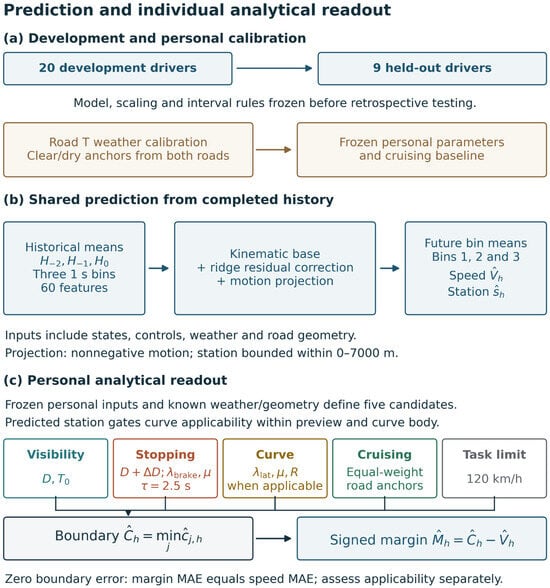
Shared prediction and personal analytical readout. (a) Development fixes the model, scaling and interval rules before retrospective held-out testing; Road T weather calibration and equal-weight clear/dry anchors from both roads supply personal inputs. (b) Three completed one-second bins enter the 60-feature kinematic–residual predictor, which forecasts three future-bin means. (c) Predicted Road V station gates curve applicability, and the five-candidate minimum gives the signed margin. The stopping inverse uses visibility plus the calibrated distance offset. With zero boundary error, margin MAE equals speed MAE; applicability is assessed separately.
  • Article
  • Open Access

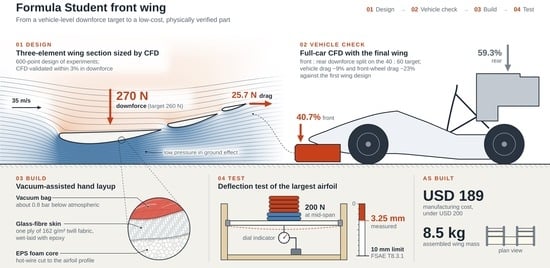
This paper presents an integrated design, manufacturing, and validation methodology for aerodynamic components, demonstrated on a Formula Student front wing built within a USD 192 budget. A Computational Fluid Dynamics (CFD) workflow, validated against measured forces on a double-element wing in ground effect within 3% in downforce, was applied in a target-driven sequence: a four-parameter two-element configuration reached approximately 166 N in 3D, below the 260 N target, motivating a seven-parameter, 600-point Design of Experiments for a three-element configuration. The final design predicted 270.0 N of downforce and 25.7 N of drag, with a 40.7:59.3 front-to-rear vehicle split against the 40:60 target. A scaled wind tunnel test confirmed the drag level only qualitatively, owing to Reynolds-number and ground-effect mismatch. Finite Element Method (FEM) analysis confirmed compliance with the Formula SAE (FSAE) deflection rule T8.3.1. A decision matrix selected 162 g/m2 twill glass fibre, wet-laid with epoxy over an expanded polystyrene core and vacuum-consolidated at about 0.8 bar below atmospheric on a fume-hood vacuum line, as the available pump could run for only 15 min. The largest airfoil of the 8.5 kg wing deflected 3.25 mm under the 200 N regulatory load, well within the 10 mm limit. The workflow provides a reproducible, low-cost route from vehicle-level targets to a physically verified component.

Vehicles

19 November 2026

General workflow for the design, materialization, manufacture, and verification of an aerodynamic component, as applied in this study. Diamonds denote acceptance checks; section numbers indicate where each step is reported. CFD, computational fluid dynamics; DOE, design of experiments; FEM, finite element method; GCI, grid convergence index.

Highly Accessed Articles

News & Conferences

Latest Issues

Open for Submission

Journal Sections

XFacebookLinkedIn
Vehicles - ISSN 2624-8921