Skip Content
You are currently on the new version of our website. Access the old version .

Veterinary Sciences

Veterinary Sciences is an international, peer-reviewed, open access journal on veterinary sciences, published monthly online by MDPI.
The College of Veterinary Medicine, Yangzhou University is affiliated with Veterinary Sciences and its members receive a discount on the article processing charges.
Indexed in PubMed | Quartile Ranking JCR - Q1 (Veterinary Sciences)

All Articles (4,368)

This study evaluated the productivity and egg quality of Japanese quails reared under different LED colors and rearing systems. A total of 720 female quails were assigned to a 3 × 2 factorial arrangement with three LED colors (red, green, and white) and two rearing systems (cage and floor) until 20 weeks of age. Production performance was evaluated across specific age intervals, while physical egg quality traits were analyzed using a Repeated-measures General Linear Model to assess temporal changes. No significant overall interactions between LED color and rearing system were observed (p > 0.05). However, significant interactions between treatment and time (p < 0.05) revealed that red LED light progressively enhanced productivity, while the floor system significantly improved feed efficiency and income during the early laying phase (weeks 6–12). Specifically, red LED light significantly improved hen-day production, egg mass, feed efficiency, and income-to-cost ratio compared to other colors (p < 0.05). Physical egg quality traits remained consistent across treatments (p > 0.05) but were significantly influenced by time (p < 0.05). In conclusion, red LED light optimizes long-term profitability, whereas the floor system offers distinct advantages during the onset of lay.

7 February 2026
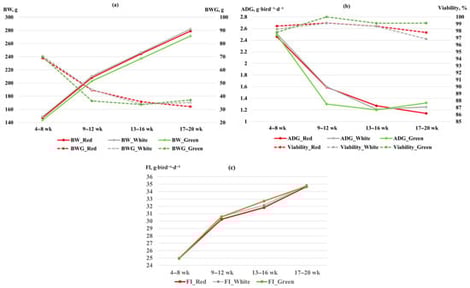
Effect of LED light color (red, white, and green) on (a) body weight (BW) and body weight gain (BWG); (b) average daily gain (ADG) and viability (%); (c) feed intake of laying Japanese quails from 4 to 20 weeks of age. Values are expressed as means for each interval.
  • Systematic Review
  • Open Access

Artificial Intelligence for the Diagnosis of Respiratory Diseases in Dogs and Cats: A Systematic Review

  • Franklin Parrales-Bravo,
  • Janio Jadán-Guerrero and
  • Rosangela Caicedo-Quiroz
  • + 1 author

Respiratory diseases represent a leading cause of veterinary consultations in dogs and cats, yet their detection remains challenging due to clinical variability and subjective interpretation of traditional diagnostic methods. In recent years, artificial intelligence (AI) has emerged as a promising tool to augment veterinary diagnostics through automated analysis of imaging and physiological data. This systematic review synthesizes and critically evaluates 24 studies published from 2019 onward that explore AI applications to support the detection of respiratory diseases in dogs and cats, focusing on three complementary modalities: audio-based (e.g., respiratory sounds), image-based (e.g., chest radiographs), and multimodal approaches. Our findings indicate that deep learning models, particularly convolutional neural networks (CNNs) and transformer architectures, achieve clinically relevant accuracy in detecting conditions such as cardiomegaly, alveolar patterns, and Brachycephalic Obstructive Airway Syndrome (BOAS). However, significant barriers remain, including data scarcity, lack of standardized datasets, and limited real-world validation. This review highlights the transformative potential of AI in veterinary respiratory diagnostics while underscoring the need for collaborative efforts in data sharing, methodological standardization, and clinical integration to realize its full impact in practice.

7 February 2026

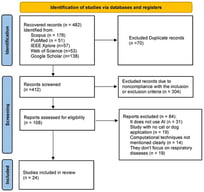
Flowchart of study selection according to the PRISMA guidelines.

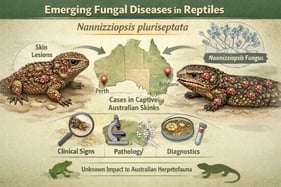
Both captive and free-living reptiles are susceptible to infection by fungi from the Nannizziopsis genus and are prone to developing severe lesions that can affect skin and deeper tissues, becoming multi-systemic. With Australia having close to 1000 reptile species—of which 93% are endemic—the prevalence, distribution and susceptibility of reptiles to this emerging fungal infection remain unknown. In this case series, captive skinks originating from the states of Queensland and Western Australia were presented to wildlife veterinarians with dermatitis. Nannizziopsis pluriseptata was identified via fungal isolation, PCR (polymerase chain reaction) and sequencing, confirming the first record of this pathogen in the country.

6 February 2026

Gross skin lesions in Shingleback skinks from Queensland and Spiny-tailed skinks from Western Australia, Australia. Shingleback skinks. Cases 1–2. (a) Focal scale roughening on the caudal ventral body and focal reddened discoloration on the lateroventral aspect of the tail (b). Spiny-tailed skinks. Cases 3–4. Multifocal ventral yellow discoloration and scale roughening on the mid to caudal ventral body (c) and focally on the cranial ventral body (d).

Hepatitis E in Wildlife: Emerging Threats to Human Health

  • Slavica M. Vesković Moračanin,
  • Branislav I. Kureljušić and
  • Božidar M. Savić
  • + 5 authors

Hepatitis E virus (HEV) is a significant public health concern and a leading cause of acute viral hepatitis worldwide. In recent years, HEV has been increasingly recognized as a wildlife-associated zoonotic pathogen, with numerous free-ranging species contributing to its maintenance and transmission. While domestic pigs remain the primary reservoir for human infection globally, growing evidence indicates that wild animals, particularly wild boars, cervids, lagomorphs, rodents, and carnivores, play a critical role in the ecology of HEV. Wild boars are the principal wildlife reservoir, with HEV seroprevalence in Europe ranging from less than 5% to more than 50%, including some of the highest levels reported in the Balkans. In addition to the frequent detection of HEV RNA in wild boar liver and muscle, viral RNA has also been identified in several other game species, most consistently in red deer, roe deer, and, in some regions, hares and wild rabbits, highlighting food safety risks associated with the consumption of raw or undercooked game meat. In regions such as the Balkans, where hunting activities and handling of wild game are widespread, these practices may further increase occupational and dietary exposure to HEV. Rodents may further complicate the epidemiological landscape through environmental contamination of water, soil, and farm surroundings, thereby facilitating indirect transmission pathways. As wildlife populations expand and human–animal interfaces intensify, understanding HEV dynamics in free-ranging species is essential for assessing zoonotic risks and implementing a strengthened One Health approach. This narrative review synthesizes and critically examines current evidence on HEV prevalence, molecular characteristics, and transmission pathways in wildlife, with particular emphasis on Europe and focused consideration of the Balkans as an epidemiologically heterogeneous and underrepresented subregion; examines associated public health implications; and highlights the importance of integrating wildlife into food safety and One Health surveillance frameworks. Existing knowledge gaps and limitations in wildlife surveillance are also discussed.

6 February 2026

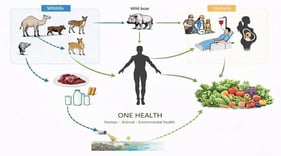
Transmission cycle of the hepatitis E virus. Legend (Geographical distribution of HEV genotypes): Genotypes 1 and 2—restricted to humans; prevalent in Asia, Africa, and Mexico. Genotype 3—zoonotic; widespread in Europe, North America, and parts of Asia. Genotype 4—zoonotic; mainly reported in East and Southeast Asia, recently also in Europe. Genotypes 5 and 6—zoonotic; identified in wild boars in Japan. Genotypes 7 and 8—zoonotic; detected in dromedary and Bactrian camels in the Middle East and Central Asia.

News & Conferences

Issues

Open for Submission

Editor's Choice

Reprints of Collections

Advanced Therapy in Companion Animals
Reprint

Advanced Therapy in Companion Animals

2nd Edition
Editors: Zhijun Zhong, Ziyao Zhou
Viral Crossroads
Reprint

Viral Crossroads

The Interface Between Wildlife and Domestic Animal Health
Editors: Vesna Milicevic, Teufik Goletić

Get Alerted

Add your email address to receive forthcoming issues of this journal.

XFacebookLinkedIn
Vet. Sci. - ISSN 2306-7381