


Abstract
Service-learning (SL) is the subject of a growing number of studies and is becoming increasingly popular in physical education teacher education (PETE) programs. The objective of this study was to conduct a systematic review of the implementation of SL programs with PETE students. The databases used were Web of Science, SPORTDiscus (EBSCO), and SCOPUS. Articles were selected on the basis of the following criteria: (a) published in a peer-reviewed journal; (b) covers the use of SL programs with PETE students; (c) relates to physical education or physical activity programs; (d) availability of a full-text version in English and/or Spanish. Thirty-two articles met the inclusion criteria. Two types of findings were observed: firstly, findings relating to the study characteristics and objectives and, secondly, recommendations for improvement of this type of intervention. The objectives of the different studies focused on (a) the impact of the SL methodology on PETE students’ professional, social, and personal skills; (b) its impact on the community; (c) analysis of the effectiveness and quality of the programs. All but two studies analyzed the impact of SL on PETE, while only four analyzed community participants and only three analyzed the quality of the SL program. Recommendations for improving SL programs used with PETE students included: all stakeholders, e.g., students and community participants, should be studied and coordinated; the quality of the programs should be assessed, as studying the effectiveness of SL programs could help to attain the objectives of both students and the community; mixed methods should be used; and intervention implementation periods should be extended to provide more objective, controlled measurements.
1. Introduction
Service-learning (SL) has been defined in multiple ways. The common thread running through these definitions is that SL is a methodological strategy that involves a program or a support service provided by students to the community. This methodology is widely used in university education, specifically in training physical education teacher education (PETE) students. Such programs are planned, coordinated, and integrated into university curricula to optimize learning and meet community needs [1]. SL seeks innovative methodologies to respond to the demands of higher education, reinforces ethical and civic learning among students, and meets higher education institutions’ needs when it comes to interacting with their wider context through social responsibility measures [2,3]. SL represents the union of several key aspects: theory and practice, classroom and reality [4], training and commitment, and cognition and emotion [5,6].
Carson and Raguse [7] state that SL is an ideal strategy for universities and PETE student training to achieve three main objectives: teaching, research, and service provision. SL gives rise to educational experiences that enrich academic study, promote social engagement, and enhance professional and personal skills [8,9]. A number of studies analyze SL for PETE students [10,11,12]. Within the areas of physical education (PE) and physical activity (PA), Carson and Raguse [7] explain that there is a wide range of SL services for PETE students: athletic training programs [13]; recreation [14,15]; health education and promotion [16,17]; rehabilitation and therapy [18,19]; sports management and PE [20].
A number of systematic reviews have focused on SL methodology across different disciplines, such as university social responsibility [21], nursing [22], scientific production [23], and medical education [24]. For instance, a systematic review [7] covered three types of publications: research, overviews of SL programs, and implementation in youth physical activity settings published from 1990 to 2012. Another review [25] on physical education and sports science included publications such as descriptions of educational experiences, research articles, and conceptual papers. To the best of our knowledge, there are no systematic reviews focusing solely on the implementation of SL programs with PETE students.
Research on SL for PETE students has become increasingly prominent as a training resource for students in recent years. Due to its practical nature, there are numerous publications on the use of SL with this group, but only a few have centred around the implementation of PE programs, included scientific data, or been published in peer-reviewed journals.
The results of the implementation of SL with PETE students tend to relate to three main elements: the students themselves, the community, and the SL program [26,27]. However, many existing studies focus solely on analyzing students, overlooking community participants and the SL program itself. Some authors also establish subcategories within the analysis of students [28], who analyzed academic, personal, social, and civic characteristics [6,27,29].
Studies on SL for PETE students continue to be published, but there is no consensus as to their objectives. There is a need to determine whether SL really works and whether the results obtained from these interventions are positive. To this end, this review provides the levels of evidence of a selection of existing studies and analyses the duration of the interventions, the research methodology used, and the focus of the research: students, the community, or the SL program.
The purpose of this systematic review is twofold. Firstly, it aims to analyze the characteristics of studies on the implementation of SL programs with PETE students that have been published in peer-reviewed journals and to identify their objectives: to assess the benefits for students and/or community participants, and/or to evaluate the effectiveness and/or quality of the SL programs themselves. Based on the literature reviewed, our second objective was to propose guidelines to help the scientific community to improve the implementation and quality of SL interventions in PETE.
2. Materials and Methods
2.1. Search Strategy
The search process was carried out following the protocol outlined in the PRISMA statement. A comprehensive search was conducted in the following databases: Web of Science (WOS), SPORTDiscus (EBSCO), and SCOPUS. Individual searches of all peer-reviewed studies published between 2013 and 2020 were performed. An 8-year window was applied to include only the most recent studies involving the implementation of SL with PETE students. The last search was conducted in November 2020. Search terms synonymous with “service learning” were used in combination with the search terms “physical activity” and “physical education”. Searches were conducted in English and Spanish. Only original articles were included in this study.
2.2. Selection Criteria
Potentially relevant studies for this review were checked against the following selection criteria (PRISMA #6) [30]: (a) the study had been published in an international peer-reviewed journal; (b) the study included the implementation of SL with PETE students; (c) the study reported on the implementation of PE, PA, or sports interventions; (d) a full-text version was available in English and/or Spanish. Theses, book chapters, and articles focusing on the discussion of methodological strategies were excluded from this review because their methodological designs lacked empirical rigour. Duplicates were discarded. The study selection process consisted of screening the titles and abstracts identified during the search. Potentially relevant full-text studies were independently checked for eligibility by two researchers. Discrepancies in the selection of the articles were resolved by discussion.
A flow chart was prepared based on the recommendations listed in the PRISMA statement. A total of 303 studies were retrieved from the literature search. Of these, 234 studies were discarded for failing to meet the inclusion criteria, leaving 38 potentially relevant studies. The full texts of these studies were examined in greater detail. A total of 26 of them failed to meet the inclusion criteria. As a result, a total of 31 articles were included in the systematic review. Figure 1 shows the sampling process used.
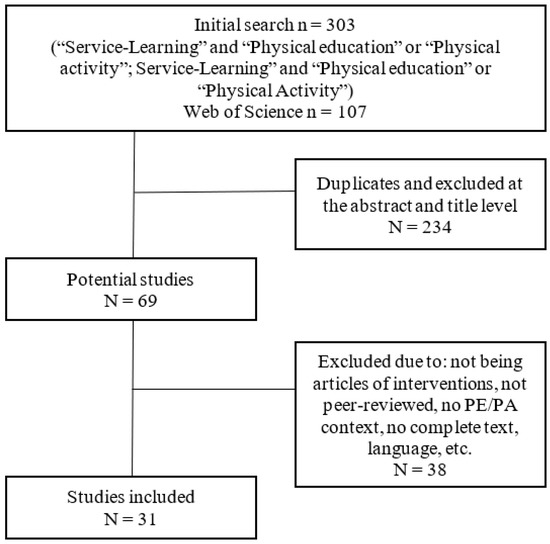
Figure 1.
Flow chart of the sampling process.
2.3. Data Extraction and Reliability
Data extraction was carried out independently and consistently by two reviewers (A.N. and R.P-O), who read all the titles and abstracts. Discrepancies were discussed until a consensus was reached. The studies were summarized, and the potentially relevant papers were screened for retrieval. Pilot test forms were used to extract data from the studies. A content analysis of the articles included in this review was also performed. Subsequently, the data were discussed and confirmed by the researchers. The following categories were defined a priori using the method suggested by Harris et al. [31]: authors; journal; year; name of study; location; objectives; sample size; participant profile; duration of study; data sources; methodological analysis; results.
2.4. Quality Assessment and Level of Evidence
The criteria for assessing the quality of the studies included were adapted to the Consolidated Standards of Reporting Trials (CONSORT) Statement [32] as used by Pozo, Grao-Cruces, and Pérez-Ordás [33]. The quality assessment criteria were: (a) the SL intervention was implemented with PETE students; (b) the number of participants in the study; (c) the journal in which the article was published is included in the Journal Citation Reports; (d) the duration of implementation; (e) a description of the methodological process was included. Each item was rated from 0 to 2, as shown in Table 1. The overall quality of each study was assessed by adding the number of positive elements together (with the overall score ranging from 0 to 10). Studies with a total score of 7 or higher were considered to be of high quality (HQ); studies with a total score of 4–6 were considered to be of average quality (AQ); studies with a total score lower than 4 were considered to be of low quality (LQ). Quality was assessed by two reviewers independently. Discrepancies in the assessment of the studies were discussed by the two reviewers until a consensus was reached.

Table 1.
List of studies included and quality level.
The risk of bias is difficult to ascertain in qualitative, social science studies. Version 5.1.0 of the Cochrane handbook emphasizes that, in many situations, it is not practical or possible to blind participants or study staff in the intervention group.
3. Results
3.1. Duration of the Intervention Programs
The duration of the interventions ranged from 2 weeks [55] to 4 years [48]. In some studies, the exact duration of the intervention was specified, as in Ruiz et al. [54] who indicate that SL intervention was structured in two 40-min weekly sessions and was 10-weeks long.
3.2. Methodology and Analysis
The interventions included in this review followed three distinctive methodological approaches: qualitative (21/31), quantitative (2/31) and mixed (9/31). Studies analyzing the results from PETE students used all three types of methodology. Five studies used experimental and control groups: Chiva-Bartoll et al. [40], Chiva-Bartoll et al. [29], and Capella et al. [38] used a mixed methods approach, while Chiva-Bartoll et al. [42] and Willard and Crandall [58] used quantitative methods.
In qualitative studies, both inductive and deductive study designs were found (21). Several data collection procedures, including interviews (10), self-reflection journals (13), reflective reports (5), focus groups (8), literature reviews (1), videos (3), life stories or biographical records (2), observations and field notes (6), and observation sheets (3), were used. Questionnaires intended for trainees were used in the only study adopting quantitative methods [58]. Mixed methods were also employed (9). The instruments used were questionnaires (8), interviews (5), self-reflection journals (4), reflective reports (4), literature reviews (1), life stories or biographical records (2), observations and field notes (1), focus group (1) and test (1). The most frequently used instruments in these designs were questionnaires analyzing the skills acquired by PETE students.
3.3. Summary of the Results
The objectives of the different studies focused on: the benefits of SL programs for PETE students; the benefits of SL programs for the community and the effectiveness and quality of the SL programs.
The most common objective in studies on SL for PETE students was to analyze how SL affected PETE students’ training. A total of 30 studies analyzed the influence of SL on PETE students (29/31); however, other studies had a twofold objective: they also analyzed the benefits of SL programs for community participants (4/31) or the quality of the SL program (3/31).
3.3.1. The Benefits of SL Programs for PETE Students (29/31)
The total number of PETE students in the SL interventions was 1872, ranging from 4 [26,36] to 346 [27].
Three types of benefits for PETE students’ skills were identified in the studies: 1. professional skills; 2. social and personal skills and 3. other.
Professional Skills (21/31)
The studies focusing on the effects of SL for PETE students analyzed professional skills training (21/31), including generic, academic and professional skills. Lamoneda [49] observed improvements to communication, planning, and organizational skills.
With regards to the pedagogical skill of reflective teaching, improvements in technical content and methodological strategies were also identified [27,36]. Capella et al. [36] indicated that SL improved future training, awareness of the value of practical training, and learning about PETE practice (conflict management, adaptability, feedback, and evaluation).
SL contributed to the learning of participating students in general [48,50,57]. Heo et al. [48] found that students acquired a greater understanding of the subject, an improved ability to analyze problems, and improved skills and classroom material resources for application to real problems. Wilkinson et al. [57] confirmed that participants learned to combine theory and practice and that the project had a positive impact on their professional development as a result of their participation in applied learning, their work in a multidisciplinary environment, and their support of the community.
Capella et al. [38,39] compared the development of teaching competence among PETE students using two intervention methods from the same SL program. Two groups of PETE students exhibited significant differences in their dedication to the SL program in terms of duration and intensity. The authors provided significant evidence of enhanced teaching competence among students with greater dedication to the SL program. In the same vein, Marttinen et al. [11], Galván et al. [46], and Du Toit [44] concluded that the SL program improved students’ pedagogical knowledge and professional skills. Franco-Solà and Figueras [45] assessed teaching skills using the Framework for 21st Century Learning and found that SL helped to improve cognitive, emotional, and social competences among PETE students.
Other studies assessed the acquisition of professional skills from SL with specific populations (17/31) such as cognitively impaired individuals [52,55], children with disabilities special educational needs [27,34,38,39,43,45,59] children with attention deficit hyperactivity disorder [51], others diversity as cultural dimension, low SES schools, disadvantaged population, minority groups [10,11,35,42,47,52] and older adults [54,58]. Surprisingly, Willard and Crandall [58] found no increase in students’ knowledge of PA and attitudes towards PA with older adults. When comparing the SL intervention with the control groups, the main effect was not statistically significant, with both groups showing no significant increase in their knowledge of ageing (λ = 0.979, F(1,24) = 0.531, p = 0.473, = 0.021).
Chiva-Bartoll et al. [41] studied children with special educational needs and obtained an inclusive, critical educational experience that allowed them to link theory and practice in a particularly effective way. In turn, Ruiz et al. [54] reported findings related to academic and professional learning when working with older adults.
Social (18/31) and Personal Skills (8/31)
Other objectives were to assess the acquisition of social attitudes and skills and personal skills. The studies focusing on these objectives are shown in Table 2.
Table 2.
Objectives of the studies.
According to Capella et al. [26], SL promotes the development of social skills and moral values. These authors concluded that SL also promotes the development of students’ critical thinking, reflective capacity, and skills such as conflict management and flexibility. Chiva-Bartoll et al. [40] found that the two experimental groups significantly improved their social skills and attitudes, unlike the control group. Statistically significant differences between the pre-test and the post-test results for the two experimental groups were found: t(40) = 2.9; p < 0.05 for experimental group I and t(40) = 5.98; p < 0.05 for experimental group II. As expected, no significant differences between the pre-test and the post-test results for the control group were found: t(40) = 1.11; p > 0.05. Chiva-Bartoll et al. [29] also found significant differences (t(106) = 2.94; p < 0.05) in the overall results of the experimental group in the Effective Personality Test for University Students (in which ‘effective personality’ is understood as a construct whereby personality traits are related to effective behaviours in professional or academic contexts). Heo et al. [48] found that PETE students developed their empathy skills with SL. These students built relationships with older adults (their community participants) and were less likely to hold negative stereotypes towards them. By contrast, Lamoneda [49] analyzed PETE students’ friendliness, involvement, teamwork, listening skills, and support during the SL program. According to Webster et al. [56], SL can offer opportunities for PETE students to develop knowledge, skills, and attitudes useful for leadership roles. The results of Wilkinson et al. [57] suggest that SL is a contemporary caring pedagogy that prepares future teachers for the realities and challenges of a changing world. Willard and Crandall [58] assumed that contact with older adults would result in more positive student attitudes and greater knowledge of ageing, but failed to find positive results in this case. Finally, Martínez et al. [51] analyzed the influence of SL on students’ social participation and highlighted the importance of the latter among the impacts of the SL methodology.
Chiva-Bartoll et al. [41,42] studied values, personal attitudes, and/or personal life plans, concluding that SL promotes subjective happiness and pro-social attitudes [42]. Ruiz et al. [54] analyzed social sensitivity and disconfirmation of negative stereotypes, satisfaction and personal growth, and desire for social justice, resulting in relevant items for PETE students. Capella et al. [37] reported that SL promoted social entrepreneurship skills in PETE, which represents a highly valuable, innovative educational experience on a personal and social level. Bruce [35] pointed out that SL helps students to become more open and ethically responsible towards others.
Other (8/31)
Two studies analyzed changes in PETE students’ identities [27,51]. According to their results, SL is a source of positive feelings that prompt change in students and their values, one of the most prominent of which is empathy.
Martínez et al. [51], Peralta et al. [53], and Lleixà and Ríos [50] studied the acquisition of cultural training and understanding (3/31). Martínez et al. [51] concluded that SL also helped students to overcome stereotypes, contextualize their training, learn to approach PE as a resource for social intervention, and improve their communication and decision-making skills. Peralta et al. [53] reported that PETE students’ perception of their cultural competence had also improved. Differences in pre-service teachers’ perceptions of their cultural competence had improved from baseline (M = 59.59; SD = 8.25) to follow-up (M = 69.89; SD = 8.70) and were statistically significant (t(54) = −6.81; p < 0.001). Gil-Gómez et al. [27] found that PETE students showed a limited understanding of cultural competence. In turn, Lleixà and Ríos [50] viewed the experience as highly positive, as it exposed students to a reality that is often socially stigmatized and difficult to access.
Ruiz et al. [54] analyzed social sensitivity and disconfirmation of negative stereotypes, satisfaction and personal growth, and desire for social justice. In turn, Capella et al. [37] assessed social entrepreneurship skills, while Giles et al. [47] studied emotions in PETE students. In this case, positive views and emotions prevailed among students. The joy of feeling valued and loved by children, as well as welcomed and respected by teachers, was particularly emphasized. Negative emotions became positive, which helped students to build their professional identity through reflection and self-criticism.
3.3.2. The Benefits of SL Programs for the Community
Only four studies focused on community participants, but their objective was twofold: to analyze the benefits of SL programs for PETE students and the community [46,50,54,56]. These studies analyzed elementary and middle school participants, older adults, youth, staff, and parents from a school and inmates.
There are no studies exclusively assessing members of the community. The number of participants in the SL programs studied here could not be specified because most of the studies did not report or study them, or because they varied depending on the day or session [50,56,60].
There were different types of participants: people with special educational needs (15/31); people with other special characteristics (victims of disasters, individuals of low socioeconomic status, specific ethnic groups) (8/31); primary and secondary school children (3/31); the school community as a whole (staff, students, and parents) (1/31); elderly people (3/31); prisoners (1/31); and others (1/31).
Regarding the implementation of an SL program at a school, Webster et al. [56] concluded that SL was a viable strategy to increase opportunities for promoting PA among children, staff, and parents. The benefits of SL for prisoners in Lleixà and Ríos [50] related primarily to the impact of PA and sport on their socialization, communication, and personal skills. This study found that SL provided prisoners with the sense of optimism needed to overcome their deprivation of liberty while also keeping them in touch with reality, helping them to release tension, increasing their expressive abilities, giving them a break from their routines, and other benefits related to hygiene and motor and physical improvements. Ruiz et al. [54] identified four emerging categories among the benefits of SL with older adults: disconfirmation of negative stereotypes, improvement of physical function, satisfaction and desire of continuity, and social interaction.
3.3.3. The Effectiveness and Quality of the SL Programs
Three studies analyzed the effectiveness of SL programs [10,49,52]. Lamoneda [49] focused on whether a sports recreation program during school break times was providing a good quality service. The following elements were assessed: teachers, facilities, activities, and relationships with staff. In the overall assessment, the sports promotion services were considered to be acceptable (3.42 ± 0.5). Regarding the sports initiation program, there was room for improvement with regard to its duration (2.69 ± 0.9) and the number of sessions per week (2.44 ± 1.1). In the sports entertainment program, satisfactory results were obtained for all items. The overall evaluation of the sports promotion services suggested that the activity was good (4.11 ± 0.6). The aspects to be improved in the sports entertainment program included updating the activities (3.67 ± 0.7) and increasing the number of sessions (3.78 ± 0.8). MacPhail and Sohun [10] studied a course-embedded SL project in a physical education teacher education program to provide a broader, potentially more critical view of the experience, knowledge, and learning related to our effort to link service and learning. They concluded that linking academic coursework with community service structured through reflective practice is a challenge, and that there is a need to invest more time so that PETE teachers and students engage in dialogue with one another focusing specifically on SL. Santos et al. [52] addressed the limitations of SL in the training of PETE students. They concluded the following: there is a lack of training in project design, implementation, and evaluation; SL places a heavy workload on PETE students and teachers; it is difficult to coordinate everyone involved.
Table 3 provides an overview of the data obtained from each of the 31 empirical articles reviewed: authors, objectives, number of participants, program recipients, instruments used, research methodology, and main results.
Table 3.
General overview of the literature review.
4. Discussion
The purpose of this systematic review was twofold: to analyze the characteristics of studies on the implementation of SL programs with PETE students and, in view of the shortcomings identified, to propose future lines of research on SL in PETE. The results from the first study objective can be grouped into three categories: the benefits of SL programs for PETE students, the benefits of SL programs for the community, the effectiveness and quality of the SL programs. In this review, most studies (29 studies) focused on students, while four focused on community participants. Only three studies examined the effectiveness and quality of services provided in the SL program. These data are consistent with research in other areas, where the community is outside the scope of the study [7,80,81]. In addition, results focusing on PETE students were classified into three types of benefits or skills: professional skills; social and personal skills; and other skills (identity, vocational skills, cultural competence, emotions, etc.). This classification is very similar to that used by other authors [51], who refer to skills as competencies. This review found that 28 of the 31 selected studies reported positive results in the acquisition of professional, social, and personal skills by PETE students. These data are in line with the conclusions of meta-analyses of SL programs in other fields (nursing, medicine, social work) with participants at different educational levels (primary, secondary, and higher education, and vocational training) [82,83,84]. Celio et al. [82] conducted a meta-analysis of 62 studies with 11,837 students who participated in SL interventions and made significant progress in five outcome areas: personal and academic skills, attitudes towards school and learning, civic engagement, and social engagement, all of which are consistent with the findings identified in this study. SL helped to promote the development of social, moral, and personal skills, and the findings in this review coincide with those of Yorio and Ye [84]. Their review of 40 studies involving business and management scholars reported the effects of SL on understanding social issues, social awareness and sensitivity, perception of disabled individuals, interpersonal skills, ethical and moral values, responsibility, community engagement, and personal insight. The findings in this review are also consistent with Puig [85], who views SL as a methodology promoting improved social relationships. This improvement occurs in the following ways: through collaboration between colleagues in community service tasks, by improving relationships between participants, by contributing to the common good, and through citizen participation. SL enables a cultural shift towards values such as solidarity, social cohesion, equality, environmental engagement, and social responsibility. Only one of the studies obtained unexpected results concerning the acquisition of knowledge and attitudes towards PA with older adults [58]. Interestingly, this was one of the two studies using a quantitative method. This raises the question of whether an exclusively quantitative approach is appropriate for this type of research.
In this review, only four studies analyzed the benefits of SL programs for the community. SL interventions proved to be positive for the community subjects, and their objectives were achieved in all the cases studied. These data are consistent with those reported by Doolittle and Rukavina [86] and Jones et al. [87]. It is clear that SL would be meaningless without the contribution that it makes to the community [88]. Therefore, studies should analyze whether the objectives for the community are met and whether the methods used are appropriate to benefit community participants. Sallis [89] adds that, in order to achieve real, tangible, long-lasting benefits, multi-level work strategies must be prioritized and studies must include an analysis of the benefits for the community. Chiva et al. [90] argue that evaluation of the social impact of SL has been neglected and propose a model for evaluating the impact of SL in PETE, with special emphasis on its social dimension.
In this review, only three authors [10,49,52] analyzed the effectiveness of the SL program and focused on assessing the quality of the service provided. Lamoneda [49], assessed: teachers, facilities, activities, and relationships with staff. According to the results, the duration of the program and the number of sessions needed to be improved, corroborating the findings of Conway et al. [83], who examined the impact of specific elements of the program (moderators) on the degree of change seen in participants. Other researchers also emphasize that the duration, structured reflections, and number of service hours offered by SL programs should be improved [12]. In this vein, Eyler et al. [91] and Tannenbaum and Berrett [92] list several sources demonstrating the benefits of increasing the intensity and duration of SL programs [93]. In turn, Santos et al. [52] have designed and validated a scale for evaluating SL programs with PETE students to standardize their evaluation and validate their quality and effectiveness.
Regarding the second objective of this research, analysis of the results of the studies has allowed us to identify several potential lines of work to ensure that SL programs in PETE produce better outcomes for all stakeholders, which may become possible lines of research. It is essential to analyze all the actors involved in SL programs in PETE. There is a lack of research assessing community participants, which is consistent with studies [94], who authored an article focusing exclusively on this shortcoming in SL programs. It seems contradictory to implement programs with the aim of helping the community and neglect to evaluate whether these objectives are actually attained. The effectiveness of SL is only relevant if the community objectives are met [10,91], requiring examination of these objectives in order to confirm this effectiveness. Lleixà and Ríos [50] concluded that their experience demonstrated that interactive dialogue between the different stakeholders in SL could actively promote collaborative learning. Blouin and Perry [95] noted that there is a wealth of research reporting numerous pedagogical and personal benefits for students, such as improved grades, greater civic engagement, and increased understanding and appreciation of diversity, but there are few studies on the impact of SL on the community.
The quality of the program was only analyzed by three of the studies. We believe that focusing on program quality would benefit both students and community participants and that further research is required in this area. The quality of SL programs for PETE students should be assessed as a determinant of their effectiveness. In addition, Blouin and Perry [95] discuss obstacles to effective SL: problems related to student behaviour, lack of communication between instructors, and problems in the organizations themselves. These quality-related factors should also be considered and studied.
We observed significant heterogeneity in terms of the research methods and techniques employed, as well as disadvantages in the use of exclusively quantitative methods. For this reason, we believe that mixed methods are more appropriate. These data are consistent with those observed in other systematic reviews [51], whose research focused on SL and its interaction with university social responsibility. Only one in 24 studies used a quantitative method [96]. Willard and Crandall [58] argue that future researchers should consider the collection of qualitative data in the form of student reflections, as they are already a crucial tool in the study of SL.
The limitations of this study are rather similar to those found in reviews of SL in other fields, such as nursing, medicine, and social work. It is possible that only papers with positive results were published. The strength of this study lies in its specific analysis of the implementation of SL programs with PETE students, which had not yet been studied. With regard to future lines of research, we propose the following: using mixed methods, coordinating the different stakeholders, and studying community participants and the quality of the programs themselves as well as students.
5. Conclusions
This article sought to analyze the benefits of SL programs for PETE students and it is safe to say that, as a learning methodology, SL has excellent potential as a resource for developing professional, personal, and social skills in PETE students. SL also promotes participation in teaching by connecting future PE professionals to the realities and challenges of a diverse and constantly evolving educational environment. This produces benefits for the community and connects education to the real world. Teaching, research, and service objectives can be accomplished by including all stakeholders in the SL process. With respect to the guidelines to help the scientific community to improve the implementation and quality of SL interventions in PETE, we believe that further studies are needed to analyze all three factors: PETE students, community participants, and program quality. There is a need for a mixed research methodology that compiles contributions from all stakeholders. The effectiveness of the studies should also be assessed via longer implementation periods, as this could result in more objective, controlled measurements and more generalizable findings.
Author Contributions
Conceptualization, R.P.-O. and A.N.; methodology, A.F.-M. and A.G.-C.; investigation, R.P.-O.; supervision, A.N.; writing—original draft preparation, A.F.-M. and A.G.-C.; writing—review and editing, R.P.-O., A.F.-M., A.G.-C. and A.N.; All authors have read and agreed to the published version of the manuscript.
Funding
This research received no external funding.
Institutional Review Board Statement
The study was conducted according to the guidelines of the Declaration of Helsinki, and approved by the Research Ethics Committee of the Andalusian Regional Government (Andalusia, Spain).
Informed Consent Statement
Not applicable.
Data Availability Statement
Data available on request due to restrictions.
Conflicts of Interest
The authors declare no conflict of interest.
References
- Baldwin, S.C.; Buchanan, A.M.; Rudisill, M.E. What Teacher Candidates Learned About Diversity, Social Justice, and Themselves From Service-Learning Experiences. J. Teach. Educ. 2007, 58, 315–327. [Google Scholar] [CrossRef]
- García, J. Innovación y aprendizaje-servicio virtual: Elementos para una reflexión basada en la experiencia. RIDAS 2020, 62–80. [Google Scholar] [CrossRef]
- Martínez Martín, M. Aprendizaje Servicio y Responsabilidad Social de las Universidades; Octaedro-Universitat de Barcelona, Institut de Ciències de l’Educació: Barcelona, Spain, 2008; ISBN 84-8063-969-5. [Google Scholar]
- Cervantes, C.M.; Meaney, K.S. Examining service-learning literature in physical education teacher education: Recommendations for practice and research. Quest 2013, 65, 332–353. [Google Scholar] [CrossRef]
- Butin, D.W. The limits of service-learning in higher education. Rev. High. Educ. 2006, 29, 473–498. [Google Scholar] [CrossRef]
- Rodríguez Gallego, M.R. El aprendizaje-servicio como estrategia metodológica en la Universidad. Rev. Complut. Educ. 2014, 25, 95–113. [Google Scholar] [CrossRef]
- Carson, R.L.; Raguse, A.L. Systematic review of service-learning in youth physical activity settings. Quest 2014, 66, 57–95. [Google Scholar] [CrossRef]
- Cashman, S.B.; Seifer, S.D. Service-Learning. Am. J. Prev. Med. 2008, 35, 273–278. [Google Scholar] [CrossRef]
- Soska, T.M.; Sullivan-Cosetti, M.; Pasupuleti, S. Service Learning: Community Engagement and Partnership for Integrating Teaching, Research, and Service. J. Community Pract. 2010, 18, 139–147. [Google Scholar] [CrossRef]
- MacPhail, A.; Sohun, R. Interrogating the enactment of a service-learning course in a physical education teacher education programme: Less is more? Eur. Phys. Educ. Rev. 2018, 25, 876–892. [Google Scholar] [CrossRef]
- Marttinen, R.; Daum, D.N.; Banville, D.; Fredrick, R.N. Pre-service teachers learning through service-learning in a low SES school. Phys. Educ. Sport Pedagog. 2019, 25, 1–15. [Google Scholar] [CrossRef]
- Peralta, L.R.; Marvell, C.L.; Cotton, W.G. A sustainable service-learning program embedded in PETE: Examining the short-term influence on preservice teacher outcomes. J. Teach. Phys. Educ. 2019, 40, 1–10. [Google Scholar] [CrossRef]
- Heinerichs, S.; Gardiner-Shires, A.M. Incorporating Service Learning in Athletic Training. Athl. Ther. Today 2010, 15, 36–38. [Google Scholar] [CrossRef]
- Coetzee, B.; Bloemhoff, H.; Naudé, L. Students’ reflections on the attainment of competencies in a community service-learning module in human movement science. Afr. J. Phys. Health Educ. Recreat. Dance 2011, 17, 547–563. [Google Scholar] [CrossRef]
- Hendricks, W.W.; Miranda, B. A Service-Learning Approach to Wilderness Education. J. Phys. Educ. Recreat. Dance 2003, 74, 21–24. [Google Scholar] [CrossRef]
- Champagne, N. Using the NCHEC Areas of Responsibility to Assess Service Learning Outcomes in Undergraduate Health Education Students. Am. J. Health Educ. 2006, 37, 137–145. [Google Scholar] [CrossRef]
- Tremethick, M.J.; Smit, E.M. Preparing culturally competent health educators: The development and evaluation of a cultural immersion service-learning program. Int. Electron. J. Health Educ. 2009, 12, 185–193. [Google Scholar]
- Romack, J.; Hsu, S. Using service-learning to shape undergraduate experiences with persons having disabilities. Palaestra 2011, 25, 33–39. [Google Scholar]
- Waite, P.J.; Tatchell, T. The perceived health benefits of community service-learning: Reminiscence therapy’s impact on novice practitioners. Coll. Stud. J. 2005, 39, 104–116. [Google Scholar]
- Timken, G.L.; McNamee, J. New Perspectives for Teaching Physical Education: Preservice Teachers’ Reflections on Outdoor and Adventure Education. J. Teach. Phys. Educ. 2012, 31, 21–38. [Google Scholar] [CrossRef]
- Martínez-Usarralde, M.-J.; Gil-Salom, D.; Macías-Mendoza, D. Revisión sistemática de Responsabilidad Social Universitaria y Aprendizaje Servicio. Análisis para su institucionalización. Rev. Mex. Investig. Educ. 2019, 24, 149–172. [Google Scholar]
- Poblete-Troncoso, M.; Correa-Schnake, M.; Aguilera-Rojas, P.; González-Acuña, J.C. Valores profesionales de enfermería en el posmodernismo: Una revisión sistemática. Acta Bioethica 2019, 25, 243–252. (In Spanish) [Google Scholar] [CrossRef]
- Redondo-Corcobado, P.; Fuentes, J.L. Research on Service Learning in Spanish Scientific Production: A Systematic Review. Rev. Complut. Educ. 2020, 31, 69–84. [Google Scholar] [CrossRef]
- Stewart, T.; Wubbena, Z.C. A Systematic Review of Service-Learning in Medical Education: 1998–2012. Teach. Learn. Med. 2015, 27, 115–122. [Google Scholar] [CrossRef] [PubMed]
- Chiva-Bartoll, O.; Ruiz-Montero, P.J.; Martín-Moya, R.; Pérez-López, I.J.; Girela, J.G.; García-Suárez, J.; Rivera-García, E. University Service-Learning in Physical Education and Sport Sciences: A systematic review. Rev. Complut. Educ. 2019, 30, 1147–1164. [Google Scholar] [CrossRef]
- Capella Peris, C.; Gil Gómez, J.; Martí Puig, M.; Chiva-Bartoll, Ó. Estudio de caso múltiple con historias de vida en el grado de educación infanitl: Aprendizaje-servicio en la didáctica de la Educación Física. Profesorado 2015, 19, 334–348. [Google Scholar]
- Gil-Gómez, J.; Chiva-Bartoll, O.; Martí-Puig, M. The impact of service learning on the training of pre-service teachers. Eur. Phys. Educ. Rev. 2015, 21, 467–484. [Google Scholar] [CrossRef]
- Billig, S.; Root, S.; Jesse, D. The Impact of Participation in Service-Learning on High School Students’ Civic Engagement; CIRCLE Working Paper 33; Center for Information and Research on Civic Learning and Engagement (CIRCLE), University of Maryland: College Park, MD, USA, 2005. [Google Scholar]
- Chiva-Bartoll, Ò.; Pallarés-Piquer, M.; Gil-Gómez, J. Aprendizaje-servicio y mejora de la personalidad eficaz en futuros docentes de educación física. Rev. Complut. Educ. 2017, 29, 181–197. [Google Scholar] [CrossRef]
- Urrútia, G.; Bonfill, X. Declaración PRISMA: Una propuesta para mejorar la publicación de revisiones sistemáticas y metaanálisis. Med. Clín. 2010, 135, 507–511. [Google Scholar] [CrossRef]
- Harris, J.D.; Quatman, C.E.; Manring, M.; Siston, R.A.; Flanigan, D.C. How to Write a Systematic Review. Am. J. Sports Med. 2014, 42, 2761–2768. [Google Scholar] [CrossRef]
- Moher, D.; Schulz, K.F.; Altman, D.G. The CONSORT statement: Revised recommendations for improving the quality of reports of parallel-group randomised trials. Lancet 2001, 357, 1191–1194. [Google Scholar] [CrossRef]
- Pozo, P.; Grao-Cruces, A.; Pérez-Ordás, R. Teaching personal and social responsibility model-based programmes in physical education. Eur. Phys. Educ. Rev. 2018, 24, 56–75. [Google Scholar] [CrossRef]
- An, J. Learning to Teach Students with Disabilities through Community Service-Learning: Physical Education Preservice Teachers’ Experiences. Int. J. Disabil. Dev. Educ. 2019, 1–14. [Google Scholar] [CrossRef]
- Bruce, J. On racism and prejudice: Exploring post-critical possibilities for service-learning within physical education teacher education. Asia-Pac. J. Health Sport Phys. Educ. 2015, 6, 233–244. [Google Scholar] [CrossRef]
- Capella Peris, C.; Gil Gómez, J.; Martí Puig, M. La metodología del aprendizaje-servicio en la educación física. Apunts 2014, 33–43. [Google Scholar] [CrossRef]
- Capella-Peris, C.; Cosgrove, M.M.; Pallarès Piquer, M.; Santágueda-Villanueva, M. Aprendizaje servicio en la formación inicial docente de educación física: Análisis de una propuesta en el contexto norteamericano. Publicaciones 2019, 49, 49–67. (In Spanish) [Google Scholar] [CrossRef]
- Capella-Peris, C.; Gil-Gómez, J.; Chiva-Bartoll, Ò. Innovative Analysis of Service-Learning Effects in Physical Education: A Mixed-Methods Approach. J. Teach. Phys. Educ. 2020, 39, 102–110. [Google Scholar] [CrossRef]
- Capella Peris, C.; Salvador García, C.; Chiva-Bartoll, Ò.; Ruiz-Montero, P.J. Alcance del aprendizaje-servicio en la formación inicial docente de educación física: Una aproximación metodológica mixta. RETOS 2020, 37, 465–472. [Google Scholar]
- Chiva-Bartoll, Ò.; Capella Peris, C.; Pallarès Piquer, M. Investigación-acción sobre un programa de aprendizaje-servicio en la didáctica de la educación física. RIE 2017, 36, 277. (In Spanish) [Google Scholar] [CrossRef]
- Chiva-Bartoll, O.; Capella-Peris, C.; Salvador-García, C. Service-learning in physical education teacher education: Towards a critical and inclusive perspective. J. Educ. Teach. 2020, 46, 395–407. [Google Scholar] [CrossRef]
- Chiva-Bartoll, O.; Montero, P.J.R.; Capella-Peris, C.; Salvador-García, C. Effects of service learning on physical education teacher education students’ subjective happiness, prosocial behavior and professional learning. Front. Psychol. 2020, 11, 331. [Google Scholar] [CrossRef]
- Douglas, S.; Krause, J.M.; Franks, H.M. Shifting preservice teachers’ perceptions of impairment through disability-related simulations. Palaestra 2019, 33, 45–56. [Google Scholar]
- Du Toit, D. Service-learning within field experience of physical education teacher education in South Africa: Experiences of pre-service and in-service teachers. S. Afr. J. Res. Sport Phys. Educ. Recreat. 2019, 41, 13–29. [Google Scholar]
- Franco-Solá, M.; Figueras, S. Aprendizaje-servicio en educación física: Un modelo de implementación en educación superior. RICCAFD 2020, 9, 114–123. [Google Scholar] [CrossRef]
- Galvan, C.; Meaney, K.; Gray, V. Examining the Reciprocal Nature of Service-Learning for Underserved Students and Preservice Teachers. J. Teach. Phys. Educ. 2018, 37, 363–372. [Google Scholar] [CrossRef]
- Giles Girela, F.J.; Trigueros Cervantes, C.; Rivera García, E. Emocionarse ante el proceso de enseñanza y aprendizaje. Vivencias de los futuros docentes desde una pedagogía de aprendizaje-servicio crítico. Publicaciones 2019, 49, 69–87. [Google Scholar] [CrossRef]
- Heo, J.; King, C.; Lee, J.; Kim, H.M.; Ni, C. Learning from healthy older adults: An analysis of undergraduate students’ reflective essays. Asia-Pac. Edu. Res. 2014, 23, 537–545. [Google Scholar] [CrossRef]
- Lamoneda, J. Programas de aprendizaje-servicio en estudiantes de ciclo formativo en animación y actividad física. J. Sport Health Res. 2018, 10, 65–77. [Google Scholar]
- Lleixà, T.; Ríos, M. Service-learning in physical education teacher training. Physical education in the Modelo Prison, Barcelona. QRE 2015, 4, 106–133. [Google Scholar] [CrossRef]
- Martínez, R.C.; Miravet, L.M.; Puig, M.M.; Gómez, J.G.; Bartoll, Ó.C. Academic, cultural, participatory and identity’s effects of service learning in preservice teachers thought physical education. Profesorado 2015, 19, 280–297. [Google Scholar]
- Santos Pastor, M.L.; Cañadas, L.; Martínez Muñoz, L.F.; García Rico, L. Diseño y validación de una escala para evaluar el aprendizaje-servicio universitario en actividad física y deporte. Educación XX1 2020, 23, 67–93. (In Spanish) [Google Scholar] [CrossRef]
- Peralta, L.R.; O’Connor, D.; Cotton, W.G.; Bennie, A. Pre-service physical education teachers’ Indigenous knowledge, cultural competency and pedagogy: A service learning intervention. Teach. Educ. 2015, 27, 248–266. [Google Scholar] [CrossRef]
- Ruiz-Montero, P.J.; Chiva-Bartoll, O.; Salvador-García, C.; González-García, C. Learning with older adults through intergenerational service learning in physical education teacher education. Sustainability 2020, 12, 1127. [Google Scholar] [CrossRef]
- Ward, S.; Pellett, H.H.; Perez, M.I. Cognitive Disequilibrium and Service-Learning in Physical Education Teacher Education: Perceptions of Pre-Service Teachers in a Study Abroad Experience. J. Teach. Phys. Educ. 2017, 36, 70–82. [Google Scholar] [CrossRef]
- Webster, C.A.; Nesbitt, D.; Lee, H.; Egan, C. Preservice Physical Education Teachers’ Service Learning Experiences Related to Comprehensive School Physical Activity Programming. J. Teach. Phys. Educ. 2017, 36, 430–444. [Google Scholar] [CrossRef]
- Wilkinson, S.; Harvey, W.J.; Bloom, G.A.; Joober, R.; Grizenko, N. Student teacher experiences in a service-learning project for children with attention-deficit hyperactivity disorder. Phys. Educ. Sport Pedagog. 2013, 18, 475–491. [Google Scholar] [CrossRef]
- Willard, M.; Crandall, J. Intergenerational service-learning to combat ageism in exercise science students. Ky. Assoc. Health Phys. Educ. Recreat. Dance 2016, 53, 55–62. [Google Scholar]
- Woodruff, E.A.; Sinelnikov, O.A. Teaching young adults with disabilities through service learning. Eur. Phys. Educ. Rev. 2014, 21, 292–308. [Google Scholar] [CrossRef]
- Galvan, C.; Parker, M. Investigating the Reciprocal Nature of Service-Learning in Physical Education Teacher Education. J. Exp. Educ. 2011, 34, 55–70. [Google Scholar] [CrossRef]
- Maxwell, J.A.; Miller, B.A. Categorizing and connecting strategies in qualitative data analysis. In Handbook of Emergent Methods; The Guilford Press: New York, NY, USA, 2008; pp. 461–477. [Google Scholar]
- Pujadas, J. El Método Biográfico. El Uso de las Historias de Vida en Ciencias Sociales; Centro de Investigaciones Sociológicas: Madrid, Spain, 1992; ISBN 978-84-7476-174-0. [Google Scholar]
- Capella-Peris, C.; Gil-Gómez, J.; Martí-Puig, M.; Ruiz-Bernardo, P. Development and Validation of a Scale to Assess Social Entrepreneurship Competency in Higher Education. J. Soc. Entrep. 2019, 11, 23–39. [Google Scholar] [CrossRef]
- Capella-Peris, C.; Gil-Gómez, J.; Chiva Bartoll, Ò. A rubric to assess the teaching competency using motor skills and body language games: Initial development and validation. J. Phys. Educ. Sport 2018, 18, 944–954. [Google Scholar]
- Gómez Masera, R. Evaluación de la Personalidad Eficaz en Población Universitaria; Universidad de Huelva: Huelva, Spain, 2012. [Google Scholar]
- Moraleda, M.; González, A.; García-Gallo, J. AECS, Actitudes y Estrategias Cognitivas Sociales; TEA: Madrid, Spain, 1998; ISBN 84-7174-539-9. [Google Scholar]
- García-Rico, L.; Santos-Pastor, M.L.; Martínez-Muñoz, L.F. La perspectiva del alumnado universitario de actividad físico-deportiva sobre la repercusión del aprendizaje-servicio para su formación inicial. In Metodologías Activas en Ciencias del Deporte; Wanceulen: Sevilla, Spain, 2019; Volume II, pp. 135–158. (In Spanish) [Google Scholar]
- Butin, D.W. Of What Use Is It? Multiple Conceptualizations of Service Learning Within Education. Teach. Coll. Rec. 2003, 105, 1674–1692. [Google Scholar] [CrossRef]
- Méndez-Leite, A.; Cortés-González, P.; Rivas-Flores, J. Narrativa y creatividad en la universidad. ¿Es posible transitar otros caminos en la enseñanza y el aprendizaje? In Creatividad, Comunicación y Educación: Más Allá de las Fronteras del Saber Establecida; Universidad de Málaga: Málaga, Spain, 2017; pp. 151–164. [Google Scholar]
- Pérez-Samaniego, V.P.; Miguel, J.F.; Devis, J.D. El análisis narrativo en la educación física y el deporte. Movimento 2011, 17, 11–42. [Google Scholar]
- Hsieh, H.-F.; Shannon, S.E. Three approaches to qualitative content analysis. Qual. Health Res. 2005, 15, 1277–1288. [Google Scholar] [CrossRef] [PubMed]
- Hernández Mendo, A. Un cuestionario para evaluar la calidad en programas de actividad física. Rev. Psicol. Deporte 2001, 10, 179–196. [Google Scholar]
- Corbin, J.M.; Strauss, A. Grounded theory research: Procedures, canons, and evaluative criteria. Qual. Sociol. 1990, 13, 3–21. [Google Scholar] [CrossRef]
- Miller, M. The role of service-learning to promote early childhood physical education while examining its influence upon the vocational call to teach. Phys. Educ. Sport Pedagog. 2012, 17, 61–77. [Google Scholar] [CrossRef]
- Gil Gómez, J. El Aprendizaje-Servicio en La Enseñanza Superior: Una Aplicación en el Ámbito de la Educación Física; Universitat Jaume I: Castellón, Spain, 2012. [Google Scholar]
- Marshall, C.; Rossman, G. Data collection methods. In Designing Qualitative Research; Sage Publications: London, UK, 2011. [Google Scholar]
- Spanierman, L.B.; Oh, E.; Heppner, P.P.; Neville, H.A.; Mobley, M.; Wright, C.V.; Dillon, F.R.; Navarro, R. The Multicultural Teaching Competency Scale: Development and Initial Validation. Urban Educ. 2011, 46, 440–464. [Google Scholar] [CrossRef]
- Groenewald, T. A Phenomenological Research Design Illustrated. Int. J. Qual. Methods 2004, 3, 42–55. [Google Scholar] [CrossRef]
- Palmore, E. Facts on aging: A short quiz. Gerontologist 1977, 17, 315–320. [Google Scholar] [CrossRef]
- McWilliams, A.; Rosemond, C.; Roberts, E.; Calleson, D.; Busby-Whitehead, J. An Innovative Home-Based Interdisciplinary Service-Learning Experience. Gerontol. Geriatr. Educ. 2008, 28, 89–104. [Google Scholar] [CrossRef]
- Rosenkranz, R.R. Service-learning in Higher Education Relevant to the Promotion of Physical Activity, Healthful Eating, and Prevention of Obesity. Int. J. Prev. Med. 2012, 3, 672–681. [Google Scholar]
- Celio, C.I.; Durlak, J.; Dymnicki, A. A Meta-Analysis of the Impact of Service-Learning on Students. J. Exp. Educ. 2011, 34, 164–181. [Google Scholar] [CrossRef]
- Conway, J.M.; Amel, E.L.; Gerwien, D.P. Teaching and Learning in the Social Context: A Meta-Analysis of Service Learning’s Effects on Academic, Personal, Social, and Citizenship Outcomes. Teach. Psychol. 2009, 36, 233–245. [Google Scholar] [CrossRef]
- Yorio, P.L.; Ye, F. A Meta-analysis on the effects of service-learning on the social, personal, and cognitive outcomes of learning. AMLE 2012, 11, 9–27. [Google Scholar] [CrossRef]
- Puig Rovira, J.M. Aprendizaje Servicio (ApS): Educación y Compromiso Cívico; Grao: Barcelona, Spain, 2009; ISBN 978-84-7827-766-7. [Google Scholar]
- Doolittle, S.A.; Rukavina, P.B. Chapter 6 Case Study of an Institutionalized Urban Comprehensive School Physical Activity Program. J. Teach. Phys. Educ. 2014, 33, 528–557. [Google Scholar] [CrossRef]
- Jones, E.M.; Taliaferro, A.R.; Elliott, E.M.; Bulger, S.M.; Kristjansson, A.L.; Neal, W.; Allar, I. Chapter 3 Feasibility Study of Comprehensive School Physical Activity Programs in Appalachian Communities: The McDowell CHOICES Project. J. Teach. Phys. Educ. 2014, 33, 467–491. [Google Scholar] [CrossRef]
- Hildenbrand, S.M.; Schultz, S.M. Implementing Service Learning in Pre-Service Teacher Coursework. J. Exp. Educ. 2015, 38, 262–279. [Google Scholar] [CrossRef]
- Sallis, J.F. Needs and challenges related to multilevel interventions: Physical activity examples. Health Educ. Behav. 2018, 45, 661–667. [Google Scholar] [CrossRef]
- Chiva-Bartoll, O.; Santos Pastor, M.; Martínez Muñoz, F.; Salvador-García, C. Valoración del impacto del aprendizaje-servicio universitario en el ámbito de la actividad física y el deporte: Una propuesta desde la teoría de stakeholders. Publicaciones 2019, 49, 27–46. [Google Scholar] [CrossRef]
- Eyler, J.S.; Giles, D.E.; Stenson, C.M.; Gray, C.J. At a Glance: What We Know About the Effects of Service-Learning on College Students, Faculty, Institutions and Communities, 1993–2000; National Service Learning Clearinghouse: Scotts Valley, CA, USA, 2001.
- Tannenbaum, S.C.; Berrett, R.D. Relevance of service-learning in college courses. Acad. Exch. Q. 2005, 9, 197–201. [Google Scholar]
- Mabry, J.B. Pedagogical variations in service-learning and student outcomes: How time, contact, and reflection matter. Mich. J. Community Serv. Learn. 1998, 5, 32–47. [Google Scholar]
- Boyle-Baise, M.; Epler, B.; McCoy, W.; Paulk, G.; Clark, J.; Slough, N.; Truelock, C. Shared Control: Community voices in multicultural service learning. Educ. Forum 2001, 65, 344–353. [Google Scholar] [CrossRef]
- Blouin, D.D.; Perry, E.M. Whom does service learning really serve? Community-based organizations’ perspectives on service learning. Teach. Sociol. 2009, 37, 120–135. [Google Scholar] [CrossRef]
- Canney, N.; Bielefeldt, A. Volunteerism in Engineering Students and its Relation to Social Responsibility. In Proceedings of the ASEE Annual Conference & Exposition, Seattle, WA, USA, 14–17 June 2015; pp. 14–17. [Google Scholar]
Publisher’s Note: MDPI stays neutral with regard to jurisdictional claims in published maps and institutional affiliations. |
© 2021 by the authors. Licensee MDPI, Basel, Switzerland. This article is an open access article distributed under the terms and conditions of the Creative Commons Attribution (CC BY) license (http://creativecommons.org/licenses/by/4.0/).