Abstract
Motivated by the Carleo’s work (Science, 2017, 355: 602), we focus on finding the neural network quantum statesapproximation of the unknown ground state of a given Hamiltonian H in terms of the best relative error and explore the influences of sum, tensor product, local unitary of Hamiltonians on the best relative error. Besides, we illustrate our method with some examples.
1. Introduction
The quantum many-body problem is a general name for a vast category of physical problems pertaining to the properties of microscopic systems made of a large number of interacting particles. In such a quantum system, the repeated interactions between particles create quantum correlations [1,2,3], quantum entanglement [4,5,6], Bell nonlocality [7,8,9], Einstein-Poldolsky-Rosen (EPR) steering [10,11,12]. As a consequence, the wave function of the system is a complicated object holding a large amount of information, which usually makes exact or analytical calculations impractical or even impossible. Thus, many-body theoretical physics most often relies on a set of approximations specific to the problem at hand, and ranks among the most computationally intensive fields of science. Gordon [13] indicated that if one knows an accurate energy for the ground state (say from experiment), then one can construct a sequence of upper and lower bounds to the overlap between the approximate function and the true (but unknown) ground-state wave function. Wang [14] constructed a set of intermediate resolvents from the intermediate Hamiltonians introduced by Weinstein. From these intermediate resolvents they obtained a new formula for the lower bound of the overlap between the approximate and exact wave functions of a quantum-mechanical system. Merkel [15] proposed a method and tested it for approximating the integrals over and required by Weinhold’s technique as products of integrals involving only H. Cioslowski [16] constructed a connected-moments expansion for the overlap between the approximate and the exact (but unknown) wave function of the ground state. Hornik [17] shown that LRV’s algorithm, with some relatively trivial modifications, can estimate the overlap of an approximate with the exact wave function. Marmorino [18] derived two methods from the t expansion of Horn and Weinstein to bound from above the magnitude of the overlap of an approximate wavefunction with the ground state. Nomura [19] developed a machine learning method to construct accurate ground-state wave functions of strongly interacting and entangled quantum spin as well as fermionic models on lattices.
Artificial neural networks are important tools in machine learning due to their efficient approximation ability [20,21,22,23,24]. Especially, Roux [25] proved that restricted Boltzmann machines are universal approximators of discrete distributions.
Applying neural networks in solving the quantum many-body problem, Carleo and Troyer in [26] demonstrated the remarkable power of a reinforcement learning approach in calculating the ground state or simulating the unitary time evolution of complex quantum systems with strong interactions. Their idea consists in using neural networks as variational wave functions to approximate ground states of many-body quantum systems. In this direction, the networks are trained or optimized by the standard variational Monte Carlo method while a few different neural-network architectures were tested [26,27,28,29], and the most promising results so far have been achieved with Boltzmann machines [29]. In particular, state-of-the-art numerical results have been obtained on popular models with restricted Boltzmann machines (RBM), and recent effort has demonstrated the power of deep Boltzmann machines to represent ground states of many-body Hamiltonians with polynomial-size gap and quantum states generated by any polynomial size quantum circuits [30,31]. Deng et al. [32] show that the RBM can be used to describe topological states and constructed exact representations for symmetry-protected topological states and intrinsic topologically ordered states. Glasser et al. [33] show that there are strong connections between neural network quantum states in the form of RBM and some classes of tensor-network states in arbitrary dimensions and obtain that neural network quantum states and their string-bond-state extension can describe a lattice fractional quantum Hall state exactly. Gardas, Rams and Dziarmaga [34] show that the approach of Carleo and Troyer [26] can be realized experimentally using quantum annealers and they conducted experimental simulations of many-body quantum systems using a hybrid classical-quantum algorithm. Cai and Liu in [35] demonstrated the expressibility of artificial neural networks in quantum many-body physics by showing that a feed-forward neural network with a small number of hidden layers can be trained to approximate with high precision the ground states of some notable quantum many-body systems. In [36], Saito and Kato developed a variational method to obtain many-body ground states of the Bose-Hubbard model using feed forward artificial neural networks and proved that many-body ground states with different numbers of atoms can be generated by a single network. By employing the formalism of tensor networks, Clark [37] show that neural network quantum states given in [26] are a special form of correlator product states.
Despite such exciting developments, it is unknown whether a general state can be expressed by neural networks efficiently. Recently, by generalizing the idea of [26], we introduced in [38] neural networks quantum states (NNQSs) based on general input observables and explored some related properties about NNQSs. Secondly, we established some necessary and sufficient conditions for a general graph state to be represented by an NNQS.
In this paper, based on the NNQSs introduced in [38], we focus on finding the NNQS approximation of the unknown ground state of a given Hamiltonian H. The remaining part of this paper is organized as follows. In Section 2, we recall the concept and the related properties of NNQSs introduced in [38]. In Section 3, we explore the NNQS approximation of the unknown ground state of a given Hamiltonian H in terms of the best relative error and consider the influence of sum, tensor product, local unitary of Hamiltonian on the best relative error. Besides, we illustrate our method with some examples.
2. Neural Network Quantum States
To start with, let us recall the concept and the related properties of NNQSs introduced in [38]. Let be N quantum systems with state spaces of dimensions , respectively. We consider the composite system Q of with state space .
Let be non-degenerate observables of systems , respectively. Then is an observable of the composite system Q. Use to denote the eigenbasis of corresponding to eigenvalues . Thus,
It is easy to check that the eigenvalues and corresponding eigenbasis of are
respectively. Put
called an input space. For parameters
write and put
Then we obtain a complex-valued function of the input variable . We call it a neural network quantum wave function (NNQWF). Then we define
which is a nonzero vector (not necessarily normalized) of the Hilbert space . We call it a neural network quantum state (NNQS) induced by the parameter and the input observable (Figure 1).
Figure 1.
Artificial neural network encoding an NNQS. It is a restricted Boltzmann machine architecture that features a set of N visible artificial neurons (blue disks) and a set of M hidden neurons (yellow disks). For each value of the input observable S, the neural network computes the value of the .
Note that we do not assume that an NNQWF satisfies the normalization condition:
Indeed, when a state can be written as NNQS, this normalization condition is automatically satisfied.
By definition, an NNQWF can be reduced to
It is can be described by the following “quantum artificial neural network” (Figure 2) where , and are functions such that
Figure 2.
Quantum artificial neural network with parameter .
We call this network a quantum artificial neural network because its input eigenvalues of quantum observables and the outcomes are values of an NNQWF, while it has a network structure similar to a usual artificial neural network.
Next, let us consider the tensor product of the two NNQSs. We have proved the following.
Proposition 1.
[38] Suppose that and are two NNQSs with parameters
respectively. Then is also an NNQS with parameters
Now, we discuss the influence of local unitary operation (LUO) on an NNQS. We conclude this as follows.
Proposition 2.
[38] Suppose that is an NNQS and is a local unitary operator on . Then , which is also an NNQS with the input observable and the parameter Ω, and has the same NNQWF as .
Remark 1.
It can be seen from Proposition 2 that if two pure states are LU-equivalent and an NNQS representation of one of the two states is easily given, then that of another state can be obtained from that of the former.
To conclude this section, we discuss a special class of NNQSs.
When , we have
and .
In this case, the NNQS (4) becomes
This leads to the NNQS induced in [26] and discussed in [32]. We call such an NNQS a spin-z NNQS.
3. Approximating Ground States by Neural Network Quantum States

In this section, we try to find approximate solution to the static Schrödinger equation for a given Hamiltonian H. For example, to find approximation of ground states by neural network quantum states.
Let be an NNQS given by Equation (4) and let H be a Hamiltonian whose smallest eigenvalue is not zero. Put
We seek the minimum relative error between and over ,
We call the best relative error between and .
Obviously, when the minimum in Equation (7) is attained at the parameter , we can use the normalized NNQS as an approximation of the ground state of H with the best relative error .
Generally, . Hence, can also be expressed as
Next, we discuss the influence of the sum of Hamiltonians on the best relative error. We obtain the following conclusion.
Proposition 3.
Suppose that and are two Hamiltonians, , and are the smallest eigenvalue of , and , respectively, is an NNQS. Then
Furthermore, if , then
where
Proof.
We can easily compute that
It is easily see that . Generally,
Besides, when , we see from that
□
Now, we discuss the influence of tensor product of Hamiltonians on the best relative error. We get the following conclusion.
Proposition 4.
Suppose that and are two Hamiltonians, , and are the smallest eigenvalue of , and , respectively. and are two NNQSs with parameters
respectively. Let
Then
Furthermore, if and are positive definite, then where
Proof.
Since and are two NNQSs, we know from Proposition 1 that is also an NNQS. Furthermore, we can compute
Since and are positive, . Observe that
Thus, we have
□
Now, we discuss the influence of local unitary operation on the best relative error. We conclude this conclusion as follows.
Proposition 5.
Suppose that H is a Hamiltonian, is an NNQS and is a local unitary operator on . are the smallest eigenvalue of H and , respectively. Then
and where
Proof.
We can obtain from Proposition 2 that , which is also an NNQS. Therefore
Since U is a local unitary operator, . We can easily obtain that . □
Lastly, we give two examples in order to illustrate our method.
Example 1.
Suppose that . Then H can be represented under the basis by . It is easy to see that the minimum eigenvalue of H is 1, the ground state is .
Next we use spin-z NNQSs
to approximate the ground state of H, where
When , we have
We can easily calculate that
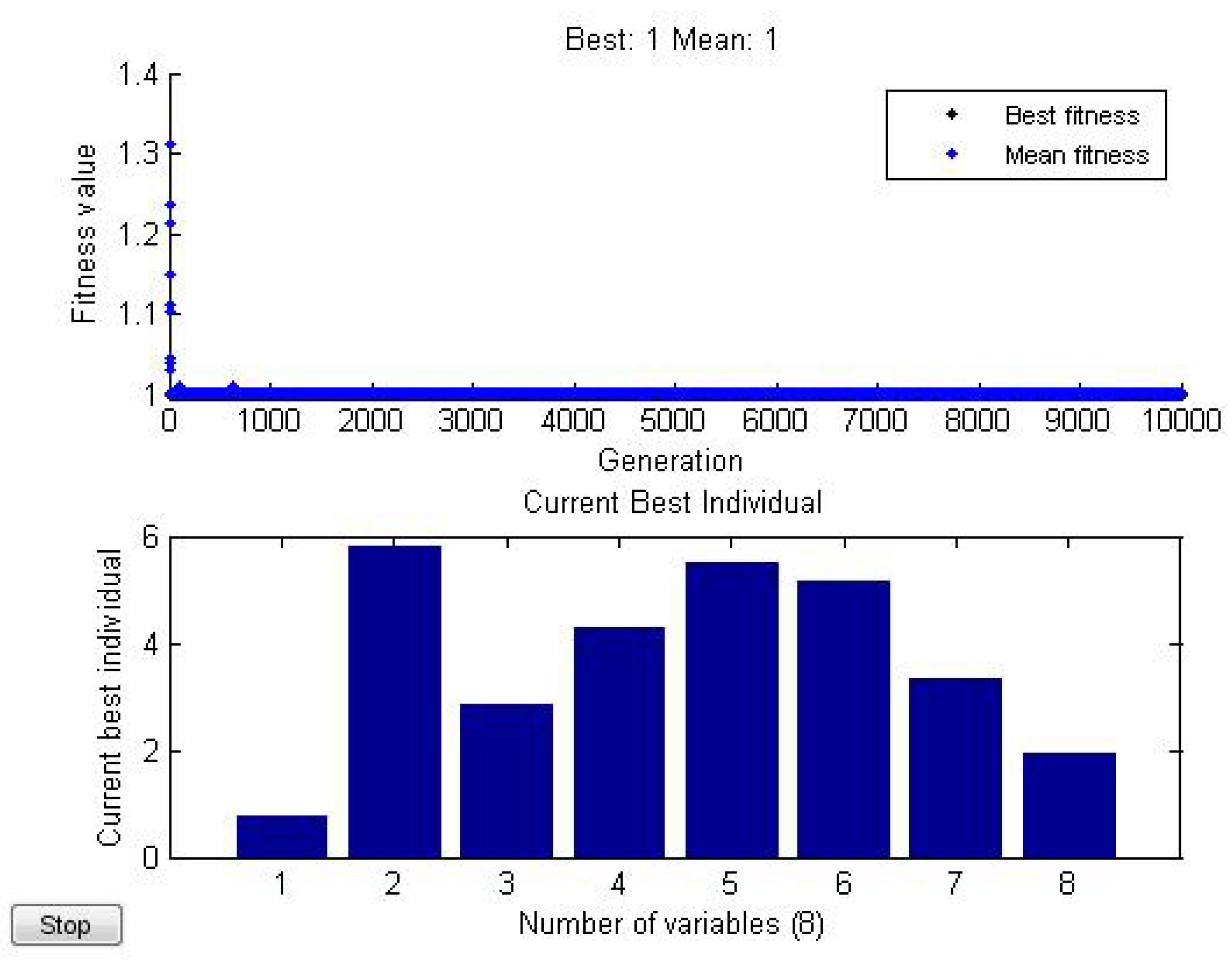
Next we seek the minimum value of over Ω. By letting
we define a function g by
and then numerically minimize g over (see Figure 3).
Figure 3.
Numerically minimize g over by optimization.
By using Matlab, we find
We obtain
Meanwhile, the corresponding NNQS is
then the normalized NNQS is
Besides, we can also calculate the distance between the actual ground state and the approximate state to be
Example 2.
Suppose that
where . It is easy to see that the minimum eigenvalue of is , the ground state is cluster state . Hence, .
Next we use spin-z NNQSs
to approximate the ground state of , where
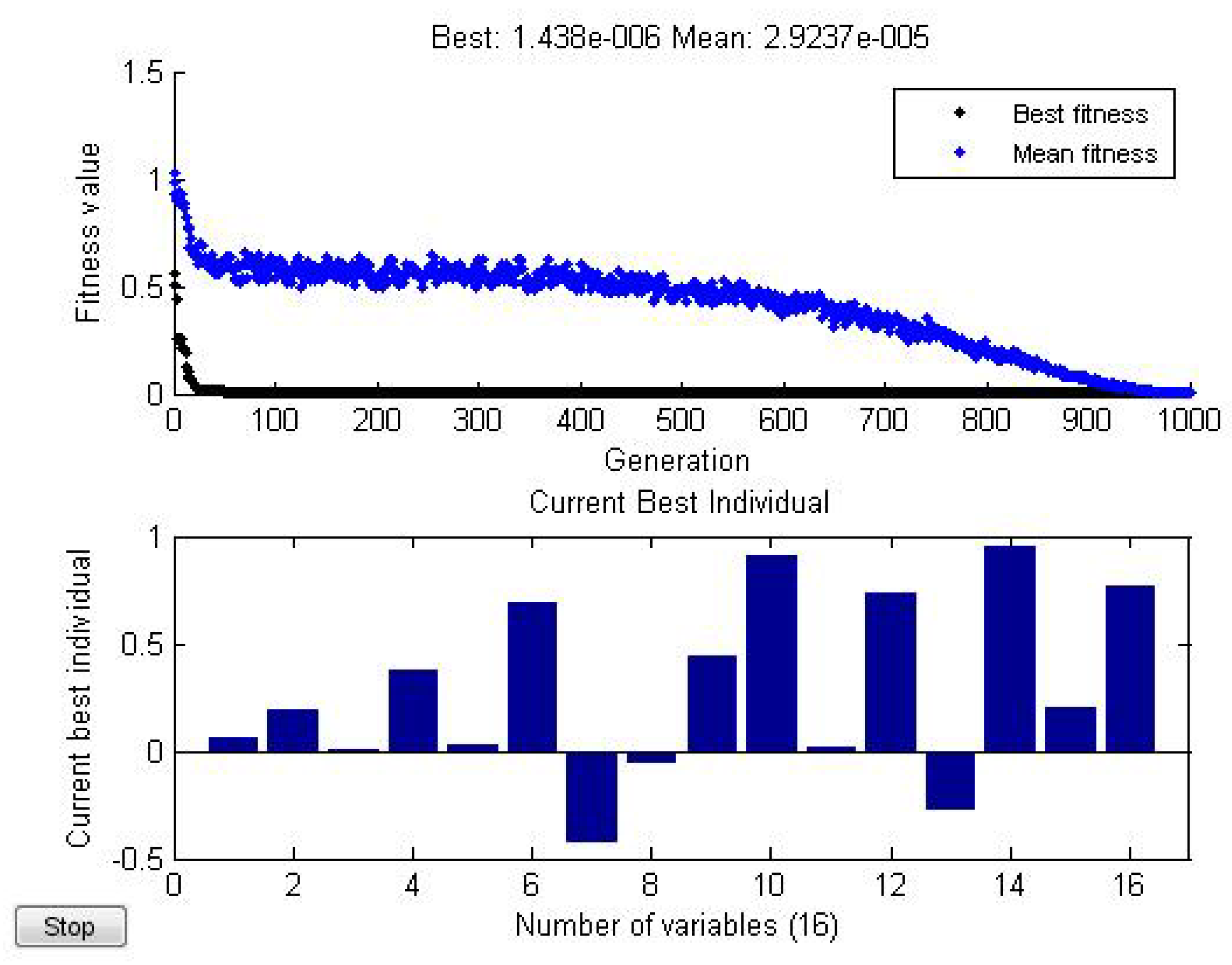
(i) When . By letting
using Matlab(see Figure 4), we find
where
Figure 4.
Numerically minimize ϵ by optimization.
Meanwhile, the corresponding NNQS is
then normalized NNQS is
Besides, we can also calculate the fidelity between the actual ground state
and the approximate state to be
Hence, .
In addition, we find that when , ϵ gets smaller and smaller as M changes, see Table 1.
Table 1.
The numerical simulation results of .
Figure 5.
Numerically minimize ϵ by optimization.
Meanwhile, the corresponding NNQS is
then normalized NNQS is
Besides, we can also calculate the fidelity between the actual ground state
and the approximate state to be
Hence, .
4. Conclusions
In this paper, the question of approximating ground states by neural network quantum states has been discussed in terms of the best relative error (BRE). Some properties of the BREs have been obtained, including the BREs of sums, tensor products, and local unitary transformations of Hamiltonians. Besides, our method has been illustrated with two examples.
Author Contributions
The work of this paper was accomplished by Y.Y., C.Z. and H.C. Moreover, all authors have read the paper carefully and approved the research contents that were written in the final manuscript.
Funding
This work was supported by the National Natural Science Foundation of China (Nos. 11871318, 11771009, 11571213, 11601300), the Fundamental Research Funds for the Central Universities (GK201703093, GK201801011), Shaanxi Province Innovation Ability Support Program (2018KJXX-054), and Subject Research Project of Yuncheng University (XK-2018032).
Acknowledgments
We thank Wenfei Cao of Shaanxi Normal University for his help in writing algorithms.
Conflicts of Interest
The authors declare no conflict of interest.
References
- Luo, S.L. Using measurement-induced disturbance to characterize correlations as classical or quantum. Phys. Rev. A 2008, 77, 022301. [Google Scholar] [CrossRef]
- Guo, Z.H.; Cao, H.X.; Qu, S.X. Partial correlations in multipartite quantum systems. Inf. Sci. 2014, 289, 262. [Google Scholar] [CrossRef]
- Zhang, T.G.; Yang, H.; Lijost, X. Uniform Quantification of Correlations for Bipartite Systems. Phys. Rev. A 2017, 95, 042316. [Google Scholar] [CrossRef]
- Vedral, V.; Plenio, M.B.; Rippin, M.A.; Knight, P.L. Quantifying entanglement. Phys. Rev. Lett. 1997, 78, 2275. [Google Scholar] [CrossRef]
- Vidal, G.; Werner, R.F. A computable measure of entanglement. Phys. Rev. A 2002, 65, 032314. [Google Scholar] [CrossRef]
- Amico, L.; Osterloh, A.; Vedral, V. Entanglement in many-body systems. Rev. Mod. Phys. 2007, 80, 517. [Google Scholar] [CrossRef]
- Luo, S.L.; Fu, S.S. Measurement-induced nonlocality. Phys. Rev. Lett. 2011, 106, 120401. [Google Scholar] [CrossRef] [PubMed]
- Guo, Y.; Hou, J.C. Local channels preserving the states without measurement-induced nonlocality. J. Phys. A Math. Theor. 2013, 46, 325301. [Google Scholar] [CrossRef]
- Cao, H.X.; Guo, Z.H. Characterizing Bell nonlocality and EPR steering. Sci. China-Phys. Mech. Astron. 2019, 62, 030311. [Google Scholar] [CrossRef]
- Skrzypczyk, P.; Navascues, M.; Cavalcanti, D. Quantifying Einstein-Podolsky-Rosen steering. Phys. Rev. Lett. 2014, 112, 180404. [Google Scholar] [CrossRef]
- Sun, K.; Ye, X.J.; Xu, J.S.; Xu, X.Y.; Tang, J.S.; Wu, Y.C.; Chen, J.L.; Li, C.F.; Guo, G.C. Experimental quantification of asymmetric Einstein-Podolsky-Rosen steering. Phys. Rev. Lett. 2016, 116, 160404. [Google Scholar] [CrossRef]
- Cavalcanti, D.; Skrzypczyk, P. Quantum steering: A review with focus on semidefinite programming. Rep. Prog. Phys. 2017, 80, 024001. [Google Scholar] [CrossRef] [PubMed]
- Gordon, R.G. Error bounds for the energy and overlap of approximate wavefunctions. J. Chem. Phys. 1968, 48, 4984. [Google Scholar] [CrossRef]
- Wang, P.S.C. Lower bounds for the overlap of approximate wave functions. J. Chem. Phys. 1970, 52, 4464. [Google Scholar] [CrossRef]
- Merkel, R.R. A study of a lower bounding formula for the overlap between the exact and an approximate wavefunction. J. Chem. Phys. 1975, 62, 3198. [Google Scholar] [CrossRef]
- Cioslowski, J. Estimation of the overlap between the approximate and exact wave function of the ground state from the connected-moments expansion. Phys. Rev. A 1987, 36, 3441. [Google Scholar] [CrossRef]
- Hornik, M.; Snajdr, M.; Rothstein, S.M. Estimating the overlap of an approximate with the exact wave function by quantum Monte Carlo methods. J. Chem. Phys. 2000, 113, 3496. [Google Scholar] [CrossRef]
- Marmorino, M.G. Upper bounds to the overlap of approximate and exact wavefunctions. Int. J. Theor. Phys. 2000, 39, 2439. [Google Scholar] [CrossRef]
- Nomura, Y.; Darmawan, A.; Yamaji, Y.; Imada, M. Restricted-Boltzmann-machine learning for solving strongly correlated quantum systems. Phys. Rev. B 2006, 96, 205152. [Google Scholar] [CrossRef]
- Kolmogorov, A.N. On the representation of continuous functions of many variables by superposition of continuous functions of one variable and addition. Am. Math. Soc. Transl. 1963, 28, 55. [Google Scholar]
- Cybenko, G. Approximation by superposition of a sigmoidal function. Math. Control Signal 1989, 2, 303. [Google Scholar] [CrossRef]
- Funahashi, K. On the approximate realization of continuous mappings by neural networks. Neural Netw. 1989, 2, 183. [Google Scholar] [CrossRef]
- Hornik, K.; Stinchcombe, M.; White, H. Multilayer feedforward networks are universal approximators. Neural Netw. 1989, 2, 359. [Google Scholar] [CrossRef]
- Hornik, K. Approximation capabilities of multilayer feedforward networks. Neural Netw. 1991, 4, 251. [Google Scholar] [CrossRef]
- Le Roux, N.; Bengio, Y. Representational power of restricted boltzmann machines and deep belief networks. Neural Comput. 2008, 20, 1631. [Google Scholar] [CrossRef] [PubMed]
- Carleo, G.; Troyer, M. Solving the quantum many-body problem with artificial neural networks. Science 2017, 355, 602. [Google Scholar] [CrossRef] [PubMed]
- Ackley, D.H.; Hinton, G.E.; Sejnowski, T.J. A learning algorithm for Boltzmann machines. Cogn. Sci. 1985, 9, 147. [Google Scholar] [CrossRef]
- Cai, Z. Approximating quantum many-body wave functions using artificial neural networks. arXiv, 2017; arXiv:1704.05148. [Google Scholar] [CrossRef]
- Saito, H. Solving the bose-hubbard model with machine learning. J. Phys. Soc. Jpn. 2017, 86, 093001. [Google Scholar] [CrossRef]
- Gao, X.; Duan, L.M. Efficient representation of quantum many-body states with deep neural networks. Nat. Commun. 2017, 8, 662. [Google Scholar] [CrossRef]
- Huang, Y.; Moore, J.E. Neural network representation of tensor network and chiral states. arXiv, 2017; arXiv:1701.06246. [Google Scholar]
- Deng, D.L.; Li, X.P.; Das Sarma, S. Machine learning topological states. Phys. Rev. B 2017, 96, 195145. [Google Scholar] [CrossRef]
- Glasser, I.; Pancotti, N.; August, M.; Rodriguez, I.D.; Cirac, J.I. Neural-network quantum states, string-bond states, and Chiral topological states. Phys. Rev. X 2018, 8, 011006. [Google Scholar] [CrossRef]
- Gardas, B.; Rams, M.M.; Dziarmaga, J. Quantum neural networks to simulate many-body quantum systems. Phys. Rev. B 2018, 98, 184304. [Google Scholar] [CrossRef]
- Cai, Z.; Liu, J.G. Approximating quantum many-body wave-functions using artificial neural network. Phys. Rev. B 2018, 97, 035116. [Google Scholar] [CrossRef]
- Saito, H.; Kato, M. Machine learning technique to find quantum many-body ground states of bosons on a lattice. J. Phys. Soc. Jpn. 2018, 87, 014001. [Google Scholar] [CrossRef]
- Clark, S.R. Unifying neural-network quantum states and correlator product states via tensor networks. arXiv, 2017; arXiv:1710.03545. [Google Scholar] [CrossRef]
- Yang, Y.; Cao, H.X.; Zhang, Z.J. Neural network representations of ground states. Sci. China-Phys. Mech. Astron. 2019. submitted. [Google Scholar]
© 2019 by the authors. Licensee MDPI, Basel, Switzerland. This article is an open access article distributed under the terms and conditions of the Creative Commons Attribution (CC BY) license (http://creativecommons.org/licenses/by/4.0/).