


Journal Menu
► ▼ Journal Menu-
- Diversity Home
- Aims & Scope
- Editorial Board
- Reviewer Board
- Topical Advisory Panel
- Instructions for Authors
- Special Issues
- Topics
- Sections & Collections
- Article Processing Charge
- Indexing & Archiving
- Editor’s Choice Articles
- Most Cited & Viewed
- Journal Statistics
- Journal History
- Journal Awards
- Conferences
- Editorial Office
Journal Browser
► ▼ Journal BrowserNeed Help?
Announcements
24 August 2026
Diversity | Highly Cited Articles from China in 2025
As all articles published in Diversity (ISSN 1424-2818) are open access, you have free and unlimited access to their full text.
For more details about Diversity, please visit: https://www.mdpi.com/journal/diversity.
We welcome you to read our most-cited articles from China in 2025, listed below:
1. “The Diversity of Edible Flowers and Its Biocultural Role in Local Food System in Dali, Southwest China”
by Qing Zhang, Jihai Zhang, Congli Xu, Xianjin Wu and Chunlin Long
Diversity 2025, 17(1), 70; https://doi.org/10.3390/d17010070
Available online: https://www.mdpi.com/1424-2818/17/1/70
2. “Environmental Factors Affecting the Phytoplankton Composition in the Lake of Tibetan Plateau”
by Qinghuan Zhang, Zijian Xie, Chunhua Li, Chun Ye, Yang Wang, Zishu Ye, Weiwei Wei and Hao Wang
Diversity 2025, 17(1), 47; https://doi.org/10.3390/d17010047
Available online: https://www.mdpi.com/1424-2818/17/1/47
3. “The Status and Spatial Patterns of Poaching, Illegal Trade, and Human–Bear Conflict of Asiatic Black Bears in China, 2010–2020”
by Shuzhi Long and Sheng Li
Diversity 2025, 17(2), 93; https://doi.org/10.3390/d17020093
Available online: https://www.mdpi.com/1424-2818/17/2/93
4. “Nuclear Phylogenomics of Angiosperms and Evolutionary Implications”
by Lin Zhang, Chien-Hsun Huang, Guojin Zhang, Caifei Zhang, Yiyong Zhao, Jie Huang, Jing Guo, Lin Cheng, Taikui Zhang and Hong Ma
Diversity 2025, 17(2), 136; https://doi.org/10.3390/d17020136
Available online: https://www.mdpi.com/1424-2818/17/2/136
5. “Annual Dynamics of Phytoplankton Communities in Relation to Environmental Factors in Saline–Alkaline Lakes of Northwest China”
by Yuying Ma, Linghui Hu, Ruomei Ma, Liting Yang, Qiang Huo, Yong Song, Xuyuan Lin, Zhen Sun, Sheng'ao Chen and Daoquan Ren
Diversity 2025, 17(5), 328; https://doi.org/10.3390/d17050328
Available online: https://www.mdpi.com/1424-2818/17/5/328
6. “A Review on Landscape Factors for Biodiversity Performance Enhancement in Urban Parks”
by Qiting Ye, Xiuzhi Wang, Lingzi Liang, Jian-Wen Qiu and Siu-Tai Tsim
Diversity 2025, 17(4), 262; https://doi.org/10.3390/d17040262
Available online: https://www.mdpi.com/1424-2818/17/4/262
by Xiaoli Zhang and Zhe Zhang
Diversity 2025, 17(6), 427; https://doi.org/10.3390/d17060427
Available online: https://www.mdpi.com/1424-2818/17/6/427
24 August 2026
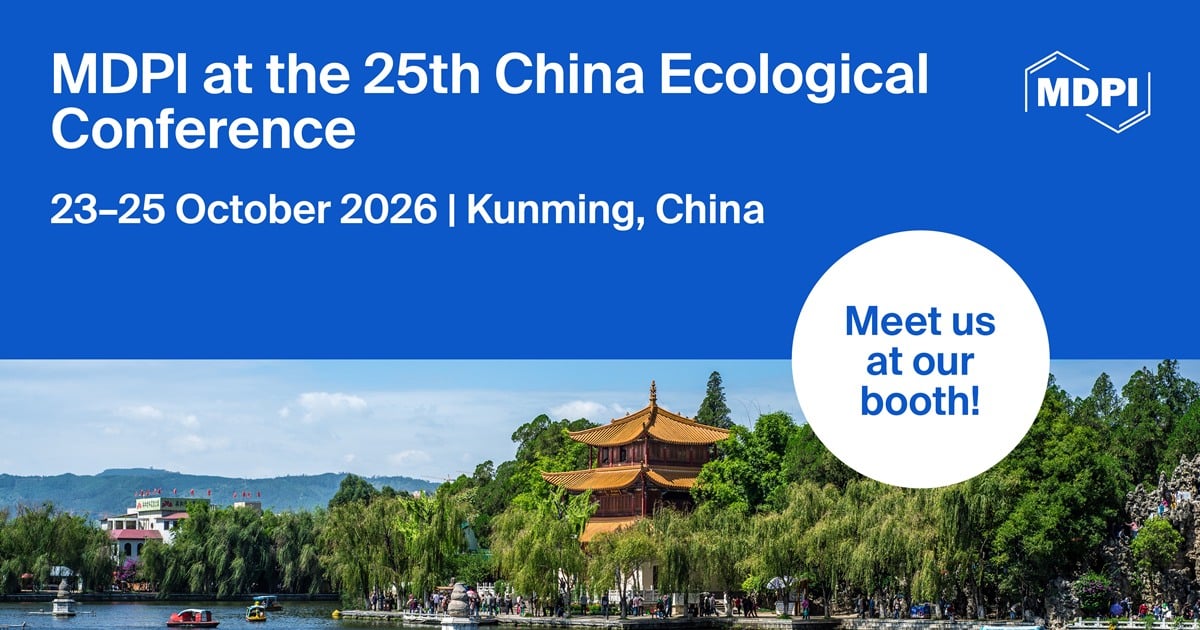
Meet Us at the 25th China Ecological Conference, 23–25 October 2026, Kunming, China
Conference: 25th China Ecological Conference
Organization: Ecological Society of China
Date: 23–25 October 2026
Place: Kunming, China
Organized by the Ecological Society of China (ESC), the conference centers on the theme: “New Mission of Ecological Science: Serving Systematic Governance of Regional Eco-Environments”. The scientific program will cover four major areas: ecological theory, methodology and practical innovation; ecosystem functions, services and human well-being; ecological responses and restoration under global change; and ecology and sustainable development in the era of artificial intelligence.
The following MDPI journals will be represented:
If you attend this conference, please feel free to visit our booth. Our delegates look forward to meeting you in person and answering any questions that you may have.
20 August 2026
Meet Us at the 5th Fisheries Ecology and Environment Conference, 28–30 August, Weihai, China

Conference: The 5th Fisheries Ecology and Environment Conference
Date: 28-30 August 2026
Location: Weihai, China
MDPI will participate as an exhibitor at the 5th Fisheries Ecology and Environment Conference. We welcome researchers and professionals to visit our booth and engage with our team.
The theme of the 5th Fisheries Ecology and Environment Conference is “Wisdom in Fisheries Ecology, Building a Blue Granary Together”. In response to the latest research advances in the field, the conference will feature multiple topical discussion sessions. The formats for knowledge exchange include keynote presentations, invited talks, postgraduate forums, and poster presentations.
To facilitate interdisciplinary discussions among researchers from diverse fields and to explore multidisciplinary applications and new perspectives, MDPI is launching the following topic:
Closely aligned with the UN Sustainable Development Goals (SDGs) and the FAO “Blue Transformation” strategy, this topic will present and disseminate the most recent advances in aquaculture and fisheries science that integrate smart ecological stewardship with sustainable production innovation. We consider contributions addressing the nexus of aquatic ecosystem health, pollution control, precision aquaculture technologies, and the sustainable utilization of fishery resources. By bridging cutting-edge research with practical management and policy implementation, this topic will support the global transition toward a resilient, productive, and environmentally harmonious “Blue Granary” for future generations.
Topic Submission Link: https://www.mdpi.com/topics/J6P714DX9O;
Submission Deadline: 31 July 2027.
It is worth mentioning that during this conference, Fishes will celebrate its 10th anniversary. To mark this special occasion, MDPI has prepared a range of engaging interactives at our booth. We invite all researchers and students to join us in celebrating this important milestone.
The following open access journals will be represented:
11 August 2026
Diversity | Highly Viewed Papers in the First Half of 2026
As all articles published in Diversity (ISSN 1424-2818) are open access, you have free and unlimited access to their full text. We welcome you to read our most highly viewed papers published in the first half of 2026, listed below:
1. “A Thick-Skulled Troodontid Theropod from the Late Cretaceous of Mexico”
by Hector E. Rivera-Sylva, Martha C. Aguillón-Martinez, Jose Flores-Ventura, Ivan E. Sánchez-Uribe, Jose Ruben Guzman-Gutierrez and Nicholas R. Longrich
Diversity 2026, 18(1), 38; https://doi.org/10.3390/d18010038
Available online: https://www.mdpi.com/1424-2818/18/1/38
2. “A Titanosaurian Sauropod with South American Affinities (Lognkosauria: Argentinosauridae) from the Late Maastrichtian of Morocco and Evidence for Dinosaur Endemism in Africa”
by Nicholas R. Longrich, Agustín Pérez-Moreno, Verónica Díez Díaz, Xabier Pereda-Suberbiola, Nathalie Bardet and Nour-Eddine Jalil
Diversity 2026, 18(5), 241; https://doi.org/10.3390/d18050241
Available online: https://www.mdpi.com/1424-2818/18/5/241
3. “New Species of Vegavis (Neornithes) from Antarctica Highlights Unexpected Cretaceous Antarctic Diversity”
by Facundo Irazoqui, Carolina Acosta Hospitaleche, Ariana Paulina-Carabajal, Paula Bona and Nahuel Vega
Diversity 2026, 18(2), 82; https://doi.org/10.3390/d18020082
Available online: https://www.mdpi.com/1424-2818/18/2/82
4. “A Giant Halisaurine from the Late Maastrichtian of Morocco”
by Nicholas R. Longrich and Nour-Eddine Jalil
Diversity 2026, 18(3), 159; https://doi.org/10.3390/d18030159
Available online: https://www.mdpi.com/1424-2818/18/3/159
5. “Reproductive and Trophic Patterns Associated with Non-Native Fish Dominance in a Mexican Spring Ecosystem”
by Arely Ramírez-García, Enid Michelle Escamilla-Espejo, Fhernando Salvador Jacobo-Cabrera, Paola Pedroza-Vargas, Andrea Pérez-Pérez, Alejandro Díaz-Flores, Juan Francisco Cardenas-Menera, Michael Köck and Omar Domínguez-Domínguez
Diversity 2026, 18(5), 311; https://doi.org/10.3390/d18050311
Available online: https://www.mdpi.com/1424-2818/18/5/311
6. “Artificial Intelligence-Assisted Daytime Video Monitoring for Bird, Insect, and Other Wildlife Interactions with Photovoltaic Solar Energy Facilities”
by Yuki Hamada, Adam Z. Szymanski, Paul F. Tarpey and Leroy J. Walston
Diversity 2026, 18(2), 95; https://doi.org/10.3390/d18020095
Available online: https://www.mdpi.com/1424-2818/18/2/95
7. “Mass Bird Deaths Following New Year's Eve Fireworks”
by Rusko Petrov, Svetoslav Asenov and Adriana Dzhamalova
Diversity 2026, 18(2), 86; https://doi.org/10.3390/d18020086
Available online: https://www.mdpi.com/1424-2818/18/2/86
8. “An Investigation into How Marine Mammal Distribution Is Being Affected by Climate Change, with a Focus on Out of Habitat Marine Mammals, Based on Expert Opinion”
by Maia Killian, Laetitia Nunny, Dan Jarvis, Lewis Griffin, Carlos Yaipen-Llanos, Anna Pili and Mark Simmonds
Diversity 2026, 18(5), 270; https://doi.org/10.3390/d18050270
Available online: https://www.mdpi.com/1424-2818/18/5/270
9. “Recapturing Vipera ursinii: Photo-Identification and HDF Telemetry in a Meadow Viper Population from Maiella National Park, Italy”
by Daniele Marini, Vincenzo Ferri, Alice Funk, Oscar Giuseppe Gialdini, Paolo Crescia and Marco Carafa
Diversity 2026, 18(4), 202; https://doi.org/10.3390/d18040202
Available online: https://www.mdpi.com/1424-2818/18/4/202
by Thierry Bourgoin, Nicolas Bailly, René Zaragüeta and Régine Vignes-Lebbe
Diversity 2026, 18(4), 205; https://doi.org/10.3390/d18040205
Available online: https://www.mdpi.com/1424-2818/18/4/205
5 August 2026
MDPI INSIGHTS: The CEO’s Letter #37 – Canada Summit, Sciforum Relaunch, 30 Years of Impactful Research & ISPRS 2026

Welcome to the MDPI Insights: The CEO's Letter.
In these monthly letters, I will showcase two key aspects of our work at MDPI: our commitment to empowering researchers and our determination to facilitating open scientific exchange.
Opening Thoughts

Reflections from the MDPI Canada Summit 2026 in Toronto (9–10 July)
As part of this year’s MDPI Summit events, we were delighted to host Editors-in-Chief (EiCs) and Editorial Board Members (EBMs) in Toronto for the MDPI Canada Summit 2026 this July.
Across the two days, we presented on topics including research integrity, editorial leadership, artificial intelligence, peer review, and the evolving role of the EiC. More importantly, the Summit created space for feedback and conversations with the academic community: these engagements continue play and important role in shaping how MDPI develops its journals and services.
Why Canada?
Canada has become one of the world’s leading Open Access (OA) nations. In 2025, 68% of Canadian research publications were published OA, with more than 73,000 OA articles produced during the year. Over the past five years alone, Canadian researchers have published more than 526,000 scholarly articles, showing both the scale and quality of Canadian research.
MDPI Toronto Office

“Canada has become one of the world’s leading Open Access nations”
Since opening in 2019, our Toronto office has grown to more than 85 colleagues supporting editorial operations, research integrity, marketing, societies, conferences, indexing, author services, and many other functions across North America. It was great to spend time with the team, see first-hand the energy and enthusiasm they bring to their work, and recognize the significant role they play in building relationships with the Canadian research community and delivering events such as this Summit.
MDPI and Canada
Today, Canada is an important part of the MDPI community:
- More than 53,800 articles from Canadian institutions published with MDPI since 1996
- More than 5,800 MDPI publications from Canadian researchers in 2025
- Nearly 1,900 Canadian Editorial Board Members, including 24 Editors-in-Chief; 49 Section Editors-in-Chief
- More than 30 Institutional Open Access Partnerships (IOAP) with universities across Canada

“The academic community is at the center of everything we do”
These numbers reflect the long-term partnerships with researchers, reviewers, editors, and institutions who continue to place their trust in MDPI.
Summit Program
Throughout the Summit, we presented and discussed topics against the following agenda:
- MDPI at 30: Introduction, Reflections and the Road Ahead – Stefan Tochev (CEO)
- Engagement with Academic Community and Society Partnerships – Karen Irwin (Associate Editorial Engagement Manager) and Carla Aloè (Head of Societies and Acquisition)
- Latest Developments in the Editorial Process – Summer Huggard (Operations Manager)
- Research Integrity and Publication Ethics – Renato Merki (Research Integrity Specialist)
- AI and Technology in Publishing – Dr. Barnaby Crook (Regional Engagement Editor)
- Panel Discussion – Bob Vrooman (Head of Business Development / Operations Manager, USA), Summer Huggard, Renato Merki, and myself

These presentations reinforce something we often say at MDPI: The academic community is at the center of everything we do. Each session concluded with a Q&A, allowing for discussions throughout the Summit to engage directly with our EiCs and EBMs.
Further Reading
I also had the opportunity to be interviewed by University Affairs about the evolving landscape of scholarly publishing, Open Access, and the importance of engaging with the research community. If you’re interested, you can read the interview in:
- English: University Affairs – MDPI Toronto Summit 2026: Bringing Together Leaders to Shape the Future of Scholarly Publishing
- Français: Affaires universitaires – Sommet MDPI de Toronto 2026
Thank You
As OA continues to grow around the world, events such as the MDPI Canada Summit remind us of the importance of meeting with our academic community in person. Listening to feedback, exchanging ideas, and building relationships are essential to ensuring that MDPI continues to evolve alongside the researchers, editors, reviewers, and institutions we serve.

Impactful Research

Five Journals, Five Different Stories of Success
Each year, the release of the Journal Citation Reports (JCR) provides an opportunity to look at the progress of our journal portfolio and, more importantly, the achievements of the research communities behind it.
A recent MDPI Blog article from Tommy Lax (Content Specialist, MDPI) highlights five journals whose 2025 Journal Impact Factor results show that success can take many forms – from achieving a first Impact Factor, to steady long-term growth, to leadership within highly competitive disciplines.
The featured journals include:
- Machine Learning & Knowledge Extraction (MAKE) – Among the 330 MDPI journals which received an Impact Factor in 2025, MAKE (ISSN 2504-4990) holds the accolade of having the highest rating of 8.4. The journal, which provides an advanced forum for the study of machine learning and its applications, is placed in Q1 for three subject categories: Computer science, artificial intelligence; Computer science, interdisciplinary applications; and Engineering, electrical & electronic.
- Antioxidants – Continuing its strong position across multiple scientific disciplines, Antioxidants (ISSN 2076-3921) was awarded an exceptional Impact Factor of 8.2. In addition, the journal was placed in Q1 in three subject categories: Biochemistry & molecular biology; Chemistry, medicinal; and Food science & technology.
- Biomass – This year, Biomass (ISSN 2673-8783) was recognized in the JCR for the first time, with a strong debut Impact Factor of 6.7. What makes this achievement even more impressive is the journal’s placement in Q1 of the category Engineering, chemical.
- Analytica – Remaining with the theme of growth, Analytica (ISSN 2673-4532), which provides an advanced forum for all aspects of fundamental and applied analytical chemistry, recorded one of the largest year-on-year increases in Journal Impact Factor, with a 7.4 – an astounding 3.8-point increase from its 2024 rating of 3.6.
- Batteries – Indexed in SCIE, Batteries (ISSN 2313-0105) received an updated Impact Factor of 6.3 this year, representing an increase of 1.5 versus last year, demonstrating consistent growth and increasing visibility over several years.
While citation metrics provide one perspective on journal performance, they tell only part of the story. Every milestone reflects the dedication of Editors-in-Chief, Editorial Board Members, reviewers, authors, and colleagues across MDPI who work together to uphold rigorous editorial standards and support high-quality research.
As a signatory of the Declaration on Research Assessment (DORA), MDPI supports a balanced approach to research evaluation. Journal-level metrics should be viewed alongside article-level indicators and the broader scientific and societal impact of published research.
Thank you to everyone whose commitment continues to strengthen our journals and advance Open Access across the global research community.
Inside MDPI

Building Better Tools for the Research Community: The Relaunch of Sciforum
Innovation at MDPI extends beyond journals. Over the past decade, we have continued to invest in products that support researchers, conference organizers, editors, reviewers, and institutions throughout the research lifecycle. As part of this ongoing investment, our Product and Engineering teams have been modernizing several of MDPI’s digital platforms. One important milestone in that journey is the relaunch of Sciforum, our conference management platform.
Read More: Sciforum Relaunch: Empowering Science through Seamless Event Management
Rather than simply updating an existing system, our product and engineering teams have rebuilt Sciforum, using a modern architecture designed to improve the user experience, support future growth, and continue to strengthen our position in the conference management market.
“Scalable technology is essential to delivering a high-quality experience”
Why We Rebuilt Sciforum
Technology must continue evolving alongside the needs of our users. The previous platform had served MDPI well for many years but had become difficult to extend and maintain. The new platform introduces a modular architecture that enables faster development, more flexibility, and a scalable foundation for future work.
Major improvements include:
- Simplified submission workflows
- Role-based dashboards
- A modern website builder
- Flexible pricing options
- Permanent data hosting
- A scalable architecture for future development

Supporting Our Conference Community
Sciforum is more than a software platform: it supports researchers, conference organizers, reviewers, speakers, and attendees by helping them organize, participate in, and share scientific meetings more efficiently. As MDPI continues to expand its conference activities worldwide, investing in modern, scalable technology is essential to delivering a high-quality experience for both our external partners and our internal teams.
Looking Ahead
The relaunch represents the beginning Sciforum’s next chapter. Planned improvements include: the Program Builder, Communication Hub, expanded payment options, Zoom integration, and a mobile application. These will continue to enhance the platform over the coming months.
Coming Together for Science

Highlights from ISPRS Congress 2026 – Toronto, Canada
In early July, I had the pleasure of attending the XXV ISPRS Congress in Toronto, one of the world’s leading gatherings for the geospatial and remote sensing research community. It was a great opportunity to meet researchers, editors, society leaders, and collaborators, while gaining insights into some of the latest developments in geospatial science and technology.
Over several days, I had the privilege of presenting the Jack Dangermond Award; speaking about MDPI’s approach to AI in publishing and our 30-year journey in Open Access publishing; participating in Editorial Board meetings; and engaging with members of the ISPRS community.
Below is a summary of these activities:
Celebrating excellence in research
One of the highlights of the week was presenting the Jack Dangermond Award for the best paper published in the ISPRS International Journal of Geo-Information (IJGI). Sponsored by MDPI and ESRI, the award recognizes an outstanding paper published over a four-year period and includes an ISPRS certificate together with a USD 10,000 prize.

Awards such as these remind us that journals are much more than publication platforms: they celebrate research that advances knowledge, inspires future work, and delivers meaningful impact for both science and society.
Presentations at ISPRS
I also had the pleasure to give two presentations during the congress:

1. The AI Revolution in Publishing: Challenges, Innovations, and MDPI’s Vision
The development of AI continues to transform scholarly publishing. During this session, I shared how MDPI is integrating AI responsibly, not to replace editorial judgement or peer review, but to support our staff by improving efficiency while maintaining scientific quality and research integrity.
2. MDPI: 30 Years of Open Access Publishing
I also had the opportunity to share MDP’s 30-year journey from a small publishing initiative to becoming a global Open Access publisher serving millions of researchers worldwide. As part of this session, my colleague Carla Aloè (Head of Societies and Acquisitions) introduced the ISPRS International Journal of Geo-Information (IJGI), sharing its development and contribution to the geospatial research community.

Meeting with Our Editorial Boards
Another rewarding aspect of the congress was meeting with the Editorial Boards of two of our journals:
- Remote Sensing
- ISPRS International Journal of Geo-Information
These discussions went beyond journal metrics. We heard ideas about editorial quality and emerging research areas, and we discussed reviewer engagement, diversity within editorial boards, and how journals can continue serving their communities for the future. These conversations are a great way to connect directly to the scientists who help shape our journals.


“One of our core missions has always been to make high-quality research openly accessible”
Partnerships matter
Scientific publishing is built on collaboration. Throughout the congress, our team welcomed researchers to the MDPI booth, met with authors and editors, and discussed opportunities for collaboration across our journals and society partnerships.
Special thanks to our MDPI colleagues who were present throughout the ISPRS congress supporting our Editorial Board meetings and the MDPI booth: Andy Tran, Carla Aloè, Carlo Cunanan, Diana Ribeiro Tosato, and Elena Duan.

Thank you to ISPRS for organizing this congress, to the researchers who shared their work, to our Editorial Board members, and to MDPI colleagues whose dedication continues to shape the journals and communities we support.
Closing Thoughts

Insights Into 30 Years of Impactful MDPI Research
As we celebrate 30 years of MDPI, it’s worth reflecting on the impact that the research we publish has on society. One of our core missions has always been to make high-quality research openly accessible so that it can inform new discoveries, public policy, education and innovation around the world.
A recent article on the MDPI Blog highlights several examples of MDPI publications that have gone beyond academic citations to help inform governments, international organizations and public policy discussions.
Research Creating Real-World Impact
The MDPI blog article features research that has contributed to topics including:
- protecting the Amazon rainforest through satellite mapping
- understanding climate change and urban heat inequality
- encouraging more young women to pursue STEM careers
- tackling obesity through healthier food environments
- shaping sustainable urban planning through the “15-minute city” concept
These examples remind us that publishing research is not only about producing articles: it is about helping knowledge reach the people who can use it to improve lives and address global challenges.
Thirty Years of Open Access
MDPI’s 30th Anniversary is also an opportunity to recognize the collective contribution of everyone across MDPI. Every manuscript processed, every review coordinated, every system developed, every conference organized, every partnership established and every article published contributes to a much larger purpose: helping scientific knowledge move further and faster.
You can explore the full article here: 30 Years of Impactful MDPI Research
You can also visit our 30th Anniversary page to learn more about MDPI’s journey over the past three decades.
Chief Executive Officer
MDPI AG
30 July 2026
MDPI’s Journal Cluster of Ecosystem and Resource Management | Multiple Journals Receive Updated Impact Factors and Increased CiteScores

The 2025 Journal Citation Reports (JCR) and CiteScore metrics were officially released in June 2026.
Multiple journals within the MDPI Ecosystem and Resource Management Journal Cluster have delivered outstanding performances, achieving significant growth in both Impact Factors and CiteScores.
Compared with the previous year, several journals in the cluster have shown notable improvement, maintaining their Q1/Q2 rankings in both JCR and Scopus. These results reflect the rising academic influence of journals.
Impact Factor growth:
|
Journal Name |
2025 Impact Factor |
Year-over-Year Growth |
JCR Subject Category |
JCR Quartile |
|
3.1 |
+24.00% |
“Forestry” |
Q2 |
|
|
3.2 |
+18.52% |
“Forestry” |
Q1 |
|
|
2.3 |
+9.50% |
“Biodiversity Conservation” |
Q2 |
|
|
2.9 |
+52.63% |
“Ecology” |
Q2 |
The 2025 Journal Impact Factor is calculated by dividing the number of citations received in 2025 to all publications in the journal from 2023 and 2024 by the total number of citable publications from those same years.
CiteScore growth:
|
Journal Name |
2025 CiteScore |
Year-over-Year Growth |
Scopus Subject Category |
CiteScore Quartile |
|
5.4 |
+17.39% |
“Forestry” |
Q1 |
|
|
5.1 |
+30.77% |
“Forestry” |
Q1 |
|
|
4.6 |
+15.00% |
“Nature and Landscape Conservation” |
Q1 |
|
|
3.5 |
+9.38% |
“Agricultural and Biological Sciences (miscellaneous)” |
Q2 |
|
|
3.6 |
+20.00% |
‘Ecology, Evolution, Behavior and Systematics” |
Q2 |
The current CiteScores measure the average number of citations within a journal over a four-year window (2022–2025). The Scopus database provides a comprehensive suite of metrics that support informed publishing strategies, research evaluation, and enable benchmarking of journal performance.
The continued success of these journals would not be possible without the dedication and support of our editors, reviewers, authors, and readers. We sincerely thank all scholars for their ongoing support of the MDPI Ecosystem and Resource Management Cluster.
For more details, please visit the full announcement at https://www.mdpi.com/about/announcements/13361.
20 July 2026
Diversity | Highly Cited Papers Published in 2024 on Mollusca
As all articles published in Diversity (ISSN 1424-2818) are open access, you have free and unlimited access to their full text. We welcome you to read our most highly cited papers published in 2024 on the topic of Mollusca, listed below:
1. “Population Reinforcement of the Endangered Freshwater Pearl Mussel (Margaritifera margaritifera): Lessons Learned”
by Louise Lavictoire and Christopher West
Diversity 2024, 16(3), 187; https://doi.org/10.3390/d16030187
Available online: https://www.mdpi.com/1424-2818/16/3/187
2. “Thermal Threats to Freshwater Mussels: An Empirical Stream Assessment”
by Tamara J Pandolfo, W. Gregory Cope, Daniel M. Weaver and Thomas J. Kwak
Diversity 2024, 16(1), 37; https://doi.org/10.3390/d16010037
Available online: https://www.mdpi.com/1424-2818/16/1/37
3. “Community Structural and Functional Features of Benthic Macroinvertebrates in a Cascade-Dams River”
by Mengyue Zhang, Guangxia Shang and Sen Ding
Diversity 2024, 16(12), 772; https://doi.org/10.3390/d16120772
Available online: https://www.mdpi.com/1424-2818/16/12/772
4. “Thermal Tolerance and Vulnerability to Climate Change of a Threatened Freshwater Mussel”
by Annekatrin Wagner, Daniel Linke, Felix Grunicke and Thomas U. Berendonk
Diversity 2024, 16(1), 39; https://doi.org/10.3390/d16010039
Available online: https://www.mdpi.com/1424-2818/16/1/39
5. “Mass Mortality Event of Mediterranean Mussels (Mytilus galloprovincialis) in the Middle Adriatic: Potential Implications of the Climate Crisis for Marine Ecosystems”
by Luca Bracchetti, Martina Capriotti, Massimiliano Fazzini, Paolo Cocci and Francesco Alessandro Palermo
Diversity 2024, 16(3), 130; https://doi.org/10.3390/d16030130
Available online: https://www.mdpi.com/1424-2818/16/3/130
17 July 2026
Diversity | Interview with Prof. Dr. Stuart Kininmonth—Session Chair of The 4th International Online Conference on Diversity: Biodiversity of Animals, Plants and Microorganisms (IOCDV 2026)

- What is your impression of the Diversity journal?
The Diversity journal is a new and exciting scientific publication that promises fast delivery of high-quality articles on ecological diversity. With an open access policy and extended article length, this journal enables a wider audience to engage with the important ecological issues of our time.
- Why did you choose to participate in the IOCDV 2026, and what was the most appealing aspect for you?
Conferences about ecology primarily aim to facilitate the sharing of new ideas. However, travel distances and costs often create barriers to participation and contribute to a lasting carbon footprint. This International Electronic Conference is free and accessible to everyone, anywhere in the world. It provides an opportunity for people globally to share their research and build collaborative networks.
- Could you please provide a brief introduction to the session you are chairing, titled “Marine Diversity”?
With two-thirds of the world dominated by marine diversity, there is a significant imperative to focus our research efforts on this topic. From coral reefs and seagrass meadows to deep ocean trenches, understanding these ecological systems is critical as threats continue to increase at all scales. This session will highlight local and global marine diversity research from all parts of the ocean.
- What types of studies, data, or emerging topics would you particularly like to see submitted to the “Marine Diversity” session at our conference?
Ideally, a well-rounded array of research projects that include fieldwork, theoretical explorations, remote ecosystems, and cryptic species would foster interesting discussions. I would also enjoy seeing studies on the complex shifts in species diversity resulting from changes in marine management or direct intervention.
- What message would you give to young researchers or first-time attendees about why they should participate?
The challenging world of scientific research can be made more rewarding through collaborations and the sharing of ideas and perspectives. Conferences like these provide an excellent opportunity for early-career researchers to begin building networks that will enhance their future research efforts. Don’t be afraid to reach out and make contact with more senior researchers.
- Given your research on coral reef ecosystems as well as your field experience observing rapidly warming Antarctica, what are the similarities and disparities between these two ecosystems regarding their adaptive capacity under climate change?
The dramatic lessons from the last few decades highlight how fragile all these systems are, yet they are primarily resilient against climate change as a direct function of their spatial extent. Coral reefs form vast structures housing the majority of marine diversity, while Antarctic ecoregions contain very high biological abundances. Both are connected through global energy transfer and, in some cases, migration. Climate change is challenging the very fabric of interactions within these systems at scales not seen for many thousands of years. The adaptive capacity of these systems is currently being hampered by anthropogenic activities, and the effects of this abuse are of the gravest concern to informed citizens of the world.
- Your research focuses on the complex interplay between social and natural systems, particularly in coral reef ecosystems. What do you see as the most urgent questions or emerging frontiers in marine diversity research today?
Diversity around the world is decreasing simply due to the damage caused by the exploitation of an ever-increasing global population. However, the key understanding is that humans and the natural environment are intrinsically co-dependent for survival. Coral reefs, in particular, are a dominant ecosystem for many tropical coastal communities, and the socio-ecological question we need to address is the following: how can we make this arrangement sustainable?
- How do you envision this conference fostering collaboration or sparking new research directions among attendees?
I am hopeful that research targeting multiple ecosystems across diverse ecoregions at a variety of scales will continue the process of identifying new research areas, particularly in the field of conservation and sustainability. The facilitation of direct and meaningful communication between researchers is a major reason to be part of a conference like this.
Introduction of Diversity 2026:
Conference date: 4–6 November 2026;
Deadline for registration: 30 October 2026;
Conference chair: Prof. Michael Wink (Heidelberg University, Germany).
For more details, https://sciforum.net/event/IOCDV2026.
For any enquiries regarding the event, please get in touch with iocdv2026@mdpi.com.
16 July 2026
Diversity Best Paper Award—Winners Announced

Diversity (ISSN 1424-2818) is pleased to announce the winners of the Diversity Best Paper Award. Three research articles and one review were selected from all papers published in Volume 16 of the journal. The committee selected the award-winning papers based on a comprehensive evaluation of their originality, scientific significance, and overall impact, with citation and download metrics considered as part of the assessment.
We would like to congratulate the following winners:
“One Genome, Multiple Phenotypes: Would Rhodnius milesi Carcavallo, Rocha, Galvão & Jurberg, 2001 (Hemiptera, Triatominae) Be a Valid Species or a Phenotypic Polymorphism of R. neglectus Lent, 1954?”
by Fabricio Ferreira Campos, Jader de Oliveira, Jociel Klleyton Santos Santana, Amanda Ravazi, Yago Visinho dos Reis, Laura Marson Marquioli, Cleber Galvão, Maria Tercília Vilela de Azeredo-Oliveira, João Aristeu da Rosa and Kaio Cesar Chaboli Alevi
Diversity 2024, 16(8), 472; https://doi.org/10.3390/d16080472
“Reintroduction of the Extinct-in-the-Wild Spix’s Macaw (Cyanopsitta spixii) in the Caatinga Forest Domain of Brazil”
by Cromwell Purchase, Camile Lugarini, Candice Purchase, Ariane Ferreira, Ugo Eichler Vercillo, Mark L. Stafford and Thomas H. White, Jr.
Diversity 2024, 16(2), 80; https://doi.org/10.3390/d16020080
“DNA Barcoding for Species Identification of Moss-Dwelling Invertebrates: Performance of Nanopore Sequencing and Coverage in Reference Database”
by Stephan Koblmüller, Philipp Resl, Nadine Klar, Hanna Bauer, Lukas Zangl and Christoph Hahn
Diversity 2024, 16(4), 196; https://doi.org/10.3390/d16040196
“Strengthening Partnerships to Safeguard the Future of Herbaria”
by Barbara M. Thiers
Diversity 2024, 16(1), 36; https://doi.org/10.3390/d16010036
The announcement of the winners can be found on the following website: https://www.mdpi.com/journal/diversity/awards/3606.
8 July 2026
MDPI’s Newly Launched Journals in June 2026
Our portfolio of journals available for publishing up-to-date research in immediate open access format has been further expanded. In June 2026, eleven new journals released their inaugural issues and two transferred journals released their first issue as part of MDPI, covering the subjects of environmental & earth sciences, chemistry & materials science, public health & healthcare, engineering, medicine & pharmacology, and biology & life sciences.
We extend our gratitude to the Editors-in-Chief, Associate Editors, and Editorial Board Members who will shape the future course of these new journals. Each journal is dedicated to upholding strong editorial standards through a thorough peer review process, enabling impactful open access scholarship.
Please feel free to browse and discover more about the new journals below.
|
New Journals |
Founding Editor(s)-in-Chief |
Journal Topics (Selected) |
|
|
Prof. Dr. Xiaochuan Pan, Peking University, China |
public health research, practice, policy, and education; eco-health equity | |
|
|
Prof. Dr. Xin-Gao Gong Fudan University, China; Prof. Dr. Zhimei Sun Beihang University, China |
AI-enhanced theory & simulation; generative design & discovery; autonomous experimentation; AI for characterization; large language models and agents | |
|
|
Prof. Dr. Yong Liu, Wuhan University, China |
hydropower technology; renewable energy; water resources; optimization; rock and soil mechanics; power system stability | |
|
|
Prof. Dr. Giovanni Rezza, University Vita-Salute San Raffaele, Italy |
pandemic preparedness; public health; global outbreak dynamics and epidemiology; outbreak prediction and risk forecasting; one health approach; zoonotic and pre-pandemic vaccines | |
|
|
Prof. Dr. Brian Horton, University of Texas at Austin, USA |
stratigraphy; sedimentology; earth surface processes; basin evolution and tectonics; climate and paleoclimate | |
|
|
Prof. Dr. Yike Guo, Hong Kong University of Science and Technology, China |
artificial intelligence (AI); application of AI to engineering; Explainable AI (XAI); AI-driven design and optimization; AI for manufacturing and automation | view journal scope | submit an article |
|
|
Prof. Dr. Hei Wong, City University of Hong Kong, China |
novel semiconductor materials; advanced heterogeneous integration technologies; advanced characterization and testing techniques; heterogeneously integrated systems and applications; modeling and design automation| |
|
|
Prof. Dr. Michail Panagiotidis, Mississippi State University, USA |
plant-based medicines; natural products-based drug discovery; plant-based bioactive compounds; pharmacognosy; phytochemicals; pharmacokinetics | |
|
|
Prof. Dr. Khalid Meksem, Southern Illinois University, USA |
genome biotechnology; applied genomics; genetic engineering; agricultural biotechnology; medical biotechnology; data science and AI| |
|
|
Dr. Chenxi Wu, Chinese Academy of Sciences, China |
environmental cleanup; ecological restoration; environmental management and governance; environmental modeling and monitoring | |
|
|
Prof. Dr. Janusz Kozinski, Lakehead University, Canada |
renewable energy; sustainable agriculture; green innovation; climate change; artificial intelligence and environmental sustainability | |


|
Transferred Journals |
Editor(s)-in-Chief |
Journal Topics (Selected) |
|
|
Prof. Dr. Thomas Frese, Martin-Universität Halle-Wittenberg, Germany |
health services in primary care; integrated care models; quality and safety of care; coordination across primary and secondary care services; patient management; primary care clinical practice and interventions; clinical interventions delivered in primary care settings; |
|
|
Prof. Dr. Paul Gerson Unschuld, Geneva University Hospitals (HUG), Switzerland |
neurology, psychiatry, psychotherapy, and the neurosciences | |


We would like to thank everyone who has supported the development of open access publishing. If you would like to create a new journal, you are welcome to send an application here or contact the New Journal Committee (newjournal-committee@mdpi.com).
