Skip to Content
  • 6.0
    Impact Factor
  • 10.3
    CiteScore
  • 15 days
    Submission to First Decision
  • 3 days
    Acceptance to Publication

Foods

Foods is an international, peer-reviewed, open access journal on food science published semimonthly online by MDPI. The Italian Society of Food Sciences (SISA) and Spanish Nutrition Foundation (FEN) are affiliated with Foods and their members receive discounts on the article processing charges.  

Get Alerted

Add your email address to receive forthcoming issues of this journal.

All Articles (27,473)

  • Article
  • Open Access

Organophosphorus pesticide residues severely threaten agricultural products. Thus, it is important to explore sensitive and efficient analytical detection methods for target detection. In this study, a lychee-like gold core-manganese oxide shell structure (Au@MnOx) was synthesized, which displays prominent oxidase (OXD)-like activity. It is able to catalyze 3,3′,5,5′-tetramethylbenzidine (TMB) oxidation to a blue product (oxTMB) without the need for hydrogen peroxide. Malathion can inhibit acid phosphatase (ACP) activity, reduce L-ascorbic acid (AA) production, weaken the color-quenching effect, and restore blue color to the system. Based on this “signal inhibition-recovery” mode, a colorimetric sensor was constructed and applied to quantitatively analyze malathion in food matrices, with a limit of detection (LOD) of 1.51 ng/mL. The average recoveries of malathion in cucumber and cabbage samples were in the ranges of 97.2–104.5% and 99.4–102.5%, respectively, with all relative standard deviations (RSDs) less than 7%. This study provides a sensitive and efficient colorimetric detection strategy for malathion, which has significant application value in the field of food safety.

Foods

5 November 2026

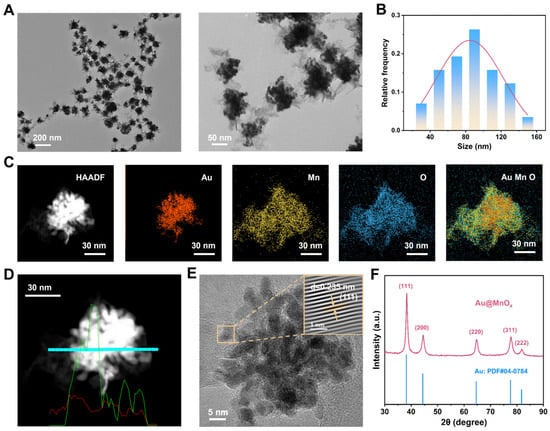
The characterization of Au@MnOx. (A) TEM images of Au@MnOx (Left: low magnification; Right: high magnification). (B) Particle size distribution histogram of Au@MnOx. (C) HAADF-STEM image and corresponding EDS elemental mapping of Au@MnOx. (D) EDS line scan profile of a single Au@MnOx. The cyan line denotes the scanning track, while the green and red curves represent the line signals of Au and Mn elements, respectively. (E) High-resolution TEM (HR-TEM) image of Au@MnOx (Inset: lattice fringes of the Au (111) plane). (F) XRD pattern of Au@MnOx.
  • Editorial
  • Open Access

Fresh fruit and vegetables remain metabolically active after harvest and are susceptible to chilling injury, senescence, and microbial decay, all of which can reduce quality and shorten their marketable life [...]

Foods

5 November 2026

  • Article
  • Open Access

Lotus sprouts are a widely consumed aquatic vegetable, yet their quality remains poorly characterized. This study integrated physicochemical analysis, volatile flavor profiling, and metabolomics to evaluate quality differences among three lotus sprout cultivars, as well as different parts and grades. The apical portions had significantly higher contents of protein, total phenolics, and γ-aminobutyric acid than the stem portions. A total of 46 volatile compounds were identified by headspace solid-phase micro-extraction combined with gas chromatography–mass spectrophotometry (HS-SPME-GC-MS), and the abundance of 2,4-di-tert-butylphenol and 1-octen-3-ol was further confirmed using standards. Untargeted metabolomics identified 335 compounds, with sugars, polyphenols, and amino acids being the most abundant categories. Differentially accumulated metabolites between parts and cultivars were significantly enriched in glutathione metabolism, flavonoid biosynthesis, and amino acid metabolism. Notably, the two Baiyuzan cultivars generally accumulated higher levels of beneficial metabolites than Wuzhi No. 2, whereas the stem portion of the higher-grade Wuzhi No. 2 showed lower accumulation of sucrose and paprazine. Quantitative analysis of eight alkaloids using external standard calibration curves indicated that nuciferine was the most abundant alkaloid (13.3 to 31.1 μg/g). Collectively, this study provides a foundational framework for evaluating the metabolite profiles and application potential of lotus sprouts.

Foods

4 November 2026

  • Article
  • Open Access

4-Alkyl branched-chain fatty acids (BCFAs), including 4-methyloctanoic acid (4-MOA), 4-ethyloctanoic acid (4-EOA), and 4-methylnonanoic acid (4-MNA), are important contributors to the characteristic odor of sheep meat. Their concentrations and composition are closely related to meat flavor quality and consumer acceptance. Understanding the mechanisms that regulate BCFA formation and accumulation is therefore important for improving sheep meat flavor. In this study, the concentrations of these three BCFAs were measured in muscle samples from Altay (ALT), Turpan (TLF), Inner Mongolian (NM), Tan, and Hu sheep. Untargeted muscle metabolomic data from ALT and TLF sheep were integrated with publicly available datasets, including metabolomic data from Tan sheep under different feeding conditions and transcriptomic and metabolomic data from Hu and Zang sheep. These datasets were used to investigate BCFA-related metabolic networks and candidate regulatory factors associated with ecological environment, nutritional conditions, and genetic background. The results show clear differences in BCFA accumulation among the sheep populations. All three BCFAs were below the limits of detection in ALT, TLF and NM sheep. Both 4-MOA and 4-EOA were detected in Tan sheep, whereas all three BCFAs were detected in Hu sheep. The concentrations of 4-MOA and 4-EOA in Hu sheep were approximately 14.4- and 12.5-fold higher than those in Tan sheep, respectively (p < 0.001). Multi-omics integration showed that BCFA-related metabolic variation was mainly associated with branched-chain amino acid metabolism, short-chain carbon metabolism, the tricarboxylic acid (TCA) cycle, and lipid metabolism. MMUT, ACAT1, and EHHADH were identified as candidate regulatory genes. These genes are involved in methylmalonyl-CoA conversion, acetyl-CoA/acetoacetyl-CoA metabolism, and fatty acid β-oxidation, respectively. Changes in energy demand, substrate utilization, and precursor availability may alter the partitioning of BCFA precursor carbon between central energy metabolism and lipid metabolism, thereby affecting BCFA formation and accumulation. In summary, MMUT, ACAT1, and EHHADH may influence the formation and accumulation of 4-MOA, 4-EOA, and 4-MNA by regulating key metabolic reactions and carbon partitioning between the TCA cycle and lipid metabolism. Ecological environment and dietary conditions may further contribute to this process by modifying energy metabolism and precursor substrate supply. These findings provide a theoretical basis for understanding BCFA-related flavor formation and for improving sheep meat flavor through genetic selection and nutritional regulation.


Foods

4 November 2026

Highly Accessed Articles

News & Conferences

Latest Issues

Open for Submission

Journal Sections

XFacebookLinkedIn
Foods - ISSN 2304-8158