



Journal Menu
► ▼ Journal Menu-
- Processes Home
- Aims & Scope
- Editorial Board
- Reviewer Board
- Topical Advisory Panel
- Instructions for Authors
- Special Issues
- Topics
- Sections & Collections
- Article Processing Charge
- Indexing & Archiving
- Editor’s Choice Articles
- Most Cited & Viewed
- Journal Statistics
- Journal History
- Journal Awards
- Society Collaborations
- Conferences
- Editorial Office
Journal Browser
► ▼ Journal BrowserNeed Help?
Announcements
22 May 2026
Meet Us at the 2026 International Congress on Membranes and Membrane Processes (ICOM 2026), 18–25 July 2026, San Antonio, Texas, USA
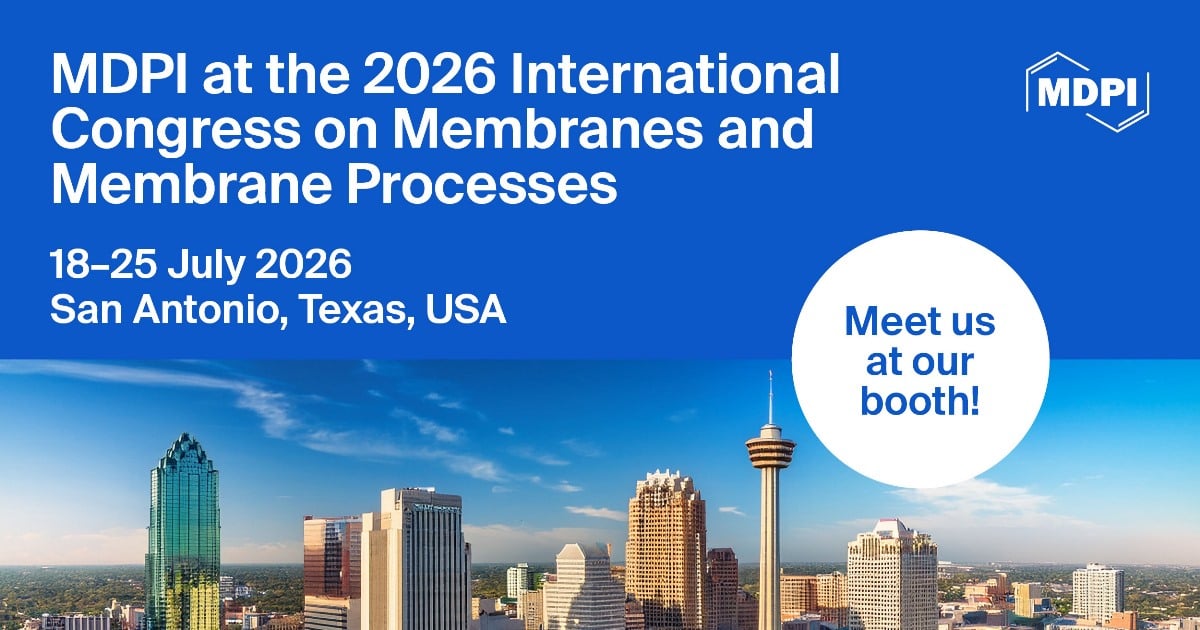
We are pleased to announce that MDPI will be participating in the 2026 International Congress on Membranes and Membrane Processes (ICOM 2026), organized by the North American Membrane Society, taking place from 18 to 25 July 2026 in San Antonio, Texas, USA.
The ICOM 2026 presents a unique opportunity for international and regional communities to collaborate together toward the aim of advancing scalable membrane engineering. Visit our booth to discover MDPI’s latest publications, Special Issues, and open access initiatives in hydrogen technologies and related fields. Our Editors will be on hand to discuss your research and answer any questions about publishing with MDPI.
The following MDPI journals will be represented at this conference:
- Membranes;
- ChemEngineering;
- Purification;
- Materials;
- Applied Sciences;
- Separations;
- Processes;
- Water;
- Clean Technologies.
If you are planning to attend this conference, please feel free to reach out online and start a conversation with us. Our delegates look forward to meeting you in person at our booth and answering any questions you may have. For more information about this event, please click the following link: https://www.membranes.org/icom2026.
21 May 2026
Processes Webinar | Nature-Based Solutions for Sustainable Cities and Communities: From Concept to Measurable Environmental Impact, 29 May 2026
MDPI is pleased to announce the 24th Processes webinar, entitled “Nature-Based Solutions for Sustainable Cities and Communities: From Concept to Measurable Environmental Impact”. This webinar welcomes researchers, practitioners, and professionals interested in sustainable urban development, environmental remediation, and nature-based strategies for improving environmental resilience and community well-being.
As environmental pressures continue to intensify, including soil degradation, contamination, and increasing stress on water resources, there is a growing need for sustainable approaches that work in harmony with natural processes. This webinar will explore how nature-based solutions can support urban resilience, enhance environmental quality, and contribute to sustainable city and community development through low-impact and resource-efficient technologies.
Participants will gain valuable insights into the design, implementation, and evaluation of nature-based solutions, as well as the long-term environmental and societal impacts of these innovative strategies.
Keywords: nature-based solutions; ecosystem-based approaches; low-impact technologies; urban resilience; sustainable cities; sustainable environmental management
Date: 29 May 2026
Time: 10:00 a.m. CEST
Webinar ID: 872 3378 6016
Register now for free!

Program:
|
Speaker/Presentation |
Time in CEST |
|
MDPI Host |
10:00–10:05 a.m. |
|
Dr. Raluca-Maria Hlihor (Chair) |
10:05–10:10 a.m. |
|
Prof. Dr. Alessandra Bonoli |
10:10–10:30 a.m. |
|
Dr. Petronela Cozma |
10:30–10:50 a.m. |
|
Dr. Isabela-Maria Simion |
10:50–11:10 a.m. |
|
Dr. Diana Elena Radulescu |
11:10–11:20 a.m. |
|
Q&A Session |
11:20–11:35 a.m. |
|
Dr. Raluca-Maria Hlihor |
11:35–11:40 a.m. |
After registering, you will receive a confirmation email with instructions on how to join. Please note that participants registering with academic institutional email addresses may be prioritized.
Unable to attend? Register anyway, and we will notify you when the recording becomes available.
Webinar Chair and Speakers:
- Dr. Raluca-Maria Hlihor, Department of Exact Sciences, Faculty of Horticulture, “Ion Ionescu de la Brad” Iasi University of Life Sciences, Romania;
- Prof. Dr. Alessandra Bonoli, Department of Civil, Chemical, Environmental and Materials Engineering (DICAM), Alma Mater Studiorum-Università di Bologna, Italy;
- Dr. Petronela Cozma, Department of Environmental Engineering and Management, “Cristofor Simionescu” Faculty of Chemical Engineering and Environmental Protection, “Gheorghe Asachi” Technical University of Iasi, Romania;
- Dr. Isabela-Maria Simion, “Ion Ionescu de la Brad” Iasi University of Life Sciences, Romania.
21 May 2026
Processes Exceptional Reviewers List 2026
We are thrilled to share the updated Exceptional Reviewers List 2026. This program was established to recognize and honor scholars who have consistently delivered exceptional review reports to our journal. Committed to fostering rigorous research and promoting knowledge exchange, Processes (ISSN: 2227-9717) acknowledges the vital role our reviewers play in maintaining the quality and integrity of the articles we publish. According to surveys conducted in 2025, 93% of our authors rated the peer review process as good or excellent, reflecting the strength and effectiveness of our reviewer community.
We would like to express our sincere appreciation to all the reviewers who have generously volunteered their time and expertise to assist in Processes’ peer-review process. Their dedication and attention to detail in evaluating manuscripts, offering valuable feedback, and contributing to academic rigor are truly commendable.
The Exceptional Reviewers List was introduced in 2026. Each quarter, we will select a group of outstanding reviewers and announce them here.
Q1
Name: Dr. Jakub Mokrzycki
Affiliation: AGH University of Krakow, Poland
Name: Dr. Yong Wei Tiong
Affiliation: Institute of Sustainability for Chemicals, Singapore
Name: Dr. Gabriela Ionescu
Affiliation: National University of Science and Technology Politehnica Bucharest, Romania
Name: Dr. Dariusz Kowalczyk
Affiliation: University of Life Sciences in Lublin, Poland
Name: Dr. Agata Jankowska
Affiliation: Poznań University of Life Sciences, Poland
Name: Dr. Guillaume Giudicelli
Affiliation: Idaho National Laboratory, United States
Name: Dr. Maik Linnemann
Affiliation: Fraunhofer Institute for Machine Tools and Forming Technology IWU, Germany
Name: Dr. Ladislau Radermacher
Affiliation: University of Petrosani, Str. Universitatii, Nr. 20, Petrosani, Hunedoara, Romania
“I approach peer review with rigor, objectivity and an interdisciplinary perspective, supported by experience in two related doctoral fields.”
Name: Dr. Zoltán Péter Jákói
Affiliation: University of Szeged, Hungary
“Peer review is both a responsibility and a privilege, helping to strengthen scientific quality through constructive feedback—at MDPI, the process is clear, organized and also rewarding.”
Name: Dr. Marco Race
Affiliation: University of Cassino and Southern Lazio, Italy
14 May 2026
Prof. Dr. Tiancheng Mu Appointed Section Editor-in-Chief of Section “Separation Processes” in Processes

We are pleased to announce that Prof. Dr. Tiancheng Mu has been appointed Section Editor-in-Chief of the “Separation Processes” Section in Processes (ISSN: 2227-9717). We look forward to his contribution to the continued success of the journal.
 |
Name: Prof. Dr. Tiancheng Mu |
The following is a short Q&A with Prof. Dr. Tiancheng Mu, who shared his vision for the journal with us, as well as his views of the research area and open access publishing:
1. You have collaborated with the journal Processes for many years, could you share your experience of working with the journal and your expectations for the future?
What impresses me most about the journal is its rapid-response mechanism. Against the backdrop of lengthy review cycles typical of traditional chemical engineering journals, Processes has established an efficient feedback system. This is especially crucial for the fast-moving fields of novel separation materials and process intensification technologies, as it ensures that readers can access research results as soon as possible.
I hope the journal can make the leap from tracking hot topics to defining paradigms. Papers should not stop at laboratory data — I look forward to seeing more in-depth work that includes life cycle assessment (LCA) and techno-economic analysis (TEA). I also encourage the publication of studies that combine both experiments and simulations, particularly those that address breakthrough outcomes related to multi-scale coupling — from molecular recognition to industrial unit scale-up. Furthermore, the journal should have the courage to publish disruptive, even controversial, exploratory work. An academic journal should be a front line for the collision of ideas, not merely a showroom for consensus.
2. What are the main areas of focus in your current research?
Currently, my research focuses on efficient and green separation processes, with an emphasis on three main directions. The first is green solvent substitution technology, developing low-toxicity, biodegradable green solvents for the separation and conversion of complex systems. The second is AI-driven process design, using machine learning to accelerate the screening of high-performance separation materials and system optimization. The third is green electricity-driven coupling processes, exploring the use of renewable electricity to replace traditional thermochemical driving forces, aiming for intrinsic decarbonization of reaction and separation processes. Overall, through interdisciplinary research, I aim to advance separation processes toward greater efficiency, greenness, and intelligence.
3. As the Section Editor-in-Chief, what kind of academic identity or distinctive features do you hope the “Separation Processes” Section will develop within Processes?
I want this Section to drive the field forward, not just collect papers. We will focus on three things: real-world industrial robustness, multi-scale thinking that connects microscopic and macro design, and future-oriented areas like extreme-condition separation, intelligent micro/nano systems, and support for new energy and biomanufacturing.
4. Could you provide an in-depth analysis of the key scientific challenges and technical bottlenecks currently facing the field of separation processes?
Five key challenges we are facing right now:
- First, energy intensity–Separation accounts for a major portion of chemical industry energy consumption. Breaking the limitations of conventional thermal processes like distillation is critical;
- Second, precise separation of complex systems–Multi-component systems, trace-level impurities, and high-salinity or high-viscosity streams push the limits of both selectivity and mass transfer efficiency;
- Third, the materials-to-engineering gap–Many novel materials fail during scale-up due to poor stability, fouling resistance, or manufacturability;
- Fourth, unclear multi-scale coupling mechanisms–We lack a fundamental understanding of how dynamic behaviors couple across molecular, interfacial, and equipment scales;
- Fifth, shallow application of AI–Industrial AI applications remain nascent. The key hurdles are reliable data acquisition and model generalizability.
5. What are your views on the future prospects of the separation processes field?
Separation is irreplaceable in industrial processes, and its strategic importance will only increase. Looking ahead, I see four major trends:
- First, transformative separation paradigms—moving toward green, low-carbon processes with intensification strategies to save energy;
- Second, high selectivity and precision—driven by semiconductors and biopharma, the need for ultrahigh purity and trace-level recognition will keep growing;
- Third, integration and modularization—more reaction-separation coupling, evolving into miniaturized, plug-and-play smart separation units;
- Fourth, AI fusion—using AI to optimize separation and reshape traditional design approaches.
6. What do you think of the development of open access in the publishing field?
Open access (OA) is the future of academic publishing. It increases visibility and removes barriers for researchers in SMEs and developing countries, which is a major boost for interdisciplinary innovation. However, open access also faces quality challenges. We must guard against academic misconduct and ensure that false or low-quality research does not mislead the public. The key is balancing openness with quality. One practical step is to improve peer review by involving more high-quality early-career researchers. This would add depth and diversity to the review process. Overall, high-quality, professional OA platforms will play an increasingly important role in research. I hope Processes continue to lead the way.
We wish Prof. Dr. Tiancheng Mu every success both in his research and in the development of Processes.
For more information about this Section, please visit: https://www.mdpi.com/journal/processes/sections/separation_processes.
8 May 2026
Processes Webinar | Applied Biocatalysis: Pathways to Sustainability and Decarbonization, 14 May 2026

Our current way of life is characterized by high standards in medical care, a demand for convenient solutions in our daily lives, and substantial energy consumption to sustain telecommunications and advanced technologies. This webinar will focus on biocatalysis as a sustainable pathway to a more environmentally friendly future. In this webinar, you will learn about the different stages of biocatalysis from three experts, ranging from fundamental molecular approaches to real-world applications for soil and sustainability.
Date: 14 May 2026 at 3:00 p.m. CEST | 9:00 a.m. EDT | 9:00 p.m. CST Asia
Webinar ID: 854 2150 6241
Register now for free!

Program:
| Speaker/Presentation | Time in CEST | Time in EDT |
| MDPI Host Processes and Webinar Introduction |
3:00–3:05 p.m. | 9:00–9:05 a.m. |
| Dr. Carminna Ottone Chair Introduction |
3:05–3:10 p.m. | 9:05–9:10 a.m. |
| Dr. Kírian Bonet-Ragel Synthesis of Bioplastics: From Crude HMF to 2,5-FDCA via Enzymatic Route |
3:10–3:30 p.m. | 9:10–9:30 a.m. |
| Prof. Dr. Claudia Bernal Decarboxylases as Green Biocatalysts for the Generation of C6 Chemical Precursors From CO2 |
3:30–3:50 p.m. | 9:30–9:50 a.m. |
| Dr. Francesca Demichelis Biomass Conversion Into Bio-Material and Bio-Energy for a Decarbonized Production System |
3:50–4:10 p.m. | 9:50–10:10 a.m. |
| MDPI Host Processes Journal Report |
4:10–4:20 p.m. | 10:10–10:20 a.m. |
| Q&A Session | 4:20–4:30 p.m. | 10:20–10:30 a.m. |
| Dr. Carminna Ottone Closing of Webinar |
4:30–4:35 p.m. | 10:30–10:35 a.m. |
After registering, you will receive a confirmation email containing information on how to join the webinar. Registrations with academic institutional email addresses will be prioritized.
Unable to attend? Register anyway and we’ll let you know when the recording is available to watch.
Webinar Chair and Keynote Speakers:
- Dr. Carminna Ottone, School of Biochemical Engineering, Pontificia Universidad Católica de Valparaíso, Chile;
- Dr. Kírian Bonet-Ragel, Department of Chemical, Biological and Environmental Engineering, Universitat Autònoma de Barcelona, Spain;
- Prof. Dr. Claudia Bernal, Chemistry Department. Universidad de La Serena, Chile;
- Dr. Francesca Demichelis, Department of Applied Science and Technology (DiSAT), Politecnico di Torino, Italy.
Relevant Special Issue:
“Advanced Catalytic Approaches for Sustainable Biofuel Production”
Guest Editor: Dr. Oyetola Ogunkunle
Submission deadline: 10 August 2026
6 May 2026
MDPI INSIGHTS: The CEO's Letter #34 - MDPI US Office, Coatings 2026, Media and Partnerships, Recapping Poland Summit & Serbia Salon

Welcome to the MDPI Insights: The CEO's Letter.
In these monthly letters, I will showcase two key aspects of our work at MDPI: our commitment to empowering researchers and our determination to facilitating open scientific exchange.
Opening Thoughts

MDPI Opens First US Office in Philadelphia
I am delighted to highlight an important milestone in MDPI’s continued global development: the recent opening of our first office in the United States, located in Philadelphia.
This marks a significant step in building our engagement with one of the world’s most important research communities. The new office will serve as a hub for supporting scholars across the US, creating closer connections and more localized support.
As highlighted in recent coverage by our press release in InPublishing, this expansion reflects MDPI’s broader commitment to growing our international presence while remaining focused on the needs of the research community.
A Key Market for Research and Collaboration
The United States continues to play a central role in global research. To date, MDPI has published more than 237,000 articles affiliated with US institutions, and we collaborate with nearly 12,000 Editorial Board Members across the country. These relationships are fundamental to our mission of supporting Open Access and advancing scientific communication.
The opening of this office is not just about geography; it is about proximity to the communities we serve. It allows us to better understand the evolving needs of researchers while continuing to build collaboration and trust within the academic ecosystem.
The Team Behind this Milestone

This milestone reflects the efforts of teams across MDPI. I extend a special thank-you to Bob Vrooman (Head of Business Development, MDPI), who is leading this expansion, as well as to our colleagues in Toronto and across our North American teams for their continued support.
Bob shared: “MDPI is already a trusted partner of the North American research community, due in no small part to our dedicated team in Canada. Launching our first US office in Philadelphia is a great first step towards expanding MDPI’s market share and recognition in the US. I’m thrilled to be a part of this new phase in MDPI’s journey.”
As we continue to grow, our focus remains on supporting researchers globally and advancing Open Access with integrity.
Impactful Research

Coatings 2026: Highlights from Our Latest MDPI Conference (20-22 April)
I am pleased to share the successful completion of MDPI conference Coatings 2026, which took place last week in Athens from 20 to 22 April 2026. This conference brought together a diverse international community of researchers, industry experts, and partners, highlighting MDPI’s role not only as a publisher but also as a platform for scientific exchange and collaboration.
Conference Highlights
Coatings 2026 in numbers:
- The event attracted approximately 140 participants from 25 countries
- 143 submissions and a strong scientific program of talks and posters
- 2 keynote speakers and a wide range of invited contributions
- 7 sponsors and 11 media partners supporting the event
|
|
|
|
|
|


Scientific Programme
The program centered on “Safe and Sustainable by Design,” reflecting the growing importance of sustainability, regulatory frameworks, and technological innovation in materials science. Topics ranged from advanced coating technologies and additive manufacturing to AI-driven simulations and strategies to phase out potentially harmful substances in industrial processes.
Importantly, the conference brought together both academic and industrial perspectives, creating a space for dialogue on how research can translate into real-world impact. This is important as industries navigate environmental challenges, evolving regulations, and the need for more sustainable and circular approaches to production.
Thank You!
I would like to thank the entire conference team for their work in organizing this successful event. As we continue to grow, conferences like this play an important role in building our connection with global research communities, supporting interdisciplinary collaboration, and positioning MDPI at the intersection of science, technology, and societal impact.
 Members from Exelisis and MDPI EU Conference & Social Media team at the Coatings 2026 Conference in Athens, Greece.
Inside MDPI

Recent Media Coverage and Partnerships
Over the past two months, news from MDPI has enjoyed strong visibility across international publishing and academic media, reflecting our continued expansion and the increasing relevance of our work within the research community.
Below are some highlights covering partnerships, institutional agreements, and milestones that continue to shape our position in publishing – some of which are featured in leading industry platforms such as InPublishing, which is highly selective and reflects the growing recognition of MDPI’s growth within the publishing ecosystem.
Key Press Releases & Coverage (March–April 2026)
-
MDPI × Sikt (Norway): Partnership Renewal
We renewed our national Open Access agreement with Sikt, a key consortium partnership, continuing to support researchers across Norway through this partnership. The renewal was covered by several international publishing trade outlets.
Covered by: Research Information, STM Publishing News, ALPSP, Europe Says
-
MDPI × Jisc (UK): New Two-Year Open Access Agreement
A new two-year agreement with Jisc significantly expands MDPI’s footprint across UK academic institutions. Coverage appeared across major publishing industry titles in the UK and internationally.
Covered by: InPublishing, Research Information, STM Publishing News, ALPSP
-
MDPI Opens First US Office
The opening of our first US office marks an important milestone in our North American expansion to build engagement with one of the world’s leading research communities.
Coverage by: EurekAlert!, InPublishing, EdTech Innovation Hub, STM Publishing News, ALPSP
-
MDPI × SIGG: Italian Society of Gerontology and Geriatrics
We established a new partnership with the Italian Society of Gerontology and Geriatrics (SIGG), adding to our growing portfolio of society collaborations.
Coverage by: EurekAlert!, STM Publishing News, ALPSP
-
MDPI × Fast Track Health: New Journal Launch
The launch of a new journal in partnership with Fast Track Health reflects our continued expansion into emerging areas of health innovation.
Coverage by: EurekAlert!, Scienmag, STM Publishing News, ALPSP
-
MDPI 2025 Annual Report
Our 2025 Annual Report was also widely covered across international media, highlighting a 12% increase in submissions and continued investment in research integrity, infrastructure, and partnerships.
Coverage by: EurekAlert!, Research Information, STM Publishing News, ALPSP, Choice 360
Coverage also spanned multiple regions including Poland, Romania and South Korea, reflecting our ongoing efforts to communicate more effectively with regional research communities.
Looking Ahead
This coverage shows that MDPI is growing and building on its position through partnerships, visibility, and engagement across regions. As we continue to expand, our focus remains on supporting researchers globally, building on our institutional collaborations, and advancing Open Access with integrity.
Thank you to all teams involved in delivering these initiatives, and to our External Affairs team for ensuring our work is effectively communicated across the global publishing landscape!
Coming Together for Science

Recapping MDPI Poland Summit 2026 in Krakow (23 April)
On 23 April 2206, we hosted the first MDPI Poland Summit 2026 in Kraków, bringing together an engaged group of editors, researchers, and academic leaders from the country.
The Poland Summit welcomed some 45 participants, including Editors-in-Chief, Associate Editors, and Editorial Board Members, many with strong academic track records and international recognition.
Our engagements were open and constructive, focusing on MDPI’s positioning and reputation in Poland, alongside community interest in supporting our development, with active participation across our sessions, including Q&A and panel discussions.
|
|
|
|


MDPI Poland Summit Programme
From research integrity and peer review quality to AI in publishing and the future of academic communication, the agenda featured important topics currently shaping our industry.
During the day, MDPI colleagues shared a series of presentations covering:
- MDPI’s performance, growth, and impact in Poland: Stefan Tochev (CEO)
- Engagement with Academic Community: Dr. Marta Colomer (Public Affairs Lead)
- Research Integrity and Publication Ethics: Anna Pena (Research Integrity Manager)
- MDPI Editorial Process and Peer-Review Quality Metrics: Dr. Liliane Auwerter (Conference Organizer)
- AI in the Publishing Industry – Challenges, Innovation and MDPI’s vision: Dr. Enric Sayas (AI Product Owner)
- Panel Session: The Future of Academic Publishing, moderated by Dr. Marta Colomer
|
|
|
|
|
|
|
|


Poland as a Key Market for Open Access
The summit also highlighted the importance of Poland within the global research landscape.
In 2025:
- 75% of publications in Poland were made in Open Access
- 71% of those in Gold Open Access
- and over 344,000 publications produced in the last five years
MDPI plays a significant role in the Polish publishing ecosystem:
- #1 Open Access publisher in Poland
- 17% share of Open Access publications in 2025
- More than 12,500 publications from Polish institutions in 2025
- More than 91,000 publications overall since 1996
Looking Ahead
Events like the Poland Summit are an important part of how we evolve as an organization. They allow us to share the latest developments of MDPI and listen directly to our researchers and editors to better understand the market and align our development with the needs of the local community.
As MDPI continues to grow, this type of engagement will remain essential in ensuring that we are not only scaling globally, but doing so in a way that is aligned, trusted, and collaborative.

With Igor Matic (Office Manager, Krakow, Poland, MDPI) at the MDPI Poland Summit in Krakow.
Closing Thoughts

Recapping MDPI Serbia Salon 2026 in Belgrade (22 April)
On 22 April 2026, we hosted the MDPI Serbia Salon 2026 in Belgrade. The Salon welcomed over 50 participants, including more than 40 invited scholars from leading Serbian institutions, alongside colleagues from MDPI. The event also marked two important milestones: 30 years of MDPI and 10 years of our presence in Serbia, making it a celebration and an opportunity for reflection.

A Platform for Exchange
The Salon was designed not just as a series of presentations, but as a place for dialogue. Throughout the day, discussions focused on important topics around publishing today: research integrity and editorial standards, journal indexing and visibility, the evolving role of artificial intelligence, and funding and support for Open Access publishing.
|
|
|
|
|
|
|
|


Program Overview
- Opening the Salon MDPI Serbia 2026 – Serbia results and direction: Emir Ramadani (Operations Manager)
- Update on MDPI’s performance and growth: Stefan Tochev (CEO)
- Collaboration with MDPI – A personal perspective: Prof. Dr Srećko Stopić (Editorial Board Member)
- Linking Scientific Quality and Visibility: The role of indexing in publishing
- Research integrity and editorial ethics: Ana Stanković (Research Integrity Specialist)
- Artificial Intelligence in Scientific Publishing – Challenges, innovations and vision of MDPI: Dr Miloš Čučulović (Head of Technology Innovation)
It was encouraging to see the high level of engagement and discussion with the local academic community.
|
|
|
|
|
|
|
|


Publishing in Serbia
With 10 years of MDPI in Serbia (since 2016) and over 620 colleagues across 10 departments spread across offices in Belgrade and Novi Sad, MDPI continues to invest in the long-term development of the research community in Serbia and beyond.
Some high-level indicators illustrate both the strength of the local research ecosystem and MDPI’s role within it:
- 12,910 total publications in Serbia in 2025, of which 8,708 (67%) were Open Access (of which, in turn, 75% were Gold OA)
- A total of more than 55,000 publications (2021–2025), with 68% published Open Access
- 2,122 MDPI publications from Serbian institutions in 2025
- 25% of all Open Access publications in Serbia are published with MDPI
- More than 11,000 MDPI publications from Serbian institutions since 1996
- More than 75 Editorial Board Members from Serbia, including Editors-in-Chief and Associate Editors.
These figures reflect the growth of OA publishing in Serbia and the strong collaboration between MDPI and Serbia's research community.
Top 5 Publishers in Serbia (MDPI #1 with steady growth)

Looking Ahead
Research integrity and artificial intelligence will remain central topics for the industry. At the same time, clear communication of editorial processes will be essential in building trust and transparency.
Workshops and direct engagement remain among the most effective ways to strengthen these connections. As Open Access funding models continue to evolve, new opportunities for collaboration are emerging across institutions, publishers, and the broader research community.
Thank You!
The excellent feedback from participants shows the value of creating spaces where ideas can be exchanged openly and constructively. Sincere thanks to everyone who contributed to the success of this event: our speakers, participants, and especially the MDPI Serbia team for their great organization and support.

Chief Executive Officer
MDPI AG
4 May 2026
Welcoming New Early Career Editorial Board Members of Processes
Processes (ISSN: 2227-9717) is pleased to add the following 183 researchers to the 2026 Early Career Editorial Board and congratulates them on becoming part of the Processes community.
|
|
Name: Dr. Anteneh Bayeh |
|
|
Name: Dr. Fan Xu |
|
|
Name: Dr. Amit Kumar Shringi |
|
|
Name: Dr. Anupam Biswas |
|
|
Name: Dr. Abderraouf Arabi |
|
|
Name: Dr. Di Liu |
|
|
Name: Dr. Adolph Anga Muleja |
|
|
Name: Dr. Cancan Liu |
|
|
Name: Dr. Cristiano E. Rodrigues Reis |
|
|
Name: Dr. Lei Yan |
|
|
Name: Dr. Cheng-Han Lee |
|
|
Name: Dr. Alessia Di Giuseppe |
|
|
Name: Prof. Dr. Alicia Esther Ares |
|
|
Name: Dr. Dongheon Lee |
|
|
Name: Dr. Dimitrios-Rafail Kalompatsios |
|
|
Name: Dr. Ayomikun Bello |
|
|
Name: Dr. Abhijeet Singh |
|
|
Name: Dr. Bonginkosi Allen Thango |
|
|
Name: Dr. Chenliang Liu |
|
|
Name: Dr. Alessandro Cosenza |
|
|
Name: Dr. Abdullah Anwar |
|
|
Name: Dr. Pradeep Parajuli |
|
|
Name: Dr. Sheraz Ahmed |
|
|
Name: Dr. Yuanxing Xia |
|
|
Name: Dr. Prashant Kumar |
|
|
Name: Dr. Siwei Lou |
|
|
Name: Dr. Willyam Barros |
|
|
Name: Dr. Wilgince Apollon |
|
|
Name: Dr. Zhipeng Qie |
|
|
Name: Dr. Samy Shaban |
|
|
Name: Dr. Yuze Sun |
|
|
Name: Dr. Shuyuan Zhao |
|
|
Name: Dr. Wei Feng |
|
|
Name: Dr. Xiaosong Du |
|
|
Name: Dr. Yiwei Wang |
|
|
Name: Dr. York Castillo Santiago |
|
|
Name: Dr. Youjun Deng |
|
|
Name: Dr. Yuzhou Zhou |
|
|
Name: Dr. Ansen Gao |
|
|
Name: Dr. Giulia Modica |
|
|
Name: Dr. Heng Wu |
|
|
Name: Dr. Francesco Taddeo |
|
|
Name: Dr. Lei Wang |
|
|
Name: Dr. François Nkinahamira |
|
|
Name: Dr. Kaibo Huang |
|
|
Name: Dr. Jorge Manuel Chávez Aguilar |
|
|
Name: Dr. Fan Wang |
|
|
Name: Dr. Jasmina Nikić |
|
|
Name: Dr. Dening Song |
|
|
Name: Dr. Fidel Vallejo |
|
|
Name: Dr. Guofeng Song |
|
|
Name: Prof. Dr. Liang Huang |
|
|
Name: Dr. Juye Shi |
|
|
Name: Dr. Lu Wang |
|
|
Name: Dr. Fernanda F. Roman |
|
|
Name: Dr. Giulia Culletta |
|
|
Name: Dr. Hang Li |
|
|
Name: Dr. Ivana Jelić |
|
|
Name: Dr. Janitha Jeewantha |
|
|
Name: Dr. Haojie Li |
|
|
Name: Dr. Juan Zhai |
|
|
Name: Dr. Xuefeng Jiang |
|
|
Name: Dr. Lázaro Adrián González Fernández |
|
|
Name: Dr. Fushou Xie |
|
|
Name: Dr. Xinpo Lin |
|
|
Name: Dr. Zhenbao Pan |
|
|
Name: Dr. Xinxing Wei |
|
|
Name: Dr. Zongbiao Ye |
|
|
Name: Dr. Wei Song |
|
|
Name: Dr. Zhaodong Xi |
|
|
Name: Dr. Waad Abuwatfa |
|
|
Name: Dr. Zhuang Liu |
|
|
Name: Dr. Xuezhong Zhang |
|
|
Name: Dr. Weixiang Ye |
|
|
Name: Dr. Zihao Lei |
|
|
Name: Dr. Zhu Ma |
|
|
Name: Dr. Xiao Chen |
|
|
Name: Dr. Xu Wang |
|
|
Name: Dr. Weiliang Qiao |
|
|
Name: Dr. Xueqiang Shi |
|
|
Name: Prof. Dr. Zhenyong Zhang |
|
|
Name: Dr. Yanfang Gao |
|
|
Name: Dr. Alireza Zendehboudi |
|
|
Name: Dr. Anil Meher |
|
|
Name: Dr. Bohao Wu |
|
|
Name: Dr. Chao Liu |
|
|
Name: Dr. Hui Li |
|
|
Name: Dr. Mira Chitt |
|
|
Name: Dr. Ntuthuko W. Hlongwa |
|
|
Name: Dr. Jean Claude Assaf |
|
|
Name: Dr. Mohamad Fahrul Radzi Bin Hanifah |
|
|
Name: Dr. Long Xu |
|
|
Name: Dr. Jelena Petrović |
|
|
Name: Dr. Marija Simić |
|
|
Name: Prof. Dr. Liang Yang |
|
|
Name: Dr. Pablo Gutiérrez-Sánchez |
|
|
Name: Dr. Neeraj Dhariwal |
|
|
Name: Dr. Sachin Jaidka |
|
|
Name: Dr. Jahan Zeb Alvi |
|
|
Name: Dr. Jiuwu Hui |
|
|
Name: Dr. Mansheng Wang |
|
|
Name: Dr. Mohd Faheem Khan |
|
|
Name: Dr. Jianbo Zhang |
|
|
Name: Dr. Kudzanayi Chiteka |
|
|
Name: Dr. Kang Zhou |
|
|
Name: Dr. Karl Ezra Pilario |
|
|
Name: Dr. Jian Tao |
|
|
Name: Dr. Xuan Zhang |
|
|
Name: Dr. Zhi Wang |
|
|
Name: Prof. Dr. Tian Li |
|
|
Name: Dr. Songbai Yao |
|
|
Name: Dr. Syed Comail Abbas |
|
|
Name: Dr. Qiang Fu |
|
|
Name: Dr. Nadia Cerone |
|
|
Name: Dr. Shengquan Zhou |
|
|
Name: Dr. Qi Zhao |
|
|
Name: Dr. Shuo Qiao |
|
|
Name: Dr. Quanlin Shi |
|
|
Name: Dr. Sai Liu |
|
|
Name: Prof. Dr. Yiqi Cao |
|
|
Name: Dr. Song Yang |
|
|
Name: Dr. Matia Mukama |
|
|
Name: Dr. Shuaiwei Ding |
|
|
Name: Dr. Yuanqiang Zhou |
|
|
Name: Dr. Rui Zhang |
|
|
Name: Dr. Vinod Kumar Nathan |
|
|
Name: Dr. Qingchao Li |
|
|
Name: Dr. Marko Šolić |
|
|
Name: Dr. Minmin Yan |
|
|
Name: Prof. Dr. Nilay Baylan |
|
|
Name: Dr. Orlando Palone |
|
|
Name: Dr. Mohammed Gmal-Osman |
|
|
Name: Dr. Shaoqi Zhou |
|
|
Name: Dr. Huang Ping-Hsiu |
|
|
Name: Dr. Qi Yang |
|
|
Name: Dr. Pratheep Panneerselvam |
|
|
Name: Dr. Vivek Garg |
|
|
Name: Dr. Sakrit Hait |
|
|
Name: Dr. Pan Zhou |
|
|
Name: Prof. Dr. Sheng Du |
|
|
Name: Dr. Otman El Mountassir |
|
|
Name: Dr. Lun Ma |
|
|
Name: Dr. Jiajia Chen |
|
|
Name: Dr. Marija Koprivica |
|
|
Name: Dr. Junyu Chen |
|
|
Name: Dr. Qi Jing |
|
|
Name: Dr. Hu Song |
|
|
Name: Dr. Weifeng Liu |
|
|
Name: Prof. Dr. Yang Tang |
|
|
Name: Dr. Hamed Hashemi |
|
|
Name: Dr. Bo Pang |
|
|
Name: Dr. Ena Cegledi |
|
|
Name: Dr. Chengwei Wu |
|
|
Name: Dr. Dong Zhang |
|
|
Name: Dr. Hamidreza Mahdavi |
|
|
Name: Dr. Gang Li |
|
|
Name: Dr. Liu Bai |
|
|
Name: Dr. António Benjamim Mapossa |
|
|
Name: Dr. Hafida Wahia |
|
|
Name: Dr. Dejun Yang |
|
|
Name: Dr. Chenyu Wu |
|
|
Name: Dr. Chao Chen |
|
|
Name: Dr. Chenghao Sun |
|
|
Name: Dr. Biswarup Mondal |
|
|
Name: Dr. Everton Morais |
|
|
Name: Dr. Guangxian Wang |
|
|
Name: Dr. Darina Dupláková |
|
|
Name: Prof. Dr. Changfang Zhao |
|
|
Name: Dr. Dongxu Ouyang |
|
|
Name: Dr. Harnimarta Deol |
|
|
Name: Dr. Palash Kumar Bhowmik |
|
|
Name: Dr. Kun Yu |
|
|
Name: Dr. Mohd Lokman Ibrahim |
|
|
Name: Prof. Dr. Miguel Angel Selles |
|
|
Name: Dr. Kang Li |
|
|
Name: Dr. Ng Ching Yin |
|
|
Name: Dr. Wenhao He |
|
|
Name: Dr. Srinivasulu Cherukupalli |
|
|
Name: Dr. Xingyuan Liang |
|
|
Name: Dr. Zhenzhi Wang |
|
|
Name: Dr. Antonios Stamopoulos |
|
|
Name: Prof. Dr. Jiantao Shi |
|
|
Name: Dr. Guangrong Chen |


29 April 2026
Processes Young Investigator Award—Winner Announced

Dear colleagues,
As the Editor-in-Chief of Processes (ISSN: 2227-9717), I am pleased to announce the recipient of the 2025 Young Investigator Award. The award has been granted to Dr. Haoshui Yu, Associate Professor in the Department of Chemistry and Bioscience, Aalborg University, Denmark.
Dr. Yu was selected in recognition of his outstanding research contributions in the field of chemical and energy process systems engineering, especially his pioneering work on green transition methodologies for sustainable energy systems, waste heat recovery, carbon capture, and advanced energy storage technologies. As the awardee, he will receive an honorarium of CHF 2000 and an electronic certificate.
The award was evaluated based on the applicants’ track record of producing groundbreaking research and their significant contribution to the advancement of their research field. Given the high quality of the applications, the evaluation process and final decision were challenging. We would like to thank all the applicants for submitting such a wide and fascinating range of research topics.
On behalf of the assessment committee, I congratulate the winner on this accomplishment.
Prof. Dr. Giancarlo Cravotto
Editor-in-Chief of Processes
On behalf of the Processes 2025 Young Investigator Award Evaluation Committee
24 April 2026
Processes Webinar | Is Microkinetic Modeling the New Standard in Reaction Engineering? 6 May 2026

A welcome message from the webinar Chair:
It is my great pleasure to welcome you to this Processes webinar entitled “Is Microkinetic Modeling the New Standard in Reaction Engineering?”.
For decades, catalytic kinetics has often been described using empirical or semi-empirical rate expressions. Although these approaches remain useful for reactor design and process optimization, they provide limited insight into the molecular-level events that ultimately control activity, selectivity, and stability. Microkinetic modeling represents a profound shift: instead of assuming the rate-determining steps or the most abundant surface intermediates, it builds kinetics from elementary surface reactions, enforcing stoichiometric and thermodynamic consistency.
At its core, microkinetic modeling aims to bridge scales—from electronic structure and adsorption energetics to reactor performance. By integrating reaction networks, surface coverages, scaling relations, and increasingly data-driven or machine learning-based tools, MKM allows us to move from describing kinetics to predicting catalytic behavior. In this sense, it is not merely a modeling tool but a framework for rational catalyst design.
However, with this development comes challenges. The construction of reaction networks requires a careful balance between completeness and tractability. The choice of energetics, approximations such as mean-field treatments, uncertainty quantification, and transferability across catalysts and conditions remain active research questions. As highlighted in the recent literature, issues of stiffness, computational cost, and even the need for surrogate models continue to shape the field’s evolution. At the same time, scaling relations and sensitivity analyses reveal both the opportunities and intrinsic limitations imposed by thermodynamics and kinetics.
So, we may ask the following: Is microkinetic modeling simply a more detailed description of known kinetics? Or is it becoming an essential, predictive tool for the next generation of catalytic processes?
Today’s speakers bring complementary perspectives—from the fundamental kinetic modeling of catalytic reactions to state- and site-specific microkinetic frameworks, to applications in CO₂ and nitrogen reduction. Together, they illustrate both the maturity of the methodology and the open questions that still drive research in this area.
I hope this webinar will stimulate discussion on the true potential of microkinetic modeling: its power, its limitations, and its role in shaping the future of reaction engineering.
Date: 6 May 2026 at 02:00 p.m. CEST | 8:00 a.m. EDT | 8:00 p.m. CST Asia
Landing Page: https://sciforum.net/event/Processes-22?subscribe
Register now for free!

Program:
| Speaker | Presentation Title | Time in CEST | Time in EDT | Time in CST Asia |
| MDPI Speaker - Elena-Catalina Marin | Processes and Webinar introduction | 2:00–2:05 p.m. | 8:00–8:05 a.m. | 8:00–8:05 p.m. |
| Prof. Sébastien Leveneur | Chair Introduction | 2:05–2:10 p.m. | 8:05–8:10 a.m. | 8:05–8:10 p.m. |
| Prof. Dionisios G. Vlachos | State and Site-Specific Microkinetic Models | 2:10–2:40 p.m. | 8:10–8:40 a.m. | 8:10–8:40 p.m. |
| Prof. Dmitry Yu. Murzin | Kinetic Modelling of Catalytic Reactions Over Zeolites: New Twists and Turns | 2:40–3:10 p.m. | 8:40–9:10 a.m. | 8:40–9:10 p.m. |
| Prof. Dr. Blaž Likozar | Micro-kinetics of Catalytic CO2 and Nitrogen Reduction Reactions Towards E-chemicals | 3:10–3:50 p.m. | 9:10–9:50 a.m. | 9:10–9:50 p.m. |
| Q&A Session | 3:50–4:05 p.m. | 9:50–10:05 a.m. | 9:50–10:05 p.m. | |
| MDPI Speaker - Elena-Catalina Marin | Processes Journal Report | 4:05–4:10 p.m. | 10:05–10:10 a.m. | 10:05–10:10 p.m. |
| Prof. Sébastien Leveneur | Closing of Webinar | 4:10–4:15 p.m. | 10:10–10:15 a.m. | 10:10–10:15 p.m. |
After registering, you will receive a confirmation email containing information on how to join the workshop. Registrations using academic institutional email addresses will be prioritized.
Unable to attend? Register anyway and we’ll let you know when the recording is available to watch.
Webinar Chair and Keynote Speakers:
- Professor Sébastien Leveneur, Lyon 1 University, Villeurbanne, France;
- Professor Dmitry Yu. Murzin, Åbo Akademi University, Turku, Finland;
- Prof. Dr. Blaž Likozar, National Institute of Chemistry, Ljubljana, Slovenia;
- Professor Dionisios G. Vlachos, University of Delaware, Newark, USA.
Relevant Special Issue:
“Preparation, Characterization and Application of Heterogeneous Catalysts”
Guest Editor: Wladimir Reschetilowski
Deadline for manuscript submissions: 15 May 2026
24 April 2026
Prof. Dr. William Gerwick Appointed Chair of the 2026 Tu Youyou Award Committee
We are honored to announce that Prof. Dr. William Gerwick will serve as the Chair of the 2026 Tu Youyou Award Committee.
A world-renowned authority in marine natural products chemistry and pharmacology, Professor Gerwick is a Distinguished Professor at both the Scripps Institution of Oceanography and the Skaggs School of Pharmacy and Pharmaceutical Sciences at the University of California San Diego (UCSD). His pioneering work at the intersection of ocean sciences and drug discovery makes him a fitting leader for an award centered on transformative medicinal breakthroughs.
Under Professor Gerwick’s stewardship, the 2026 Tu Youyou Award Committee will focus on recognizing innovative and impactful research in natural products chemistry and medicinal chemistry, particularly work with the potential to drive meaningful advances in both scientific understanding and human health.
To provide further insight into his perspectives, we include below an interview with Professor Gerwick, in which he reflects on his scientific journey, his views on the field, and his vision for the Tu Youyou Award.
A Conversation with the Chair

1. Could you please introduce yourself and your research journey?
My research focuses on the natural products of marine algae and cyanobacteria, their application in medicine, their biosynthesis using genomic approaches, and innovative methods in the structure elucidation of natural products.
I received my BS degree from the University of California at Davis, my PhD from the University of California at San Diego, and conducted postdoctoral work at the University of Connecticut. After a couple of years in a junior faculty position at the Department of Chemistry at the University of Puerto Rico, I spent 21 years as Professor of Pharmacy at Oregon State University. In 2005, I returned to my PhD institution at the Scripps Institution of Oceanography and the Skaggs School of Pharmacy and Pharmaceutical Sciences at UC San Diego, where I am currently a Distinguished Professor of Oceanography and Pharmaceutical Sciences.
Throughout my career, I have been dedicated to advancing the field through both leadership and mentorship. I have served as president of the American Society of Pharmacognosy, chaired and co-chaired several major research conferences, and served as an associate editor for the Journal of Natural Products. I am a Fellow of the American Association for the Advancement of Science (AAAS) and of the American Society of Pharmacognosy. I have trained over 100 doctoral and postdoctoral students, and my research group has published nearly 500 papers and more than 25 patents on topics in the natural product sciences and medicinal chemistry.
2. What motivated you to accept the role of Chair of the 2026 Tu Youyou Award Committee?
Of course, I am a huge supporter of all awards that are given in recognition of excellent scientific research, and especially so in the natural products sciences and medicinal chemistry. However, this award is truly special in that it recognizes scientific excellence as well as impact, and is given in the name of an individual, Tu Youyou, who clearly had many challenges along the path to reach the pinnacle of her success. Not only was she the first Chinese person to win a Nobel prize in this area, but she was also the first Chinese woman to receive a Nobel prize, and this was achieved without graduate education in China or elsewhere. It’s a true testament to what can be achieved by hard work, determination, and vision. To read the history of her extraordinary approach to discovering novel antimalarial compounds from Traditional Chinese Medicine is truly inspirational. It is, therefore, the inspiration provided by the extraordinary life and career of Tu Youyou that motivated me to accept the Chair of the Award Committee for 2026.
3. How do you view the role of natural products chemistry and medicinal chemistry in today’s scientific landscape, and what major advances over the past decade have shaped this field?
A quite remarkable integration of fields is currently transforming natural products science and medicinal chemistry. In natural products, we are seeing integration of different omics methods, from metabolites to proteins to nucleic acids. Sophisticated biological and pharmacological approaches are driving the discovery of exquisitely potent and selective natural products. Advances are being made to integrate molecular-level recognition of natural products with chemical ecological studies, and sophisticated methods of structure determination using Artificial Intelligence or pioneering new tools such as microED are being applied with increasing frequency. High-level synthetic methodologies, such as protecting group-free synthetic routes, are enhancing medicinal chemistry, accelerating the identification of lead molecules with attractive pharmaceutical properties at an increasing pace.
4. How do you consider the balance between fundamental discovery (e.g., new molecules or mechanisms) and practical impact (e.g., therapeutic applications)?
Many individuals are excellent scientists and mentors, and have essential roles in developing our culture that values science and the scientific method. It should also be pointed out that not all scientific discoveries are going to have a broad societal impact, but they are nevertheless critical to the overall body and structure of science. But it is a truly remarkable individual who makes a key scientific discovery, recognizes its potential value to society in general, and then has the skills and determination to bring it forward as a useful product. That was the type of person the Tu Youyou is, and that is the type of person who is honored by the prize in her name.
5. What do you see as the key challenges or opportunities currently facing the field?
We are on the crux of an amazing revolution in many of the sciences, including natural products and medicinal chemistry; the purposeful application of Artificial Intelligence to solving many of the difficulties involved in the search for new pharmaceuticals from Nature. AI is transforming how we select organisms for study, what pharmaceutical targets to go after, rapidly resolving the chemical structures of new compounds, identifying efficient routes to their chemical synthesis, understanding their molecular mechanisms of action, and finally, designing their clinical application. The role of people in these pursuits is changing. Increasingly, the human role will be providing overall vision: what can we do? What should we do? And it is important to remember that AI is providing hypotheses, not truth. Scientists with expert domain knowledge will be critical for discerning the correctness of hypotheses put forth by AI. Altogether, advances in technology, expanding knowledge, and the appropriate use of AI methods are preparing society to be able to address emerging diseases, such as pandemics, as well as conditions that are not effectively treated by currently existing therapeutics.
6. How do you expect the Tu Youyou Award to contribute to the advancement of natural product chemistry, medicinal chemistry, and human health over the coming years?
The Tu Youyou Award is potentially transformative for the broad fields of natural products science and medicinal chemistry as it brings a significantly increased level of visibility to these topics and their contributions to human health. It will be crucial to have excellent communication to news agencies, social media and other communication outlets so that the general public is informed and educated on the high impact of these natural product/medicinal chemistry contributions. This will bring increased funding, attract promising students, and generally enrich the interface of these fields with the health sector.
7. What message would you like to convey to the research community and the public during this open nomination phase?
This prize gives broad societal visibility to the role that natural products have had in shaping a majority of our current medicines, as well as understanding the life forms with whom we share the planet. Further, it recognizes a woman scientist working under sub-optimal conditions who could persevere and make discoveries of global impact. The prize and what it represents, therefore, inspires current and future generations to engage in the study of Nature and its relationship to Human Health, to overcome adversity, and to aspire to making one’s life impactful.
About the Tu Youyou Award
Established in 2016, the Tu Youyou Award seeks to honor those who excel in the fields of natural products chemistry and medicinal chemistry. This award offers a total prize of CHF 100,000, which will be equally divided among the winners if there is more than one, with each recipient receiving an award medal and a certificate.
The 2026 Tu Youyou Award is open for nominations until 31 October 2026. We encourage all eligible candidates to participate in this prestigious recognition, as this award not only honors individual achievement but also encourages further scientific exchange, exploration and discovery in critical areas of medicine.
If you are interested in participating, please visit the Tu Youyou Award website for more information on the nomination requirements.
