


Abstract
Recently, chaotic dynamics-based data encryption techniques for wired and wireless networks have become a topic of active research in computer science and network security such as robotic systems, encryption, and communication. The main aim of deploying a chaos-based cryptosystem is to provide encryption with several advantages over traditional encryption algorithms such as high security, speed, and reasonable computational overheads and computational power requirements. These challenges have motivated researchers to explore novel chaos-based data encryption techniques with digital logics dealing with hiding information for fast secure communication networks. This work provides an overview of how traditional data encryption techniques are revised and improved to achieve good performance in a secure communication network environment. A comprehensive survey of existing chaos-based data encryption techniques and their application areas are presented. The comparative tables can be used as a guideline to select an encryption technique suitable for the application at hand. Based on the limitations of the existing techniques, an adaptive chaos based data encryption framework of secure communication for future research is proposed.
1. Introduction
Advances in secure wired and wireless communication devices have led to the development of highly secure and fast data encryption techniques, so pervasive surveillance, chaotic-based encryption systems have attracted significant attention in many application domains such as the military, mobile communication, and private data encryption, as well as the intelligent and reliable applications. In these applications real time, fast, secure and reliable monitoring are essential requirements. These applications yield a huge volume of dynamic and heterogeneous text, image, audio and video data for transmission. These raw data can be transmitted in encrypted form (cipher text). For this purpose many traditional encryption algorithms can be used, but some of these algorithms are hard to understand, complex to implement, slow for encryption, and not suitable for real time applications, so a new concept of a chaotic system has arisen for highly secure, fast and easy implemented encryption systems for secure transmission networks.
2. Cryptology
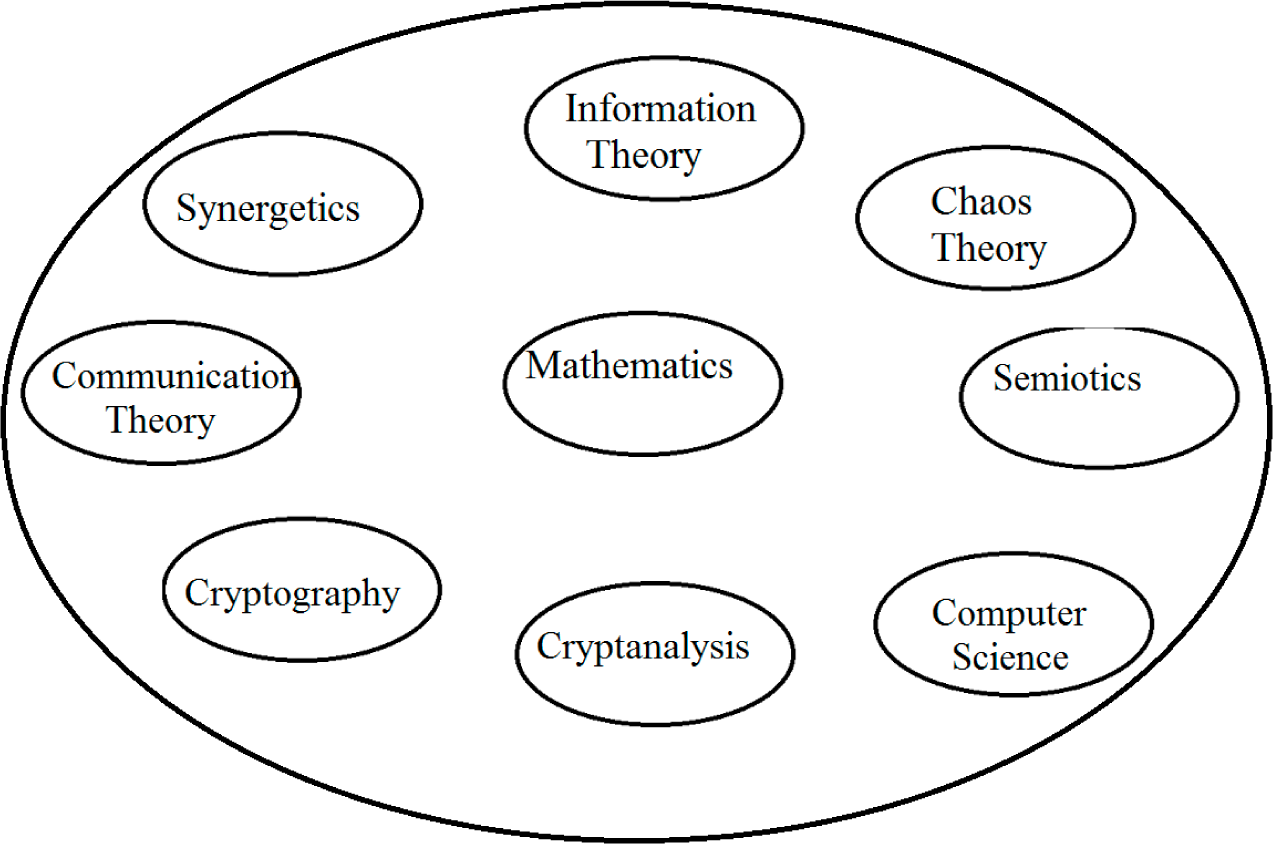
It is the mathematical study of cryptography and cryptanalysis. It is used to provide protection for private information against theft. There are several contributing areas of cryptology [1]. (Figure 1).
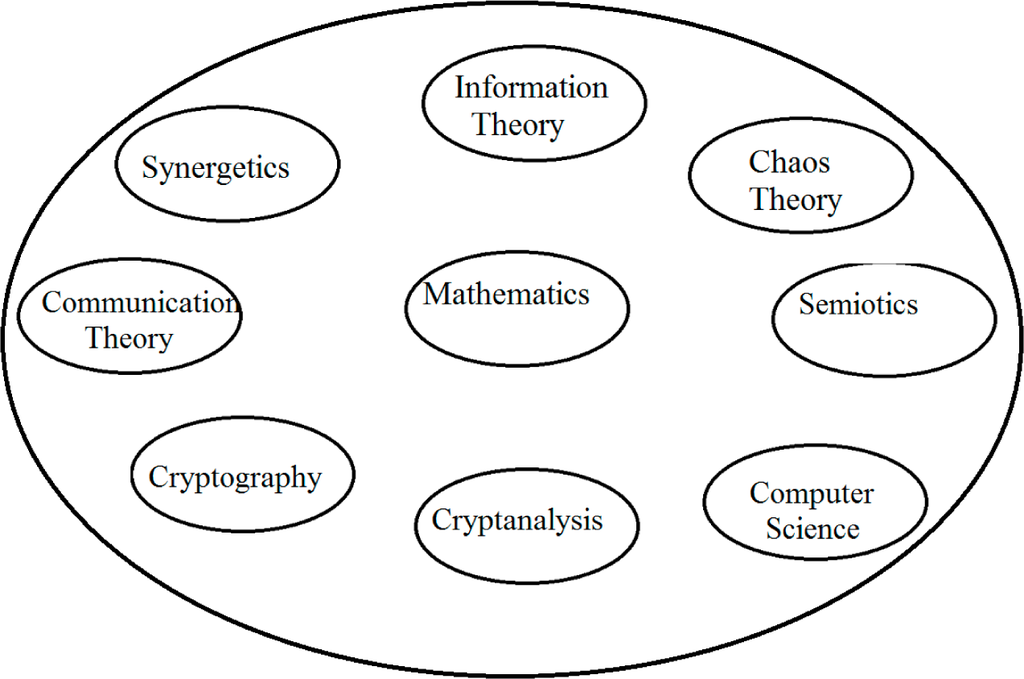
Figure 1.
Contributing subject areas of cryptology.
3. Cryptography
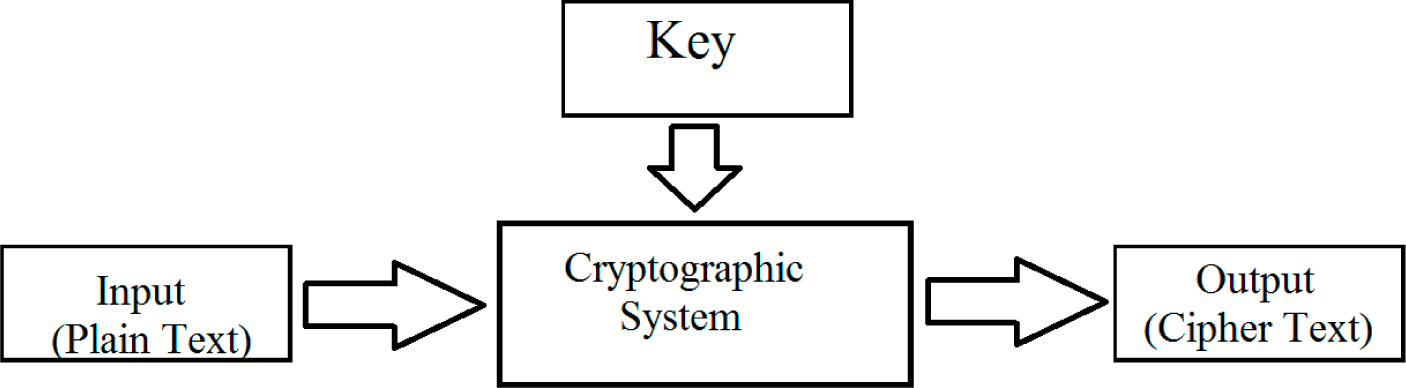
A cryptographic system is a program or collection of programs which has transformed the information in unreadable format (cipher text) in a key dependent and unpredictable manner (Figure 2) [1].
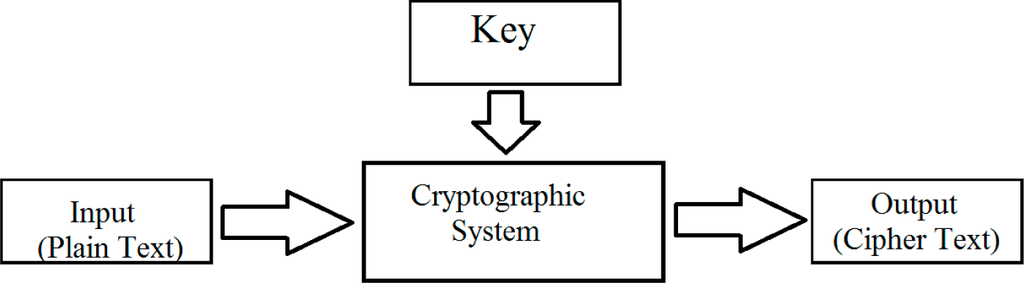
Figure 2.
Cryptosystem.
4. Cryptanalysis [2]
Cryptanalysis is used to break the code and deduce a specific plain text or the key being used. All future and past information encrypted with that key are compromised. Table 1 summarizes the several types of cryptanalysis attacks, based on the amount of information identified by the cryptanalyst.

Table 1.
Cryptanalysis Attacks.
5. Chaos Theory
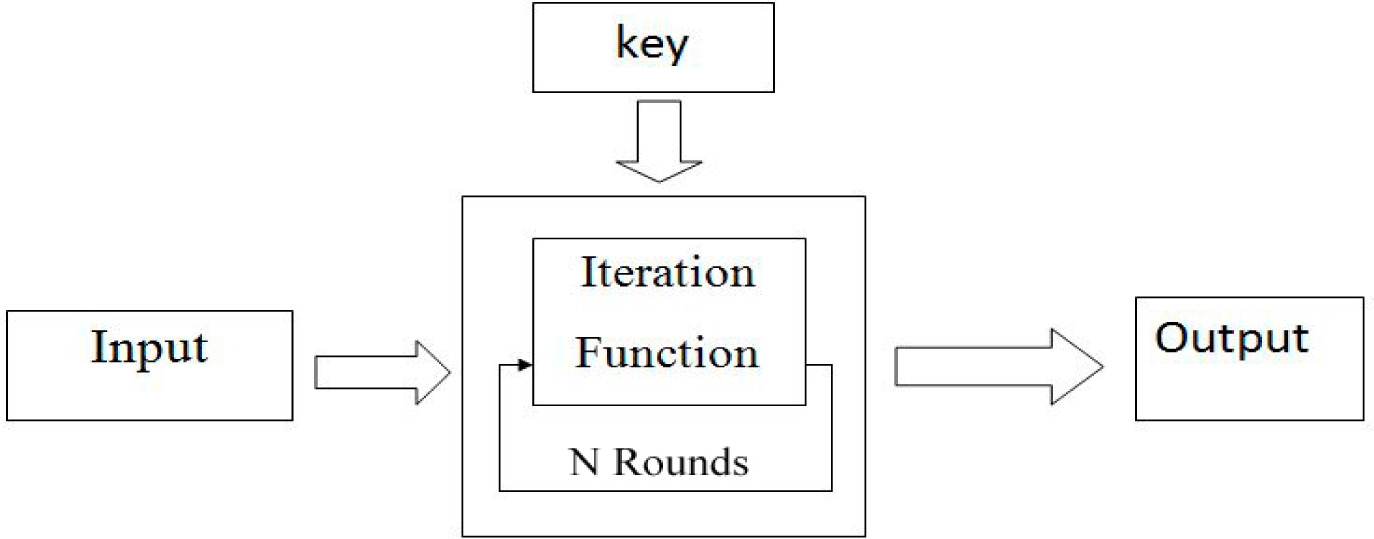
Chaos or chaotic system for short is an intervention between rigid regularity and unpredictability based on probability (Figure 3) [3].
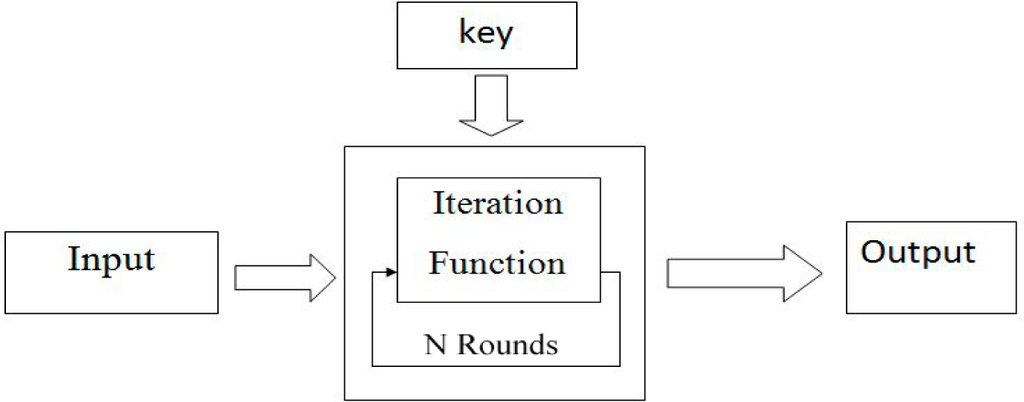
Figure 3.
Chaos iterative function.
Chaos can be defined by some special characteristics [4].
- Nonlinearity: nonlinearity means that the change in an element at an initial time can escort to a change in the same or a different element at a later time, that is not depend to the change at the initial time.
- Determinism: it has not probabilistic (deterministic) which is governed by exact and correct rules with none of the element of chance.
- Sensitivity to initial condition: negligible changes in its initial state can generate fully different final state.
- Irregularity: it means “order in disorder”.
- Long term prediction: chaos gives uncontrolled long term prediction due to sensitivity to initial conditions.
- The logistic map: the chaotic function uses logistic map. The map is one dimensional so it gives scalars for the encryption process.
6. Application Areas of Chaos [4]
Historically, the chaos is used in mathematics and physics in starting. It prolonged into engineering and more recently into information and social science. A few years ago there has been rising interest in commercial and industrial applications of chaotic systems. There are several types of latent commercial and industrial applications based on different aspects of chaos based system which are shown in Table 2 [4].
Table 2.
Chaos based Applications.
7. Chaos and Cryptography [1]
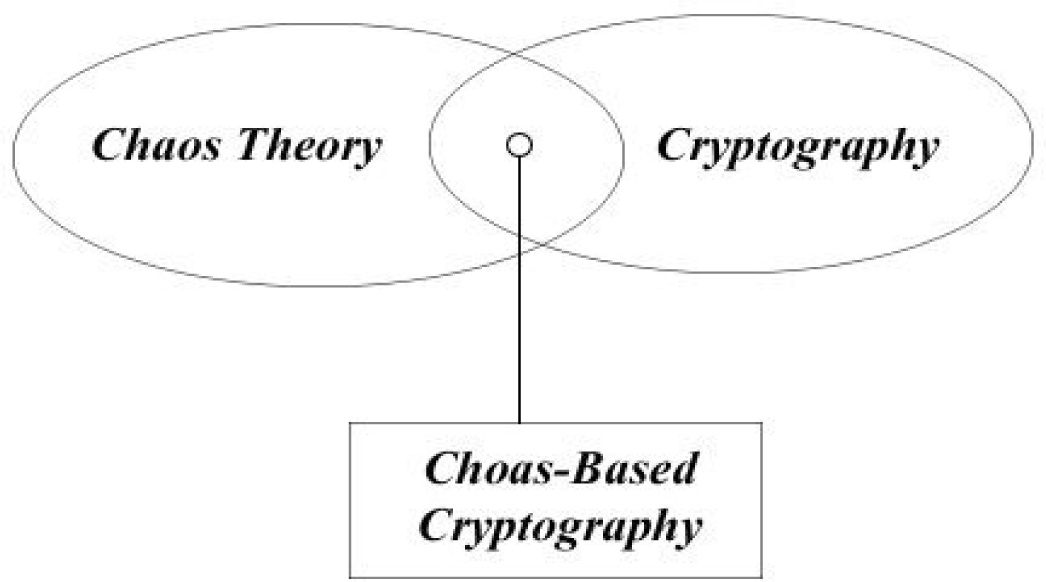
Chaos and cryptography share some similar characteristics shown in Figure 4:
- Both chaotic map and encryption system are deterministic (not probable).
- Both are unpredictable and not simple. It any external observer which has not any knowledge of the algorithm and initial condition as key, cannot understand the random behavior of the system.
- A chaotic system is sensitive to initial condition means Small changes of any element can be fully changed the output. Cryptography is depending key based confusion and diffusion, means modification of one bit of plain text or key could change all bits of the cipher text with 50% probability.
- The iterative chaotic system is topological transitive and cryptography is multi round transformation means Single chaotic map with iterative transformation.
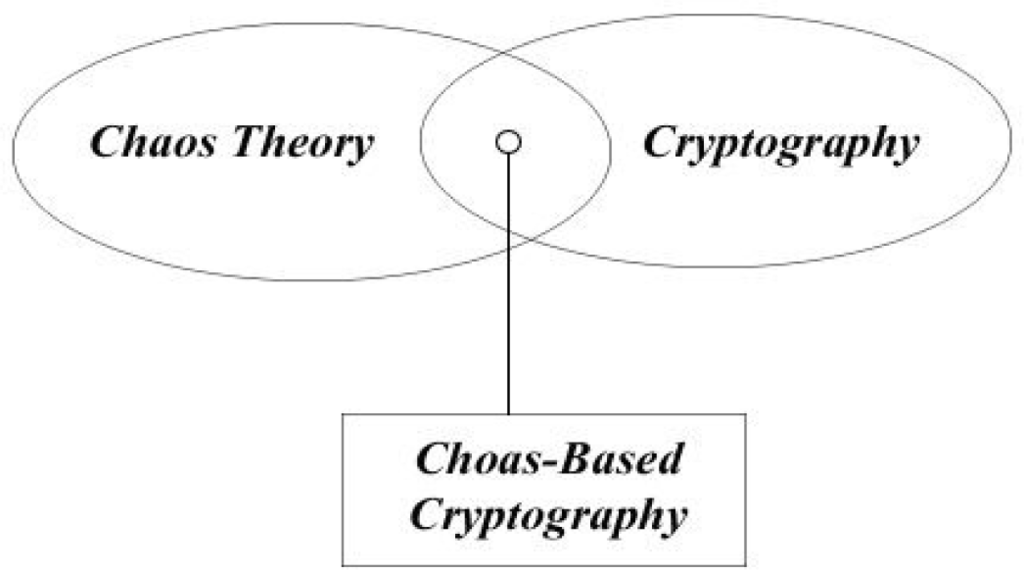
Figure 4.
Relation between chaos and cryptography.
8. Traditional Encryption and Chaos Based Encryption [1]
Chaos is also different from cryptography in some other features [1].
- Chaotic systems are based on real/complex number spaces (bounded continuous space) whereas cryptography defined binary sequences (finite discrete space).
- Chaos theory is providing the idea to understand the asymptotic behavior of iterative processes whereas cryptography defined the characteristics of first a few iterations.
9. Literature Survey
A new scheme is proposed performing lossless compression is based on the arithmetic coding (AC) and also encryption of data is based on a pseudo random bit generator (PRBG). The PRBG based on the standard logistic map and the Engel Continued Fraction (ECF) map to generate a key stream with both chaotic and algebraic features. The effectiveness and high performance of the BAC in lossless data compression and chaotic theory-based data encryption provide a technique used in many applications such as multimedia applications and medical Imaging [3]. Zhang, B. et al. proposed an improved chaos-based stream cipher in which a secret key with two158 key space sizes is composed of three independent chaos initial states. One chaos initial state gives two sampling quantified sequences which are generated by other two chaos initial states based on the pre-image compressibility of the logistic map. The probability of success of the algorithm is 1 and the computational complexity is 260.7 and negligible memory complexity and data complexity. The secret key entropy of the technique reduces from 158 to 60.7 [5]. A Modified Logistic Map (MLM) is used to get better logistic map performance based on the higher Lyapunov exponent and uniformity of bifurcation map. The proposed cipher provides 16 bits of encrypted data per clock cycle and hardware implementation results on aXilinx Virtex-6 FPGA provides a synthesis clock frequency of 93 MHz and a throughput of 1.5 Gbps using 16 hardware multipliers, so the cipher is appropriate for embedded strategies which have fixed constraints on power consumption, hardware resources and real-time parameters [6,7]. A chaos-based Short Message Service (SMS) encryption scheme is developed which combines with the improved A5/1 algorithm for mobile phones on FPGA. The security of chaos-based SMS encryption scheme can be analyzed on mobile phones [8]. The new high speed chaotic cryptographic scheme requires a little memory capacity, but provides higher security. The proposed method generates better results than the AESCTR based on correlation, UACI, NPCR, and NIST statistical tests. Encryption speed and security of the method is very high and its realization is easy with large key size and low memory capacity, so it fulfills the requirements of industrial control used in Wi-Fi and ZigBee networks [9,10].
Electrocardiogram (ECG) signals could be applied as a new tool for biometric recognition which isused for information security. The encryption system collects ECG signals from the person performing the encryption using a portable instrument. The chaos theory-based algorithm is used to generate initial keys for the logistic map for encryption. Simulation results show the efficiency, security and feasibility of the system. The encryption time is also acceptable with same sizes of cipher text and plaintext [11]. The chaotic system at the transmitter and receiver has a secret key and a chaotic system is used for mixing the plaintext with the chaotic output known as pseudo noise. This methodology demonstrated that chaotic maps enhanced the strength of the algorithms as compared to the cases when no chaos is used [12]. A chaotic pseudo cryptosystem is implemented on a finite precision machine to show both analog and digital implementation with the limitations using a pseudo-chaotic cryptosystem [13].
The weaknesses of synchronized chaotic-based cryptosystem are also investigated against known plaintext and chosen plaintext attacks to recover the system parameters. It is shown that the computational complexity of the chosen plaintext attack can be reduced to yield a simple set of linear equations [14]. Chaotic dynamical systems in cryptography are also represented some mathematical properties which determine the security and performance of different algorithms and systems [15]. Periodic switching of cryptographic keys is normally used as a method to boost the security of cryptographic systems, so a new encryption approach is proposed that combines chaotic behavior with the periodic switching of keys. A drawback of the cycling chaos results from the fact that the switching of attractors can potentially enhance the encryption time of each character which is not quantified [16]. The two-dimensional discretized chaotic map-based encryption algorithm was proposed for analyzing the security weaknesses against chosen cipher text attacks. A dependence among secret parameters give a smaller key space that can be revealed using a chosen cipher text attack and also shows the feasibility of attacks [17]. The discrete-time hyper chaotic system is applied for the synchronization of a two-channel secure communication system. Numerical simulations demonstrate the efficiency of the two channel-secure communications approach using the synchronization of 3D indiscriminate hyper chaotic H’enon maps as transmitter and receiver key [18].
Chaos-based techniques are also useful for block encryption ciphers based on two well-known chaotic maps—exponential and logistic—used to produce ciphers with differential and linear approximation probabilities. Cryptanalysis shows that there exists no more efficient attack to ciphers than brute force in a Feistel network. The Feistel network generates secure S-boxes: table-driven nonlinear substitution operations with the help of chaos theory[19,20]. The theoretical and simulation results show the high speed and easy implementation and high security of the algorithm with chaotic properties such as ergodicity and sensitive dependence on initial conditions, so it is used practically in secure communication [21,22]. Chaos-based encryption techniques have high unpredictability and simplicity of implementation over conventional secure communications systems. The four chaotic modulation techniques Chaotic Masking (CM), Chaos Shift Keying (CSK), Chaos On-Off Keying (COOK), and Differential Chaos Shift Keying (DCSK) are implemented for the Lorenz system as a chaos generator using Simulink in a Matlab environment [23,24]. The AES algorithm has been used for various wireless sensor network standards such as Zig Bee, Wireless HART and ISA100.11a. Both algorithms are evaluated on TelosB motes and it was demonstrated that the chaos-based algorithm is much faster than the AES-based algorithm with the same cryptography quality [25].
A differential analysis method is introduced to evaluate the feasibility and the security of chaos used in cryptographic algorithm design and conventional cryptosystem for commercial fields [26,27]. The Wei scheme is perfectly used against Unicity distance (The length of an original cipher text needed to break the cipher by reducing the number of possible spurious keys to zero in a brute force attack) mathematically or logically which makes the Wei scheme suitable for practical applications [28]. Chaos cryptogram shave a significant advantage in the encryption of multimedia information which is transmitted in the form of streams from the initial crunode to other crunodes [29]. The public-key cipher based on the finite-state Chebyshev map is slower than RSA and the best conventional algorithms, such as AES. Since this result is by nature asymptotic it is believed that it has no practical consequences, but it does put limits (if theoretical) onchaos-based cryptography with the same standards of security and speed as in conventional cryptography [30,31]. The Chebyshev polynomials-based public key encryption algorithm for textual data provides security against cryptanalysis attacks using a simple hashing algorithm and digital signature [32].
A novel authentication scheme combining chaotic cryptographics and a hashing scheme to produce the hash value for a given message for collision free encryption is used in practical secure communication [33]. The Baptista-type chaotic cryptosystem for embedding compression and encryption using a lookup table is determined adaptively by the probability of occurrence of plaintext symbols. The key space of the cryptosystem is equivalent to 130 bits, which guarantees that the cipher text is no longer than the plaintext [34,35]. A symmetric cryptographic technique based on chaos properties (sensitivity to initial conditions and ergodicity) which are exploited to produce an avalanches effect by which two different keys produce different cipher text for the same message is proposed in [36].
Digital chaotic generators are capable of building robust and fast chaos-based cryptosystems and chaos-based steganography and watermarking systems whose performances are measured in terms of the tradeoff between security and speed [37]. A novel digital anticounterfeiting scheme is developed based on chaotic cryptography which supports multiple and repeated queries for authentication and intelligent identification and provided security against batch copy and database attack fraud [38]. A quantum key establishment process-based cryptography, an extension to the BB84 protocol, K05, using chaos functions with shortest key is developed for faster encryption [39]. Several one-dimensional chaotic maps generate independent and approximately uniform pseudo dynamic sequences for the block encryption algorithm [40]. Deng developed improved clock synchronized and unsynchronized schemes using a chaotic maps-based key agreement protocol. It is described that the asynchronous key agreement protocol can’t resist replaying attacks so it is not used for security applications [2]. Every single character is encrypted by the Baptista method using a regular changing key for controlling the chaos attractor to improve the encryption security [41]. A new kind of chaotic encryption algorithm, duality chaos, is also proposed to overcome the limitations of chaotic systems for practical applications [42].
10. Comparison Table
The various research papers have been summarized based on some features in Table 4.
Table 4.
Comparison table.
11. Summary
Security and reliability of chaos-based encryption algorithms is enhanced by using PWLCM and Periodic Switching in C++ and a Matlab environment but at the same time implementation and maintenance cost of techniques are also increased because of the complexity of the algorithms. These applications are very useful for industrial and medical applications [3,9,16]. If an algorithm is compromised with security and feasibility then the cost and space-time complexity is reduced [3,6,43]. Qualities of techniques depend upon the accuracy, cost and processing time of the algorithm. If the feasibility of an algorithm is not possible then it shows the low quality and efficiency of the encryption technique [10,11,46]. Key length is also used to measure the prediction possibility and the complexity of algorithms. Large key length enhances the security and also space and time complexity but also increases the processing and memory cost [5,45–47].
Security of algorithms is analyzed against security attacks, i.e., linear and differential cryptanalysis attacks using the Baptista system and TDCM system [13,17]. Some proposed algorithms are very strong against all cryptanalysis (plain text attack, known plaintext attack, etc.) attacks but the cost of these cryptosystems also enhanced with the quality and accuracy [12,13,17,18]. Key length is taken to be very large for increasing the complexity and security of algorithms [12–14]. Feasibility and efficiency are also used to describe the quality of maintenance and accuracy [18,48].
Chaotic masking and switching used for block and stream cipher in non-linear dynamic systems enhances the security, speed, accuracy and reliability of encryption systems without compromising the quality and feasibility [23,24,50,57]. Complexity of the algorithms is also increased with large key size, large space complexity and high processing speed by using discrete time chaotic systems for internet banking and communication systems, but also this also enhances the processing and maintenance costs [19,20,23,49]. Industrial and communication systems widely use unpredictable and feasible encryption techniques for secure and fast transmission of information [8,26,29]. Speed and accuracy of algorithms are also important factors for measuring the complexity and quality of algorithms. Security is a major issue for military and industrial applications [1]. It is the strength of the algorithms against different intruder attacks and cryptanalysis attacks [25,26,30].
Data integration, repudiation, secrecy and authentication are necessary key factors of any communication system. These are achieved by using some special techniques PLCM map, 3D Baker map, Huffman coding and unicity distance which are secure, fast, reliable and accurate [27,28,32,34]. Feasible and predictive systems are easily attacked by intruders with some effort [27,37]. The secrecy and security is enhanced by using large key size and complex algorithms. These techniques are widely used in multimedia applications [33,51]. High cost is an unnecessary drawback for industrial and communication systems but systems cannot use cheap circuits and equipment because of security [31,35,52]. Cost is also increased by using large key-based encryption systems and expensive environment like the NIST, Rosseler system and Lyapunov exponent system but security and quality of the algorithm are also enhanced [24,53]. All the systems are not much stronger against different types of attacks so these are not useful for real time applications [22,52]. The running time and space complexity have much high for large key size [36,54]. These properties are useful for industrial and multimedia applications with secure, qualitative, accurate and fast transmission for authenticated and confidential communication [15,56]. Feasible systems with data integration, repudiation, secrecy and authentication are achieved by taking large key size and complex algorithms which are widely used in mutual authentication systems [38,39,59]. The quality of the techniques depends upon the accuracy of the algorithm and key which are given unpredictable and infeasible stream and block cipher [40,57]. The speed of these systems is considerable because key length and implementation complexity of algorithm is high using the REC/RPB Scheme, BB84 Algorithm, and Digital Anticounterfeiting Technique [39,57,58].
Biological, physical, chemical and communication systems are broadly used for accurate and unpredictable secure encryption techniques [4,41]. These systems use complex algorithms and large key size for encrypting and decrypting the messages [2,7,41]. This introduces unwanted processing delays but also increases the security, accuracy and quality of algorithms [4,42,62]. Fast encryption does not provide reliability and high security, but reduces processing time [2,61].
12. Conclusions
On the basis of a study of all the above mentioned research papers it is determined that chaos has a number of characteristics such as good pseudo randomness, unpredictability and extreme sensitivity to initial state and structural parameters. These properties of chaotic systems are useful for faster and secure encryption and decryption of text as well as images with less computation as compared to conventional cryptography. Chaos-based encryption techniques are easily realized and have a very large key range and need low memory capacity, so they can be used in Wi-Fi and ZigBee networks in industrial control. Chaos-based algorithms should be implemented for protecting multimedia contents and logistic maps utilized to design new cryptographic algorithms. New hash functions can be generated with the help of a logistic map which gives better results than the current existing hash functions and it can also implemented in hardware. Chaotic maps increase the strength of the algorithm as compared to the cases when no chaos is used. The confusion and diffusion of chaos functions should be used for providing better trade-offs between security and computational complexity.
Conflicts of Interest
The authors declare no conflict of interest.
References
- Blackledge, J.M. Cryptography using Chaos. Available online: http://konwersatorium.pw.edu.pl/wyklady/2010_VLZ7_02_wyklad.pdf accessed on 17 March 2015.
- Guo, X.; Zhang, J. Cryptanalysis of the Chaotic-based Key Agreement Protocols. Proceedings of the International Symposium on Biometrics and Security Technologies (ISBAST), Islamabad, Pakistan, 23–24 April 2008, 1–3.
- Masmoudi, A.; Puech, W.; Bouhlel, M.S. A new joint lossless compression and encryption scheme combining a binary arithmetic coding with a pseudo random bit generator. Int. J. Comput. Sci. Inf. Secur. 2010, 8, 170–175. [Google Scholar]
- Ditto, W.; Munakata, T. Principles and Applications of Chaotic System. Comm. ACM. 1995, 38, 96–102. [Google Scholar]
- Zhang, B.; Jin, C. Cryptanalysis of a Chaos-based Stream Cipher. Proceedings of the 9th International Conference for Young Computer Scientists, Hunan, China, 18–21 November 2008, 2782–2785.
- Pande, A.; Zambreno, J. A Chaotic Encryption Scheme for Real-Time Embedded Systems: Design and Implementation. Telecommun. Syst. 2013, 52, 551–561. [Google Scholar]
- Geng, Z.; Guanrong, C.; Jingqing, F.; Gang, X. Block Cipher Design: Generalized Single-Use-Algorithm Based on Chaos. Tsinghua Sci. Tech. 2011, 16, 194–206. [Google Scholar]
- Pan, J.; Ding, Q.; Qi, N. The Research of Chaos-based SMS Encryption in Mobile Phone. Proceedings of the Second International Conference on Instrumentation & Measurement, Computer, Communication and Control, Harbin City, China, 8–10 December 2012, 501–504.
- Bakhache, B.; Ahmad, K.; el Assad, S. A New Chaotic Encryption Algorithm to Enhance the Security of ZigBee and Wi-Fi networks. Int. J. Intell. Comput. Res. 2011, 2, 219–227. [Google Scholar]
- Bakhache, B.; Ahmad, K.; el Assad, S. Chaos Based Improvement of the Security of ZigBee and Wi-Fi Networks Used for Industrial Controls. Proceedings of the International Conference on Information Society (i-Society), London, UK, 27–29 June 2011, 139–145.
- Chen, C.K.; Lin, C.L. Text Encryption Using ECG signals with Chaotic Logistic Map. Proceedings of the the 5th Conference on Industrial Electronics and Applications (ICIEA) IEEE, Taichung, Taiwan, 15–17 June 2010, 1741–1746.
- Elkamshoushy, D.H.; Aboulsoud, A.K. Cryptographic Schemes Using Chaotic System. Proceedings of the National Radio Science Conference NRSC, Tanta, Egypt, 18–20 March 2008, 1–6.
- Curiac, D.I.; Iercan, D.; Dranga, O.; Dragan, F.; Banias, O. Chaos-Based Cryptography: End of the Road? Proceedings of the International Conference on Emerging Security Information, System and Technologies, Valencia, Spain, 14–20 October 2007, 71–76.
- Solak, E. Cryptanalysis of Observer Based Discrete-Time Chaotic Encryption Schemes. Int. J. Bifurcat. Chaos Appl. Sci. Eng. 2005, 15, 653–658. [Google Scholar]
- Schmitz, R. Use of chaotic dynamical systems in cryptography. J. Franklin Inst. 2001, 338, 429–441. [Google Scholar]
- Palacios, A.; Juarez, H. Cryptography with cycling chaos. Phys. Lett. 2002, 345–351. [Google Scholar]
- Solak, E.; Cokal, C. Cryptanalysis of a cryptosystem based on discretized two-dimensional chaotic maps. Phys. Lett. 2008, 372, 6922–6924. [Google Scholar]
- Linda, F.R.; Hammami, S.; Benrejeb, M.; Borne, P. Synchronization of Discrete-Time Hyperchaotic Maps Based on an Aggregation Technique for Encryption. Proceedings of the 9th International Multi-Conference on systems, Signals and Devices, Chemnitz, Germany, 20–23 March 2012, 1–6.
- Babu, G.S.; Ilango, P. Higher Dimensional Chaos for Audio Encryption. 52–58.
- Jakimoski, G.; Kocarev, L. Chaos and Cryptography: Block Encryption Ciphers Based on Chaotic Maps. IEEE Trans. Circ. Syst. Fund. Theor. Appl. 2001, 48, 163–169. [Google Scholar]
- Tang, G.; Liao, X.; Xiao, D.; Li, C. A Secure Communication Scheme Based on Symbolic Dynamics. Proceedings of the 2004 International Conference on Communications, Circuits and Systems, Chengdu, China, 27–29 June 2004, 13–17.
- Kocarev, L. Chaos-Based Cryptography: A Brief Overview. IEEE Circ. Syst. Mag. 2001, 1, 1–16. [Google Scholar]
- Kamil, I.A.; Fakolujo, O.A. Lorenz-Based Chaotic Secure Communication Schemes. Ubiq. Comput. Commun. J 2008, 7, 1248–1254. [Google Scholar]
- Sobhy, M.I.; Shehata, A.R. Chaotic Algorithm for Data Encryption. 997–1000.
- Mansour, I.; Chalhoub, G.; Barkhache, B. Evaluation of a fast symmetric cryptographic algorithm based on the chaos theory for wireless sensor networks. 913–919.
- Wei, J.; Zheng, J.; Yu, J.; Shuai, Y. Selection of Chaotic States in Cryptosystem Based on Chaos with Differential Analysis. Proceedings of the 7th International Conference on Computer Science & Education, Melbourne, Australia, 14–17 July 2012, 325–330.
- Wei, J.; Shuai, Y.; Yu, J. Cryptography with Two Discretized Chaotic Maps. Proceedings of the 8th International Conference on Computer Science & Education, Colombo, Sri Lanka, 26–28 April 2013, 977–981.
- Wei, J.; Zheng, J.; Yu, J.; Shuai, Y. Application of Unicity distance in a cryptosystem based on chaos. Proceedings of the 7th International Conference on Computer Science & Education, Melbourne, Australia, 14–17 July 2012, 345–348.
- Luo, J.; Shi, H. Research of Chaos Encryption Algorithm Based on Logistic Mapping. Proceedings of the International Conference on Intelligent Information Hiding and Multimedia Signal, Pasadena, CA, USA, 18–20 December 2006, 1–3.
- Amigo, J.M.; Kocarev, L.; Szczepanski, J. Theory and practice of chaotic cryptography. Phys. Lett. 2007, 366, 211–216. [Google Scholar]
- Kocarev, L.; Amigo, J.M.; Szczepanski, J. Chaos-based Cryptography: an overview. Proceedings of the International Symposium on Nonlinear Theory and its Applications, Bruges, Belgium, 18–21 October 2005, 453–456.
- Prasadh, K.; Ramar, K.; Gnanajeyaraman, R. Public key cryptosystems based on chaotic Chebyshev polynomials. J. Eng. Tech. Res. 2009, 1, 122–128. [Google Scholar]
- Wei, J.; Zheng, X.; Yu, J.; Shuai, Y. A Novel Authentication Scheme Based on Chaos. Proceedings of the 8th International Conference on Computer Science & Education, Colombo, Sri Lanka, 26–28 April 2013, 879–882.
- Wong, K.W.; Yuen, C.H. Embedding Compression in Chaos-Based Cryptography. IEEE Trans. Circ. Syst. 2008, 55, 1193–1197. [Google Scholar]
- Wong, K.-W.; Lin, Q.; Chen, J. Simultaneous Arithmetic Coding and Encryption Using Chaotic Maps. IEEE Trans. Circ. Syst. 2010, 57, 146–150. [Google Scholar]
- Rani, P.J.; Bhavani, S.D. Symmetric Encryption using Logistic Map. Proceedings of the 1st International Conference on Recent Advances in Information Technology (RAIT), Dhanbad, India, 15–17 March 2012, 1–5.
- Assad, S.E. Chaos Based Information Hiding and Security. Proceedings of the 7th International Conference for Internet Technology and Secured Transactions, London, UK, 10–12 December 2012, 67–72.
- Sheng, S.; Wu, X. A New Digital Anti-counterfeiting Scheme Based on Chaotic Cryptography. International Conference on ICT Convergence (ICTC), Jeju City, Korea, 15–17 October 2012, 687–691.
- Kartalopoulos, S.V. Chaotic Quantum Cryptography: The Ultimate for Network Security. Proceedings of the International Conference on e-Business (ICE-B), Athens, Greece, 26–28 July 2010, 1–16.
- Yuan, W.X.; Qing, Y. A block encryption algorithm based on dynamic sequences of multiple chaotic systems. Comm. Nonlinear. Sci. Numer. Simulat. 2009, 14, 574–581. [Google Scholar]
- Xiao, Y.P.; Han, Y. An Encrypt Approach Using Dynamic Encrypt Keys. Proceedings of the 6th International Conference on Machine Learning and Cybernetics, Hong Kong, China, 19–22 August 2007, 3273–3277.
- Zhang, Z.; Liu, K.; Niu, X.; Bai, X. The Research of Hardware Encryption Card Based on Chaos. Proceedings of the International Conference on Sensor Network security Technology and Privacy Communication System (SNS & PCS), Taipei, Taiwan, 18–19 May 2013, 116–119.
- Orue, A.B.; Fernandez, V.; Alvareza, G.; Pastor, G.; Shujun Lib, M.; Montoya, F. Determination of the Parameters for a Lorenz System and Application to Break the Security of Two-channel Chaotic Cryptosystems. Phys. Lett. 2008, 372, 5588–5592. [Google Scholar]
- Elshamy, A.M.; Rashed, A.N.Z.; Mohamed, A.E.A.; Faragalla, O.S.; Mu, Y.; Alshebeili, S.A.; El-Samie, F.E.A. Optical Image Encryption Based on Chaotic Baker Map and Double Random Phase Encoding. J. Lightwave Tech. 2013, 31, 2533–2539. [Google Scholar]
- Agrawal, B.; Agrawal, H. Survey Report on Chaos Based Cryptography. Int. J. Appl. Sci. Eng. Tech. 2012, 2, 1–19. [Google Scholar]
- Aimone, B.; Larson, S. Chaotic Circuits and Encryption. Available online: http://edrf.ucsd.edu/neurophysics/courses/physics_173_273/AimoneLarsonChaos.pdf accessed on 17 March 2015.
- Wang, C.; Ge, S.S. Adaptive synchronization of uncertain chaotic systems via backstepping design. Chaos Solitons Fractals. 2001, 12, 1199–1206. [Google Scholar]
- Peng, F.; Zhu, X.W.; Long, M. An ROI Privacy Protection Scheme for H.264 Video Based on FMO and Chaos. IEEE Trans. Inf. Foren. Sec. 2013, 8, 1688–1699. [Google Scholar]
- Alvarez, G.; Montoya, F.; Romera, M.; Pastor, G. Cryptanalysis of a Chaotic Encryption System. Phyc. Lett. 2000, 276, 191–196. [Google Scholar]
- Alvarez, G.; Li, S. Some Basic Cryptographic Requirements for Chaos-Based Cryptosystems. Int. J. Bifurcat. Chaos Appl. Sci. Eng. 2006, 16, 2129–2151. [Google Scholar]
- Kelber, K.; Schwarz, W. General Design Rules for Chaos-Based Encryption Systems. Proceedings of the International Symposium on Nonlinear Theory and its Applications NOLTA, Bruges, Belgium, 18–21 October 2005, 465–468.
- Sheu, L.J.; Chen, W.C.; Chen, Y.C.; Weng, W.T. A Two-Channel Secure Communication Using Fractional Chaotic Systems. Proc. World Acad. Sci. Eng. Tech. 2010, 41, 1057–1061. [Google Scholar]
- Azzaz, M.S.; Tanougast, C.; Sadoudi, S.; Dandache, A. New Hardware Cryptosystem Based Chaos for the Secure Real-Time of Embedded Applications. 251–254.
- Beltran, R.H. Low-complexity chaotic encryption system. Revista Mexicana De Fisica. 2007, 53, 58–65. [Google Scholar]
- Li, S.; Mou, X.; Cai, Y. Improving Security of a Chaotic Encryption Approach. Phys. Lett. 2001, 290, 127–133. [Google Scholar]
- Li, S.; Alvarez, G.; Li, Z.; Halang, W.A. Analog Chaos-based Secure Communications and Cryptanalysis: A Brief Survey. Proceedings of 3rd International IEEE Scientific Conference on Physics and Control (PhysCon’ 2007), Potsdam, Germany, 3–7 September 2007, 1–6.
- Hong, S.C.; Kuo, C.H.; Chen, H.K.; Chen, C.H. A Chaos based Multiple Security Encryption system for Compressed Video. Int. J. Innov. Comput. Inf. Control. 2011, 7, 4635–4652. [Google Scholar]
- Vaidyanathan, S. Complete Synchronization of Hyperchaotic Xu and Hyperchaotic Lu Systems via Active Control. Int. J. Comput. Sci. Eng. Survey. 2012, 3, 1–15. [Google Scholar]
- Yang, T. A Survey of Chaotic Secure Communication Systems. Int. J. Comput. Cognit. 2004, 2, 81–130. [Google Scholar]
- Lozi, R.; Chua, L.O. Secure Communications via Chaotic Synchronization II: Noise Reduction by Cascading Two Identical Receivers. Int. J. Bifurcat. Chaos Appl. Sci. Eng. 1993, 3, 1319–1325. [Google Scholar]
- Wu, Z.G.; Shi, P; Su, H.; Chu, J. Sampled-Data Synchronization of Chaotic Lur’e Systems with Time Delays. IEEE Trans. Neural Netw. Learn. Syst. 2013, 24, 410–421. [Google Scholar]
- Li, Z.; Li, K.; Wen, C.; Soh, Y.C. A New Chaotic Secure Communication System. IEEE Trans. Commun. 2003, 51, 1306–1312. [Google Scholar]
© 2015 by the authors; licensee MDPI, Basel, Switzerland This article is an open access article distributed under the terms and conditions of the Creative Commons Attribution license (http://creativecommons.org/licenses/by/4.0/).