


Abstract
Three-way concept analysis (3WCA) is extended research of formal concept analysis (FCA) by combining three-way decision. The three-way object oriented concept lattice (OEOL) is one of the important data structures which integrates rough set, concept lattice and three-way decision in 3WCA. In the paper, we investigate the characteristics of formal context based on the isomorphic relationship among the kinds of concept lattices with OEOL. Firstly, II-dual intersectable attributes and II-dual intersectable context are proposed and the relationship between the type I-dual intersectable context(dual intersectable context) and the type II-dual intersectable context are studied. In addition, the relationship among the kinds of concept lattices with OEOL are studied when the formal context is both I-dual intersectable context and II-dual intersectable context. Finally, the inverse problems of the above conclusions are discussed and the following two conclusions are obtained: (1) the formal context is the type II-dual intersectable context, when the object oriented concept lattice and OEOL are isomorphic. (2) In addition, the formal context is the type I-dual intersectable context, when the concept lattice and OEOL are anti-isomorphic.
1. Introduction
In order to find an application carrier for lattice, FCA was proposed by Wille in 1982 [1,2]. It studies the hierarchical structures (that is, concept lattice) which is induced by a binary relation of objects and attributes. In recent years, FCA becomes an helpfull tool for data processing and knowledge discovery [3,4,5,6,7,8,9,10]. For adapting to different data analysis, Wang et al. studied the AFS concept lattice [11]. Ma et al. proposed the variable threshold concept lattice [12]. Guo et al. provided the power concept lattice [13]. Li et al. gave the approximate concept lattice [14] based on incomplete data. Düntsch and Gediga [15] and Yao [16] proposed the property oriented concept the lattice and object oriented concept lattice, respectively, and so on.
Recently, an outline of three-way decision was proposed [17]. Conflict analysis and FCA has been widely developed based on three-way decision. Three-way conflict analysis was proposed and studied [18,19,20]. In addition, 3WCA was firstly introduced by Qi, Wei and Yao in 2014 [21]. Then, 3WCA has become one of the helpful research problems. Firstly, Qi et al. gave the connections between the three-way concept lattice and classical concept lattice [22]. In terms of lattice building, Qian et al. proposed the method based formal context from the perspective of context [23]. Later, Yang et al. in 2020 proposed the method based on the composite of classical lattices from the perspective of lattice [24]. In terms of attribute reduction, Ren et al studies the reduction theory of three-way concept lattices from the perspectives of preserving intersection (Union) irreducible elements, preserving granular and preserving lattice structure, respectively [25].
In addition, inspired by 3WCA, some new three-way concept lattice models are proposed. Firstly, OEOL was proposed by Wei and Qian based on the ideal of locally completely (no-) possessing [26]. Later, Qian et al. discussed them more comprehensively and detailedly in [27]. Li et al. put forward three-way cognitive concepts based on cognitive theory and studied them through multi granularity method [28]. Conflict analysis model was proposed based on 3WCA by Zhi et al. [29]. Mao and Cheng proposed the three-way rough semiconcept in 2021 [30]. Meanwhile, intuitionistic fuzzy three-way formal concept analysis were studied by using attribute correlation degree in 2021 [31].
However, 3WCA are much more complex than FCA because of the large amount of information the three-way concept lattices carried. So, this brings us a lot of trouble in dealing with them. In addition, FCA has improved maturely. Therefore, it is a good idea to deal with the problems of 3WCA by using the related methods of FCA. Along the above research ideas, Yang et al. used the composite of classical lattices to construct the three-way concept lattices [24]. Long et al. studied attribute-induced three-way concept lattice in incomplete fuzzy formal context by double threshold construction method [32]. Chen et al. used unlabelled text mining methods to study object-induced three-way concept lattice [33]. From the perspective of formal context characteristics, Qian et al. gave a kind of attribute characteristics, that is , which is called the dual intersectable attribute (later, we call it the type I-dual intersectable attribute. The corresponding formal context is called type I-dual intersectable formal context). Furthermore, they studied the isomorphic relation between concept lattice and three-way concept lattices based on the dual intersectable formal context [34].
The literature [34] tells us that means original information describes supplementary information. Inspired by it, we consider another attribute feature by using supplementary information to describe original information and then we investigate the isomorphism among concept lattices, especially the relationship between concept lattice and OEOL in this paper.
The rest of the paper is organized as follows. Section 2 reviewes some notions briefly. In Section 3, we propose the type II-dual intersectable formal context and investigate the relations among some concept lattices including concept lattice, the object oriented concept lattice and OEOL when the formal context is the type II-dual intersectable context. In Section 4, the inverse proposition of related conclusions in Section 3 are given. In addition, several theorems and examples are given. Finally, the summary is given by using a diagram in Section 5.
2. Preliminaries
2.1. Concept Lattice
Firstly, some basic definitions are given.
Definition 1.
[2] Let G and M be two finite sets and I be a binary relation between G and M, we call a formal context. In addition, and are called the object and the attribute, respectively. means that the object g has the attribute m.
A pair of dual operators ∗ for any and and the definitions of formal concept and concept lattice are given as follows.
, X and A are, respectively, called a formal concept, an extent and an intent when and . If and , then and are abbreviated to and , respctively.
If , and , we call the canonical context.
If , and , we call the clarified context.
The set of all formal concepts is called the concept lattice denoted by . For any
, the partial order is defined by:
And it is easy to prove it is a complete lattice with the above partial order.
Remark 1.
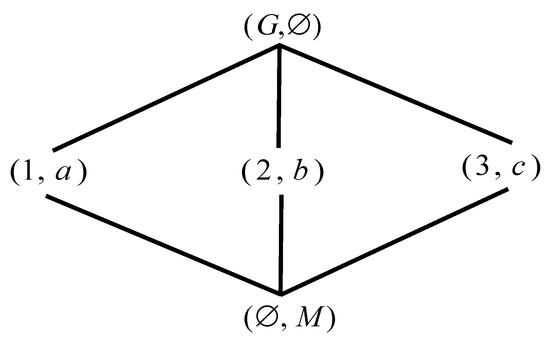
(1) Extent (intent) is still extent (intent) after the intersection of sets. And the properties of operators are shown in the literature [2]; (2) Every set in a lattice except G, M and ∅ is also expressed directly by listing its elements.
2.2. The Object Oriented Concept Lattice
The object oriented concept lattice was proposed by Yao in [16]. In addition, it is recalled as follows.
Definition 2.
[16] Let a formal context be . For any and , a pair of operators and as follows.
is called an object oriented concept. X and A are, respectively, called the extent and the intent of when and . The set of all object oriented concepts form a complete lattice which is called the object oriented concept lattice and is denoted by . The partial order on it is defined as follows:
Remark 2.
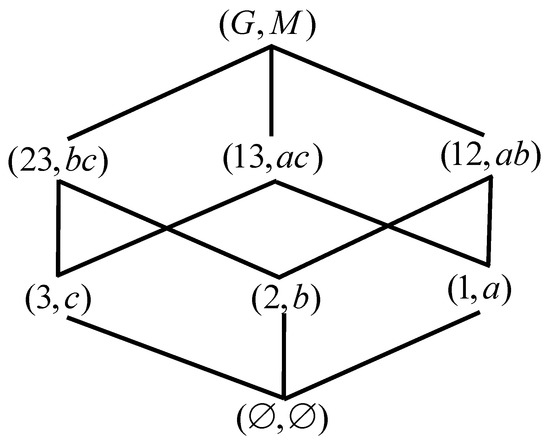
Extent is still extent after the union of sets. And the properties of operators are shown in the literature [16].
2.3. The Three-Way Object Oriented Concept Lattice
Inspired by 3WCA, Wei and Qian [26,27] proposed OEPL and OEOL. The relevant definitions are as follows. Firstly, the negative operators of ∗ are recalled.
Definition 3.
[21,22] Let a formal context be and . For , another pair of operators, and are called negative operators, as follows. For and ,
Based on , the following pair of new negative operators of □ and ◊ are given by using the semantics of locally completely (no-) possessing.
Definition 4.
[26] Let a formal context be . For and , new negative operators are defined as follows: and for and ,
Wei and Qian gave OEO-operators, OEO-concept and OEOL by combing the operators □, ◊, and together.
Definition 5.
[26] Let a formal context be . For and , a new pair of operators(OEO operators), and , are defined by and , respectively.
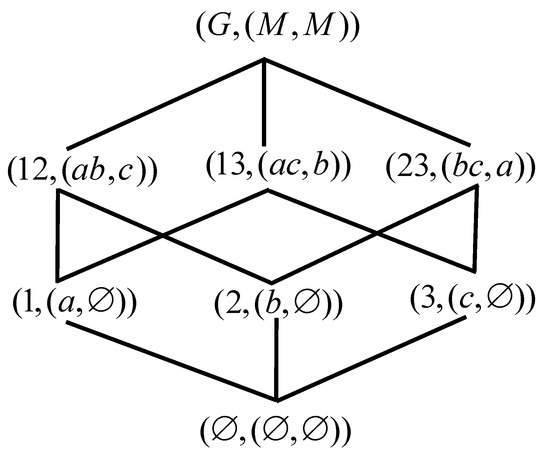
, X and are, respectively, called a three-way object oriented concept (OEO-concept), an extent and an intent, if and only if and . The family of all OEO-concepts of is denoted as , and is abbreviated as OEOL, where ≤ is
3. The Relations between Kinds of Concept Lattices and OEOL
In this section, the relations between kinds of concept lattice and OEOL based on some context are explored firstly.
For the convenience of description, we give the following symbols:
The set consisting of all extents of the formal concepts, the set of all extents of the object oriented concepts and the family of all extents of the three-way object oriented conceptsis are, respectively, denoted by , and .
3.1. The Type II-Dual Intersection Formal Context
In fact, Qian et al. studied the isomorphic relation between concept lattice and three-way concept lattices. In addition, then they proposed the dual intersectable context [34]. Similarly, we propose another form of dual feature of attributes in this subsection. In order to distinguish, we call the original dual feature of attributes as type I.
Definition 6.
Let a formal context be , . If there are some which satisfies , then a is called a type II-dual intersection attribute.
The attribute features described in Definition 6 means that original information are described supplementary information. Let’s explain it with the following example.
Example 4.

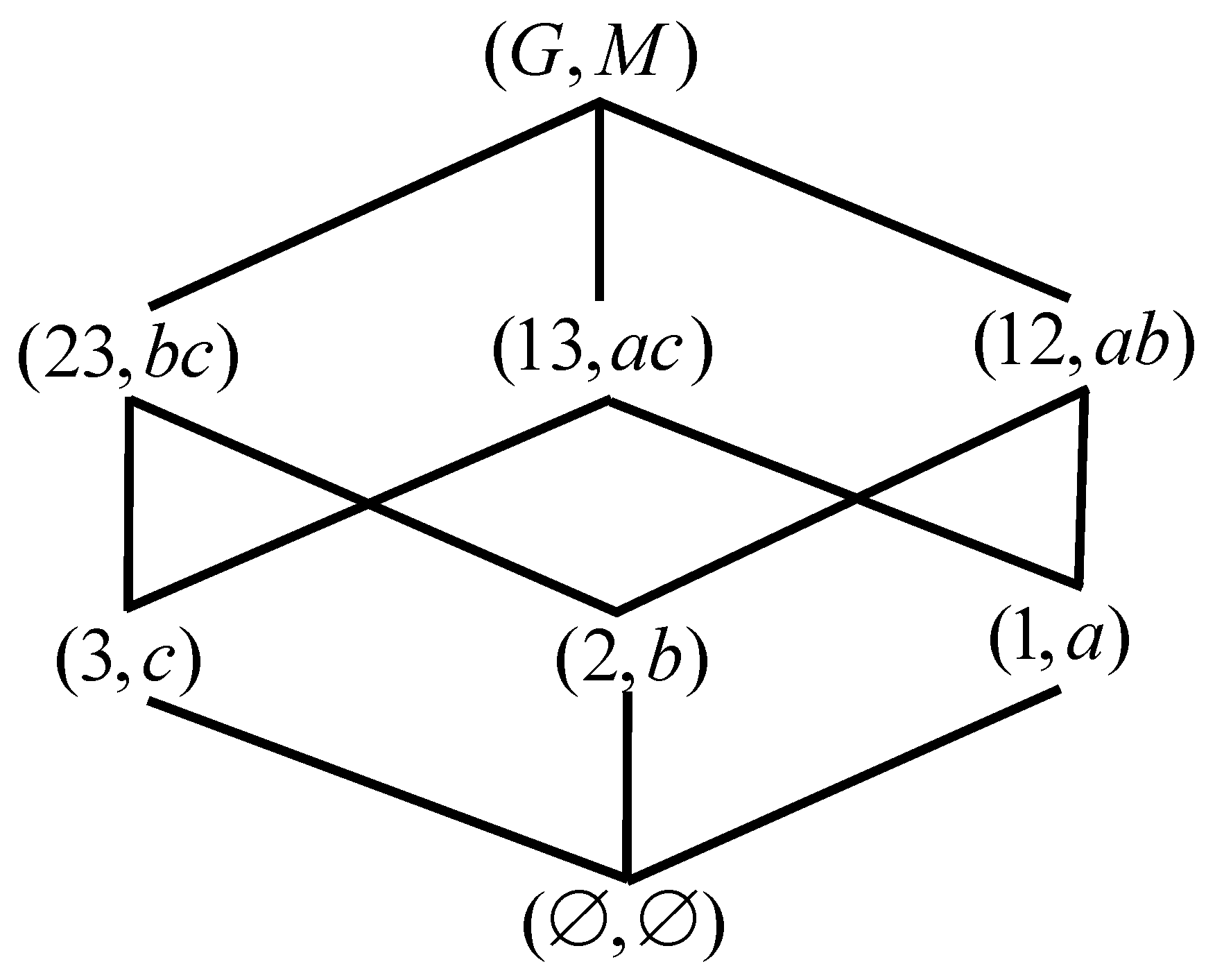
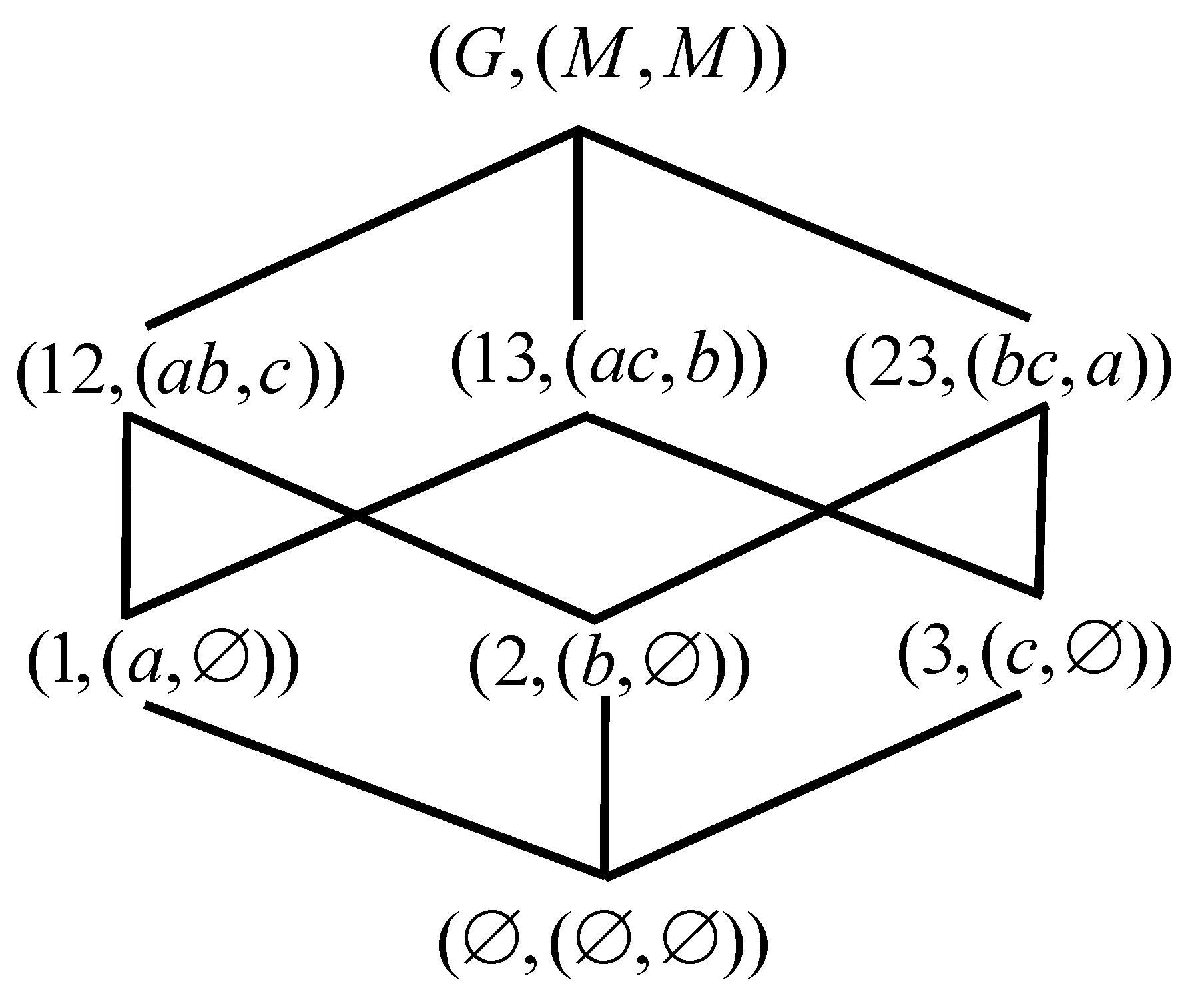
A formal context is represented in Table 2. By definition of *, we can compute that , , so we get . It’s easy for us to verify that a is a type II-dual intersection attribute by Definition 6.
Table 2.
A formal context .
Next, we describe the features of formal context based on the above attribute features. In addition, we explain it by examples.
Definition 7.
Let a formal context be . If a is type II-dual intersection attribute for any , then is called a attribute-induced type II-dual intersection formal context.
Example 5.
We can calculate the following results in turn from Table 2.
, , , so we get ).
, , , so we get ).
, , , so we get ).
, , so we get .
, , so we get .
It’s easy for us to verify is a attribute-induced type II-dual intersection formal context by Definition 7.
Let’s use a theorem to illustrate the relationship between type I-dual intersection formal context and type II-dual intersection formal context.
Theorem 1.
Let be a formal context. is a type II-dual intersection formal context if and only if is a type I-dual intersection formal context, where .
Proof.
Since we get . In the same way, . Therefore, when is a type II-dual intersection formal context, we obtain for any a by Definition 7. And then is equivalent to . So we get is a type I-dual intersection formal context. vice versa. □
By the proof of Theorem 1, we can easily draw the relationship between type I and type II: (1) a is a type II-dual intersection attribute of if and only if a is a type I-dual intersection attribute of ; (2) is a type II-dual intersection formal context if and only if is a type I-dual intersection formal context.
3.2. The Relationship between Kinds of Concept Lattices and OEOL Based on the Type II-Dual Intersection Context
In the subsection, we will study the relationship among kinds of concept lattices based on the type II-dual intersection context. Firstly, the conclusions about the object oriented concept lattices based on the type II-dual intersection context are discussed.
Theorem 2.
Let a formal context be . If is a type II-dual intersection formal context, then .
Proof.
For any , we get by the property of operators . And . Similarly, we can get . Since is a type II-dual intersection formal context, we can get . Thus, we can get by De Morgan’s law. That is, . In addition, we know . So, we know by the property of operators ◊. For any , we can get . Thus, by the property of operators ◊. Therefore, . □
Combing Theorem 1 and Theorem 2, we can easily obtain the following conclusion.
Theorem 3.
Let be a formal context. If is both a type I-dual intersection formal context and a type II-dual intersection formal context, then .
Theorem 4.
Let a formal context be . If is a type II-dual intersection formal context, then and are isomorphic.
Proof.
For any , we get and by Definition 5. Since is a type II-dual intersection formal context, we can obtain by Theorem 2. And then . Thus, . Therefore, . In addition, for any , we can easily get by the properties of □ and ◊. That is, . In summary, . Therefore, and are isomorphic. □
Next, the following conclusions about concept lattices based on the type II-dual intersection context are drawn.
Theorem 5.
Let a formal context be . If is both a type I-dual intersection formal context and a type II-dual intersection formal context, then .
Proof.
Since is a type I-dual intersection formal context, we get that there are some which satisfies , for any . That is , for any . Thus, by the property of operators. Therefore, . Similarly, since is also a type II-dual intersection formal context, we get . So . □
Through Theorem 5, we can easily establish the following conclusion by constructing isomorphic mapping.
Theorem 6.
Let a formal context be . If is both a type I-dual intersection formal context and a type II-dual intersection formal context, then and are isomorphic.
Proof.
Let , for any , . So we can easily prove that it’s an isomorphic mapping. Thus, we obtain and are isomorphic. □
Let’s illustrate that the inverse proposition of Theorem 6 does not hold by an example.
Example 6.
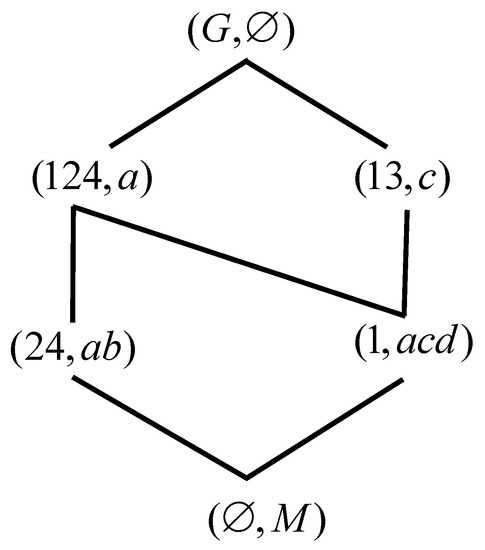
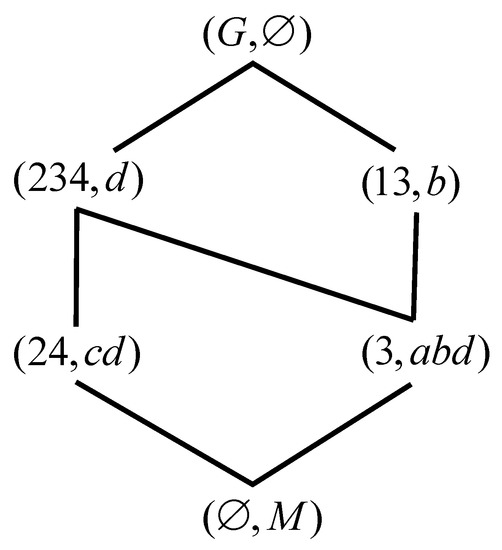
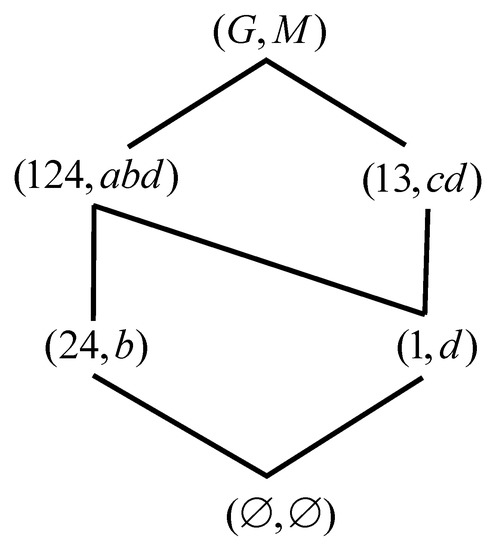
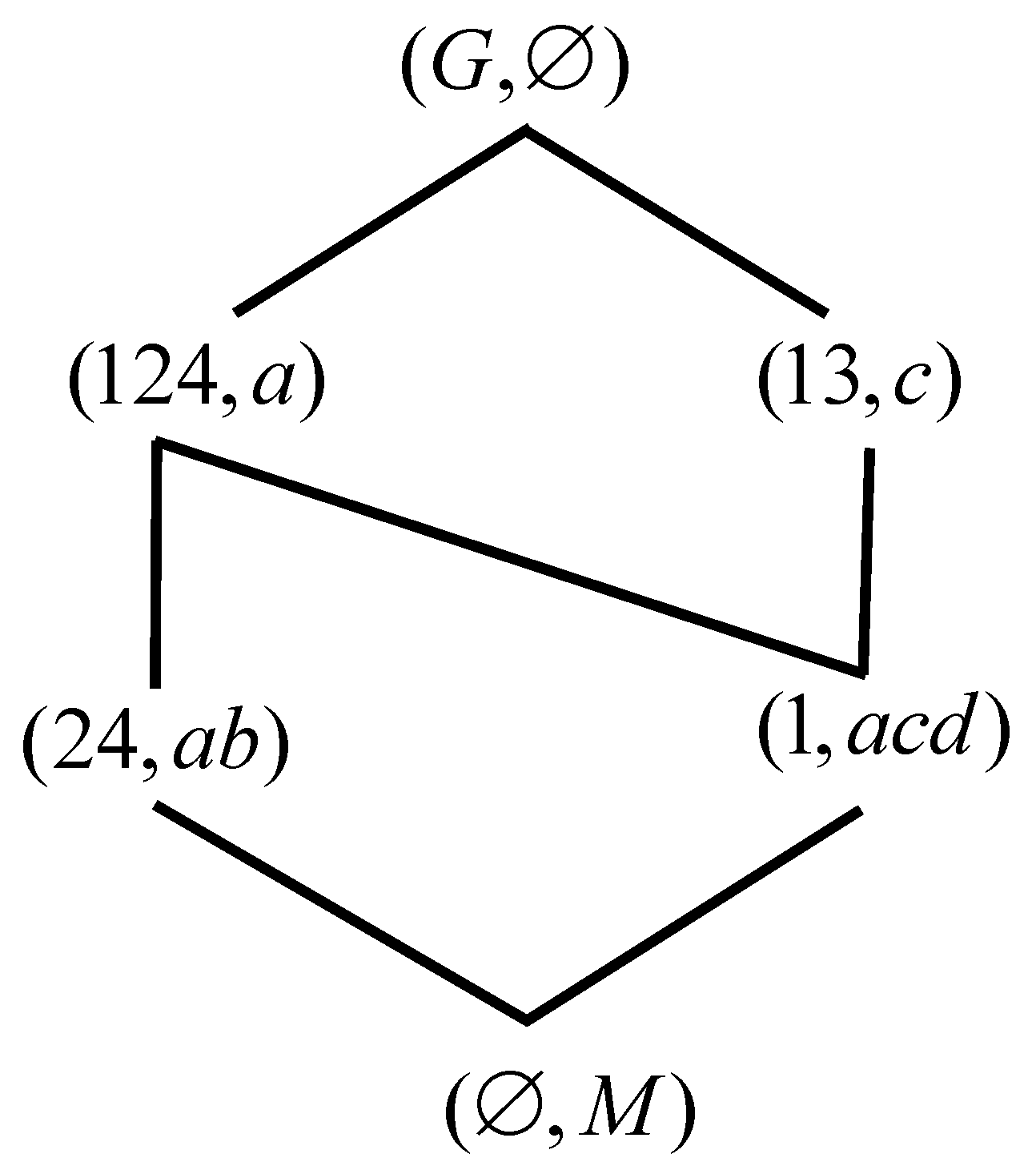
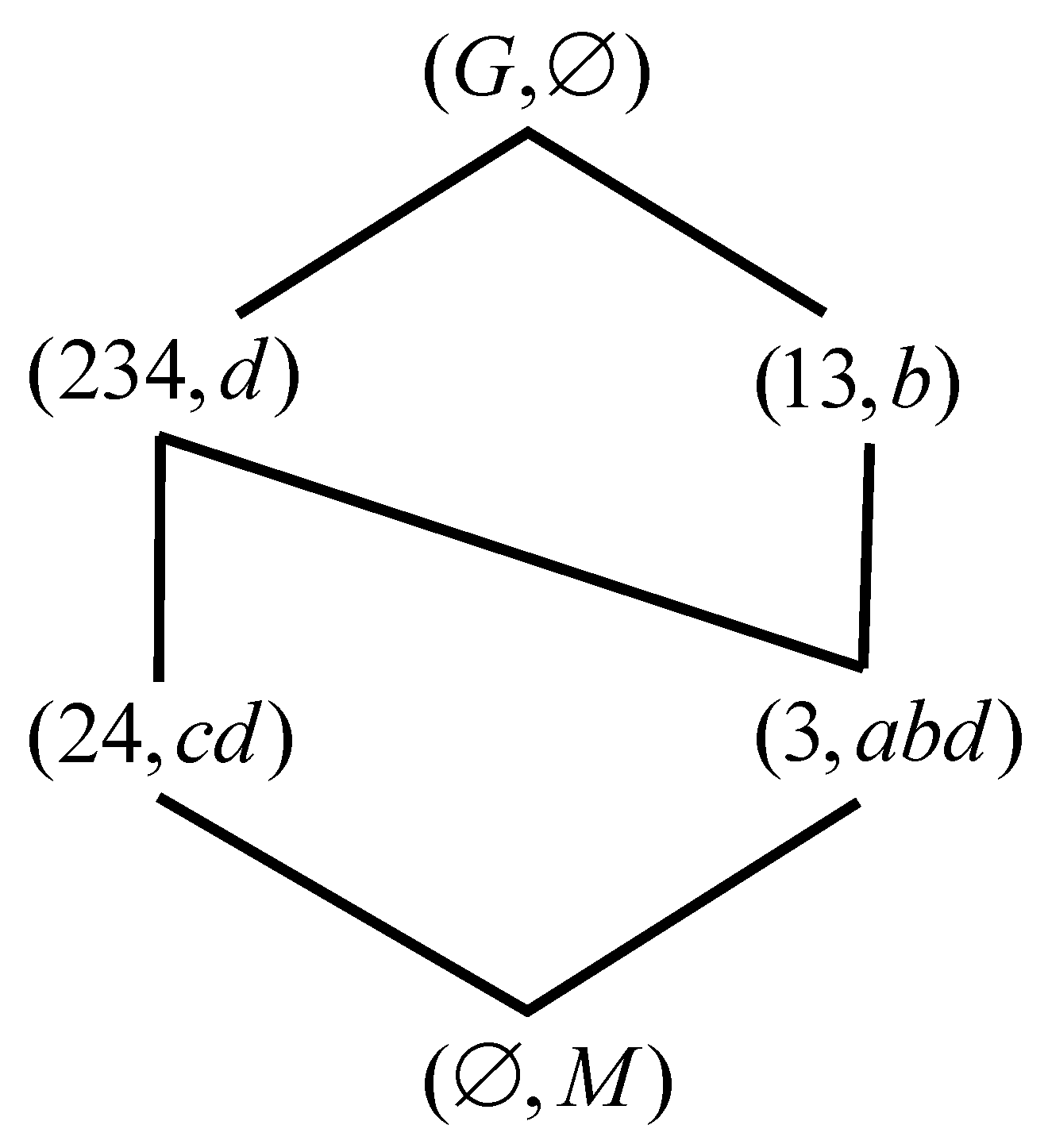
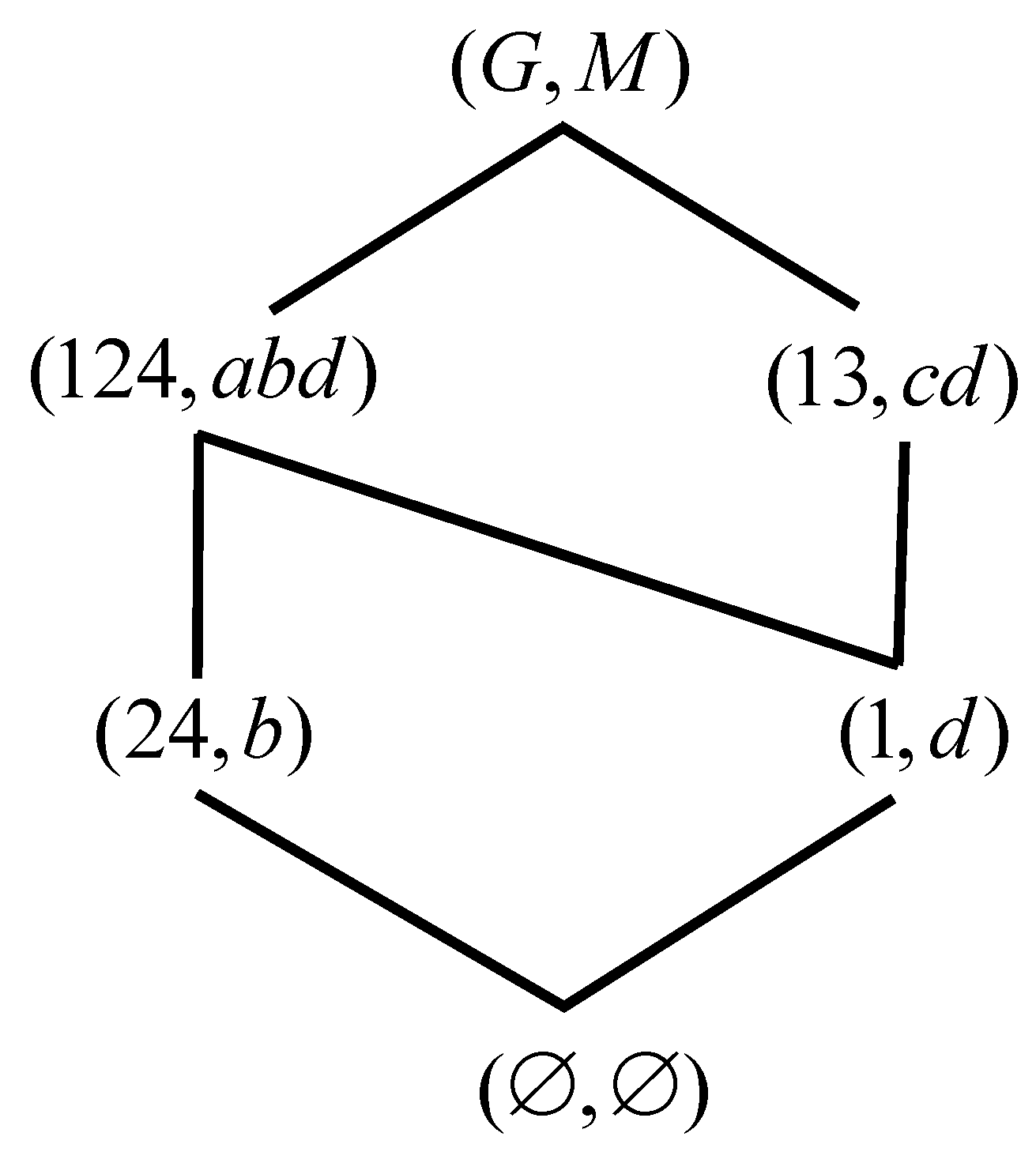
A formal context is shown in Table 3. Figure 4 and Figure 5 are and , respectively. We can obtain , , , , from Table 3. In addition, it’s easy for us to verify d is not a type type I-dual intersection attribute, Thus, the formal context of Table 3 is not a type I-dual intersection formal context. But we can get and are isomorphic from Figure 4 and Figure 5. In fact, we can summarily compute , , , , from Table 3. And it’s easy for us to verify a is not a type II-dual intersection attribute by Definition 6. Thus, the formal context of Table 3 is not a type II-dual intersection formal context by Definition 7.
Table 3.
A formal context .
Figure 4.
of Table 3.
Figure 5.
of Table 3.
Theorem 7.
Let a formal context be . If is a type II-dual intersection context, then and are anti isomorphic.
Proof.
Let , for any , . So let’s prove that it’s an anti isomorphic mapping. In fact, we know and are anti isomorphic. And then through Theorem 4 and transitive properties of isomorphism, we can easily get is an anti isomorphic mapping. □
4. The Characteristics of Formal Context Based on the Relationship among Kinds of Concept Lattices
Next, we mainly discuss the inverse proposition of the theorems in Section 3.
Theorem 8.
Let a formal context be . If , then is a type II-dual intersection formal context.
Proof.
For any , we get by the property of operators *. In addition, since , we can obtain . So we can have . In addition, then we get by Definition 1. Thus, we can get a is a type II-dual intersection attribute by Definition 6. By the arbitrariness of a, we get is a type II-dual intersection formal context by Definition 7. □
Theorem 9.
Let a formal context be . If , then is a type I-dual intersection formal context.
Proof.
For any , we get by the property of operators ◊. In addition, since , we can obtain . So we can get . In addition, . Similarly, we can get . by Definition 1. So we get by De Morgan’s law. And then we get is a type I-dual intersection formal by the arbitrariness of a context. □
Theorem 10.
If , then is both a type I-dual intersection formal context and a type II-dual intersection formal context.
Proof.
Since , we can get and . When , we can obtain is a type II-dual intersection formal context by Theorem 8. In addition, When , we can obtain is a type II-dual intersection formal context by Theorem 7. In addition, when is a type II-dual intersection formal context, we can get is a type I-dual intersection formal context by Theorem 1. In summary, we get is both a type I-dual intersection formal context and a type II-dual intersection formal context. □
Similarly to Theorem 10, we have the following conclusion which is obviously true by combining with Theorem 9.
Theorem 11.
Let a formal context be . If , then is both a type I-dual intersection formal context and a type II-dual intersection formal context.
Let a formal context be . If and are anti-isomorphic, then is a type I-dual intersection context. This is not necessarily true. See the following example for details.
Example 7.
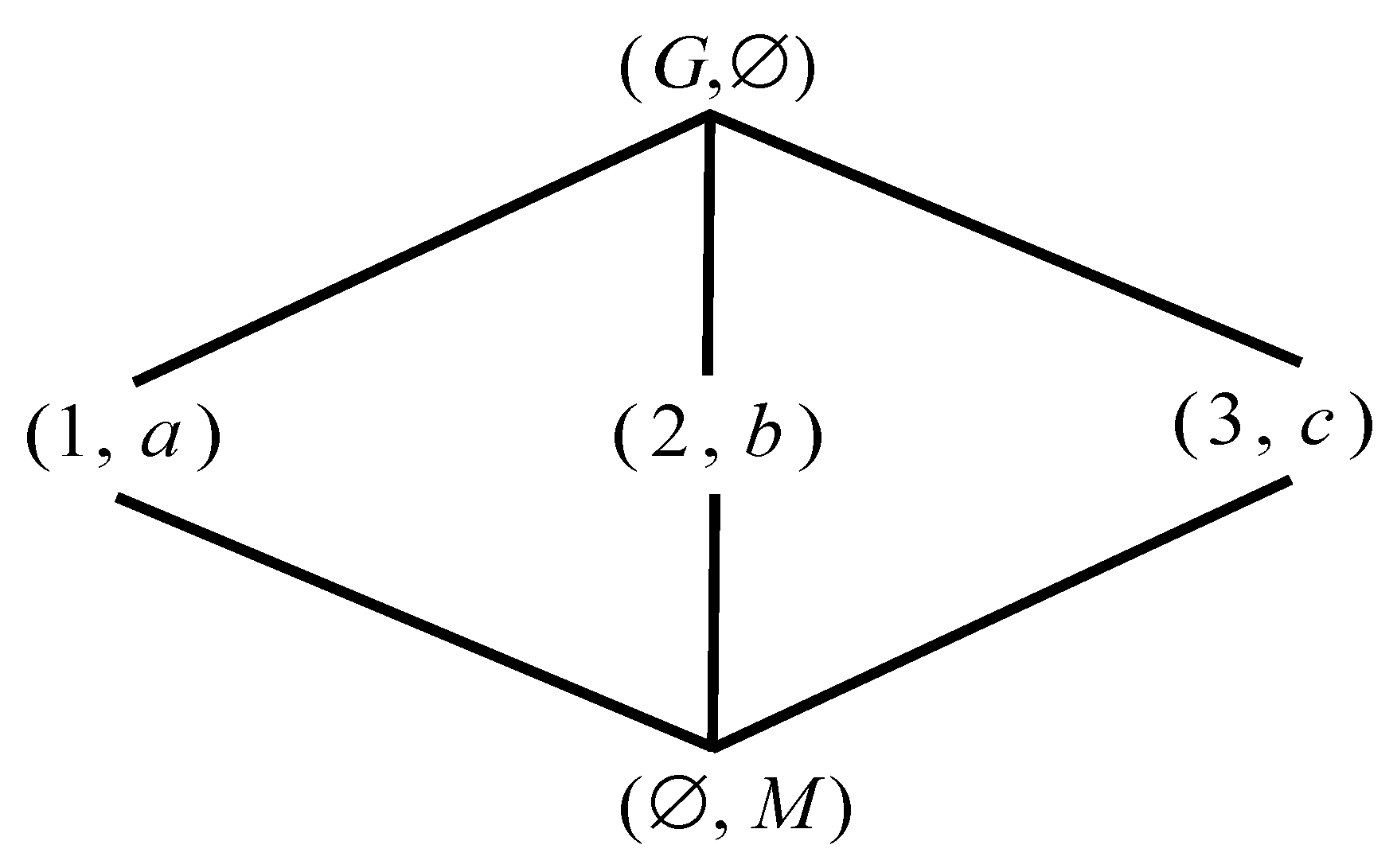
The formal context is shown in Table 3. Its the object oriented concept lattice is shown by Figure 6. We can easily obtain and are anti-isomorphic. But according to Example 6, we know is not a type I-dual intersection context and is not also a type II-dual intersection context.
Figure 6.
of Table 3.
Next, let’s study the characteristics of formal context when two-way lattices and three-way lattice are isomorphic.
Theorem 12.
Let a formal context be . If and are isomorphic, then is a type II-dual intersection formal context.
Proof.
Suppose , we can get , . In addition, . So, , Thus, we can obtain by the definition of OEO-concept. Therefore, . Similarly, we can get . Since and are isomorphic, we can get . Thus, . Therefore, is a type II-dual intersection formal context by Theorem 11. □
Theorem 13.
Let a formal context be . If and are anti-isomorphic, then is a type I-dual intersection formal context.
Proof.
Suppose , we can get , . In addition, . So, , Thus, we can obtain . So, . Similarly, we can get .
Suppose , we define , for any , . So we can easily prove that it’s a reverse order isomorphic mapping. So, and are anti isomorphic. In addition, we know and are anti isomorphic. So we can obtain that and are isomorphic from the transitivity of isomorphism.
And we know . Thus, . Combining with , we can get . Therefore, is a type II-dual intersection formal context by Theorem 8. In addition, when is a type II-dual intersection formal context, we can get is a type I-dual intersection formal context by Theorem 1. □
5. Conclusions
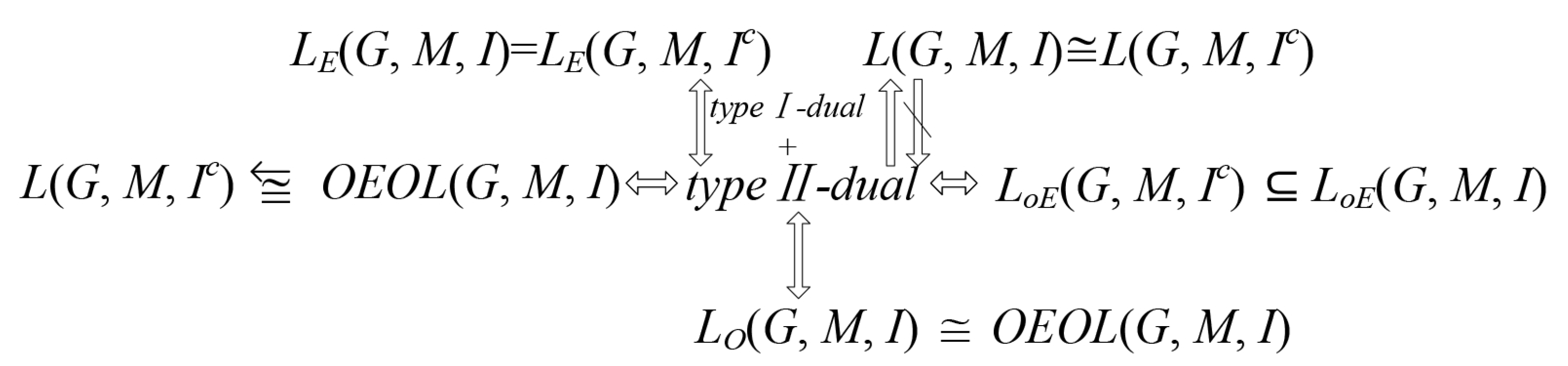
In the paper, we firstly gave a new attribute characteristic which is called type II-dual intersection attribute, and then we described the formal context and proposed the type II-dual intersection formal context. Secondly, we give the relation among some concept lattices based on the type II-dual intersection formal context and we proved some related theorems. Thirdly, the inverse proposition of related conclusions in Section 3 are studies. Some related theorems and counterexamples are give. The detailed conclusions are shown in Figure 7. However, there is a problem here that has not been solved. That is, what is the formal context like when it is both the type I-dual intersection formal context and the type II-dual intersection formal context. We conjecture that it is dual formal context whose every attribute has dual attribute. In the future, we will explore this issue.
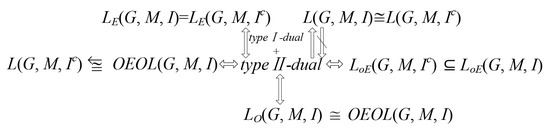
Figure 7.
The detailed conclusions.
Author Contributions
Writing—original draft preparation, T.Q.; writing—review and editing, Y.Y. and X.H.; funding acquisition, T.Q. and X.H. All authors have read and agreed to the published version of the manuscript.
Funding
This research was funded by the National Natural Science Foundation of China (No. 11801440,12001422), the Natural Science Basic Research Plan in Shaanxi Province of China (No. 2019JQ-816) and Innovation and Entrepreneurship Training Program for College Students(No. 202110705035) and 2021 Provincial College Students’ Innovation and Entrepreneurship Training Program in Henan Province (No. S202110479028).
Institutional Review Board Statement
Not applicable.
Informed Consent Statement
Not applicable.
Data Availability Statement
Not applicable.
Conflicts of Interest
The authors declare no conflict of interest.
Abbreviations
The following abbreviations are used in this manuscript:
| 3WCA | Three-way concept analysis |
| FCA | formal concept analysis |
| three-way property oriented concept lattices | |
| the concept lattice | |
| three-way property oriented concept lattices | |
| the object oriented concept lattices | |
| the set of the object oriented concept extents |
References
- Wille, R. Restructuring lattice theory: An approach based on hierarchies of concepts. In Ordered Sets; Rival, I., Ed.; D. Reidel Publishing Company: Boston, MA, USA, 1982; pp. 445–470. [Google Scholar]
- Ganter, B.A.; Wille, R. Formal Concept Analysis: Mathematical Foundations; Springer: Berlin, Germany, 1999. [Google Scholar]
- Chemmalar, S.G.; Lakshmi, P.G.G. Three-way formal concept clustering technique for matrix completion in recommender system. Int. J. Pervasive Comput. Commun. 2020, 17, 167–183. [Google Scholar]
- Belohlavek, R.; Sigmund, E.; Zacpal, J. Evaluation of IPAQ questionnaires supported by formal concept analysis. Inf. Sci. 2011, 181, 1774–1786. [Google Scholar] [CrossRef]
- Long, B.H.; Xu, W.H.; Zhang, X.Y.; Yang, L. The dynamic update method of attribute-induced three-way granular concept in formal contexts. Int. J. Approx. Reason. 2020, 126, 228–248. [Google Scholar] [CrossRef]
- Zou, L.; Lin, H.; Song, X.; Feng, K.; Liu, X. Rule extraction based on linguistic-valued intuitionistic fuzzy layered concept lattice. Int. J. Approx. Reason. 2021, 133, 1–16. [Google Scholar] [CrossRef]
- Wang, C.Z.; Wang, Y.; Shao, M.W.; Qian, Y.H.; Chen, D.G. Fuzzy rough attribute reduction fori categorical data. IEEE Trans. Fuzzy Syst. 2020, 28, 818–830. [Google Scholar] [CrossRef]
- Sérgio, M.D.; Newton, J.V. A methodology for analysis of concept lattice reduction. Inf. Sci. 2017, 396, 202–217. [Google Scholar]
- Mi, J.S.; Leung, Y.; Wu, W.Z. Approaches to attribute reduction in concept lattices induced by axialities. Knowl.-Based Syst. 2010, 23, 504–511. [Google Scholar] [CrossRef]
- Sun, L.; Zhang, X.Y.; Qian, Y.H.; Xu, J.C.; Zhang, S.G. Feature selection using neighborhood entropy-based uncertainty measures for gene expression data classification. Inf. Sci. 2019, 502, 18–41. [Google Scholar] [CrossRef]
- Wang, L.D.; Liu, X.D. Concept analysis via rough set and AFS algebra. Inf. Sci. 2008, 178, 4125–4137. [Google Scholar] [CrossRef]
- Zhang, W.X.; Ma, J.M.; Fan, S.Q. Variable threshold concept lattices. Inf. Sci. 2007, 177, 4883–4892. [Google Scholar] [CrossRef]
- Guo, L.K.; Huang, F.P.; Li, Q.G.; Zhang, G.Q. Power contexts and their concept lattices. Discret. Math. 2011, 311, 2049–2063. [Google Scholar] [CrossRef] [Green Version]
- Li, J.H.; Mei, C.L.; Lv, Y.J. Incomplete decision contexts: Approximate concept construction, rule acquisition and knowledge reduction. Int. J. Approx. Reason. 2013, 54, 149–165. [Google Scholar] [CrossRef]
- Düntsch, I.; Gediga, G. Modal-style operators in qualitative data analysis. In Proceedings of the 2002 IEEE International Conference on Data Mining, Maebashi, Japan, 9–12 December 2002. [Google Scholar]
- Yao, Y.Y. A Comparative study of formal concept analysis and rough set theory in data analysis. In Rough Sets and Current Trends in Computing; Tsumoto, S., Słowiński, R., Komorowski, J., Grzymała-Busse, J.W., Eds.; Springer: Berlin, Germany, 2004; pp. 59–68. [Google Scholar]
- Yao, Y.Y. An outline of a theory of three-way decisions. In Proceedings of the 2012 International Conference on Rough Sets and Current Trends in Computing, Chengdu, China, 17–20 August 2012. [Google Scholar]
- Yao, Y.Y. Three-way conflict analysis: Reformulations and extensions of the Pawlak model. Knowl.-Based Syst. 2019, 180, 26–37. [Google Scholar] [CrossRef]
- Lang, G.M.; Miao, D.Q.; Cai, M.J. Three-way decision approaches to conflict analysis using decision-theoretic rough set theory. Inf. Sci. 2017, 406–407, 185–207. [Google Scholar] [CrossRef]
- Sun, B.Z.; Chen, X.T.; Zhang, L.Y.; Ma, W.M. Three-way decision making approach to conflict analysis and resolution using probabilistic rough set over two universes. Inf. Sci. 2020, 507, 809–822. [Google Scholar] [CrossRef]
- Qi, J.J.; Wei, L.; Yao, Y.Y. An outline of a theory of three-way decisions. In Proceedings of the 2014 International conference on Rough Sets and Knowledge Technology, Shanghai, China, 24–26 October 2014. [Google Scholar]
- Qi, J.J.; Qian, T.; Wei, L. The connections between three-way and classical concept lattices. Knowl.-Based Syst. 2016, 91, 143–151. [Google Scholar] [CrossRef]
- Qian, T.; Wei, L.; Qi, J.J. Constructing three-way concept lattices based on apposition andsubposition of formal contexts. Knowl.-Based Syst. 2017, 116, 39–48. [Google Scholar] [CrossRef]
- Yang, S.C.; Lu, Y.N.; Jia, X.Y.; Li, W.W. Constructing three-way concept lattice based on the composite of classical lattices. Int. J. Approx. Reason. 2020, 121, 174–186. [Google Scholar] [CrossRef]
- Ren, R.S.; Wei, L. The attribute reductions of three-way concept lattices. Knowl.-Based Syst. 2016, 99, 92–102. [Google Scholar] [CrossRef]
- Wei, L.; Qian, T. The three-way object oriented concept lattice and three-way property oriented concept lattice. In Proceedings of the 2015 International Conference on Machine Learning and Cybernetics (ICMLC), Guangzhou, China, 12–15 July 2015. [Google Scholar]
- Qian, T.; Wei, L.; Qi, J.J. A theoretical study on the object (property) oriented concept lattices based on three-way decisions. Soft Comput. 2019, 23, 9477–9489. [Google Scholar] [CrossRef]
- Li, J.H.; Huang, C.C.; Qi, J.J.; Qian, Y.H.; Liu, W.Q. Three-way cognitive concept learning via multi-granularity. Inf. Sci. 2017, 378, 244–263. [Google Scholar] [CrossRef]
- Zhi, H.L.; Qi, J.J.; Qian, T.; Ren, R.S. Conflict analysis under one-vote veto based on approximate three-way concept lattice. Inf. Sci. 2020, 516, 316–330. [Google Scholar] [CrossRef]
- Mao, H.; Cheng, Y.L. Three-way rough semiconcept. J. Intell. Fuzzy Syst. 2021, 40, 4317–4330. [Google Scholar] [CrossRef]
- Xin, X.W.; Song, J.H.; Xue, Z.A.; Peng, W.M. Intuitionistic fuzzy three-way formal concept analysis based attribute correlation degree. J. Intell. Fuzzy Syst. 2021, 40, 1567–1583. [Google Scholar] [CrossRef]
- Long, B.H.; Xu, W.H.; Zhang, X.Y. Double threshold construction method for attribute-induced three-way concept lattice in incomplete fuzzy formal context. J. Eng. 2020, 13, 549–554. [Google Scholar] [CrossRef]
- Chen, X.Y.; Qi, J.J.; Zhu, X.M.; Wang, X.; Wang, Z. Unlabelled text mining methods based on two extension models of concept lattices. Int. J. Mach. Learn. Cybern. 2020, 11, 475–490. [Google Scholar] [CrossRef]
- Qian, T.; Zhao, S.Y.; Wang, J.T. Research on construction methods and algorithms of three-way concept lattices based on isomorphism theory. J. Zhejiang Univ. 2020, 47, 322–328. [Google Scholar]
Publisher’s Note: MDPI stays neutral with regard to jurisdictional claims in published maps and institutional affiliations. |
© 2021 by the authors. Licensee MDPI, Basel, Switzerland. This article is an open access article distributed under the terms and conditions of the Creative Commons Attribution (CC BY) license (https://creativecommons.org/licenses/by/4.0/).