


Abstract
This paper proves the optimal estimations of a low-order spatial-temporal fully discrete method for the non-stationary Navier-Stokes Problem. In this paper, the semi-implicit scheme based on Euler method is adopted for time discretization, while the special finite volume scheme is adopted for space discretization. Specifically, the spatial discretization adopts the traditional triangle trial function pair, combined with macro element form to ensure local stability. The theoretical analysis results show that under certain conditions, the full discretization proposed here has the characteristics of local stability, and we can indeed obtain the optimal theoretic and numerical order error estimation of velocity and pressure. This helps to enrich the corresponding theoretical results.
1. Introduction
Recently, due to the characteristics of simple implementation, the finite volume method has been widely used in many scientific research and engineering fields. It has obtained many ideal numerical simulation and calculation results, and often used to solve the complex engineering calculation problems well. Nevertheless, compared with a wide range of application scenarios, its theoretical analysis, such as stability and convergence analysis, is far behind, which inevitably shadow benefits of the finite volume method, so it needs to be studied continuously. Among them, the theoretical analysis of Navier Stokes process is one of the important field.
Finite volume method is an effective method to solve differential equations. In the past several decades, the calculation methods used to solve Navier-Stokes problems have developed rapidly. The results are richer and richer, but to our dismay, the theoretical analysis of the algorithm is still insufficient [1,2]. As we all know, based on the current advanced computing equipment, simple numerical methods are easy to distribute and suitable for large-scale computing, which makes them the hope of solving complex problems, such as incompressible Navier-Stokes equations. Among them, using simple coordinated low-order elements and local stabilization method is a good choice [3,4].
However, it is well known that low order coordinated finite volume function pairs, such as , are unstable for numerical solution of Navier-Stokes equations. The common way to overcome this shortage is to use local stabilization technique, that is, add “macro element condition” to improve the stability of the algorithm. This kind of low order method has been widely analyzed and applied, and has been proved to be effective in practice [5,6,7,8,9]. The basic idea of this method was first proposed by Boland and Nicolaides, and has been vigorously developed since then. The recent work of Wen [10] and Li [11] paves the way for the numerical analysis of Stokes and Navier Stokes problems. In addition, He [12] and Li [13] have given the locally stable finite volume method for partial spatial discretization of Navier-Stokes problems, which has a good effect except some fully discrete results.
This paper continues to analyze the convergence results of using FVM to solve two-dimensional time-dependent Navier-Stokes equations, so as to enrich the relevant theories. Here we will still focus on pairs. For this purpose, let’s assume is the uniform and regular triangulation of . It should be reminded that the finite element space here does not have the inf-sup condition for , so a similar skill in the paper [11,12,13] is required. Because these papers mainly discuss the spatial discrete case, this paper studies a approximation based on time-discretization is Euler semi-implicit and space-discretization is Locally stable FVM.
For brevity, this paper assumes is a regular triangulation that satisfies the general regular condition [14,15]. Let the mesh size is h and the time step is , the theoretical results of the optimal order convergence of the fully discrete FVM based on the low order coordinated finite element local stabilization are as follows:
For such a finite volume solution obtained by the fully discrete locally stabilized FVM, we derive in this paper the following order error estimates:
where .
The rest of the paper is organized as follows. Section 2 introduces some basic concepts and function definitions related to Navier-Stokes problem and the locally stable FVM. Some basic results are prepared in Section 3. Section 4 mainly analyzes the error estimation of time semi-discretization based on Euler semi-implicit scheme. Section 5 proves the error estimations of time and spatial fully discretization. Section 6 contains some numerical results and a summary of the article is included in Section 7.
2. Foundation of Finite Volume Method for the Navier-Stokes Problem
This article consider the follow non-stationary Navier-Stokes equations
where be a bounded domain in assumed to have a common continuous boundary (stronger than Lipschitz continuity) [14,16]; are the velocity vector and is the pressure, is the body force, is the initial velocity, and is the viscosity.
For the convenience of analysis of problem (3), we introduce the following common abbreviations
where V is the closed subset of X and H is denote the closed subset of Y, respectively. The spaces , are endowed with the common norm denoted by and , respectively. The norms of the Hilbert space and X are
For more information about the above marks, we refer the reader to [14,16,17]. We also need to denote as the Laplace operator and as the Stokes operator, where P is the -orthogonal projection of Y onto H.
It is known [17] that
where , is positive constant depending only on . C, like the quantities , appear subsequently, is a positive constant depending on .
This paper uses following kind of continuous bilinear forms and on and , respectively,
and a trilinear form on
With the above notations, the general variational formulation of problem (3) is: get satisfy:
for all .
In order to get the fully dispersed error estimates, we need the following smoothness.
Theorem 1.
Assume some continuity of and are valid [14,17]. Then problem (6) admits a unique solution satisfying the following estimates:
for all , where κ is a positive constant.
Now, we consider the fully discrete locally stabilized FVM for two-dimensional time-dependent incompressible Navier-Stokes Equation (3). For convenience, let a partitioning of into triangles satisfied the regular in the usual sense (see [5,14]). are the corresponding finite element subspace of . is the set of all interelement boundaries.
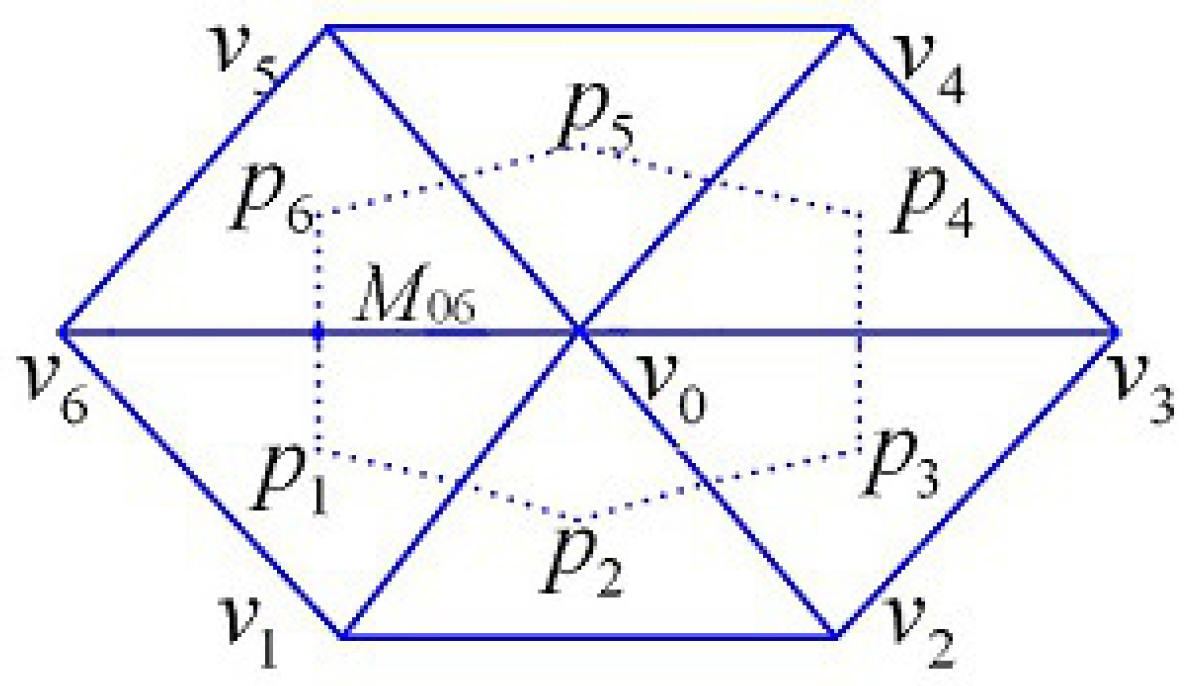
In order to define the finite volume method for Equation (3), We need introduce a popular configuration of dual partition for : the interior point is chosen to the barycenter of element , and the midpoint on side of . See Figure 1. This type of dual partition is locally regular if is locally regular.
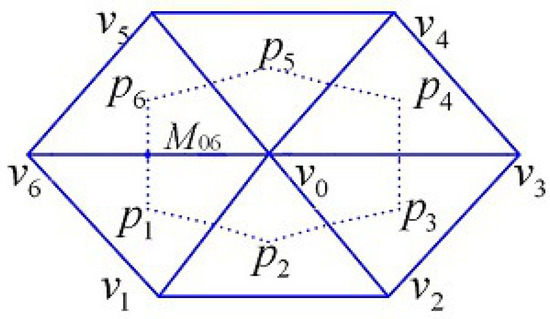
Figure 1.
The finite volume partition of geometric region.
Corresponding to Hilbert space , we define the following finite element velocity subspaces
and the pressure subspace
The finite volume dual of velocity is
Let interpolation operator :.
The dimensional reduction and are defined as follows:
The finite volume forms of velocity on is,
where is the unit outnormal vector. The finite volume form of pressure on is defined as
To facilitate the analysis, we need the following two trilinear forms.
The last time difference part is
The finite volume form of the right side is
For the convenience of reading, we introduce the following generalized form
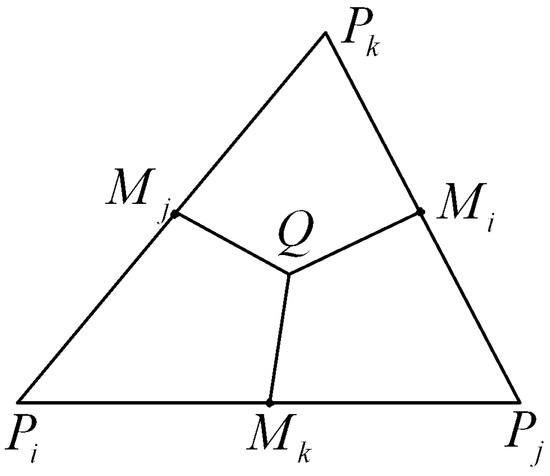
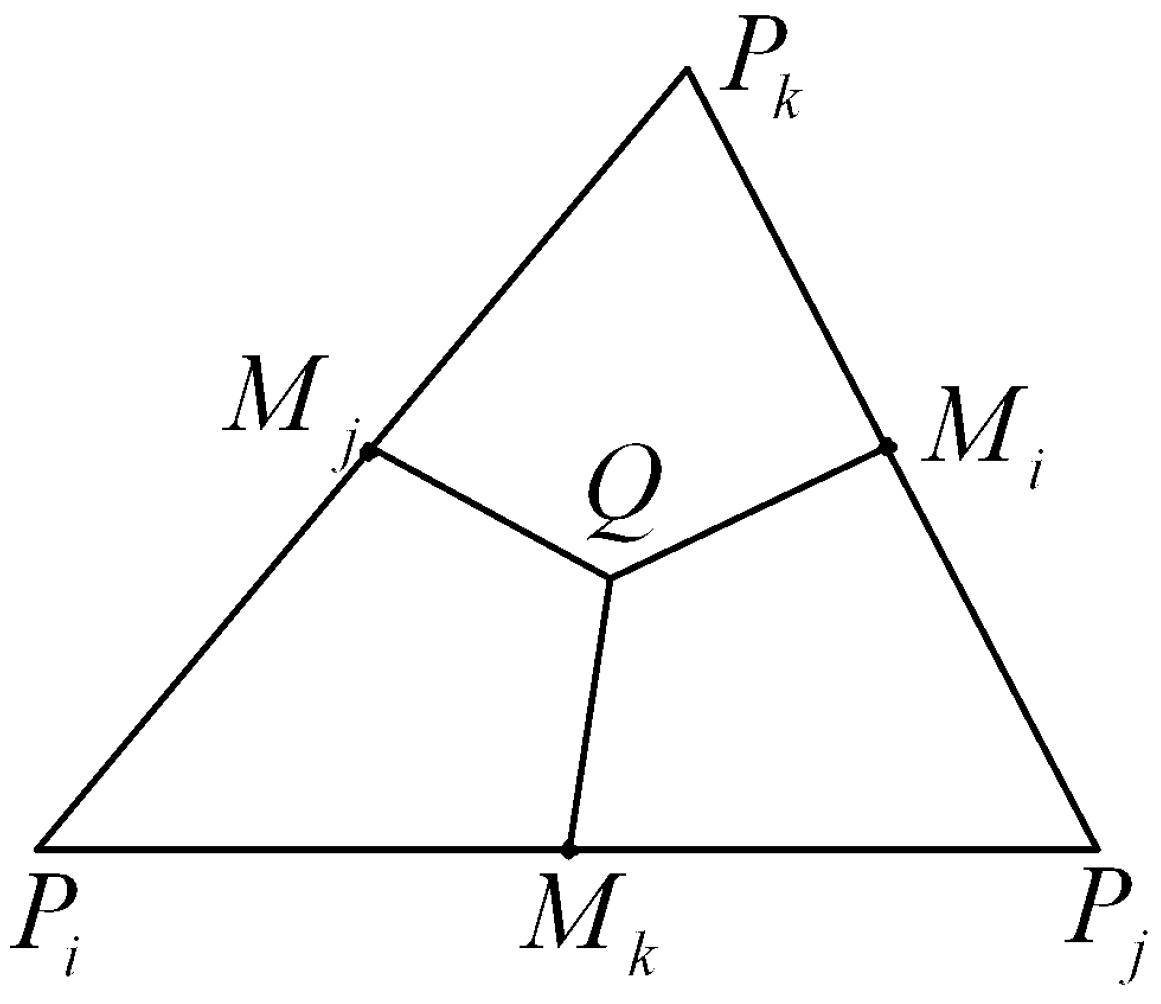
Figure 2.
The area of partition of triangular.
To describe the locally stabilized formulation of the non-stationary Navier-Stokes problem, we use the classic not overlap macroelement partitioning [18]. For every macroelement in , the set of interelement(small finite element) edges is denoted by , and the length of an edge is denoted by .
With the above definitions, a locally stabilized formulation of the non-stationary Navier-Stokes problem (3) can be stated as follows.
Definition 1.
Locally stabilized finite volume formulation for non-stationary Navier-Stokes: Find such that for all
where
for all in the algebraic sum , and is the jump operator across and is the local stabilization parameter.
In order get the regularity of the above definitions, we need the following stability results [5,8,9,12].
Theorem 2.
For any two neighboring macroelements and with , if there exists such that
Then
for all , and
where and are two constant.
3. Technical Preliminaries
The main task of this section is to prepare many basic estimates which will help the error analyses for the finite volume solution .
Since the bilinear forms and are coercive on , they generate invertible operators and respectively through the condition:
Moreover, we also need the discrete gradient operators:
Firstly, we have the following classical properties (see [8,19])
where . For the triangular element, It follows from (4), (5) and (13) that [20,21]
As for the trilinear forms and ,we can deduce the following results.
Lemma 1.
If , we have
Proof.
Similar to the results in [12], we also need to define the projection operator as
Due to Theorem 2, we know that is well defined and have the properties [12]:
for all .
Beside, we need the specific result in He et al. [12].
Theorem 3.
Under the assumptions of Theorems 1 and 2, satisfies
for all .
Since our error analysis for the time discretization depends heavily on these regularity estimates, we then provide some smoothness estimates of . The main idea is similar to the work in He et al. [9,23].
Theorem 4.
Under the assumptions of Theorems 3, the finite volume solution satisfies
for all .
Proof.
Finally, in order to get the upper bounders of velocity and pressure in the time related case, we state the classical Gronwall lemma used in [24].
Lemma 2.
Let and , for integers , be nonnegative numbers such that
Then,
The following is dual Gronwall lemma.
Lemma 3.
Given integer and let C and , for integers , be nonnegative numbers such that
Then,
5. Error Analysis for Time and Spacial Discrete
In this section we proof the upper bounds for the error in and norms, and deduce the last optimal order estimates. Firstly, we have
Lemma 7.
Assume that the assumptions of Theorem 3 are valid and satisfies (39). Then, the error satisfies the following bound:
Proof.
Lemma 8.
Under the assumptions of Lemma 7, we have
Proof.
Lemma 9.
Under the assumptions of Lemma 7, we have that
for all .
Proof.
Lemma 10.
Under the assumptions of Lemma 7, the error satisfies the following bound:
Proof.
Lemma 11.
Under the assumptions of Lemma 7, the error satisfies the following bound:
Proof.
Theorem 5.
Under the assumptions of Lemma 7, the error satisfies the following optimal bounds:
for all .
Proof.
Integration by parts directly can show
Summing (67) from to , using (19) and noting , we obtain
Combining (68) with (14), Theorem 3, Lemmas 7 and 9 yields the first estimate in (66).
6. Single Numerical Example
In this section, some numerical results are computed to test the rationality of the theoretical analysis. Because it is difficult to obtain the analytical solution of the general problem governed by the Navier-Stokes equation, we show the relevant numerical results through an example with analytical solution for simplicity. So we consider the following model problem in the unit square area . Here this example might as well takes as 0.01. Only the velocities and pressure are given here. The right term f of the equations can be obtained by bringing the relationship between and into the NS equations, and the initial values of and can be obtained by bringing into the calculation.
Now, consider a unit square domain with an exact solution given by
f is determined by (3). It can be verified that such satisfy the non divergence condition.
For simplicity, we can record the time and spatial discretization of the problem as follows:
where the matrices in (80) correspond to the differential operators: , and I is the identity matrix. The right-hand side contains the source term.
To make the next iterations less complex, here are a few new notations. Let , , then we can further record the above equation as follows:
Besides, in order to improve the calculation efficiency, we can generally adopt Newton iterative method to solve the above nonlinear problems. The typical calculation steps are as follows:
It is worth noting that since Newton iterative method requires high initial values, we need to use the following Picard method to obtain the initial values of Newton iterative method:
In this way, we can finally transform the time-dependent Navier Stokes problem into a large-scale linear system of equations and solve it through such links: Euler time discretization → finite volume space discretization → Newton iterative transformation → Picard format transformation → large linear equations → solving equations.
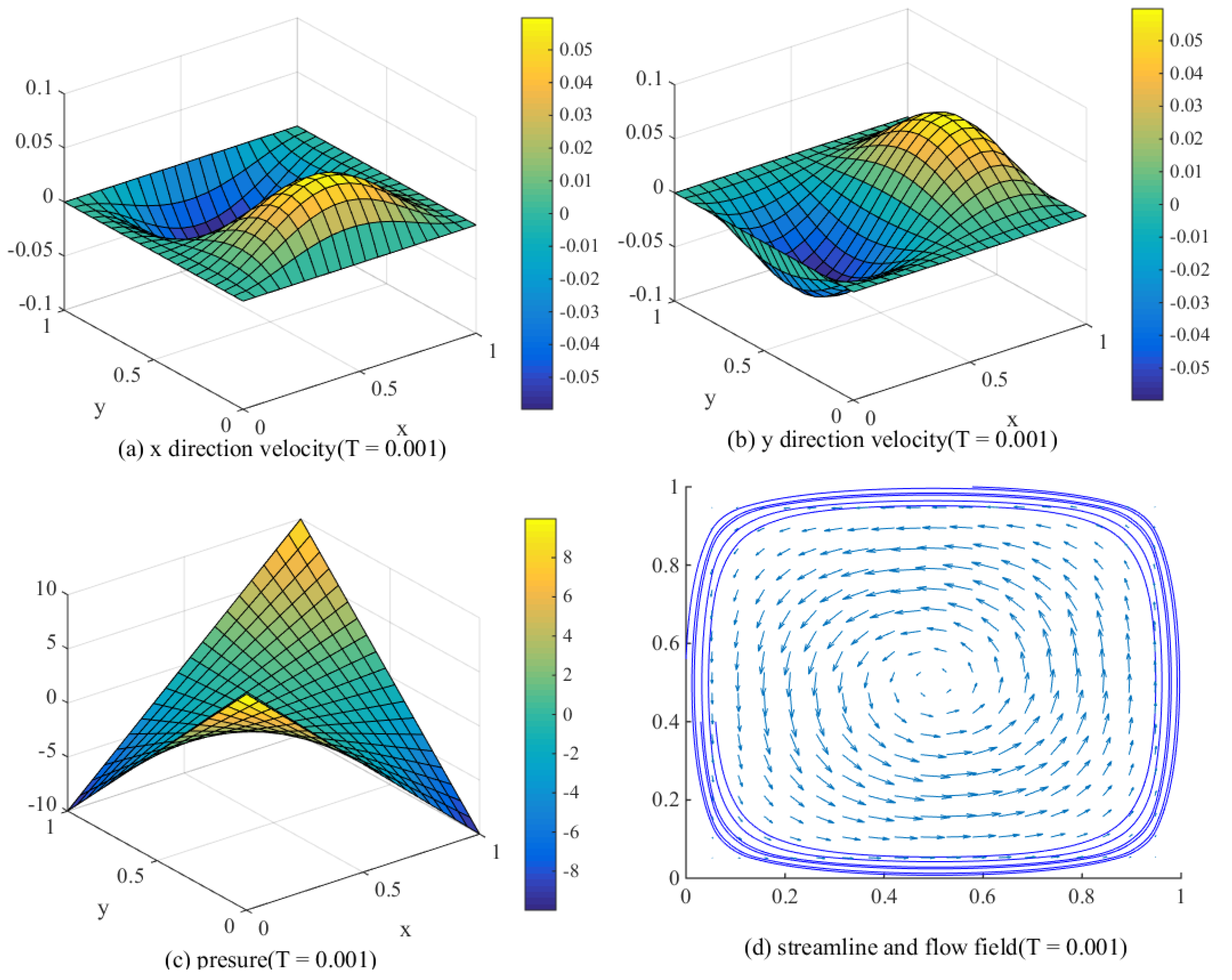
Based on the above description, we can get some simulation results (). The following Figure 3 is the result of one iteration based on the initial value. The time step here is , and the spatial grid is divided into two congruent triangles on the basis of equidistant rectangular grid. We only pay attention to that only of the data in both X and Y directions are selected.
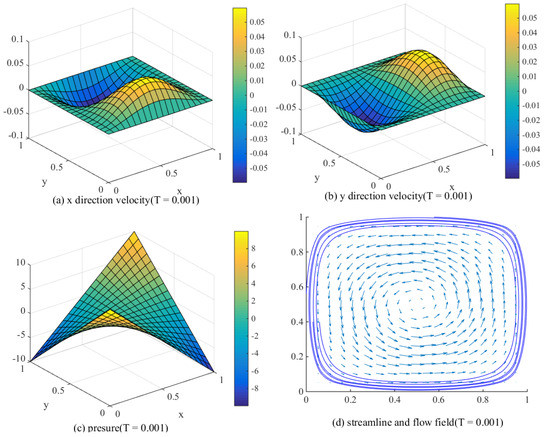
Figure 3.
Preliminary calculated velocity and pressure.
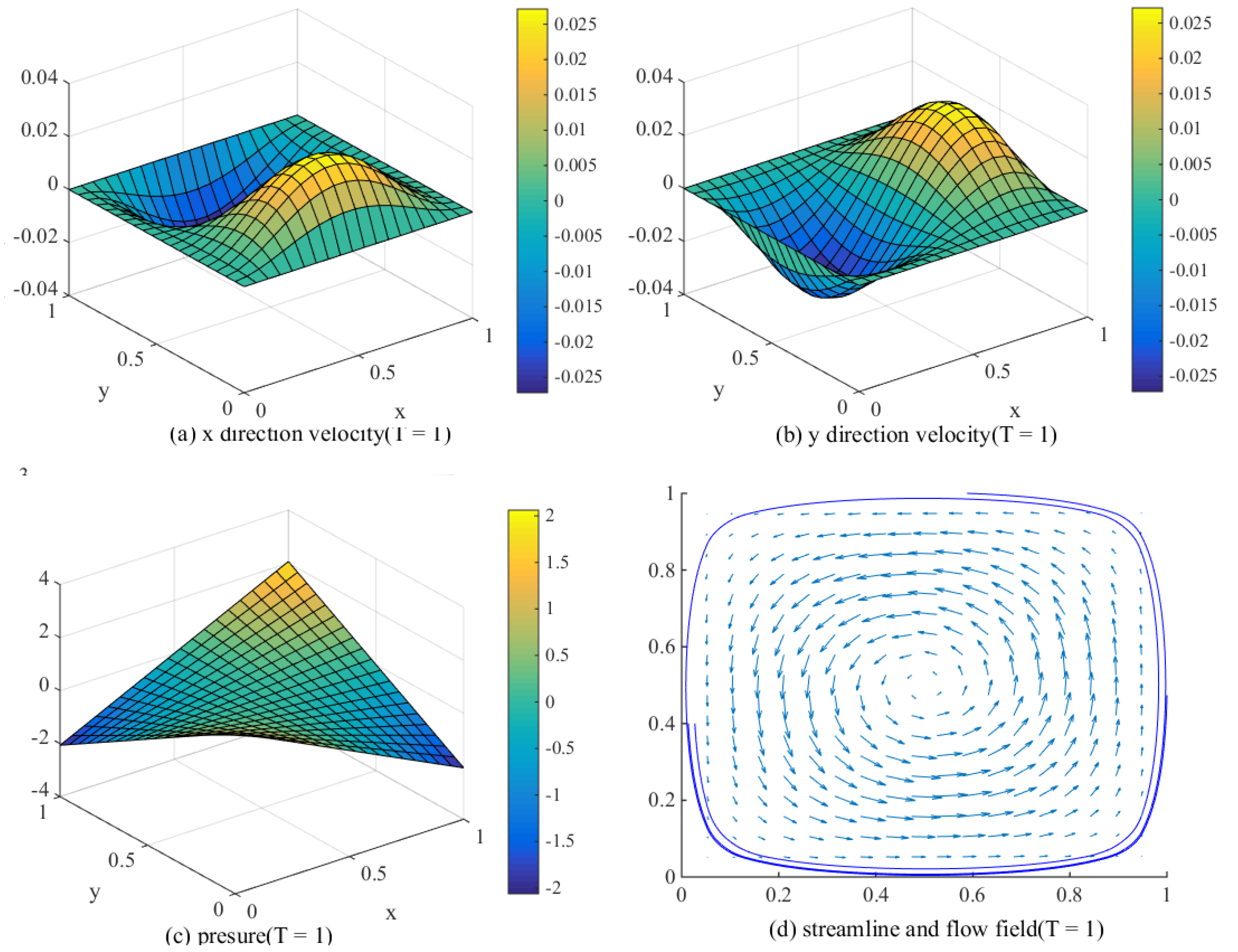
The following Figure 4 is the result after 1000 iterations with time step . Here, the reference value of streamline is the same as that when .
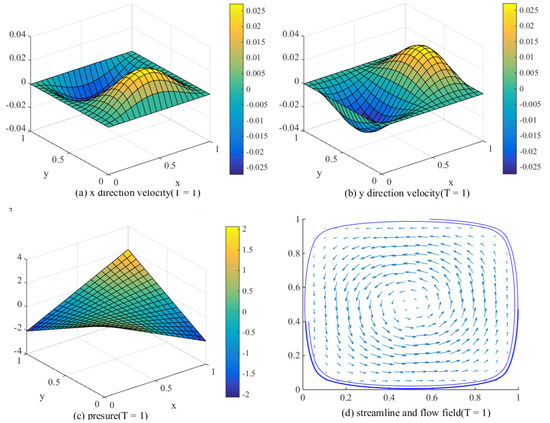
Figure 4.
The calculated velocity and pressure at .
Compared Figure 2 with Figure 3, it can be seen from Figure 3 that the streamline and flow field are weakened accordingly. It is easy to understand that since the interpretation constructed here is decaying, both velocity and pressure show a decaying trend. This also shows that our numerical method maintains strong robustness, and the calculation results are more intuitive.
The following table shows the error order of velocity and pressure after 1000 iterations with grids selected under the condition of .
From the above Table 1, we can see the optimal convergence rate, almost 2 for velocities and 1 for pressure are really obtained, which confirm the numerical analysis above.

Table 1.
Convergence order of spatial solution the FVM (, ).
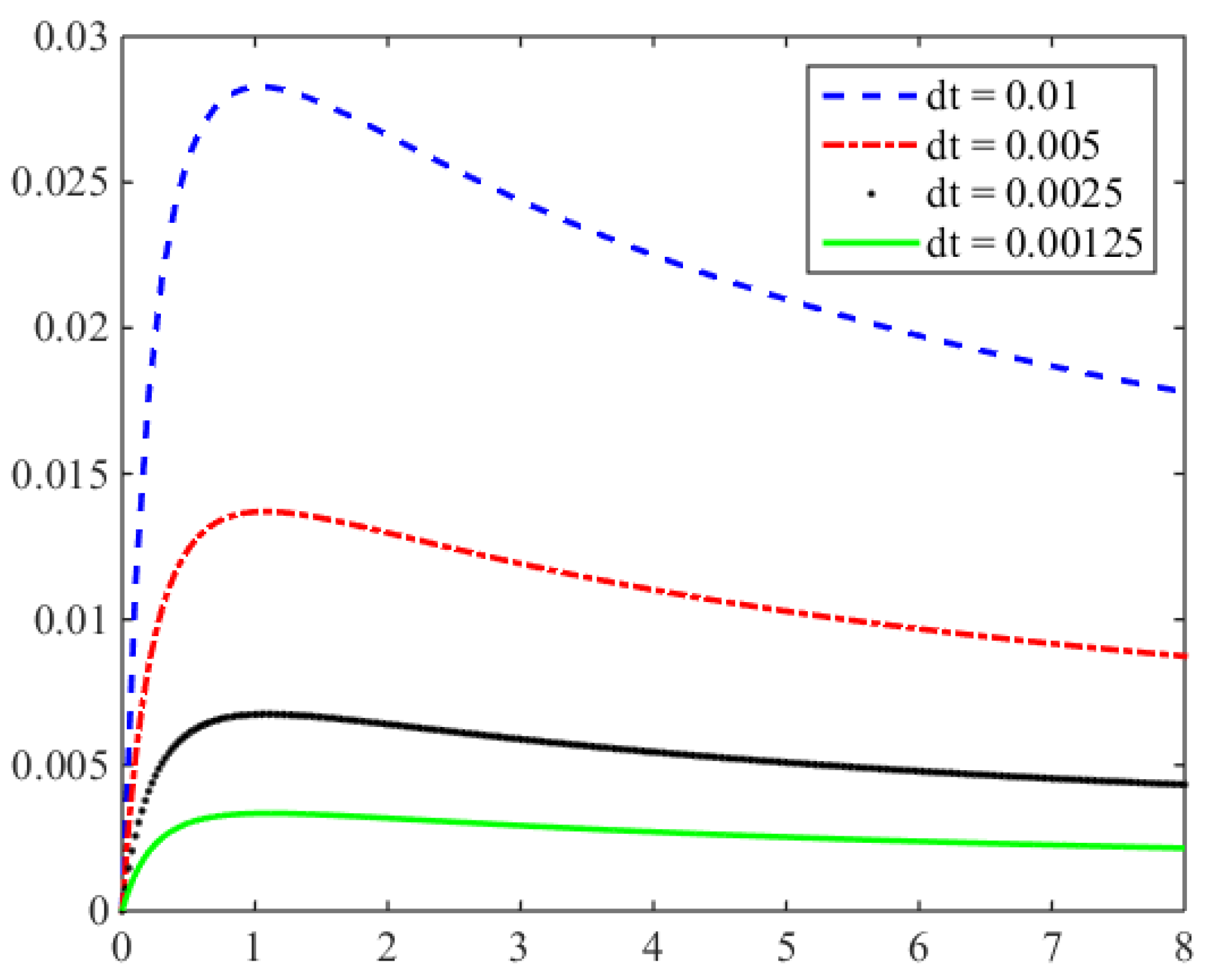
The following Figure 5 shows the error curve calculated based on spatial grid with different time steps: (`dt’ in Figure 5 is ). It can be seen from here that the initial error tends to increase, but the error also decreases with the decrease of flow field energy, which shows that the time iteration is stable.
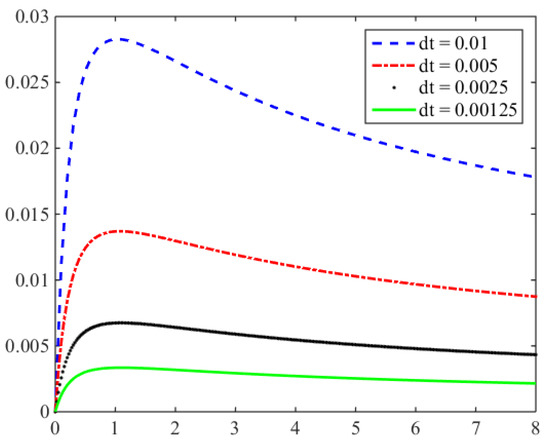
Figure 5.
Velocity error of different time steps.
The following Table 2 shows the error ratio of different time steps: = 0.01, 0.005, 0.0025, 0.00125:
Table 2.
Numerical results of the FVM (, ).
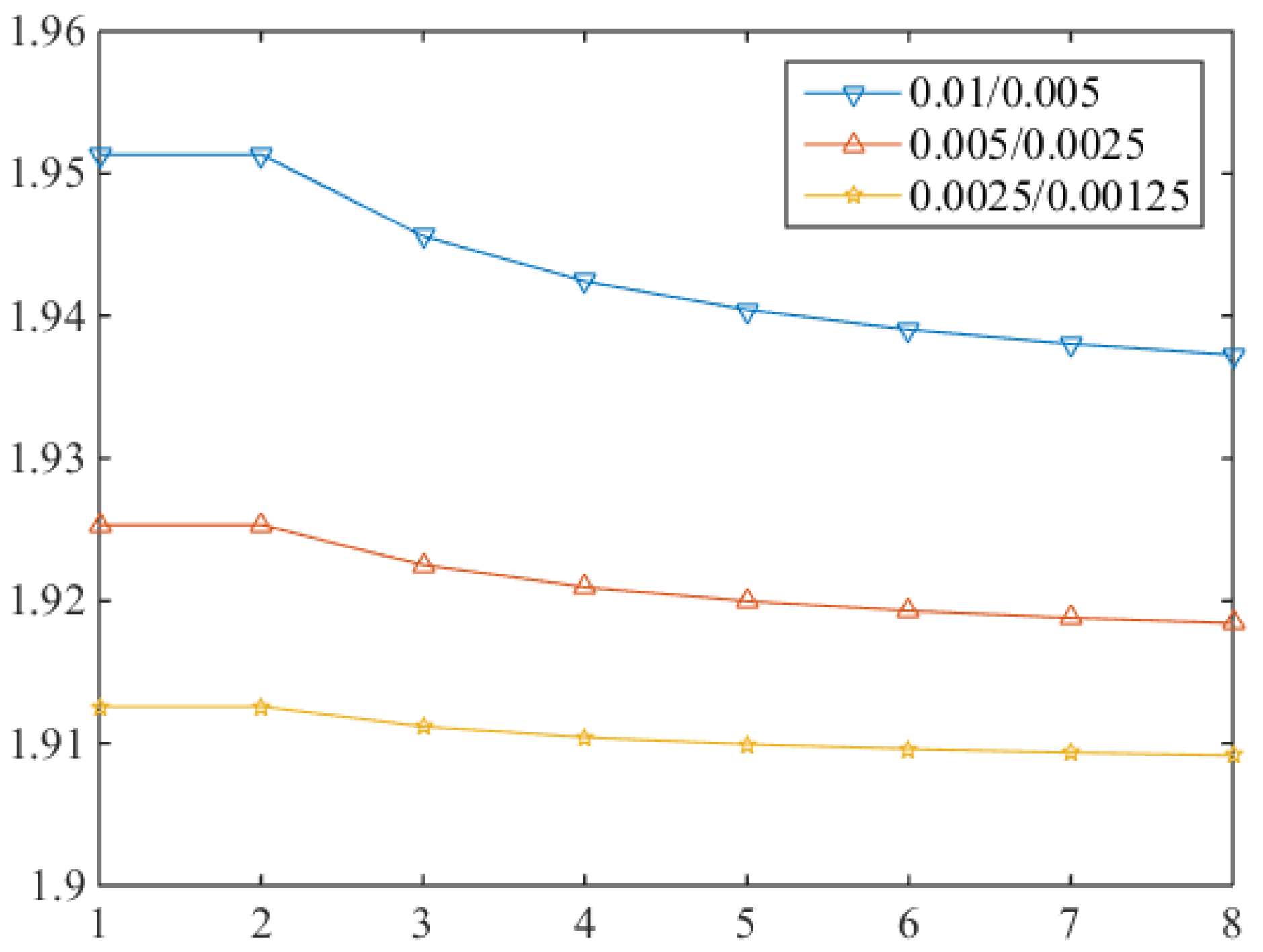
The error ratio curve in the Figure 6 below shows the convergence of one section of time and is relatively stable.
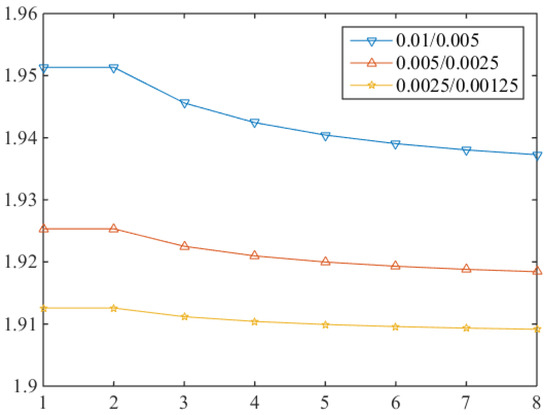
Figure 6.
1 order convergence ratio in time direction.
Table 2 and Figure 6 tell us the optimal convergence rate of time is 1 which is consistent with the theoretical analysis.
Due to time constraints, our numerical results only show these. It is also worth noting that if the solution does not decay but increases, and if the growth rate is fast, the error of numerical results will increase with the increase of numerical calculation time. At that time, the method may not converge or inefficient. This requires a little attention in specific applications.
7. Conclusions
After detailed theoretical analysis, this article finally proves that if we use the finite volume method based on element to approximate the non-stationary Navier-Stokes equation, we can achieve the follow optimal numerical error estimation:
The optimal error estimate (83) shows that the time discretization of Euler method is 1 order and the space discretization is 2 order in this space-time full discretization finite volume method, which is consistent with the theoretical optimal order error estimation of element in solving differential equations. Although the proof process is challenging and cumbersome, the optimal result is also obvious and certain. However, this work is still helpful to reveal some special aspects of the finite volume method which is different from finite element and other methods in solving complex differential equations. Therefore, it is helpful to improve the corresponding numerical analysis theory.
In addition, with the continuous research and exploration of using neural network to solve differential equations recently [25,26,27], although very gratifying numerical results have been obtained, but the effectiveness and convergence of neural network-based methods for solving differential equations are still unclear, and there is a lack of theory. However, we know gradually that the key point of neural network in the calculation of differential equations is to use low-order functions for numerical approximation, which is similar to the basic principle of using low-order continuous functions to discretize and approximate differential equations, except that the former is global approximation while the latter is piecewise approximation. Therefore, improving and enriching the low-order function approximation theory also provides some important reference in further understanding the neural network in solving differential equations efficiently, It is worth studying.
Author Contributions
Individual contributions: theoretical analysis, G.H.; formal analysis, G.H. and Y.Z.; writing—original draft preparation, G.H. and Y.Z.; writing—review and editing, G.H.; visualization, Y.Z.; project administration, G.H. All authors have read and agreed to the published version of the manuscript.
Funding
This research was funded by the National Science Foundation of China, grant number: 10926133, 60973015.
Acknowledgments
The author is very grateful for the inspiration of relevant literature and the valuable opinions put forward by reviewers. Thank the research team of computing science and engineering for their enlightening suggestions in the process of study.
Conflicts of Interest
The funders had no role in the design of the study; in the collection, analyses, or interpretation of data; in the writing of the manuscript, or in the decision to publish the results.
References
- Carstensen, C.; Dond, A.K.; Nataraj, N.; Pani, A.K. Three First-Order Finite Volume Element Methods for Stokes Equations under Minimal Regularity Assumptions. SIAM J. Numer. Anal. 2018, 56, 2648–2671. [Google Scholar] [CrossRef]
- Feireisl, E.; Lukáčová-Medviďová, M.; Mizerová, H.; She, B. On the Convergence of a Finite Volume Method for the Navier-Stokes-Fourier System. IMA J. Numer. Anal. 2021, 41, 2388–2422. [Google Scholar] [CrossRef]
- Chen, W.; Gunzburger, M.; Hua, F.; Wang, X. A Parallel Robin-Robin Domain Decomposition Method for the Stokes-Darcy System. SIAM J. Numer. Anal. 2011, 49, 1064–1084. [Google Scholar] [CrossRef] [Green Version]
- Yu, J.; Shi, F.; Zheng, H. Local and Parallel Finite Element Algorithms Based on the Partition of Unity for the Stokes Problem. SIAM J. Sci. Comput. 2014, 36, C547–C567. [Google Scholar] [CrossRef]
- Kechkar, N.; Silvester, D. Analysis of Locally Stabilized Mixed Finite Element Methods for the Stokes Problem. Math. Comput. 1992, 58, 1–10. [Google Scholar] [CrossRef]
- Kay, D.; Silvester, D. A Posteriori Error Estimation for Stabilized Mixed Approximations of the Stokes Equations. Siam J. Sci. Comput. 2000, 21, 1321–1337. [Google Scholar] [CrossRef]
- Norburn, S.; Silvester, D. Stabilised vs. Stable Mixed Methods for Incompressible Flow. Comput. Methods Appl. Mech. Eng. 1998, 166, 1–10. [Google Scholar] [CrossRef]
- He, Y.; Lin, Y.; Sun, W. Stabilized Finite Element Method for the Non-stationary Navier-Stokes Problem. Discret. Contin. Dyn. Syst.-Ser. S 2006, 6, 41–68. [Google Scholar] [CrossRef]
- He, Y. A Full Discrrete Stabilized Finite-Element Method for the Time-Dependent Navier-Stokes Equations. IMA J. Numer. Anal. 2003, 23, 665–691. [Google Scholar] [CrossRef]
- Wen, J.; He, Y.; Zhao, X. Analysis of a New Stabilized Finite Volume Element Method Based on Multiscale Enrichment for the Navier-Stokes Problem. Int. J. Numer. Methods Heat Fluid Flow 2016, 26, 2462–2485. [Google Scholar] [CrossRef]
- Li, J.; Lin, X.; Zhao, X. Optimal Estimates on Stabilized Finite Volume Methods for the Incompressible Navier-Stokes Model in Three Dimensions. Numer. Methods Part. Differ. Equ. 2018, 35, 28–154. [Google Scholar] [CrossRef] [Green Version]
- He, G.; He, Y. The Finite Volume Method Based on Stabilized Finite Element for the Stationary Navier-Stokes Problem. Numer. Methods Part. Differ. Equ. 2007, 23, 1167–1191. [Google Scholar] [CrossRef]
- Li, J.; Chen, Z. On the Semi-Discrete Stabilized Finite Volume Method for the Transient Navier-Stokes Equations. Adv. Comput. Math. 2013, 38, 281–320. [Google Scholar] [CrossRef]
- Girault, V.; Raviart, P.A. Finite Element Method for Navier-Stokes Equations: Theory and Algorithms; Springer: Berlin/Heidelberg, Germany, 1987; pp. 5–47. [Google Scholar]
- Boland, J.; Nicolaides, R.A. Stability of Finite Elements under Divergence Constraints. SIAM J. Numer. Anal. 1983, 20, 722–731. [Google Scholar] [CrossRef]
- Bercovier, J.; Pironneau, O. Error Estimates for Finite Element Solution of the Stokes Problem in the Primitive Variables. Numer. Math. 1979, 33, 211–226. [Google Scholar] [CrossRef]
- Heywood, J.G.; Rannacher, R. Finite Element Approximation of the Nonstationary Navier-Stokes Problem I: Regularity of Solutions and Second-Order Error Estimates for Spatial Discretization. SIAM J. Numer. Anal. 1982, 19, 275–311. [Google Scholar] [CrossRef]
- Stenberg, R. Analysis of Mixed Finite Elements for the Stokes Problem: A Unified Approach. Math. Comput. 1984, 42, 9–23. [Google Scholar]
- Bramble, J.H.; Xu, J. Some Estimates for a Weighted L2 Projection. Math. Comput. 1991, 56, 463–576. [Google Scholar]
- Li, R. Generalized difference methods for a nonlinear dirichlet problem. SIAM J. Numer. Anal. 1987, 24, 77–88. [Google Scholar]
- Ewing, R.E.; Lin, T.; Lin, Y. On the Accuracy of The Finite Volume Element Method Based on Picewise Linear Polynomails. SIAM J. Numer. Anal. 2002, 39, 1865–1888. [Google Scholar] [CrossRef]
- Hill, A.T.; Suli, E. Approximation of the Global Attractor for the Incompressible Navier-Stokes Problem. IMA J. Numer. Anal. 2000, 20, 633–667. [Google Scholar] [CrossRef]
- Discacciati, M.; Oyarzúa, R. A Conforming Mixed Finite Element Method for the Navier-Stokes/Darcy Coupled Problem. Numer. Math. 2017, 135, 1–36. [Google Scholar] [CrossRef] [Green Version]
- Shen, J. Long Time Stability and Convergence for Fully Discrete Nonlinear Galerkin Methods. Appl. Anal. 1990, 38, 201–229. [Google Scholar] [CrossRef]
- Baymani, M.; Effati, S.; Niazmand, H.; Kerayechian, A. Artificial Neural Network Method for Solving the Navier-Stokes Equations. Neural Comput. Appl. 2015, 26, 765–773. [Google Scholar] [CrossRef]
- Jin, X.; Cai, S.; Li, H.; Karniadakis, G.E. NSFnets (Navier-Stokes Flow nets): Physics-Informed Neural Networks for the Incompressible Navier-Stokes Equations. J. Comput. Phys. 2021, 426, 109951. [Google Scholar] [CrossRef]
- Christopher, J.; King, A.P. Active Training of Physics-Informed Neural Networks to Aggregate and Interpolate Parametric Solutions to the Navier-Stokes Equations. J. Comput. Phys. 2021, 438, 1–17. [Google Scholar]
Publisher’s Note: MDPI stays neutral with regard to jurisdictional claims in published maps and institutional affiliations. |
© 2022 by the authors. Licensee MDPI, Basel, Switzerland. This article is an open access article distributed under the terms and conditions of the Creative Commons Attribution (CC BY) license (https://creativecommons.org/licenses/by/4.0/).