1. Introduction
In recent decades, codes over finite commutative chain rings have been studied considerably (see Refs. [
1,
2,
3,
4,
5,
6,
7]). In the last few years, some specific non-chain rings have been used as an alphabet for codes (see Refs. [
8,
9,
10,
11,
12]). Constacyclic codes form an important class of linear codes and have practical applications to other disciplines including classical and quantum communication systems as they can be encoded with shift registers because of their algebraic structures. Since the factorization of the polynomials over non-commutative structures is not unique, they are potentially more convenient for obtaining good code parameters than commutative structures. This fact makes the study of skew polynomial rings more attractive. Over standard polynomial rings the algebraic structure of
-constacyclic codes of length
n is totally determined by the polynomial divisors of the binomial
In [
13], Boucher, Solé and Ulmer used skew polynomials to determine the algebraic structure of constacyclic codes under a skew constacyclic shift. Afterwards, in [
14,
15], Boucher and Ulmer explored more properties and good examples of such codes.
For the first time, linear complementary dual (LCD) codes over finite fields were introduced by Massey in [
16]. In recent years, many researches have been conducted to obtain conditions for certain families of linear codes to be LCD. For a cyclic code, the necessary and sufficient condition to be an LCD code was derived by Yang and Massey in [
17]. Zhu et al. in [
18] and Koroglu and Sarı in [
19] constructed some classes of maximum distance separable (MDS) LCD codes from negacyclic codes. Esmaeili and Yari studied on quasi-cyclic linear complementary dual codes [
20]. For a list of papers on LCD codes from other families of linear codes see Refs. [
21,
22,
23,
24,
25,
26,
27].
Recently entanglement-assisted quantum error-correcting codes (EAQECCs) have been studied vigorously by researchers, see Refs. [
28,
29,
30,
31,
32,
33,
34,
35,
36,
37,
38,
39,
40,
41,
42,
43,
44,
45]. Especially, the construction of EAQECCs from LCD codes has been the main focus of attention since the number of pairs of maximally entangled states of an EAQECC derived from an LCD code of length
n and dimension
k is
which give us the occasion to construct EAQECCs with maximal entanglement [
33,
38,
44]. In [
44], Qian and Zhang showed that a
-constacyclic code over
is a Hermitian LCD code if the multiplicative order of
does not divide
, and by the help of this fact, they obtained new entanglement-assisted quantum maximum distance separable codes of length
from MDS Hermitian LCD codes. In [
46], Sarı and Koroglu expanded the range of parameters by considering the defining sets given in [
44] with a different approach.
The rest of the paper is organized as follows. In
Section 2, we recall some basic notations and results that are needed in the remaining part of the study. In
Section 3, we remind the algebraic structure of the ring
and then give a decomposition of it. In the same section, we determine automorphism group of the ring and define a Gray type map over it. Further, we recall some results regarding to the algebraic structure of the linear codes over the ring
In
Section 4, we introduce basics of the skew constacyclic codes over finite fields. In
Section 5, we define LCD codes over
and give a characterization for skew constacyclic codes over
to be Euclidean LCD and Hermitian LCD. We also tabulate some parameters of almost maximum distance separable (MDS) and near MDS LCD codes over
. In
Section 6, we apply the skew constacyclic Hermitian LCD codes over
to obtain EAQECCs and give some parameters of EAQECCs over
.
2. Preliminaries
In this section, we will fix some notations for the sequel of the paper and recall some basic notations and results that are needed in the rest of the study. Throughout this work, we will use the following notation unless otherwise noted.
is a prime power and for positive integers a and b, where .
is the finite field of q elements.
.
such that .
is the unit group of .
is the automorphism group of .
A linear code of length
n and dimension
k over
is a vector subspace of the vector space
An element of a linear code is termed as a codeword. The minimum Hamming distance
d of a linear code
is the minimum Hamming weight
of
, where
and
A linear code
over
of length
n, dimension
k and minimum distance
d is denoted by the triple
and this code corrects up to
errors. For an
linear code
C, if
, then it is called a maximum distance separable (MDS) code. We say that it is an almost maximum distance separable (MDS) code if
, and it is a near MDS code if
. The (Euclidean) dual
of a linear code
over
of length
n is the set
The (Hermitian) dual
of a linear code
over
of length
n is the set
where
Note that the dual of a linear code is also linear. For a linear code
over
, a Hermitian parity check matrix
H is a matrix whose rows form a basis of
Conjugate transpose of an
matrix
with entries in
is denoted by
and is an
matrix such that
Let be a nonzero element. Then a -constacyclic code over the finite field of length n is a linear code satisfying that for each codeword By mapping a codeword to a polynomial one gets that a -constacyclic code over of length n corresponds to a principal ideal in the quotient ring . Note that a constacyclic code of length n is of dimension, where For the code is called a cyclic code and for the code is called a negacyclic.
3. Structure of the Ring and Linear Codes over
In this section, we remind algebraic structure of the ring and we give a decomposition of it. We determine automorphism group of the ring and define a Gray type map over it. Finally, we recall structure of the linear codes over the ring
An automorphism of the finite field is a bijection from the field onto itself. The distinct automorphisms of over are exactly the mappings , defined by for and
The ring
such that
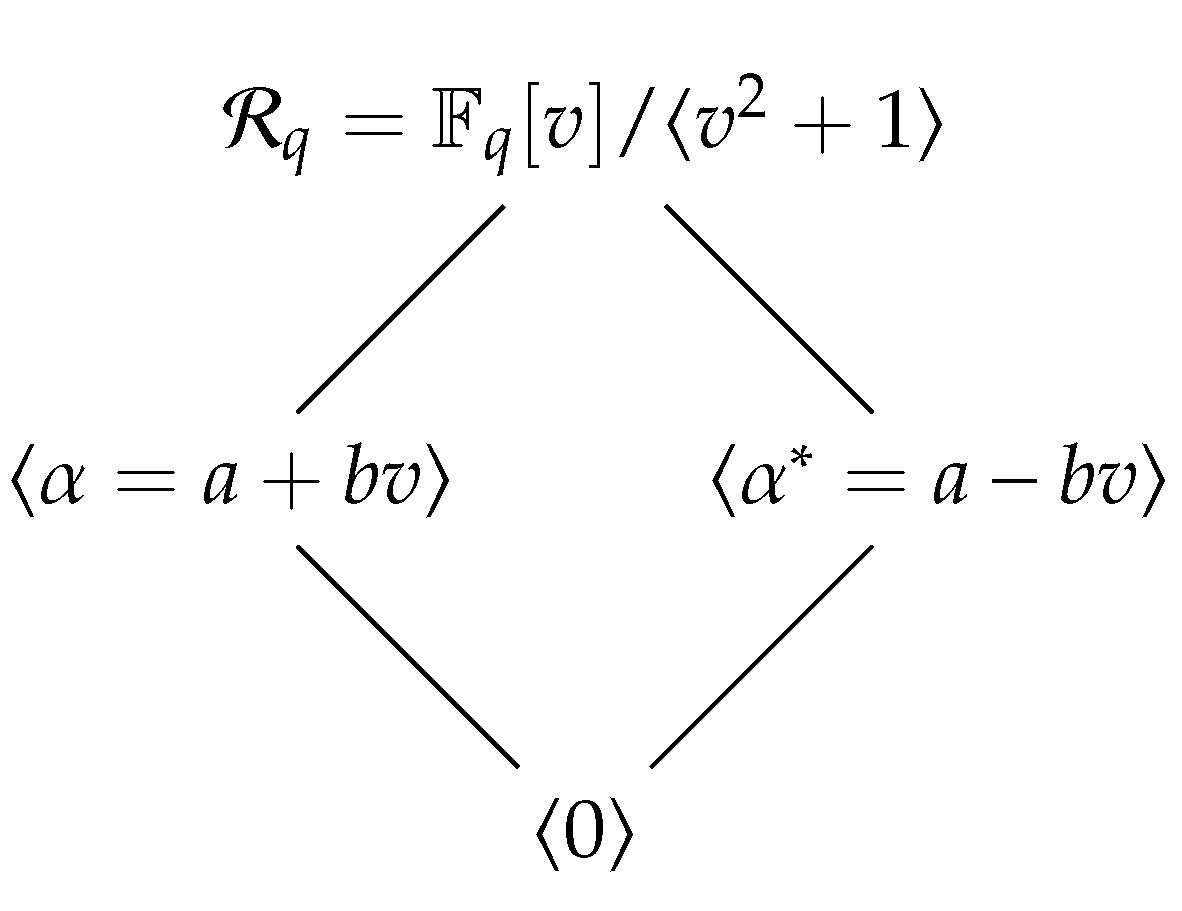
is a non-chain principal ideal ring with two maximal ideals
and
where
is an element of
and
, which is called as the conjugate of the element
The ideal lattice of
is given in
Figure 1.
An element
is called an idempotent if
and two idempotents
are said to be orthogonal if
An idempotent of
is said to be primitive if it is non-zero and it cannot be written as sum of orthogonal idempotents. A collection
of idempotents of
is complete if
Any complete collection of idempotents in
is a basis of the
-vector space
Hence, any element
can be uniquely represented as
where
For more details readers may consult reference [
11].
Let
and
be two elements in
It is easy to see that the set
is a complete set of idempotents in
Therefore, any element
can be uniquely represented as
where
From the
Figure 1, we can easily see that an element
is a unit if and only if both
x and
y are nonzero. Then the unit group of
is described as
Because of the choice of
x and
the number of unit elements of
i.e., the cardinality of the set
is equal to
Theorem 1. Let θ be an automorphism of and σ be a permutation of the set Then the map is an automorphism of the ring Further, the cardinality of the automorphism group of where is the permutation group of the set is Proof of Theorem 1. It is easy to check that
is an automorphism of the ring
Hence,
On the other hand, if
, then the restriction of
over
is
Thus, for any
we have
Now the set
is another complete set of primitive pairwise orthogonal idempotents in
By the idempotent decomposition of the ring
it follows that there exists a permutation of the set
such that
Therefore,
and
Eventually,
and hence
□
Example 1. Let , , and . Then, is a complete set of idempotents of the ring . The maximal ideals of are and . Morevoer, and since the automorphisms on are and .
The map
such that
is a ring epimorphism and can be extended to
as
This Gray type map is an isomorphism of vector spaces over
The Gray weight of any element
is defined as
It is apparent that the linear Gray type map
is a weight preserving map from
to
A linear code
of length
n is an
-submodule of
The Euclidean dual of a linear code
over
of length
n is defined by
. Let
for a vector
where
. The Hermitian dual of a linear code
over
of length
n is defined by
. Note that Euclidean (resp. Hermitian) dual of a linear code over
(resp.
) is also linear code over
(resp.
).
Proposition 1. Let be a linear code of length n over . Then, Further, is a self-dual code iff is a self-dual code of length
Proof of Proposition 1. It is enough to show that the map
preserves the orthogonality, that is,
when
. By the linearity of
, let
such that
. Then, we get
and so
. In this case, it follows that
, which completes the proof. □
Since it follows that Let be a linear code of length n over and Then where , and Let for It is obvious that and are linear codes of length n over and . This implies that for any linear code over of length n there exist linear codes and over of length n such that . The following determines the duals of linear codes over .
Proposition 2. Let be a linear code of length n over . Then Further, is a self-dual code iff both and are self dual.
4. Skew Constacyclic Codes over the Ring
In this section, first we will introduce basics of the skew constacyclic codes over finite fields, which are important for determining the algebraic structure of the skew constacyclic codes over non-chain ring
For a given automorphism of the set of formal polynomials forms a ring with identity under the usual addition of polynomials and the polynomial multiplication with the restriction The multiplication is extended to all the elements of via distributivity and associativity. This ring is called the skew polynomial ring over
Definition 1. For a given element and an automorphism θ of , a θ-skew λ-constacyclic code over the finite field of length n is a linear code satisfying that for each codeword
By the definition of a -skew -constacyclic code over , each codeword can be considered as a skew polynomial in the skew quotient ring
For the purpose of characterization of skew constacyclic codes over
we recollect some well known results about skew-constacyclic codes over finite fields [
8,
13,
14,
15,
47,
48,
49].
The skew reciprocal polynomial of a polynomial
of degree
denoted by
is defined as
If
, the left monic skew reciprocal polynomial of
is
(see Definition 3 [
47]).
From the reference [
14], we have the following result.
Proposition 3 [
14]
. Let be a θ-skew λ-constacyclic code of length n over Then there exists a monic polynomial of minimal degree in such that is a right divisor of and . Let
be a generator of a
-skew
-constacyclic code of length
n over
. It follows from
for some
that the constant term
of
can not be zero in
. From [
47], we have the following result on the duals of
-skew
-constacyclic codes over
.
Proposition 4 (Theorem 1 [
47])
. Let be a θ-skew λ-constacyclic code of length n over generated by a monic polynomial of degree with Let Then is a θ-skew -constacyclic code of length n over such that where is a monic polynomial of degree k such that Moreover is a right divisor of Definition 2. Let be a linear code of length over and be units in and The code is called -double twisted with respect to if for all where and the word Now, we give the definition of skew constacyclic codes over below.
Definition 3. Let and . A linear code of length n over is said to be a -skew λ-constacyclic code of length n over if then .
We investigate the -Gray images of -skew -constacyclic codes over .
Proposition 5. Let and . Suppose that be a -skew λ-constacyclic code of length n over . Thenis a-double twisted code of length over with respect to .
Proof of Proposition 5. Let
where
. Then,
. Since
is a
-skew
-constacyclic code over
, we get
Therefore, we have
which completes the proof. □
As an immediate result of Proposition 5, letting and we deduce the following theorem:
Theorem 2. Let and . Suppose that be a linear code of length n over . Then, is a -skew λ-constacyclic code over of length n if and only if is a θ-skew -constacyclic code over of length n.
Proof of Theorem 2. It follows from the proof of Proposition 5 by taking . □
Hereafter, we only consider the automorphism
defined by
where
.
Now, we give a generator of a -skew -constacyclic code over , where .
Proposition 6. Let and . Suppose that be a -skew λ-constacyclic code of length n over . Then there exist polynomials and such that with .
Proof of Proposition 6. Let and let such that Since is a left submodule of the skew ring there exist and such that and hence .
On the other hand, let
then there exist
and
such that
. Then there exist
and
such that
, thus
This shows that
. □
We give the exact characterization of -skew -constacyclic codes over as a consequence of Proposition 6.
Theorem 3. Let and . Suppose that be a -skew λ-constacyclic code of length n over . Then is principally generated with , where and is a right divisor of in .
Proof of Theorem 3 It is apparent that
. Since
for
, we have
This implies that
Since
is a right divisor of
there exists
such that
Seeing that
, hence
This shows that
is a right divisor of
□
Proposition 2, Proposition 3, Theorem 2 and Theorem 3 together imply the following result:
Theorem 4. Let and . If is a -skew λ-constacyclic code of length n over with , , then is a -skew -constacyclic code of length n over , where and .
Proof of Theorem 4 Recall that by Proposition 2 and is a -skew -constacyclic code over by Proposition 4. Then, by Theorem 2, is a -skew -constacyclic code over . Finally, Theorem 3 gives the generator polynomial of . □
5. Linear Complementary Dual Skew Constacyclic Codes over
In this section, we define LCD codes over and give a characterization for skew constacyclic codes over to be Euclidean LCD and Hermitian LCD. Before giving the definition of LCD codes over , we briefly state some basic definitions and results on LCD codes over .
A linear code
over
is said to be an Euclidean LCD code if the intersection of
and
is zero, that is,
[
16]. A Hermitian LCD code is a linear code
C over
with
. From [
50], we have the following theorem for skew constacyclic codes over finite fields to be Euclidean LCD and Hermitian LCD.
Theorem 5 (Theorem 2 [
50])
. Let and .
Let be a θ-skew λ-constacyclic code of length n over with .
Let with .
Then,- (1)
is an Euclidean LCD code ⇔. (Here, represents the greatest common right divisor of g and )
- (2)
Let q be an even power of a prime number. Then, is a Hermitian LCD code ⇔. (For , .)
The definitions of Euclidean LCD and Hermitian LCD codes over are similar to the ones over finite fields.
Definition 4. A linear code C over (resp. ) is called an Euclidean (resp. Hermitian) LCD code if (resp. ).
The following explores when a linear code over is an Euclidean LCD or a Hermitian LCD.
Proposition 7. Let be a linear code over (resp. ). Then, is an Euclidean (resp. Hermitian) LCD code over (resp. ) if and only if ’s are Euclidean (resp. Hermitian) LCD codes over (resp. ).
Proof of Proposition 7. Since
by Proposition 2, we get
which implies that
⇔
. The Hermitian case is similar. □
Theorem 6. Let and . A -skew λ-constacyclic code of length n over (resp. over ), where and , is an Euclidean (resp. Hermitian) LCD code over if and only if (resp. ).
Proof of Theorem 6. See that if . The remain of the proof follows from Proposition 7 and Theorem 5. The Hermitian case is similar. □
We also have the following result from Proposition 7.
Theorem 7. Let be a linear code over (resp. ). Then, is an Euclidean (resp. Hermitian) LCD code over (resp. ) if and only if is an Euclidean (resp. Hermitian) LCD codes over (resp. ).
Example 2. Let , , and . Then, and . Let , where . Let be Frobenius automorphism. Observe that and in . Let and be an Euclidean LCD θ-skew cyclic code and an Euclidean LCD θ-skew negacyclic () code of length 4 over , respectively. Then is an Euclidean LCD -skew -constacyclic code of length 4 over with generator polynomial and is an Euclidean LCD code with parameters , which is almost MDS. Moreover, we list some Euclidean LCD -skew constacyclic codes over of length 4 and present the parameters of almost MDS and near MDS Euclidean LCD codes over of length 8 obtained via the map Φ in Table 1. 6. Entanglement-Assisted Quantum Codes with Maximal Entanglement from Skew Constacyclic LCD Codes over
In this section, we apply the skew constacyclic LCD codes over
to obtain parameters for the entanglement assisted quantum codes with maximal entanglement [
28].
An
EAQECC is a quantum code that encodes
k information qubits into
n qubits and corrects up to
errors via
c pairs of maximally entanglement states. For an
EAQECC, the number
c of maximally entanglement states based on the linear codes is less than or equal to
, and if
, then this is called an EAQECC with maximal entanglement [
51]. We have the following construction for EAQECCs obtained from linear codes over
.
Theorem 8 [
45]
. If there exists an linear code with parity check matrix H, then there exists an EAQECC having parameters , where . We also have the following from [Proposition 3.2] [
34].
Proposition 8 [
34]
. If is a linear code with parity check matrix H, then . Theorem 8 and Proposition 8 together imply that since and so for an Hermitian LCD code, one gets an EAQECC. Since the -images of the Hermitian LCD codes over are also Hermitian LCD codes over , we derive a family of EAQECCs from -skew -constacyclic codes over as following.
Theorem 9. Let and . Let be a -skew λ-constacyclic code of length n over , where and . If , then there exists a maximal entanglement EAQECC having parameters , where , and is the minimum distance of .
Example 3. Let , , and . Then, and . Let , where . Let be Frobenius automorphism. See that and in . Note that and be a Hermitian LCD θ-skew cyclic code and a Hermitian LCD θ-skew negacyclic () code of length 6 over , respectively. Then is a Hermitian LCD -skew -constacyclic code of length 6 over with generator polynomial and is a Hermitian LCD code with parameters . Applying Theorem 9, we get an EAQECC with maximal entanglement. Furthermore, we list some Hermitian LCD -skew constacyclic codes over of length 6 and present the parameters of EAQECCs with maximal entanglement over of length 12 obtained via the map Φ and Theorem 9 in Table 2. 7. Conclusions
In this paper, by determining the automorphism group of the ring we define and study the skew constacyclic codes over . We characterize the algebraic structure of skew constacyclic codes and their duals over . We investigate the -images of skew constacyclic codes over . Moreover, we consider LCD codes over and give a necessary and sufficient condition for skew constacyclic codes to be Euclidean and Hermitian LCD. We also give some examples of Euclidean LCD codes over of length 4 and tabulate the parameters of almost MDS and near MDS Euclidean LCD codes over of length 8 as the -images of these codes over . Finally, as an application of these Hermitian LCD skew constacyclic codes over , we obtain a class of EAQECCs with maximal entanglement and tabulate parameters of some EAQECCs with maximal entanglement over of length 12. In the process of preparing this study, the following two questions were among those that we could not answer yet, but which offer potential avenues for future research.
- (Q1)
We just determine the algebraic structure of the -skew -constacyclic codes over . What about the algebraic structure of the more general case -skew -constacyclic codes over ?
- (Q2)
What about the self-duality of -skew -constacyclic codes over ? In this case, does there exists any restriction on ?