Are the Biological and Biomechanical Properties of Meniscal Scaffolds Reflected in Clinical Practice? A Systematic Review of the Literature



Abstract
1. Introduction
2. Results
2.1. Coleman Methodology Score
2.2. Demographic Features of the Patients and Lesions Treated
2.3. Clinical Outcome Measures and MRI Outcome Measures
2.4. Second-Look Arthroscopy and Histological Evaluation of Biopsies
2.5. Complications and Treatment Failures
2.6. Do the Scaffolds Improve Clinical Outcomes?
2.7. Do the Scaffolds Have a Chondroprotective Effect?
2.8. How Are the Properties of the Scaffold Reflected in the Genovese Signal Intensity and Morphology Scores?
3. Discussion
3.1. Quality of Included Studies
3.2. How do the Scaffolds Perform in Relation to Clinical Outcomes?
3.3. Is Initial Porosity and Maturation of the Scaffolds Evident after Implantation?
3.4. Do Scaffolds Resorb Well, as Assessed by MRI?
3.5. Do the Scaffolds Have Chondroprotective Properties?
3.6. Are the Regenerative Properties of the Scaffolds Evident?
3.7. Are the Integrative Properties of the Scaffolds Evident?
3.8. Limitations
3.9. The Future of Meniscal Scaffolds
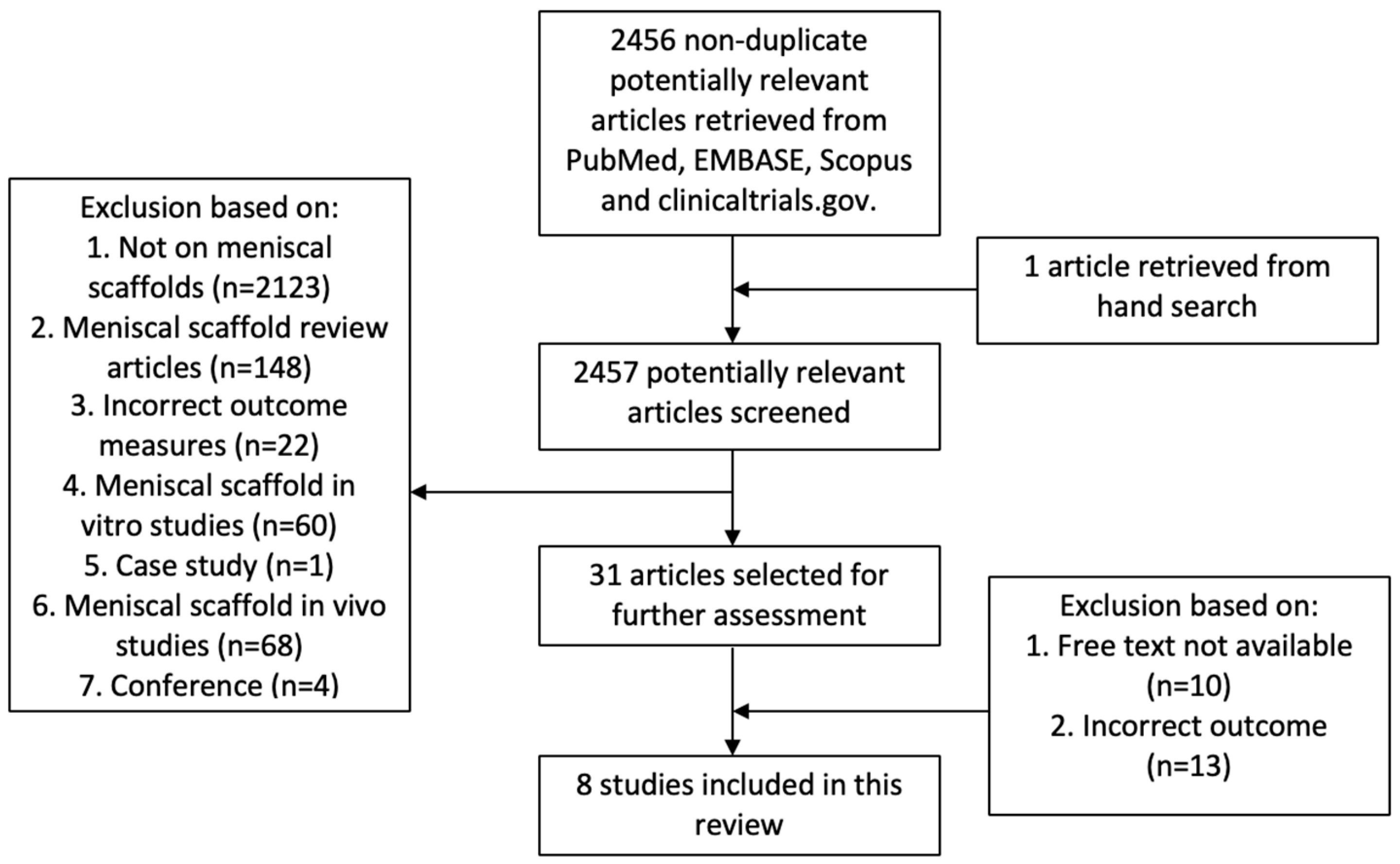
4. Methods
5. Conclusions
Supplementary Materials
Author Contributions
Conflicts of Interest
Abbreviations
| ACL | Anterior Cruciate Ligament |
| CMI | Collagen Meniscus Implant |
| CMS | Coleman Methodology Score |
| ECM | Extracellular Matrix |
| EQ-5D | EuroQol 5 dimensions |
| GelMA | Gelatin methacrylamide |
| GAG | Glycosaminoglycan |
| MeHA | Methacrylated hyaluronic acid |
| HA | Hyaluronic Acid |
| ICRS | International Cartilage Repair Society |
| IKDC | International Knee Documentation Committee Score |
| KOOS ADL | Knee injury and Osteoarthritis Outcome Function in daily life score, |
| KOOS QOL | Knee injury and Osteoarthritis Outcome Quality of Life score |
| KOOS Sport/rec | Knee injury and Osteoarthritis Outcome Function in Sport and Recreation score |
| KOOS Symp/stiffness | Knee injury and Osteoarthritis Outcome Symptom score, KSS Knee Society Score, |
| KSS | Knee Society Score |
| M | Months |
| MAT | Meniscal Allograft Transplantation |
| MRI | Magnetic resonance imaging |
| N/A | Not Applicable |
| NO | Nitric Acid |
| NR | Not Reported |
| PRISMA | Preferred Reporting Items for Systematic Reviews and Meta-Analyses |
| UCLA | University of California, Los Angeles activity scale, |
| VAS | Visual Analog Scale |
| Y | Years |
References
- Herwig, J.U.; Egner, E.B.; Buddecke, E.C. Chemical changes of human knee joint menisci in various stages of degeneration. Ann. Rheum. Dis. 1984, 43, 635. [Google Scholar] [CrossRef] [PubMed]
- Tan, G.K.; Cooper-White, J.J. Interactions of meniscal cells with extracellular matrix molecules: Towards the generation of tissue engineered menisci. Cell Adhes. Migr. 2011, 5, 220–226. [Google Scholar] [CrossRef]
- Guo, W.; Liu, S.; Zhu, Y.; Yu, C.; Lu, S.; Yuan, M.; Gao, Y.; Huang, J.; Yuan, Z.; Peng, J.; et al. Advances and prospects in tissue-engineered meniscal scaffolds for meniscus regeneration. Stem Cells Int. 2015, 2015, 517520. [Google Scholar] [CrossRef] [PubMed]
- Baker, B.E.; Peckham, A.C.; Pupparo, F.; Sanborn, J.C. Review of meniscal injury and associated sports. Am. J. Sports Med. 1985, 13, 1–4. [Google Scholar] [CrossRef]
- Pengas, I.; Assiotis, A.; Nash, W.; Hatcher, J.; Banks, J.; Mcnicholas, M.J. Meniscectomy & Osteoarthritis: A Mean 40-Year Follow-Up. Arthrosc. J. Arthrosc. Relat. Surg. 2013, 10, 67–68. [Google Scholar]
- Baratz, M.E.; Fu, F.H.; Mengato, R. Meniscal tears: The effect of meniscectomy and of repair on intraarticular contact areas and stress in the human knee: A preliminary report. Am. J. Sports Med. 1986, 14, 270–275. [Google Scholar] [CrossRef]
- Hede, A.; Larsen, E.; Sandberg, H. The long term outcome of open total and partial meniscectomy related to the quantity and site of the meniscus removed. Int. Orthop. 1992, 16, 122–125. [Google Scholar] [CrossRef]
- Verdonk, R.; Volpi, P.; Verdonk, P.; Van der Bracht, H.; Van Laer, M.; Almqvist, K.F.; Vander Eecken, S.; Prospero, E.; Quaglia, A. Indications and limits of meniscal allografts. Injury 2013, 44, 21–27. [Google Scholar] [CrossRef]
- Gomoll, A.H.; Filardo, G.; Almqvist, F.K.; Bugbee, W.D.; Jelic, M.; Monllau, J.C.; Puddu, G.; Rodkey, W.G.; Verdonk, P.; Verdonk, R.; et al. Surgical treatment for early osteoarthritis. Part II: Allografts and concurrent procedures. Knee Surg. Sports Traumatol. Arthrosc. 2012, 20, 468–486. [Google Scholar] [CrossRef]
- Verdonk, P.; Forsyth, R.; Verdonk, R. Tissue regeneration, maturation and integration following meniscal repair with a novel polyurethane meniscus scaffold in humans. Orthop. Proc. 2010, 92, 508. [Google Scholar]
- Suzuki, Y.; Takeuchi, N.; Sagehashi, Y.; Yamaguchi, T.; Itoh, H.; Iwata, H. Effects of hyaluronic acid on meniscal injury in rabbits. Arch. Orthop. Trauma Surg. 1998, 117, 303–306. [Google Scholar] [CrossRef] [PubMed]
- Takahashi, K.; Hashimoto, S.; Kubo, T.; Hirasawa, Y.; Lotz, M.; Amiel, D. Hyaluronan suppressed nitric oxide production in the meniscus and synovium of rabbit osteoarthritis model. J. Orthop. Res. 2001, 19, 500–503. [Google Scholar] [CrossRef]
- Stone, K.R.; Rodkey, W.G.; Webber, R.; McKinney, L.; Steadman, J.R. Meniscal regeneration with copolymeric collagen scaffolds: In vitro and in vivo studies evaluated clinically, histologically, and biochemically. Am. J. Sports Med. 1992, 20, 104–111. [Google Scholar] [CrossRef] [PubMed]
- Hansen, R.; Bryk, E.; Vigorita, V. Collagen scaffold meniscus implant integration in a canine model: A histological analysis. J. Orthop. Res. 2013, 31, 1914–1919. [Google Scholar] [CrossRef] [PubMed]
- De Groot, J. Actifit, Polyurethane meniscus implant: Basic science. In The Meniscus; Springer: Berlin/Heidelberg, Germany, 2010; pp. 383–387. [Google Scholar]
- Van Minnen, B.; Van Leeuwen, M.B.M.; Kors, G.; Zuidema, J.; Van Kooten, T.G.; Bos, R.R.M. In vivo resorption of a biodegradable polyurethane foam, based on 1,4-butanediisocyanate: A three-year subcutaneous implantation study. J. Biomed. Mater. Res. Part A 2008, 85, 972–982. [Google Scholar] [CrossRef] [PubMed]
- Baynat, C.; Andro, C.; Vincent, J.P.; Schiele, P.; Buisson, P.; Dubrana, F.; Gunepin, F.X. Actifit® synthetic meniscal substitute: Experience with 18 patients in Brest, France. Orthop. Traumatol. Surg. Res. 2014, 100, 385–389. [Google Scholar] [CrossRef] [PubMed]
- Tienen, T.G.; Heijkants, R.G.; de Groot, J.H.; Pennings, A.J.; Schouten, A.J.; Veth, R.P.; Buma, P. Replacement of the knee meniscus by a porous polymer implant: A study in dogs. Am. J. Sports Med. 2006, 34, 64–71. [Google Scholar] [CrossRef]
- Sun, J.; Vijayavenkataraman, S.; Liu, H. An overview of scaffold design and fabrication technology for engineered knee meniscus. Materials 2017, 10, 29. [Google Scholar] [CrossRef]
- Ionescu, L.C.; Mauck, R.L. Porosity and cell preseeding influence electrospun scaffold maturation and meniscus integration in vitro. Tissue Eng. Part A 2012, 19, 538–547. [Google Scholar] [CrossRef]
- Moher, D.; Liberati, A.; Tetzlaff, J.; Altman, D.G. Preferred reporting items for systematic reviews and meta-analyses: The PRISMA statement. Ann. Intern. Med. 2009, 151, 264–269. [Google Scholar] [CrossRef]
- Bulgheroni, P.; Murena, L.; Ratti, C.; Bulgheroni, E.; Ronga, M.; Cherubino, P. Follow-up of collagen meniscus implant patients: Clinical, radiological, and magnetic resonance imaging results at 5 years. Knee 2010, 17, 224–229. [Google Scholar] [CrossRef] [PubMed]
- Zaffagnini, S.; Marcheggiani Muccioli, G.M.; Lopomo, N.; Bruni, D.; Giordano, G.; Ravazzolo, G.; Molinari, M.; Marcacci, M. Prospective long-term outcomes of the medial collagen meniscus implant versus partial medial meniscectomy: A minimum 10-year follow-up study. Am. J. Sports Med. 2011, 39, 977–985. [Google Scholar] [CrossRef] [PubMed]
- Zaffagnini, S.; Marcheggiani Muccioli, G.M.; Bulgheroni, P.; Bulgheroni, E.; Grassi, A.; Bonanzinga, T.; Kon, E.; Filardo, G.; Busacca, M.; Marcacci, M. Arthroscopic collagen meniscus implantation for partial lateral meniscal defects: A 2-year minimum follow-up study. Am. J. Sports Med. 2012, 40, 2281–2288. [Google Scholar] [CrossRef] [PubMed]
- Bulgheroni, P.; Bulgheroni, E.; Regazzola, G.; Mazzola, C. Polyurethane scaffold for the treatment of partial meniscal tears. Clinical results with a minimum two-year follow-up. Joints 2013, 1, 161. [Google Scholar] [CrossRef] [PubMed]
- Dhollander, A.; Verdonk, P.; Verdonk, R. Treatment of painful, irreparable partial meniscal defects with a polyurethane scaffold: Midterm clinical outcomes and survival analysis. Am. J. Sports Med. 2016, 44, 2615–2621. [Google Scholar] [CrossRef] [PubMed]
- Leroy, A.; Beaufils, P.; Faivre, B.; Steltzlen, C.; Boisrenoult, P.; Pujol, N. Actifit® polyurethane meniscal scaffold: MRI and functional outcomes after a minimum follow-up of 5 years. Orthop. Traumatol. Surg. Res. 2017, 103, 609–614. [Google Scholar] [CrossRef] [PubMed]
- Schüttler, K.F.; Pöttgen, S.; Getgood, A.; Rominger, M.B.; Fuchs-Winkelmann, S.; Roessler, P.P.; Ziring, E.; Efe, T. Improvement in outcomes after implantation of a novel polyurethane meniscal scaffold for the treatment of medial meniscus deficiency. Knee Surg. Sports Traumatol. Arthrosc. 2015, 23, 1929–1935. [Google Scholar] [CrossRef] [PubMed]
- Bulgheroni, E.; Grassi, A.; Campagnolo, M.; Bulgheroni, P.; Mudhigere, A.; Gobbi, A. Comparative study of collagen versus synthetic-based meniscal scaffolds in treating meniscal deficiency in young active population. Cartilage 2016, 7, 29–38. [Google Scholar] [CrossRef]
- Coleman, B.D.; Khan, K.M.; Maffulli, N.; Cook, J.L.; Wark, J.D. Studies of surgical outcome after patellar tendinopathy: Clinical significance of methodological deficiencies and guidelines for future studies. Scand. J. Med. Sci. Sports Rev. Artic. 2000, 10, 2–11. [Google Scholar] [CrossRef]
- Yulish, B.S.; Montanez, J.; Goodfellow, D.B.; Bryan, P.J.; Mulopulos, G.P.; Modic, M.T. Chondromalacia patellae: Assessment with MR imaging. Radiology 1987, 164, 763–766. [Google Scholar] [CrossRef]
- Genovese, E.; Angeretti, M.G.; Ronga, M.; Leonardi, A.; Novario, R.; Callegari, L.; Fugazzola, C. Follow-up of collagen meniscus implants by MRI. Radiol. Med. 2007, 112, 1036–1048. [Google Scholar] [CrossRef] [PubMed]
- Xie, J.; Ihara, M.; Jung, Y.; Kwon, I.K.; Kim, S.H.; Kim, Y.H.; Matsuda, T. Mechano-active scaffold design based on microporous poly (L-lactide-co-ε-caprolactone) for articular cartilage tissue engineering: Dependence of porosity on compression force-applied mechanical behaviors. Tissue Eng. 2006, 12, 449–458. [Google Scholar] [CrossRef] [PubMed]
- De Coninck, T.; Verdonk, P.; Verstraete, K. MR-imaging of meniscal substitution. J. Belg. Soc. Radiol. 2016, 100. [Google Scholar] [CrossRef] [PubMed]
- Zaffagnini, S.; Grassi, A.; Muccioli, G.M.M.; Bonanzinga, T.; Nitri, M.; Raggi, F.; Ravazzolo, G.; Marcacci, M. MRI evaluation of a collagen meniscus implant: A systematic review. Knee Surg. Sports Traumatol. Arthrosc. 2015, 23, 3228–3237. [Google Scholar] [CrossRef]
- Zuidema, J.; Van Minnen, B.; Span, M.M.; Hissink, C.E.; van Kooten, T.G.; Bos, R.R.M. In vitro degradation of a biodegradable polyurethane foam, based on 1,4-butanediisocyanate: A three-year study at physiological and elevated temperature. J. Biomed. Mater. Res. Part A 2009, 90, 920–930. [Google Scholar] [CrossRef]
- Hirschmann, A.; Schiapparelli, F.F.; Schenk, L.; Keller, L.; Amsler, F.; Hirschmann, M.T. The Genovese grading scale is not reliable for MR assessment of collagen meniscus implants. Knee 2017, 24, 9–15. [Google Scholar] [CrossRef]
- Li, X.; Cheng, J.; Lin, K.; Saadat, E.; Bolbos, R.I.; Jobke, B.; Ries, M.D.; Horvai, A.; Link, T.M.; Majumdar, S. Quantitative MRI using T1ρ and T2 in human osteoarthritic cartilage specimens: Correlation with biochemical measurements and histology. Magn. Reson. Imaging 2011, 29, 324–334. [Google Scholar] [CrossRef]
- Verdonk, R.; Forsyth, R. Histological Analysis of Tissue Ingrowth and Organization Following Implantation of a Novel Synthetic Acellular Meniscal Scaffold for the Treatment of Irreparable Partial Meniscus Tears and/or Partial (SS-27A). Arthroscopy 2011, 27, 44–45. [Google Scholar] [CrossRef]
- Vrancken, A.C.T.; Buma, P.; van Tienen, T.G. Synthetic meniscus replacement: A review. Int. Orthop. 2013, 37, 291–299. [Google Scholar] [CrossRef]
- Myers, K.R.; Sgaglione, N.A.; Kurzweil, P.R. A current update on meniscal scaffolds. Oper. Tech. Sports Med. 2013, 21, 75–81. [Google Scholar] [CrossRef]
- Verdonk, R.; Verdonk, P.; Huysse, W.; Forsyth, R.; Heinrichs, E.L. Tissue ingrowth after implantation of a novel, biodegradable polyurethane scaffold for treatment of partial meniscal lesions. Am. J. Sports Med. 2011, 39, 774–782. [Google Scholar] [CrossRef] [PubMed]
- Houck, D.A.; Kraeutler, M.J.; Belk, J.W.; McCarty, E.C.; Bravman, J.T. Similar clinical outcomes following collagen or polyurethane meniscal scaffold implantation: A systematic review. Knee Surg. Sports Traumatol. Arthrosc. 2018, 26, 2259–2269. [Google Scholar] [CrossRef] [PubMed]
- Makris, E.A.; Hadidi, P.; Athanasiou, K.A. The knee meniscus: Structure-function, pathophysiology, current repair techniques, and prospects for regeneration. Biomaterials 2011, 32, 7411–7431. [Google Scholar] [CrossRef] [PubMed]
- Zur, G.; Linder-Ganz, E.; Elsner, J.J.; Shani, J.; Brenner, O.; Agar, G.; Hershman, E.B.; Arnoczky, S.P.; Guilak, F.; Shterling, A. Chondroprotective effects of a polycarbonate-urethane meniscal implant: Histopathological results in a sheep model. Knee Surg. Sports Traumatol. Arthrosc. 2011, 19, 255–263. [Google Scholar] [CrossRef] [PubMed]
- Elsner, J.J.; Shemesh, M.; Shefy-Peleg, A.; Gabet, Y.; Zylberberg, E.; Linder-Ganz, E. Quantification of in vitro wear of a synthetic meniscus implant using gravimetric and micro-CT measurements. J. Mech. Behav. Biomed. Mater. 2015, 49, 310–320. [Google Scholar] [CrossRef] [PubMed]
- Van Der Straeten, C.; Doyen, B.; Dutordoir, C.; Goedertier, W.; Pirard, S.; Victor, J. Short-and medium-term results of artificial meniscal implants. Orthop. Proc. 2016, 98, 91. [Google Scholar]
- Mandal, B.B.; Park, S.H.; Gil, E.S.; Kaplan, D.L. Multilayered silk scaffolds for meniscus tissue engineering. Biomaterials 2011, 32, 639–651. [Google Scholar] [CrossRef] [PubMed]
- Yan, L.P.; Oliveira, J.M.; Oliveira, A.L.; Caridade, S.G.; Mano, J.F.; Reis, R.L. Macro/microporous silk fibroin scaffolds with potential for articular cartilage and meniscus tissue engineering applications. Acta Biomater. 2012, 8, 289–301. [Google Scholar] [CrossRef] [PubMed]
- Gruchenberg, K.; Ignatius, A.; Friemert, B.; von Lübken, F.; Skaer, N.; Gellynck, K.; Kessler, O.; Dürselen, L. In vivo investigation of an innovative silk scaffold for partial meniscus replacement. J. Biomech. 2012, 45, 156. [Google Scholar] [CrossRef]
- Pillai, M.M.; Gopinathan, J.; Senthil Kumar, R.; Sathish Kumar, G.; Shanthakumari, S.; Sahanand, K.S.; Bhattacharyya, A.; Selvakumar, R. Tissue engineering of human knee meniscus using functionalized and reinforced silk-polyvinyl alcohol composite three-dimensional scaffolds: Understanding the in vitro and in vivo behavior. J. Biomed. Mater. Res. Part A 2018, 106, 1722–1731. [Google Scholar] [CrossRef] [PubMed]
- Bahcecioglu, G.; Hasirci, N.; Bilgen, B.; Hasirci, V. Hydrogels of agarose, and methacrylated gelatin and hyaluronic acid are more supportive for in vitro meniscus regeneration than three dimensional printed polycaprolactone scaffolds. Int. J. Biol. Macromol. 2019, 122, 1152–1162. [Google Scholar] [CrossRef] [PubMed]
- Mainil-Varlet, P.; Aigner, T.; Brittberg, M.; Bullough, P.; Hollander, A.; Hunziker, E.; Kandel, R.; Nehrer, S.; Pritzker, K.; Roberts, S.; et al. Histological assessment of cartilage repair: A report by the Histology Endpoint Committee of the International Cartilage Repair Society (ICRS). JBJS 2003, 85, 45–57. [Google Scholar] [CrossRef]


| Author | Year | Type of Meniscal Implant or Scaffold | Number of Patients | Mean Patient Age (Y) | Male:Female | Type of Lesion: Medial or Lateral | Mean Follow-up (Range) (M) | Details of Concomitant Procedure |
|---|---|---|---|---|---|---|---|---|
| Bulgheroni [25] | 2013 | Actifit | 19 | 32.8 | 17:2 | 16 medial, 2 lateral, 1 bilateral | 24 (24–46) | 17 patients: 8 ACL reconstructions, 1 ACL repair, 7 high tibial osteotomies and 1 femoral osteotomy |
| Dhollander [26] | 2016 | Actifit | 44 | 32.1 | 24:20 | 29 medial and 15 lateral | 60 (24–60) | 8 patients: 4 ACL reconstructions and 4 high tibial osteotomies |
| Leroy [27] | 2017 | Actifit | 15 | 30.0 | 8:7 | 6 medial 9 lateral | 72 (60–97.2) | 6 patients: 5 ACL reconstructions, 1 mosaicplasty |
| Schuttler [28] | 2015 | Actifit | 18 | 32.5 | NR | 18 medial | NR - minimum 24 | No patients |
| Bulgheroni [22] | 2010 | CMI | 34 | 39.0 | 25:9 | 34 medial | NR (60–76) | 14 patients: 11 ACL reconstructions, 2 high tibial osteotomies and 1 microfracture |
| Zaffagnini [23] | 2011 | CMI | 17 | 38.0 | 17:0 | 17 medial | 135 (120–152) | 2 patients: 2 ACL reconstructions |
| Zaffagnini [24] | 2012 | CMI | 24 | 36.3 | 20:4 | 24 lateral | 26 (24–31) | 11 patients: 4 ACL reconstructions, 6 lateral tibial plateau microfractures, 1 ACL cyst removal |
| Bulgheroni [29] | 2016 | CMI and Actifit | 28 CMI; 25 Actifit | 38.7 CMI; 34.4 Actifit | 19:9 CMI; 20:5 Actifit | 53 medial | NR—minimum 24 | Actifit—25 patients: 11 tibial osteotomies, 9 ACL reconstructions, 3 microfractures, 1 healing response, 1 suture CMI—15 patients: 3 tibial osteotomies, 11 ACL reconstructions and 1 microfracture |
| Author | Year | Clinical Scores (Mean ± Standard Deviation) | OR Description of Main Clinical Results | ||||
|---|---|---|---|---|---|---|---|
| 0M | 6M | 12M | 24M | 60M | |||
| ACTIFIT | |||||||
| Bulgheroni [25] | 2013 | Lysholm: 66.2 | 86.8* | 90.7 | 90.5 | - | Clinical outcome scores were significantly improved after 6M compared to baseline. |
| Tegner: 3.8 | 4.1* | 4.9 | 6 | - | |||
| VAS: 6.23 | 3.07* | 2.1 | 1.94 | - | |||
| Dhollander [26] | 2016 | KOOS Total: 206.5 ± 79.7 | - | - | 329.8 ± 108.9* | 333.6 ± 112.2* | All post-operative clinical outcome scores showed statistically significant improvement when compared to baseline. |
| KOOS Pain: 48.3 ± 20.3 | - | - | 72.9 ± 23.6* | 77.2 ± 24.5* | |||
| KOOS Symp/stiffness: 52.4 ± 19.7 | - | - | 73.2 ± 18.4* | 69.4 ± 20.9* | |||
| KOOS ADL: 54.4 ± 21.5 | - | - | 77.1 ± 23.9* | 80.2 ± 26.1* | |||
| KOOS sport/rec: 19.1 ± 20.0 | - | - | 57.0 ± 35.6* | 49.7 ± 34.8* | |||
| KOOS QOL: 32.2 ± 14.2 | - | - | 49.6 ± 21.6* | 56.9 ± 24.0* | |||
| VAS for pain: 56.2 ± 21.6 | - | - | 24.6 ± 22.7* | 19.3 ± 26.9* | |||
| IKDC subjective form: 38.7 ± 14.8 | - | - | 63.4 ± 24.3* | 66.9 ± 23.1* | |||
| Leroy [27] | 2017 | Intention to treat group | |||||
| VAS: 5.5 ± 2.0 | - | 3.7 ± 2 | 2.9 ± 2.1 | 2.9 ± 2.6* | Intention to treat group: VAS and IKDC subjective score statistically improved from baseline to final post-operative timepoint, with no other measures showing statistical improvement. | ||
| IKDC subjective: 51.2 ± 20 | - | 62.1 ± 19 | 65.1 ± 22 | 66.1 ± 23 | |||
| IKDC objective: 2A/6B/3C/2D | - | 4A/5B/3C/1D | 3A/2B/7C/1D | 2A/7B/3C/1D | |||
| KOOS Symp/stiffness: 69.4 ± 13 | - | 75 ± 14 | 76.5 ± 15 | 68.3 ± 23 | |||
| KOOS pain: 62.9 ± 15 | - | 75 ± 16 | 77.8 ± 18 | 76.1 ± 25 | |||
| KOOS ADL: 72 ± 20 | - | 79.7 ± 14 | 83.5 ± 17 | 81.7 ± 23 | |||
| KOOS Sport/rec: 51.2 ± 14 | - | 55.8 ± 21 | 61.2 ± 17 | 53.5 ± 33 | |||
| KOOS QOL: 40.9 ± 18 | - | 57.7 ± 27 | 64.3 ± 25 | 59.9 ± 31 | |||
| Per protocol group | |||||||
| VAS: 5.3 ± 2.2 | - | - | - | 1.9 ± 1.7* | Per protocol group: VAS, IKDC subjective, KOOS pain, KOOS daily activities and KOOS QOL were statistically improved from baseline to final post-operative time point with no other measures showing statistical improvement | ||
| IKDC subjective: 49.6 ± 19 | - | - | - | 75.4 ± 15* | |||
| IKDC objective: 1A/5B/2C/2D | - | - | - | 2A/6B/2C/0D | |||
| KOOS symp/stiffness: 67.1 ± 14 | - | - | - | 76.3 ± 16 | |||
| KOOS pain: 60.6 ± 16 | - | - | - | 86 ± 13* | |||
| KOOS ADL: 70.3 ± 21 | - | - | - | 90.2 ± 11* | |||
| KOOS sport/rec: 50.5 ± 14 | - | - | - | 65.5 ± 25 | |||
| KOOS QOL: 42.7 ± 17 | - | - | - | 71.1 ± 25* | |||
| Schuttler [28] | 2015 | KOOS pain: 47 ± 14.5 | KOOS pain: 75 ± 17.7* | KOOS pain: 82 ± 17.4* | KOOS pain: 83 ± 18.6* | - | All KOOS subdomains showed statistically significant improvements comparing preoperative and 24M scores. KSS function and knee both showed statistically significant improvement over whole time period. VAS: Statistically significant reduction compared to baseline at every time point. UCLA: Statistically significant increase compared to baseline was only seen at 2 years. |
| KOOS symp/stiffness: 60 ± 16.2 | KOOS symp/stiffness: 67 ± 18.5* | KOOS symp/stiffness: 85 ± 9.7* | KOOS symp/stiffness: 81 ± 13.4* | ||||
| KOOS ADL: 53.1 ± 16.0 | KOOS ADL: 85 ± 14.5* | KOOS ADL: 88 ± 13.0* | KOOS ADL: 91 ± 14.7* | ||||
| KOOS Sport/rec:26 ± 20.5 | KOOS Sport/Rec: 60 ± 25.3* | KOOS Sport/Rec: 68 ± 24.5* | KOOS Sport/Rec: 66 ± 28.5* | ||||
| KOOS QOL: 28 ± 16.6 | KOOS QOL: 55 ± 26.9* | KOOS QOL: 67 ± 20.4* | KOOS QOL: 63 ± 18.9* | ||||
| KSS function score: 61 ± 22.2 | KSS function score: 87 ± 10.2* | KSS function score: 89 ± 15.7* | KSS function score: 96 ± 7.9* | ||||
| KSS knee score: 65 ± 9.4 | KSS knee score: 89 ± 13.1* | KSS knee score: 87 ± 14.1* | KSS knee score: 88 ± 12.4* | ||||
| UCLA: 5.4 ± 1.8 | UCLA: 6.1 ± 1.8 | UCLA: 6.5 ± 2.1 | UCLA: 7.3 ± 1.8* | ||||
| VAS: 5.1 ± 2.0 | VAS: 2.1 ± 2.4* | VAS: 1.8 ± 2.3* | VAS: 1.5 ± 2.1* | ||||
| CMI | |||||||
| Bulgheroni [22] | 2010 | Lysholm: 58 | - | - | 94* | - | Both clinical outcome scores showed statistically significant improvements comparing 24M to baseline. |
| Tegner: 2 | - | - | 5* | - | |||
| Zaffagnini [23] | 2011 | - | - | - | - | - | Comparing 10-year follow-up to baseline, statistically significant improvements seen in all clinical outcome measures: VAS, Lysholm, SF-36 PHI, SF-36 MI, IKDC and Tegner scales. |
| Zaffagnini [24] | 2012 | Lysholm: 64 ± 16.2 | 89.9 ± 11.4* | - | 92.7 ± 13.8* | - | All clinical outcome scores showed statistically significant improvements from baseline to last post-operative follow up. |
| VAS: 55.2 ± 29.4 | 18.3 ± 18.1* | - | 19.5 ± 25.6* | - | |||
| Tegner: 3 (median) | 4 (median) | - | 5 (median)* | - | |||
| Objective IKDC: 6A, 14B, 4C, 0D | 20A, 3B, 0C, 1D* | - | 20A, 3B, 0C, 1D* | - | |||
| EQ-5D: 0.579 ± 0.28 | - | - | 0.892 ± 0.14* | - | |||
| ACTIFIT VS CMI | |||||||
| Bulgheroni [29] | 2016 | CMI Group | |||||
| Lysholm: 58.4 ± 17.3 | - | 92.5 ± 8.5* | 94.5 ± 6.0* (at minimum 24M follow-up) | - | In both CMI and Actifit groups, all clinical outcome scores showed a statistically significant improvement across the follow-up period when compared to baseline. However, none of the differences between values at 12M and final-follow up reached statistical significance. | ||
| Tegner:2 | - | 5* | 5* (at minimum 24M follow-up) | - | |||
| Actifit Group | |||||||
| Lysholm: 67.0 ± 15.7 | - | 87.4 ± 13.0* | 90.3 ± 13.1* (at minimum 24M follow-up) | - | As above | ||
| Tegner:4 | - | 4* | 5* (at minimum 24M follow-up) | - | |||
| Author | Year | MRI Findings | |||||||||
|---|---|---|---|---|---|---|---|---|---|---|---|
| Yulish Score at Follow-up (M) | ICRS Grade at Follow-up (M) | Genoverse Grading | |||||||||
| 0 | 24-120M | Final Follow-up | Or Description of Yulish Results | 0 | 24 | 60 | Or Description of ICRS Grade Finding | Genovese Morphology at Follow-up | Genovese Signal Intensity at Follow-up | ||
| ACTIFIT | |||||||||||
| Bulgheroni [22] | 2013 | 1 | At 24M: 1.1 | Articular cartilage was not degenerated | 12 M: 1.3 24 M: 1.4 Scaffolds did not change in morphology. | 12M: Grade 2 24 M: Grade 2 | |||||
| Dhollander [26] | 2016 | Patient 1: 2 | Patient 1: 2 | Patient 1: 3a | Cartilage of the index compartment remained stable in 46.7% of patients after 5 years. 1 patient showed a temporary improvement in cartilage after 2 years which then deteriorated at 5-year follow-up. The remaining 46.7% patients showed a deterioration in cartilage. A chondroprotective effect was therefore not seen. | 24M and 60M: Grade type 2b in all patients | 24M and 60M: Grade 1 in 60% of patients, grade 2 in 40% of patients | ||||
| Patient 2: 2 | Patient 2: 1 | Patient 2: 3a | |||||||||
| Patient 3: 0 | Patient 3: 1 | Patient 3: 2 | |||||||||
| Patient 4: 1 | Patient 4: 1 | Patient 4: 2 | |||||||||
| Patient 5: 1 | Patient 5: 1 | Patient 5: 3a | |||||||||
| Patient 6: 1 | Patient 6: 1 | Patient 6: 1 | |||||||||
| Patient 7: 0 | Patient 7: 0 | Patient 7: 1 | |||||||||
| Patient 8: 0 | Patient 8: 0 | Patient 8: 0 | |||||||||
| Patient 9: 0 | Patient 9: 0 | Patient 9: 0 | |||||||||
| Patient 10: 1 | Patient 10: 2 | Patient 10: 2 | |||||||||
| Patient 11: 0 | Patient 11: 0 | Patient 11: 3b | |||||||||
| Patient 12: 0 | Patient 12: 0 | Patient 12: 0 | |||||||||
| Patient 13: 0 | Patient 13: 0 | Patient 13: 0 | |||||||||
| Patient 14: 0 | Patient 14: 0 | Patient 14: 0 | |||||||||
| Patient 15: 0 | Patient 15: 0 | Patient 15: 0 | |||||||||
| Leroy [27] | 2017 | 6 patients with Grade 0. | Mean ICRS grade was stable pre-operatively to 60M follow-up. | 14.4M and 60M: Average Grade 2 | 14.4M and 60M: Average Grade 2 | ||||||
| 1 patient with Grade 1. | |||||||||||
| 3 patients with Grade 2. | |||||||||||
| 3 patients with Grade 3. | |||||||||||
| 2 patients with Grade 4. | |||||||||||
| Schuttler [28] | 2015 | 89% of patients showed stable articular cartilage from 6 months to 24 months follow-up. 11% of patients showed interval progression of 1 or more ICRS grades from 6 months to 24 months follow-up. 27.8% of patients showed improvements in chondral wear after 24 months. Overall, there was no significant difference in cartilage damage comparing consecutive MRIs. | 1 patient showed Grade 1 after 24M. All other results not specified. | 24M: All patients showed Grade 1 or Grade 2 signal intensity. (numbers not specified) | |||||||
| CMI | |||||||||||
| Bulgheroni [22] | 2010 | At 24M: Grade 0 in 67% of patients, Grade 1 in 14% of patients, Grade 2 in 4% of patients, Grade 3 in 4% of patients, Grade 4 in 11% of patients. | At 60M, Grade 0 in 60% of patients, Grade 1 in 14% of patients, Grade 2 in 11% of patients, Grade 3 in 4% of patients, Grade 4 in 11% of patients. | No signs of degeneration of the articular cartilage of medial compartment. | 2Y: Grade 2 in 60.7% of patients 5Y: Grade 2 in 71.4% of patients. The remaining patients had Grade 3 morphology. | 2Y: Majority of patients showed Grade 1 intensity 5Y: Majority of patients showed Grade 2 intensity (percentages not specified) | |||||
| Zaffagnini [23] | 2011 | 2 ± 1.5 (median) | At 120M: 2 (median) | Articular cartilage seemed to be preserved across the follow-up period, however this did not reach statistical significance | At 60M and 120M: 2 (median) | At 60M and 120M: 2 (median). | |||||
| Zaffagnini [24] | 2012 | Lateral Tibial Plateau: Modified score: 1.5 (1.0-2.0) (median, IQR) Lateral Femoral Condyle: Modified score: 2.0 (1.0-2.0) (median, IQR) | Lateral Tibial Plateau: Modified score: 1.0 (1.0-0.5) (median, IQR). Lateral Femoral Condyle: Modified score: 1.5 (1.0-2.0) (median, IQR) | Mean modified Yulish scores showed an improvement comparing baseline to final post-operative scores for both lateral femoral condyle and lateral tibial plateau, however this did not reach statistical significance | 24M: 75% had Grade 2, 12.5% had Grade 1, 12.5% had Grade 3 | 24M: 50% of patients had Grade 2, 37.5% had Grade 3 (remaining not specified) | |||||
| ACTIFIT VS CMI | |||||||||||
| Bulgheroni [29] | 2016 | CMI patients: Preoperatively: 67.9% of patients showed Grade 0, 14.3% showed Grade 1, 3.6% showed Grade 2, 3.6% showed Grade 3, 10.7% showed Grade 4. Actifit patients: Preoperatively: 16% of patients showed Grade 0, 36% showed Grade 1, 32% showed Grade 2, 12% showed Grade 3, 4% showed Grade 4. | CMI patients: 2 years: 60.7% of patients showed Grade 0, 14.3% showed Grade 1, 10.7% showed Grade 2, 3.6% showed Grade 3, 10.7% showed Grade 4. Actifit patients: 2 years: 20% of patients showed Grade 0, 44% showed Grade 1, 20% showed Grade 2, 16% showed Grade 3. | Therefore, there was no statistically significant evidence of degeneration over the follow-up period. | CMI patients: Genovese morphology: 61% patients Grade 2, 39% patients Grade 3, 1 case Grade 1 (complete resorption of the scaffold). Actifit patients: Genovese morphology: 79% patients Grade 2, 21% patients Grade 3. | CMI patients: Genovese signal intensity: 54% patients Grade 2A, 46% patients Grade 2B Actifit patients: Genovese signal intensity: 68% patients Grade 2A, 38% patients Grade 2B (number as stated in paper). | |||||
| Author | Year | Second Look Arthroscopy | Histology | Complications/Failure Rate |
|---|---|---|---|---|
| ACTIFIT | ||||
| Bulgheroni [25] | 2013 | 9/19 patients had second look arthroscopy. Performed at 12M and 18M. 12M: scaffold was well integrated, reduced in size. 18M: scaffold was reduced in size compared to original scaffold, irregular margin. | 4M: new heterogenous tissue formed made up of fibroblastic cells 36M: the tissue was more organised Vessels were never found | Complication: knee stiffness in 1 patient with ACL reconstruction + scaffold Failure rate: 1/19 (5.3%). |
| Dhollander [26] | 2016 | N/A | N/A | Failure rate: 14/44 (31.8%) |
| Leroy [27] | 2017 | N/A | N/A | Complications: 3 complications Failure rate: 3/15 (20%) |
| Schuttler [28] | 2015 | N/A | Complications: None. Failure rate: 0/18 (0%) | |
| CMI | ||||
| Bulgheroni [22] | 2010 | 8/34 patients had second look arthroscopy. Performed at either 7M (4 cases), 12M, 18M, 36M, 80M. All showed scaffold was well integrated, reduced in size compared to original scaffold. | Biopsies were taken for histological analysis during second look arthroscopy. 36M: meniscoid tissue with vasculogenesis 60M: fibres of the scaffold were completely absorbed. Two different connective tissues were observed - one more compact and the other looser | 2 complications: 1. suture tied with infrapatellar branch of the saphenous nerve 2. continuous swelling in knee Failure rate: 2/34 (5.8%) |
| Zaffagnini [23] | 2011 | N/A | N/A | Complications: Swelling in 1 case and pain with swelling in 1 case. Failure rate: 2/17 (12%) |
| Zaffagnini [24] | 2012 | N/A | N/A | Complications: No complications reported that were related to the implant. 1 patient had arthroscopic debridement 6 months after implantation as they reported knee pain and swelling. Failure rate: 1/24 (4%) |
| ACTIFIT VS CMI | ||||
| Bulgheroni [29] | 2016 | 7/28 CMI patients and 11/25 Actifit patients had second look arthroscopy. Performed at range of 4-45M. In all but 1, scaffold was well integrated, reduced in size compared to original scaffold, irregular margin. 1 CMI patient had complete resorption of scaffold. | CMI: fibrous tissue, vascular Actifit: fibrocartilaginous, avascular Both: developed over time, showed no signs of necrosis | CMI Group: 3 complications: neuro apraxia of infrapatellar branch of the saphenous nerve, persistent synovitis, superficial infection. Actifit Group: 5 complications: 1 case of joint stiffness, 4 cases of synovitis. Failure rate: not mentioned. |
© 2019 by the authors. Licensee MDPI, Basel, Switzerland. This article is an open access article distributed under the terms and conditions of the Creative Commons Attribution (CC BY) license (http://creativecommons.org/licenses/by/4.0/).
Share and Cite
Ranmuthu, C.D.S.; Ranmuthu, C.K.I.; Russell, J.C.; Singhania, D.; Khan, W.S. Are the Biological and Biomechanical Properties of Meniscal Scaffolds Reflected in Clinical Practice? A Systematic Review of the Literature. Int. J. Mol. Sci. 2019, 20, 632. https://doi.org/10.3390/ijms20030632
Ranmuthu CDS, Ranmuthu CKI, Russell JC, Singhania D, Khan WS. Are the Biological and Biomechanical Properties of Meniscal Scaffolds Reflected in Clinical Practice? A Systematic Review of the Literature. International Journal of Molecular Sciences. 2019; 20(3):632. https://doi.org/10.3390/ijms20030632
Chicago/Turabian StyleRanmuthu, Chanuka D. S., Charindu K. I. Ranmuthu, Jodie C. Russell, Disha Singhania, and Wasim S. Khan. 2019. "Are the Biological and Biomechanical Properties of Meniscal Scaffolds Reflected in Clinical Practice? A Systematic Review of the Literature" International Journal of Molecular Sciences 20, no. 3: 632. https://doi.org/10.3390/ijms20030632
APA StyleRanmuthu, C. D. S., Ranmuthu, C. K. I., Russell, J. C., Singhania, D., & Khan, W. S. (2019). Are the Biological and Biomechanical Properties of Meniscal Scaffolds Reflected in Clinical Practice? A Systematic Review of the Literature. International Journal of Molecular Sciences, 20(3), 632. https://doi.org/10.3390/ijms20030632