


Schiff bases are widely in use for synthetic purposes both by organic and inorganic chemists.1 They are used as biological, analytical, polymer and liquid crystalline materials.2 Schiff bases are reported to show a variety of biological activities such as antibacterial3,4,5, antifungal6,7, anticancer 8,9 and herbicidal 10 activities . Pyridinium compounds have biological activities11 such as antifungal12 and antibacterial12,13 activities. The presence of a chloro moiety in different types of compounds causes them to exhibit pesticidal activity.10
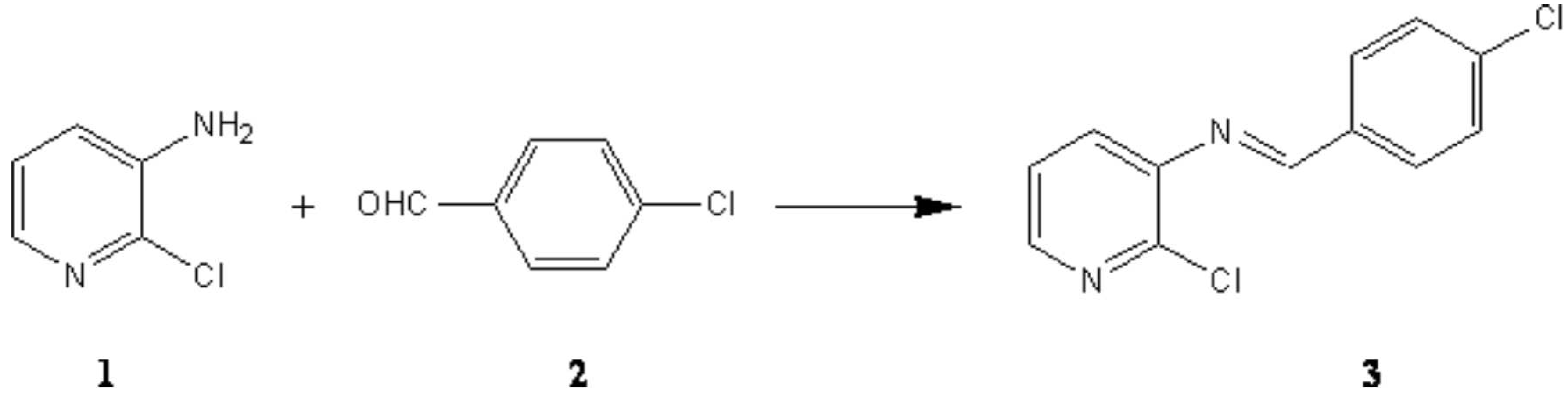
A mixture of 3-amino-2-chloro pyridine 1 (1.28 g, 10 mmol), 4-chlorobenzaldehyde 2 (1.40 g, 10 mmol) and anhydrous sodium sulfate (4.00 g) in dry dichloromethane (40.00 mL) was stirred at room temperature for seven hours. The suspension was filtered and washed with dichloromethane. The solvent was evaporated and new schiff base 3 was formed, which was washed with 10 mL acetic acid 5%, 10 mL NaHCO3 5% and water, successively, (2.04 g, 82 %).
Melting point: 54-56oC.
IR(KBr, cm-1): 1600.1 (CH=N); 1624.0 (C=N pyridine ring).
1H-NMR (250MHz, CDCl3): δ= 6.97-8.17 (7H, m, 2 Ph); 8.31 (1H, s, HC=N).
13C-NMR (62.9 MHz, CDCl3): δ= 123.55-146.49 (aromatic carbons); 162.55 (HC=N).
MS (m/z, %): 251 ([M+], 63.3); 250 (M-1, 100.0); 215 (C5H3NClN=CC6H4 , 14.8); 139 (C5H3NClN=C, 15.4); 112 (C5H3NCl, 52.2 ), 89 (C5H3NN, 19.4); 77 (C5H3N, 15.1).
Supplementary materials
Supplementary File 1Supplementary File 2Supplementary File 3Acknowledgment
The authors thank the Shiraz University Research Council for financial support (Grant No. 83-GR-SC-31and 84-GR-SC-23 ).
References
- Arora, K.; Gupta, A.; Agarwall, D. D. Asian. J. Chem. 2002, 14, 1611.
- Tanaka, K.; Shiraishi, R. Green Chem. 2000, 2, 272.
- Shaikh kabeer, A.; Baseer, M. A.; Mote, N. A. Asian J. Chem. 2001, 13(2), 496.
- Pandeya, S. N.; Sriram, D.; Nath, G.; De Clercq, E. Il Farmaco 1999, 54, 624. [PubMed]
- El-masry, Afaf. H.; Fahmy, H. H.; Ali Abdelwahed, S. H. Molecules 2000, 5, 1429.
- More, P. G.; Bhalvankar, R. B.; Pattar, S. C. J. Indian Chem. Soc. 2001, 78, 474.
- Singh, W. M.; Dash, B. C. Pesticides 1988, 22(11), 33.
- Desai, S. B.; Desai, P. B.; Desai, K. R. Hetrocycl. Commun. 2001, 7(1), 83.
- Phatak, P.; Jolly, V. S.; Sharma, K. P. Orient. J. Chem. 2000, 16(3), 493.
- Samadhiya, S.; Halve, A. Orient. J. Chem. 2001, 17(1), 119.
- Sepcic, Kristina. J. Toxicol., Toxin Rev. 2000, 19(2), 139.
- Sliwa, W.; Mianowska, B. Hetrocycles 1989, 29(3), 557.
- Durta, I.; Dinica, R.; Bacu, E.; Anderi, M. Chem. Abstr. 2000, 132, 205326b.
- Sample Availability: Available from MDPI.
© 2005 MDPI. All rights reserved.