


Abstract
A novel compound, 5,5'-(1,4-phenylenedimethylylidene)bis(1,3-diethyl-2-thioxodihydropyrimidine-4,6(1H,5H)-dione) (3) has been synthesized by condensation of 1,3-diethyl-2-thiobarbituric acid and terephthalaldehyde in anhydrous ethanol in the presence of pyridine. The structure of this compound was established by elemental analysis, IR, 1H-NMR, 13C-NMR and EI-MS spectral analysis.
Barbituric acid derivatives such as phenobarbital [1] and mephobarbital [2] are used for clinical treatment of epilepsy. Thiobarbituric acid dramatically increases the diversity of biological activity. Substitution reactions at the C-5 position with different aldehydes in the presence of base or Lewis acid catalysts such as ZnCl2 [3], CdI2 [4], by Knoevenagel condensation give donor acceptor chromophores. These donor acceptor chromophores are applicable in optical limiting [5], electrochemical sensing [6], Langmuir film and photoinitiated polymerization [7]. As evident from the literature, it was noted that a lot of research has been carried out on donor acceptor chromophores but no work has been done on this type of bis-donor acceptor chromophore [8]. In this paper, we report the synthesis of a novel bis donor acceptor chromophore from thiobarbituric acid and terephthalaldehyde.
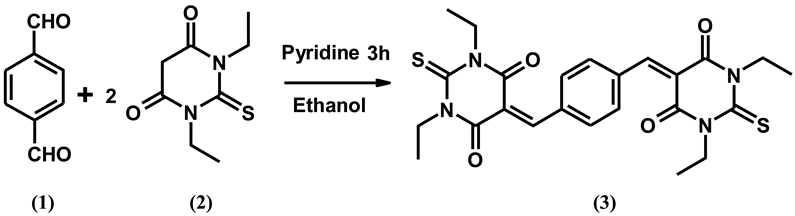
A mixture of 1,3-diethyl-2-thiobarbituric acid (1.49 g, 0.00746 mol) (1), terephthalaldehyde (0.5 g, 0.00373 mol) (2) and a few drops of pyridine in anhydrous ethanol (15 mL) was refluxed at 80 °C for 3 h with continuous stirring. Progress of the reaction was monitored by TLC. After completion of the reaction, the solution was cooled. The heavy precipitate thus obtained was collected by filtration and purified by recrystallization from methanol/chloroform to give the title compound (3).
Yield: 72%; m.p. 245 °C.
EI-MS m/z (rel. int.%): 499 (60) [M+1]+
IR (KBr) vmax cm-1: 2975 (C-H), 1606 (C=C), 1182 (C=S).
1H-NMR (CDCl3) δ: 6.82 (s, 4H, Ar-H), 6.23 (s, 2H, C=CH), 2.65 (q, J = 7.2 Hz, 8H, CH3-CH2-N), 1.32 (t, J = 7.2 Hz, 12H, CH3-CH2-N).
13C-NMR (CDCl3) δ: 173.98, 161.51, 145.35, 142.77, 126.89, 125.78, 96.31, 43.02, 42.77, 12.55, 12.08.
Anal. calc. for C24H26O4N4S2: C, 57.83, H, 5.22, N, 11.24 Found: C, 57.78, H, 5.18, N, 11.22.
Supplementary materials
Supplementary File 1Supplementary File 2Supplementary File 3Acknowledgements
The authors would like to thank the Chemistry Department, King Abdul Aziz University, Jeddah Saudi Arabia for providing the research facilities.
References and Notes
- Laurence, L.B. Goodman & Gilman’s the Pharmacological Basis of Therapeutics; McGraw-Hill Co.: New York, NY, USA, 1996; Volume 9, p. 471. [Google Scholar]
- Laurence, L.B. Goodman & Gilman’s the Pharmacological Basis of Therapeutics; McGraw-Hill Co.: New York, NY, USA, 1996; Volume 9, p. 472. [Google Scholar]
- Rao, P.S.; Venkataratnam, R.V. Zinc chloride as a new catalyst for Knoevenagel condensation. Tetrahedran Lett. 1991, 32, 5821–5822. [Google Scholar]
- Prajapati, D.; Sandhu, J.S. Cadmium iodide as a new catalyst for Knoevenagel condensations. J. Chem. Soc. Perkin Trans. 1993, 1, 739–740. [Google Scholar] [CrossRef]
- Patil, L.S.; Pandey, R.K.; Bange, J.P.; Gaikwd, S.A.; Gautam, D.K. Effect of deposition temperature on the chemical properties of thermally deposited silicon nitride films. Opt. Mater. 2005, 27, 663–670. [Google Scholar] [CrossRef]
- Tonle, I.K.; Ngameni, E.; Tcheumi, H.L.; Tchieda, V.; Carteret, C.; Walcarius, A. Sorption of methylene blue on an organoclay bearing thiol groups and application to electrochemical sensing of the dye. Talanta 2008, 74, 489–497. [Google Scholar] [CrossRef] [PubMed]
- Prieto, I.; Fernandez, A.J.; Munoz, E.; Martin, M.T.; Camacho, L. Langmuir-Blodgett films containing water-soluble molecules: the methylene blue-dimyristoyl phosphatidic acid system. Thin Solid Films 1996, 284, 162–165. [Google Scholar] [CrossRef]
- Asiri, A.M.; Khan, S.A. 2,6-Bis(9-ethyl-9H-carbazolylmethylene)cyclohexanone. Molbank 2009, 2009, M635. [Google Scholar] [CrossRef]
© 2010 by the authors; licensee Molecular Diversity Preservation International, Basel, Switzerland. This article is an open-access article distributed under the terms and conditions of the Creative Commons Attribution license (http://creativecommons.org/licenses/by/3.0/).