


Abstract
The new polyheterocyclic compound, 2-benzyl-7-(4-chlorophenyl)-3-morpholino-6-((1-phenyl-1H-1,2,3-triazol-4-yl)methyl)-6,7-dihydro-5H-pyrrolo[3,4-b]pyridin-5-one, was synthesized by a sequential combination of 4-chlorobenzaldehyde, (1-phenyl-1H-1,2,3-triazol-4-yl)methanamine, 2-isocyano-1-morpholino-3-phenylpropan-1-one, and maleic anhydride under a microwave-assisted one-pot process [Ugi-Zhu/aza Diels-Alder cycloaddition/N-acylation/decarboxylation/dehydration] with a 28% overall yield. The synthesized compound was fully characterized by 1D (1H, 13C) and 2D (COSY, HSQC, and HMBC) NMR, FT-IR, and HRMS.
1. Introduction
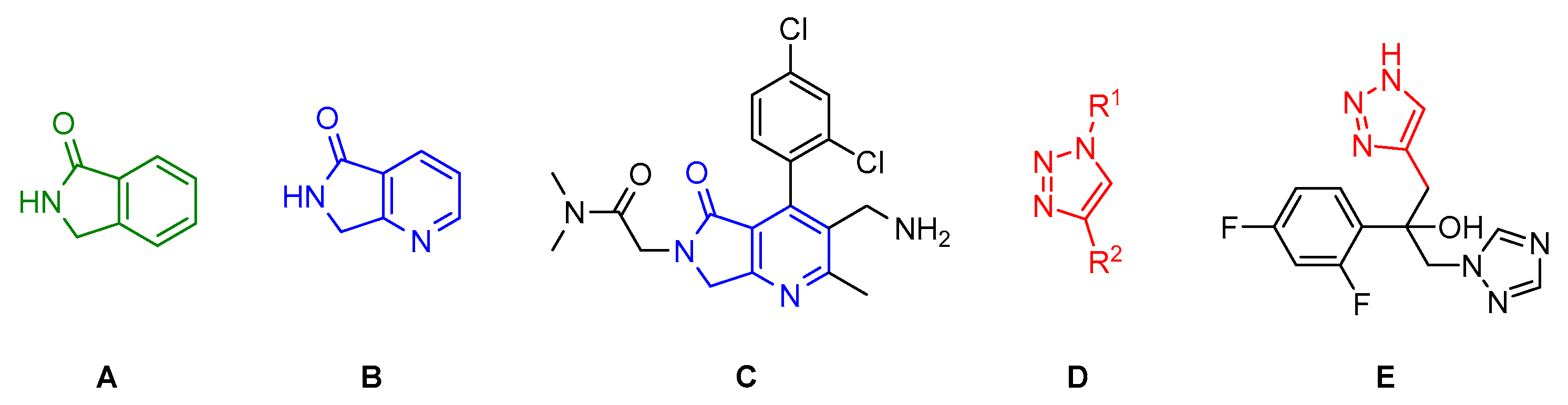
Heterocyclic compounds are of great interest in various fields of science and technology as many of them are present in different natural, semi- and/or synthetic products. The main importance of heterocycles derives not only from their abundance in nature but also from the fact that they form part of a plethora of molecules present in life such as vitamins, antibiotics, herbicides, hormones, dyes, and materials, among others [1]. Isoindolin-1-one (Figure 1A) is a heterocyclic system present in many natural products used to treat inflammatory processes, feverish conditions, and stomach pain [2]. Pyrrolo[3,4-b]pyridin-5-one (Figure 1B) is an aza-analogue of the isoindolin-1-one core as it has a pyridine ring instead of the benzene ring in its fused structure, giving it properties of biological interest [3]. Furthermore, the structural core of pyrrolo[3,4-b]pyridin-5-one is present in several products that also have important biological properties, e.g., in anti-hypoglycemics like the compound in Figure 1C [4]. Heterocyclic compounds containing the 1H-1,2,3-triazole nucleus (Figure 1D) have been of great interest for the design and development of new drug candidates and approved drugs. These compounds could actively participate in hydrogen bonding and dipole–dipole interactions due to their strong dipole moments [5]. In the development of combinatorial chemistry, copper-catalyzed alkyne azide cycloaddition (CuAAC) has been used for the synthesis of 1H-1-2,3-triazoles by the reaction of alkynes with sodium azide, and hence it has become the most used methodology to synthesize them on a large-scale [6,7], for example, to synthesize various chemotherapeutic agents, such as anticancers [8,9], antifungals [10,11,12] such as Fluconazole (Figure 1E) [13], and antibacterials [14], among others.
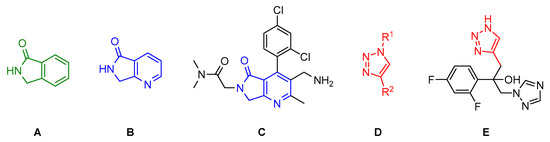
Figure 1.
Isoindolin-1-one (A), pyrrolo[3,4-b]pyridin-5-one (B), anti-hypoglycemic (C), 1H-1,2,3-triazole (D), and Fluconazole (E).
Multi-component reactions (MCRs) are defined as one-pot processes in which three or more reactants are combined sequentially to assemble structurally complex products that incorporate most of the atoms coming from the reactants. As one-pot processes, a single work-up, a single extraction, and a just one purification process are required, resulting in considerable savings in solvents, energy, labor time, and supplies for purifications [15]. MCRs differ from conventional synthetic methodologies in that they are highly convergent processes and in that are carried out in a single reactor [16]. Another advantage of MCRs over stepwise synthetic strategies is that the products are assembled by a sequence of elementary chemical reactions. Therefore, there are series of chemical equilibria that conclude with a final irreversible step, leading to the products [17]. In contrast, multistep or stepwise reactions are carried out in sequences involving several steps (one after the other) to obtain the final products. However, in most cases, the products are synthesized in low yields due to the large number of steps involved, where each step requires work up and purification, making the synthetic processes unfeasible and often expensive [18]. Thus, in the present work, the synthesis of a new and complex polyheterocycle via a one-pot strategy involving an initial Ugi-Zhu three-component reaction is described [19]. It is noteworthy that such a product may be considered for further in vitro studies because it contains more than two heterocyclic moieties of high interest in medicinal chemistry and also in optics, due to its double-zone π-conjugation.
2. Results and Discussion
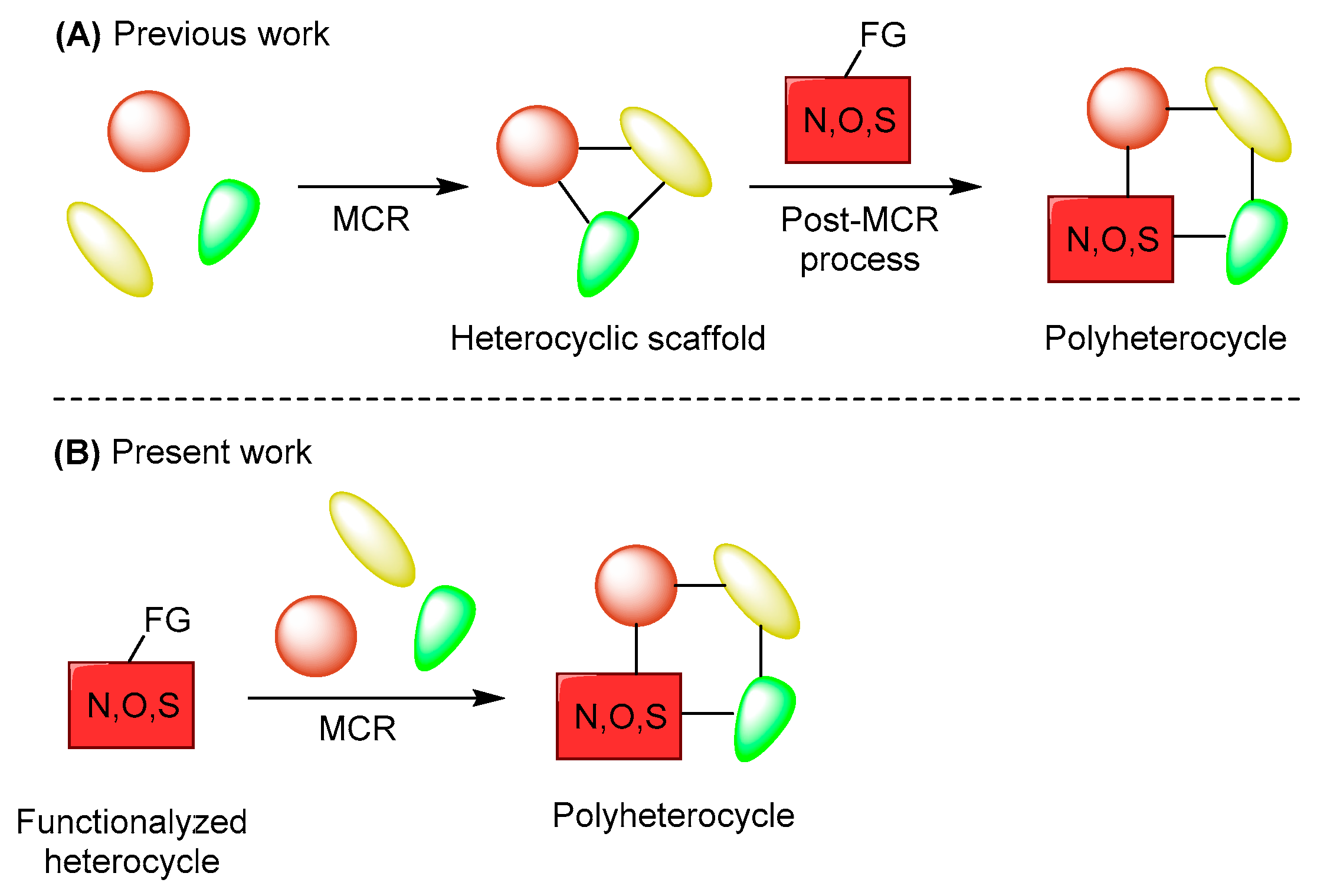
R. Lavilla proposed four modular roles of heterocycles in multicomponent reactions: (1) synthesis of heterocycles by a MCR, (2) synthesis of heterocycles by a MCR/post-MCR transformation, (3) synthesis of polyheterocycles by a MCR involving the use of a functionalized heterocyclic reagent, and (4) functionalization of heterocycles by a MCR [20]. Thus, in 2019, Gámez-Montaño and co-workers reported the synthesis of some new triazolyl-pyrrolo[3,4-b]pyridin-5-ones via a two-step process based on the Lavilla’s second modular role, where the starting materials were reacted together in a multicomponent reaction to obtain a precursor (heterocyclic scaffold), whereby, by a subsequent transformation with another reagent, some new polyheterocycles were obtained (Figure 2A) [21]. The third modular role is directly involved in the present developed methodology, where a heterocycle decorated with a functional group (primary amine in the current case) is used to carry out a multicomponent reaction to obtain directly (without precursors nor intermediates) a new polyheterocyclic and structurally complex product. For the present work, an amazing advantage is the fact that one of the starting reagents was already functionalized with the heterocyclic system 1H-1,2,3-triazole (Figure 2B). Indeed, the third modular role takes advantage of the large variety of previously functionalized heterocycles (natural, semi-, and/or synthetic) that can be used as reagents of MCRs.
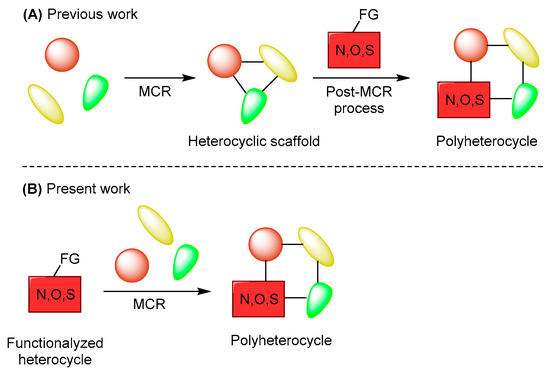
Figure 2.
2nd and 3rd Key modular roles of heterocycles in MCRs by Lavilla et al. [20]. (A) Synthesis of polyheterocycles via a MCR /post-MCR transformation strategy by Gámez-Montaño et al. [21]. (B) Synthesis of polyheterocycles via a direct MCR.
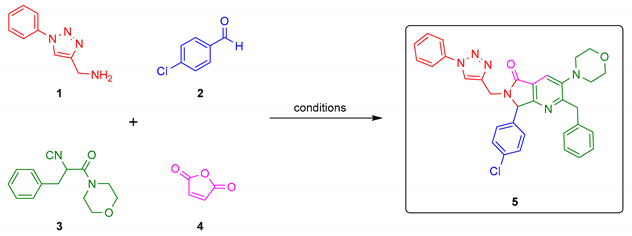
Thus, parameters such as temperature and solvents were screened behind the optimal reaction conditions for the synthesis of the new polyheterocyclic compound 2-benzyl-7-(4-chlorophenyl)-3-morpholino-6-((1-phenyl-1H-1,2,3-triazol-4-yl)methyl)-6,7-dihydro-5H-pyrrolo[3,4-b]pyridin-5-one (5). Thus, for the first attempt, (1-phenyl-1H-1,2,3-triazol-4-yl)methanamine (1), 4-chlorobenzaldehyde (2), 2-isocyano-1-morpholino-3-phenylpropan-1-one (3), and maleic anhydride (4) were combined sequentially in toluene as a solvent, using MW as a heat source (standard conditions for the Ugi-Zhu reaction [22]) but it did not proceed at the chosen temperature (70 °C). This behavior could be due to the fact that the amino component (1-phenyl-1H-1,2,3-triazol-4-yl)methanamine (1) was not well solubilized in toluene, at least at 70 °C. For this reason, for the next three attempts (Entries 2 to 4, Table 1), the temperature was raised gradually to better solubilize the heterocyclic amine but it did not proceed as expected. Therefore, the solvent was changed to methanol to increase the polarity and the temperature was varied gradually one more time (Entries 5 to 7, Table 1) but the reaction did not proceed again. At this point, we decided to use solvent mixtures: first, a toluene/methanol (1:1 v/v) system and, at the end of the reaction, the product was detected at trace levels (Entry 8, Table 1). Therefore, we proceeded to change the proportion of toluene/methanol (5:2 v/v) in the solvent mixture and, then, the product was obtained with a yield of 8% (Entry 9, Table 1). Thus, in the next attempt, the reaction time was extended under the same conditions, obtaining a yield of 28% (Entry 10, Table 1). An additional experiment was performed with a longer reaction time with respect to the last entry but only traces were detected because decomposition was observed by thin-layer chromatography (Entry 11, Table 1). It should be noted that, in all the experiments, scandium triflate [III] was used as a catalyst (Table 1).

Table 1.
Synthesis of 2-benzyl-7-(4-chlorophenyl)-3-morpholino-6-((1-phenyl-1H-1,2,3-triazol-4-yl)methyl)-6,7-dihydro-5H-pyrrolo[3,4-b]pyridin-5-one (5).
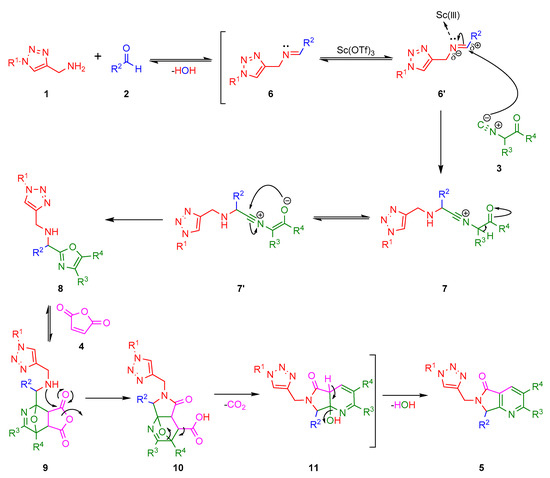
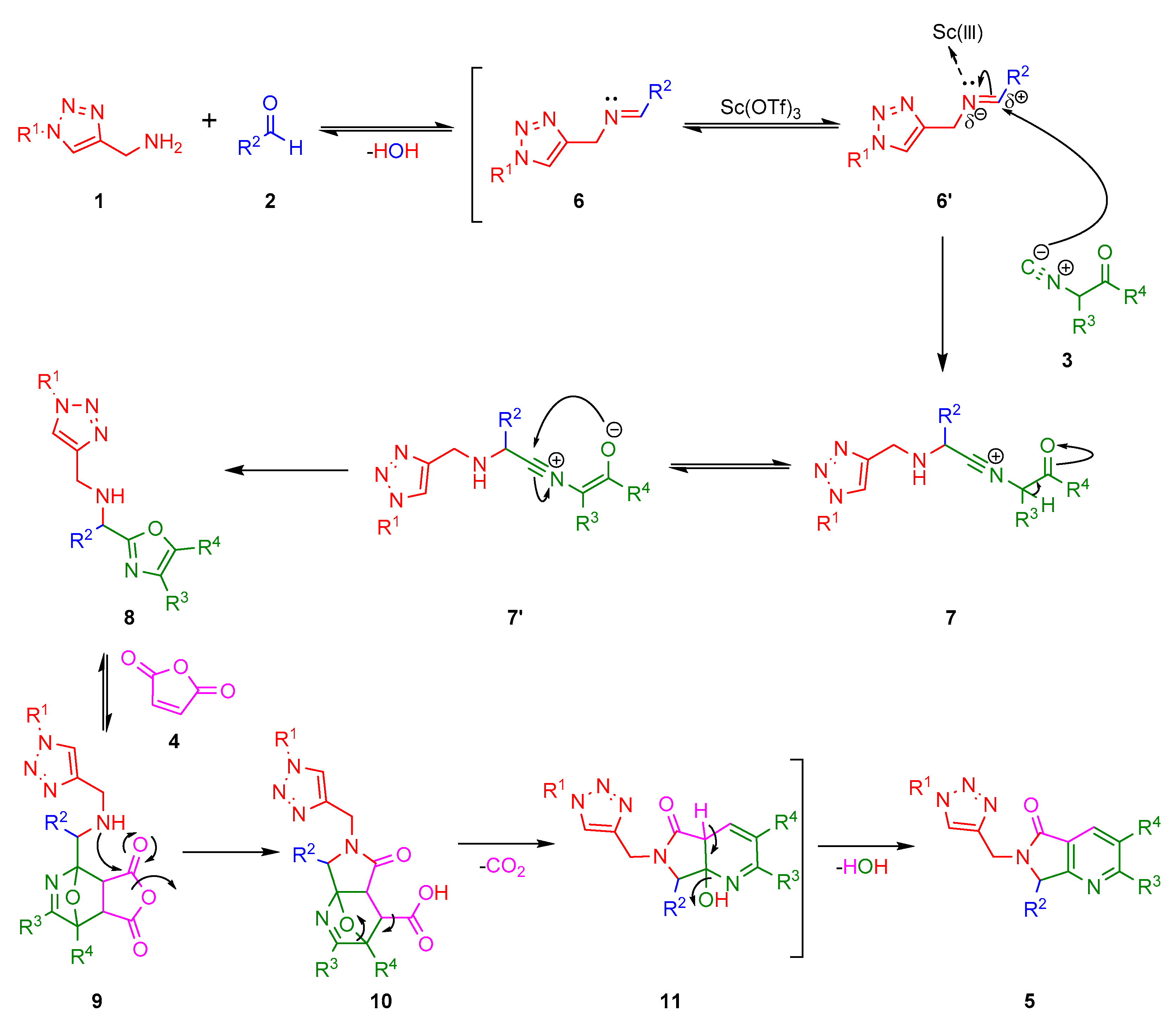
Scheme 1 shows the most likely reaction mechanism for the synthesis of polyheterocycles based on pyrrolo[3,4-b]pyridin-5-one. The triazole-amine 1 is condensed with the aldehyde 2 to access the imine 6 which is nucleophilically attacked by the isonitrile 3 [23], forming the nitrile cation 7. In the first stage of the multicomponent process, 5-aminooxazole 8 is obtained via an Ugi-Zhu type MCR process, which carries out a [4+2] aza Diels-Alder cycloaddition with the maleic anhydride (4) to obtain the oxa-bridged intermediate 9 which, as a last stage, undergoes a ring opening followed by decarboxylation and, finally, dehydration; all this happens under a cascade process to obtain the pyrrolo[3,4-b]pyridin-5-one 5.
Scheme 1.
Mechanism of the one pot methodology [Ugi-Zhu/aza Diels–Alder/N-acylation/decarboxylation/dehydration].
3. Materials and Methods
3.1. General Information, Instrumentation, Software, and Chemicals
1H, 13C, and 15N Nuclear Magnetic Resonance (NMR) spectra were acquired on a Bruker AMX Advance III spectrometer (500 MHz, Fällande, Uster, Switzerland). The solvents used for NMR experiments was deuterated chloroform (CDCl3) and deuterated dimethyl sulfoxide (DMSO-d6). Chemical shifts are reported in parts per million (d/ppm). Coupling constants are reported in Hertz (J/Hz). The internal reference for NMR spectra was tetramethyl silane (TMS) at 0.00 ppm. Multiplicities of the signals are reported using the standard abbreviations: singlet (s), doublet (d), triplet (t), quartet (q), and multiplet (m). NMR spectra were analyzed using the MestReNova software Ver. 12.0.0-20080 (A Coruña, Spain). The infrared (IR) spectrum was acquired on a Perkin-Elmer 2000 spectrometer (Norwalk, CT, USA) using the Attenuated Total Reflectance (ATR) method. The maximum absorbance peaks are reported in reciprocal centimeters (νmax/cm−1), uncorrected. The IR spectrum was analyzed using the Origin software (Ver. 2018b, 9.55, OriginLab Corporations, Northampton, MA, USA). The high-resolution mass spectroscopy (HRMS) spectrum was acquired by Electrospray Ionization (ESI) on a Micro-TOF II spectrometer Bruker Daltonics GmbH (Bremen, Germany). The sample was injected directly (Apollo source) and analyzed by the time-of-flight method (TOF). The HRMS spectrum was analyzed using the Compass software Ver. 1.5 (Bruker Daltonik GmbH, Bremen, Germany). Microwave-assisted reactions were performed in closed-vessel mode on a CEM Discover SP MW-reactor (Matthews, North Carolina, CA, USA). Reaction progress was monitored by thin-layer chromatography (TLC) and the spots were visualized under ultraviolet (UV) light (254 or 365 nm). Glass preparative plates (20 × 20 cm) coated with silica-gel 60 doped with UV indicator F254 (Sigma–Aldrich–Merck, Toluca, EdoMex, México) were used to purify the products. Mixtures of n-hexane (Hex) and ethyl acetate (EtOAc) in 3:1 (v/v) proportion were used to run TLC, preparative plates, and to measure the retention factor (Rf) values (using the same mobile phase for all the experiments). All starting reagents and solvents were used as received (without further purification, distillation, or dehydration). Melting point was measured using a Fischer-Jones Apparatus Stuart Mod. SMP11 (Avantor, Inc., Radnor Township, PA, USA), uncorrected. The purity of synthesized compound 5 (>99%) was assessed by 1H-NMR.
3.2. Synthesis and Characterization of the 2-Benzyl-7-(4-chlorophenyl)-3-morpholino-6-((1-phenyl-1H-1,2,3-triazol-4-yl)methyl)-6,7-dihydro-5H-pyrrolo[3,4-b]pyridin-5-one (5)
General Procedure (GP): (1-phenyl-1H-1,2,3-triazol-4-yl) methanamine (20.0 mg, 0.115 mmol) and 4-chlorobenzaldehyde (13.4 mg, 0.095 mmol,) were placed in a sealed CEM Discover microware reaction tube (10 mL) and diluted in a mixture of anhydrous toluene (0.5 mL) with anhydrous methanol (0.2 mL). Then, the reaction mixture was stirred and heated using microware irradiation (100 °C, 100 W) for 40 min, twice, and scandium [III] triflate (2.3 mg, [4% mol], 0.005 mmol, 0.04 equiv.) was added. The mixture was stirred and heated using microware irradiation again (130 °C, 150 W) for 25 min, and 2-isocyano-1-morpholino-3-phenylpropan-1-one (30.3 mg, 0.124 mmol) was added. The new mixture was stirred and heated using microware irradiation (100 °C, 100 W) for 45 min and maleic anhydride (14.1 mg, 0.135 mmol) was added. The new mixture was stirred and heated using microware irradiation under the same conditions. A light brown liquid was obtained. The crude was purified by preparative TLC using a mixture of n-hexane with ethyl acetate 3:1 (v/v) as mobile phase. Then, it was brought to dryness and re-purified with the same mobile phase. Later, it was taken to dryness and a final purification, using a mixture of n-hexane with ethyl acetate 3:1 (v/v) as mobile phase, was carried out and, subsequently, it was brought to dryness to isolate 18.6 mg of the product 5 (28% yield) as white powder; mp = 233–235 °C; Rf = 0.39 (Hex–AcOEt = 3:1, v/v); 1H-NMR (500 MHz, CDCl3): d 7.99 (s, 1H, H-34), 7.86 (s, 1H, H-15), 7.68 (m, 2H, H-38, 42), 7.51 (m, 2H, H-39, 41), 7.44 (m, 1H, H-40), 7.37 (m, 2H, H-25,27), 7.25 (m, 2H, H-24,28), 7.16 (m, 5H, H-18,19,20,21,22), 5.67 (s, 1H, H-11), 5.31 (d, J = 15.41 Hz, 1H, H-29), 4.29 (d, J = 13.89 Hz, 1H, H-16), 4.22 (d, J = 15.31 Hz, 1H, H-29), 4.18 (d, J = 13.82 Hz, 1H, H-16), 3.81 (t, J = 4.57 Hz, 4H, H-2,6), 2.81 (m, 4H, H-3,5) 13C-NMR (125 MHz, CDCl3): d 167.0 (C-13), 162.5 (C-8), 160.1 (C-10), 147.9 (C-7), 144.0 (C-30), 139.1 (C-17), 136.8 (C-37), 134.7 (C-26), 133.8 (C-23), 129.7 (C-24,28), 129.2 (C-25,27), 128.8 (C-38,40,42), 128.2 (C-39,41), 126.2 (C-20), 123.7 (C-15), 123.6 (C-14), 121.0 (C-34), 120.5 (C-18,19,21,22), 67.1 (C-2,6), 64.5 (C-11), 53.0 (C-3,5), 40.0 (C-16), 35.3 (C-29) ppm; HRMS: (ESI+) m/z calcd. for [M + H]+ C33H30ClN6O2+ 577.2113, found 577.2092 (error = 3.6 ppm). See the Supplementary Materials for further details.
4. Conclusions
The synthesis of a new and complex tris-heterocyclic compound was performed successfully using a one-pot methodology [Ugi-Zhu/aza Diels-Alder/N-acylation/decarboxylation/dehydration] with a 28% overall yield, which seems to be low but, considering the high number of bonds formed in one experimental step, and that only two molecules of water and one molecule of carbon dioxide were released in the whole process, such a yield is good. The developed synthetic methodology was designed considering Lavilla’s third role of heterocycles in MCRs. As can be seen, the polyheterocyclic product was synthesized directly in only one experimental procedure, which differs from the previous work reported by Gámez-Montaño et al., mainly in that the latter required two experimental steps; the first one to assemble the heterocyclic pivotal precursor, and the second to construct the final polyheterocyclic system. Finally, the title product may be considered for further in vitro studies because it contains at least two pharmacophoric moieties, pyrrolo[3,4-b]pyridin-5-one and 1H-1,2,3-triazole. In the same way, it could be used for further studies into its optical properties because, by TLC at 254 nm, it exhibited a strong blue emission.
Supplementary Materials
The following supporting information can be downloaded online. Synthesis and characterization of the non-commercial starting reagents (triazolyl-amine and isocyanide). Copies of 1H-NMR, 13C-NMR, 2D-NMR (COSY, HSQC, and HMBC), FT-IR, and HRMS spectra for the new polyheterocyclic product 5.
Author Contributions
Synthesis and characterization, P.I.-J. and C.G.-F.; investigation and methodology, S.L.C.-A. and E.C.-J.; conceptualization and writing—original draft preparation, D.C.-G. and E.G.-Z.; funding acquisition and writing—review and editing, A.I.-J. All authors have read and agreed to the published version of the manuscript.
Funding
A.I.-J. acknowledges “Proyecto Apoyado por el Fondo Sectorial de Investigación para la Educación CONACyT-SEP CB-2017-2018 (A1-S-32582)” for their financial support.
Institutional Review Board Statement
Not applicable.
Informed Consent Statement
Not applicable.
Data Availability Statement
Not applicable.
Acknowledgments
P.I.-J. thanks CONACyT–México for his PhD scholarship (1098528). S.L.C.A. and E.C.-J. thank Fondos Federales México (HIM-2022-051 FF, project). All authors gratefully acknowledge Atilano Gutierrez-Carrillo, Mónica A. Rincón-Guevara, and Citlali A. Arroyo-Gómez for their NMR, HRMS, and IR acquisitions, respectively.
Conflicts of Interest
The authors declare no conflict of interest. The funders had no role in the design of the study; in the collection, analyses, or interpretation of data; in the writing of the manuscript, or in the decision to publish the results.
References
- Heravi, M.M.; Zadsirjan, V. Prescribed drugs containing nitrogen heterocycles: An overview. RSC Adv. 2020, 72, 44247–44311. [Google Scholar] [CrossRef] [PubMed]
- Máthé, Á.; Bandoni, A. (Eds.) Medicinal and Aromatic Plants of South America Vol. 2; Springer: Berlin/Heidelberg, Germany, 2021. [Google Scholar] [CrossRef]
- Mota, K.; Magauer, T. The chemistry of isoindole natural products. Beilstein J. Org. Chem. 2013, 9, 2048–2078. [Google Scholar] [CrossRef]
- Devasthale, P.; Wang, Y.; Wang, W.; Fevig, J.; Feng, J.; Wang, A.; Harrity, T.; Egan, D.; Morgan, N.; Cap, M.; et al. Optimization of Activity, Selectivity, and Liability Profiles in 5-Oxopyrrolopyridine DPP4 Inhibitors Leading to Clinical Candidate (Sa)-2-(3-(Aminomethyl)-4-(2,4-dichlorophenyl)-2-methyl-5-oxo-5H-pyrrolo [3,4-b]pyridin-6(7H)-yl)-N,N-dimethylacetamide (BMS-767778). J. Med. Chem. 2013, 56, 7343–7357. [Google Scholar] [CrossRef] [PubMed]
- Kumar, D.; Reddy, V.B.; Varma, R.S. A facile and regioselective synthesis of 1,4-disubstituted 1,2,3-triazoles using click chemistry. Tetrahedron Lett. 2009, 50, 2065–2068. [Google Scholar] [CrossRef]
- Kuang, G.C.; Guha, P.M.; Brotherton, W.S.; Simmons, J.T.; Stankee, L.A.; Nguyen, B.T.; Zhu, L. Experimental Investigation on the Mechanism of Chelation-Assisted, Copper(II) Acetate-Accelerated AzideAlkyne Cycloaddition. J. Am. QuÍMica Soc. 2011, 133, 13984–14001. [Google Scholar] [CrossRef]
- McNulty, J.; Keskar, K.; Vemula, R. The First Well-Defined Silver(I)-Complex-Catalyzed Cycloaddition of Azides onto Terminal Alkynes at Room Temperature. Eur. J. Org. 2011, 17, 14727–14730. [Google Scholar] [CrossRef]
- Lal, K.; Yadav, P. Recent Advancements in 1,4-Disubstituted 1H-1,2,3-Triazoles as Potential Anticancer Agents. Anti-Cancer Agents Med. Chem. 2018, 18, 21–37. [Google Scholar] [CrossRef]
- Alshamari, A.K. Design and Synthesis of Novel 1,2,3-Triazole Levonorgestrel Derivatives via Click Chemistry. Anticancer Activity and Molecular Docking. Russ. J. Org. Chem. 2022, 58, 1878–1888. [Google Scholar] [CrossRef]
- Lima-Neto, R.G.; Cavalcante, N.N.M.; Srivastava, R.M.; Mendonça Junior, F.J.B.; Wanderley, A.G.; Neves, R.P.; dos Anjos, J.V. Synthesis of 1,2,3-Triazole Derivatives and in Vitro Antifungal Evaluation on Candida Strains. Molecules 2012, 17, 5882–5892. [Google Scholar] [CrossRef]
- Kategaonkar, A.H.; Shinde, P.V.; Kategaonkar, A.H.; Pasale, S.K.; Shingate, B.B.; Shingare, M.S. Synthesis and biological evaluation of new 2-chloro-3-((4-phenyl-1H-1,2,3-triazol-1-yl)methyl)quinoline derivatives via click chemistry approach. Eur. J. Med. Chem. 2010, 4, 3142–3146. [Google Scholar] [CrossRef]
- Shalini, K.; Kumar, N.; Drabu, S.; Sharma, P.K. Advances in synthetic approach to and antifungal activity of triazoles. Beilstein J. Org. Chem. 2011, 7, 668–677. [Google Scholar] [CrossRef] [PubMed]
- Aher, N.G.; Pore, V.S.; Mishra, N.N.; Kumar, A.; Shukla, P.K.; Sharma, A.; Bhat, M.K. Synthesis and antifungal activity of 1,2,3-triazole containing fluconazole analogues. Bioorganic Med. Chem. Lett. 2009, 19, 759–763. [Google Scholar] [CrossRef] [PubMed]
- Lopes, S.M.M.; Novais, J.S.; Costa, D.C.S.; Castro, H.C.; Figueiredo, A.M.S.; Ferreira, V.F.; da Silva, F.C. Hetero-Diels-Alder reactions of novel 3-triazolyl-nitrosoalkenes as an approach to functionalized 1,2,3-triazoles with antibacterial profile. Eur. J. Med. Chem. 2018, 143, 1010–1020. [Google Scholar] [CrossRef] [PubMed]
- Dömling, A.; Wang, W.; Wang, K. Chemistry and Biology of Multicomponent Reactions. Chem. Rev. 2012, 112, 3083–3135. [Google Scholar] [CrossRef]
- Cioc, R.C.; Ruijter, E.; Orru, R.V.A. Multicomponent reactions: Advanced tools for sustainable organic synthesis. Green Chem. 2014, 16, 2958–2975. [Google Scholar] [CrossRef]
- Ugi, I.; Domling, A.; Werner, B. Since 1995 the new chemistry of multicomponent reactions and their libraries, including their heterocyclic chemistry. J. Heterocycl. Chem. 2000, 37, 647–658. [Google Scholar] [CrossRef]
- Dömling, A.; Ugi, I. Multicomponent Reactions with Isocyanides. Angew. Chem. 2000, 39, 3168–3210. [Google Scholar] [CrossRef]
- Flores-Reyes, J.C.; Islas-Jácome, A.; González-Zamora, E. The Ugi three-component reaction and its variants. Org. Chem. Front. 2021, 8, 5460–5515. [Google Scholar] [CrossRef]
- Isambert, N.; Lavilla, R. Heterocycles as Key Substrates in Multicomponent Reactions: The Fast Lane towards Molecular Complexity. Chem. Eur. J. 2008, 14, 8444–8454. [Google Scholar] [CrossRef]
- Rentería-Gómez, M.A.; Islas-Jácome, A.; Pharande, S.G.; Vosburg, D.A.; Gámez-Montaño, R. Synthesis of Tris-Heterocycles via a Cascade IMCR/Aza Diels-Alder + CuAAC Strategy. Org. Chem. Front. 2019, 7, 546. [Google Scholar] [CrossRef]
- Islas-Jácome, A.; González-Zamora, E.; Gámez-Montaño, R. A short microwave-assisted synthesis of tetrahydroisoquinolin-pyrrolopyridinones by a triple process: Ugi-3CR–aza Diels–Alder/S-oxidation/Pummerer. Tetrahedron Lett. 2011, 52, 5245–5248. [Google Scholar] [CrossRef]
- Fayol, A.; Housseman, C.; Sun, X.; Janvier, P.; Bienaymé, H.; Zhu, J. Synthesis of α-Isocyano-α-alkyl(aryl)acetamides and their use in the multicomponent synthesis of 5-aminooxazole, pyrrolo [3,4-b]pyridin-5-one and 4,5,6,7-tetrahydrofuro [2,3-c]pyridine. Synthesis 2005, 1, 161–165. [Google Scholar] [CrossRef]
Disclaimer/Publisher’s Note: The statements, opinions and data contained in all publications are solely those of the individual author(s) and contributor(s) and not of MDPI and/or the editor(s). MDPI and/or the editor(s) disclaim responsibility for any injury to people or property resulting from any ideas, methods, instructions or products referred to in the content. |
© 2023 by the authors. Licensee MDPI, Basel, Switzerland. This article is an open access article distributed under the terms and conditions of the Creative Commons Attribution (CC BY) license (https://creativecommons.org/licenses/by/4.0/).