


Abstract
In this work, combined efforts by Greek and Turkish scientists produced an updated validated NIS inventory of the Aegean ecoregion, covering 120 years of records up to August 2024. Of the 342 NIS currently present in the Aegean Sea, the majority (281 species) have invaded the South Aegean, followed by the North Aegean (128 species out of 206 NIS). A total of 73 species were added to the list, while 56 were removed. Overall, unaided spread of Lessepsian immigrants from the Levantine Sea and shipping are equally responsible for NIS reported at the regional level. An increase in publications addressing NIS matches the upward trend of NIS since the mid-1990s, which continues to the present day. While unaided introductions of Lessepsian species and/or direct introductions via the Suez Canal peaked in the South Aegean during 2000–2005, they peaked in 2012–2017 in the North Aegean—a decade later. The opposite pattern was observed in ship-transferred NIS. The spatial distribution of introduction hotspots largely reflects the following phenomena/processes: unaided introduction is witnessed initially in the southeastern Aegean Sea; monitoring efforts are concentrated in vulnerable and at-risk areas; and research efforts relate to the spatial allocation of institutions and marine experts working on marine NIS along the Aegean coasts.
1. Introduction
The Aegean Sea occupies the northeastern part of the East Mediterranean Sea. It incorporates Greek and Turkish territorial waters and international waters. An imaginary line delineates the borders of Greek and Turkish territorial coastal waters.
The Aegean Sea stands as a unique Mediterranean ecoregion with intricate geomorphological attributes and diverse habitats. The North Aegean comprises the northern continental shelf, which receives significant freshwater input from large rivers, while water with reduced salinity enters also from the Black Sea through the Dardanelles Straits. The South Aegean is characterized by the elongated deep basin known as the Cretan Sea. This area contains the greatest depths in the Aegean Sea, with the Karpathos Basin reaching depths of approximately 2500 m. The area is intensively exploited by industrial, small-scale coastal, and recreational fisheries. The aquaculture industry is well-developed, and its islands are popular touristic destinations [1,2]. Shipping activity in the Aegean is substantial, both for recreational and passenger vessels as well as for commercial vessels, particularly with three major port destinations, namely the ports of Piraeus, Thessaloniki, and Izmir [3]. At the same time, due to its complex morphology, it hosts a multitude of habitats, reflected in a high species richness [4]. It has a high coverage of important keystone habitats, such as Posidonia oceanica beds, coralligenous formations, and marine caves [5]), as well as photophilic algal communities of high conservation value [6]. A series of marine protected areas have been established under various conservation schemes, both along the Turkish coastline [7] and throughout the Greek part of the Aegean [4].
The Aegean Sea is a favorite destination not only for tourists from all over the world, but also for marine biota, including the so-called non-indigenous species (NIS), which arrive either unaided or by other means, such as vessels. Indeed, marine NIS are introduced to the Aegean Sea from all directions, that is: southwards from the Black Sea via the Dardanelles Straits; northwards from the Levantine Sea or even further from the Red Sea via the Suez Canal; eastwards from the Ionian Sea. Non-indigenous species (NIS) along the Turkish or Greek coastal areas have been reported either at the regional/subregional scale (e.g., Aegean [8,9,10]; North Aegean [11]) or as part of national reviews: Türkiye [12,13,14]; Greece [15,16,17]. Additional NIS are reported in the recent literature (2020–2024), related mostly to findings of new species in Greek coastal waters [18,19,20,21,22,23,24,25,26,27,28,29,30,31,32,33,34,35,36,37,38,39,40,41,42] and/or in Turkish coastal waters [23,27,43,44,45,46,47,48,49,50,51]. In addition to the new records for the study area, recent publications address the geographic expansion from the South to the North Aegean Sea [11,39,52], as well as the successful establishment of certain invasive species.
Although the largest species richness and most records of alien species in the Aegean Sea occur in its southernmost part [53], several species have also been recorded in the North Aegean Sea. By September 2020, there were 212 NIS records in the Aegean Greek coastal waters: 92 NIS in the North Aegean, and 196 in the South Aegean Sea [17].
Nevertheless, a recently published study [54] indicated that the main trajectory of the Lessepsian NIS of fishes follow a northward path in the Levantine Sea, accompanied by a westward movement towards the southern parts of the Aegean Sea. Apparently, NIS of fishes accelerate their spread over time and space, particularly following their initial introduction into the Mediterranean Sea (via the Suez Canal), successfully moving beyond the warmer Levantine Sea to the progressively colder waters of the Greek South Aegean Sea [54]. Furthermore, several Lessepsian NIS have been recorded in the even colder and less saline waters of the North Aegean Sea [1].
Even though Greek and Turkish NIS experts have a long history of collaboration in the context of Mediterranean inventories [55,56,57,58,59,60], as well as individual publications in [27,61,62,63], this is the first concerted effort to address NIS in the whole of the Aegean as an ecoregional unit, bringing together data from both its coasts.
The aim of this work is to present an updated and thoroughly validated list of NIS in the Aegean Sea and their rate of introduction and distribution along the south–north axis, and explore their relevance to pathways and scientific effort.
2. Methodology
The limits of oceans and seas vary in the literature, especially when it comes to their spatial classification related either to management- or ecological-based purposes [64,65,66]. Fourcy and Lorvelec [67] noted that toponyms of the International Hydrographic Organization [64,68] could occasionally not be located or proved aberrant. In one of the most widely used recent studies [65], the boundaries of the Aegean Sea included zones south of Crete and east of Rhodes, areas that, according to the Greek Ministry of Environment and Energy, belong to the Levantine Sea [69].
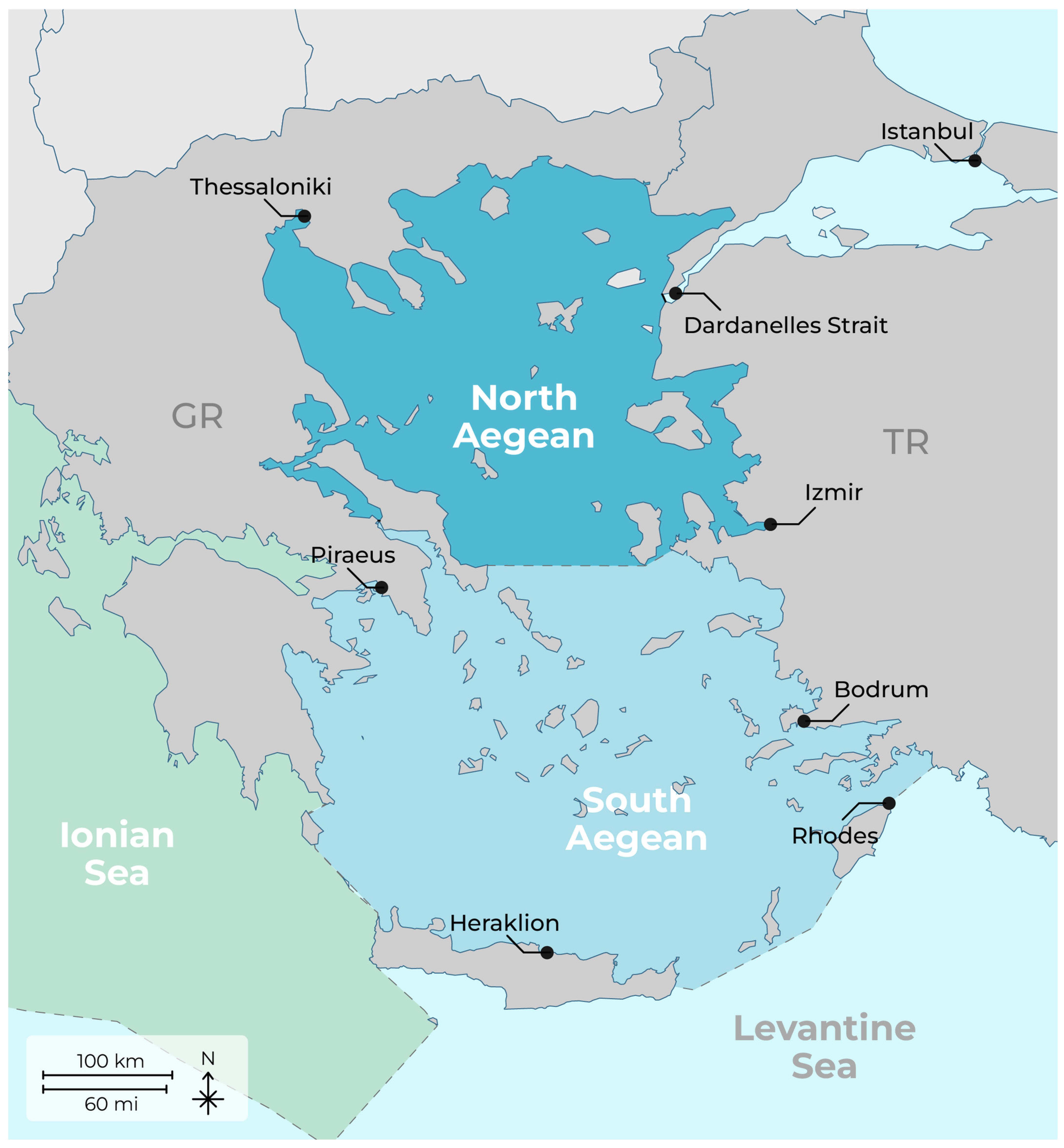
In our study, as a rule, the borders of the Aegean were delimited according to Jensen and Panagiotidis [66], who have harmonized them with existing boundaries established under the Regional Sea Conventions, the biogeographic boundaries established under the Habitats Directive and the boundaries of marine waters reported by EU Member States, but modified to include non-EU waters (Figure 1). Northwards, the Aegean Sea is separated from the Black Sea by a line connecting the Mehmetcik and Kumkale lighthouses in the Dardanelles Strait [64]. This definition is also in line with the Barcelona Convention, which was adopted in 1976 and entered into force in 1978. For the west borders of the Aegean with the Ionian Sea, we followed the boundaries of the Greek Ministry of Environment and Energy [69]. Similarly, we followed the boundaries of the Aegean with the Levantine up to the port of the island of Rhodes [69], but these were freely extended to the Turkish coasts up to Dalaman River’s estuary.
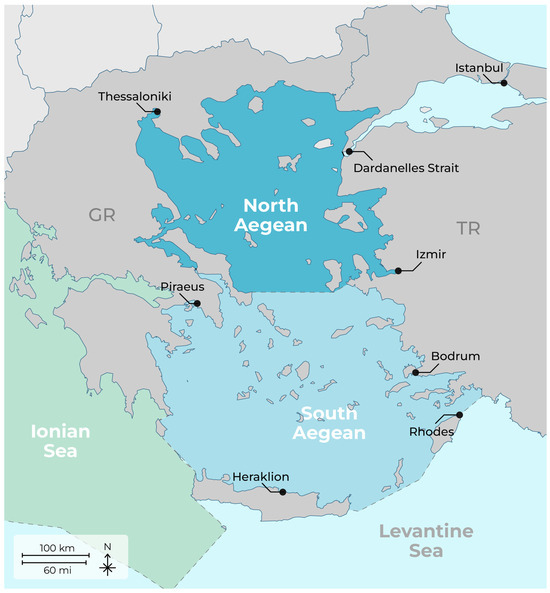
Figure 1.
Geographic limits of the study area. The two sections of each subregion are defined by the coastal waters of Greece and Türkiye respectively.
With regard to the limits of the North Aegean Sea versus the South Aegean, the line followed the borders defined by the Greek Ministry of Environment and Energy [69] for the Greek part but was freely extended to the Turkish coasts up to Karaabdullah Burnu.
Reviews and individual papers about all species reported from the Aegean Sea were compiled in a single sheet but were also archived for the southern and northern areas of both countries (Aegean sectors: North Aegean Türkiye, South Aegean Türkiye, North Aegean Greece, South Aegean Greece). The basis of our work consists of the latest reviews of NIS in Turkish waters [14] and Greek waters [17] that include their distribution in the Aegean coasts. Moreover, some unpublished records are reported herein.
The NIS reported from the Aegean Sea [14,17], classified as misidentification, native, or cryptogenic [60,70,71] were excluded in our work. In contrast, species with divergence of opinions among Mediterranean countries/experts, but considered NIS by most Mediterranean countries, were retained in our list. NIS previously reported with a “questionable” establishment status according to [70,71]—i.e., with uncertainty regarding the taxonomic validity of the species records—were judged on a case-by-case basis. Finally, polychaete species classified in [60] as likely aliens (considered debatable species by [72], in many cases without re-examination of the available material or comparison with type specimens) were kept in our list. While this may appear inconsistent with regional inventories, the key point here is that regional lists emerge as a result of consensus building among experts, with the understanding that, after informed discussion, national lists remain at the discretion of the national experts [73]. Furthermore, designations at the national level are often accompanied by lower uncertainty compared to wider geographic scales (i.e., higher confidence in species/specimen identification, introduction pathways, etc.), hence the inclusion of some debatable species sensu [60] in the Aegean list is considered justified.
All records were validated by taxonomic experts among the authors: Mollusca—Alper Doğan, Argyro Zenetos; Polychaeta—Ertan Dağlı, Georgios Chatzigeorgiou; Crustacea—Ahmet Kerem Bakir, Maria Corsini-Foka; Macrophytes—Ergun Taşkın; fishes—Maria Corsini-Foka, Athanasios Evangelopoulos; Foraminifera—Mehmet Baki Yokeş, Engin Meriç; remaining groups—Argyro Zenetos, Marika Galanidi.
Nomenclature follows the World Register of Marine Species [74].
The species list includes every first novel report of species introduction, irrespective of the establishment status. In our analysis, we only considered the first new record of a NIS within a subregion/sector. The number of species detected/observed per six-year cycle since 1970 was analyzed from these datasets.
Pathways of introduction were assigned to first records according to the Convention on Biological Diversity classification [75,76], namely: (i) corridor (COR) (e.g., movement of alien species via canals); (ii) escape from confinement (EC) (e.g., aquaculture); (iii) transport stowaway (TS) (e.g., moving of live alien species by maritime transport via ballast water and sediments, bio-fouling of water vessels and dredging, angling or fishing equipment); (iv) release in nature (REL) (e.g., intentional introduction of live alien species for fishing, release of aquarium trade species); (v) transport contaminant (TC) (unintentional movement of live pests, through international trade); and (vi) unaided (UNA) (e.g., natural dispersal of invasive alien species that have been introduced by different pathways).
The overlap in NIS between the four Aegean sectors (North Aegean Türkiye, South Aegean Türkiye, North Aegean Greece, South Aegean Greece) was visualized with Venn diagrams, utilizing the package ‘ggvenn’ [77] in the R statistical environment. For the purposes of this analysis, “unique” species are defined as those species that appear in one sector, while “shared” species are the species that are present and shared among two or more sectors.
The distribution of NIS in the neighboring seas was extracted from the unpublished database of the Hellenic Centre for Marine Research (HCMR) for the Ionian and Levantine Seas, while for the Marmara Sea [14], it was updated with the recent literature, e.g., [39,51].
3. Results
In total, 342 NIS have been introduced to the Aegean Sea since 1894, of which 240 were found along the Turkish coasts and 254 along the Greek coasts (Supplementary File). Seventy-three (73) species were added to the list of Aegean NIS (Table 1), twenty of which had been reported before 2000; the remaining were reported in the period 2000–2024. The majority of new records belong to Mollusca (25 species), Crustacea (15 species) and Polychaeta (14 species).

Table 1.
Introduced NIS along the Aegean coasts of Türkiye and/or Greece, reported in the period 2020–2024. Shaded species correspond to records published before 2020 but missing from Çınar et al. and/or Zenetos et al. [14,17]. Group: ASC = Ascidiacea; BRY = Bryozoa; CHLO = Chlorophyta; CNI = Cnidaria; CRU/CIR = Crustacea/Cirripedia; CRU/DEC = Crustacea/Decapoda; CRU/AMP = Crustacea/Amphipoda; CRU/COP = Crustacea/Copepoda; CRU/ISO = Crustacean/Isopoda; FISH = fishes; MAM = mammals; MOL = Mollusca; RHO = Rhodophyta; OCHR = Ochrophyta; PAR = Parasites; POL = Polychaeta.
Species reported as NIS from the Aegean Sea [14,17] but excluded here (misidentification, native, cryptogenic, absent), following [60,70,71], are listed in Table 2. Species with divergence of opinions that are included in our list are presented in Table 3.
Table 2.
Species reported as NIS from the Aegean Sea (Greece—GR 2000 [17]; Türkiye TR 2021 [14]) but excluded due to misidentification, absence, native, cryptogenic, or questionable records. Group: ASC = Ascidiacea; BRY = Bryozoa; CNI = Cnidaria; FISH = fishes, CRU/DEC = Crustacea/Decapoda; CRU/CIR = Crustacea/Cirripedia; CRU/ISO = Crustacean/Isopoda; CRU/TAN = Crustacea/Tanaidacea; FOR = Foraminifera; RHO = Rhodophyta; TRA = Tracheophyta POL = Polychaeta.
Table 3.
Species with divergence of opinions according to Galanidi et al. [60] included in our list. Group: ECH = Echinodermata; MOL = Mollusca; POL = Polychaeta.
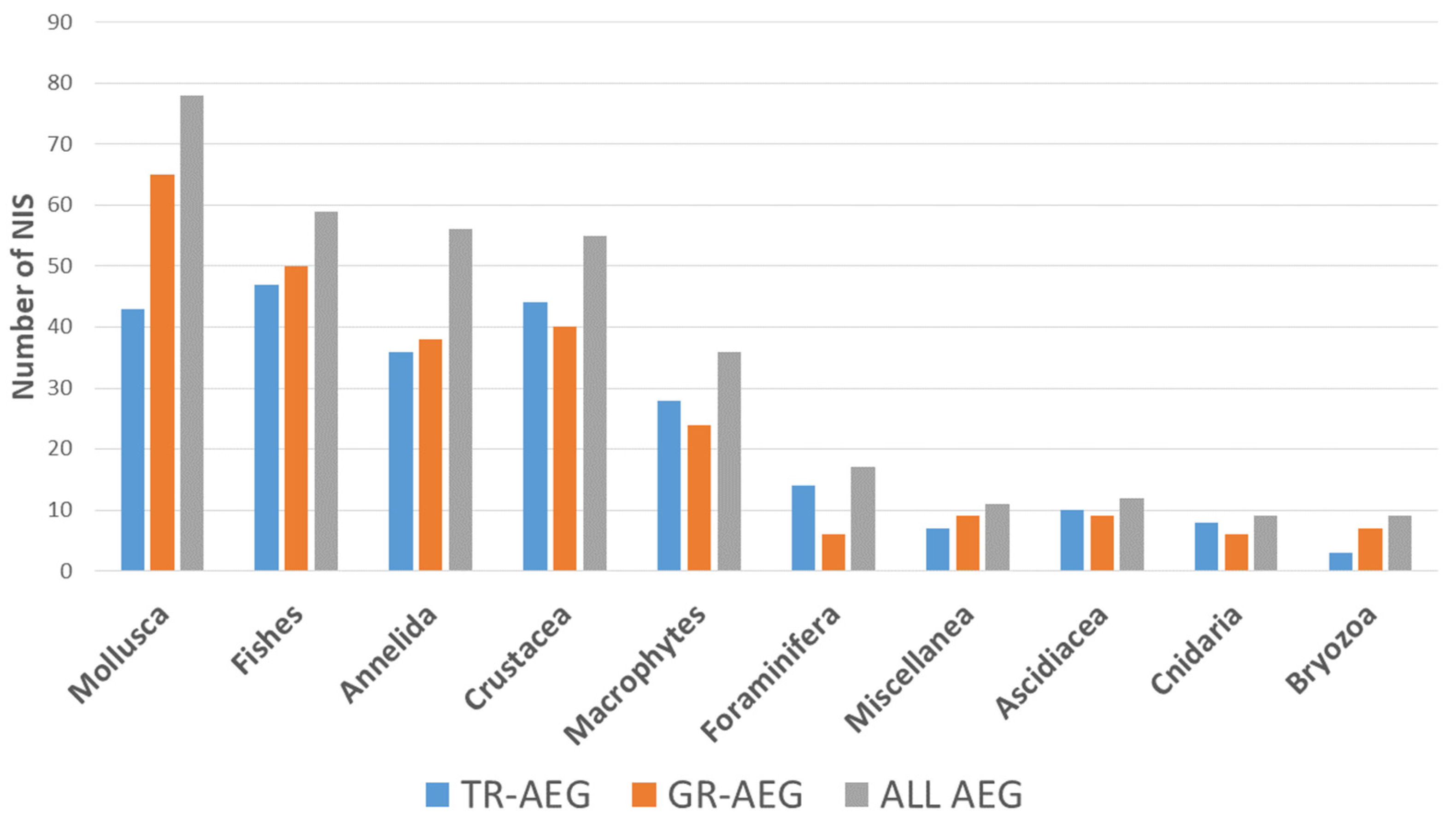
Among the 342 validated NIS species in the Aegean Sea, most species belong to Mollusca (70 NIS), followed by fishes (59 NIS), Annelida (Polychates: 56 NIS), and Arthropoda (Crustaceans: 55 NIS) (Figure 2).
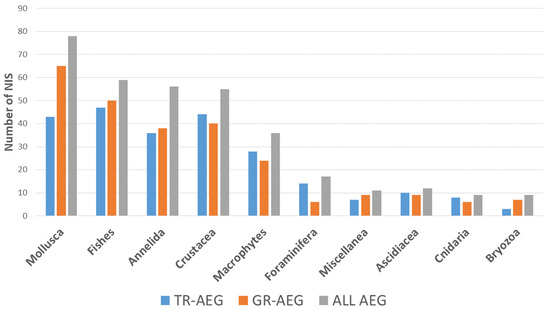
Figure 2.
Representation of the major taxa groups among the NIS present in the Turkish part (TR-AEG) and the Greek part (GR-AEG) of the Aegean.
The majority of NIS are distributed in the South Aegean, with 281 NIS, 39% of which (109 species) are common in both the Greek and Turkish coasts. The North Aegean hosts 206 NIS, 32% of which (66 species) are common in the Greek and Turkish coasts. With regard to the continuity of the North Aegean with the South Aegean, approximately 46% of the South Aegean’s NIS (128 species) are also present in the North Aegean, making up 63% of its NIS biota.
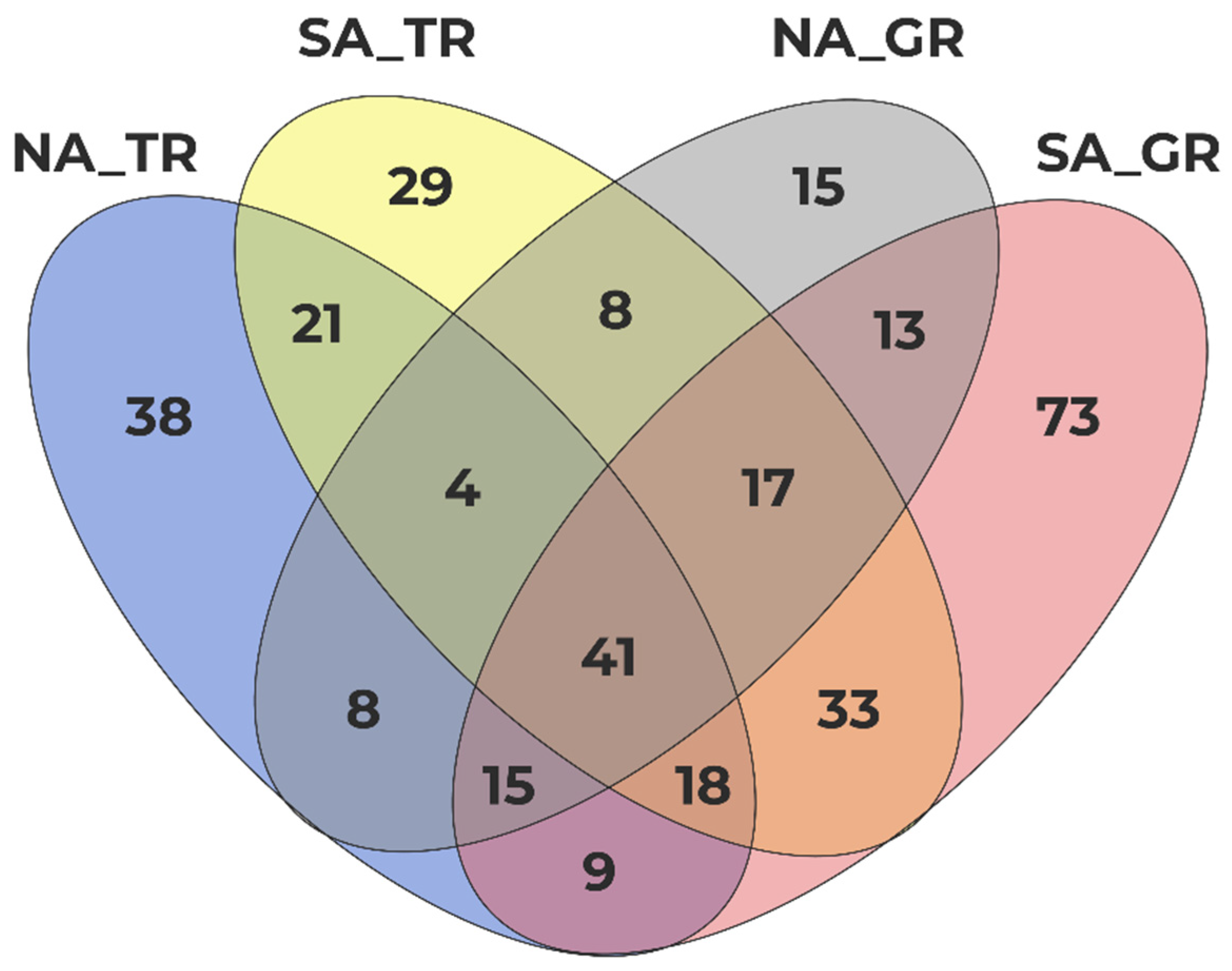
Details of the NIS distribution across the four Aegean sectors are depicted in Figure 3.
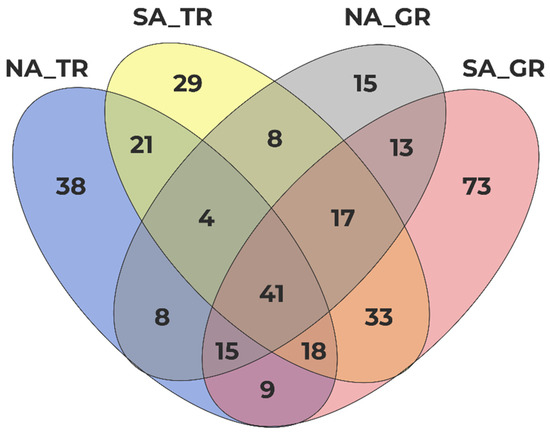
Figure 3.
Number of species that are unique to or shared between the four Aegean subregions. Each intersection in the Venn diagrams represents the number of species contained only within the specific combination of geographic areas and nowhere else. NA_TR = North Aegean Türkiye; SA_TR = South Aegean Türkiye; NA_GR = North Aegean Greece; SA_GR = South Aegean Greece.
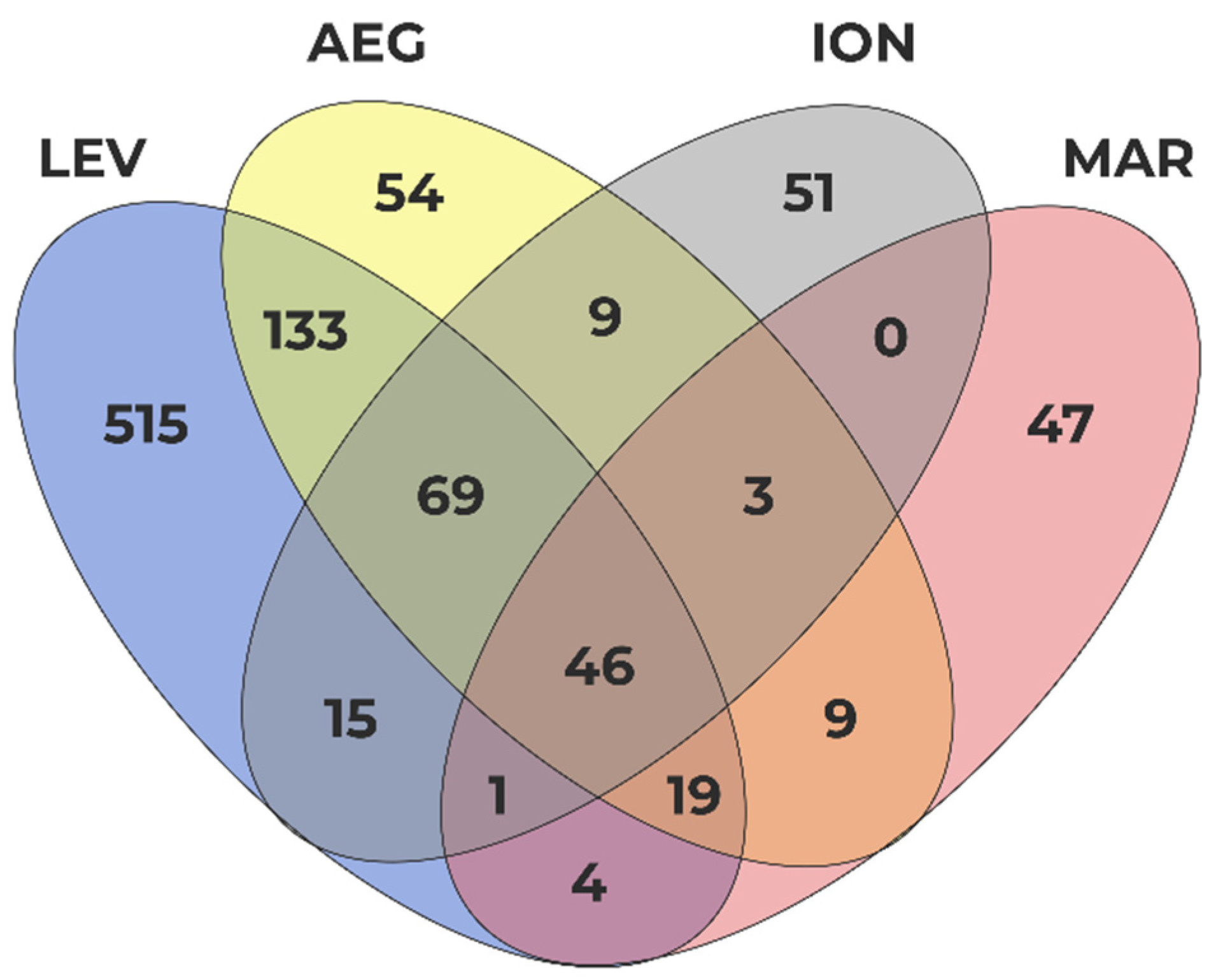
The similarity in NIS composition between the Aegean and its neighboring seas (Levantine, Ionian, Marmara) is shown in Figure 4. Of the 802 species that have been introduced into the Levantine Sea, 267 (33%) also occur in the Aegean Sea and 131 (16%) occur in the Ionian Sea, while only 70 (9%) of them have reached the sea of Marmara. The Aegean Sea shares 127 NIS with the Ionian Sea, and 77 NIS with the Sea of Marmara.
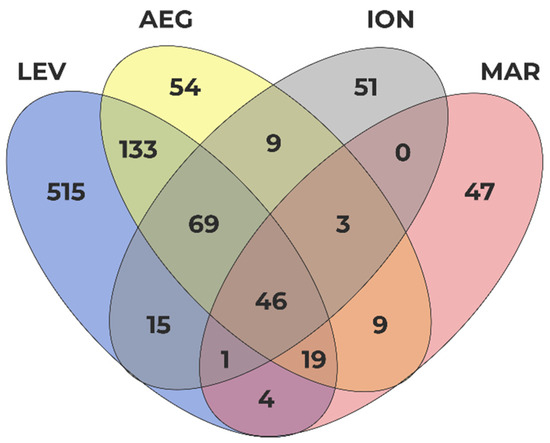
Figure 4.
Shared species of the study area (AEG = Aegean Sea) with the neighboring seas: LEV = Levantine Sea; ION = Ionian Sea; MAR = Marmara Sea.
As an example of the most likely pathway responsible for the occurrence of NIS in the neighboring seas, the distribution of the 41 widespread NIS across all Aegean sectors and in the neighboring seas is given in Table 4. It is clear that the majority of species occurring across the Aegean Sea originate as NIS in the Levantine Sea. They are all Red Sea species that have invaded the Levantine Sea via the Suez Canal (Lessepsian immigrants), with some of them progressively reaching the Sea of Marmara and/or the Ionian Sea. On the other hand, such a pattern is not clear for those NIS transported with vessels (pathway TS), which are often first introduced into either the Aegean or the Ionian and then spread to the other subregions independently of the counterclockwise Mediterranean circulation.
Table 4.
List of species common across the Aegean sectors and their distribution in the neighboring seas. The year the species was initially detected is shown in bold. Pathway: COR = corridor; TS = transport stowaway; UNA = unaided; REL = release in nature.
3.1. Trends in NIS Introduction
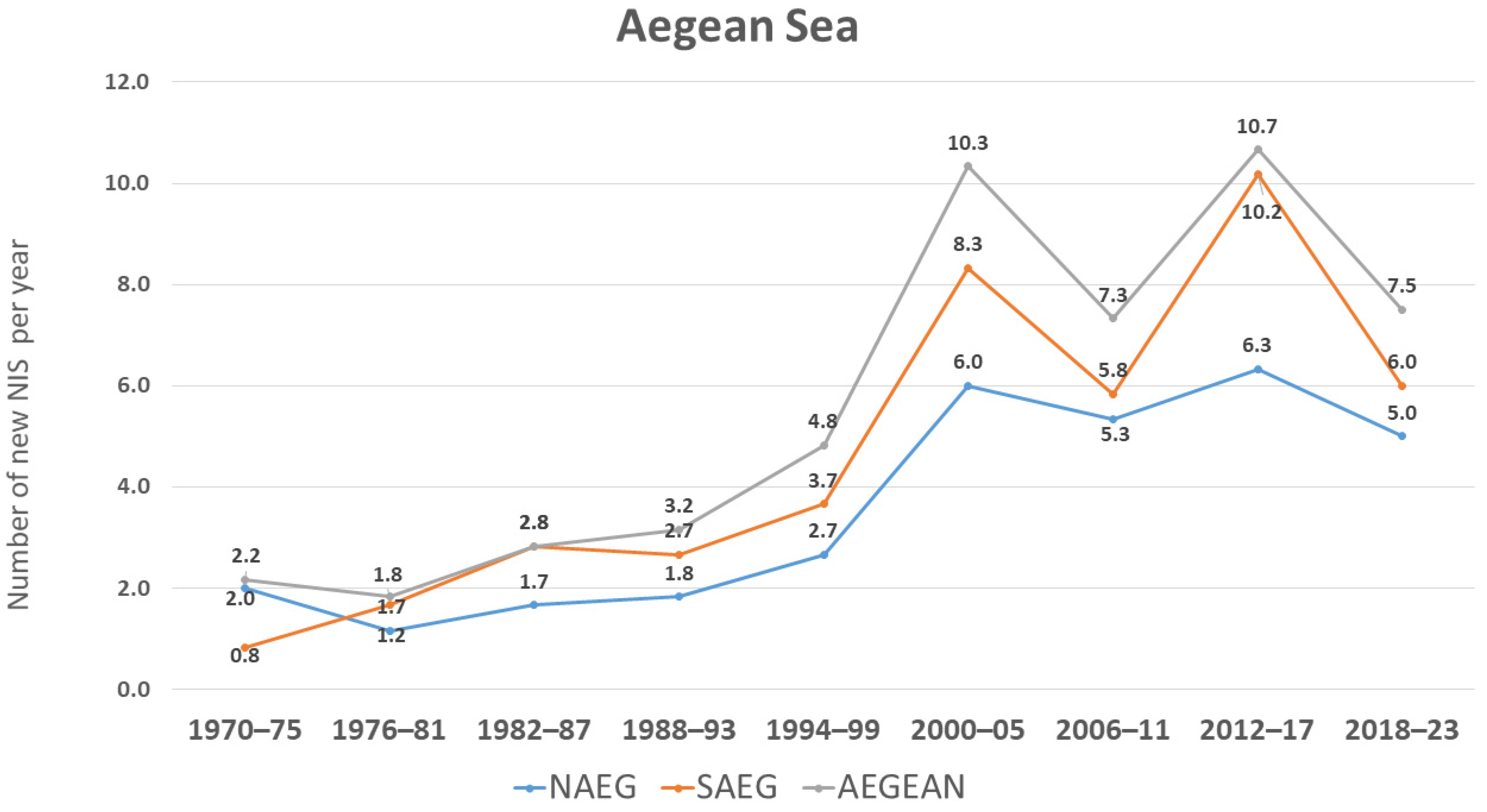
A peak in NIS introductions (62 species = 10.3 species per year) was observed in the 2000–2005 period, while a significant decline was noted in the following period. During 2012–2017, NIS reached the highest value (64 species = 10.7 species per year), which was more evident in the South Aegean (10.2 NIS per year) compared to the North Aegean (6.3 NIS per year). However, this number dropped again in the most recent period (Figure 5).
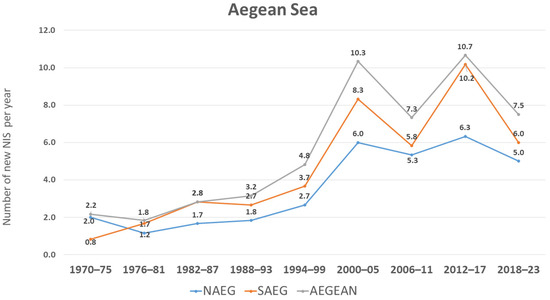
Figure 5.
Annual rate of NIS introductions (6-year average) at different geographic levels: NAEG = North Aegean; SAEG = South Aegean.
3.2. Trends in Pathway
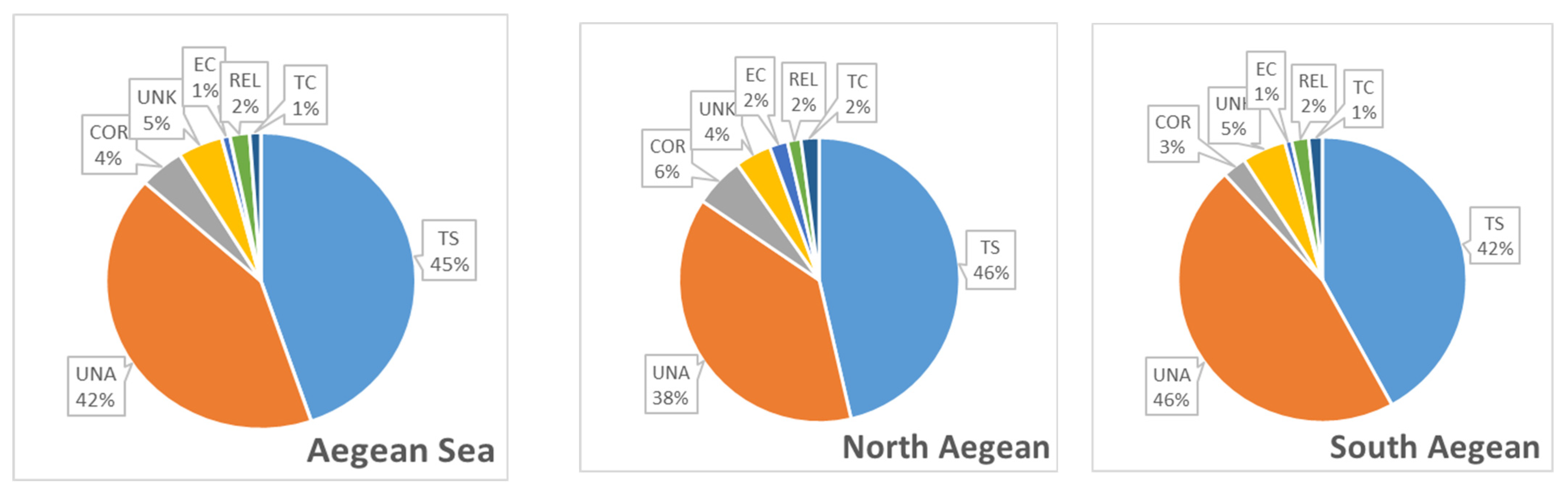
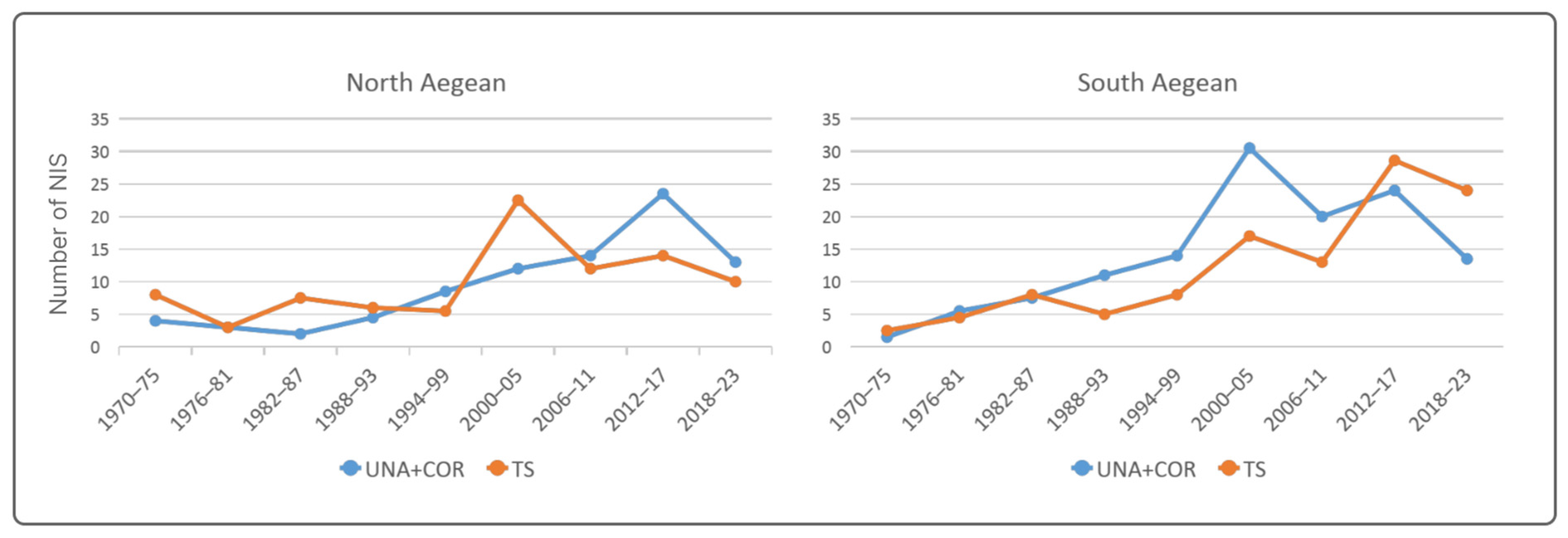
On average, 91% of all introductions are attributed to shipping (TS = 45%) or migration via the Suez Canal (UNA = 42%, COR = 4%), while all other pathways make up just 1–2% (Figure 6). However, the relative importance of these pathways differs in the two Aegean sectors. Unaided introductions prevail in the South Aegean (46%), followed by shipping (42%), whereas in the North Aegean, ship-transferred NIS introductions reach 46%, followed by unaided introductions (38%). The chronological entry of Lessepsian (UNA + COR) and vessel-transferred NIS is presented separately in the South and North Aegean (Figure 7). While unaided introductions of Lessepsian species and/or direct introductions via the Suez Canal peaked in the South Aegean during 2000–2005, their peak in the North Aegean was in 2012–2017, a decade later. The opposite pattern was observed for ship-transferred NIS (TS). The maximum was observed during 2000–2005 in the North Aegean (26 NIS), while in the South Aegean, ship-transferred NIS reached their maximum in the period 2012–2017 (32 species). Regarding the 41 widespread NIS across all Aegean sectors (Table 4), it is noteworthy that shipping-mediated species are less represented in comparison (between 31% and 38%), while the majority are naturally dispersing Lessepsian species, which are first observed in the Levantine.
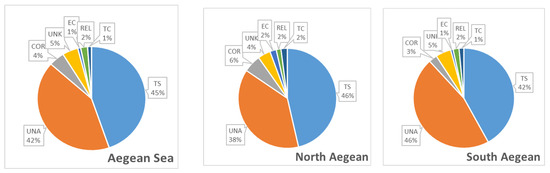
Figure 6.
Pathway of NIS introductions to the Aegean Sea at different geographic levels: all Aegean Sea, North Aegean, South Aegean.
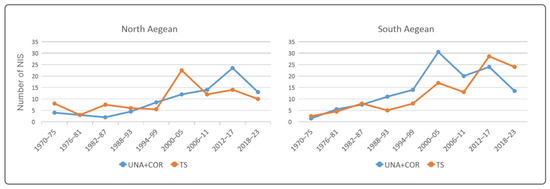
Figure 7.
Trends in transport stowaway (TS) and Lessepsian immigrants (UNA + COR) associated new NIS introductions per six-year cycle since 1970 in the North Aegean (left) and the South Aegean Sea (right).
3.3. Hot Spot Areas
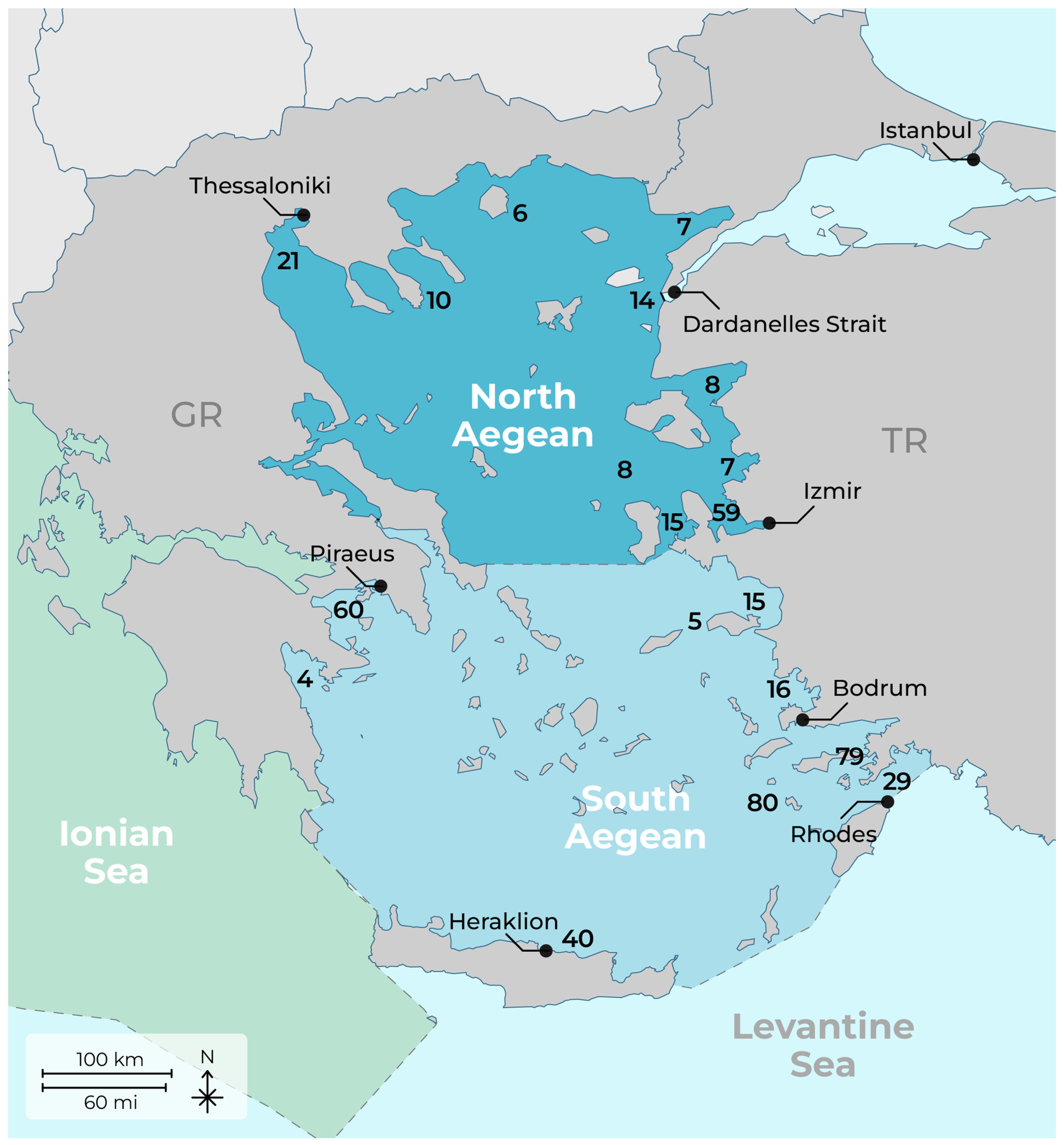
The map of Figure 8 depicts the spatial distribution of first record locations in each country. The highest number of first species’ records in the South Aegean, both in Greece and in Türkiye, is detected in the southeast of the region, i.e., the Dodecanese islands (primarily Rhodes) and the coastal areas south of Bodrum, where a number of marine protected areas are located. Two additional hotspot areas for NIS detection are the island of Crete and the Saronik Gulf, which encompasses the port of Piraeus. In the North Aegean, two hotspots of introduction stand out, both hosting major commercial ports: Izmir Bay with the Izmir port and Thermaikos Gulf with the Thessaloniki port. The rest of the national first records in the North Aegean are relatively evenly distributed among the various bays and islands of the region.
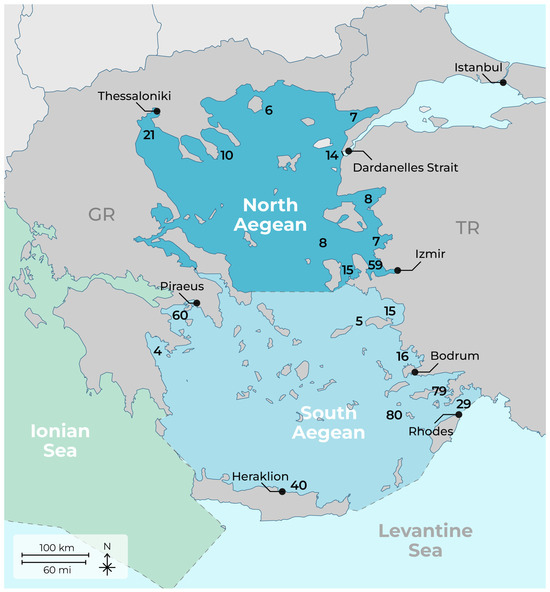
Figure 8.
Map of the study area with the number of country first records in wider geographic areas (number locations are approximate and indicative).
3.4. Research Effort
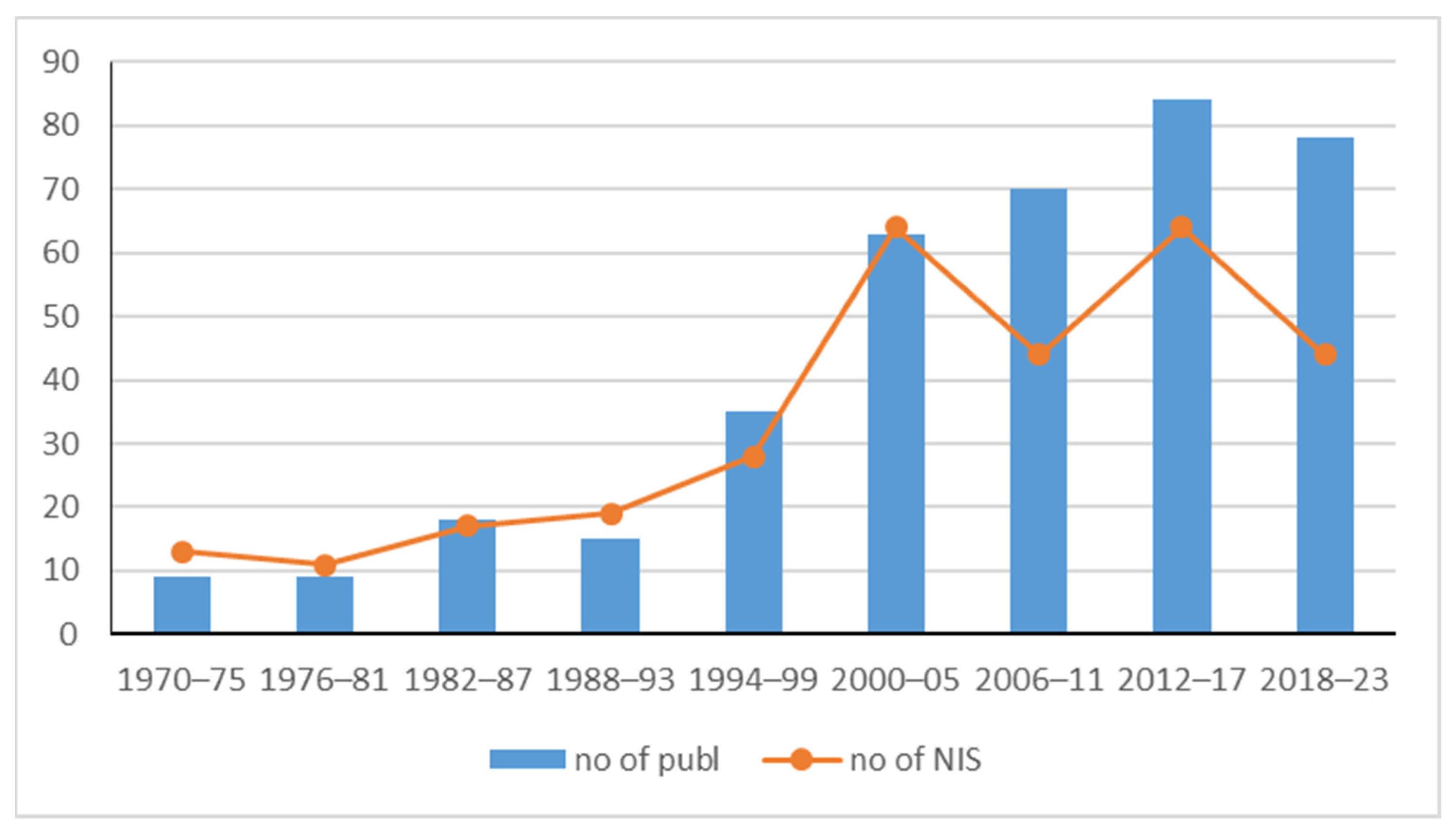
The compilation and analysis are based on 415 works published in the period 1904–2024 (up to August) and a few unpublished data examined by the authors (see Annex 1). The earliest publications (from the early 20th century to 1970) that included NIS in the Aegean Sea did not mention their invasion status. Publications worth mentioning include ten PhD theses, reports by HCMR and TUBITAK, 25 collective articles in the series “New Mediterranean Biodiversity Records”, and 57 publications derived from citizen scientists’ observations that mostly address molluscs [40], fishes [11], and decapod crustaceans [4]. An increase in publications is evident after 1988 and continues to the present day (Figure 9). The numbers of new NIS correlated strongly with the numbers of relevant publications until 2005 (r = 0.98). New publications after 2005 address the spread of species within the Aegean [South to North Aegean; east (Türkiye) to west (Greece)].
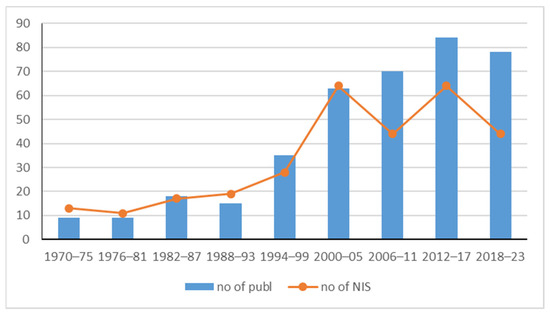
Figure 9.
Scientific effort (number of publications as proxy) vs number of new NIS reported in the Aegean Sea per six-year cycle since 1970.
4. Discussion
Our concerted effort to address NIS in the whole of the Aegean ecoregion (both Turkish and Greek coasts) resulted in a grand total of 342 species reported by August 2024 and covering 120 years of records. In revising our list, 56 species were excluded (mostly foraminiferan) and 73 species were included. Among the included species are species that, according to Karachle et al. [110], were expected to invade the area, such as the tunicate Polyclinum constellatum Savigny, 1816 in Greek and Turkish waters, the rhodophyte Womersleyella setacea (Hollenberg) R.E. Norris in Türkiye, the annelid Hydroides operculata (Treadwell, 1929) in Greek waters, the Lessepsian fishes Cheilodipterus novemstriatus (Rüppell, 1838) and Sillago suezensis Golani, Fricke and Tikochinski, 2013 in Greek waters.
Regarding the Turkish Aegean coasts, 30 NIS have been added to the list of Cinar et al. [14], 13 of which were reported in the period 2020–2024 (Table 3). Of these, the Chlorophyta Udotea flabellum (J. Ellis and Solander) M. Howe, consists first record for the Mediteranean [47]. However, the increase in NIS has not been linear. The 98 species reported in the Aegean Turkish waters in 2005 [12] increased to 165 in 2011 [13] and 222 by 2015 [8], climbing to 262 in 2020 [14]. Notably, a large number of Foraminifera (35 species) were excluded from the Turkish NIS fauna [14]. A meticulous search of their distribution revealed that they are either cryptogenic or most likely native (having type localities or fossil records within the Mediterranean). Conclusively, this work includes 240 validated NIS in total along the Aegean Turkish waters.
In contrast, the 216 NIS noted in the Aegean Greek coasts by 2020 [17] increased to 254 species by August 2024. Forty species have been reported in the Greek coasts of the Aegean in the period 2020–2024, some of which are first records in the Mediterranean (e.g., the tunicate Botryllus gaiae Brunetti, 2020 [105]; the molluscs Elysia nealae Ostergaard, 1955, Heliacus implexus (Mighels, 1845) [25], and Juxtacribrilina mutabilis (Ito, Onishi and Dick, 2015) [37]). Another six species classified as cryptogenic or questionable [111] have been added to our list. On the other hand, 14 species reported as alien in earlier studies have been documented to be native—e.g., the foram Triloculina fichteliana d’Orbigny, 1839 [112]—cryptogenic—e.g., the Bryozoan Amathia verticillata (delle Chiaje, 1822) [113]—or misidentifications—e.g., Halophila decipiens Ostenfeld [108]—and have thus been removed from our work (see Table 1).
Although the largest species richness and most records (281 species) of NIS in the Aegean Sea occur in its southernmost part, in accordance with [17,53], 206 NIS have been recorded in the North Aegean Sea. The North and South Aegean share 128 NIS.
With the exception of Mollusca, the number of NIS is similar along the Greek and Turkish coasts for most taxa. The dominance of molluscan NIS in the Greek part of the Aegean may be attributed to the higher number of taxonomic experts in Greece [114], but also to the contribution of citizen scientists. A sound example of the latter is the case of the Saronikos Gulf, where 24 out of 29 molluscan species (83%) have been reported by citizen scientists [115], the most recent one being Stosicia lineata (Dunker, 1860) [41]). In contrast, citizen scientists, and in particular shell collectors, have contributed the most to NIS identification along the Levantine part of Türkiye [116].
Crustacean NIS found in the Aegean Sea are widely different in terms of mobility and natural dispersal capabilities, ranging from copepoda and decapoda with long-lived pelagic larvae, whose dispersal is primarily governed by circulation patterns along a complex topography, to brooding amphipods and low-mobility isopods [117]. For the low-mobility species in particular, anthropogenic factors play a critical role in their spread and contribute to a distinct division in the species found on either side of the Aegean. Notably, such species found in both regions were recorded years apart, highlighting a potential gap in scientific research. This delay in observation can be attributed to the natural lag in species distribution versus human detection. A prime example is Paracerceis sculpta (Holmes, 1904), which was first reported in 2015 on a boat’s hull in Fethiye Bay yet remained unrecorded until a 2022 study in Izmir Bay revealed it in abundance across various habitats [51,89]. It is likely that this species formed populations in various areas in 2015 that were not detected at the time. The species was already well established in two marinas located in the Greek part of the North Aegean since 2009 [118]. Similarly, Caprella scaura Templeton, 1836, was identified among fouling organisms in aquaculture cages in 2008 in south Türkiye [119] and in a marina in Crete in 2012 [120]; by the time it was detected in the Greek North Aegean in 2020, it was already well established [34], illustrating the intricate dynamics of NIS distribution in the region. A well-communicated early warning system alongside regular, targeted monitoring, with e-DNA where appropriate, could certainly improve the chances of early detection of highly successful invaders. On the other hand, southern Türkiye has more NIS of Crustacea than northern Türkiye, with a few differences in species. However, this situation aligns with a much greater species difference on the Greek side. This indicates that northern Greece is a more challenging region for foreign crustacean species to reach. A total of 36 marine alien macrophytes were reported in the Aegean Sea (TR: 28, GR: 24), of which 31 species were found in the South Aegean and 28 species in the North Aegean. The highest number of NIS in the Aegean Sea was recorded in northern Türkiye, with 26 species, followed by southern Greece (21 species), southern Türkiye (20 species), and northern Greece (16 species). In Türkiye, eight species show invasive behavior (the green algae Caulerpa cylindracea, Codium fragile, the brown alga Stypopodium schimperi, the red algae Asparagopsis armata, Asparagopsis taxiformis, Bonnemaisonia hamifera, Polysiphonia morrowi, and the Spermatophyta Halophila stipulacea), while in Greece, six species exhibit invasive behavior (Caulerpa cylindracea Codium fragile, Asparagopsis taxiformis, Stypopodium schimperi, Womersleyella setacea, and Halophila stipulacea) [9] (see Annex 1). Recently, the green alga Caulerpa taxifolia var. distichophylla was recorded in the Marmara Sea [121].
While previous studies in the region did not distinguish between the North and South Aegean, this study provides more detailed information on the distribution of the NIS belonging to the Polychaeta group in the Aegean Sea. The present study also includes as yet unpublished data on the range expansion of NIS: Ceratonereis mirabilis, Laonice norgensis, and Pista unibranchia are new records for the North Aegean coast of Türkiye, while Chaetozone corona, Hydroides elegans, Leonnates persicus, Metasychis gotoi, Polydora cornuta, Prionospio depauperata, Prosphaerosyllis longipapillata and Pseudonereis anomala are new records for the South Aegean coast of Türkiye. Seven new species have been detected in the framework of a project focused on NIS in Greek ports [92].
Until the 2000s, studies on recent Foraminifera in Türkiye focused on the Sea of Marmara and the Gulf of Iskenderun. The only relevant Aegean research was performed on sediments from its northernmost region (Saros Bay, Gokceada, and Bozcaada). Later studies included foraminiferan from Antalya, Bodrum, Marmaris, etc. A few studies addressed recent foraminifera along the Greek coasts.
Fifty-nine NIS of fishes have been recorded in the Aegean Sea (Greece, 50; Türkiye, 47), including 38 species shared by both countries. A substantial number of these NIS have established populations or become invasive in both Greece (69%) and Türkiye (76%). However, Türkiye has a longer list of invasive species (17) compared to Greece (nine). Furthermore, 52 NIS of fishes have been documented in the South Aegean Sea and 35 in the North Aegean Sea, with 28 shared between the two sub-basins. While most species recorded in the North Aegean Sea have only been observed casually, species introductions and the extent of occurrence and area of occupancy of several species have been increasing since the 2000s [11].
Of the 56 NIS of fishes with identified pathways, the majority (84%) are Lessepsian migrants that dispersed naturally (UNA). Notably, all species shared between Greece and Türkiye are Lessepsian immigrants, while non-Lessepsian fish species are found exclusively in either the North or South Aegean Sea, within Türkiye or Greece. Natural dispersion appears to be the primary mechanism driving range expansion for NIS of fishes in the Aegean Sea, with Lessepsian ones likely colonizing the Dodecanese Islands first and subsequently dispersing northwards and westwards [54].
The trends in NIS introduction in the Aegean exhibited two peaks, one in 2000–2005 and one in the period 2012–2017 (10.7 NIS per year), both driven by the South Aegean pattern. The 2000–2005 peak agrees with the peak reported at the Mediterranean scale [60] and also at the pan-European scale [122]. The second peak in the period 2012–2017 may be attributed to increasing sampling effort, particularly in Greek waters, following the implementation of the Marine Strategy Framework Directive [123]. This is also reflected in the number of publications addressing NIS in the Aegean. The decline observed in the last period (7.3 NIS per year) could be due to the time lag in reporting, which exceeds one year both in Türkiye and in Greece [124].
Analysis of pathways demonstrated that the Suez Canal is responsible for 46% of all introductions into the Aegean Sea, either directly (COR = 4%) or indirectly through the spread of Lessepsian species from the Levantine Sea (UNA = 42%). The responsibility is shared with transfer with vessels (TS pathway = 45%). Çinar et al. [8] estimated that 61% of the total number of NIS reported in the eastern Aegean Sea first entered the Mediterranean via the Suez Canal and expanded their distributional ranges to the Aegean Sea by natural dispersal processes. Katsanevakis et al. [9] estimated the invasion of Lessepsian immigrants to reach 56%. Our study downgrades this pathway to 46% across the entire Aegean Sea.
It was also demonstrated that the aforementioned pathways contributed differently in the South and North Aegean. While unaided introductions prevailed in the South Aegean, transfer with vessels was the main mode of introduction in the North Aegean. It should be mentioned that the southern part of the Aegean Sea represents a hotspot of NIS introductions, a phenomenon which is evident in coastal fisheries [125]. While in the South Aegean, the introduction of Lessepsian immigrants peaked in the 2000–2005 period (reaching 30 species, or five new NIS per year), this rate declined in the following periods to almost half. In contrast, Lessepsian immigrants invaded the North Aegean at an increasing rate since 2000, reaching their maximum in the 2012–2017 period (approximately five new NIS per year). This increase can only be justified by recent climate changes. A study [126] of the mean sea surface temperature (SST) of the northeastern Mediterranean revealed a clear increasing trend deriving from annual means (0.47 °C/decade), with significantly high annual means after 2012. The North Aegean areas revealed the strongest trends among all sub-regions, with mean (0.052 °C) and maximum (0.071 °C) levels, and the cumulative intensity of Marine Heatwaves (MHWs) was higher over the Northern Aegean Sea (>20.5 °C) [126].
As opposed to the Suez Canal pathway, shipping reached its maximum in the South Aegean in the 2012–2017 period. This is probably attributed to increased sampling efforts in hot spot areas (ports and marinas) such as the SaroniK Gulf (the wider area of Peiraeus port) [127,128] and Heraklion (northern Crete) [89]. The increased rate in the South Aegean could be due to transfers from other bioregions within the Mediterranean but also from the Black Sea. Kalyvioti et al. [128] listed the most high-risk voyage origin ports for NIS in the Saronik Gulf to be Gemlik, Ambarli, Asyaport, and Derince in the Sea of Marmara, Iskenderun, Mersin, and Nemrut in the Levantine Sea, and Izmir in the Aegean Sea.
The temporal trends for the whole of the Aegean reflect rather well the findings of breakpoint analysis for the eastern Mediterranean [129]. These authors estimated that the year in which a major shift took place in introduction rates is 1996, the mid-point of the 1994–1999 6-year period, after which sharp increases are observed in our study as well. A small delay in the South Aegean peak may be interpreted as the time it takes for Lessepsian species to reach the Aegean from the Levantine. At the same time, the mid-1990s is the period in which the increasing trend for ship-mediated introductions started to become apparent (Figure 7), particularly in the North Aegean. Thus, it can be concluded that, for the purposes of setting a reference period for assessment, a starting point between 1996–1997 constitutes a robust estimation that can be applied at both the Aegean and eastern Mediterranean level.
The spatial distribution of introduction hotspots largely reflects two phenomena/processes. One is undoubtedly related to the pathways of introduction themselves, mainly in the form of unaided dispersal of Lessepsian species entering the Aegean from the south-east and being initially detected in the Dodecanese [130] and the gulfs and peninsulas of the southern Turkish coast, as well as ship-mediated introductions taking place in the main ports of the North and South Aegean. The other is related to the concentration of monitoring efforts in vulnerable and at-risk areas, such as ports and marinas, as well as areas of conservation value. As such, the MPAs, for example of Gökova, Datça-Bozburun, and Köyceğiz-Dalyan, have been the focus of systematic surveys over distinct periods of time, revealing a significant presence of NIS [78,80,131,132,133].
Moreover, there is an incidental element to research efforts that is related to the spatial allocation of institutes and marine experts working on marine alien species along the Aegean coasts. There are notable hotspots in the Saronik Gulf, Crete (Heraklion), and the Dodecanese (Rhodes), where departments of the Hellenic Centre of Marine Research (HCMR) are located, and strong marine NIS research teams in Turkish universities, e.g., Izmir, Çanakkale, and Muğla [113]. Recently, EU fisheries data have been comprehensively analyzed by the Fisheries Research Institute (FRI) to provide up-to-date spatiotemporal information on the distributions of fish NIS in the North Aegean Sea [11].
The Saronik Gulf, hosting the ports of Piraeus and Eleusis, and Izmir Bay, hosting the port of Izmir, are arguably the best-studied areas in the Aegean Sea, owing mostly to research efforts by the Hellenic Centre of Marine Research (HCMR) and Ege University scientists.
Supplementary Materials
The following supporting information can be downloaded at: https://www.mdpi.com/article/10.3390/d17010012/s1.
Author Contributions
A.Z., conceptualization, methodology, data analysis and interpretation, writing—original draft, writing—review and editing, visualization; M.G., methodology, data analysis, writing—review and editing; A.D., conceptualization, methodology, writing—review and editing; M.C.-F., A.K.B., G.C., A.E., E.M., E.T., M.B.Y., A.D., E.D. and M.S., methodology, writing—review and editing. All authors have read and agreed to the published version of the manuscript.
Funding
This research received no external funding.
Acknowledgments
The authors are grateful to Bilal Ozturk and Panayiotis Ovalis for unpublished data on mollusks along the Turkish coasts, and to Bulent Gozcelioglu for information provided on Ascidian and Porifera. Nicholas Jason Xentidis prepared the maps. This study has been supported in part by TÜBİTAK project 121Y215 entitled “Macroflora Species Diversity and Ecological Status of the Aegean Sea”, which ran in the period 2021–2024 and included the study of alien and invasive macroflora species along the Turkish coasts of the Aegean Sea. A big thank you goes to the reviewers, whose constructive criticism has significantly improved our work.
Conflicts of Interest
Author Marika Galanidi was employed by the company ÜEE LLC. The remaining authors declare that the research was conducted in the absence of any commercial or financial relationships that could be construed as a potential conflict of interest.
References
- Katağan, T.; Tokaç, A.; Beşiktepe, Ş.; Öztürk, B. (Eds.) The Aegean Sea Marine Biodiversity, Fisheries, Conservation and Governance; Publication No 41; Turkish Marine Research Foundation (TUDAV): Istanbul, Turkey, 2015. [Google Scholar]
- Anagnostou, C.; Katsanevakis, S.; Kastanidi, E.; Streftaris, N.; Pagou, K.; Papathanassiou, E. Integrated Planning for the Adaptive Management of Human Activities and Supporting Marine Conservation in the Aegean Sea. In The Handbook of Environmental Chemistry; Springer: Berlin/Heidelberg, Germany, 2023. [Google Scholar] [CrossRef]
- REMPEC. Study on Trends and Outlook of Marine Pollution from Ships and Activities and of Maritime Traffic and Offshore Activities in the Mediterranean; Report by the Regional Marine Pollution Emergency Response Centre for the Mediterranean Sea; REMPEC: Floriana, Malta, 2021; p. 181. ISBN 978-9918-0-0322-8. [Google Scholar]
- Sini, M.; Katsanevakis, S.; Koukourouvli, N.; Gerovasileiou, V.; Dailianis, T.; Buhl-Mortensen, L.; Damalas, D.; Dendrinos, P.; Dimas, X.; Frantzis, A.; et al. Assembling Ecological Pieces to Reconstruct the Conservation Puzzle of the Aegean Sea. Front. Mar. Sci. 2017, 4, 347. [Google Scholar] [CrossRef]
- Giakoumi, S.; Sini, M.; Gerovasileiou, V.; Mazor, T.; Beher, J.; Possingham, H.P.; Abdulla, A.; Çinar, M.E.; Dendrinos, P.; Gucu, A.C.; et al. Ecoregion-Based Conservation Planning in the Mediterranean: Dealing with Large-Scale Heterogeneity. PLoS ONE 2013, 8, e76449. [Google Scholar] [CrossRef] [PubMed]
- Panayotidis, P.; Orfanidis, S.; Tsiamis, K. Cystoseira crinita community in the Aegean Sea. Rapp. Comm. Int. Pour Explor. Sci. Mer Mediterr. 2007, 38, 570. [Google Scholar]
- Güçlüsoy, H. Marine and coastal protected areas of Turkish Aegean coasts. In The Aegean Sea Marine Biodiversity, Fisheries, Conservation and Governance; Katağan, T., Tokaç, A., Beşiktepe, Ş., Öztürk, B., Eds.; Publication No. 41; Turkish Marine Research Foundation: Istanbul, Turkey, 2015; pp. 669–684. [Google Scholar]
- Çınar, M.E.; Bilecenoğlu, M. Alien species invading the Aegean Sea habitats—An eastern synthesis. In The Aegean Sea Marine Biodiversity, Fisheries, Conservation and Governance; Katağan, T., Tokaç, A., Beşiktepe, Ş., Öztürk, B., Eds.; Publication No. 41; Turkish Marine Research Foundation: Istanbul, Turkey, 2015; pp. 636–653. [Google Scholar]
- Katsanevakis, S.; Zenetos, A.; Corsini-Foka, M.; Tsiamis, K. Biological Invasions in the Aegean Sea: Temporal Trends, Pathways, and Impacts. In The Handbook of Environmental Chemistry; Springer: Berlin/Heidelberg, Germany, 2020. [Google Scholar] [CrossRef]
- Katsanevakis, S.; Tsirintanis, K.; Sini, M.; Gerovasileiou, V.; Koukourouvli, N. Aliens in the Aegean—A sea under siege (ALAS). Res. Ideas Outcomes 2020, 6, e53057. [Google Scholar] [CrossRef]
- Evangelopoulos, A.; Karampetsis, D.; Christidis, A.; Gubili, C.; Sapounidis, A.; Adamidou, A.; Kamidis, N.; Koutrakis, E. Non-native fish species in the North Aegean Sea: A review of their distributions integrating unpublished fisheries data. Front. Mar. Sci. 2024, 11, 1398037. [Google Scholar] [CrossRef]
- Çinar, M.E.; Bilecenoglu, M.; Ozturk, B.; Katagan, T.; Aysel, V. Alien species on the coasts of Turkey. Mediterr. Mar. Sci. 2005, 6, 119–146. [Google Scholar] [CrossRef]
- Çinar, M.E.; Bilecenoglu, M.; Ozturk, B.; Katagan, T.; Yokeş, M.B.; Aysel, V.; Dağlı, E.; Açik, S.; Ozcan, T.; Erdogan, H. An updated review of alien species on the coasts of Turkey. Mediterr. Mar. Sci. 2011, 12, 257–315. [Google Scholar] [CrossRef]
- Çinar, M.E.; Bilecenoğlu, M.; Yokeş, M.B.; Öztürk, B.; Taşkin, E.; Bakir, K.; Doğan, A.; Açik, Ş. Current status (as end of 2020) of marine alien species in Turkey. PLoS ONE 2021, 16, e0251086. [Google Scholar] [CrossRef]
- Tsiamis, K.; Palialexis, A.; Stefanova, K.; Gladan, N.; Skejić, S.; Despalatović, M.; Cvitković, I.; Dragičević, B.; Dulčić, J.; Vidjak, O.; et al. Non-indigenous species refined national baseline inventories: A synthesis in the context of the European Union’s Marine Strategy Framework Directive. Mar. Pollut. Bull. 2019, 145, 429–435. [Google Scholar] [CrossRef] [PubMed]
- Tsiamis, K.; Palialexis, A.; Connor, D.; Antoniadis, S.; Bartilotti, C.; Bartolo, G.A.; Berggreen, U.C.; Boschetti, S.; Buschbaum, C.; Canning-Clode, J.; et al. Marine Strategy Framework Directive, Descriptor 2, Non-Indigenous Species: Delivering Solid Recommendations for Setting Threshold Values for Non-Indigenous Species Pressure on European Seas; Publications Office of the European Union: Luxembourg, 2021; p. 36. [Google Scholar] [CrossRef]
- Zenetos, A.; Karachle, P.K.; Corsini-Foka, M.; Gerovasileiou, V.; Simboura, N.; Xentidis, N.J.; Tsiamis, K. Is the trend in new introductions of marine non-indigenous species a reliable criterion for assessing good environmental status? The case study of Greece. Mediterr. Mar. Sci. 2020, 21, 775–793. [Google Scholar] [CrossRef]
- Agamennone, F.; Sbrana, C.; Nardi, N.; Siragusa, F.; Germanà, A. Dikoleps micalii n. sp.(Gastropoda: Skeneidae) from the Eastern Aegean Sea. Boll. Malacol. 2020, 56, 91–95. [Google Scholar]
- Agamennone, F.; Micali, P.; Siragusa, F. Melanella orientalis n. sp. (Gastropoda: Eulimidae) from the Eastern Mediterranean. Boll. Malacol. 2020, 56, 172–175. [Google Scholar]
- Albano, P.G.; Steger, J.; Bakker, P.A.; Bogi, C.; Bošnjak, M.; Guy-Haim, T.; Huseyinoglu, M.F.; LaFollette, P.I.; Lubinevsky, H.; Mulas, M.; et al. Numerous new records of tropical non-indigenous species in the Eastern Mediterranean highlight the challenges of their recognition and identification. ZooKeys 2021, 1010, 1–95. [Google Scholar] [CrossRef] [PubMed]
- Crocetta, F.; Al Mabruk, S.A.A.; Azzurro, E.; Bakiu, R.; Bariche, M.; Batjakas, I.E.; Bejaoui, T.; Ben Souissi, J.; Cauchi, J.; Corsini-Foka, M.; et al. New alien Mediterranean biodiversity records (November 2021). Mediterr. Mar. Sci. 2021, 22, 724–746. [Google Scholar] [CrossRef]
- Digenis, M.; Ragkousis, M.; Vasileiadou, K.; Gerovasileiou, V.; Katsanevakis, S. New records of the Indo-Pacific shrimp Urocaridella pulchella Yokeş and Galil, 2006 from the Eastern Mediterranean Sea. BioInvasions Rec. 2021, 10, 295–303. [Google Scholar] [CrossRef]
- Kampouris, T.E.; Economidis, P.S.; Batjakas, I.E. First record of Pagrus major (Temminck & Schlegel, 1843) (Perciformes: Sparidae) from east Mediterranean Sea and the northernmost Mediterranean record of Por’s goatfish Upeneus pori Ben-Tuvia & Golani, 1989 (Perciformes: Mullidae) from Thermaikos Gulf, North-West Aegean Sea, Greece. Cah. Biol. Mar. 2020, 61, 253–258. [Google Scholar] [CrossRef]
- Kampouris, T.E.; Gkafas, G.A.; Sarantopoulou, J.; Exadactylos, A.; Batjakas, I.E. An American in the Aegean: First Record of the American Lobster Homarus americanus, H. Milne Edwards, 1837 from the Eastern Mediterranean Sea. BioInvasions Rec. 2021, 10, 170–180. [Google Scholar] [CrossRef]
- Kontadakis, C.; Mbazios, G.; Manousis, T.; Galinous-Mitsoudi, S. Records of the Indo-pacific species Heliacus implexus (Mighels, 1845)(Gastropoda, Architectonicidae) established in the Mediterranean Sea. Xenophora Taxon. 2021, 32, 18–22. [Google Scholar]
- Manousis, T. Hellenic Conches; Conchbooks: Harxheim, Germany, 2021; 609p, ISBN 978-3-948603-17-5.
- Orfanidis, S.; Alvito, A.; Azzurro, E.; Badreddine, A.; Ben Souissi, J.; Chamorro, C.; Crocetta, F.; Dalyan, C.; Fortič, A.; Galanti, L.; et al. New Alien Mediterranean Biodiversity Records (March 2021). Mediterr. Mar. Sci. 2021, 22, 180–198. [Google Scholar] [CrossRef]
- Agamennone, F.; Micali, P. First Mediterranean record of Atys ehrenbergi (A. Issel, 1869) with notes on some species of the genus Retusa (T. Brown, 1827) (Gastropoda: Cephalaspidea). Boll Malacol. 2022, 58, 87–93. [Google Scholar] [CrossRef]
- Kolátková, V.; Smulders, F.O.; Ward, E.A.; Vohník, M. Range expansion of Marinomyxa marina, a phytomyxid parasite of the invasive seagrass Halophila stipulacea, to the Caribbean. Aquat. Bot. 2022, 182, 103554. [Google Scholar] [CrossRef]
- Kourkoutmani, P.; Michaloudi, E. First record of the calanoid copepod Pseudodiaptomus marinus Sato, 1913 in the North Aegean Sea, in Thessaloniki Bay, Greece. BioInvasions Rec. 2022, 11, 738–746. [Google Scholar] [CrossRef]
- Kytinou, E.; Zotou, M.; Virgili, R.; Crocetta, F.; Katsanevakis, S. The Indo-Pacific nudibranch Baeolidia moebii Bergh, 1888 in Greece, with the first documented spawning aggregation in the Mediterranean Sea. BioInvasions Rec. 2022, 11, 461–472. [Google Scholar] [CrossRef]
- Montesanto, F.; Chimienti, G.; Gissi, C.; Mastrototaro, F. Polyclinum constellatum (Tunicata, Ascidiacea), an emerging non-indigenous species of the Mediterranean Sea: Integrated taxonomy and the importance of reliable DNA barcode data. Mediterr. Mar. Sci. 2022, 23, 69–83. [Google Scholar] [CrossRef]
- Uttieri, M.; Anadoli, O.; Banchi, E.; Battuello, M.; Beşiktepe, Ş.; Carotenuto, Y.; Cotrim Marques, S.; de Olazabal, A.; Di Capua, I.; Engell-Sørensen, K.; et al. The distribution of Pseudodiaptomus marinus in European and neighbouring waters-A rolling review. J. Mar. Sci. Eng. 2023, 11, 1238. [Google Scholar] [CrossRef]
- Tiralongo, F.; Akyol, O.; Al Mabruk, S.A.; Battaglia, P.; Beton, D.; Bitlis, B.; Borg, J.A.; Bouchoucha, M.; Çinar, M.E.; Crocetta, F.; et al. New Alien Mediterranean Biodiversity Records (August 2022). Mediterr. Mar. Sci. 2022, 23, 725–747. [Google Scholar] [CrossRef]
- Kondylatos, G.; Mavrouleas, D.; Gratsia, E.; Kasapidis, P.; Corsini-Foka, M.; Klaoudatos, D. First record of Arcania brevifrons Chen, 1989 (Decapoda; Leucosiidae) and further record of Macrophthalmus (Macrophthalmus) indicus Davie, 2012 (Decapoda; Macrophthalmidae) in Hellenic waters. BioInvasions Rec. 2023, 12, 234–244. [Google Scholar] [CrossRef]
- Kondylatos, G.; Kalaentzis, K.; Gratsia, E.; Mavrouleas, D.; Kasapidis, P.; Tsiamis, K.; Klaoudatos, D. Halimeda incrassata (Bryopsidales, Chlorophyta) in Rhodes, Greece, Eastern Mediterranean. Mediterr. Mar. Sci. 2023, 24, 633–638. [Google Scholar] [CrossRef]
- Martaeng, R.; Obst, M.; Kuklinski, P. Phylogeographic study using autonomous reef monitoring structures indicates fast range expansion of the invasive bryozoan Juxtacribrilina mutabilis. Hydrobiologia 2023, 850, 4115–4126. [Google Scholar] [CrossRef]
- Guerra-García, J.M.; Revanales, T.; Saenz-Arias, P.; Navarro-Barranco, C.; Ruiz-Velasco, S.; Pastor-Montero, M.; Sempere-Valverde, J.; Chebaane, S.; Vélez-Ruiz, A.; Martínez-Laiz, G. Quick spreading of the exotic amphipod Laticorophium baconi (Shoemaker, 1934): Another small stowaway overlooked? Meditter. Mar. Sci. 2023, 24, 644–655. [Google Scholar] [CrossRef]
- Ragkousis, M.; Zenetos, A.; Ben Souissi, J.; Hoffman, R.; Ghanem, R.; Taşkin, E.; Muresan, M.; Karpova, E.; Slynko, E.; Dağlı, E.; et al. Unpublished Mediterranean and Black Sea records of marine alien, cryptogenic, and neonative species. Bioinvasions Rec. 2023, 12, 339–369. [Google Scholar] [CrossRef]
- Alvanou, M.V.; Feidantsis, K.; Papadopoulos, D.K.; Lattos, A.; Theodorou, J.A.; Michaelidis, B.; Giantsis, I.A. Major ascidian species with negative impacts on bivalve aquaculture: Current knowledge and future research aims. Open Geosci. 2024, 16, 20220660. [Google Scholar] [CrossRef]
- Ovalis, P.; Zenetos, A. Two more alien micromolluscs in the Greek Seas: New records of Stosicia lineata and Finella pupoides from the Saronikos Gulf. Cah. Biol. Mar. 2024, 65, 169–172. [Google Scholar] [CrossRef]
- Christidis, G.; Ammar, I.A.; Antit, M.; Barhoum, Y.M.; Brundu, G.; Colletti, A.; Crocetta, F.; Desiderato, A.; Digenis, M.; Gökoğlu, M.; et al. New records of introduced species in the Mediterranean (August 2024). Mediterr. Mar. Sci. 2024, 25, 453–479. [Google Scholar] [CrossRef]
- Mutlu, E. Ecological gradients of epimegafaunal distribution along the sectors of Gulf of İzmir, Aegean Sea. COMU J. Mar. Sci. Fish. 2021, 4, 130–158. [Google Scholar] [CrossRef]
- Besiktepe, S.; Terbıyık Kurt, T.; Gubanova, A. Mesozooplankton composition and distribution in İzmir Bay, Aegean Sea: With special emphasis on copepods. Reg. Stud. Mar. Sci. 2022, 55, 102567. [Google Scholar] [CrossRef]
- Cerim, H.; Yapıcı, S.; Gül¸sahin, A.; Soykan, O.; Bilge, G. The first record of the red Cornetfısh (Fistularia petimba Lacepède, 1803) in the Aegean Sea. Düzce Üniv. Bilim Teknol. Derg. 2021, 9, 607–615. [Google Scholar] [CrossRef]
- Taşkın, E.; Çakır, M. Marine macroalgal flora on the Aegean and the Levantine coasts of Turkey. Bot. Mar. 2022, 65, 231–241. [Google Scholar] [CrossRef]
- Fortič, A.; Al-Sheikh, R.R.; Almajid, Z.; Badreddine, A.; Baez, J.C.; Belmonte-Gallegos, A.; Bettoso, N.; Borme, D.; Camisa, F.; Caracciolo, D.; et al. New records of introduced species in the Mediterranean Sea (April 2023). Mediterr. Mar. Sci. 2023, 24, 182–202. [Google Scholar] [CrossRef]
- Langeneck, J.; Bakiu, R.; Chalari, N.; Chatzigeorgiou, G.; Crocetta, F.; Doğdu, S.A.; Durmishaj, S.; García-Charton, J.A.; Gül¸sahin, A.; Hoffman, R.; et al. New records of introduced species in the Mediterranean Sea (November 2023). Mediterr. Mar. Sci. 2023, 24, 610–632. [Google Scholar] [CrossRef]
- Çinar, M.E.; Özgül, A. Clogging nets-Didemnum vexillum (Tunicata: Ascidiacea) is in action in the eastern Mediterranean. J. Mar. Biol. Assoc. United Kingd. 2023, 103, e89. [Google Scholar] [CrossRef]
- Öztürk, B.; Türkçü, N.; Bitlis, B. New records of gastropods (Caenogastropoda and Heterobranchia) from the Turkish coasts with observations on some poorly known species. Turk. J. Zool. 2023, 47, 135–146. [Google Scholar] [CrossRef]
- Dağli, E.; Bakir, K.; Gündeğer, G.; Nerlovic, V.; Doğan, A. Review of marine alien isopods in Türkiye with two new records: Of Paracerceis sculpta and Paranthura japonica. Mediterr. Mar. Sci. 2024, 25, 204–212. [Google Scholar] [CrossRef]
- Katsanevakis, S.; Poursanidis, D.; Hoffman, R.; Rizgalla, J.; Rothman, S.B.-S.; Levitt-Barmats, Y.; Hadjioannou, L.; Trkov, D.; Garmendia, J.M.; Rizzo, M.; et al. Unpublished Mediterranean records of marine alien and cryptogenic species. Bioinvasions Rec. 2020, 9, 165–182. [Google Scholar] [CrossRef]
- Ragkousis, M.; Sini, M.; Koukourouvli, N.; Zenetos, A.; Katsanevakis, S. Invading the Greek Seas: Spatiotemporal Patterns of Marine Impactful Alien and Cryptogenic Species. Diversity 2023, 15, 353. [Google Scholar] [CrossRef]
- Vagenas, G.; Karachle, P.K.; Oikonomou, A.; Stoumboudi, M.T.; Zenetos, A. Decoding the spread of non-indigenous fishes in the Mediterranean Sea. Sci. Rep. 2024, 14, 6669. [Google Scholar] [CrossRef]
- Zenetos, A.; Cinar, M.E.; Pancucci-Papadopoulou, M.A.; Harmelin, J.G.; Furnari, G.; Andaloro, F.; Bellou, N.; Streftaris, N.; Zibrowius, H. Annotated list of marine alien species in the Mediterranean with records of the worst invasive species. Mediterr. Mar. Sci. 2005, 6, 63–118. [Google Scholar] [CrossRef]
- Zenetos, A.; Meriç, E.; Verlaque, M.; Galli, P.; Boudouresque, C.F.; Giangrande, A.; Çinar, M.E.; Bilecenoglu, M. Additions to the annotated list of marine alien biota in the Mediterranean with special emphasis on Foraminifera and Parasites. Mediterr. Mar. Sci. 2008, 9, 119–166. [Google Scholar] [CrossRef]
- Zenetos, A.; Gofas, S.; Verlaque, M.; Cinar, M.E.; Raso, J.E.G.; Bianchi, C.N.; Morri, C.; Azzurro, E.; Bilecenoglu, M.; Froglia, C.; et al. Alien species in the Mediterranean Sea by 2010. A contribution to the application of European Union’s Marine Strategy Framework Directive (MSFD). Part, I. Spatial distribution. Mediterr. Mar. Sci. 2010, 11, 381–493. [Google Scholar] [CrossRef]
- Zenetos, A.; Gofas, S.; Morri, C.; Rosso, A.; Violanti, D.; Garcia Raso, J.E.; Cinar, M.E.; Almogi-Labin, A.; Ates, A.S.; Azzurro, E.; et al. Alien species in the Mediterranean Sea by 2012. A contribution to the application of European Union’s Marine Strategy Framework Directive (MSFD). Part 2. Introduction trends and pathways. Mediterr. Mar. Sci. 2012, 13, 328–352. [Google Scholar] [CrossRef]
- Zenetos, A.; Çinar, M.E.; Crocetta, F.; Golani, D.; Rosso, A.; Servello, G.; Shenkar, N.; Turon, X.; Verlaque, M. Uncertainties and validation of alien species catalogues: The Mediterranean as an example. Estuar. Coast. Shelf Sci. 2017, 191, 171–187. [Google Scholar] [CrossRef]
- Galanidi, M.; Aissi, M.; Ali, M.; Bakalem, A.; Bariche, M.; Bartolo, A.G.; Bazairi, H.; Beqiraj, S.; Bilecenoglu, M.; Bitar, G.; et al. Validated Inventories of Non-Indigenous Species (NIS) for the Mediterranean Sea as Tools for Regional Policy and Patterns of NIS Spread. Diversity 2023, 15, 962. [Google Scholar] [CrossRef]
- Çevik, C.; Dogan, A.; Önen, M.; Zenetos, A. First record of the Indo-Pacific species Electroma vexillum (Mollusca: Bivalvia: Pterioida) in the eastern Mediterranean. Mar. Biodivers. Rec. 2008, 1, e1. [Google Scholar] [CrossRef]
- Kapiris, K.; Katağan, T.; Ateş, S.A.; Conides, A. Review of alien decapods (Crustacea) in the Aegean Sea. J. Black Sea/Mediterr. Environ. 2012, 18, 177–187. [Google Scholar]
- Yokeş, M.; Andreou, V.; Bakiu, R.; Bonanomi, S.; Camps, J.; Christidis, G.; Crocetta, F.; Giovos, I.; Gori, A.; Jureti’c, T.; et al. New Mediterranean Biodiversity Records (November 2018). Mediterr. Mar. Sci. 2018, 19, 673–689. [Google Scholar] [CrossRef]
- IHO (International Hydrographic Organization). Limits of Oceans and Seas, 3rd ed.; Special Publication 1953, No. 23 (S-23); International Hydrographic Organization: Monte Carlo, Monaco, 1953. [Google Scholar]
- Spalding, M.D.; Fox, H.E.; Allen, G.R.; Davidson, N.; Ferdaña, A.Z.; Finlayson, M.; Halpern, B.S.; Jorge, M.A.; Lombana, A.; Lourie, S.A. Marine ecoregions of the world: A bioregionalization of coastal and shelf areas. BioScience 2007, 57, 573–583. [Google Scholar] [CrossRef]
- Jensen, H.M.; Panagiotidis, P. Technical Document on the Delineation of MSFD Article 4 Marine Regions and Subregions 4/10/2017; Version 2.0; European Environment Agency: København, Denmark, 2017; 21p. [Google Scholar]
- Fourcy, D.; Lorvelec, O. A new digital map of limits of oceans and seas consistent with high-resolution global shorelines. J. Coast. Res. 2013, 29, 471–477. [Google Scholar] [CrossRef]
- IHO (International Hydrographic Organization). Report of the International Hydrographic Organisation. Working Paper No. 57 (WP 57). In Proceedings of the 20th Session of the United Nations Group of Experts on Geographical Names, New York, NY, USA, 17–28 January 2000. [Google Scholar]
- Ministry of Environment and Energy (MinEnv), Greece. Technical Report for the Preparation Stage of Action Plan for Marine Strategies in Greece, for the Implementation of Marine Strategy Framework Directive 2008/56/EC; APC Advanced planning-consulting SA; University of the Aegean: Lesvos, Greece, 2012.
- Zenetos, A.; Albano, P.G.; Garcia, E.L.; Stern, N.; Tsiamis, K.; Galanidi, M. Established non-indigenous species increased by 40% in 11 years in the Mediterranean Sea. Meditter. Mar. Sci. 2022, 23, 196–212. [Google Scholar] [CrossRef]
- Zenetos, A.; Albano, P.G.; Garcia, E.L.; Stern, N.; Tsiamis, K.; Galanidi, M. Corrigendum to the Review Article. Meditter. Mar. Sci. 2022, 23, 196–212, Erratum in Meditter. Mar. Sci. 2022, 23, 876–878. [Google Scholar] [CrossRef]
- Langeneck, J.; Lezzi, M.; Del Pasqua, M.; Musco, L.; Gambi, M.C.; Castelli, A.; Giangrande, A. Non-indigenous polychaetes along the coasts of Italy: A critical review. Mediterr. Mar. Sci. 2020, 21, 238–275. [Google Scholar] [CrossRef]
- UNEP/MAP. Baseline for the IMAP Common Indicator 6 related to Non-Indigenous Species. In Proceedings of the 9th Meeting of the Ecosystem Approach Coordination Group, Online, 5 July 2022. UNEP/MED WG.521/Inf.8. [Google Scholar]
- WoRMS Editorial Board. World Register of Marine Species. Available online: https://www.marinespecies.org at VLIZ (accessed on 2 February 2024).
- CBD. Pathways of Introduction of Invasive Species, Their Prioritization and Management. UNEP/CBD/SBSTTA/18/9/Add.1. Secretariat of the Convention on Biological Diversity, Montréal. 2014; p. 18. Available online: https://www.cbd.int/doc/meetings/sbstta/sbstta-18/official/sbstta-18-09-add1-en.pdf (accessed on 10 June 2024).
- Pergl, J.; Brundu, G.; Harrower, C.A.; Cardoso, A.C.; Genovesi, P.; Katsanevakis, S.; Lozano, V.; Perglová, I.; Rabitsch, W.; Richards, G.; et al. Applying the Convention on Biological Diversity Pathway Classification to alien species in Europe. Neobiota 2020, 62, 333–363. [Google Scholar] [CrossRef]
- Yan, L. ggvenn: Draw Venn Diagram by ‘ggplot2’, R Package Version 0.1.9; 2021. Available online: https://CRAN.R-project.org/package=ggvenn (accessed on 5 May 2023).
- Okuş, E.; Yüksek, A.; Yokeş, B.; Yılmaz, I.N.; Aslan-Yılmaz, A.; Karhan, Ü.; Demirel, N.; Demir, V.; Zeki, S.; Taş, S.; et al. The Final Report on Determination of the Coastal and Marine Areas Biodiversity of Gökova Special Environment Protection Area; Turkish Ministry of Environment and Forestry Environment Protection Agency for Special Areas: Ankara, Turkey, 2006; 504p, ISBN 975-8273-91-4. (In Turkish) [Google Scholar]
- Manousis, T.; Kontadakis, C.; Zaminos, G.; Zeimbekis, C.; Mbazios, G.; Galinou-Mitsoudi, S. New records of Lower Heterobranchia (Mollusca: Gastropoda) for the Mediterranean and the Hellenic Seas. Xenophora Taxon. 2020, 30, 22–39. [Google Scholar]
- Okuş, E.; Sur, H.İ.; Yüksek, A.; Yılmaz, İ.N.; Aslan-Yılmaz, A.; Karhan, S.Ü.; Öz, M.İ.; Demirel, N.; Taş, S.; Altıok, A.; et al. Datça-Bozburun Özel Çevre Koruma Bölgesinin Denizsel ve Kıyısal Alanlarının Biyolojik Çeşitliliğinin Tespiti Projesi; Final Raporu, İstanbul Üniversitesi Deniz Bilimleri ve İşletmeciliği Enstitüsü (Sunulan Kuruluş, T.C. Çevre ve Orman Bakanlığı Özel Çevre Koruma Kurumu Başkanlığı); İstanbul Üniversitesi: Ankara, Turkey, 2004; 698p. (In Turkish) [Google Scholar]
- Lipej, L.; Acevedo, I.; Akel, E.H.K.; Anastasopoulou, A.; Angelidis, A.; Azzurro, E.; Castriota, M.; Çelik, L.; Cilenti, F.; Crocetta, A.; et al. New Mediterranean Biodiversity Records (March 2017). Mediterr. Mar. Sci. 2017, 18, 179. [Google Scholar] [CrossRef]
- Öztürk, B.; Bitlis-Bakır, B.; Micali, P. Heterostropha species of the Turkish coasts: Odostomiinae Pelseneer, 1928 (Gastropoda, Heterobranchia, Pyramidellidae). Turk. J. Fish. Aquat. Sci. 2013, 13, 139–157. [Google Scholar]
- Zaminos, G.; Apostolou, C.; Porfyris, A.; Manousis, T.; Zeimbekis, C.; Tsiaras, S.; Galinou-Mitsoudi, S. New records of extant and fossil Mollusca for the Hellenic Seas. Xenophora Taxon. 2021, 34, 16–25. [Google Scholar]
- Crocetta, F.; Tringali, L.P. Mapping alien mollusca distribution in the Mediterranean Sea: The Lessepsian immigrant Retusa desgenettii (Audouin, 1826) reaches Turkey. Quat. Int. 2015, 390, 15–20. [Google Scholar] [CrossRef]
- Manousis, T. The Marine Mollusca of Greece (by January 2023): An updated, systematic catalogue, documented with bibliographic and pictorial references. Xenophora Taxon. 2023, 41, 25–63. [Google Scholar]
- Koçak, C.; Katağan, T. A comparative study of the impacts of three fish farms on the macrofauna in Izmir Bay (Aegean Sea, Turkey). Ege J. Fish. Aquat. Sci. 2005, 22, 287–296. [Google Scholar]
- Reuben Shipway, J.; Borges, L.M.; Müller, J.; Cragg, S.M. The broadcast spawning Caribbean shipworm, Teredothyra dominicensis (Bivalvia, Teredinidae), has invaded and become established in the eastern Mediterranean Sea. Biol. Invasions 2014, 16, 2037–2048. [Google Scholar] [CrossRef][Green Version]
- Ovalis, P.; Mifsud, C. A new species of Turbonilla (Risso, 1826) from SE Turkey (Pyramidellidae: Turbonillinae). Triton 2017, 35, 14. [Google Scholar]
- Ulman, A.; Ferrario, J.; Occhipinti-Ambrogi, A.; Arvanitidis, C.; Bandi, A.; Bertolino, M.; Bogi, C.; Chatzigeorgiou, G.; Çiçek, B.A.; Deidun, A.; et al. A massive update of non-indigenous species records in Mediterranean marinas. PeerJ 2017, 5, e3954. [Google Scholar] [CrossRef]
- Chatzigeorgiou, G.; Androulakis, D.; Skouradakis, G.; Rallis, I.; Gratsia, E. Polychaetes and Amphipodes from Major Ports in Greece in 2020–2021. v1.12. Hellenic Center for Marine Research. Dataset/Samplingevent. 2022. Available online: http://ipt.medobis.eu/resource?r=alienports_polychaetes&v=1.12 (accessed on 10 January 2024).
- Chatzigeorgiou, G.; Faulwetter, S.; Arvanitidis, C. Polychaetes from Two Subtidal Rocky Shores of the North Coast of Crete, Collected for the NaGISA Project 2007–2008. V1.2. Hellenic Centre for Marine Research. 2016. Available online: http://ipt.medobis.eu/resource?r=nagisa_species_2007_2008 (accessed on 7 April 2016).
- Ergen, Z.; Çınar, M.E.; Dağlı, E.; Kurt, G. Lessepsian polychaete species from the Turkish coasts. In Proceedings of Workshop on Lessepsian Migration; Öztürk, B., Basusta, N., Eds.; Turkish Marine Research Foundation: Istanbul, Turkey, 2002; Volume 9, pp. 50–55. [Google Scholar]
- Pérès, J.M. Contribution a la connaisance des Polychetes benthiques des profondeurs moyennes de la Mediterranee. Trav. Stn. Mar. Endoume 1959, 25, 103–135. [Google Scholar]
- Simboura, N.; Nicolaidou, A. The Polychaetes (Annelida, Polychaeta) of Greece: Checklist, Distribution and Ecological Characteristics; Monographs on Marine Sciences; Series no 4; NCMR: Athens, Greece, 2001; 115p. [Google Scholar]
- Yokoyama, H.; Dağlı, E.; Çinar, M.E. First record of Paraprionospio coora Wilson, 1990 (Polychaeta: Spionidae) from the Mediterranean Sea. Mediterr. Mar. Sci. 2010, 11, 133–142. [Google Scholar] [CrossRef][Green Version]
- Simboura, N.; Kurt Sahin, G.; Panagoulia, A.; Katsiaras, N. Four new alien species on the coasts of Greece (Eastern Mediterranean). Mediterr. Mar. Sci. 2010, 11, 341–352. [Google Scholar] [CrossRef][Green Version]
- Arvanitidis, C. Systematic and Bionomic Study of the Macrobenthic Polychaeta of the Northern Aegean. Ph.D. Thesis, Aristotelian University of Thessaloniki, Thessaloniki, Greece, 1994; 512p. (In Greek). [Google Scholar]
- Aker, H.V. Seasonal Distribution of Planktonıc Copepods in the Turkish Coastal Waters of the Middle Aegean Sea. Ph.D. Thesis, Ege University, İzmir, Turkey, 2002. (In Turkish). [Google Scholar]
- ELNAIS. Ellenic Network on Aquatic Invasive Species. Available online: https://elnais.hcmr.gr/elnais-species/ (accessed on 10 May 2023).
- Geldiay, R.; Kocataş, A. A preliminary research on the benthos of Izmir Bay. Ege Univ. Fac. Sci. Monograph. Ser. 1972, 12, 1–34. (In Turkish) [Google Scholar]
- Bilecenoğlu, M.; Çınar, M.E. Alien Species Threat across Marine Protected Areas of Turkey—An Updated Inventory. J. Mar. Sci. Eng. 2021, 9, 1077. [Google Scholar] [CrossRef]
- Soykan, O.; Bakır, K.; Kınacıgil, H.T. Demersal trawl discards with spatial and bathymetric emphasis in the Turkish coast of the Aegean Sea. Mar. Biol. Res. 2019, 15, 113–123. [Google Scholar] [CrossRef]
- Gerovasileiou, V.; Chintiroglou, C.C.; Vafidis, D.; Koutsoubas, D.; Sini, M.; Dailianis, T.; Issaris, Y.; Akritopoulou, E.; Dimarchopoulou, D.; Voultsiadou, E. Census of biodiversity in marine caves of the eastern Mediterranean Sea. Meditter. Mar. Sci. 2015, 16, 245–265. [Google Scholar] [CrossRef]
- Corsini-Foka, M.; Kondylatos, G.; Pancucci-Papadopoulou, M.A. A new alien crab for the Mediterranean Sea: Xanthias lamarckii (H. Milne Edwards, 1834) (Crustacea: Decapoda: Brachyura: Xanthidae). Mediterr. Mar. Sci. 2013, 14, 295–297. [Google Scholar] [CrossRef]
- Brunetti, R.; Griggio, F.; Mastrototaro, F.; Gasparini, F.; Gissi, C. Toward a resolution of the cosmopolitan Botryllus schlosseri species complex (Ascidiacea, Styelidae): Mitogenomics and morphology of clade E (Botryllus gaiae). Zool. J. Lin. Soc. 2020, 190, 1175–1192. [Google Scholar] [CrossRef]
- Frantzis, A. A Long and Deep Step in Range Expansion of an Alien Marine Mammal in the Mediterranean: First Record of the Indian Ocean Humpback Dolphin Sousa plumbea (G. Cuvier, 1829) in the Greek Seas. BioInvasions Rec. 2018, 7, 83–87. [Google Scholar] [CrossRef]
- Vohník, M.; Borovec, O.; Ozbek, E.O.; Okudan Aslan, E.S. Rare phytomyxid infection on the alien seagrass Halophila stipulacea in the southeast Aegean Sea. Mediterr. Mar. Sci. 2017, 18, 433–442. [Google Scholar] [CrossRef]
- García-Escudero, C.A.; Tsigenopoulos, C.S.; Gerakaris, V.; Tsakogiannis, A.; Apostolaki, E.T. Its DNA Barcoding Reveals That Halophila stipulacea Still Remains the Only Non-Indigenous Seagrass of the Mediterranean Sea. Diversity 2022, 14, 76. [Google Scholar] [CrossRef]
- Chaibi, M.; Azzouna, A.; Martín, D. First record of Lepidonotus tenuisetosus (Annelida: Polynoidae) from Tunisia with distributional notes. Mediterr. Mar. Sci. 2023, 24, 7–18. [Google Scholar] [CrossRef]
- Karachle, P.K.; Corsini Foka, M.; Crocetta, F.; Dulčić, J.; Dzhembekova, N.; Galanidi, M.; Ivanova, P.; Shenkar, N.; Skolka, M.; Stefanova, E.; et al. Setting-up a billboard of marine invasive species in the ESENIAS area: Current situation and future expectancies. Acta Adriat. 2017, 58, 429–458. [Google Scholar] [CrossRef][Green Version]
- Zenetos, A.; Corsini-Foka, M.; Crocetta, F.; Gerovasileiou, V.; Karachle, P.K.; Simboura, N.; Tsiamis, K.; Pancucci-Papadopoulou, M.-A. Deep cleaning of alien and cryptogenic species records in the Greek Seas (2018 update). Manag. Biol. Invasions 2018, 9, 209–226. [Google Scholar] [CrossRef]
- Albano, P.G.; Sabbatini, A.; Lattanzio, J.; Päßler, J.F.; Steger, J.; Hua, Q.; Kaufman, D.K.; Szidat, S.; Zuschin, M.; Negri, A. Alleged Lessepsian foraminifera prove native and suggest Pleistocene range expansions into the Mediterranean Sea. Mar. Ecol. Prog. Ser. 2022, 700, 65–78. [Google Scholar] [CrossRef]
- Nascimento, K.B.; Migotto, A.E.; Fehlauer-Ale, K.H. Molecular data suggest the worldwide introduction of the bryozoan Amathia verticillata (Ctenostomata, Vesiculariidae). Mar. Biol. 2021, 168, 33. [Google Scholar] [CrossRef]
- Karachle, P.K.; Zenetos, A.; Xentidis, N.J. The ESENIAS countries’ Marine alien species experts: An updated inventory. Acta Zool. Bulg. 2017, 9, 261–282. [Google Scholar]
- Zenetos, A.; Ovalis, P.; Giakoumi, S.; Kontadakis, C.; Lefkaditou, E.; Mpazios, G.; Simboura, N.; Tsiamis, K. Saronikos Gulf: A hotspot area for alien species in the Mediterranean Sea. BioInvasions Rec. 2020, 9, 873–889. [Google Scholar] [CrossRef]
- Zenetos, A.; Delongueville, C.; Scaillet, R. An Overlooked Group of Citizen Scientists in NonIndigenous Species (NIS) Information: Shell Collectors and Their Contribution to Molluscan NIS Xenodiversity. Diversity 2024, 16, 299. [Google Scholar] [CrossRef]
- Ros, M.; Navarro-Barranco, C.; González-Sánchez, M.; Ostalé-Valriberas, E.; Cervera-Currado, L.; Guerra-García, J.M. Starting the stowaway pathway: The role of dispersal behavior in the invasion success of low-mobile marine species. Biol. Invasions 2020, 22, 2797–2812. [Google Scholar] [CrossRef]
- Fryganiotis, K.; Chintiroglou, C.C. First record of the isopod Paracerceis sculpta in the Aegean Sea: Established populations in north-Aegean marinas. In Katsanevakis, S.; Acar, Ü.; Ammar, I.; Balci, B.A.; Bekas, P.; Belmonte, M.; Chintiroglou, C.C.; Consoli, P.; Dimiza, M.; Fryganiotis, K.; et al. New Mediterranean Biodiversity Records (October, 2014). Mediterr. Mar. Sci. 2014, 15, 675–695. [Google Scholar]
- Bakır, K.; Katağan, T. On the occurrence of Caprella scaura Templeton, 1836 (Crustacea: Amphipoda) in Turkish waters. Zool. Middle East 2011, 52, 125–126. [Google Scholar] [CrossRef]
- Ros, M.; Guerra-García, J.M.; Navarro-Barranco, C.; Cabezas, M.P.; Vázquez-Luis, M. The spreading of the non-native caprellid (Crustacea: Amphipoda) Caprella scaura Templeton, 1836 into southern Europe and northern Africa: A complicated taxonomic history. Mediterr. Mar. Sci. 2014, 15, 145–155. [Google Scholar] [CrossRef]
- Taşkın, E.; Evcen, A.; Bilgiç, F. Further expansion of the alien marine green macroalga Caulerpa taxifolia var. distichophylla (Sonder) Verlaque, Huisman & Procacini in Türkiye. J. Black Sea/Mediterr. Environ. 2023, 29, 121–126. [Google Scholar]
- Zenetos, A.; Tsiamis, K.; Galanidi, M.; Carvalho, N.; Bartilotti, C.; Canning-Clode, J.; Castriota, L.; Chainho, P.; Comas-González, R.; Costa, A.C.; et al. Status and trends in the rate of introduction of marine non-indigenous species in European seas. Diversity 2022, 14, 1077. [Google Scholar] [CrossRef]
- European Commission. European Commission Decision (EC2017/848 of 17 May 2017 laying down criteria and methodological standards on good environmental status of marine waters and specifications and standardized methods for monitoring and assessment, and repealing Decision 2010/477/EU. Off. J. Eur. Union 2017, L125, 43–74. [Google Scholar]
- Zenetos, A.; Gratsia, E.; Cardoso, A.; Tsiamis, K. Time lags in reporting of biological invasions: The case of Mediterranean Sea. Meditterr. Mar. Sci. 2019, 20, 469–475. [Google Scholar] [CrossRef]
- Kondylatos, G.; Vagenas, G.; Kalaentzis, K.; Mavrouleas, D.; Conides, A.; Karachle, P.K.; Corsini-Foka, M.; Klaoudatos, D. Exploring the Structure of Static Net Fisheries in a Highly Invaded Region: The Case of Rhodes Island (Eastern Mediterranean). Sustainability 2023, 15, 14976. [Google Scholar] [CrossRef]
- Androulidakis, Y.; Krestenitis, Y.; Kourafalou, V. Marine heatwaves over different coastal environments: Findings from the NE Mediterranean Sea to south Florida In Marine Heatwaves in the Mediterranean Sea and Beyond; Briand, F., Ed.; CIESM Monograph 51; CIESM Publisher: Paris, France, 2024; 174p. [Google Scholar]
- Zervoudaki, S.; Siokou, I.; Krasakopoulou, E.; Kontoyiannis, H.; Pavlidou, A.; Assimakopoulou, G.; Katsiaras, N.; Reizopoulou, S.; Karageorgis, A.P.; Kaberi, H.; et al. Biogeochemical Characteristics in the Saronikos Gulf (Aegean Sea, Eastern Mediterranean). In The Handbook of Environmental Chemistry; Springer: Berlin/Heidelberg, Germany, 2022. [Google Scholar] [CrossRef]
- Kalyvioti, G.; Galanidi, M.; Zenetos, A. Risk assessment to identify high-risk voyage origin ports and a watch list for NIS introduction in the Mediterranean with vessels: The case of Saronikos Gulf, Greece. Manag. Biol. Invasions 2024, 15, 337–370. [Google Scholar] [CrossRef]
- Galanidi, M.; Zenetos, A. Data-Driven Recommendations for Establishing Threshold Values for the NIS Trend Indicator in the Mediterranean Sea. Diversity 2022, 14, 57. [Google Scholar] [CrossRef]
- Corsini Foka, M.; Zenetos, A.; Crocetta, F.; Cinar, M.E.; Kocak, F.; Golani, D.; Katsanevakis, S.; Tsiamis, K.; Cook, E.; Froglia, C.; et al. Inventory of alien and cryptogenic species of the Dodecanese (Aegean Sea, Greece): Collaboration through COST action training school. Manag. Biol. Invasions 2015, 6, 351–366. [Google Scholar] [CrossRef]
- Bizsel, K.C.; Kozludere, S.; Beşiktepe, Ş.; Bizsel, N.; Sayın, E.; Yüksek, A.; Kaboğlu, G.; Akçalı, B.; Can Yılmaz, E.; Kavcıoğlı, R. The Final Report on Determination of Marine and Coastal Biodiversity of Köyceğiz-Dalyan Special Environmental Protection Area Project; Environment Protection Agency for Special Areas: Ankara, Turkey, 2010. (In Turkish) [Google Scholar]
- Kıraç, C.O.; Ünal, V.; Veryeri, N.O.; Güçlüsoy, H.; Yalçıner, A.C. The inventory of the coastal zone management based projects in Gökova and effectiveness in conservation. In Proceedings of the Coastal and Marine Areas of Turkey IX. National Congress, Antakya, Hatay, 14–17 November 2012; pp. 241–252. (In Turkish). [Google Scholar]
- Okus, E.; Yüksek, A.; Yilmaz, I.N.; Yilmaz, A.A.; Karhan, S.Ü.; Öz, M.İ.; Demirel, N.; Tas, S.; Demir, V.; Zeki, S.; et al. Marine biodiversity of Datça-Bozburun specially protected area (Southeastern Aegean Sea, Turkey). J. Black Sea/Mediterr. Environ. 2007, 13, 39–49. [Google Scholar]
Disclaimer/Publisher’s Note: The statements, opinions and data contained in all publications are solely those of the individual author(s) and contributor(s) and not of MDPI and/or the editor(s). MDPI and/or the editor(s) disclaim responsibility for any injury to people or property resulting from any ideas, methods, instructions or products referred to in the content. |
© 2024 by the authors. Licensee MDPI, Basel, Switzerland. This article is an open access article distributed under the terms and conditions of the Creative Commons Attribution (CC BY) license (https://creativecommons.org/licenses/by/4.0/).