


Abstract
Recently, with the development of autonomous driving technology, vehicle-to-everything (V2X) communication technology that provides a wireless connection between vehicles, pedestrians, and roadside base stations has gained significant attention. Vehicle-to-vehicle (V2V) communication should provide low-latency and highly reliable services through direct communication between vehicles, improving safety. In particular, as the number of vehicles increases, efficient radio resource management becomes more important. In this paper, we propose a deep reinforcement learning (DRL)-based decentralized resource allocation scheme in the V2X communication network in which the radio resources are shared between the V2V and vehicle-to-infrastructure (V2I) networks. Here, a deep Q-network (DQN) is utilized to find the resource blocks and transmit power of vehicles in the V2V network to maximize the sum rate of the V2I and V2V links while reducing the power consumption and latency of V2V links. The DQN also uses the channel state information, the signal-to-interference-plus-noise ratio (SINR) of V2I and V2V links, and the latency constraints of vehicles to find the optimal resource allocation scheme. The proposed DQN-based resource allocation scheme ensures energy-efficient transmissions that satisfy the latency constraints for V2V links while reducing the interference of the V2V network to the V2I network. We evaluate the performance of the proposed scheme in terms of the sum rate of the V2X network, the average power consumption of V2V links, and the average outage probability of V2V links using a case study in Manhattan with nine blocks of 3GPP TR 36.885. The simulation results show that the proposed scheme greatly reduces the transmit power of V2V links when compared to the conventional reinforcement learning-based resource allocation scheme without sacrificing the sum rate of the V2X network or the outage probability of V2V links.
1. Introduction
Today, with the development of autonomous driving technologies, vehicular communication technologies are receiving significant attention from both the industry and academia [1,2]. The 3GPP has recently designed a new radio (NR) sidelink to support direct vehicle-to-vehicle (V2V) communication without the help of a base station (BS) in a low-latency, high-throughput, and high-connection-density network [1,3,4]. V2V networks require ultra-reliable and low-latency communication (URLLC) services for use cases that demand certain safety features, such as autonomous driving systems that send and receive warning messages to and from nearby vehicles, even as the number of vehicles increases [5]. Therefore, it is important to manage radio resources efficiently to satisfy the quality of service (QoS) of vehicles in the V2V network.
Radio resource management is often formulated as a set of combined optimizations used to find the optimal solution of an objective problem, which is generally an NP-hard problem. In recent years, machine learning has been successfully applied in a wide range of areas, resulting in significant performance improvements. In particular, reinforcement learning (RL) has shown its superiority in solving the resource allocation problems in communications [6,7]. Resource allocation can be dived into three categories according to which layer of the OSI 7-layer model performs [8,9,10]. The first category is bandwidth allocation at the network layer, which aims to provide call-level QoS guarantees. The second category is the allocation of resource blocks (RBs) at the link layer. The link layer determines which RB the transmitter will use, on the basis of the channel state measured in the physical layer. The third category is the joint RB and power allocation at the cross-layer between the link layer and the physical layer [9,10]. In this paper, we focus on the resource allocation of the RB and the transmit power of V2V links at both the link layer and the physical layer. Resource allocation is based on the channel state information (CSI), i.e., the signal-to-interference-plus-noise ratio (SINR). We propose a deep Q-network (DQN)-based spectrum and power allocation scheme for energy-efficient V2V communications while maximizing the sum rate of the V2I and V2V links. The proposed Q-network uses the CSI of V2I and V2V links and the latency constraints of vehicles to find the optimal RB and transmit power of the V2V links. The contributions of this paper are as follows: First, we developed a decentralized resource allocation problem that incorporates the power consumption as well as the latency of V2V links while increasing the sum rate of the V2I and V2V links. Second, we developed a DQN model to solve the resource allocation problem, where the reward function includes the power consumption and latency conditions represented as penalties. Third, the simulation results show that the DQN-based energy-efficient resource allocation scheme greatly reduces overall power consumption in comparison with the conventional RL-based scheme without sacrificing the sum rate and latency requirements of V2V links.
The rest of the paper is organized as follows. Section 2 describes the system model. Section 3 presents a DQN-based resource allocation scheme, where the state, action, and reward functions of reinforcement learning (RL) are described in detail. Section 4 shows the simulation results in a case study of Manhattan. Finally, Section 5 concludes the paper.
2. Related Work
The resource allocation mechanism in vehicle-to-everything (V2X) communications has been studied in various ways. The authors of [11] introduced the deep reinforcement learning (DRL)-based resource allocation scheme and showed experimental results for both unicast and broadcast scenarios. They designed a reward function to ensure the latency constraints of the V2V links were satisfied. The authors of [12] proposed a QoS-aware resource allocation scheme based on the DRL framework in V2X communications, where they took QoS parameters such as the priority of V2V messages into consideration. The proposed scheme of [12] aims to maximize the sum rate of vehicle-to-infrastructure (V2I) links while satisfying the latency constraints of V2V links. The authors of [13] developed a power allocation problem in the cellular device-to-device (D2D)-based V2X communication network and mathematically solved the problem. They showed that the proposed power allocation scheme outperforms the existing algorithms in terms of power consumption. The authors of [14] developed a multi-agent RL (MARL)-based resource allocation for V2V links in the spectrum-sharing V2X network. They aimed to maximize the capacity of V2I links while also improving the reliability of the payload delivery in V2V links. They showed the MADRL-based resource allocation is efficient for the V2I and V2V network collaboration although decisions are made locally and distributed at each V2V transmitter. The authors of [15] proposed a MARL-based resource allocation scheme in order to maximize the sum rate of V2I links while satisfying the latency and reliability requirements of V2V links. In this work, they developed individual double-dueling deep recurrent Q-networks (D3RQN), where they used interference power measurements instead of the conventional CSI under the assumption that it is difficult to acquire the perfect CSI in the vehicular network. They showed that the proposed MARL-based resource allocation jointly adjusts the sub-channel and transmit power using only local interference measurements without inter-agent communication. Some studies have focused on the energy consumption in V2X networks. The authors of [16] developed an energy efficiency problem in an NR V2X network, where energy efficiency is defined as the ratio of the sum rate to power consumption. They proposed a heuristic algorithm of traffic-density-based random selection to solve the developed mixed-integer problem. The authors of [17] also developed an energy efficiency problem of vehicle users while considering the QoS requirement of cellular users in the cellular network underlying V2V communications. They transformed the latency constraint into the constraint of the queue length and solved the virtual queue problem based on the Lyapunov optimization. In V2X networks, the energy consumption of V2I links as well as V2V links is important. Some studies have focused on optimizing energy consumption across the entire wireless access network [18,19,20]. The authors of [18] proposed an energy-efficient resource management scheme based on the transmit power scaling and on/off switching of base stations. The authors of [19] formulated an optimization problem for the energy consumption of a wireless location area network (WLAN) by adjusting the transmit power and turning access stations on and off based on realistic traffic patterns. They proposed integer linear programming (ILP) optimization models and heuristic algorithms to minimize the energy consumption of the network. The authors of [20] developed an ILP model for energy saving of wireless access networks, and also developed a heuristic algorithm based on a greedy method to cope with the computational complexity of the ILP model.
Recently, graph-based deep learning solutions have been proposed for resource allocation in communication networks [7,21,22,23,24]. Graph neural networks (GNNs) have achieved some success in solving resource allocation problems in various communication networks, e.g., wireless networks, wired networks, and software-defined networks, because of their abilities to learn to capture the dependencies of graphs and to learn non-Euclidean structure data [21]. The authors of [22] presented a comprehensive review and analysis of graph-based resource allocation methods in cellular, device-to-device, and cognitive radio networks. Here, they classified the graph-based resource allocation methods in terms of graph models, tasks solved via graphs, graph formulation, and optimization methods. The authors of [23] proposed a heterogeneous bipartite GNN (HBGNN) to solve the joint user association and power allocation problem in heterogeneous ultra-dense networks (HUDNs). They modeled the downlink of the HUDN as a heterogeneous bipartite graph and compared the performance of the proposed HBGNN with the fully connected neural network and the convolutional neural network (CNN). However, the HBGNN requires supervised learning, unlike RL. The authors of [24] developed a graph convolutional network (GCN)-based DRL framework to perform joint channel selection and power adaptation in the underlying cognitive radio networks, maximizing the data rate of secondary users while maintaining the level of interference to primary users. They modeled the environment of the cognitive radio network as a dynamic graph and adopted a DRL to explore the optimal resource allocation strategy. However, the work of [24] did not take the energy efficiency and the latency constraints of the secondary users into account. The authors of [7] presented a GNN-augmented RL method to perform spectrum allocation for vehicular networks. They expressed the V2V network as a graph and exploited RL to perform resource allocation. The deep Q-network was developed to select the spectrum for each V2V pair.
Deep learning technologies for Internet of vehicle (IoV) networks have been studied previously [25,26,27,28,29]. The authors of [25] discussed deep learning applications for security and collision prediction in the internet of vehicle (IoV) networks, and they proposed a DRL-based resource allocation method to enhance multiple QoS requirements, such as latency and suitable data rate requirements. They introduced an actor–critic framework to achieve an intelligent resource allocation in the IoV network. The authors of [26] discussed deep learning techniques to enhance the performance of the overall IoV system. They addressed various learning networks, e.g., CNN, recurrent neural networks, DRL, classification, clustering, and regression. The authors of [27] presented a comprehensive review and analysis of machine learning technologies for IoV applications, e.g., energy- and buffer-aware optimization, edge caching, intelligent decisions for network scheduling and adaptation, intelligent autonomous driving, etc. The authors of [28] presented a comprehensive review of resource allocation and management for the IoV over 5G radio access networks. They described learning-based resource allocation approaches to improve the QoS and quality of experience in distributed and cloud-computing resource allocation schemes, along with big data resource allocation. The authors of [29] conducted a critical review and analysis of machine learning models used to resolve the challenge in IoV applications. Moreover, they proposed a Markov decision-process-based, edge-computing offloading model and evaluated its performance in terms of its power consumption and task latency.
Moreover, vehicular edge computing (VEC) technologies have been studied to dynamically manage computing resources, caching, and networking [30]. The authors of [31] proposed a generic approach to improve the performance of application outsourcing in the caching-assisted VEC. They mathematically showed that application caching can optimize the average response time while satisfying the long-term energy consumption constraint. The authors of [32] addressed route planning in a navigation system that finds an optimal route from the source to the target location. They proposed a real-time cache-aided route planning system based on mobile edge computing with the aim of reducing the communication delay between the access network and the remote central server and the computational time of route planning queries. The authors of [33] proposed a caching-enabled VEC scheme for jointly optimizing task caching and computation offloading in a VEC system; task caching was shown to reduce response latency but increase energy consumption. They then formulated an optimization problem that minimizes the weighted sum of the service time and energy consumption in the caching-assisted VEC system and used a genetic algorithm to solve the problem. The authors of [34] presented a comprehensive review and analysis of the vehicle routing problem (VRP). They mainly reviewed machine learning-assisted VRP modeling and optimization approaches.
3. System Model
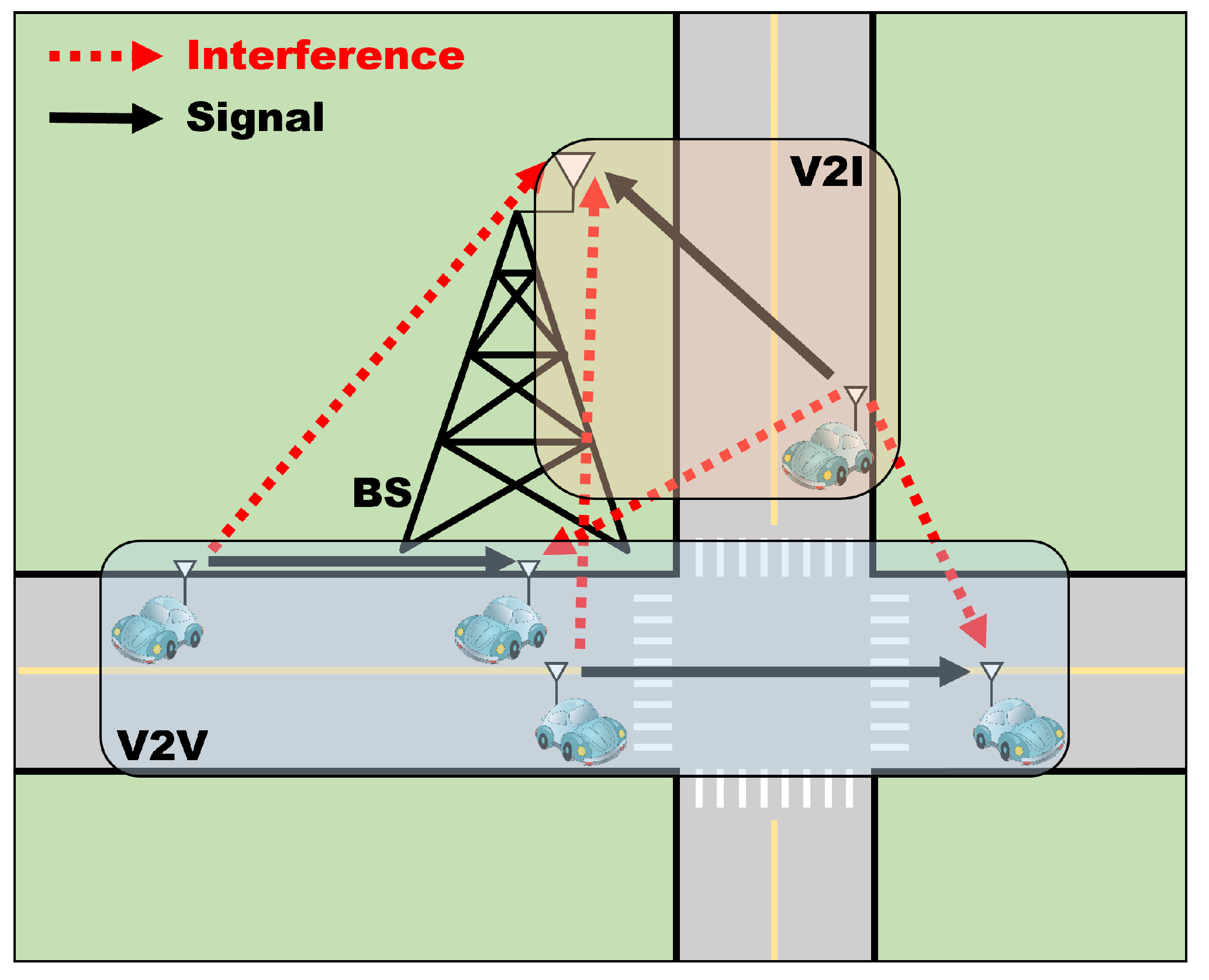
We consider a V2X network consisting of a V2I network and a V2V network as shown in Figure 1. We focus on the uplink in the V2I network, where there are L V2I links denoted by . In the V2V network, there are K V2V links denoted by . In the V2I network, the spectrum is orthogonally allocated to the vehicles, where the number of orthogonal RBs is . However, the V2V links share the resources, , of the V2I network.
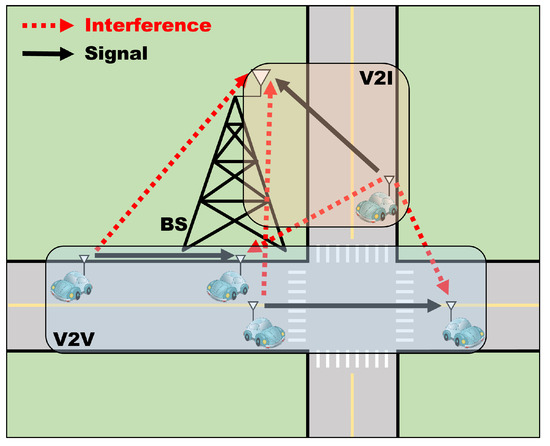
Figure 1.
A system model.
In the V2I network, the received SINR and capacity of the lth V2I link are represented as follows:
where is the transmit power of the vehicle and is the channel power gain in the lth V2I link. Additionally, is the transmit power of the kth V2V link, is the channel power gain from the transmitter of the k V2V link to the base station, is the noise power, and W is the bandwidth. The indicator function, , denotes whether the resource is shared between the kth V2V link and the lth V2I link. That is, if the kth V2V link shares the RB of the lth V2I link, ; otherwise, .
In the V2V network, the received SINR and capacity of the kth V2V link are represented as follows:
where is the transmit power of the vehicle and is the channel power gain in the kth V2V link. Additionally, is the interference from the V2I link sharing the RB of the kth V2V link, is the interference from the V2V link sharing the RB of the kth V2V link, and is the channel power gain from the transmitter of the lth V2I link to the receiver of the kth V2V link. The indicator function, , denotes whether the resource is shared between the jth V2V link and the lth V2I link. That is, if the jth V2V link shares the RB of the lth V2I link, ; otherwise, .
In order for the BS to know the channel state of the V2V links, each receiver of the V2V link reports its CSI to the BS, which results in a large signaling overhead. Hence, we assume that the BS does not know the CSI of the V2V links. The BS independently controls the resource allocation of the V2I links without considering the channel state of the V2V links. Consequently, vehicles on the V2V link individually select the RB and determine the transmit power based on the locally observed channel information. Here, the locally observed channel information in the V2V link consists of the following: the CSI of the V2I link, the interference power observed in the previous time slot, the instantaneous CSI of the V2V link, and the information on the RB selected by nearby vehicles.
Our objective is to maximize the sum rate of the V2I links while increasing the probability of meeting the latency constraint of the V2V links by controlling the selection of RB and the transmit power of each V2V link. However, finding the optimal allocations of the RB and transmit power is an NP-hard problem. Hence, we propose a DQN-based approach to solve the resource allocation problem.
4. Deep Q-Network for Energy-Efficient Resource Allocation
4.1. Reinforcement Learning
In RL, an agent observes a state in an environment that satisfies the Markov decision process (MDP). Then, the optimal action is selected according to the given policy. Depending on the selected action, the agent interacts with the environment, receives a reward from the environment, and transitions to the next state.
The goal of RL is to maximize the expected return value after the episode ends. The return formula is given as follows:
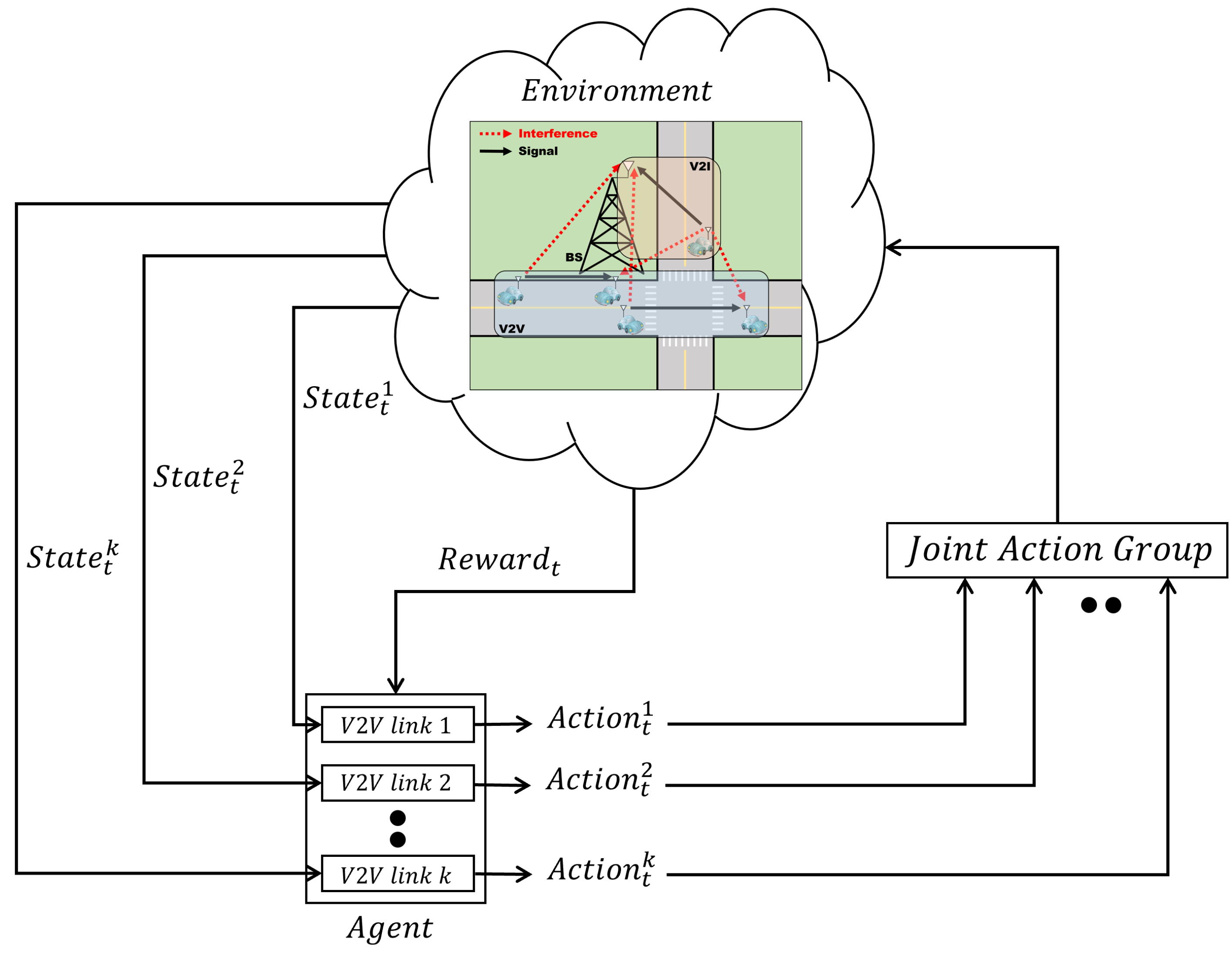
where denotes the reward obtained immediately at time t, T is the time step, and denotes the discount factor. The structure of our RL is shown in Figure 2. The agent observes the state of the environment at the time (t) and selects the best action according to the given policy. When the agent selects an action for all V2V links, the actions are stored in the joint action group and interact with the environment at the same time, and the agent receives a reward. In our system model, we develop the RL with the following parameters:
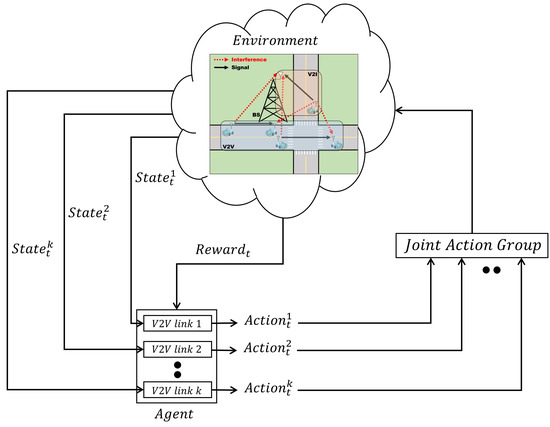
Figure 2.
The structure of the RL for the vehicular network.
- 1.
- State space: We use the following state, similar to the unicast scenario of [11].where is the CSI of V2I links at time t; is the interference power to the link at time ; is the instantaneous CSI of the corresponding V2V link at time t; is the information of RBs selected by surrounding vehicles at time ; is the time remaining to satisfy the latency constraints at time t; and is the remaining data to be received from the transmitter of the V2V link at time t. , , , and are vectors containing the state information of the corresponding RBs, and and are scalar values that are the time remaining to satisfy the latency constraints and the remaining data, respectively. Therefore, the dimension of the state space is given by .
- 2.
- Action space: The action determines the transmit power and the allocation of RBs. Hence, the dimensions of the action space are given by , where is the number of transmit power levels in the V2V link and is the number of RBs.
- 3.
- Reward: We formulate the following reward function taking two penalties into account, the transmission time and the power consumption:where is the maximum tolerable latency, and therefore, means the transmission time. Moreover, is the maximum transmit power in the V2V link. and represent the weight for the sum rate of the V2I links and the sum rate of the V2V links, respectively. and represent the weight of the penalty according to an increase in the transmission time and the penalty according to an increase in the transmit power, respectively. As the sum rate of the V2I or V2V links increases, a positive factor is added. However, as the transmission time or power consumption increases, a negative factor is added.
4.2. Deep Q-Network
A frequently used framework in the RL is a DQN [35,36,37,38]. The DQN framework is a structure that includes a Q-network consisting of a deep neural network (DNN) in the Q-learning structure. In order to train the Q-network in the DQN framework, several learning methods need to be applied [39].
In Q-learning, the Q-value means the expected return when reaching the terminal state from the state observed in time t, as follows:
The Q-value is updated as follows:
where denotes the learning rate. The agent’s behavior is determined based on the -greedy policy. The -greedy policy is a method of randomly selecting an action if the randomly sampled value is lower than the value of and selecting the action with the highest Q-value is greedy if it is high. However, because Q-learning uses a lookup table called a Q-table that stores Q-values in order to find the state and action pairs, it has several disadvantages: First, the probability of visiting the same state is very low. Second, a very large storage device is required to store an exponentially increasing number of state and action pairs. A DQN framework has been developed to overcome these disadvantages.
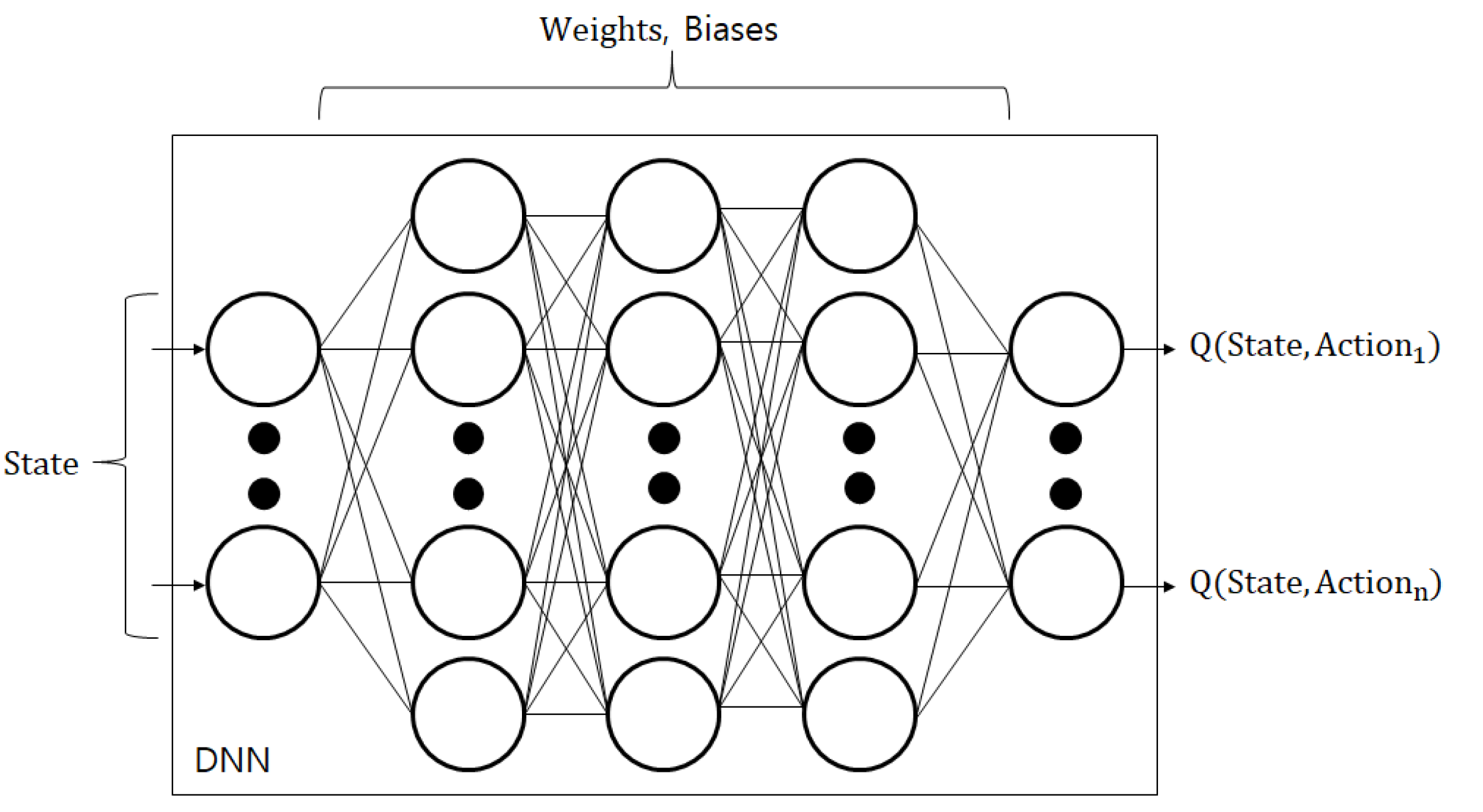
As shown in Figure 3, the DQN framework calculates Q-values using a Q-network in which weights and biases are stored. Therefore, when an agent needs a Q-value that matches a state, the agent puts the state as input to the Q-network and obtains the appropriate Q-value as output. The loss function for training the Q-network is as follows:
where and mean the weights and biases in the Q-network, respectively. means the Q-value. E is a mini-batch sampled from the experience replay memory that stores the state, action, and reward of the next-state tuples collected while the agent interacts with the environment. However, in order for the Q-network to perform an approximation function in the DQN framework, a training process that adjusts the weights and biases stored in the Q-network is required.
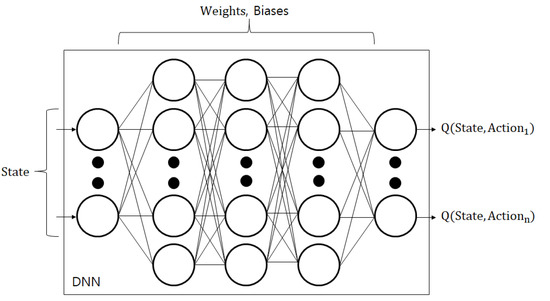
Figure 3.
A Q-network of the DQN framework.
4.3. Training and Testing Algorithm
We train the DQN with the following methods: First, we use a data sampling method with experience replay memory. Data sampling is used to remove the temporal relationships between the used data to learn the Q-network. Here, the experience replay memory is a data storage technique in which the agent collects data while interacting with the environment. The data consist of tuples of the state, action, reward, and next state. The Q-network is trained by randomly sampling data tuples from experience replay memory. In this paper, the experience replay memory is denoted by . Second, we use a fixed target network method that includes two Q-networks, the target network and the online network, in the training process. of (13) is calculated as the target network, and of (12) is calculated as the online network. Additionally, the weights of the online network are periodically copied to those of the target network.
The training process is described in Algorithm 1. Parameters of the online and target networks are initialized (lines 1–3) . The agent observes the state in the environment and selects the action according to the -greedy policy (lines 10–11) . That is, the agent performs a random selection with the probability of , inputs the current state to the online network with the probability of , and selects the largest value among the observed Q-values as output. The selected action is saved in the joint action group (line 12) . If the agent selects the actions for all V2V links, the joint action group interacts with the environment and acquires a reward (line 14) . The data tuples collected through the above process are stored in the experience replay memory (lines 15–16) . The sampled data tuples are used to update the online network. When the online network repeatedly updates the weights and biases, the weights and biases of the online network are copied to those of the target network (lines 17–25) .
The testing process is described in Algorithm 2. Unlike the training process, the testing process greedily selects an action based on the Q-network learned by the training process (lines 8–9) . After that, the action is stored in the joint action group in the same way as the training process (line 10) . If the agent selects the action for all V2V links, the joint action group interacts with the environment (line 12) . When the time step t reaches the simulation end time, the performances are evaluated in terms of the sum rate of the V2I and V2V links, the outage probability of V2V links, and the average power consumption of V2V links (lines 14–17) .
| Algorithm 1: Training algorithm |
|
| Algorithm 2: Testing algorithm |
|
5. Simulation Results
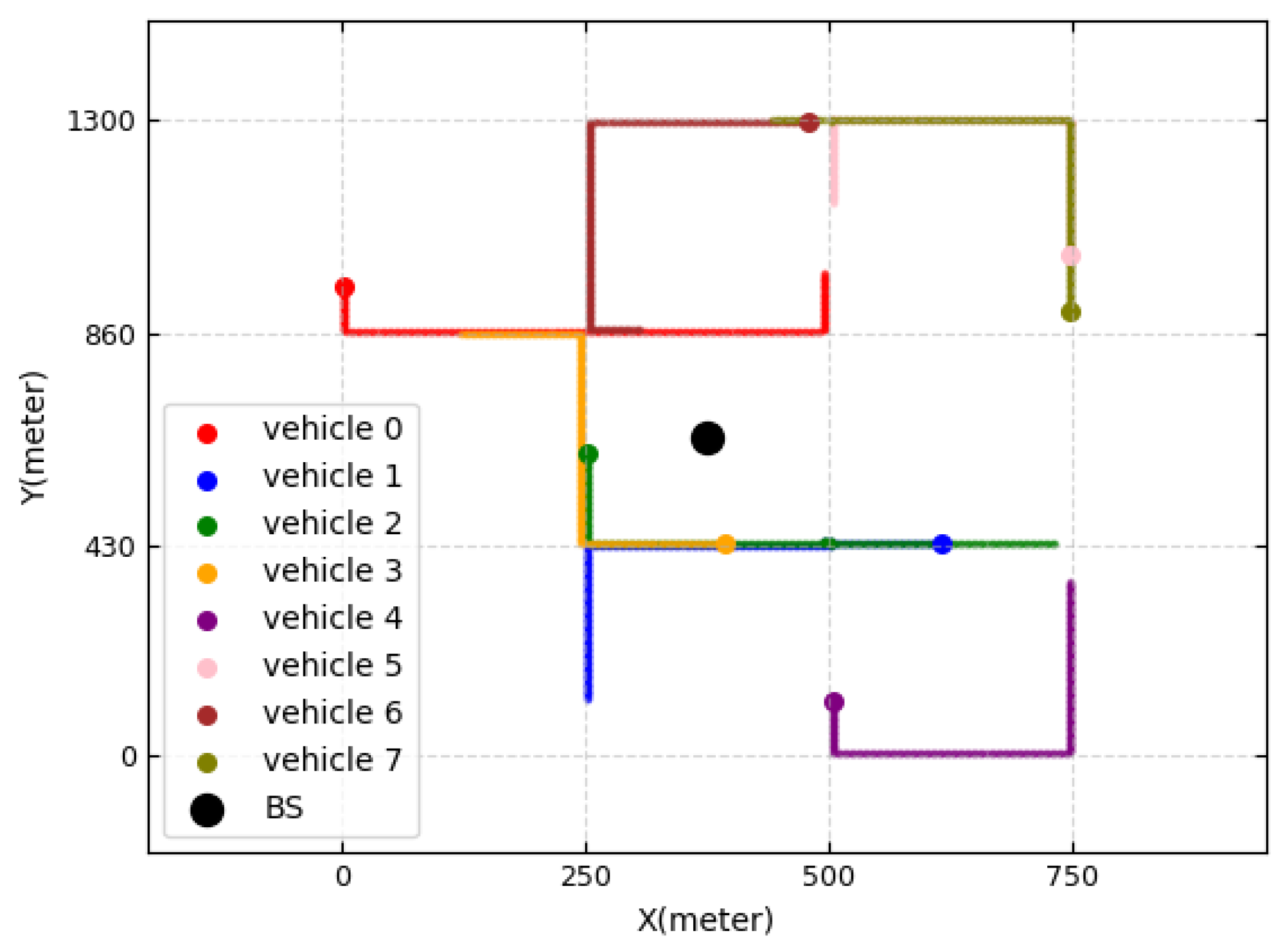
We consider a single-cell system with one base station and 20 V2I links. We follow the simulation setup for the urban case study of Manhattan with 9 blocks of 3GPP TR 36.885 [11,40]. The models of vehicle drops, mobility, and channels all follow the evaluation scenario of 3GPP TR 36.885. Vehicles are dropped on the road according to a spatial Poisson process, and the vehicle locations are updated every one time slot in the simulation. A vehicle moves at a constant speed defined in Table 1. The vehicle changes its direction at the intersection to go straight with a probability of 0.5, to turn left with a probability of 0.25, and to turn right with a probability of 0.25. Figure 4 shows the movement of vehicles for 20 s, where there are eight vehicles and one BS. The V2V channel model and V2I channel model are both described in Table 1, according to 3GPP TR 36.885. Each vehicle communicates with a vehicle nearby. We perform a time-driven simulation, where the simulation clock is advanced in increments of time slot units and the state variables are updated for every time slot. For each slot in the simulation, we calculate the CSI of the V2I and V2V links and the interference power, which results in the state of the DQN. The simulation parameters are summarized in Table 1.

Table 1.
Simulation parameters.
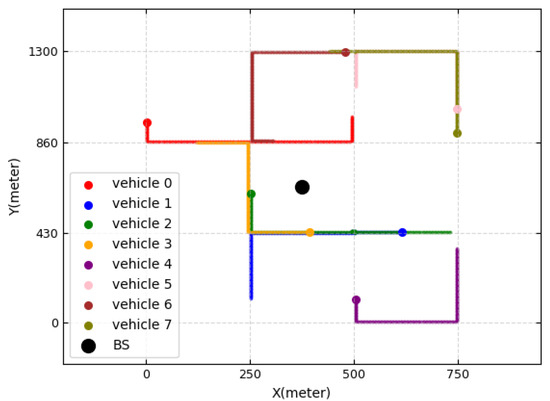
Figure 4.
Vehicle movements.
In the proposed Q-network, the number of neurons in the input layer is set to 82, the number of neurons in the hidden layers is set to [500, 250 120], and the number of neurons in the output layer is set to 60. The activation function of the hidden layers uses the ReLU function. The optimizer for training the Q-network uses RMSProp. The detailed parameters of the DQN framework are summarized in Table 2. The DQN is trained for 20,000 episodes, where an episode means 1 simulation time and new vehicles are dropped each time an episode starts. After training the DQN, the simulation is run 1000 times, and the 1000 results are averaged.
Table 2.
DQN framework parameters.
The proposed resource allocation is compared with the random resource allocation and the conventional RL-based resource allocation of [11] in terms of the average transmit power of the V2V links, the average outage probability of the V2V links, and the average sum rates of the V2V and V2I networks. In the random resource allocation, the transmitter of the V2V link transmits data with randomly selected transmit power through a randomly selected RB.
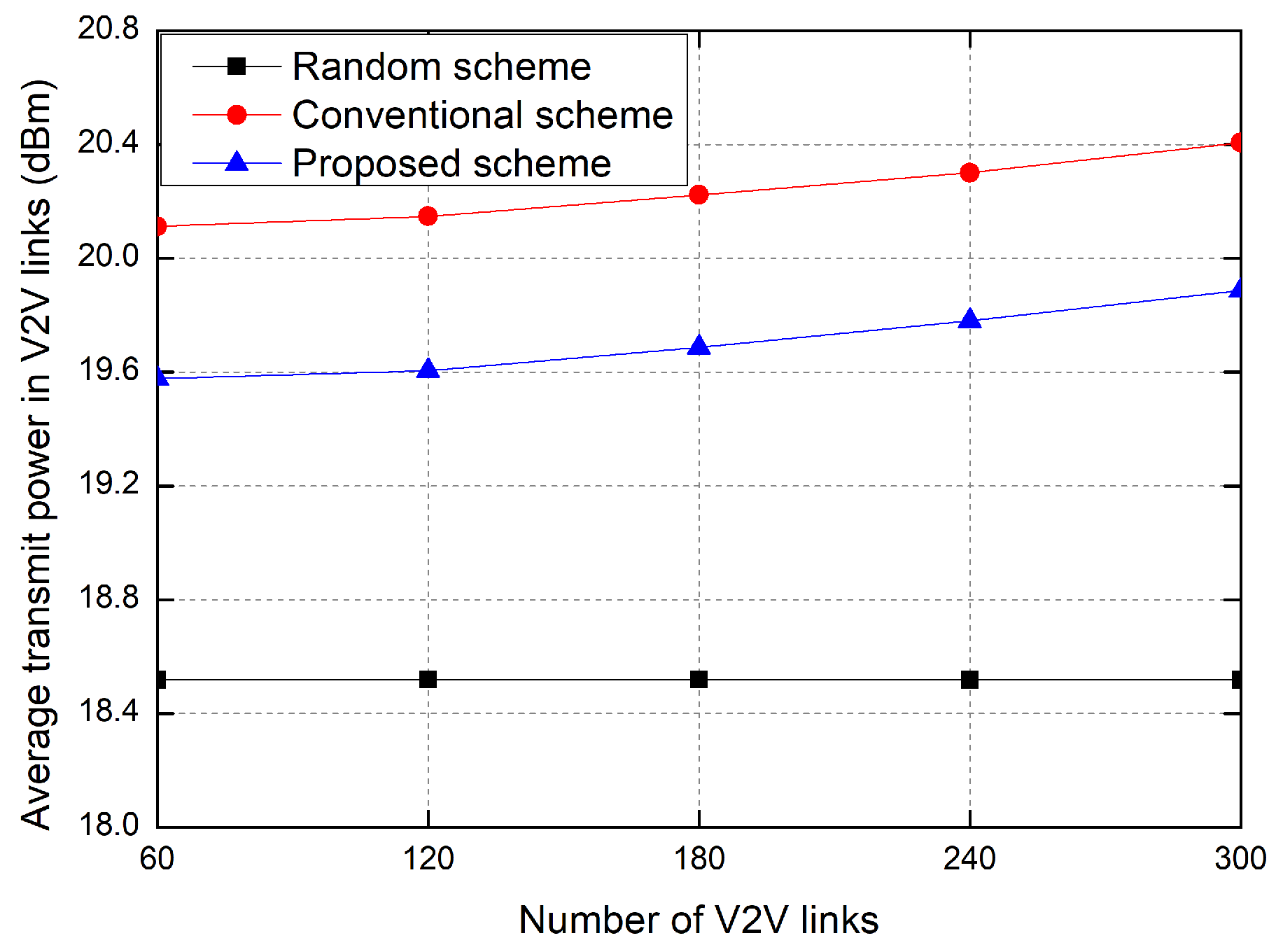
Figure 5 shows the average transmit power of V2V links according to the number of V2V links. As the number of V2V links increases, the average transmit power of vehicles increases in the proposed scheme and the conventional RL-based scheme, but the average transmit power in the random allocation scheme is fixed. Because the interference increases according to the increase in the number of V2V links, the transmit power of vehicles increases in order to overcome the interference, in the proposed scheme and the conventional RL-based scheme. The proposed scheme significantly reduces the power consumption of V2V links in comparison with the conventional RL-based scheme because of the penalty function of the transmit power in the reward. In the random allocation scheme, because the transmitter randomly selects the transmit power, the transmit power of the V2V link is fixed on average, regardless of the amount of interference caused by other V2V links. In the simulation environment of this paper, the random allocation scheme shows a low power consumption due to the low transmit power but shows an outage probability that is too high.
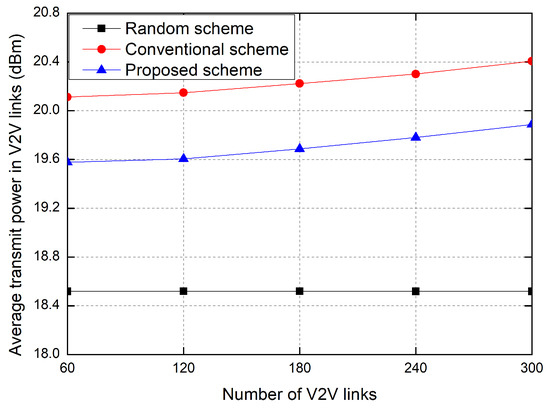
Figure 5.
Average transmit power of V2V links.
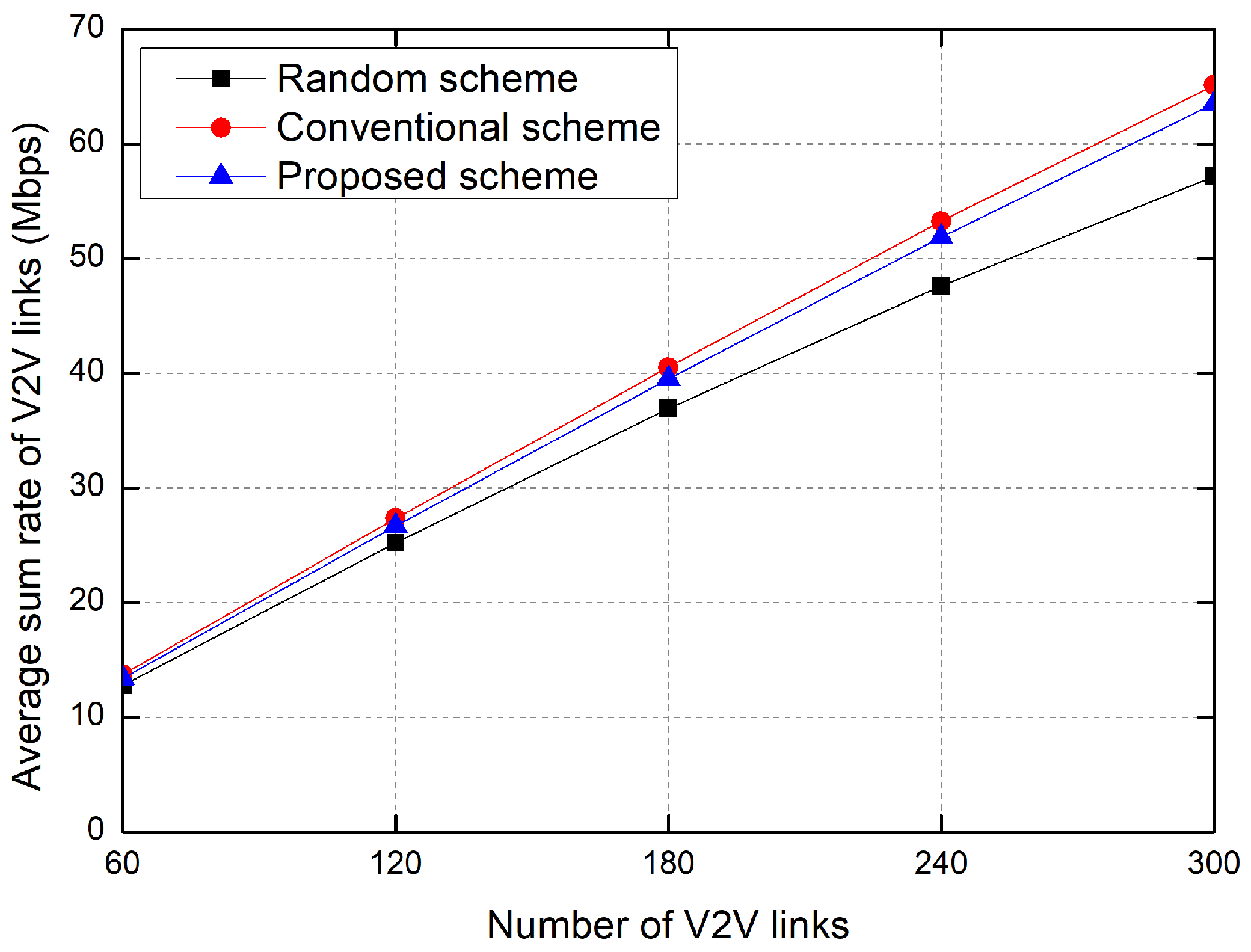
Figure 6 shows the sum rate of V2V links as the number of V2V links increases. As the number of V2V links increases, the sum rate of V2V links increases in all the resource allocation schemes. The sum rate of the conventional RL-based scheme is slightly higher than that of the proposed scheme because the proposed scheme suppresses the transmit power of vehicles for the purpose of energy efficiency. The sum rate of the random allocation scheme is the worst because it randomly selects the RBs regardless of the interference to others.
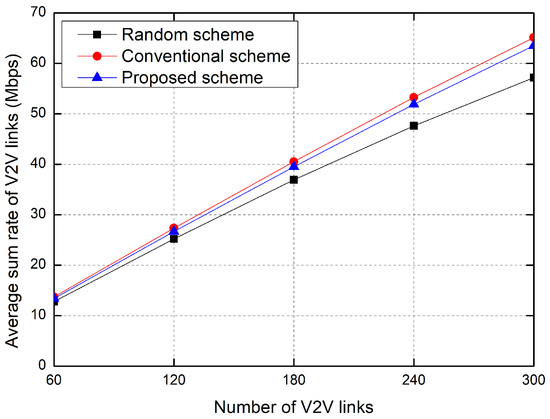
Figure 6.
Average sum rate of V2V links.
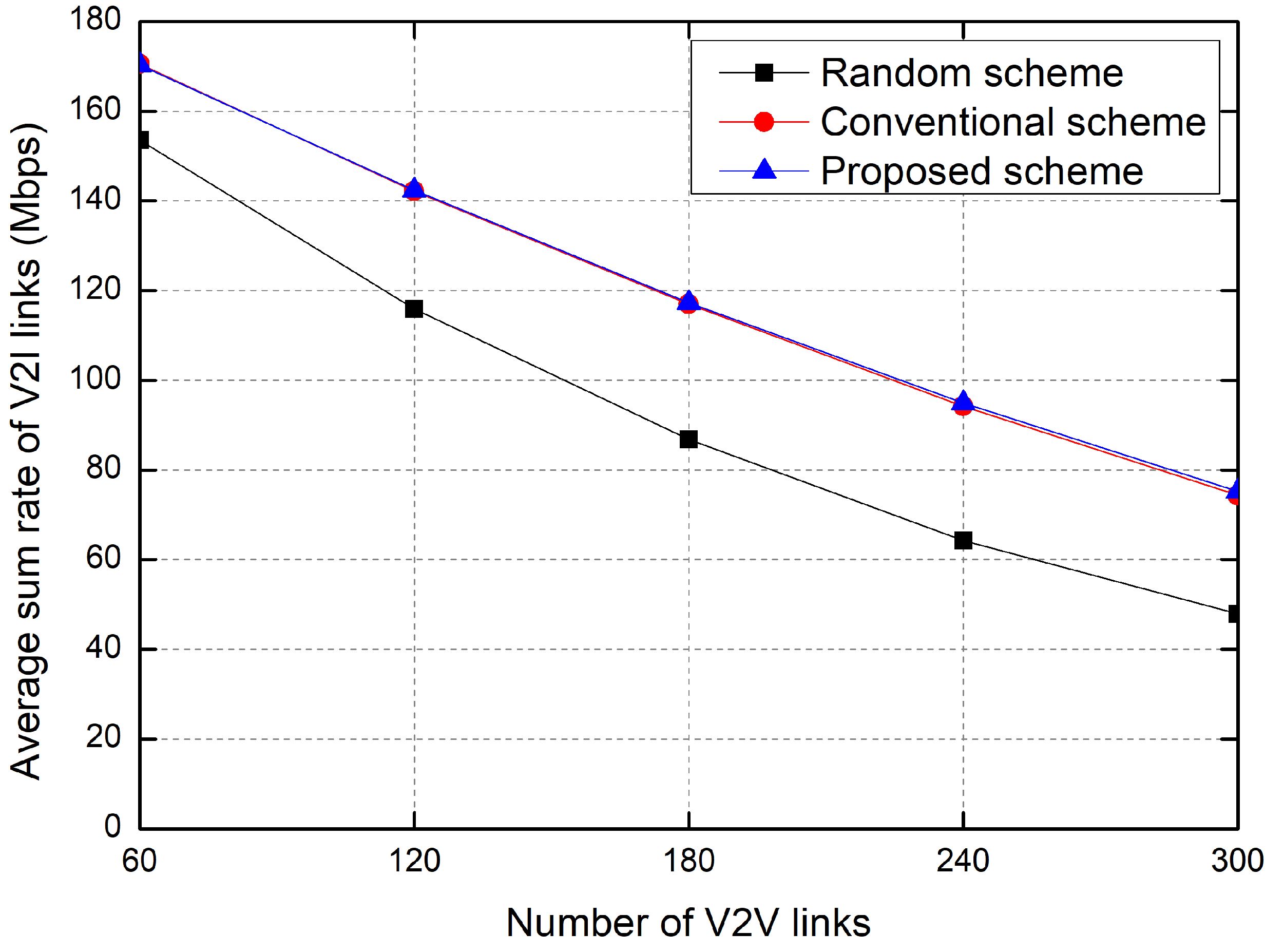
Figure 7 shows the sum rate of V2I links as the number of V2V links increases. Because the number of V2I links is fixed at 20, the interference from the V2V links increases according to the number of V2V links, and thus the sum rate of V2I links decreases with the increase in the V2V links. In particular, the performance of the proposed scheme is slightly better than that of the conventional RL-based scheme. Moreover, because the interference from the V2V links to the V2I link increases according to the number of V2V links, the sum rate of the random allocation greatly decreases with the number of V2V links.
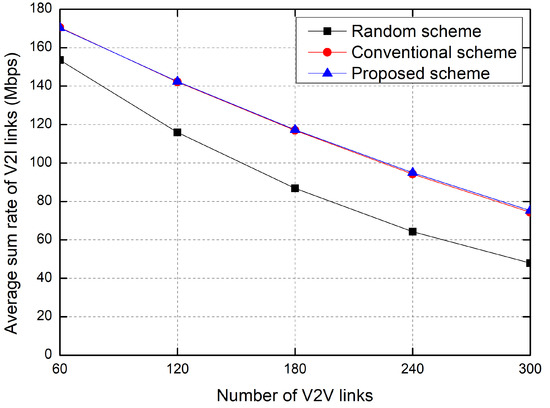
Figure 7.
Average sum rate of V2I links.
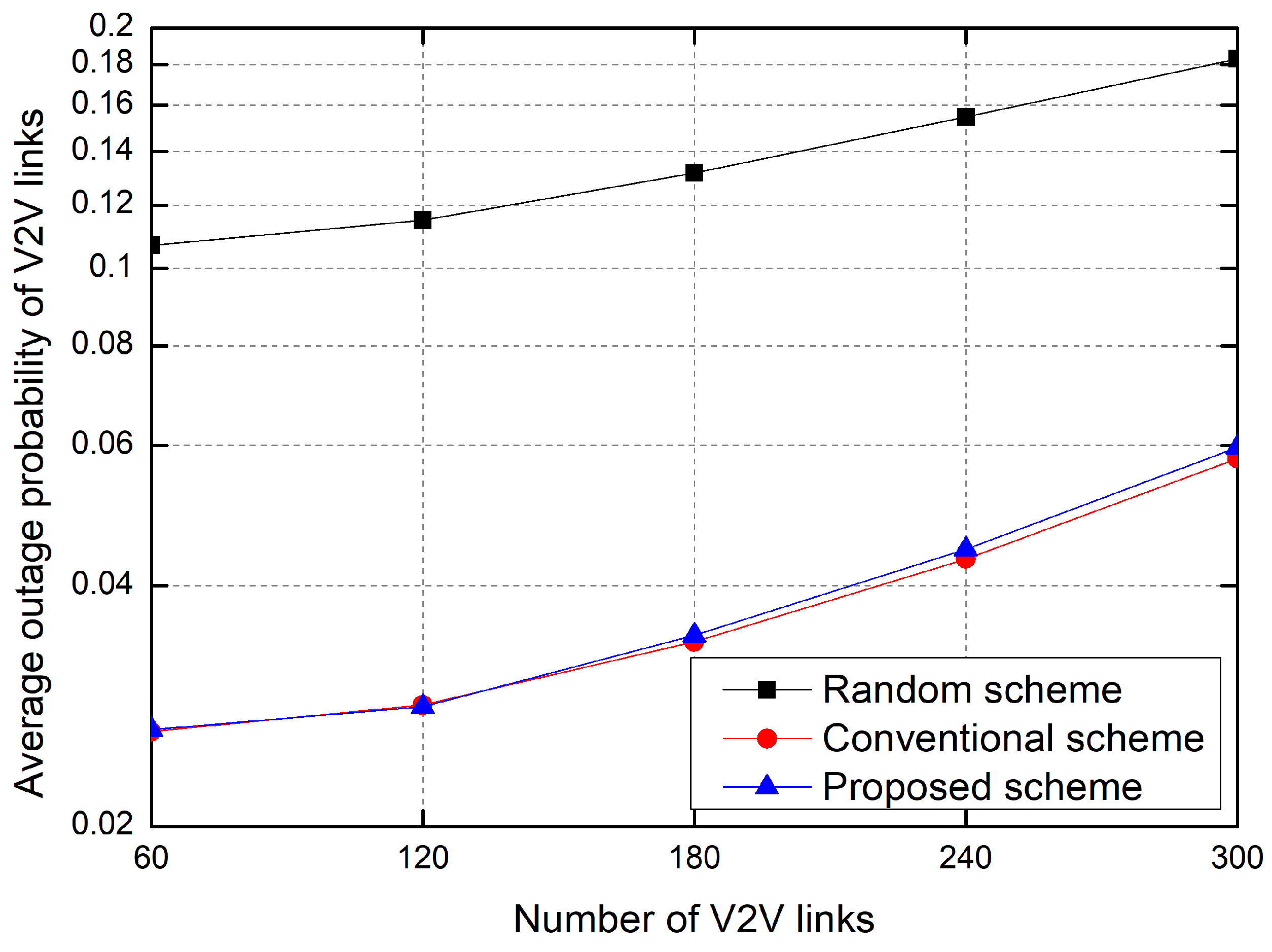
Figure 8 shows the outage probability as the number of V2V links increases. Here, the outage probability is defined as the probability that a transmitter on the V2V link fails to transmit data within the maximum allowable latency, . The outage probability is inversely proportional to the sum rate. Hence, the outage probability increases according to the number of V2V links. Moreover, the outage probability of the random allocation scheme is much higher than that of other schemes. That is, in order to efficiently allocate resources, RL-based resource allocation is required.
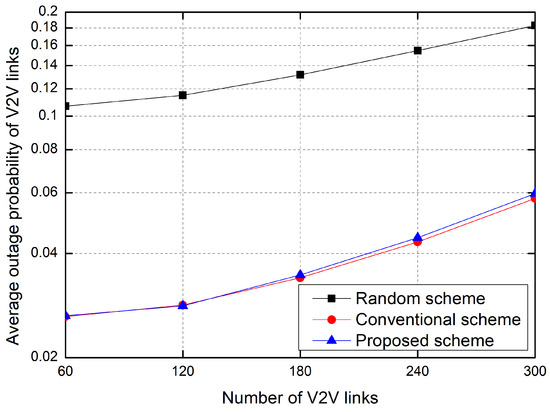
Figure 8.
Average outage probability of V2V links.
The major concerns with deep-learning-based approaches are the computational complexity and the memory space, which depend on the number of parameters to be stored and to be computed. In the proposed RL, from (8), the dimension of the state space is (=82 in our simulation) and the dimension of the action space is (=60 in our simulation), where is the number of RBs and is the number of the transmit power levels. Consider a feed-forward network with l layers, where layer 0 is the input layer and layer is the output layer. Let the number of neurons of each layer be . Then, the number of parameters (weights) of the network, including biases, is given by (=204,130 in our simulation). Because the DQN framework calculates Q-values using a DNN, the total number of parameters becomes . Moreover, because of the use of two Q-networks, the online network and the target network, the total number of parameters to be processed doubles, and the replay memory is required to store a collection of experience tuples, i.e., the parameters of the online network. In our simulation, we set the replay buffer size to 100 tuples. The computational complexity is similar to [11]. In our implementation, each selection takes less than s using GPU 2080 Ti. The computational speed is acceptable for vehicles thanks to the power of the GPU. The computational complexity of the DNN can be reduced by using lightweight DNNs [42,43].
6. Conclusions
Vehicular communications or V2X are key to the development of autonomous vehicles. In the V2X network, it is important to manage radio resources efficiently to provide low-latency and energy-efficient services. In this paper, we developed a DQN-based energy-efficient resource allocation scheme in a V2X communication network in which V2I and V2V networks share resource blocks. We formulated the reward of the DQN model by using two penalties and two positives. Here, the two penalties are the transmission time and the transmit power, and the two positives are the sum rate of the V2I and V2V networks. The proposed scheme significantly reduces the power consumption of vehicles in the V2V network without sacrificing the sum rate and outage probability. The results show that an energy-efficient resource allocation scheme is crucial in order to meet the latency and power consumption requirements of mission critical V2V applications.
Author Contributions
Conceptualization, D.H. and J.S.; software, D.H.; validation, D.H. and J.S.; investigation, D.H. and J.S.; writing—original draft preparation, D.H. and J.S.; writing—review and editing, J.S.; supervision, J.S.; project administration, J.S.; funding acquisition, J.S. All authors have read and agreed to the published version of the manuscript.
Funding
This research was supported by the National Research Foundation of Korea (NRF) grant funded by the Korea government (MSIT) (nos. 2020R1F1A1065109 and 2022R1F1A1062696).
Conflicts of Interest
The authors declare no conflict of interest.
References
- Garcia, M.H.C.; Molina-Galan, A.; Boban, M.; Gozalvez, J.; Coll-Perales, B.; Şahin, T.; Kousaridas, A. A tutorial on 5G NR V2X communications. IEEE Commun. Surv. Tutor. 2021, 23, 1972–2026. [Google Scholar] [CrossRef]
- Molina-Masegosa, R.; Gozalvez, J. LTE-V for sidelink 5G V2X vehicular communications: A new 5G technology for short-range vehicle-to-everything communications. IEEE Veh. Technol. Mag. 2017, 12, 30–39. [Google Scholar] [CrossRef]
- Lien, S.Y.; Deng, D.J.; Lin, C.C.; Tsai, H.L.; Chen, T.; Guo, C.; Cheng, S.M. 3GPP NR sidelink transmissions toward 5G V2X. IEEE Access 2020, 8, 35368–35382. [Google Scholar] [CrossRef]
- Nam, Y.; So, J. One-bit signaling-based interference management for MIMO V2V sidelink. ICT Express 2022, 8, 595–599. [Google Scholar] [CrossRef]
- Hong, C.; Shan, H.; Song, M.; Zhuang, W.; Xiang, Z.; Wu, Y.; Yu, X. A joint design of platoon communication and control based on LTE-V2V. IEEE Trans. Veh. Technol. 2020, 69, 15893–15907. [Google Scholar] [CrossRef]
- Liang, L.; Ye, H.; Yu, G.; Li, G.Y. Deep-learning-based wireless resource allocation with application to vehicular networks. Proc. IEEE 2020, 108, 341–356. [Google Scholar] [CrossRef]
- He, Z.; Wang, L.; Ye, H.; Li, G.Y.; Juang, B.H.F. Resource allocation based on graph neural networks in vehicular communications. In Proceedings of the 2020 IEEE Global Communications Conference (GLOBECOM), Taipei, Taiwan, 7–11 December 2020; pp. 1–5. [Google Scholar]
- Xu, L.; Zhuang, W. Energy-efficient cross-layer resource allocation for heterogeneous wireless access. IEEE Tran. Wirel. Commun. 2018, 17, 4819–4829. [Google Scholar] [CrossRef]
- Ismail, M.; Gamage, A.T.; Zhuang, W.; Shen, X.; Serpedin, E.; Qaraqe, K. Uplink decentralized joint bandwidth and power allocation for energy-efficient operation in a heterogeneous wireless medium. IEEE Trans. Commun. 2015, 63, 1483–1495. [Google Scholar] [CrossRef]
- Zhu, X.; Yang, B.; Chen, C.; Xue, L.; Guan, X.; Wu, F. Cross-layer scheduling for OFDMA-based cognitive radio systems with delay and security constraints. IEEE Trans. Veh. Technol. 2015, 64, 5919–5934. [Google Scholar] [CrossRef]
- Ye, H.; Li, G.Y.; Juang, B.H.F. Deep reinforcement learning based resource allocation for V2V communications. IEEE Trans. Veh. Technol. 2019, 68, 3163–3173. [Google Scholar] [CrossRef]
- Bhadauria, S.; Shabbir, Z.; Roth-Mandutz, E.; Fischer, G. QoS based deep reinforcement learning for V2X resource allocation. In Proceedings of the 2020 IEEE International Black Sea Conference on Communications and Networking (BlackSeaCom), Odessa, Ukraine, 26–29 May 2020; pp. 1–6. [Google Scholar]
- Xiao, H.; Zhu, D.; Chronopoulos, A.T. Power allocation With energy efficiency optimization in cellular D2D-based V2X communication network. IEEE Trans. Intell. Transp. Syst. 2019, 21, 4947–4957. [Google Scholar] [CrossRef]
- Liang, L.; Ye, H.; Li, G.Y. Spectrum sharing in vehicular networks based on multi-agent reinforcement learning. IEEE J. Sel. Areas Commun. 2019, 37, 2282–2292. [Google Scholar] [CrossRef]
- Xiang, P.; Shan, H.; Wang, M.; Xiang, Z.; Zhu, Z. Multi-agent RL enables decentralized spectrum access in vehicular networks. IEEE Trans. Veh. Technol. 2021, 70, 10750–10762. [Google Scholar] [CrossRef]
- Soleymani, D.M.; Ravichandran, L.; Gholami, M.R.; Del Galdo, G.; Harounabadi, M. Energy-efficient autonomous resource selection for power-saving users in NR V2X. In Proceedings of the 2021 IEEE 32nd Annual International Symposium on Personal, Indoor and Mobile Radio Communications (PIMRC), Helsinki, Finland, 13–16 September 2021; pp. 972–978. [Google Scholar]
- Gao, L.; Hou, Y.; Tao, X.; Zhu, M. Energy-efficient power control and resource allocation for V2V communication. In Proceedings of the 2020 IEEE Wireless Communications and Networking Conference (WCNC), Seoul, Republic of Korea, 25–28 May 2020; pp. 1–6. [Google Scholar]
- Lorincz, J.; Matijevic, T.; Petrovic, G. On interdependence among transmit and consumed power of macro base station technologies. Comput. Commun. 2014, 50, 10–28. [Google Scholar] [CrossRef]
- Lorincz, J.; Capone, A.; Begušić, D. Heuristic algorithms for optimization of energy consumption in wireless access networks. KSII Trans. Internet Inf. Syst. 2011, 5, 626–648. [Google Scholar] [CrossRef]
- Lorincz, J.; Bogarelli, M.; Capone, A.; Begušić, D. Heuristic approach for optimized energy savings in wireless Access Networks. In Proceedings of the 18thInternational Conference on Software, Telecommunications and Computer Networks, Dalmatia, Croatia, 23–25 September 2010; pp. 1–6. [Google Scholar]
- Jiang, W. Graph-based deep learning for communication networks: A survey. Comput. Commun. 2022, 185, 40–54. [Google Scholar] [CrossRef]
- Ivanov, A.; Tonchev, K.; Poulkov, V.; Manolova, A.; Neshov, N.N. Graph-based resource allocation for integrated space and terrestrial communications. Sensors 2022, 22, 5778. [Google Scholar] [CrossRef]
- Zhang, X.; Zhang, Z.; Yang, L. Learning-based resource allocation in heterogeneous ultradense network. IEEE Internet Things J. 2022, 9, 20229–20242. [Google Scholar] [CrossRef]
- Zhao, D.; Qin, H.; Song, B.; Han, B.; Du, X.; Guizani, M. A graph convolutional network-based deep reinforcement learning approach for resource allocation in a cognitive radio network. Sensors 2020, 20, 5216. [Google Scholar] [CrossRef]
- Alatabani, L.E.; Ali, E.S.; Mokhtar, R.A.; Saeed, R.A.; Alhumyani, H.; Hasan, M.K. Deep and reinforcement learning technologies on internet of vehicle (IoV) applications: Current issues and future trends. J. Adv. Transp. 2022, 2022, 1947886. [Google Scholar] [CrossRef]
- Alatabani, L.E.; Ali, E.S.; Saeed, R.A. Deep learning approaches for IoV applications and services. In Intelligent Technologies for Internet of Vehicles; Springer: Berlin/Heidelberg, Germany, 2021; pp. 253–291. [Google Scholar]
- Ali, E.S.; Hassan, M.B.; Saeed, R.A. Machine learning technologies on internet of vehicles. In Intelligent Technologies for Internet of Vehicles; Springer: Berlin/Heidelberg, Germany, 2021; pp. 225–252. [Google Scholar]
- Elfatih, N.M.; Hasan, M.K.; Kamal, Z.; Gupta, D.; Saeed, R.A.; Ali, E.S.; Hosain, M.S. Internet of vehicle’s resource management in 5G networks using AI technologies: Current status and trends. IET Commun. 2021, 16, 400–420. [Google Scholar] [CrossRef]
- Ali, E.S.; Hasan, M.K.; Hassan, R.; Saeed, R.A.; Hassan, M.B.; Islam, S.; Nafi, N.S.; Bevinakoppa, S. Machine learning technologies for secure vehicular communication in internet of vehicles: Recent advances and applications. Secur. Commun. Netw. 2021, 2021, 8868355. [Google Scholar] [CrossRef]
- He, Y.; Zhao, N.; Yin, H. Integrated networking, caching, and computing for connected vehicles: A deep reinforcement learning approach. IEEE Trans. Veh. Technol. 2018, 67, 44–55. [Google Scholar] [CrossRef]
- Tang, C.; Zhu, C.; Wu, H.; Li, Q.; Rodrigues, J.J.P.C. Toward response time minimization considering energy consumption in caching-assisted vehicular edge computing. IEEE Internet Things J. 2022, 9, 5051–5064. [Google Scholar] [CrossRef]
- Yao, Y.; Xiao, B.; Wang, W.; Yang, G.; Zhou, X.; Peng, Z. Real-time cache-aided route planning based on mobile edge computing. IEEE Wirel. Commun. 2020, 27, 151–161. [Google Scholar] [CrossRef]
- Tang, C.; Wu, H. Joint optimization of task caching and computation offloading in vehicular edge computing. Peer-to-Peer Netw. Appl. 2022, 15, 854–869. [Google Scholar] [CrossRef]
- Bai, R.; Chen, X.; Chen, Z.L.; Cui, T.; Gong, S.; He, W.; Jiang, X.; Jin, H.; Jin, J.; Kendall, G.; et al. Analytics and machine learning in vehicle routing research. Int. J. Prod. Res. 2023, 61, 4–30. [Google Scholar] [CrossRef]
- Zhao, Y.; Niemegeers, I.G.; De Groot, S.M.H. Dynamic power allocation for cell-free massive MIMO: Deep reinforcement learning methods. IEEE Access 2021, 9, 102953–102965. [Google Scholar] [CrossRef]
- Zhang, X.; Peng, M.; Yan, S.; Sun, Y. Deep-reinforcement-learning-based mode selection and resource allocation for cellular V2X communications. IEEE Internet Things J. 2020, 7, 6380–6391. [Google Scholar] [CrossRef]
- Cao, Y.; Zhang, G.; Li, G.; Zhang, J. A deep Q-network based-resource allocation scheme for massive MIMO-NOMA. IEEE Commun. Lett. 2021, 25, 1544–1548. [Google Scholar] [CrossRef]
- Choi, J.Y.; Jo, H.S.; Mun, C.; Yook, J.G. Deep reinforcement learning-based distributed congestion control in cellular V2X networks. IEEE Wirel. Commun. Lett. 2021, 10, 2582–2586. [Google Scholar] [CrossRef]
- Mnih, V.; Kavukcuoglu, K.; Silver, D.; Rusu, A.A.; Veness, J.; Bellemare, M.G.; Graves, A.; Riedmiller, M.; Fidjeland, A.K.; Ostrovski, G.; et al. Human-level control through deep reinforcement learning. Nature 2015, 518, 529–533. [Google Scholar] [CrossRef] [PubMed]
- Technical Specification Group Radio Access Network; Study LTE-Based V2X Services (Release 14), Document 3GPP TR 36.885 V14.0.0, 3rd Generation Partnership Project, June 2016. Available online: https://www.3gpp.org/ftp/Specs/archive/36_series/36.885/36885-e00.zip (accessed on 1 October 2022).
- Kyösti, P.; Meinilä, J.; Hentila, L.; Zhao, X.; Jämsä, T.; Schneider, C.; Narandzic, M.; Milojević, M.; Hong, A.; Ylitalo, J.; et al. WINNER II Channel Models. 02 2008, iST-4-027756 WINNER II D1.1.2 V1.2. Available online: http://www.ero.dk/93F2FC5C-0C4B-4E44-8931-00A5B05A331B (accessed on 1 October 2022).
- Wang, C.-H.; Huang, K.-Y.; Yao, Y.; Chen, J.-C.; Shuai, H.-H.; Cheng, W.-H. Lightweight deep learning: An overview. IEEE Consum. Electron. Mag. 2022, 1–12. [Google Scholar] [CrossRef]
- Rastegari, M.; Ordonez, V.; Redmon, J.; Farhadi, A. Xnor-net: Imagenet classification using binary convolutional neural networks. In Proceedings of the 2016 European Conference on Computing Vision (ECCV), Amsterdam, The Netherlands, 8–16 October 2016; pp. 525–542. [Google Scholar]
Disclaimer/Publisher’s Note: The statements, opinions and data contained in all publications are solely those of the individual author(s) and contributor(s) and not of MDPI and/or the editor(s). MDPI and/or the editor(s) disclaim responsibility for any injury to people or property resulting from any ideas, methods, instructions or products referred to in the content. |
© 2023 by the authors. Licensee MDPI, Basel, Switzerland. This article is an open access article distributed under the terms and conditions of the Creative Commons Attribution (CC BY) license (https://creativecommons.org/licenses/by/4.0/).