


Abstract
Background and objectives: This paper addresses psychological resilience, a multidisciplinary theoretical construct with important practical implications for health sciences. Although many definitions have been proposed in several contexts, an essential understanding of the concept is still lacking up to now. This negatively affects comparisons among research results and makes objective measurement difficult. The aim of this review is to identify shared elements in defining the construct of resilience across the literature examined in order to move toward a conceptual unification of the term. Materials and methods: A literature review was performed using the electronic databases ‘PubMed’ and ‘PsycINFO’. Scientific studies written in English between 2002 and May 2019 were included according to the following key terms: ‘Psychological’, ‘resilience’, and ‘definition’. Results: The review identifies five macro-categories that summarize what has been reported in the recent literature concerning the resilience phenomenon. They serve as a preliminary and necessary step toward a conceptual clarification of the construct. Conclusions: We propose a definition of psychological resilience as the ability to maintain the persistence of one’s orientation towards existential purposes. It constitutes a transversal attitude that can be understood as the ability to overcome the difficulties experienced in the different areas of one’s life with perseverance, as well as good awareness of oneself and one’s own internal coherence by activating a personal growth project. The conceptual clarification proposed will contribute to improving the accuracy of research on this topic by suggesting future paths of investigation aimed at deeply exploring the issues surrounding the promotion of resilience resources.
1. Introduction
1.1. Resilience: Historical and Cultural Development of the Concept
Over the years, much attention has been directed at the nature of resilience and how to best assess it. An extensive literature highlights the historical and cultural evolution of the concept, which assumed different shades of meaning over time.
The early studies on resilience focused on understanding why only some individuals can react to adversity in a positive way by transforming them into opportunities for growth and new adaptation [1]. Living with a condition of adversity typically encompasses negative life circumstances that are known to be statistically associated with adjustment difficulties [2]. Furthermore, the concept of adversity can be identified as the state of suffering and discomfort aroused by a difficulty, misfortune, or potentially traumatic event [3]. After the Second World War, researchers began to investigate how people overcome traumatic events which can cause psychological distress. Issues concerning the possibility of transforming a destabilizing event into a personal search engine, the ability to integrate lights and shadows, resources and vulnerability, or suffering and courage started to become primary subjects of research aimed at providing a better understanding of the processes of resilience.
In particular, case studies of soldiers with post-traumatic stress disorder, as well as other forms of pathologies which have been diagnosed as results of traumatic events experienced in war, provided descriptions of individual characteristics of war veterans, highlighting at the same time that a significant number of subjects were able to effectively process the traumatic events experienced [4]. Later, research involving the analysis of risk and protective factors for mental health began to focus on the context of developmental psychology with the aim of exploring the different life trajectories of those subjects that had experienced trauma. This has led to the idea that resilience is much more than the ability to continue developing one’s skills despite adversity or to resist trauma by protecting oneself from the influence of external circumstances. It expresses the ability to react positively despite difficulties, turning them into opportunities for growth. Therefore, psychological resilience refers to a dynamic process that takes shape as a change allowing one to find a new balance and to evolve positively [2]. During this process of change, the individual develops new skills and a renewed feeling of personal efficacy and self-enhancement. This circular mechanism helps to implement the resilience process and its whole development. Thus, the change in an allostatic process is something necessary in order to adapt to changes produced by the environment [5].
In their resilience model, Richardson et al. [6,7] attempt to integrate two perspectives by considering them both as genetically determined traits and as processes. According to the authors, we all have an innate propensity for resilience, which can allow us to face difficulties and the breakdown of a pre-existing balance. The paradigm of destabilization of an individual’s life paradigm provides the opportunity for an in-depth self-reflection upon him- or herself and for a redefinition of the self. From the experience of insight and the search for one’s own inner resources comes the identification and reinforcement of the resiliency features. Consequently, the subject will enable strategies aimed at facing the adverse condition and rebuilding their own balance.
This model assumes the circularity of the influence of the self and the environment insofar as resilience is at the same time part of the adaptation process and of its outcome. Rutter, drawing upon studies on children born to schizophrenic mothers and showing that many of them had no abnormal behavior as adults [8], proposed an early definition of resilience as a ‘positive’ response of a subject to stress and adverse conditions. Here, ‘positive’ means the absence of psychopathological consequences (i.e., conduct disorders, affective, etc.). This study was preceded by a longitudinal study by Werner and Smith [9], which lasted 30 years and was conducted on a sample of 698 children born in Kauai (Hawaii). These subjects had been enrolled in the study because they had been exposed to different risk factors (difficult birth, poverty, families with problems with alcoholism, mental illness, aggression, etc.) that could have influenced their development towards the onset of mental illness. The survey allowed the authors to monitor the evolution of the sample’s emotional and relational adaptability over time. Despite the presence of multiple risk factors and the development of severe symptoms of psychopathological maladjustment in many of these children, the study showed that 28% of subjects achieved a good level of adaptation, becoming competent and self-confident adults with a satisfactory level of affective and social functionality. Building on these data, Werner defined resilience as the consolidation of the subject’s skills in adverse situations.
With Werner’s pioneering works, a fundamental change began to take place in research on resilience. It consisted of a shift from the analysis of risk and discomfort factors to the study of protective factors. Specifically, attempts were made to identify what characterizes resilient subjects and what factors enable the activation of positive processes when critical or emotionally painful life conditions are encountered. The results of these first investigations showed the presence of subjects who were defined as ‘resilient’ because they presented satisfactory or positive evolutionary results despite an unfavorable condition [10]. This evidence gave the concept of resilience an important visibility in the development of the salutogenic perspective [11] to the extent that it is used as a wide-ranging construct from a heuristic point of view for understanding normal health processes. In particular, Antonovsky argued that stress is an unavoidable phenomenon. However, a significant percentage of individuals can find their own balance and can grow and maintain a state of well-being despite adversities. For this reason, the author underlined the importance of orienting research towards the elements that allow this development and are at the origin of health (salutogenetic factors).
The debate continued between those who theorize resilience as a stable trait of personality [12,13] and those who define it as a dynamic process that varies in relation to contexts [14,15].
More recently, those who consider resilience in terms of a trait, in line with the ‘ego resiliency’ perspective [16], argue that personality characteristics are the main protective factors against stressors.
The authors who define resilience in terms of process [17,18] consider it a resource on which the success of the transaction between the individual and his context depends. According to this approach, protective and risk factors act simultaneously and dynamically, and the effect is the result of their interaction.
Therefore, being resilient means building and reconstructing one’s life path by restoring a new balance and producing a change in oneself [19].
1.2. The Complexity of the Resilience Phenomenon
The broad and articulated research carried out on resilience has highlighted the versatility of the construct and made the attempt to reach a shared definition of the concept more complex.
Over the years, many definitions of the term ‘resilience’ have been proposed to describe the construct. Although differing in their theoretical references and in the factors highlighted, they share a common vision of resilience as a complex phenomenon and the identification of numerous interacting variables. To date, the literature agrees that there are two necessary and adequate conditions for identifying the dynamics of the resilience process: Exposure to a significant risk and positive evolution in terms of psychosocial well-being despite the threat to which one is subjected [20]. A ‘significant risk’ refers to any element of a situation that is perceived as lacking a reachable solution and that can lead to a dysfunctional adaptation and to a condition of psychological distress [21,22]. In this perspective, resilient individuals would be able to rework their individual existence thanks to a ‘positive evolution’ of their life project despite the surrounding conditions. They develop the ability to integrate suffering and psychic vulnerability with personal, family, relational, and existential resources, managing to expand them according to their own needs. Though there seems to be a common ground in the work of research focusing on the process of psychological resilience, the concept is used in many ways depending in part on the area of application, with several implications from a theoretical and practical point of view. Consequently, these discrepancies hinder a shared definition of the construct and limit comparisons among research results, making objective measurement difficult. Thus, the importance of moving towards a conceptual unification of the term becomes evident.
1.3. Aims
Based on this premise, we engaged in a literature review of definitions of the term ‘psychological resilience’ aimed at identifying shared elements in defining the construct across the works examined. Findings were used for proposing a broad definition of psychological resilience that considers the various theoretical and multidisciplinary backgrounds associated with it and the different areas of application. This conceptual unification could be a useful starting point for future research focused on identifying effective training strategies to promote and support resilience resources and thus the personal well-being.
2. Materials and Methods
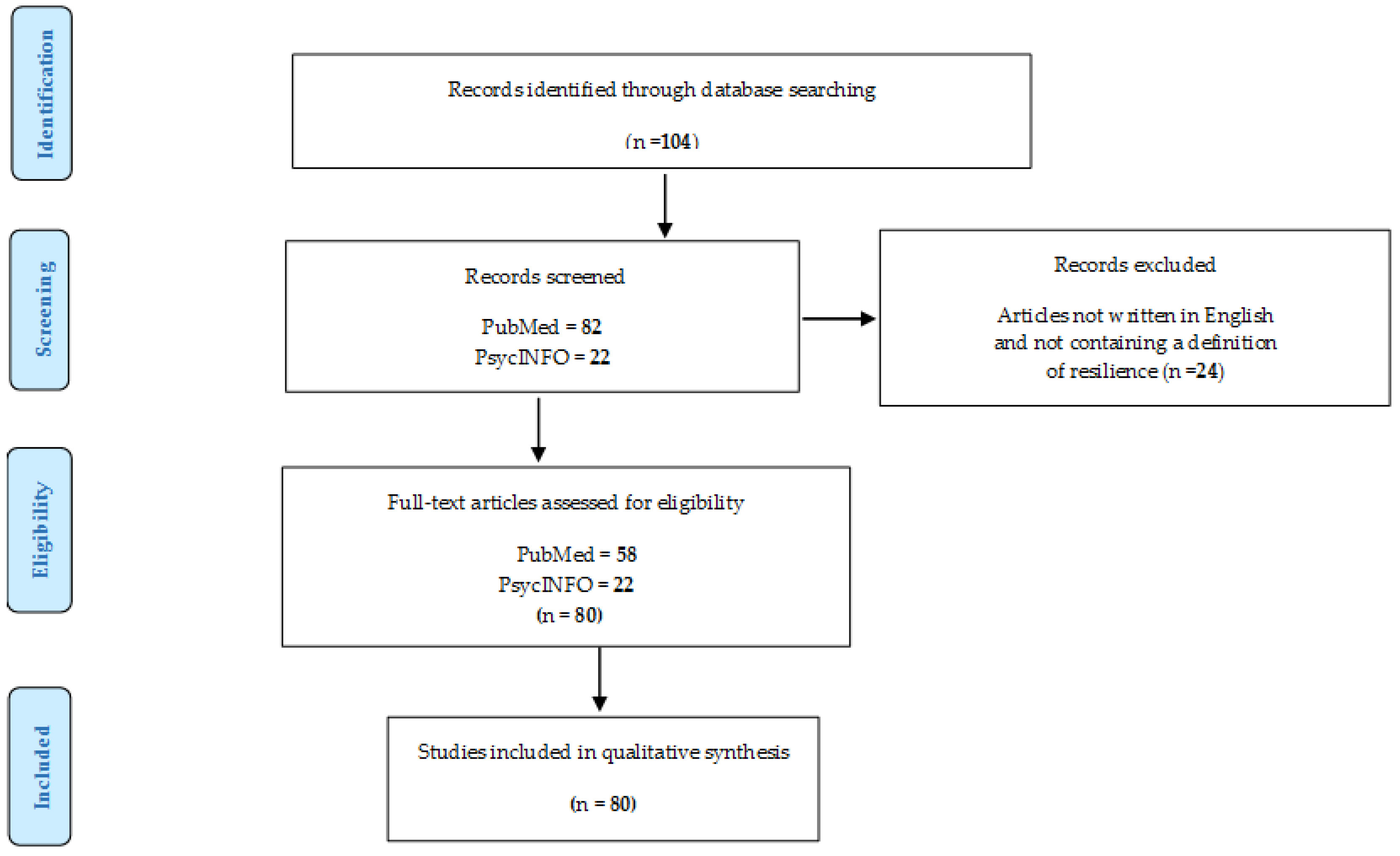
A literature review of the term ‘psychological resilience’ was performed by using the electronic databases ‘PubMed’ and ‘PsycINFO’. Scientific articles published between 2002 and May 2019 were reviewed according to the following key terms: ‘psychological’, ‘resilience’, and ‘definition’. The initial search in PubMed using the keywords ‘psychological’ and ‘resilience’ produced 7553 results. Subsequently an additional filter was added, the keyword ‘definition’, in order to focus exclusively on the articles that consider definitions of psychological resilience. This filter significantly reduced the number of publications to 82. These studies were further filtered by applying the following exclusion criteria.
Articles not written in English and those that did not contain a definition of the resilience after the full text screening were removed. In the end, 58 articles were selected through this process for the identification and analysis of the definitions, highlighting recurrent elements and specific characteristics.
The same search with the same filters was repeated in the PsycINFO online database. As a result, 22 articles were singled out, as shown in Figure 1.
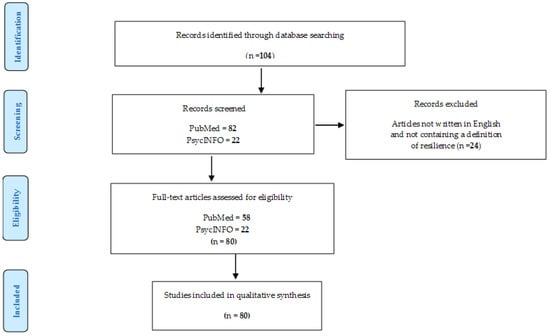
Figure 1.
PRISMA checklist showing process of articles selection for inclusion in the literature review.
The search ultimately produced 126 definitions of psychological resilience developed by 109 work groups, and each of them has been catalogued by content and authors. Data were independently reviewed by two authors, and then compared and discussed to reach a consensus. After analyzing these results, five macro-categories were identified by taking into account the specific elements of each definition.
3. Results
The five macro-areas identified summarize what has been reported in the literature in recent years concerning description of the resilience phenomenon. They serve as a preliminary and necessary step to identifying the transversal elements that can comprise a broad definition of ‘psychological resilience’. Each macro-category focuses on a specific feature of the resilience construct, helping to highlight its complex nature and its several implications in the various interacting contexts. Below is an overview of the key aspects of the following five macro-categories:
- Ability to recover
- Type of functioning that characterizes the individual
- Capacity to bounce back
- Dynamic process evolving over time
- Positive adaptation to life conditions.
3.1. Ability to Recover
Many authors focused on what makes people capable of dealing with the adversities of life, traumas, and stressors, trying to understand why some manage to recover after having experienced tragic events or particularly significant losses. In this regard, resilience has been defined as the ability to recover despite adverse conditions, looking ahead through a dynamic process of adaptation supported by a deeper knowledge of oneself and influenced by personal characteristics, family, and social resources (see Table 1).

Table 1.
Ability to recover.
3.2. Type of Functioning That Characterizes the Individual
Resilience is described in the literature as a peculiar response of the individual identified through the use of their personal characteristics to face difficult conditions. Since it is assumed that serious adversities destabilize most people, resilient functioning in such situations is considered extraordinary. It manifests itself in adaptive attitudes and behaviors that allow one to remain psychologically healthy—or even foresee personal growth—after exposure to stressful life events. The capacity for positive adaptation is given by specific personal attitudes and qualities promoting balance in the face of change (see Table 2).
Table 2.
Type of functioning that characterizes the individual.
3.3. Capacity to Bounce Back
Many authors define psychological resilience as the ability to recover at the same time as the development of one’s resources and potential in the face of difficulties or stressful events. Understood in this way, the resilience construct is configured as an attitude to adopt effective negotiation strategies that allow one to confront adversity and to bounce back from the negative experience by promoting a process of personal growth (see Table 3).
Table 3.
Capacity to bounce back.
3.4. Dynamic Process Evolving Over Time
In the literature, it also emerges that coping with situations perceived as adverse or changeable occurs through a dynamic process of adaptation, influenced by personal characteristics, family, and social resources. Resilience should therefore be understood not only as a personal attribute that can lead to success, but also as a dynamic interaction associated with adaptability and a positive history of functioning after adversities (see Table 4).
Table 4.
Dynamic process evolving over time.
3.5. Positive Adaptation to Life Conditions
Resilience is also referred to as the ability to deal with stress conditions. The processes of psychological resilience have to do with the cognitive evaluation carried out by the subject, which regulates the possibility of finding effective forms of adaptation. The thought processes, the emotional and behavioral responses through which resilient subjects build their personal vision of reality, give rise to decisions and behaviors that allow them to adapt to stressful or adverse conditions (see Table 5).
Table 5.
Positive adaptation to life conditions.
4. Discussion
Our literature review shows that psychological resilience is described in different ways. This discrepancy in terminology can hinder a shared definition of the construct, which limits comparisons among the research results and makes objective measurement difficult. Based on our analysis of the literature, we identified five macro-categories which, on the one hand, summarize the recurring elements in the definition of resilience across the works examined; on the other, they highlight the multidimensionality of the construct.
Over the years, several authors described resilience as ‘ability to recover’. However, this expression has been understood in various ways. Specifically, some authors define resilience in terms of ability to recover from trauma, stress, or deprivation; others understand it as the ability to remain well despite the difficulties or to recover completely and quickly. The recovery is also intended as a return to a state of balance, as a posttraumatic growth ability, or as learning of useful skills for overcoming future risks. Additional authors describe resilience in terms of recovery by using protective barriers to stress. In summary, the ability of recovery represents the tendency of the individual to maintain their own internal balance despite the experience of traumatic events or stressful conditions. Moreover, the capacity for resilience indicates the ability to deal positively with traumatic events and to reorganize in the face of difficulties.
We found that resilience was also described in literature as a ‘Type of functioning that characterizes the individual’. The resilience functioning was intended as an ability both to maintain good levels of psychological and physical health and to return to a state of balance despite adversities. In this context, a reference to resilient qualities emerges in terms of individual features or personality traits such as robustness and resourcefulness, with some authors affirming that these qualities are innate and influenced by the external environmental only in a limited way. The functional adaptation to adverse conditions can be facilitated or hindered by the interaction between internal protective and risk factors. In this regard, literature has recently turned towards a concept of resilience understood as a complex phenomenon in which several factors come into play, including innate personality traits, personal purposes, and the external and psychosocial context. By exploring the protective factors that enable the implementation of resilient behaviors, we can identify the following categories: Cognitive flexibility, positive affect and optimism, humor, acceptance, active coping, religion or spirituality, altruism, social support, role models, exercise, capacity to recover from negative events, and stress inoculation. In summary, what determines resilience are the personal qualities identified as protective factors despite stressful or traumatic events.
A third group of definitions, albeit small, refers to resilience as ‘capacity to bounce back’. Although this description of resilience seems to be like that of the ability of adaptation, we believe that it deserves to be included in another category as it emphasizes a particular response mode, namely referring to some specific characteristics. Thus, resilience as capacity to bounce back outlines the ability to persist and grow when faced with stressors, to cope despite adversity, and to bounce from negative experience. Resilience refers to having good outcomes despite adversity and risk, and could be described in terms of preserving the same level of outcome or rebounding back to that level after an initial setback. More specifically, resilience as ‘bouncing back’ could involve either rebounding after adversity or affectively adapting to adversity.
The resilience construct over the years has also been identified as a ‘dynamic process evolving over time’. Specifically, dynamic process here means firstly the interaction between internal and external protective factors that act to modify the personal effects of an adverse event. Secondly, it refers to the interaction between personal characteristics, biological processes, and family and social resources that can promote or hinder resilient processes. Within this macro-category, it is possible to identify several shades of meaning of the term resilience. Some authors define it as a vital motivational force of the individual that foresees an attitude of continuous struggle and an inclination not to surrender before difficulties, or as a force that can fluctuate over time and push the person to grow through the adversities or interruptions of their life trajectory. Others emphasize the ability to promote developmental processes and identify resilience with a dynamic mental state that can adapt to changing circumstances. Resilience is also defined as a process through which individuals survive or even grow in the face of adversity. It involves both a set of qualities or internal traits, such hardiness or high self-efficacy, and external factors, such as social support, that promote coping skills.
Given the great attention paid by the literature to the meaning of resilience as a capacity for adaptation, we decided to include this definition in a specific category, namely ‘positive adaptation to life condition’. In describing resilience in these terms, authors emphasize different aspects of the phenomenon. Some describe it as the ability to promote positive adaptation despite exposure to adverse, stressful, or traumatic conditions. Others define it as an adaptive attitude and behavior that allows one to remain psychologically healthy, or even to thrive until a post-traumatic growth after being exposed to stressful events. Thus conceived, resilience implies that emotional resources are used to adapt to adversity; therefore, it can also be described as the process that links resources (adaptive capacities) to results (adaptation).
Other authors focus attention on the duration of the phenomenon. In particular, some describe resilience as a temporary phenomenon, subject to fluctuations based on life circumstances and the stage of development; for others it represents a stable trajectory of operation over time.
The analysis of the literature shows that the term resilience does not have a single meaning and takes on different nuances depending on the perspective from which it is analyzed. In the field of resilience studies, there is a heated debate among scholars, in particular between those who consider resilience as a trait of personality that is fixed and stable over time and therefore measurable (‘type of functioning that characterizes the individual’) and those who do not consider it a personality trait but rather as ‘dynamic process evolving over time’, which refers to the interaction between protective factors and risk factors. Specifically, the effects of protective factors such as ‘type of functioning’ are detectable only in the presence of the stressful events, and their role is to modify the response despite adversity. The ‘dynamic process’ is instead described as the interaction of a constellation of variables that allow the reduction of the impact with the risk conditions and thus effectively dealing with the adverse condition. In the ‘recovery category’, it is also possible to identify the attitude toward a gradual return to an initial state—staying well and maintaining an effective functioning—despite the destabilization caused by an adverse event that has a significant impact on the person. Therefore, it is understood as a return to an initial state of balance. The ‘capacity to bounce back’ instead emphasizes the possibility of a personal growth despite difficulties, changes, or traumatic events rather than a return to an initial state of mind. Literally, ‘bounce back’ means rebound and change of direction. It refers to the tendency to be persevering and not to give up, assuming an attitude of openness to change.
We consider the fifth category, ‘positive adaptation to life conditions’, as transversal to the other four that we have identified because the concept of effective adaptation to life events is implicit in each of them. Nevertheless, we have established it as a different category from the others since many definitions in the literature focus on the concept of positive adaptation to define resilience. As can be seen by comparing the tables, the category that identifies resilience as ‘positive adaptation’ includes many definitions.
Summarizing all the categories, the processes of psychological resilience make it possible to face events by maintaining and enhancing one’s resources to the point of producing personal strengthening and a positive reorganization of one’s biographical history. Therefore, the use of resilient attitudes makes it possible to construct and rebuild one’s life path, to re-establish a new balance by producing change in oneself and reacting positively in the face of difficulties, transforming them into opportunities for growth.
From the study that we conducted, it was interesting to observe the multidimensionality of the resilience construct, which has been described in the literature from different points of view, in some cases with common characteristics. The revision of the definitions of resilience has allowed us to better clarify this term and to propose a broader definition characterized by the elements that we have supposed as being more indicative of the resilient attitude.
According to the results of our study, resilience should be considered as a ‘competence’ present in each individual or organization, thanks to which it is possible not to succumb to adverse events, but to react and to reach, or to return, to a state of equilibrium.
The importance of the work we carried out thus lies in having observed that resilience resources are considered as ‘skills’ that should be present and functional both on an individual level, for example in professional practice or in social relations, and in organizations.
Moreover, being a dynamic process, resilience can be implemented in order to promote a continuous growth of the person and the environment.
Getting to know more about the resilience construct also makes it feasible to structure training pathways focused on resilient human qualities as tools aimed at fostering an attitude of openness to change.
Regarding the clinical setting, the analysis of the resilience construct we carried out through the review is also a useful starting point with reference to the identification of models of psychological intervention aimed at enhancing individual resources and abilities in order to support the attitude of facing adverse situations while maintaining an adaptive functioning.
However, it is necessary to underline that this study has some limitations that we hope to fill in a future research. More specifically, a limitation refers to the methodology of selection of the articles to be analyzed. The use of the keyword ‘definition’ inserted in both of the accessed search engines has excluded some studies which could be useful to further widen the analysis of the resilience construct. Moreover, extending the study to other databases, as well as considering scientific articles written before 2002, would allow us to obtain a greater number of works and to identify probable further definitions of the term resilience. Finally, the review focused on resilience as a psychological construct, thereby excluding the possibility of accounting for nuances of the term other than the personal one that was investigated.
5. Conclusions
The analysis of the literature has made it possible to identify multiple definitions of psychological resilience. As proposed in our discussion of the results, the concept of resilience can be defined by focusing attention on different contents that describe it in a different way. Based on the previously discussed results, we propose our own definition of psychological resilience that takes into account the transversal elements found in the definitions we analyzed in order to proceed towards ‘a conceptual unification’ of the term.
According to the literature search that we carried out, it can be affirmed that psychological resilience is the ability to adapt positively to life conditions. It is a dynamic process evolving over time that implies a type of adaptive functioning that specifically allows us to face difficulties by recovering an initial balance or bouncing back as an opportunity for growth.
We believe that resilience is the ability to maintain one’s orientation towards existential purposes despite enduring adversities and stressful events. It foresees an attitude of persistence before the obstacle and openness to change. This concept can be understood as the ability to deal with the difficulties experienced in the different areas of one’s life with perseverance, maintaining a good awareness of oneself and one’s own internal and parallel coherence by activating a personal growth project. This persevering attitude makes it possible to activate one’s own resources to recover after having experienced adverse conditions, re-establishing the state of personal balance. In our definition, the term ‘purpose’ refers to long-term objectives and the overall objective regarding existence in its complexity. The latter varies from individual to individual according to their life commitments (vocational, affective, social, professional, etc.). Broadly speaking, through the acts of resilience related to partial ends, the individual becomes more and more persistent in the orientation towards their personal fulfillment. Our attempt at conceptual clarification of the term resilience, in also highlighting that specific skills and individual characteristics are necessary for a good maintaining of one’s own orientation towards existential purposes, will be a useful starting point for further research aimed at deeply exploring resilience resources and at identifying effective training strategies to support them.
Author Contributions
Study design, review, and original draft preparation, A.S. and F.V.; writing and editing the final manuscript, L.L.C. and G.R.; supervision, D.T. and V.T.
Funding
This research received no external funding.
Conflicts of Interest
The authors declare no conflict of interest.
References
- Fletcher, D.; Sarkar, M. Psychological resilience: A review and critique of definitions, concepts, and theory. Eur. Psychol. 2013, 18, 12. [Google Scholar] [CrossRef]
- Grinker, R.R.; Spiegal, J.P. Under Stress; Blakiston: Philadelphia, PA, USA, 1963. [Google Scholar]
- Jackson, D.; Firtko, A.; Edenborough, M. Personal resilience as a strategy for surviving and thriving in the face of workplace adversity: A literature review. J. Adv. Nurs. 2007, 60, 1–9. [Google Scholar] [CrossRef] [PubMed]
- Luthar, S.S.; Cicchetti, D. The construct of resilience: Implications for interventions and social policies. Dev. Psychopathol. 2000, 12, 857–885. [Google Scholar] [CrossRef]
- Vanistendael, S.; Lecomte, J. Le Bonheur est Toujours Possible: Construire La Resilience; Bayard: Paris, France, 2000. [Google Scholar]
- Richardson, G.E.; Neiger, B.L.; Jensen, S.; Kumpfer, K.L. The resiliency model. Health Educ. 1990, 21, 33–39. [Google Scholar] [CrossRef]
- Richardson, G.E.; Waite, P.J. Mental health promotion through resilience and resiliency education. Int. J. Emerg. Ment. Health 2002, 4, 65–75. [Google Scholar] [PubMed]
- Rutter, M. Resilience: Some conceptual considerations. J. Adolesc. Health 1993, 12, 626–631. [Google Scholar] [CrossRef]
- Werner, E.E.; Smith, R.S. Overcoming the Odds: High Risk Children from Birth to Adulthood; Cornell University Press: Ithaca, NY, USA, 1992. [Google Scholar]
- Masten, A.S. Ordinary magic: Resilience processes in development. Am. Psychol. 2001, 56, 227. [Google Scholar] [CrossRef]
- Antonovsky, A. The salutogenic perspective: Toward a new view of health and illness. Advances 1987, 4, 47–55. [Google Scholar]
- Miller, T.W. Advances in understanding the impact of stressful life events on health. Psychiatr. Serv. 1988, 39, 615–622. [Google Scholar] [CrossRef]
- Connor, K.M.; Davidson, J.R. Development of a new resilience scale: The Connor-Davidson resilience scale (CD-RISC). Depress. Anxiety 2003, 18, 76–82. [Google Scholar] [CrossRef]
- Flach, F. Resilience: Discovering a New Strength at Times of Stress; Ballantine Books: New York, NY, USA, 1988. [Google Scholar]
- Luthar, S.S.; Cicchetti, D.; Becker, B. The construct of resilience: A critical evaluation and guidelines for future work. Child. Dev. 2000, 71, 543–562. [Google Scholar] [CrossRef] [PubMed]
- Block, J.; Block, J.H. The role of ego-control and ego-resiliency in the organization of behavior. In Development of Cognition, Affect, and Social Relations; Psychology Press: New York, NY, USA, 2014; pp. 49–112. [Google Scholar]
- Caldeira, S.; Timmins, F. Resilience: Synthesis of concept analyses and contribution to nursing classifications. Int. Nurs. Rev. 2016, 63, 191–199. [Google Scholar] [CrossRef] [PubMed]
- Patel, S.S.; Rogers, M.B.; Amlôt, R.; Rubin, G.J. What do we mean by ‘community resilience’? A systematic literature review of how it is defined in the literature. PLoS Curr. 2017, 9. [Google Scholar] [CrossRef]
- Davydov, D.M.; Stewart, R.; Ritchie, K.; Chaudieu, I. Resilience and mental health. Clin. Psychol. Rev. 2010, 30, 479–495. [Google Scholar] [CrossRef] [PubMed]
- Luthar, S.S. Resilience in development: A synthesis of research across five decades. In Developmental Psychopathology: Volume Three: Risk, Disorder, and Adaptation; Dante Cicchetti: Mahwah, NJ, USA, 2015; pp. 739–795. [Google Scholar]
- Garmezy, N. Children in poverty: Resilience despite risk. Psychiatry 1993, 56, 127–136. [Google Scholar] [CrossRef] [PubMed]
- Rutter, M.E. Studies of Psychosocial Risk: The Power of Longitudinal Data; Cambridge University Press: Cambridge, UK, 1988. [Google Scholar]
- Stephens, T.M. Nursing student resilience: A concept clarification. Nurs. Forum 2013, 48, 125–133. [Google Scholar] [CrossRef]
- Atkinson, P.A.; Martin, C.R.; Rankin, J. Resilience revisited. J. Psychiatr. Ment. Health Nurs. 2009, 16, 137–145. [Google Scholar] [CrossRef]
- Barber, B.K. Annual research review: The experience of youth with political conflict–challenging notions of resilience and encouraging research refinement. J. Child. Psychol. Psychiatry 2013, 54, 461–473. [Google Scholar] [CrossRef]
- Bonanno, G.A. The human capacity to thrive in the face of potential trauma. Pediatrics 2008, 121, 369–375. [Google Scholar] [CrossRef]
- Whitson, H.E.; Duan-Porter, W.; Schmader, K.E.; Morey, M.C.; Cohen, H.J.; Colón-Emeric, C.S. Physical resilience in older adults: Systematic review and development of an emerging construct. J. Gerontol. Ser. A Biomed. Sci. Med. Sci. 2015, 71, 489–495. [Google Scholar] [CrossRef]
- Hardy, S.E.; Concato, J.; Gill, T.M. Resilience of community-dwelling older persons. J. Gerontol. Med. Sci. 2004, 52, 257–262. [Google Scholar] [CrossRef] [PubMed]
- Okvat, H.A.; Zautra, A.J. Community gardening: A parsimonious path to individual, community, and environmental resilience. Am. J. Community Psychol. 2011, 47, 374–387. [Google Scholar] [CrossRef] [PubMed]
- Zautra, A.J.; Hall, J.S.; Murray, K.E. Resilience: A new integrative approach to health and mental health research. Health Psychol. Rev. 2008, 2, 41–64. [Google Scholar] [CrossRef]
- De Terte, I.; Stephens, C.; Huddleston, L. The development of a three part model of psychological resilience. Stress Health 2014, 30, 416–424. [Google Scholar] [CrossRef] [PubMed]
- Leipold, B.; Greve, W. Resilience. Eur. Psychol. 2009, 14, 40–50. [Google Scholar] [CrossRef]
- Bonanno, G.A.; Brewin, C.R.; Kaniasty, K.; La Greca, A.M. Weighing the costs of disaster: Consequences, risks, and resilience in individuals, families, and communities. Psychol. Sci. Public Interest 2010, 11, 1–49. [Google Scholar] [CrossRef] [PubMed]
- Kokufu, H. Conflict accompanying the choice of initial treatment in breast cancer patients. Jpn. J. Nurs. Sci. 2012, 9, 177–184. [Google Scholar] [CrossRef]
- Vahia, I.V.; Chattillion, E.; Kavirajan, H.; Depp, C.A. Psychological protective factors across the lifespan: Implications for psychiatry. Psychiatr. Clin. 2011, 34, 231–248. [Google Scholar] [CrossRef]
- Rutter, M. Genes and Behavior: Nature-Nurture Interplay Explained; Blackwell Publishing: Oxford, UK, 2006. [Google Scholar]
- Stainton, A.; Chisholm, K.; Kaiser, N.; Rosen, M.; Upthegrove, R.; Ruhrmann, S.; Wood, S.J. Resilience as a multimodal dynamic process. Early Interv. Psychiatry 2018, 13, 725–732. [Google Scholar] [CrossRef]
- Rutten, B.P.; Hammels, C.; Geschwind, N.; Menne-Lothmann, C.; Pishva, E.; Schruers, K.; Van Den Hove, D.; Kenis, G.; Van Os, G.; Wichers, M.; et al. Resilience in mental health: Linking psychological and neurobiological perspectives. Acta Psychiatr. Scand. 2013, 128, 3–20. [Google Scholar] [CrossRef]
- Harris, M.A.; Brett, C.E.; Starr, J.M.; Deary, I.J.; McIntosh, A.M. Early-life predictors of resilience and related outcomes up to 66 years later in the 6-day sample of the 1947 Scottish mental survey. Soc. Psychiatry Psychiatr. Epidemiol. 2016, 51, 659–668. [Google Scholar] [CrossRef] [PubMed]
- Johnston, M.C.; Porteous, T.; Crilly, M.A.; Burton, C.D.; Elliott, A.; Iversen, L.; Black, C. Physical disease and resilient outcomes: A systematic review of resilience definitions and study methods. Psychosomatics 2015, 56, 168–180. [Google Scholar] [CrossRef] [PubMed]
- Lundman, B.; Aléx, L.; Jonsén, E.; Lövheim, H.; Nygren, B.; Fischer, R.S.; Strandberg, G.; Norberg, A. Inner strength in relation to functional status, disease, living arrangements, and social relationships among people aged 85 years and older. Geriatr. Nurs. 2012, 33, 167–176. [Google Scholar] [CrossRef] [PubMed]
- Dias, R.; Santos, R.L.; Sousa, M.F.B.D.; Nogueira, M.M.L.; Torres, B.; Belfort, T.; Dourado, M.C.N. Resilience of caregivers of people with dementia: A systematic review of biological and psychosocial determinants. Trends Psychiatry Psychother. 2015, 37, 12–19. [Google Scholar] [CrossRef]
- Cowan, P.A.; Cowan, C.P.; Schulz, M.S. Thinking about risk and resilience in families. Stress, Coping, and Resiliency in Children and Families; Psychology Press: New York, NY, USA, 1996; Volume 1. [Google Scholar]
- Barber, B.K.; Doty, S.B. How can a majority be resilient? Critiquing the utility of the construct of resilience through a focus on youth in contexts of political conflict. In Handbook of Resilience in Children of War; Springer: New York, NY, USA, 2013; pp. 233–252. [Google Scholar]
- Tugade, M.M.; Fredrickson, B.L. Resilient individuals use positive emotions to bounce back from negative emotional experiences. J. Personal. Soc. Psychol. 2004, 86, 320–333. [Google Scholar] [CrossRef]
- Dulin, A.J.; Dale, S.K.; Earnshaw, V.A.; Fava, J.L.; Mugavero, M.J.; Napravnik, S.; Howe, C.J. Resilience and HIV: A review of the definition and study of resilience. AIDS Care 2018, 30, 6–17. [Google Scholar] [CrossRef]
- Pecoraro, A.; Pacciolla, A.; O’Cleirigh, C.; Mimiaga, M.; Kwiatek, P.; Blokhina, E.; Verbitskaya, E.; Krupitsky, E.; Woody, G.E. Proactive coping and spirituality among patients who left or remained in antiretroviral treatment in St Petersburg, Russian Federation. AIDS Care 2016, 28, 334–338. [Google Scholar] [CrossRef]
- Hoge, E.A.; Austin, E.D.; Pollack, M.H. Resilience: Research evidence and conceptual considerations for posttraumatic stress disorder. Depress. Anxiety 2007, 24, 139–152. [Google Scholar] [CrossRef]
- Westphal, M.; Bonanno, G.A. Posttraumatic growth and resilience to trauma: Different sides of the same coin or different coins? Appl. Psychol. 2007, 56, 417–427. [Google Scholar] [CrossRef]
- Wexler, L.M.; Di Fluvio, G.; Burke, T.K. Resilience and marginalized youth: Making a case for personal and collective meaning-making as part of resilience research in public health. Soc. Sci. Med. 2009, 69, 565–570. [Google Scholar] [CrossRef]
- Cuhadar, D.; Tanriverdi, D.; Pehlivan, M.; Kurnaz, G.; Alkan, S. Determination of the psychiatric symptoms and psychological resilience levels of hematopoietic stem cell transplant patients and their relatives. Eur. J. Cancer Care 2016, 25, 112–121. [Google Scholar] [CrossRef] [PubMed]
- Reis, S.M.; Colbert, R.D.; Hébert, T.P. Understanding resilience in diverse, talented students in an urban high school. Roeper Rev. 2004, 27, 110–120. [Google Scholar] [CrossRef]
- Terzi, S. Üniversite ög˘rencilerinin psikolojik dayanikliliklari ile algiladiklari sosyal destek arasindaki ilis¸ki. Türk Psikolojik Danis¸ma ve Rehberlik Dergisi 2008, 3, 1–11. [Google Scholar]
- Öz, P.D.F.; Yilmaz, U.H.E.B. Ruh sağlığının korunmasında önemli bir kavram: Psikolojik sağlamlık. Hacettepe Üniversitesi Hemşirelik Fakültesi Dergisi 2009, 16, 82–89. [Google Scholar]
- Basim, N.; Çetin, F. Yetis¸kinleriçin psikolojik dayaniklilik ölçeg˘inin güvenirlik ve geçerlilik çalis¸masi. Türk Psikiyatri Dergisi 2011, 22, 104–114. [Google Scholar] [PubMed]
- Wright, M.O.D.; Masten, A.S.; Narayan, A.J. Resilience Processes in Development: Four Waves of Research on Positive Adaptation in the Context of Adversity. In Handbook of Resilience in Children; Springer: Boston, MA, USA, 2013; pp. 15–37. [Google Scholar]
- Schumacher, A.; Sauerland, C.; Silling, G.; Berdel, W.E.; Stelljes, M. Resilience in patients after allogeneic stem cell transplantation. Support. Care Cancer 2014, 22, 487–493. [Google Scholar] [CrossRef] [PubMed]
- McAllister, S.J.; Vincent, A.; Hassett, A.L.; Whipple, M.O.; Oh, T.H.; Benzo, R.P.; Toussaint, L.L. Psychological resilience, affective mechanisms and symptom burden in a tertiary-care sample of patients with fibromyalgia. Stress Health 2015, 31, 299–305. [Google Scholar] [CrossRef]
- Evers, A.W.; Zautra, A.; Thieme, K. Stress and resilience in rheumatic diseases: A review and glimpse into the future. Nat. Rev. Rheumatol. 2011, 7, 409. [Google Scholar] [CrossRef]
- Karoly, P.L.S. Psychological “resilience” and its correlates in chronic pain: Findings from a national community sample. Pain 2006, 123, 90–97. [Google Scholar] [CrossRef]
- Wu, G.; Feder, A.; Cohen, H.; Kim, J.J.; Calderon, S.; Charney, D.S.; Mathe, A.A. Understanding resilience. Front. Behav. Neurosci. 2013, 7, 10. [Google Scholar] [CrossRef]
- Bonanno, G.A. Loss, trauma, and human resilience: Have we underestimated the human capacity to thrive after extremely avversive events? Am. Psychol. 2004, 59, 20–28. [Google Scholar] [CrossRef] [PubMed]
- Bonanno, G.A.; Galea, S.; Bucciarelli, A.; Vlahov, D. What predicts psychological resilience after disaster? The role of demographics, resources, and life stress. J. Consult. Clin. Psychol. 2007, 75, 671–682. [Google Scholar] [CrossRef] [PubMed]
- Bonanno, G.A.; Ho, S.M.; Chan, J.C.; Kwong, R.S.; Cheung, C.K.; Wong, C.P.; Wong, V.C. Psychological resilience and dysfunction among hospitalized survivors of the SARS epidemic in Hong Kong: A latent class approach. Health Psychol. 2008, 27, 659–667. [Google Scholar] [CrossRef]
- Costanzo, E.S.; Ryff, C.D.; Singer, B.H. Psychosocial adjustment among cancer survivors: Findings from a national survey of health and well-being. Health Psychol. 2009, 28, 147–156. [Google Scholar] [CrossRef] [PubMed]
- Scali, J.; Gandubert, C.; Ritchie, K.; Soulier, M.; Ancelin, M.L.; Chaudieu, I. Measuring resilience in adult women using the 10-items Connor-Davidson Resilience Scale (CD-RISC). Role of trauma exposure and anxiety disorders. PLoS ONE 2012, 7, e39879. [Google Scholar] [CrossRef] [PubMed]
- Lam, W.W.; Bonanno, G.A.; Mancini, A.D.; Ho, S.; Chan, M.; Hung, W.K.; Or, A.; Fielding, R. Trajectories of psychological distress among Chinese women diagnosed with breast cancer. Psychooncology 2010, 19, 1044–1051. [Google Scholar] [CrossRef] [PubMed]
- Taylor, J.; Jacoby, A.; Baker, G.A.; Marson, A.G.; Ring, A. White head M: Factors predictive of resilience and vulnerability in new on set epilepsy. Epilepsia 2011, 52, 610–618. [Google Scholar] [CrossRef] [PubMed]
- Sharpley, C.F.; Bitsika, V.; Wootten, A.C.; Christie, D.R. Does resilience ‘buffer’against depression in prostate cancer patients? A multi-site replication study. Eur. J. Cancer Care 2014, 23, 545–552. [Google Scholar] [CrossRef]
- Charney, D.S. Psychobiological mechanisms of resilience and vulnerability: Implications for successful adaptation to extreme stress. Am. J. Psychiatry 2004, 161, 195–216. [Google Scholar] [CrossRef]
- Sudom, K.A.; Lee, J.E.; Zamorski, M.A. A longitudinal pilot study of resilience in Canadian military personnel. Stress Health 2014, 30, 377–385. [Google Scholar] [CrossRef]
- Garcia-Dia, M.J.; DiNapoli, J.M.; Garcia-Ona, L.; Jakubowski, R.; O’flaherty, D. Concept analysis: Resilience. Arch. Psychiatr. Nurs. 2013, 27, 264–270. [Google Scholar] [CrossRef] [PubMed]
- Ungar, M. Resilience, trauma, context, and culture. Trauma Violence Abuse 2013, 14, 255–266. [Google Scholar] [CrossRef] [PubMed]
- Rutter, M. Implications of resilience concepts for scientific understanding. Ann. N. Y. Acad. Sci. 2006, 1094, 1–12. [Google Scholar] [CrossRef] [PubMed]
- Earvolino-Ramirez, M. Resilience: A concept analysis. In Nursing Forum; Blackwell Publishing Inc: Malden, MA, USA, 2007; Volume 42, pp. 73–82. [Google Scholar]
- Block, J.H.; Block, J. The role of ego-control and ego-resiliency in the organization of behavior. In Development of Cognition, Affect and Social Relations: The Minnesota Symposia on Child Psychology; Collins, W.A., Hillsdale, N.J., Eds.; Erlbaum: Hillsdale, NJ, USA, 1980; Volume 13, pp. 39–101. [Google Scholar]
- Pfefferbaum, B.; Pfefferbaum, R.L.; Van Horn, R.L. Community resilience interventions: Participatory, assessment-based, action-oriented processes. Am. Behav. Sci. 2015, 59, 238–253. [Google Scholar] [CrossRef]
- Ong, A.D.; Bergeman, C.S.; Bisconti, T.L.; Wallace, K.A. Psychological resilience, positive emotions, and successful adaptation to stress in later life. J. Personal. Soc. Psychol. 2006, 91, 730–749. [Google Scholar] [CrossRef]
- Wachs, T.D. Contributions of temperament to buffering and sensitization processes in children’s development. Ann. N. Y. Acad. Sci. 2006, 1094, 28–39. [Google Scholar] [CrossRef]
- Harvey, J.; DelFabbro, P.H. Psychological resilience in disadvantaged youth: A critical overview. Aust. Psychol. 2004, 39, 3–13. [Google Scholar] [CrossRef]
- Rutter, M. Resilience: Some conceptual considerations initiatives. In Proceedings of the Conference on Fostering Resilience, Washington, DC, USA, December 1991. [Google Scholar]
- McAllister M Lowe, J.B. The Resilient Nurse: Empowering Your Practice; Springer: New York, NY, USA, 2011. [Google Scholar]
- Rutter, M. Resilience as a dynamic concept. Dev. Psychopathol. 2012, 24, 335–344. [Google Scholar] [CrossRef]
- Brodsky, A.E.; Cattaneo, L.B. A transconceptual model of empowerment and resilience: Divergence, convergence and interactions in kindred community concepts. Am. J. Community Psychol. 2013, 52, 333–346. [Google Scholar] [CrossRef]
- Cattaneo, L.B.; Chapman, A.R. The process of empowerment: A model for use in research and practice. Am. Psychol. 2010, 65, 646–659. [Google Scholar] [CrossRef]
- Kim-Cohen, J.; Turkewitz, R. Resilience and measured gene–environment interactions. Dev. Psychopathol. 2012, 24, 1297–1306. [Google Scholar] [CrossRef] [PubMed]
- Cicchetti, D.; Blender, J.A. A multiple-levels-of-analysis perspective on resilience: Implications for the developing brain, neural plasticity, and preventive interventions. Ann. N. Y. Acad. Sci. 2006, 1094, 248–258. [Google Scholar] [CrossRef] [PubMed]
- Luthar, S.S.; Brown, P.J. Maximizing resilience through diverse levels of inquiry: Prevailing paradigms, possibilities, and priorities for the future. Dev. Psychopathol. 2007, 19, 931–955. [Google Scholar] [CrossRef] [PubMed]
- Masten, A.S. Resilience in children. In Developmental Psychology: Revisiting the Classic Studies; SAGE Publications: London, UK, 2012; p. 204. [Google Scholar]
- Southwick, S.M.; Vythilingam, M.; Charney, D.S. The psychobiology of depression and resilience to stress: Implications for prevention and treatment. Annu. Rev. Clin. Psychol. 2005, 1, 255–291. [Google Scholar] [CrossRef]
- Hilliard, M.E.; McQuaid, E.L.; Nabors, L.; Hood, K.K. Resilience in youth and families living with pediatric health and developmental conditions: Introduction to the special issue on resilience. J. Pediatr. Psychol. 2015, 40, 835–839. [Google Scholar] [CrossRef]
- Graber, R.; Turner, R.; Madill, A. Best friends and better coping: Facilitating psychological resilience through boys’ and girls’ closest friendships. Br. J. Psychol. 2016, 107, 338–358. [Google Scholar] [CrossRef]
- Black, C.; Ford-Gilboe, M. Adolescent mothers: Resilience, family health work and health promoting practices. J. Adv. Nurs. 2004, 48, 351–360. [Google Scholar] [CrossRef]
- Campbell-Sills, L.; Cohan, S.L.; Stein, M.B. Relationship of resilience to personality, coping, and psychiatric symptoms in young adults. Behav. Res. Ther. 2006, 44, 585–599. [Google Scholar] [CrossRef]
- Tan, W.S.; Beatty, L.; Kemp, E.; Koczwara, B. What contributes to resilience in cancer patients? A principal component analysis of the Connor—Davidson Resilience Scale. Asia Pac. J. Clin. Oncol. 2019, 15, 115–119. [Google Scholar] [CrossRef]
- Bonanno, G.A.; Westphal, M.; Mancini, A.D. Resilience to loss and potential trauma. Annu. Rev. Clin. Psychol. 2011, 7, 511–535. [Google Scholar] [CrossRef]
- Southwick, S.M.; Bonanno, G.A.; Masten, A.S.; Panter-Brick, C.; Yehuda, R. Resilience definitions, theory, and challenges: Interdisciplinary perspectives. Eur. J. Psychotraumatol. 2014, 5, 25338. [Google Scholar] [CrossRef] [PubMed]
- Iacoviell, B.M.; Charney, D.S. Psychosocial facets of resilience: Implications for preventing posttrauma psychopathology, treating trauma survivors, and enhancing community resilience. Eur. J. Psychotraumatol. 2014, 5, 23970. [Google Scholar] [CrossRef] [PubMed]
- Eshel, Y.; Kimhi, S.; Lahad, M.; Leykin, D.; Goroshit, M. Risk Factors as Major Determinants of Resilience: A Replication Study. Community Ment. Health J. 2018, 54, 1228–1238. [Google Scholar] [CrossRef] [PubMed]
- Eshel, Y.; Kimhi, S. Determinants of individual resilience following missile attacks: A new perspective. Personal. Individ. Differ. 2016, 95, 190–195. [Google Scholar] [CrossRef]
- Eshel, Y.; Kimhi, S.; Lahad, M.; Leykin, D. Individual, community, and national resiliencies and age: Are older people less resilient than younger individuals? Am. J. Geriatr. Psychiatry 2016, 24, 644–647. [Google Scholar] [CrossRef]
- Masten, A.S. Resilience in children threatened by extreme adversity: Frameworks for research, practice, and translational synergy. Dev. Psychopathol. 2011, 23, 493–506. [Google Scholar] [CrossRef]
- Ungar, M. Community resilience for youth and families: Facilitative physical and social capital in contexts of adversity. Child. Youth Soc. Serv. Rev. 2011, 33, 1742–1748. [Google Scholar] [CrossRef]
- Howe, A.; Smajdor, A.; Stöckl, A. Towards an understanding of resilience and its relevance to medical training. Med. Educ. 2012, 46, 349–356. [Google Scholar] [CrossRef]
- O’cleirigh, C.; Ironson, G.; Weiss, A.; Costa, P.T., Jr. Conscientiousness predicts disease progression (CD4 number and viral load) in people living with HIV. Health Psychol. 2007, 26, 473. [Google Scholar] [CrossRef]
- Dale, S.; Cohen, M.; Weber, K.; Cruise, R.; Kelso, G.; Brody, L. Abuse and resilience in relation to HAART medication adherence and HIV viral load among women with HIV in the United States. AIDS Patient Care Stds. 2014, 28, 136–143. [Google Scholar] [CrossRef]
- Casale, R.; Sarzi-Puttini, P.; Botto, R.; Alciati, A.; Batticciotto, A.; Marotto, D.; Torta, R. Fibromyalgia Concept Resilience. Clin. Exp. Rheumatol. 2019, 37 (Suppl. 116), 105–113. [Google Scholar] [PubMed]
- Ayed, N.; Toner, S.; Priebe, S. Conceptualizing resilience in adult mental health literature: A systematic review and narrative synthesis. Psychol. Psychother. Theory Res. Pract. 2018. [Google Scholar] [CrossRef] [PubMed]
- Li, Y.; Cao, F.; Cao, D.; Liu, J. Nursing students’ post-traumatic growth, emotional intelligence and psychological resilience. J. Psychiatr. Ment. Health Nurs. 2015, 22, 326–332. [Google Scholar] [CrossRef] [PubMed]
- Bonanno, G.A.; Papa, A.; O’Neill, K. Loss and human resilience. Appl. Prev. Psychol. 2001, 10, 193–206. [Google Scholar] [CrossRef]
- Von Ammon Cavanagh, S.; Furlanetto, L.; Creech, S.; Powell, L. Medical illness, past depression, and present depression: A predictive triad for in hospital mortality. Am. J. Psychiatry 2001, 158, 43–48. [Google Scholar] [CrossRef]
- Bitsika, V.; Sharpley, C.; Aroutzidis, A.; Smith, D. The impact of students ‘internally-’ versus ‘externally-oriented’ coping strategies upon anxiety and depression: Implications for counselling processes. Asia-Pac. J. Couns. Psychother. 2011, 2, 71–81. [Google Scholar] [CrossRef]
- Sharpley, C.; Bitsika, V.; Christie, D. How prostate cancer patients cope: Evaluation and refinement of the Prostate Cancer Patients’ Coping Strategies Scale. J. Men Health 2012, 9, 70–78. [Google Scholar] [CrossRef]
- De Terte, I.; Stephens, C. Psychological resilience of workers in high-risk occupations. Stress Health 2014, 30, 353–355. [Google Scholar] [CrossRef]
- Silverman, A.M.; Verrall, A.M.; Alschuler, K.N.; Smith, A.E.; Ehde, D.M. Bouncing back again, and again: A qualitative study of resilience in people with multiple sclerosis. Disabil. Rehabil. 2017, 39, 14–22. [Google Scholar] [CrossRef]
- Chen, X.; Wang, Y.; Yan, Y. The Essential Resilience Scale: Instrument Development and Prediction of Perceived Health and Behaviour. Stress Health 2016, 32, 533–542. [Google Scholar] [CrossRef]
- Davidson, J.R.T.; Payne, V.M.; Connor, K.M.; Foa, E.B.; Rothbaum, B.O.; Hertzberg, M.A.; Weisler, R.H. Trauma, resilience and saliostasis: Effects of treatment in post-traumatic stress disorder. Int. Clin. Psychopharmacol. 2005, 20, 43–48. [Google Scholar] [CrossRef] [PubMed]
- Prince-Embury, S.; Saklofske, D.H. Resilience in Children, Adolescents, and Adults: Translating Research into Practice; Springer Science Business Media: New York, NY, USA, 2013. [Google Scholar]
- Brush, B.L.; Kirk, K.; Gultekin, L.; Baiardi, J.M. Overcoming: A concept analysis. In Nursing Forum; Blackwell Publishing Inc.: Malden, MA, USA, 2011; Volume 46, pp. 160–168. [Google Scholar]
- Netuveli, G.; Wiggins, R.D.; Montgomery, S.M.; Hildon, Z.; Blane, D. Mental health and resilience at older ages: Bouncing back after adversity in the British Household Panel Survey. J. Epidemiol. Community Health 2008, 62, 987–991. [Google Scholar] [PubMed]
- Violanti, J.M.; Paton, D.; Johnston, P.; Burke, K.J.; Clarke, J.; Keenan, D. Stress shield: A model of police resiliency. Emerg. Mental Health 2008, 10, 95–108. [Google Scholar]
- Klein, R.; Nicholls, R.J.; Thomalla, F. Resilience to natural hazards: How useful is this concept? Glob. Environ. Chang. Part B Environ. Hazards 2003, 5, 35–45. [Google Scholar] [CrossRef]
- Kalisch, R.; Müller, M.B.; Tüscher, O. A conceptual framework for the neurobiological study of resilience. Behav. Brain Sci. 2015, 38, 92. [Google Scholar] [CrossRef]
- Windle, G. What is resilience? A review and concept analysis. Rev. Clin. Gerontol. 2011, 21, 152–169. [Google Scholar] [CrossRef]
- Xing, C.; Sun, J.M. The role of psychological resilience and positive affect in risky decision-making. Int. J. Psychol. 2013, 48, 935–943. [Google Scholar] [CrossRef]
- Lazarus, R.S. From psychological stress to the emotions: A history of changing outlooks. Annu. Rev. Psychol. 1993, 44, 1–21. [Google Scholar] [CrossRef]
- Brooks, R. The power of parenting. In Handbook of Resilience in Children; Brooks, R., Goldstein, S., Eds.; Kluwer Academic/Plenum: New York, NY, USA, 2005; pp. 443–458. [Google Scholar]
- Tedeschi R Kilmer, R. Assessing strengths, resilience, and growth to guide clinical interventions. Prof. Psychol. Res. Pract. 2005, 36, 230–237. [Google Scholar] [CrossRef]
- Alvord, M.; Grados, J. Enhancing resilience in children: A proactive approach. Prof. Psychol. Res. Pract. 2005, 36, 238–245. [Google Scholar] [CrossRef]
- Brandão, J.M.; Mahfoud, M.; Gianordoli-Nascimento, I.F. The construction of the concept of resilience in psychology: Discussing the origins of resilience. Paid (Ribeirão Preto) 2011, 21, 263–271. [Google Scholar] [CrossRef]
- Yunes, M.A.M. Psicologia positiva e resiliência: O foco no indivíduo e na família. Psicologia em Estudo Maringá 2003, 8, 75–84. [Google Scholar] [CrossRef]
- Gillespie, B.M.; Chaboyer, W.; Wallis, M. Development of a theoretically derived model of resilience through concept analysis. Contemp. Nurse 2007, 25, 124–135. [Google Scholar] [CrossRef] [PubMed]
- Haase, J.E.; Peterson, S.J. Resilience. In Middle Range Theories: Application to Nursing Theories; Peterson, S.J., Bredow, T.S., Eds.; Wolters Kluwer/Lippincott Williams and Wilkins: Philadelphia, PA, USA, 2013; pp. 278–279. [Google Scholar]
- Jacelon, C.S. The trait and process of resilience. J. Adv. Nurs. 1997, 25, 123–129. [Google Scholar] [CrossRef] [PubMed]
- Richardson, G.E. The metatheory of resilience and resiliency. J. Clin. Psychol. 2002, 58, 307–321. [Google Scholar] [CrossRef] [PubMed]
- Lemyre, L.; Clément, M.; Corneil, W.; Craig, L.; Boutette, P.; Tyshenko, M.; Karyakina, N.; Clarke, R.; Krewski, D.; GAP-Santé Research Team. A psychosocial risk assessment and management framework to enhance response to CBRN terrorism threats and attacks. Biosecur. Bioterror. Biodef. Strategy Pract. Sci. 2005, 3, 316–330. [Google Scholar] [CrossRef]
- Masten, A.S.; Narayan, A.J. Child development, disaster, and war. Annu. Rev. Psychol. 2012, 63, 227–257. [Google Scholar] [CrossRef]
- Norris, F.H.; Stevens, S.P.; Pfefferbaum, B.; Wyche, K.F.; Pfefferbaum, R.L. Community resilience as a metaphor, theory, set of capacities, and strategy for disaster readiness. Am. J. Community Psychol. 2008, 41, 127–150. [Google Scholar] [CrossRef]
- Levine, K.A. Against all odds: Resilience in single mothers of children with disabilities. Soc. Work Health Care 2009, 48, 402–419. [Google Scholar] [CrossRef]
- Patterson, J. Understanding family resilience. J. Clin. Psychol. 2002, 58, 233–246. [Google Scholar] [CrossRef]
- Rutter, M. Resilience: Causal pathways and social ecology. In The Social Ecology of Resilience; Unique; Springer: New York, NY, USA, 2012; pp. 33–42. [Google Scholar]
- Tusaie, K.; Puskar, K.; Sereika, S.M. A predictive and moderating model of psychosocial resilience in adolescents. J. Nurs. Scholarsh. 2007, 39, 54–60. [Google Scholar] [CrossRef] [PubMed]
- Hernandez, P.; Gangsei, D.; Engstrom, D. Vicarious resilience: A new concept in work with those who survive trauma. Fam. Process. 2007, 46, 229–241. [Google Scholar] [CrossRef] [PubMed]
- Lee, I.; Lee, E.O.; Kim, H.S.; Park, Y.S.; Song, M.; Park, Y.H. Concept development of family resilience: A study of Korean families with a chronically ill child. J. Clin. Nurs. 2004, 13, 636–645. [Google Scholar] [CrossRef] [PubMed]
- Woodgate, R.L. A review of the literature on resilience in the adolescent with cancer: Part, II. J. Pediatr. Oncol. Nurs. 1999, 16, 78–89. [Google Scholar] [PubMed]
- Masten, A.S. Resilience in developing systems: Progress and promise as the fourth wave rises. Dev. Psychopathol. 2007, 921–930. [Google Scholar] [CrossRef] [PubMed]
- Olson, C.A.; Bond, L.; Burns, J.M.; Vella-Brodrick, D.A.; Sawyer, S.M. Adolescent resilience: A conceptual analysis. J. Adolesc. 2003, 26, 1–11. [Google Scholar] [CrossRef]
- Takahashi, K.; Kato, A.; Igari, T.; Sase, E.; Shibanuma, A.; Kikuchi, K.; Nanishi, K.; Jimba, M.; Yasuoka, J. Sense of coherence as a key to improve homebound status among older adults with urinary incontinence. Geriatr. Gerontol. Int. 2015, 15, 910–917. [Google Scholar] [CrossRef]
- De Alfieri, W.; Costanzo, S.; Borgogni, T. Biological resilience of older adults versus frailty. Med. Hypotheses 2011, 76, 304–305. [Google Scholar] [CrossRef]
- Paletti, R. Recovery in context: Bereavement, culture, and the transformation of the therapeutic self. Death Stud. 2007, 32, 17–26. [Google Scholar] [CrossRef]
- Benard, B. Fostering resilience in children. ERIC Digest 1995, 1–6. Available online: https://eric.ed.gov/?id=ED386327 (accessed on 8 November 2019).
- Luthar, S.S. Resilience: A construct of value? Presented at the 104th Annual Convention of the American Psychological Association, Toronto, ON, Canada, 15 August 1996. [Google Scholar]
- Pangallo, A.; Zibarras, L.; Lewis, R.; Flaxman, P. Resilience through the lens of interactionism: A systematic review. Psychol. Assess. 2014, 27, 1–20. [Google Scholar] [CrossRef] [PubMed]
- Masten, A.S.; Hubbard, J.; Gest, S.; Tellegen, A.; Garmezy, N.; Ramirez, M. Competence in the context of adversity: Pathways to resilience and maladaptation from childhood to late adolescence. Dev. Psychopathol. 1999, 11, 143–169. [Google Scholar] [CrossRef] [PubMed]
- Werner, E. Risk, resilience, and recovery: Perspectives from the Kauai Longitudinal Study. Dev. Psychopathol. 1993, 5, 503–515. [Google Scholar] [CrossRef]
- Ungar, M. The social ecology of resilience: Addressing contextual and cultural ambiguity of a nascent construct. Am. J. Orthopsychiatr. 2011, 81, 17. [Google Scholar] [CrossRef]
- Dale, S.K.; Grimes, T.; Miller, L.; Ursillo, A.; Drainoni, M.L. “In our stories”: The perspectives of women living with HIV on an evidence-based group intervention. J. Health Psychol. 2017, 22, 1035–1045. [Google Scholar] [CrossRef]
- De Santis, J.P.; Florom-Smith, A.; Vermeesch, A.; Barroso, S.; DeLeon, D.A. Motivation, management, and mastery: A theory of resilience in the context of HIV infection. J. Am. Psychiatr. Nurses Assoc. 2013, 19, 36–46. [Google Scholar] [CrossRef]
- Kent, M.; Davis, M.C.; Stark, S.L.; Stewart, L.A. A resilience-oriented treatment for posttraumatic stress disorder: Results of a preliminary randomized clinical trial. J. Trauma. Stress 2011, 24, 591–595. [Google Scholar] [CrossRef]
- Steinhardt, M.; Dolbier, C. Evaluation of a resilience intervention to enhance coping strategies and protective factors and decrease symptomatology. J. Am. Coll. Health 2008, 56, 445–453. [Google Scholar] [CrossRef]
- Bekhet, A.K. Effects of positive cognitions and resourcefulness on caregiver burden among caregivers of persons with dementia. Int. J. Mental Health Nurs. 2013, 22, 340–346. [Google Scholar] [CrossRef]
- Fernández-Lansac, V.; Crespo, L.M.; Cáceres, R.; Rodríguez-Poyo, M. Resilience in caregivers of patients with dementia: A preliminary study. Rev. Esp. De Geriatr. Y Gerontol. 2012, 47, 102–109. [Google Scholar] [CrossRef]
- O’Rourke, N.; Kupferschmidt, A.L.; Claxton, A.; Smith, J.Z.; Chappell, N.; Beattie, B.L. Psychological resilience predicts depressive symptoms among spouses of persons with Alzheimer disease over time. Aging Ment. Health 2010, 14, 984–993. [Google Scholar] [CrossRef] [PubMed]
- Bull, M.J. Strategies for sustaining self used by family caregivers for older adults with dementia. J. Holist. Nurs. 2014, 32, 127–135. [Google Scholar] [CrossRef] [PubMed]
- Fitzpatrick, K.E.; Vacha-Haase, T. Marital satisfaction and resilience in caregivers of spouses with dementia. Clin. Gerontol. 2012, 33, 165–180. [Google Scholar] [CrossRef]
- Garces, S.B.B.; De Rosso Krug, M.; Hansen Brunelli, A.V.; da Costa, F.T.L.; Rosa, C.B.; Seibel, R. Avaliação da resiliência do cuidador de idosos com Alzheimer. Revista Brasileira de Geriatria e Gerontologia 2012, 15, 335–352. [Google Scholar] [CrossRef]
- Wilks, S.E.; Croom, B. Perceived stress and resilience in Alzheimer’s disease caregivers: Testing moderation and mediation models of social support. Aging Ment. Health 2008, 12, 357–365. [Google Scholar] [CrossRef] [PubMed]
- Hilliard, M.E.; Harris, M.A.; Weissberg-Benchell, J. Diabetes resilience: A model of risk and protection in type 1 diabetes. Curr. Diabetes Rep. 2012, 12, 739–748. [Google Scholar] [CrossRef]
- Hofer, M.A. Evolutionary basis of adaptation in resilience and vulnerability: Response to Cicchetti and Blender. Ann. N. Y. Acad. Sci. 2006, 1094, 259–262. [Google Scholar] [CrossRef]
- Schneiderman, N.; Ironson, G.; Siegel, S.D. Stress and health: Psychological, behavioral, and biological determinants. Annu. Rev. Clin. Psychol. 2005, 1, 607–628. [Google Scholar] [CrossRef]
- Lee, T.Y.; Cheung, C.K.; Kwong, W.M. Resilience as a positive youth development construct: A conceptual review. Sci. World J. 2012, 2012, 390450. [Google Scholar] [CrossRef]
- Masten, A.; Best, K.; Garmezy, N. Resilience and development: Contributions from the study of children who overcome adversity. Dev. Psychopathol. 1990, 2, 425–444. [Google Scholar] [CrossRef]
- Thomas, L.J.; Revell, S.H. Resilience in nursing students: An integrative review. Nurse Educ. Today 2016, 36, 457–462. [Google Scholar] [CrossRef] [PubMed]
- McAllister, M.; McKinnon, J. The importance of teaching and learning resilience in the health disciplines: A critical review of the literature. Nurse Educ. Today 2009, 29, 371–379. [Google Scholar] [CrossRef] [PubMed]
- Thompson, K.A.; Bulls, H.W.; Sibille, K.T.; Bartley, E.J.; Glover, T.L.; Terry, E.L.; Vaughn, I.A.; Cardoso, J.S.; Sotolongo, A.; Staud, R.; et al. Optimism and psychological resilience are beneficially associated with measures of clinical and experimental pain in adults with or at risk for knee osteoarthritis. Clin. J. Pain 2018, 34, 1164–1172. [Google Scholar] [PubMed]
- Norman, E. Resiliency Enhancement: Putting the Strength Perspective into Social Work Practice; Columbia University Press: New York, NY, USA, 2012. [Google Scholar]
- Rabkin, J.G.; Remien, R.; Katoff, L. Williams JBW. Resilience in adversity among long-term survivors of AIDS. Hosp. Community Psychiatry 1993, 44, 162–167. [Google Scholar] [PubMed]
- Hart, P.; Brannan, J.; Chesma, M. Resilience in nurses: An integrative review. J. Nurs. Manag. 2014, 22, 720–734. [Google Scholar] [CrossRef] [PubMed]
- Eisenach, J.H.; Sprung, J.; Clark, M.M.; Shanafelt, T.D.; Johnson, B.D.; Kruse, T.N.; Long, T.R. The Psychological and Physiological Effects of Acute Occupational Stress in New Anesthesiology Residents. A Pilot Trial. J. Am. Soc. Anesthesiol. 2014, 121, 878–893. [Google Scholar] [CrossRef] [PubMed]
- Vaishnavi, S.; Connor, K.; Davidson, J.R. An abbreviated version of the Connor-Davidson Resilience Scale (CD-RISC), the CD-RISC2: Psychometric properties and applications in psychopharmacological trials. Psychiatry Res. 2007, 152, 293–297. [Google Scholar] [CrossRef]
- Catalano, R.F.; Berglund, M.L.; Ryan, J.A.M.; Lonczak, H.S.; Hawkins, J.D. Positive youth development in the United States: Research findings on evaluations of positive youth development programs. Ann. Am. Acad. Political Soc. Sci. 2004, 591, 98–124. [Google Scholar] [CrossRef]
- Wagnild, G.M.; Collins, J.A. Assessing resilience. J. Psychosoc. Nurs. Ment. Health Serv. 2009, 47, 28–33. [Google Scholar] [CrossRef]
- Wang, L.; Shi, Z.; Zhang, Y.; Zhang, Z. Psychometric properties of the 10-item Connor–Davidson Resilience Scale in Chinese earthquake victims. Psychiatry Clin. Neurosci. 2010, 64, 499–504. [Google Scholar] [CrossRef]
- Miller, A.M.; Chandler, P.J. Acculturation, resilience, and depression in midlife women from the former Soviet Union. Nurs. Res. 2002, 51, 26–32. [Google Scholar] [CrossRef] [PubMed]
- Wagnild, G.M.H.M. Development and psychometric evaluation of the Resilience Scale. J. Nurs. Meas. 1993, 1, 165–178. [Google Scholar] [PubMed]
- Gibson, C.A. An integrated approach to managing disruption-related risk: Life and death in a model community. J. Bus. Contin. Emerg. Plan. 2010, 4, 246–261. [Google Scholar]
- Horn, S.R.; Charney, D.S.; Feder, A. Understanding resilience: New approaches for preventing and treating PTSD. Exp. Neurol. 2016, 284, 119–132. [Google Scholar] [CrossRef]
- Cosco, T.D.; Kaushal, A.; Hardy, R.; Richards, M.; Kuh, D.; Stafford, M. Operationalising resilience in longitudinal studies: A systematic review of methodological approaches. J. Epidemiol. Community Health 2017, 71, 98–104. [Google Scholar] [CrossRef] [PubMed]
- Luthar, S.S.; Doernberger, C.H.; Zigler, E. Resilience is not a unidimensional construct: Insights from a prospective study of inner-city adolescents. Dev. Psychopathol. 1993, 5, 703–717. [Google Scholar] [CrossRef]
- Masten, A.S.; Coatsworth, J.D. The development of competence in favourable and unfavourable environments: Lessons from research on successful children. Am. Psychol. 1998, 53, 205–220. [Google Scholar] [CrossRef]
- Waugh, C.E.; Fredrickson, B.L.; Taylor, S.F. Adapting to life’s slings and arrows: Individual differences in resilience when recovering from an anticipated threat. J. Res. Personal. 2008, 42, 1031–1046. [Google Scholar] [CrossRef]
- Masten, A.S. Pathways to integrated resilience science. Psychol. Inq. Int. J. Adv. Psychol. Theory 2015, 26, 187–196. [Google Scholar] [CrossRef]
- Earnshaw, V.A.; Bogart, L.M.; Dovidio, J.F.; Williams, D.R. Stigma and racial/ethnic HIV disparities: Moving toward resilience. Am. Psychol. 2013, 68, 225–236. [Google Scholar] [CrossRef]
- Unger, M. Resilience across cultures. Br. J. Soc. Work 2008, 38, 218–235. [Google Scholar] [CrossRef]
© 2019 by the authors. Licensee MDPI, Basel, Switzerland. This article is an open access article distributed under the terms and conditions of the Creative Commons Attribution (CC BY) license (http://creativecommons.org/licenses/by/4.0/).