


Abstract
Food strategies are currently used to improve inflammation and oxidative stress conditions in chronic pain which contributes to a better quality of life for patients. The main purpose of this systematic review is to analyze the effectiveness of different dietary strategies as part of the treatment plan for patients suffering from chronic pain and decreased health. PubMed, Web of Science, ProQuest, Scopus, Cumulative Index to Nursing & Allied Health Literature (CINAHL), Cambridge Core, and Oxford Academy databases were used to review and to appraise the literature. Randomized clinical trials (RCT), observational studies, and systematic reviews published within the last 6 years were included. The Physiotherapy Evidence Database (PEDro) scale, the PEDro Internal Validity (PVI), the Standard Quality Assessment Criteria for Evaluating Primary Research Papers from a variety of fields (QUALSYT), and the Quality Assessment Tool of Systematic Reviews scale were used to evaluate the risk of bias of the included studies. A total of 16 articles were included, of which 11 were RCTs and 5 were observational studies. Six of them showed an improvement in pain assessment, while two studies showed the opposite. Inflammation was shown to be decreased in four studies, while one did not show a decrease. The quality of life was shown to have improved in five studies. All of the selected studies obtained good methodological quality in their assessment scales. In the PVI, one RCT showed good internal validity, five RCTs showed moderate internal quality, while five of them were limited. Current research shows that consensus on the effects of an IF diet on pain improvement, in either the short or the long term, is lacking. A caloric restriction diet may be a good long term treatment option for people suffering from pain. Time restricted food and ketogenic diets may improve the quality of life in chronic conditions. However, more studies analyzing the effects of different nutritional strategies, not only in isolation but in combination with other therapies in the short and the long term, are needed.
1. Introduction
Chronic pain has an enormous impact on a personal and socioeconomic level [1]. Its nature is not specific, meaning that the level of tissue damage is not related to the severity of the pain experience [2].
Chronic musculoskeletal pain is defined as pain that recurs for more than three months, has a significant impact on functionality, and causes emotional stress [3]. This type of pain usually appears after an illness or injury, however it is not understood as a symptom but as a characteristic of the condition [4]. Chronic pain can be classified as nociceptive or neuropathic [2], with the central and the peripheral nervous systems being affected by the multiple etiologies that cause pain [5,6]. It can vary greatly from one person to another and even within the same individual depending on the context [6,7]. In the US population, 37% suffer from chronic pain, which is much higher than any other disease. In the European Union, the prevalence is between 18.6% (Switzerland) and 45.6% (France) [2,3].
A prolonged neuroinflammation, which is a failure in the response of the immune system when helping to promote homeostasis, may result in chronic pain [8]. When this failure lasts for a period of time, it aggravates the damage and a chronic low grade inflammation (LGI) develops [9]. The presence of this chronic LGI suggests the existence of chronic musculoskeletal pain as well as peripheral sensitization, which ultimately leads to central sensitization [10]. LGI is considered to be a risk factor in chronic diseases [11]. Current research shows that the food regimen being followed has a direct impact on the immune system, which is activated by a high-fat diet, leading to an increase in cytokine levels, and this has a direct impact on pain [12,13]. In addition, high glucose levels have been shown to facilitate central nervous system (CNS) sensitization [14]. A poor diet contributes to CNS sensitivity by producing necrotic cells, oxidative stress, and tissue damage in the body, thus producing Toll-like receptors. These receptors, when activated, trigger a series of inflammatory immune events and activation of the glial cell, which results in low-grade inflammation. Glial activity is capable of initiating an alteration in CNS sensitization through different mechanisms [14].
Recent research confirms that nutritional interventions mainly in the dietary pattern, the intake of specific nutrients, and the number of meals can provide significant relief for patients with chronic pain. This happens through a great diversity of molecular systems that support both neural function and plasticity, and they produce effects similar to antidepressants [15]. These improvements may be secondary to clinical benefits, and they may arise due to a dietary link with CNS sensitization and therefore hypersensitivity to pain [11,13,14]. Some of the most modern food strategies being researched to improve both health and quality of life, are intermittent fasting, caloric restriction, time restricted feeding, a ketogenic diet, and a Mediterranean diet [10,14,16]. Intermittent fasting (IF) promotes cell efficiency by reducing inflammation and oxidative stress. In turn, this decrease in the number of meals per day favors the increase of synaptic plasticity and it stimulates the creation of new neurons that develop from neuronal stem cells [17]. Intermittent fasting improves the effectiveness of interventions that are used to treat chronic pain, both functionally and mechanically, and it helps to decrease pain perception and to reduce central and peripheral inflammation [17].
One of the most widely used diets for weight loss is caloric restriction, which reduces the daily calorie intake without causing malnutrition. It is a nutritional strategy, which has been shown to play a crucial role in people’s longevity and health [18]. In the short and long term, it increases glucocorticoid levels, which consequently reduces depressive symptoms [15].
Time restricted feeding is the regulation of food intake over a period of time. It consists of maintaining a daily meal routine, with a certain number of hours designated to fasting and others to eating [19]. This strategy is a specific type of IF where 12–18 h of fasting duration is used depending on the source of the information [19,20]. The benefits obtained are similar to those achieved by the IF diet, and they include a balancing of the circadian rhythm, which means better synchronization and function of physiological processes [20].
The ketogenic diet (KD), which is a proven strategy for epilepsy, is characterized by maintaining the carbohydrate intake to below 50 g per day or no more than 10% of the total energy ingested [21,22]. Improvements in pain and inflammation have been reported after using a KD. This can be explained through ketolytic metabolism, which produces an improvement in the mitochondrial coenzyme Q couple and in the cytoplasmic glutathione couple as well as a decrease in reactive oxygen species [23].
The Mediterranean diet (MD)is characterized by the frequent consumption of olive oil, fresh or dried fruit and vegetables, a moderate amount of fish, unrefined cereals, dairy and meat, and many condiments and spices, which are all accompanied by wine or its infusions; and, therefore, it is rich in nutrients and bioactive compounds with anti-inflammatory effects [10]. Many different conditions, such as cardiovascular disease [11,12], type 2 diabetes mellitus [13,14], dementia [15], and various types of cancer [16,17,18] can benefit from an MD.
Furthermore, other factors have to be taken into account such as the microbiota–brain axis, which is the relationship between the microbiota and the CNS. The existence of intestinal inflammation produces an inflammatory response which may reach the CNS and lead to chronic pain and its intensification [10]. On the other hand, changes in behavior and lifestyle may cause changes in the brain, which are associated with chronic pain. These changes may possibly be modifiable and reversible [17].
An essential part of attaining musculoskeletal well-being is the nutritional and dietary behavior of the patient in order to avoid the alteration or perpetuation of chronic musculoskeletal pain conditions. Therefore, research on the nutritional strategies used and which strategies are considered to be useful for the improvement of health and quality of life in terms of chronic musculoskeletal pain and inflammation is of great importance.
Thus, the main goal of the study was to review current research focused on the efficacy of intermittent fasting, time restricted feeding, caloric restriction, and ketogenic and Mediterranean diets when applied to improve both health and chronic musculoskeletal pain. Furthermore, we assessed the methodological quality of the studies analyzed.
2. Method
2.1. Study Design
The present study is a systematic review of the literature on randomized clinical trials, observational studies, and systematic reviews. It was carried out following the criteria defined in the PRISMA declaration for the preparation and the development of systematic reviews and meta-analyses [24].
2.2. Search Strategy
Seven electronic databases were used for the bibliographic search from inception to March 2022 by two independent investigators (M.C.-C. and J.J.P.-M.): PubMed, Web of Science, ProQuest, Scopus, CINAHL, Cambridge Core, and Oxford Academy.
The research question followed the description of the components of the PICO strategy (Population: patients with chronic musculoskeletal pain for more than three months and older than 18 years of age; Intervention: reduction of the symptoms of chronic pain after the application of nutritional strategies; Comparison: application or not of food strategies; Outcomes: effectiveness of nutritional strategies in health and chronic pain).
A sensitive search strategy using relevant search terms that were developed from Medical Subject Headings (MeSH) and Descriptors in Health Sciences dictionaries (DeCS) was used, as shown in Table 1.

Table 1.
Search strategy in the different databases used.
2.2.1. Eligibility Criteria
The PECOS framework, as aforementioned, was followed to determine which studies were included in the present systematic review. Each study had to meet the following inclusion criteria:(i) published from January 2015 to March 2022, (ii) published in the English language and internationally peer-reviewed, (iii) classified as RCTs, observational studies, (iv) full text available, (v) adults over 18 years of age, and (vi) participants had to be suffering from chronic musculoskeletal pain for at least 3 months. The exclusion criteria were studies that (i) did not evaluate chronic pain, (ii) did not apply food strategies in people with chronic pain as treatment, and (iii) did not show results or interpretation of their data.
2.2.2. Study Selection
All studies identified by the search strategy were screened using the eligibility criteria that were previously specified. The first stage of assessment involved the screening of titles and abstracts by two reviewers (M.C.-C. and J.J.P.-M.). The same reviewers undertook the second stage, screening the full text. In cases of disagreement, a decision was made by consensus or, when necessary, a third reviewer (S.N.-L.) was consulted.
2.2.3. Data Extraction
Two independent reviewers (M.C.-C. and J.J.P.-M.) who were blinded to each other extracted the following relevant data from each study: study details (first author, year of publication), characteristics of participants, setting, pain condition, SE measuring instrument, outcome measures, duration of follow-up, and study design. If there was any discrepancy between reviewers, a third reviewer was consulted (S.N.-L.).
2.3. Deviation from the Protocol
The scope of the search included all aspects of research within the field of nutrition, such as macronutrients, micronutrients, foods, food groups, dietary supplements, diet analysis, diet patterns, applied diets, dietary behavior. However, this approach resulted in 24,500 eligible studies with evidence of a link between nutrition (dietary patterns, dietary supplements, specific nutrients, intravenous nutrient therapy, intramuscular vitamin injection, etc.) and chronic pain.
In order to increase the quality of the study, an extra search was carried out which included different etiologies of when non-musculoskeletal chronic pain appeared. Additionally, we also attempted to consider individuals’ overall dietary intake and eating habits. This provided a quantity of more than 13,000 articles. However, a review that includes so many articles with a broad nutritional focus would decrease readability and understandability. Therefore, it was decided to narrow down, and focus the review on chronic musculoskeletal pain. However, the scientific evidence on chronic musculoskeletal pain from other pathologies was reflected, which, even narrowing the search criteria, continued to appear, and we understood that it was important to add it given the similar clinical characteristics.
2.4. Assessment of Methodological Quality
2.4.1. Assessment of the Methodological Quality of RCTs
The methodological quality of the RCTs was performed using the PEDro scale translated and adapted into Spanish. This scale allows the validity of the articles to be evaluated.
The PEDro scale examines, through 11 items, the external and the internal validity of a study. For each completed item, with the exception of the first, the scale adds 1 point to the total score; therefore, the global score of the PEDro scale has a range of 0 to 10 points [25]. The evaluation of the internal validity of the RCTs was carried out by means of the Internal Validity Score (PVI). This scale collects the items of the PEDro scale selected as the most representative for internal validity. The selected values are 2, 3, 5, 6, 7, 8, and 9, and they are classified as follows: Articles with a PVI between 9 and 10 are considered to have an excellent methodological quality; articles with a PVI between 6 and 7 are considered to have a high methodological quality; articles with a PVI between 4 and 5 are considered to have an average methodological quality; and articles with a PVI between 0 and 3 are considered to have a low methodological quality [25].
2.4.2. Assessment of the Methodological Quality of Observational Studies
The methodological quality of the observational studies was performed using the Quality Assessment Tool for Observational Cohort and Cross-Sectional Studies scale.
This scale is made up of 14 items that allow us to examine and to determine the internal quality of an observational study. Each item, if it is fulfilled, adds a point to the global score, which ranges from 0 to14 points; where 0 means poor methodological quality and 14 good [26].
2.4.3. Qualitative Synthesis of the Selected Observational Studies
The quality of the study depends on the score acquired. The evaluation of the methodology is determined as “high”, “average”, and “low” [26].
It is understood that naming a study as “good” quality means it tends to have a lower risk of bias and its results are treated as valid. When rated as “fair”, the possibility of bias is relative, and the results are insufficiently valid. Finally, a methodology classified as “bad” is understood as one that presents a significant risk of bias and poor validity [26].
3. Results
The results found in the different selected studies are detailed below.
3.1. Study Selection
The searches performed in the seven different databases yielded: PubMed studies, Web of Science studies, ProQuest studies, Scopus studies, CINAHL studies, Cambridge Core studies, and Oxford Academy studies.
All those that did not meet the aforementioned inclusion criteria were eliminated.
Finally, a total of 16 studies were selected, including 11 RCTs and 5 observational studies. The study selection process is shown in Figure 1 [24].
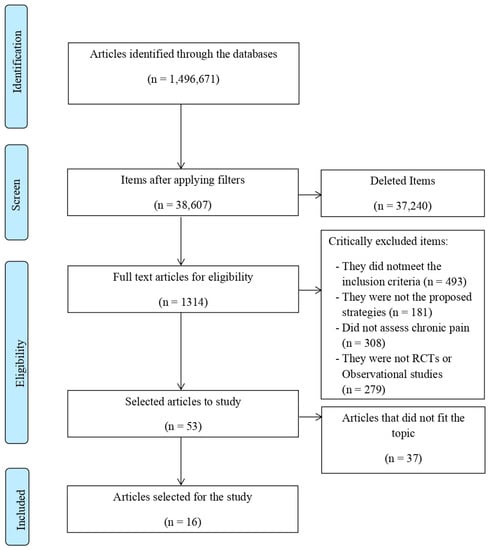
Figure 1.
Flow diagram according to the PRISMA system. Study selection and exclusion process.
3.2. Assessment of Methodological Quality
A methodological quality assessment was carried out using the different scales with the results being shown in Table 2, Table 3 and Table 4. Development of the general characteristics of the selected studies is shown in Table 5.
Table 2.
Study of the methodological quality of the RCTs through the PEDro Scale.
Table 3.
Internal validity of the selected RCTs.
Table 4.
Study of the methodological quality of observational studies through the Quality Assessment Tool for Observational Cohort and Cross-Sectional Studies Scale.
Table 5.
Development of the general characteristics of the selected studies.
3.3. Study Instruments
3.3.1. Pain
The intensity, quality, and frequency of pain in the patients who participated in the application of dietary strategies were not reduced in the studies by Baurersfeld SP. et al. [29].
On the contrary, the studies carried out by, Holton KF. et al. [36] and Towery P. et al., [39] showed that the use of different types of food and nutrition significantly impacted the improvement of chronic pain symptoms in patients who suffered from it.
A decrease in pain levels was observed via SF-36 and AIMS2-2F [39]). In addition, there was a statistically significant association to adherence to the treatment plan, since those who did not adhere to the plan had no improvement in their pain symptoms (p = 0.025) [34,41,42].
3.3.2. Inflammation
The concentration of slCAM-1, a soluble component of intercellular adhesion, which is a part of the inflammatory process, was studied and analyzed in different tissues and in structures in patients suffering from chronic pain and altered health. In the study by Stekovic S. et al. [33], they showed that there is no notable improvement in this variable.
On the other hand, the studies by Liu B. et al. [30] and Vadell AKE. et al. [34] stated that the application of dietary strategies can greatly decrease the levels of inflammation found in those suffering from chronic pain.
The levels of inflammation seen in tissues increased after the ingestion of food (p = 0.02) [30], and it was less during periods of fasting (p = 0.04) [32].The concentration of anti-inflammatory indicators (EPA and DHA) in the groups in which a treatment strategy had been applied increased (p ≤ 0.001 in both cases) [34].
3.3.3. Quality of Life
The studies by Towery P. et al. [39] and Vadell AKE. et al. [34] showed that the application of dietary strategies for people suffering from chronic pain had a positive impact on quality of life.
A statistically significant association between diet and quality of life was found via the following questionnaires: a MED (p = 0.0001), WOMAC Scores (p = 0.01) [38], Health Questionnaires (p = 0.023), and General Questionnaires (p = 0.033) [39,40].
- -
- Visual Analogue Scale (VAS): a scale used to measure pain. It consists of a horizontal or a vertical line that represents the pain intensity with a score from 0 to 10, where the number 0 is synonymous with “no pain” and 10 is synonymous with “very intense pain/worst pain imaginable” [43].
- -
- SF-36: a tool for the evaluation of Health-Related Quality of Life (HRQoL). Scale applicable to any population. It contains 36 items that lead to the assessment of a positive and a negative quality of life. These questions are divided into eight scales in which physical function, physical role, bodily pain, general health, vitality, social function, emotional role, and mental health are questioned [44].
- -
- Functional Assessment of Cancer Therapy (FACT-G): a quality of life assessment scale. This questionnaire is made up of 27 items that collect, on four scales, the values of physical state, family and social environment, emotional state, and functional capacity. Each item has a value of 0 to 4 points [45].
- -
- Functional Assessment of Chronic Illness Therapy-Fatigue (FACIT-F): a questionnaire related to health and quality of life associated with chronic pain illnesses. It consists of 27 general questions that encompass physical well-being, family/social well-being, emotional well-being, and functional well-being [46].
- -
- Functional Assessment of Chronic Illness Therapy-Trial Outcome Index (FACIT-TOI): a calculator for any illness, treatment or condition scale. An appraisal criterion that is normally used in clinical trials since it responds to physical and to functional changes [46].
- -
- Fibromyalgia Survey Questionnaire (FSQ): a questionnaire for the evaluation of symptoms in people suffering from fibromyalgia. It incorporates the WPI scale and the modification of the SSS [47].
- -
- Arthritis Impact Measurement Scales 2 (AIMS2-SF): a questionnaire that assesses physical, mental, and social conditions based on nine scales: mobility, physical activity, stroke, dexterity, household activities, pain, social activity, depression, and anxiety. Each scale is made up of four to seven items. The overall score ranges from 0 to 10 points [48].
- -
- Numerical Pain Scale (NPRS): a one-dimensional tool for measuring pain in adults, consisting of 11 items. It is a version of the VAS scale that has scores from 0 to 10, with 0 being synonymous with “no pain” and 10 being “the most intense pain imaginable” [43].
- -
- Western Ontario and McMaster Universities Osteoarthritis Index (WOMAC): a specific questionnaire for the measurement and the evaluation of pain, stiffness, and functional capacity in knee and hip osteoarthritic disease. It is composed of three scales (pain, stiffness, and functional capacity), which includes 24 items. The items are answered verbally using a scale which has five levels (0–4), ranging from little to a lot [49].
- -
- EuroQoL-5D (EQ-5D):an assessment of the standard of living in Europe. It consists of five questions about mobility, personal care, day-to-day activities, pain/discomfort, and anxiety/depression [50].
- -
- Health Assessment Questionnaire (HAQ): a questionnaire used to calculate the health of people with rheumatoid arthritis. It quantifies gastropathy, risk factors, and the risk of death in rheumatoid arthritis [51].
- -
- Patient Global Assessment (PGA): one of the most used assessments in rheumatoid arthritis. It is based on a question related to general health or disease activity that has a numerical answer from 0 to 10 or 0 to 100 [52].
- -
- Short-Form Health Outcome Survey (SF-12): a survey comprised of 12 questions that evaluates health in relation to quality of life [53].
- -
- Knee Injury and Osteoarthritis Outcome Score (KOOS): this separately evaluates pain (9 items), symptoms (7 items), ADL function (17 items), sport and recreation functioning (5 items), and quality of life (4 items). Each item can be scored on a scale of 0 to 4 [54].
- -
- Disease Activity Score on 28 joints (DAS28): a system to evaluate the activity of the disease and the treatment response in rheumatoid arthritis. The stipulated limit for an increase in treatment is 3.2 [51].
- -
- Simple Disease Activity Index (SDAI): a system to evaluate, at any time or place, the activity of rheumatoid arthritis. Doctors can choose the evaluation tool that best fits the environment they find themselves in [55].
- -
- Rheumatic Arthritis Impact of Disease (RAID): this evaluates pain, functional impairment, fatigue, sleep, and physical and emotional functioning in patients with rheumatoid arthritis. It is a validated tool that is highly trustworthy and sensitive to change [56].
- -
- Healthy Eating Index 2015 (HEI-2015): a measuring tool to evaluate whether certain food groups follow the Dietary Guidelines for Americans (DGA). Each time a new DGA is published, the HEI is updated. In comparison to the 2010 update, the 2015 version included specific recommendations on the limitation of added sugars and saturated fats [57].
3.4. Intermittent Fasting
Intermittent fasting in healthy individuals [27,32] over a six month intervention period and in chemotherapy patients in the short term [29] can be well tolerated without causing adverse effects.
Fasting significantly reduced the levels of plasma insulin but left them unchanged if anti-oxidant supplementation was consumed [27].A decrease in the level of oxidative stress, no significant change in gene expression, but a trend in SIRT3 toward significance [27] was seen. On the other hand, an increase in insulin resistance was observed at the end of the fasting period [28].
In the short term (less than 12 weeks), intermittent fasting appears to improve quality of life and fatigue in healthy subjects [27] and in patients on chemotherapy [29].
A reduction in total weight was observed in subjects who had a decrease in lean muscle mass, although overall there was no significant change in the weight of subjects during intermittent fasting. Those who presented a decrease in lean muscle mass led to a reduction in total weight, however there was no significant change in the overall weight of subjects during intermittent fasting [28,32]. In the medium term (more than 12 weeks and less than 6 months), there was a significantly observable decrease in weight, fat [30,32], and serum non-esterified fatty acids [30]. After fasting, non-esterified fatty acids, M1-macrophages (CD40+) in adipose tissue, and M2-macrophages (CD163+) in muscle tissue had increased. Additionally, the changes in non-esterified fatty acids and in the mRNA of pan-macrophage marker CD68 in adipose tissue were positively correlated [30].
Inflammation markers, in serum (TNFα, IL6, and IL10) and in subcutaneous adipose tissue and skeletal muscle (CD68, CD40 and CD163), remained unchanged after the eating phases [30]. In addition, positive effects resulted in a reduction in sICAM-1 and DAS28-ESR [32,34]. The levels of low-density lipoprotein and metabolic regulator triiodothyronine were reduced after long-term intermittent fasting (more than 6 months) [32].
Moreover, changes in measurements, such as average dolorimetry, symptom score, tender point number, myalgic score, the Chalder Fatigue Scale, and significantly less Gulf War Illness symptoms, have been reported [36].
Intermittent fasting improved cardiovascular markers and b-hydroxybutyrate levels increased even on non-fasting days. On fasting days, pro-aging amino-acid methionine was periodically depleted, while polyunsaturated fatty acids were elevated [32].
On the other hand, an increase in LDL, plasma TNF-alfa, plasma cortisol, and systolic blood pressure, and a decrease in HDL, VO2 max, and the CANTAB score were produced by intermittent fasting, while avoiding physical activity and spending time resting in bed [28].
3.5. Time Restricted Feeding
The results obtained showed that levels of biomarkers HbA1 and fasting plasma glucose were reduced by 18% (p < 0.001) and 15% (p < 0.001), respectively, after the intervention of TRF. There was a significant improvement in the HOMA-β (p = 0.005) and HOMA-IR. (p = 0.02) scales along with a reduction in body weight and BMI [37].
In regards to the eating window, no significant differences were found when comparing results between groups (p = 0.62) [37].
After the intervention, an improvement in quality of life was produced in those that received TRF. The final rating on the SF-12 questionnaire was favorable (p < 0.001) [37].
3.6. Caloric Restriction
The level of adipocytes decreased in all groups (p = 0.01). A significant increase in the level of tissue inflammation after eating (p = 0.02) was found. These levels decreased with intermittent fasting (p ≤ 0.01) but not with caloric restriction. Body weight and body fat decreased (p < 0.05) [30].
Once the follow-up time period had ended, no significant changes were observed in glucose level (p = 0.956), HDL-C (p = 0.728), or LDL-C (p = 0.726) [30].
3.7. Ketogenic Diet
A reduction in glucose levels (p = 0.001) and an increase in oxidative metabolic stress, at the cellular level, were observed in patients who received radiation or chemotherapy after having completed 90 days of the intervention [33].The levels of cholesterol (p = 0.43), triglycerides(p = 0.42), HDL-C (p = 0.39), LDL-C (p = 0.45), TC:HDL-C ratio (p = 0.28), TG:HDL-C ratio (p = 0.94), thyroid hormone, and electrolytes showed no difference between groups. After the intervention, lactate values decreased significantly after 12 weeks of intervention(p = 0.02) [31,35].
A decrease in sugar consumption (p < 0.0001), daily calories (p < 0.01), weight loss (p < 0.001), BMI (p < 0.001), body fat (p = 0.03), and the sensation of appetite/hunger were all observed after 12 weeks of a KD intervention (p = 0.02). In addition, blood lipids were improved [32,34,36].
3.8. Mediterranean Diet
Subjects with a higher adherence to a Mediterranean diet, of unspecified duration, scored better results in quality of life scales [39,41,42], however a smaller group reported a non-significant variation in those scores [42]. Levels of pain, functional disability, wellness of sleep, physical and general well-being, and pain location and severity were significantly lower in subjects who followed a Mediterranean diet [39,41,42], but pain frequency and articular stiffness were exceptions [38,41]. There was a reduction in the mass of those subjects who had strictly adhered to a Mediterranean diet but this was not a significant conclusion [42]. A Mediterranean diet is considered to be a protective factor against arterial hypertension [40] and depression [38,41].
The strict adherence to a Mediterranean diet is significantly related to a healthier score in quality of life and chronic disease symptom scales and questionnaires [38,40,41,42].
4. Discussion
The objective of this study was to systematically review the existing scientific evidence on the efficacy of dietary strategies applied as part of the treatment of chronic musculoskeletal pain and health. As a result, 16 articles were selected of which 11 were RCTs and 5 were observational studies.
Within the selected studies, six of them showed an improvement in chronic pain symptoms in response to a specific food strategy. These strategies included: a low glutamate diet for Gulf War Syndrome [36], the diet recommended in the HEL-2015 Guide for different age groups [58], a vegetarian/vegan diet, intermittent fasting, caloric restriction, food restricted time, a Mediterranean diet, a plant-based diet, a diet rich in polyunsaturated fatty acids, antioxidant vitamins and minerals, fruits and fibers, a FODMAP diet, and the elimination of monosodium glutamate for patients suffering from fibromyalgia, rheumatoid arthritis, chronic musculoskeletal pain, and neuropathic pain [10,59,60,61]. There were two studies where no decrease in the perception of pain intensity and/or frequency were found [29,39]. With regard to the levels of inflammation, four studies found it decreased through the combination of intermittent fasting and caloric restriction for people diagnosed with obesity [30], through anti-inflammatory nutrition for rheumatoid arthritis sufferers [34], and through intermittent fasting, caloric restriction, a vegan/vegetarian diet and a Mediterranean diet for people with chronic musculoskeletal pain, fibromyalgia and/or rheumatoid arthritis [60,61]. Only one study showed no improvement in the levels of inflammation [32].The quality of life was significantly increased in six studies that applied: (i) anti-inflammatory and omega 3 diets in patients with rheumatoid arthritis [34,61]; (ii) a plant-based diet and intermittent fasting for musculoskeletal pain [39,62]; and (iii) a vegan/vegetarian diet, a FODMAP diet, and glutamate elimination for fibromyalgia [59,61].
4.1. Effects and Benefits of Dietary Strategies on Chronic Musculoskeletal Pain
Studies have shown that the use of nutritional strategies may have an impact on pain and health. In this regard, current research shows that intermittent fasting improves pain perception in patients suffering from chronic pain in the short term. However, other studies have shown these changes to have no significant effect [62]. Caloric restriction has been shown to be a good long term treatment option for people suffering from pain of a rheumatic etiology [60], and a time restricted feeding strategy may serve as a first step towards a caloric restriction diet [20], which has shown both quantitative and qualitative changes in the level of health. These changes include the regulation of the circadian rhythm which are different physiological processes that occur 24 h a day such as blood pressure, the sleep cycle, respiration, heart rate, and cognitive processes [20].
Pain symptoms have been shown to improve by following a diet low in glutamate. High levels of glutamate can produce an excess of oxytocin, which is one of the causes of oxidative stress and neuroinflammation, leading to cell death. The purpose of a low glutamate diet is to reduce exposure to glutamate, while taking in nutrients that protect against an excess of oxytocin and oxidative stress. This type of diet improves the metabolic energy of the neuronal cell, which not only helps to explain improvements in fatigue but also increases the potential for glutamate release in the neurotransmission process [36]. In addition, the use of a Mediterranean diet has been shown to decrease the level of pain [39,41,42], although the contrary is seen when assessing pain frequency and articular stiffness [38,41].
The increased consumption of sugar has become an aggravating factor in health [58] as there is a pro-inflammatory effect that favors an increase in chronic symptoms. Hence, an essential factor in the control and the treatment of arthritis should be to reduce sugar intake [58].
Other nutritional strategies, such as the KD and TRF, have not been found to produce changes in pain perception. However, the majority of these studies were carried out in healthy or overweight and obese adults, and therefore studies using these strategies are needed [20].
4.2. Effects and Benefits of Dietary Strategies on Quality of Life in Those Suffering from Chronic Pain
A Mediterranean diet has been shown to positively affect low inflammatory diseases since it is comprised of elements that promote health and regulate certain immunological parameters [58]. Furthermore, it has also been shown to increase the quality of life, sleep wellness, physical, and general well-being. Fasting creates greater tolerance to chemotherapy sessions, as well as positive effects at the metabolic, endocrine, and hematological levels as well as a decrease in DNA damage [29]. Moreover, the addition of exercise to this food strategy reduces insulin resistance and inflammation levels, which positively affects glucose metabolism and increases cognitive functions [27,28], creating beneficial effects on cardiovascular risk factors [28]. Evidence shows that intermittent fasting moderately increases the expression of SIRT3, the main mitochondrial deacetylase, which modulates oxygen production and reduces its damage on cellular components [27].
TRF has been shown to produce quantitative and qualitative changes in the level of health, including the regulation of the circadian rhythm, which represents different physiological processes that occur 24 h a day such as blood pressure, sleep cycle, respiration, heart rate, and cognitive processes. Our knowledge of how meal frequency and timing impact health and the circadian rhythm has yet to be explored, and it needs to be increased [20,63]. In this context, lifestyle factors have also been associated to SNC functioning, brain derived neurotrophic factor, and inflammation, thus highlighting the importance of both assessing and treating patients, including nutritional interventions, within a multimodal treatment [63,64,65].
Finally, the KD seems to improve the quality of life in those suffering from breast cancer, but evidence is scarce and more studies are needed to corroborate these findings [35].
4.3. Strengths and Weaknesses of the Study
This review presents a number of strengths. First, the use of different scales to ensure a good methodological quality of the studies collected and, therefore, the results obtained. Second, a wide variety in the studies analyzed, namely RCTs, observational studies, and systematic reviews. Finally, this study exposes current gaps in our understanding of how food strategies affect people suffering from chronic pain, and it proposes new directions to follow in this line. On the other hand, some weak points should be mentioned. The extensive variety of food strategies that can be used in this field of research makes the extrapolation of the results difficult to summarize. Moreover, due to the heterogeneity of the participants the results from this study should be interpreted with caution. Finally, due to the vast number of studies obtained during the search we did not research nor make comparisons between combinations of regimens as we did with the nutritional strategies in isolation.
4.4. Clinical Application of the Results and Future Research Lines
Current scientific literature shows that for diseases such as rheumatoid arthritis [34,61], cancer [29], fibromyalgia [59], or chronic musculoskeletal pain [10,40,62], the application of different dietary strategies may be effective. This is due to the fact that it favors the reduction of inflammation levels [9], which lead to a decrease in CNS sensitization. This triggers a decrease in the perception of pain, and therefore an improvement in the quality of life and health of the subjects [10]. Furthermore, the use of nutritional strategies to improve the gut microbiome may justify changes in pain perception and quality of life since poor nutrition has been shown to cause changes in the microbiome that results in inflammation of the systemic and the central nervous system. The chronification and the amplification of pain may be increased by both central and peripheral immune activity, which causes aberrant glial activity and reinforces this mechanism. Based on the results of the presented study, and in order to increase the quality of both research and treatment, several future research lines are proposed: (i) to carry out studies analyzing the efficacy of food strategies on chronic pain and health in combination with other therapies such as exercise and physiotherapy in different conditions, for example chronic pain, cancer, fibromyalgia, cardiovascular, and metabolic diseases; (ii) to analyze the molecular mechanisms that exist behind the benefits produced after the combined application of dietary strategies and other strategies on those patients; and (iii) to analyze changes in oxidative stress biomarkers and inflammatory cell populations, as well as circadian rhythms, after the application of a combined intervention of dietary strategies and other therapies in patients with chronic musculoskeletal pain.
5. Conclusions
Studies that show consensus on the effects of an IF diet on pain improvement, in either the short or the long term, are lacking. IF improves mitochondrial metabolism, and with the addition of exercise both insulin resistance and inflammation levels may be decreased, thereby improving glucose metabolism, cognitive functions, and the cardiovascular system.
Caloric restriction is a good long term treatment option for people suffering from pain of a rheumatic etiology. The TRF intervention improves health by affecting the circadian rhythm, and it therefore helps blood pressure, sleep quality, breathing quality, heart rate, and cognitive processes. The KD may improve the quality of life in those suffering from breast cancer.
The quality of the studies collected on dietary strategies in the treatment of chronic pain and health is good. Further studies analyzing the effects of different food strategies on pain, quality of life, the circadian rhythm, and sleep quality, not only in isolation but in combination with other therapies in the short and the long term, are needed.
Author Contributions
Conceptualization, S.N.-L. and A.G.-M.; methodology, M.C.-C. and J.J.P.-M.; software, M.C.G.-R.; validation, S.N.-L., A.G.-M. and M.C.G.-R.; formal analysis, M.C.-C., J.J.P.-M. and S.N.-L.; investigation, M.C.-C. and S.N.-L.; resources, M.C.-C., J.J.P.-M. and A.G.-M.; data curation, M.C.-C., J.J.P.-M. and S.N.-L., writing—original draft preparation, M.C.-C. and S.N.-L.; writing—review and editing, S.N.-L. and A.G.-M.; visualization, M.C.G.-R.; supervision, S.N.-L. and M.C.G.-R.; project administration, S.N.-L. All authors have read and agreed to the published version of the manuscript.
Funding
This research received no external funding.
Institutional Review Board Statement
Not applicable.
Informed Consent Statement
Not applicable.
Data Availability Statement
Data can be requested from the corresponding author.
Conflicts of Interest
The authors declare no conflict of interest.
Abbreviations
| ADL | Activities of Daily Living |
| AIMS2-SF | Arthritis Impact Measurement Scales 2 |
| ALT | Alanine Transminase |
| AST | Asparate Aminotransferase |
| BMI | Body mass index |
| BUN | Blood Urea Nitrogen |
| CG | Control Group |
| CINAHL | Cumulative Index to Nursing & Allied Health Literature |
| CNS | Central Nervous System |
| DHA | Docosahexaenoic Acid |
| DNA | Deoxyribonucleic Acid |
| EG | Experimental Group |
| EPA | Eicosapentaenoic Acid |
| FACT-G | Functional Assessment of Cancer Therapy—General |
| FSQ | Fibromyalgia Survey Questionnaire |
| HDL | High Density Lipoprotein |
| HRQL | Generic health-related quality of life |
| IVS | Internal Validity Score |
| LDL | Low Density Lipoprotein |
| MeSH | Medical Subject Headings |
| NPRS | Numeric Pain Rating Scale |
| PRISMA | Preferred Reporting Items for Systematic Reviews and Meta-Analyses |
| RCTs | Randomized Clinical Trials |
| RMI | Magnetic Resonance Imaging |
| SF-36 | Health Questionnaire |
| SIRT3 | Sirtuin 3 |
| SSS | Symptom Severity Scale |
| TC | Total Cholesterol |
| TG | Triglyceride |
| VAS | Visual analogue Scale |
| VO2 Max | Maximum Oxygen Volume |
| WPI | Widespread Pain Index |
| WOMAC | Western Ontario and McMaster Universities Osteoarthritis Index |
References
- Nijs, J.; D’Hondt, E.; Clarys, P.; Deliens, T.; Polli, A.; Malfliet, A.; Coppieters, I.; Willaert, W.; Tumkaya Yilmaz, S.; Elma, Ö.; et al. Lifestyle and Chronic Pain across the Lifespan: An Inconvenient Truth? PMR 2020, 12, 410–419. [Google Scholar] [CrossRef]
- Nijs, J.; Leysen, L.; Vanlauwe, J.; Logghe, T.; Ickmans, K.; Polli, A.; Malfliet, A.; Coppieters, I.; Huysmans, E. Treatment of central sensitization in patients with chronic pain: Time for change? Expert Opin. Pharmacother. 2019, 20, 1961–1970. [Google Scholar] [CrossRef] [PubMed]
- Puntillo, F.; Giglio, M.; Paladini, A.; Perchiazzi, G.; Viswanath, O.; Urits, I.; Sabbà, C.; Varrassi, G.; Brienza, N. Pathophysiology of musculoskeletal pain: A narrative review. Ther. Adv. Musculoskelet. Dis. 2021, 13, 1759720X2199506. [Google Scholar] [CrossRef]
- Mills, S.E.E.; Nicolson, K.P.; Smith, B.H. Chronic pain: A review of its epidemiology and associated factors in population-based studies. Br. J. Anaesth. 2019, 123, e273–e283. [Google Scholar] [CrossRef] [PubMed]
- Scholz, J.; Finnerup, N.B.; Attal, N.; Aziz, Q.; Baron, R.; Bennett, M.I.; Benoliel, R.; Cohen, M.; Cruccu, G.; Davis, K.D.; et al. The IASP classification of chronic pain for ICD-11: Chronic neuropathic pain. Pain 2019, 160, 53–59. [Google Scholar] [CrossRef] [PubMed] [Green Version]
- Lee, J.Y.; Lee, G.J.; Lee, P.R.; Won, C.H.; Kim, D.; Kang, Y.; Oh, S.B. The analgesic effect of refeeding on acute and chronic inflammatory pain. Sci. Rep. 2019, 9, 16873. [Google Scholar] [CrossRef]
- Bushnell, M.; Čeko, M.; Low, L. Cognitive and emotional control of pain and its disruption in chronic pain. Nat. Rev. Neurosci. 2013, 14, 502–511. [Google Scholar] [CrossRef] [Green Version]
- Sommer, C.; Leinders, M.; Üçeyler, N. Inflammation in the pathophysiology of neuropathic pain. Pain 2018, 159, 595–602. [Google Scholar] [CrossRef]
- Prasad, J.D.; Gunn, K.C.; Davidson, J.O.; Galinsky, R.; Graham, S.E.; Berry, M.J.; Bennet, L.; Gunn, A.J.; Dean, J.M. Anti-Inflammatory Therapies for Treatment of Inflammation-Related Preterm Brain Injury. Int. J. Mol. Sci. 2021, 22, 4008. [Google Scholar] [CrossRef]
- Elma, Ö.; Yilmaz, S.T.; Deliens, T.; Coppieters, I.; Clarys, P.; Nijs, J.; Malfliet, A. Do Nutritional Factors Interact with Chronic Musculoskeletal Pain? A Systematic Review. J. Clin. Med. 2020, 9, 702. [Google Scholar] [CrossRef] [Green Version]
- Sjaarda, L.A.; Radin, R.G.; Swanson, C.; Kuhr, D.L.; Mumford, S.L.; Galai, N.; Silver, R.M.; Wactawski-Wende, J.; Perkins, N.J.; Schisterman, E.F. Prevalence and Contributors to Low-grade Inflammation in Three U.S. Populations of Reproductive Age Women. Paediatr. Perinat. Epidemiol. 2018, 32, 55–67. [Google Scholar] [CrossRef] [Green Version]
- Owen, L.; Corfe, B. The role of diet and nutrition on mental health and wellbeing. Proc. Nutr. Soc. 2017, 76, 425–426. [Google Scholar] [CrossRef] [PubMed] [Green Version]
- Totsch, S.K.; Waite, M.E.; Tomkovich, A.; Quinn, T.L.; Gower, B.A.; Sorge, R.E. Total Western Diet Alters Mechanical and Thermal Sensitivity and Prolongs Hypersensitivity Following Complete Freund’s Adjuvant in Mice. J. Pain 2016, 17, 119–125. [Google Scholar] [CrossRef] [PubMed] [Green Version]
- Nijs, J.; Elma, Ö.; Yilmaz, S.T.; Mullie, P.; Vanderweeën, L.; Clarys, P.; Deliens, T.; Coppieters, I.; Weltens, N.; Van Oudenhove, L.; et al. Nutritional neurobiology and central nervous system sensitisation: Missing link in a comprehensive treatment for chronic pain? Br. J. Anaesth. 2019, 123, 539–543. [Google Scholar] [CrossRef] [PubMed]
- Manchishi, S.M.; Cui, R.J.; Zou, X.H.; Cheng, Z.Q.; Li, B.J. Effect of caloric restriction on depression. J. Cell. Mol. Med. 2018, 22, 2528–2535. [Google Scholar] [CrossRef] [PubMed] [Green Version]
- Pace, L.A.; Crowe, S.E. Complex Relationships Between Food, Diet, and the Microbiome. Gastroenterol. Clin. N. Am. 2016, 45, 253–265. [Google Scholar] [CrossRef] [PubMed] [Green Version]
- Masino, S.A.; Ruskin, D.N. Ketogenic diets and pain. J. Child Neurol. 2013, 28, 993–1001. [Google Scholar] [CrossRef] [Green Version]
- Elma, Ö.; Yilmaz, S.T.; Deliens, T.; Clarys, P.; Nijs, J.; Coppieters, I.; Polli, A.; Malfliet, A. Chronic Musculoskeletal Pain and Nutrition: Where Are We and Where Are We Heading? PMR 2020, 12, 1268–1278. [Google Scholar] [CrossRef]
- Sibille, K.T.; Bartsch, F.; Reddy, D.; Fillingim, R.B.; Keil, A. Increasing neuroplasticity to bolster chronic pain treatment: A role for intermittent fasting and glucose administration? J. Pain 2016, 17, 275–281. [Google Scholar] [CrossRef] [Green Version]
- Caristia, S.; De Vito, M.; Sarro, A.; Leone, A.; Pecere, A.; Zibetti, A.; Filigheddu, N.; Zeppegno, P.; Prodam, F.; Faggiano, F.; et al. Is Caloric Restriction Associated with Better Healthy Aging Outcomes? A Systematic Review and Meta-Analysis of Randomized Controlled Trials. Nutrients 2020, 12, 2290. [Google Scholar] [CrossRef]
- Pureza, I.R.D.O.M.; Macena, M.d.L.; da Silva Junior, A.E.; Praxedes, D.R.S.; Vasconcelos, L.G.L.; Bueno, N.B. Effect of early time-restricted feeding on the metabolic profile of adults with excess weight: A systematic review with meta-analysis. Clin. Nutr. 2021, 40, 1788–1799. [Google Scholar] [CrossRef] [PubMed]
- Adafer, R.; Messaadi, W.; Meddahi, M.; Patey, A.; Haderbache, A.; Bayen, S.; Messaadi, N. Food Timing, Circadian Rhythm and Chrononutrition: A Systematic Review of Time-Restricted Eating’s Effects on Human Health. Nutrients 2020, 12, 3770. [Google Scholar] [CrossRef] [PubMed]
- D’Andrea Meira, I.; Romão, T.T.; Do Prado, H.J.P.; Krüger, L.T.; Pires, M.E.P.; Da Conceição, P.O. Ketogenic diet and epilepsy: What we know so far. Front. Neurosci. 2019, 13, 5. [Google Scholar] [CrossRef] [PubMed] [Green Version]
- Alsharairi, N.A. The role of short-chain fatty acids in mediating very low-calorie ketogenic diet-infant gut microbiota relationships and its therapeutic potential in obesity. Nutrients 2021, 13, 3702. [Google Scholar] [CrossRef] [PubMed]
- Welch, V.; Petticrew, M.; Tugwell, P.; Moher, D.; O’Neill, J.; Waters, E.; White, H. Extensión PRISMA-Equidad 2012: Guías para la escritura y la publicación de revisiones sistemáticas enfocadas en la equidad en salud. Rev. Panam. Salud Publica 2013, 34, 60–67. [Google Scholar]
- Maher, C.G.; Sherrington, C.; Herbert, R.D.; Moseley, A.M.; Elkins, M. Reliability of the PEDro scale for rating quality of randomized controlled trials. Phys. Ther. 2003, 83, 713–721. [Google Scholar] [CrossRef] [Green Version]
- Harrison, R.; Jones, B.; Gardner, P.; Lawton, R. Correction to: Quality assessment with diverse studies (QuADS): An appraisal tool for methodological and reporting quality in systematic reviews of mixed- or multimethod studies. BMC Health Serv. Res. 2021, 21, 231. [Google Scholar] [CrossRef]
- Wegman, M.P.; Guo, M.H.; Bennion, D.M.; Shankar, M.N.; Chrzanowski, S.M.; Goldberg, L.A.; Xu, J.; Williams, T.A.; Lu, X.; Hsu, S.I.; et al. Practicality of Intermittent Fasting in Humans and its Effect on Oxidative Stress and Genes Related to Aging and Metabolism. Rejuvenation Res. 2015, 18, 162–172. [Google Scholar] [CrossRef] [Green Version]
- Harder-Lauridsen, N.M.; Nielsen, S.T.; Mann, S.P.; Lyngbæk, M.P.; Benatti, F.B.; Langkilde, A.R.; Law, I.; Wedell-Neergaard, A.S.; Thomsen, C.; Møller, K.; et al. The effect of alternate-day caloric restriction on the metabolic consequences of 8 days of bed rest in healthy lean men: A randomized trial. J. Appl. Physiol. 2017, 122, 230–241. [Google Scholar] [CrossRef]
- Bauersfeld, S.P.; Kessler, C.S.; Wischnewsky, M.; Jaensch, A.; Steckhan, N.; Stange, R.; Kunz, B.; Brückner, B.; Sehouli, J.; Michalsen, A. The effects of short-term fasting on quality of life and tolerance to chemotherapy in patients with breast and ovarian cancer: A randomized cross-over pilot study. BMC Cancer 2018, 18, 476. [Google Scholar] [CrossRef]
- Liu, B.; Hutchison, A.T.; Thompson, C.H.; Lange, K.; Heilbronn, L.K. Markers of adipose tissue inflammation are transiently elevated during intermittent fasting in women who are overweight or obese. Obes. Res. Clin. Pract. 2019, 13, 408–415. [Google Scholar] [CrossRef] [PubMed]
- Cohen, C.W.; Fontaine, K.R.; Arend, R.C.; Gower, B.A. A Ketogenic Diet Is Acceptable in Women with Ovarian and Endometrial Cancer and Has No Adverse Effects on Blood Lipids: A Randomized, Controlled Trial. Nutr. Cancer 2020, 72, 584–594. [Google Scholar] [CrossRef] [PubMed]
- Stekovic, S.; Hofer, S.J.; Tripolt, N.; Aon, M.A.; Royer, P.; Pein, L.; Stadler, J.T.; Pendl, T.; Prietl, B.; Url, J.; et al. Alternate Day Fasting Improves Physiological and Molecular Markers of Aging in Healthy, Non-obese Humans. Cell Metab. 2019, 30, 462–476.e5. [Google Scholar] [CrossRef]
- Khodabakhshi, A.; Akbari, M.E.; Mirzaei, H.R.; Mehrad-Majd, H.; Kalamian, M.; Davoodi, S.H. Feasibility, Safety, and Beneficial Effects of MCT-Based Ketogenic Diet for Breast Cancer Treatment: A Randomized Controlled Trial Study. Nutr. Cancer 2020, 72, 627–634. [Google Scholar] [CrossRef] [PubMed] [Green Version]
- Vadell, A.K.E.; Bärebring, L.; Hulander, E.; Gjertsson, I.; Lindqvist, H.M.; Winkvist, A. Anti-inflammatory Diet in Rheumatoid Arthritis (ADIRA)—A randomized, controlled crossover trial indicating effects on disease activity. Am. J. Clin. Nutr. 2020, 111, 1203–1213. [Google Scholar] [CrossRef] [Green Version]
- Khodabakhshi, A.; Seyfried, T.N.; Kalamian, M.; Beheshti, M.; Davoodi, S.H. Does a ketogenic diet have beneficial effects on quality of life, physical activity or biomarkers in patients with breast cancer: A randomized controlled clinical trial. Nutr. J. 2020, 19, 87. [Google Scholar] [CrossRef]
- Holton, K.F.; Kirkland, A.E.; Baron, M.; Ramachandra, S.S.; Langan, M.T.; Brandley, E.T.; Baraniuk, J.N. The low glutamate diet effectively improves pain and other symptoms of gulf war illness. Nutrients 2020, 12, 2593. [Google Scholar] [CrossRef]
- Che, T.; Yan, C.; Tian, D.; Zhang, X.; Liu, X.; Wu, Z. Time-restricted feeding improves blood glucose and insulin sensitivity in overweight patients with type 2 diabetes: A randomised controlled trial. Nutr. Metab. 2021, 18, 88. [Google Scholar] [CrossRef]
- Veronese, N.; Stubbs, B.; Noale, M.; Solmi, M.; Luchini, C.; Maggi, S. Adherence to the Mediterranean diet is associated with better quality of life: Data from the Osteoarthritis Initiative. Am. J. Clin. Nutr. 2016, 104, 1403–1409. [Google Scholar] [CrossRef]
- Towery, P.; Guffey, J.S.; Doerflein, C.; Stroup, K.; Saucedo, S.; Taylor, J. Chronic musculoskeletal pain and function improve with a plant-based diet. Complement. Ther. Med. 2018, 40, 64–69. [Google Scholar] [CrossRef]
- Ingegnoli, F.; Schioppo, T.; Scotti, I.; Ubiali, T.; De Lucia, O.; Murgo, A.; Marano, G.; Boracchi, P.; Caporali, R. Adherence to Mediterranean diet and patient perception of rheumatoid arthritis. Complement. Ther. Med. 2020, 52, 102519. [Google Scholar] [CrossRef] [PubMed]
- Ortolá, R.; García-Esquinas, E.; Sotos-Prieto, M.; Struijk, E.A.; Caballero, F.F.; Lopez-Garcia, E.; Rodríguez-Artalejo, F. Mediterranean Diet and Changes in Frequency, Severity, and Localization of Pain in Older Adults: The Seniors-ENRICA Cohorts. J. Gerontol. Ser. A 2022, 77, 122–130. [Google Scholar] [CrossRef] [PubMed]
- Cooper, I.; Brukner, P.; Devlin, B.L.; Reddy, A.J.; Fulton, M.; Kemp, J.L.; Culvenor, A.G. An anti-inflammatory diet intervention for knee osteoarthritis: A feasibility study. BMC Musculoskelet. Disord. 2022, 23, 47. [Google Scholar] [CrossRef] [PubMed]
- Hawker, G.A.; Mian, S.; Kendzerska, T.; French, M. Measures of adult pain: Visual Analog Scale for Pain (VAS Pain), Numeric Rating Scale for Pain (NRS Pain), McGill Pain Questionnaire (MPQ), Short-Form McGill Pain Questionnaire (SF-MPQ), Chronic Pain Grade Scale (CPGS), Short Form-36 Bodily Pain Scale (SF-36 bps), and Measure of Intermittent and Constant Osteoarthritis Pain (ICOAP). Arthritis Care Res. 2011, 63, S240–S252. [Google Scholar] [CrossRef]
- Lins, L.; Carvalho, F.M. SF-36 total score as a single measure of health-related quality of life: Scoping review. SAGE Open Med. 2016, 4, 205031211667172. [Google Scholar] [CrossRef] [PubMed] [Green Version]
- Cella, D.; Hernandez, L.; Bonomi, A.E.; Corona, M.; Vaquero, M.; Shiomoto, G.; Baez, L. Spanish Language Translation and Initial Validation of the Functional Assessment of Cancer Therapy Quality-of-Life Instrument. Med. Care 1998, 36, 1407–1418. [Google Scholar] [CrossRef]
- Webster, K.; Cella, D.; Yost, K. The Functional Assessment of Chronic Illness Therapy (FACIT) Measurement System: Properties, applications, and interpretation. Health Qual. Life Outcomes 2003, 1, 79. [Google Scholar] [CrossRef] [Green Version]
- Carrillo-de-la-Peña, M.T.; Triñanes, Y.; González-Villar, A.; Romero-Yuste, S.; Gómez-Perretta, C.; Arias, M.; Wolfe, F. Convergence between the 1990 and 2010 ACR diagnostic criteria and validation of the Spanish version of the Fibromyalgia Survey Questionnaire (FSQ). Rheumatol. Int. 2015, 35, 141–151. [Google Scholar] [CrossRef]
- Guillemin, F.; Coste, J.; Pouchot, J.; Ghézail, M.; Bregeon, C.; Sany, J. The AIMS2-SF: A short form of the arthritis impact measurement scales 2. Arthritis Rheum. 1997, 40, 1267–1274. [Google Scholar] [CrossRef]
- Bellamy, N.; Buchanan, W.W.; Goldsmith, C.H.; Campbell, J.; Stitt, L.W. Validation study of WOMAC: A health status instrument for measuring clinically important patient relevant outcomes to antirheumatic drug therapy in patients with osteoarthritis of the hip or knee. J. Rheumatol. 1988, 15, 1833–1840. [Google Scholar]
- Balestroni, G.; Bertolotti, G. EuroQol-5D (EQ-5D): An instrument for measuring quality of life. Monaldi Arch. Chest Dis. 2012, 78, 2. [Google Scholar] [CrossRef] [PubMed]
- Jensen Hansen, I.M.; Asmussen Andreasen, R.; Van Bui Hansen, M.N.; Emamifar, A. The reliability of disease activity score in 28 joints-c-reactive protein might be overestimated in a subgroup of rheumatoid arthritis patients, when the score is solely based on subjective parameters: A cross-sectional, exploratory study. J. Clin. Rheumatol. 2017, 23, 102–106. [Google Scholar] [CrossRef] [PubMed] [Green Version]
- Nikiphorou, E.; Radner, H.; Chatzidionysiou, K.; Desthieux, C.; Zabalan, C.; van Eijk-Hustings, Y.; Dixon, W.G.; Hyrich, K.L.; Askling, J.; Gossec, L. Patient global assessment in measuring disease activity in rheumatoid arthritis: A review of the literature. Arthritis Res. Ther. 2016, 18, 251. [Google Scholar] [CrossRef] [PubMed]
- Huo, T.; Guo, Y.; Shenkman, E.; Muller, K. Assessing the reliability of the short form 12 (SF-12) health survey in adults with mental health conditions: A report from the wellness incentive and navigation (WIN) study. Health Qual. Life Outcomes 2018, 16, 34. [Google Scholar] [CrossRef] [PubMed] [Green Version]
- Roos, E.M.; Roos, H.P.; Lohmander, L.S.; Ekdahl, C.; Beynnon, B.D. Knee Injury and Osteoarthritis Outcome Score (KOOS)—Development of a Self-Administered Outcome Measure. J. Orthop. Sports Phys. Ther. 1998, 28, 88–96. [Google Scholar] [CrossRef]
- Aletaha, D.; Smolen, J.S. The Simplified Disease Activity Index (SDAI) and Clinical Disease Activity Index (CDAI) to monitor patients in standard clinical care. Best Pract. Res. Clin. Rheumatol. 2007, 21, 663–675. [Google Scholar] [CrossRef]
- Mistry, J.; Sharif, M.; Prideaux, A.; Smith, C.; Sumbwanyambe, M.; Sibley, M.; Carpenter, L.; Sweeney, M.; Kiely, P. Use of rheumatoid arthritis impact of disease (RAID) in routine care; identification of DAS28 remission and unmet patient-reported outcomes. Rheumatol. Adv. Pract. 2020, 4, rkaa013. [Google Scholar] [CrossRef]
- Krebs-Smith, S.M.; Pannucci, T.R.E.; Subar, A.F.; Kirkpatrick, S.I.; Lerman, J.L.; Tooze, J.A.; Wilson, M.M.; Reedy, J. Update of the Healthy Eating Index: HEI-2015. J. Acad. Nutr. Diet. 2018, 118, 1591–1602. [Google Scholar] [CrossRef] [Green Version]
- Carter, T.; D’Cunha, N.M.; Georgousopoulou, E.N.; Isbel, S.; Davey, R.; Mellor, D.D.; Kellett, J.; McKune, A.J.; Naumovski, N. Assessing the diet quality of individuals with rheumatic conditions: A cross-sectional study. Rheumatol. Int. 2020, 40, 1439–1448. [Google Scholar] [CrossRef]
- Lowry, E.; Marley, J.; McVeigh, J.G.; McSorley, E.; Allsopp, P.; Kerr, D. Dietary Interventions in the Management of Fibromyalgia: A Systematic Review and Best-Evidence Synthesis. Nutrients 2020, 12, 2664. [Google Scholar] [CrossRef]
- Dragan, S.; Șerban, M.-C.; Damian, G.; Buleu, F.; Valcovici, M.; Christodorescu, R. Dietary Patterns and Interventions to Alleviate Chronic Pain. Nutrients 2020, 12, 2510. [Google Scholar] [CrossRef] [PubMed]
- Field, R.; Pourkazemi, F.; Turton, J.; Rooney, K. Dietary Interventions Are Beneficial for Patients with Chronic Pain: A Systematic Review with Meta-Analysis. Pain Med. 2021, 22, 694–714. [Google Scholar] [CrossRef] [PubMed]
- Brain, K.; Burrows, T.L.; Rollo, M.E.; Chai, L.K.; Clarke, E.D.; Hayes, C.; Hodson, F.J.; Collins, C.E. A systematic review and meta-analysis of nutrition interventions for chronic noncancer pain. J. Hum. Nutr. Diet. 2019, 32, 198–225. [Google Scholar] [CrossRef] [PubMed]
- Paoli, A.; Tinsley, G.; Bianco, A.; Moro, T. The influence of meal frequency and timing on health in humans: The role of fasting. Nutrients 2019, 11, 719. [Google Scholar] [CrossRef] [Green Version]
- Nanri, A.; Kochi, T.; Eguchi, M.; Kabe, I.; Mizoue, T. Demographic and lifestyle correlates of brain-derived neurotrophic factor in a working population: The Furukawa Nutrition and Health Study. Psychiatry Res. 2019, 272, 581–586. [Google Scholar] [CrossRef]

Publisher’s Note: MDPI stays neutral with regard to jurisdictional claims in published maps and institutional affiliations. |
© 2022 by the authors. Licensee MDPI, Basel, Switzerland. This article is an open access article distributed under the terms and conditions of the Creative Commons Attribution (CC BY) license (https://creativecommons.org/licenses/by/4.0/).