


Abstract
Several epidemiological studies stress the association between a diet based on high fruits and vegetables intake and a better health condition. However, elderly Europeans cannot manage the recommended fruits and vegetables consumption. This systematic review aims to explore the main factors related to fruits and vegetables consumption in elderly Europeans. We conducted literature searches on Medline, Scopus, and Web of Science from inception to May 2022. Published articles including data related to certain fruits and vegetables consumption among elderly Europeans were selected. The New Castle-Ottawa Scale and National Heart, Lung, and Blood Institute tools were used for methodological quality assessment by two authors independently. A total of 60 articles were retrieved, and data from twenty-one high-quality cross-sectional studies and five moderate-to-high-quality cohort studies, including a total of 109,516 participants, were synthesized. Associated factors mostly analyzed were those relating to demographic and socioeconomic status, such as sex, age, marital status, educational level, and income. However, the findings show a high discrepancy. Some evidence suggests a possible positive association, while other evidence shows an inverse or no association at all. The relationship between demographic and socioeconomic factors with fruits and vegetables consumption is not at all clear. More epidemiological studies with an appropriate design and corresponding statistical methods are required.
1. Introduction
In the next 20 years, an increase by about 45% of the population aged 65 years and over is expected in Europe [1]. This demographic change will have an effect on the incidence of chronic diseases, considering the association between age and multiple health outcomes such as cardiovascular, endocrine, and neurological diseases and osteoporosis [2,3]. Therefore, this situation calls for a major effort to ensure quality of life in our older population. Covering basic needs such as ensuring the consumption of healthy food is the basis for dignified and independent ageing.
Several epidemiological studies stress the importance of decreasing the consumption of simple carbohydrates and increasing high-fiber intake, as well as maintaining frequent physical activity, to prevent chronic diseases and improve human health [4,5]. Dietary patterns with high fruits and vegetables consumption, such as the Mediterranean diet, are associated with a decreased incidence of cardiovascular and endocrine diseases [6,7]. In this sense, a high daily intake of fruits and vegetables in a varied dietary pattern seems to prevent multiple chronic conditions such as cardiovascular disease, kidney disease, metabolic diseases such as obesity and type 2 diabetes, as well as depression [8,9,10,11].
At present, the World Health Organization (WHO) recommends a daily intake of five portions of fruits and vegetables [12]. However, only 12% of the European population comply with the five fruits and vegetables consumption per day, and 26% of people over 65 years do not eat any servings of fruits and vegetables. Women are the ones who better comply with the recommendations [13].
Multiple factors can be related to a greater or lesser consumption of fruits and vegetables. Some studies stress a possible relationship with sex, income, or age, as various health problems such as tooth loss, dysphagia, and cognitive problems develop over the years [14]. However, this association differs in other studies. Considering that diet can be critical for modulating the risk of chronic diseases, this systematic review aims to identify the main associated factors with low fruits and vegetables consumption among elderly Europeans.
2. Materials and Methods
This review is reported according to the 2020 update of Preferred Reporting Items for Systematic Reviews and Meta-analysis (PRISMA) (Supplementary material; Table S2).
2.1. Eligibility Criteria and Research Strategy
This review was conducted to explore the main factors associated with fruits and vegetables consumption. The research strategy was built according to the PECOS statement:
- -
- Population: non-institutionalized elderly people aged between 55 and 80 years old;
- -
- Exposure: factors associated to fruits and vegetables intake (gender, age, SES, etc.);
- -
- Comparators: lowest fruits and vegetables intake;
- -
- Outcome: fruits and vegetables consumption (quantity and variety);
- -
- Study design: quantitative and qualitative observational studies.
Three databases, Medline, Scopus, and Web of Science, were used for the research. The selection of the included studies was conducted based on previously set selection criteria: (1) quantitative and qualitative observational studies including cross-sectional and cohort design; (2) published from the inception of each database to May 2022; (3) in Spanish, English, or French; (4) conducted in Europe; (5) including non-institutionalized elderly population without specific diseases; (6) analyzing factors associated to fruits and vegetables consumption. Gray literature, books, communications, and reviews were excluded.
The research equation was established using the following keywords:
- -
- Elderly, older, aged, aging, senior*;
- -
- Fruits intake, vegetables intake, fruits consumption, vegetables consumption, food intake, food consumption, healthy food, healthy eating, healthy diet, food deserts;
- -
- Income, lower class, social class, economic, vulnerability*, social, resource, socioeconomic, poverty, inequality*;
- -
- Household, living standard, living alone, cohabiting, loneliness, residence, social relations;
- -
- Occupational level, occupation, employment, retirement*;
- -
- Educational level, education;
- -
- Gender, sex, woman*, man*;
- -
- Ethnic, race.
2.2. Quality Assessment
The quality of the selected studies was assessed independently by two authors (M.K. and C.O.-R), and discrepancies were solved through discussion with a third researcher. In accordance with the study design, three assessment tools were employed. Cross-sectional studies were evaluated using National Heart, Lung, and Blood Institute (NIHLBI) tools [15]. Two items related to a longitudinal design were not considered for cross-sectional studies: (1) sufficient time frame to see an association and (2) participants who did not engage in follow-up. Twelve items related to the research question, selection of participants, participation rate, exposure, and outcome assessment, and confounders control was also assessed. Classification of the studies was carried out based on the following cut-off scores: “0–4, low quality”, “5–9, moderate quality”, and “10–12, high quality”. For cohort studies, the Newcastle–Ottawa tool was used to assess the level of quality [16]. The scale consists in assessing 8 items related to selection, comparability, and outcome. A maximum of 9 stars can be assigned to each study (2 stars can be assigned to the item of comparability). The considered scores were “≥8 stars, high quality”, “6 to 7, moderate quality”, “≤5 stars, low quality”.
2.3. Data Extraction and Data Synthesis
Two reviewers (M.K. and C.O.-R) performed the data extraction using a predefined form. The principal information included country, year of publication, study design, sampling strategy, sample size, eligibility criteria, participant characteristics, principal outcome (dietary pattern, diet quality, fruits and vegetables quantity), assessment methods, exposure (associated factors such as socioeconomic factors, educational level, age, sex, and others), controlling factors, and principal outcomes.
Different factors associated with higher or lower consumption of fruits and vegetables were explored, and a narrative synthesis of the consulted articles was conducted for high-quality cross-sectional studies and moderate-to-high-quality cohorts.
3. Results
3.1. Literature Research
A total of 10,046 articles were retrieved. After removing duplicates, title and abstract screening was carried out, and 111 articles meeting the eligibility criteria were selected for full-text screening (further details in Table S1. Supplementary Material). Finally, 60 records published between 1995 and 2021 were included in our review (Figure 1).
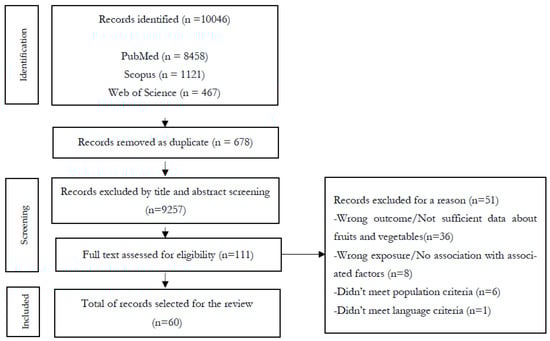
Figure 1.
Flow chart: process applied to select the included studies.
3.2. Quality Assessment of Included Studies
Methodological quality was assessed for 60 selected records. The NHLBI quality tool was applied for 51 cross-sectional studies, and the Newcastle–Ottawa Scale for nine cohorts. Regarding cross-sectional studies, 41.21% (n = 21) showed high quality, and 58.8% (n = 30) moderate quality. Weaknesses were mostly observed for the following items: (1) sample-size justification, power, variance, and effect estimation; (2) exposure measurement before the outcome measurement; (3) measurement of the outcome more than once, (4) blinding exposure (Figure 2 and Table S3). From the nine cohort studies assessed, only one showed high quality, while the percentage of low and moderate quality was similar at 44.44% (n = 4) (Table 1).
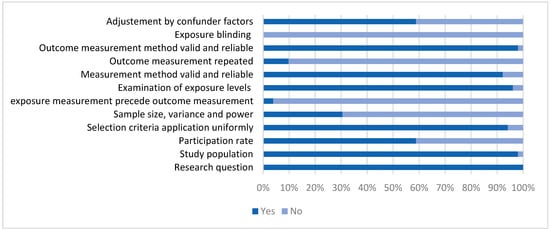
Figure 2.
Completion of cross-sectional studies using NHLBI quality assessment tool.

Table 1.
Newcastle–Ottawa Scale assessment of the cohort studies analyzing factors associated to fruits and vegetables consumption.
3.3. Characteristics of the Studies
For data synthesis, cross-sectional studies of high quality were analyzed. Regarding cohort studies, moderate-to-high-quality articles were examined as only one study showed high quality. A total of 26 articles were analyzed, including five cohorts and twenty-one cross-sectional. The mean characteristics of cohort studies were summarized in Table 2, and those of cross-sectional ones in Table 3. The distribution of studies according to the geographic area was as follows: five studies were conducted in the United Kingdom (UK) [18,19,26,27,28], five in the Netherlands [29,30,31,32,33], four in France [20,22,34,35], two in Spain [36,37], Greece [38,39] and Portugal [40,41], and only one study was conducted in each of these countries: Finland, Switzerland, Germany, Italy, and Norway. Finally, one study was multisite, conducted in France, Italy, and the UK.
Table 2.
Characteristics of cohort studies analyzing the factors associated to fruits and vegetables consumption.
Table 3.
Characteristics of cross-sectional studies analyzing factors associated to fruits and vegetables consumption.
Outcomes were averaged by fruits and vegetables consumption or adherence to fruits and vegetables guidelines. Demographic factors were the principal exposure analyzed in eighteen articles. Eleven records report an association between socioeconomic status (SES) and fruits and vegetables consumption. Sample size ranged from 3392 [19] to [22] in cohort studies, and from 98 [37] to [29] in cross–sectional studies.
3.4. Association between Demographic Determinants and Fruits and Vegetables Consumption
The association between age and fruits and vegetables consumption is not at all clear. Some studies show an inverse association [20,29,36], other studies report no association at all [35,44]. The effect of age on fruits and vegetables is not the same [45]. Moreover, outcomes can differ depending on geographic area and sex [41,43]. Regarding sex, being female was associated with high fruits and vegetables consumption [20,26,31,33,37]. However, two records do not report any association [39,43]. The findings from one study suggest a significant high fruits consumption in men [45]. Regarding marital status and social isolation determinants, we were not able to clearly define the relationship with fruits and vegetables consumption. High variation was observed in the social situation definition, which makes the comparison less evident. Regarding geographic determinants, fruits and vegetables consumption can be significantly different when comparing countries or regions [28,43]. However, the differences between rural and urban areas are not clear (Table 4).
Table 4.
Association between demographic determinants and fruits and vegetables consumption.
Other determinants were collected for this inventory (psychological state, smoking habits, cooking skills, and chewing ability). The available data were not sufficient to establish a conclusion regarding these factors (Table S4). Dijkstra et al. stress the price of fruits and vegetables and taste preferences as the principal barriers related to consumption [32]. Wandle’s findings relate fruits consumption to preferences, and vegetables consumption to nonfeasting meal patterns [47].
3.5. Association between Socioeconomic Status (SES) Predictors and Fruits and Vegetables Consumption
Outcomes related to the association between SES predictors and fruits and vegetables consumption were inconsistent. Some studies show a positive association between educational level [23,24,29,38], economic situation [24,37,39], and fruits and vegetables consumption. However, other studies show an inverse association between educational level and fruits and vegetables consumption [22,41] and no association with economic status [30,45]. Similarly, discrepancies were observed for employment status [17,22]. Outcomes can differ depending on sex [41,44] or geographic area [43] (Table 5).
Table 5.
Association between socioeconomic status (SES) determinants and fruits and vegetables consumption.
4. Discussion
This review proposes an inventory of 21 high-quality cross-sectional studies and five cohort studies with moderate to high quality reporting about associated factors to fruits and vegetables consumption in elderly people. The main associated factors analyzed in the available scientific evidence were age, sex, and determinants related to marital status and SES. Although the association between these determinants and fruit and vegetable consumption may be clear in some age groups, such as in children and adolescents, this association shows greater diversity in older Europeans. On the other hand, other factors such as liking, accessibility, psychological changes, functional disabilities and health consciousness, and knowledge and awareness of current recommendations were suggested as possible factors [49,50].
A scoping review suggests some differences in fruits and vegetables consumption especially by geographic area, socioeconomic status, marital status, and gender. Fruit and vegetables consumption varies widely according to geographical area. In some countries such as the United States, Thailand, and Baltic countries, living in a rural area was negatively associated with fruits and vegetables consumption [50,51]. However, this association does not seem accurate in all European populations. Several countries, especially those in the Mediterranean basin, such as Italy, Spain, and Greece, show high fruits and vegetables intake [43,49]. Being married and a high socioeconomic status were positively associated with fruits and vegetables consumption. Regarding gender, women tend to comply better with the recommendations than men do [14]. On the other hand, although gender shows a difference in consumption among the younger group, this relationship was not distinctive among the oldest group [51]. Articles excluded for quality show similar results regarding variability in the association of determinants such as gender and geographic area on fruits and vegetables consumption. A comparison between geographic areas, defined as countries or regions, shows some differences [52,53]. However, no difference was observed between rural and urban areas [54].
Our conclusions related to advanced age were similar to those reported previously for adults [55]. However, outcomes from other studies show a potential positive association between determinants such as income, educational level, and physical activity [27,56,57,58]. Nevertheless, no difference was observed for age, gender, and smoking status in a cross-sectional study of 504 Iranian older adults [58]. These outcomes are opposed to Baker et al.’s findings, as their outcomes on 1024 UK older adults confirm that men consume less fruits and vegetables than women do [59].
This inconsistency between various findings may be explained by the particular characteristics of participants, as belonging to different groups according to geographic area, income level, education, and culture. Determinants are typically affected by other factors. Cooking skills in British men was associated to a better consumption of fruits and vegetables [60], although other factors such as living alone may influence the ability to cook. Moreover, this cannot be generalized to other cultures or countries. On the other hand, living in some geographic areas showing less fruits and vegetables intake, such as a rural area or shanty town, is usually related to the economic situation and educational level. Differences between countries may also be related to cultural factors, as would be the case with the Mediterranean diet.
Other factors may be related to the applied study design and statistical method. Furthermore, this relationship does not look the same for fruits as it does for vegetables. This fact further complicates the comparison, since some studies evaluate fruits and vegetables together and others, separately. Finally, like Niklett et al., we also observed a deficiency in studies that specifically analyze the factors associated to fruits and vegetables consumption [14].
Our systematic review has some strengths: (1) the research was extensive and included a large list of possible associated factors, (2) only high-quality evidence was included in the results, (3) reporting review was conducted according to the PRISMA checklist. However, some limitations must be taken into account when interpreting the results. At the methodological level, the review protocol was not published previously, and the included articles were not selected in pairs. However, quality assessment and data extraction were performed by two authors independently. The fact that the associated factors were self-reported by participants is another limitation to take into account. Furthermore, it should be noted that different patterns of diet can be observed depending on the stage of aging: young-old or old-old [61].
Identifying the consumption patterns and associated factors allows us to determine population groups at risk of nutritional deficiencies. This would help to guide public health campaigns in promoting healthy lifestyles and habits. Our findings provide a summary of data obtained in the high-quality research. However, conducting second-level epidemiological studies is a necessity in order to draw more definite conclusions regarding the factors associated to fruits and vegetables consumption. Longitudinal studies may help to define a causal pathway.
5. Conclusions
Our review provides a summary of moderate-to-high-quality scientific evidence reporting data about potential associated factors to fruits and vegetables intake in elderly Europeans. Fruits and vegetables consumption may be associated to the analyzed predictors. However, confirmation of the presence of a causal relationship was not feasible due to the high level of inconsistency in the available findings. To draw stronger conclusions, more studies with an adequate design and hypothetical constructs such as health consciousness, psychological changes, independence level, and availability and diversity in local shops would be required to explore the factors associated to fruits and vegetables consumption.
Supplementary Materials
The following supporting information can be downloaded at https://www.mdpi.com/article/10.3390/ijerph20043442/s1, Table S1 Search strategy, Table S2 Full text screening: exclusion reason, Table S3 Completary list of articles included for the NHLBI quality assessment, Table S4 Other factors associated to fruit and PRISMA 2020 Checklist.
Author Contributions
Conceptualization and design: C.L.-K. and M.G.-A.; data curation: M.K. and C.O.-R.; formal analysis: M.K. and C.O.-R.; Investigation: M.K. and C.O.-R.; Methodology: M.K., C.O.-R. and J.P.A.; supervision: C.L.-K., M.G.-A. and J.P.A.; validation: C.L.-K., M.G.-A. and J.P.A.; writing— original draft preparation: M.K. and C.O.-R.; writing—review and editing: M.K., C.O.-R., C.L.-K., M.G.-A. and J.P.A.; project administration: C.L.-K. and M.G.-A. All authors have read and agreed to the published version of the manuscript.
Funding
Research project: Vegetables for Better Aging: Improving The Quality Of Eating Practices Among Elderly (IP: C.L-K). Coordination: Bosch iI Gimpera Foundation of University of Barcelona. Collaboration: Rovira i Virgili University (MG) and Pere Tarrés Foundation. Financial support: Bonduelle Foundation (2020–2022). Research Project I+D+I 2019: Eating Matters: Precarization and (In)secure Food Itineraries in Later Life (IP: M.G-A). Coordination: Universitat Rovira I Virgili. Cod. 10.13039/5011000011033, The Ministry of Science and Innovation, Spain; Research Project I+D+I 2019: Eating Matters: Environmental Risks and Dietary Uncertainties in Later Life. (IP: C.L-K). Coordination: University of Barcelona, Cod. 10.13039/5011000011033, The Ministry of Science and Innovation, Spain.
Institutional Review Board Statement
Not applicable.
Informed Consent Statement
Not applicable.
Data Availability Statement
All data generated or analyzed during this study are included in the manuscript and its Supporting Information file.
Acknowledgments
Arrebola is under contract within the Ramón y Cajal Program (RYC-2016-20155, Ministerio de Economía, Industria y Competitividad, Spain.
Conflicts of Interest
The authors declare no conflict of interest.
References
- European Commission Europe 2020—For a Healthier, EU. Available online: https://health.ec.europa.eu/other-pages/basic-page/europe-2020-healthier-eu_en (accessed on 13 October 2022).
- Eurostat Ageing Europe. Looking at the Lives of Older People in the EU; Eurostat: Luxembourg, 2020.
- Hernlund, E.; Svedbom, A.; Ivergård, M.; Compston, J.; Cooper, C.; Stenmark, J.; McCloskey, E.V.; Jönsson, B.; Kanis, J.A. Osteoporosis in the European Union: Medical Management, Epidemiology and Economic Burden. Arch. Osteoporos. 2013, 8, 136. [Google Scholar] [CrossRef] [PubMed]
- Lancet EAT-Lancet Commission Summary Report. Available online: https://eatforum.org/eat-lancet-commission/eat-lancet-commission-summary-report/ (accessed on 13 October 2022).
- Clayton, Z.S.; Craighead, D.H.; Darvish, S.; Coppock, M.; Ludwig, K.R.; Brunt, V.E.; Seals, D.R.; Rossman, M.J. Promoting Healthy Cardiovascular Aging: Emerging Topics. J. Cardiovasc. Aging 2022, 2, 43. [Google Scholar] [CrossRef]
- Shen, J.; Wilmot, K.A.; Ghasemzadeh, N.; Molloy, D.L.; Burkman, G.; Mekonnen, G.; Gongora, M.C.; Quyyumi, A.A.; Sperling, L.S. Mediterranean Dietary Patterns and Cardiovascular Health. Annu. Rev. Nutr. 2015, 35, 425–449. [Google Scholar] [CrossRef]
- Salas-Salvadó, J.; Díaz-López, A.; Ruiz-Canela, M.; Basora, J.; Fitó, M.; Corella, D.; Serra-Majem, L.; Wärnberg, J.; Romaguera, D.; Estruch, R.; et al. Effect of a Lifestyle Intervention Program With Energy-Restricted Mediterranean Diet and Exercise on Weight Loss and Cardiovascular Risk Factors: One-Year Results of the PREDIMED-Plus Trial. Diabetes Care 2019, 42, 777–788. [Google Scholar] [CrossRef] [PubMed]
- Nowson, C.A.; Service, C.; Appleton, J.; Grieger, J.A. The Impact of Dietary Factors on Indices of Chronic Disease in Older People: A Systematic Review. J. Nutr. Health Aging 2018, 22, 282–296. [Google Scholar] [CrossRef] [PubMed]
- Boeing, H.; Bechthold, A.; Bub, A.; Ellinger, S.; Haller, D.; Kroke, A.; Leschik-Bonnet, E.; Müller, M.J.; Oberritter, H.; Schulze, M.; et al. Critical Review: Vegetables and Fruit in the Prevention of Chronic Diseases. Eur. J. Nutr. 2012, 51, 637–663. [Google Scholar] [CrossRef] [PubMed]
- Jhee, J.H.; Kee, Y.K.; Park, J.T.; Chang, T.-I.; Kang, E.W.; Yoo, T.-H.; Kang, S.-W.; Han, S.H. A Diet Rich in Vegetables and Fruit and Incident CKD: A Community-Based Prospective Cohort Study. Am. J. Kidney Dis. 2019, 74, 491–500. [Google Scholar] [CrossRef] [PubMed]
- Volpe, S.L. Fruit and Vegetable Intake and Prevention of Chronic Disease. ACSMs. Health Fit. J. 2019, 23, 30–31. [Google Scholar] [CrossRef]
- WHO. Be Healthy Be Mobile. Available online: https://www.who.int/initiatives/behealthy/healthy-diet (accessed on 13 September 2022).
- European Commission EUROSTAT. Available online: https://ec.europa.eu/eurostat/databrowser/view/HLTH_EHIS_FV3E__custom_1588514/default/table?lang=en (accessed on 13 October 2022).
- Nicklett, E.J.; Kadell, A.R. Fruit and Vegetable Intake among Older Adults: A Scoping Review. Maturitas 2013, 75, 305–312. [Google Scholar] [CrossRef] [PubMed]
- NIH Study Quality Assessment Tools. Available online: https://www.nhlbi.nih.gov/health-topics/study-quality-assessment-tools (accessed on 28 January 2022).
- Wells, G.A.; Shea, B.; O’Connell, D.; Peterson, J.; Welch, V.; Losos, M.; Tugwell, P. The Newcastle-Ottawa Scale (NOS) for Assessing the Quality of Nonrandomised Studies in Meta-Analyses. Available online: http://www.ohri.ca/programs/clinical_epidemiology/oxford.asp (accessed on 28 January 2022).
- Ali-Kovero, K.; Pietiläinen, O.; Mauramo, E.; Jäppinen, S.; Rahkonen, O.; Lallukka, T.; Kanerva, N. Changes in Fruit, Vegetable and Fish Consumption after Statutory Retirement: A Prospective Cohort Study. Br. J. Nutr. 2020, 123, 1390–1395. [Google Scholar] [CrossRef] [PubMed]
- Boehm, J.K.; Soo, J.; Zevon, E.S.; Chen, Y.; Kim, E.S.; Kubzansky, L.D. Longitudinal Associations between Psychological Well-Being and the Consumption of Fruits and Vegetables. Health Psychol. 2018, 37, 959–967. [Google Scholar] [CrossRef] [PubMed]
- Kobayashi, L.C.; Steptoe, A. Social Isolation, Loneliness, and Health Behaviors at Older Ages: Longitudinal Cohort Study. Ann. Behav. Med. 2018, 52, 582–593. [Google Scholar] [CrossRef] [PubMed]
- Plessz, M.; Guéguen, A. Who Benefits from Living in a Couple? | Cairn International Edition. Rev. Française Sociol. 2017. [Google Scholar]
- Vinther, J.L.; Conklin, A.I.; Wareham, N.J.; Monsivais, P. Marital Transitions and Associated Changes in Fruit and Vegetable Intake: Findings from the Population-Based Prospective EPIC-Norfolk Cohort, UK. Soc. Sci. Med. 2016, 157, 120–126. [Google Scholar] [CrossRef] [PubMed]
- Plessz, M.; Guéguen, A.; Goldberg, M.; Czernichow, S.; Zins, M. Ageing, Retirement and Changes in Vegetable Consumption in France: Findings from the Prospective GAZEL Cohort. Br. J. Nutr. 2015, 114, 979–987. [Google Scholar] [CrossRef] [PubMed]
- Jungjohann, S.M.; Lührmann, P.M.; Bender, R.; Blettner, M.; Neuhäuser-Berthold, M. Eight-Year Trends in Food, Energy and Macronutrient Intake in a Sample of Elderly German Subjects. Br. J. Nutr. 2005, 93, 361–368. [Google Scholar] [CrossRef] [PubMed]
- Del Pozo, S.; Cuadrado, C.; Moreiras, O. Age-Related Changes in the Dietary Intake of Elderly Individuals. Euronut-SENECA Study | Cambios Con La Edad En La Ingesta Dietética de Personas de Edad Avanzada. Estudio Euronut-SENECA. Nutr. Hosp. 2003, 18, 348–352. [Google Scholar] [PubMed]
- Schroll, K.; Moreiras-Varela, O.; Schlettwein-Gsell, D.; Decarli, B.; De Groot, L.; Van Staveren, W. Cross-Cultural Variations and Changes in Food-Group Intake among Elderly Women in Europe: Results from the Survey in Europe on Nutrition and the Elderly a Concerted Action (SENECA). Am. J. Clin. Nutr. 1997, 65, 1282S–1289S. [Google Scholar] [CrossRef]
- Holmes, B.A.; Roberts, C.L.; Nelson, M. How Access, Isolation and Other Factors May Influence Food Consumption and Nutrient Intake in Materially Deprived Older Men in the UK. Nutr. Bull. 2008, 33, 212–220. [Google Scholar] [CrossRef]
- Johnson, A.E.; Donkin, A.J.M.; Morgan, K.; Neale, R.J.; Page, R.M.; Silburn, R.L. Fruit and Vegetable Consumption in Later Life. Age Ageing 1998, 27, 723–728. [Google Scholar] [CrossRef]
- Elia, M.; Stratton, R.J. Geographical Inequalities in Nutrient Status and Risk of Malnutrition among English People Aged 65 y and Older. Nutrition 2005, 1100–1106. [Google Scholar] [CrossRef] [PubMed]
- van der Toorn, J.E.; Cepeda, M.; Jong, J.C.K.; Franco, O.H.; Voortman, T.; Schoufour, J.D. Seasonal Variation of Diet Quality in a Large Middle-Aged and Elderly Dutch Population-Based Cohort. Eur. J. Nutr. 2020, 59, 493–504. [Google Scholar] [CrossRef] [PubMed]
- Schoufour, J.D.; de Jonge, E.A.L.; Jong, J.C.K.; van Lenthe, F.J.; Hofman, A.; Nunn, S.P.T.; Franco, O.H. Socio-Economic Indicators and Diet Quality in an Older Population. Maturitas 2018, 107, 71–77. [Google Scholar] [CrossRef]
- Dijkstra, S.C.; Neter, J.E.; Brouwer, I.A.; Huisman, M.; Visser, M. Adherence to Dietary Guidelines for Fruit, Vegetables and Fish among Older Dutch Adults; the Role of Education, Income and Job Prestige. J. Nutr. Health Aging 2014, 18, 115–121. [Google Scholar] [CrossRef] [PubMed]
- Dijkstra, S.C.; Neter, J.E.; Van Stralen, M.M.; Knol, D.L.; Brouwer, I.A.; Huisman, M.; Visser, M. The Role of Perceived Barriers in Explaining Socio-Economic Status Differences in Adherence to the Fruit, Vegetable and Fish Guidelines in Older Adults: A Mediation Study. Public Health Nutr. 2015, 18, 797–808. [Google Scholar] [CrossRef] [PubMed]
- Van Rossum, C.T.M.; Van De Mheen, H.; Witteman, J.C.M.; Grobbee, E.; Mackenbach, J.P. Education and Nutrient Intake in Dutch Elderly People. The Rotterdam Study. Eur. J. Clin. Nutr. 2000, 54, 159–165. [Google Scholar] [CrossRef]
- Larrieu, S.; Letenneur, L.; Berr, C.; Dartigues, J.F.; Ritchie, K.; Alpérovitch, A.; Tavernier, B.; Barberger-Gateau, P. Sociodemographic Differences in Dietary Habits in a Population-Based Sample of Elderly Subjects: The 3C Study. J. Nutr. Health Aging 2004, 8, 497–502. [Google Scholar]
- Samieri, C.; Jutand, M.-A.; Féart, C.; Capuron, L.; Letenneur, L.; Barberger-Gateau, P. Dietary Patterns Derived by Hybrid Clustering Method in Older People: Association with Cognition, Mood, and Self-Rated Health. J. Am. Diet. Assoc. 2008, 108, 1461–1471. [Google Scholar] [CrossRef]
- López-González, L.; Becerra-Tomás, N.; Babio, N.; Martínez-González, M.Á.; Díaz-López, A.; Corella, D.; Goday, A.; Romaguera, D.; Vioque, J.; Alonso-Gómez, Á.M.; et al. Variety in Fruits and Vegetables, Diet Quality and Lifestyle in an Older Adult Mediterranean Population. Clin. Nutr. 2021, 40, 1510–1518. [Google Scholar] [CrossRef]
- Jiménez-Redondo, S.; de Miguel, B.B.; Gómez-Pavón, J.; Vives, C.C. Consumo de Alimentos y Riesgo de Malnutrición En Personas Muy Mayores (≥ 80 Años) de Vida Independiente. Nutr. Hosp. 2016, 33, 572–579. [Google Scholar] [CrossRef]
- Apostolaki, I.; Pepa, A.; Magriplis, E.; Malisova, O.; Kapsokefalou, M. Mediterranean Diet Adherence, Social Capital and Health Related Quality of Life in the Older Adults of Crete, Greece: The MINOA Study. Med. J. Nutrition Metab. 2020, 13, 149–161. [Google Scholar] [CrossRef]
- Katsarou, A.; Tyrovolas, S.; Psaltopoulou, T.; Zeimbekis, A.; Tsakountakis, N.; Bountziouka, V.; Gotsis, E.; Metallinos, G.; Polychronopoulos, E.; Lionis, C.; et al. Socio-Economic Status, Place of Residence and Dietary Habits among the Elderly: The Mediterranean Islands Study. Public Health Nutr. 2010, 13, 1614–1621. [Google Scholar] [CrossRef] [PubMed]
- Cabrera-Rodriguez, R.; Luzardo, O.P.; Gonzalez-Antuna, A.; Boada, L.D.; Almeida-Gonzalez, M.; Camacho, M.; Zumbado, M.; Carolina Acosta-Dacal, A.; Rial-Berriel, C.; Alberto Henriquez-Hernandez, L. Occurrence of 44 Elements in Human Cord Blood and Their Association with Growth Indicators in Newborns. Environ. Int. 2018, 116, 43–51. [Google Scholar] [CrossRef] [PubMed]
- Oliveira, A.; Maia, B.; Lopes, C. Determinants of Inadequate Fruit and Vegetable Consumption amongst Portuguese Adults. J. Hum. Nutr. Diet. 2014, 27, 194–203. [Google Scholar] [CrossRef] [PubMed]
- Rodrigues, A.M.; Gregório, M.J.; Sousa, R.D.; Dias, S.S.; Santos, M.J.; Mendes, J.M.; Coelho, P.S.; Branco, J.C.; Canhão, H. Challenges of Ageing in Portugal: Data from the EpiDoC Cohort. Acta Med. Port. 2018, 31, 80–93. [Google Scholar] [CrossRef] [PubMed]
- Appleton, K.M.; Dinnella, C.; Spinelli, S.; Morizet, D.; Saulais, L.; Hemingway, A.; Monteleone, E.; Depezay, L.; Perez-Cueto, F.J.A.; Hartwell, H. Consumption of a High Quantity and a Wide Variety of Vegetables Are Predicted by Different Food Choice Motives in Older Adults from France, Italy and the UK. Nutrients 2017, 9, 923. [Google Scholar] [CrossRef]
- Danon-Hersch, N.; Santos-Eggimann, B. Physical Activity in Daily Life Is Associated with Lower Adiposity Values than Doing Weekly Sports in Lc65+ Cohort at Baseline. BMC Public Health 2013, 13, 1175. [Google Scholar] [CrossRef]
- Giuli, C.; Papa, R.; Mocchegiani, E.; Marcellini, F. Dietary Habits and Ageing in a Sample of Italian Older People. J. Nutr. Health Aging 2012, 16, 875–879. [Google Scholar] [CrossRef]
- Perna, L.; Mielck, A.; Lacruz, M.E.; Emeny, R.T.; Holle, R.; Breitfelder, A.; Ladwig, K.H. Socioeconomic Position, Resilience, and Health Behaviour among Elderly People. Int. J. Public Health 2012, 57, 341–349. [Google Scholar] [CrossRef]
- Wandel, M. Dietary Intake of Fruits and Vegetables in Norway: Influence of Life Phase and Socio-Economic Factors. Int. J. Food Sci. Nutr. 1995, 46, 291–301. [Google Scholar] [CrossRef]
- Cordier, S.; Bouquet, E.; Warembourg, C.; Massart, C.; Rouget, F.; Kadhel, P.; Bataille, H.; Monfort, C.; Boucher, O.; Muckle, G.; et al. Perinatal Exposure to Chlordecone, Thyroid Hormone Status and Neurodevelopment in Infants: The Timoun Cohort Study in Guadeloupe (French West Indies). Environ. Res. 2015, 138, 271–278. [Google Scholar] [CrossRef] [PubMed]
- Appleton, K.M.; McGill, R.; Neville, C.; Woodside, J. V Barriers to Increasing Fruit and Vegetable Intakes in the Older Population of Northern Ireland: Low Levels of Liking and Low Awareness of Current Recommendations. Public Health Nutr. 2010, 13, 514–521. [Google Scholar] [CrossRef] [PubMed]
- Silarak, K.; Chompikul, J.; Mongkolchati, A. Prevalence of Insufficient Fruit and Vegetable Intake and Associated Factors in Older Adults in Thaildan. J. Public Health Dev. 2017, 15, 81–99. [Google Scholar]
- Prattala, R.; Paalanen, L.; Grinberga, D.; Helasoja, V.; Kasmel, A.; Petkeviciene, J. Gender Differences in the Consumption of Meat, Fruit and Vegetables Are Similar in Finland and the Baltic Countries. Eur. J. Public Health 2007, 17, 520–525. [Google Scholar] [CrossRef] [PubMed]
- Leite, M.L.C.; Nicolosi, A.; Cristina, S.; Hauser, W.A.; Pugliese, P.; Nappi, G. Dietary and Nutritional Patterns in an Elderly Rural Population in Northern and Southern Italy: (I). A Cluster Analysis of Food Consumption. Eur. J. Clin. Nutr. 2003, 57, 1514–1521. [Google Scholar] [CrossRef] [PubMed]
- Irz, X.; Fratiglioni, L.; Kuosmanen, N.; Mazzocchi, M.; Modugno, L.; Nocella, G.; Shakersain, B.; Traill, W.B.; Xu, W.; Zanello, G. Sociodemographic Determinants of Diet Quality of the EU Elderly: A Comparative Analysis in Four Countries. Public Health Nutr. 2014, 17, 1177–1189. [Google Scholar] [CrossRef] [PubMed]
- Friel, S.; Newell, J.; Kelleher, C. Who Eats Four or More Servings of Fruit and Vegetables per Day? Multivariate Classification Tree Analysis of Data from the 1998 Survey of Lifestyle, Attitudes and Nutrition in the Republic of Ireland. 2004. Public Health Nutr. 2004, 8, 159–169. [Google Scholar] [CrossRef]
- Kamphuis, C.B.M.; Giskes, K.; de Bruijn, G.-J.; Wendel-Vos, W.; Brug, J.; van Lenthe, F.J. Environmental Determinants of Fruit and Vegetable Consumption among Adults: A Systematic Review. Br. J. Nutr. 2006, 96, 620–635. [Google Scholar] [CrossRef] [PubMed]
- van der Avoort, C.M.T.; Ten Haaf, D.S.M.; De Vries, J.H.M.; Verdijk, L.B.; Van Loon, L.J.C.; Eijsvogels, T.M.H.; Hopman, M.T.E. Higher Levels of Physical Activity Are Associated with Greater Fruit and Vegetable Intake in Older Adults. J. Nutr. Health Aging 2020, 25, 230–241. [Google Scholar] [CrossRef]
- Groeniger, J.O.; Kamphuis, C.B.M.; Mackenbach, J.P.; Beenackers, M.A.; van Lenthe, F.J. Are Socio-Economic Inequalities in Diet and Physical Activity a Matter of Social Distinction? A Cross-Sectional Study. Int. J. Public Health 2019, 64, 1037–1047. [Google Scholar] [CrossRef] [PubMed]
- Sabzghabaee, A.M.; Mirmoghtadaee, P.; Mohammadi, M. Fruit and Vegetable Consumption among Community Dwelling Elderly in an Iranian Population. Int. J. Prev. Med. 2010, 1, 98–102. [Google Scholar] [PubMed]
- Baker, A.H.; Wardle, J. Sex Differences in Fruit and Vegetable Intake in Older Adults. Appetite 2003, 40, 269–275. [Google Scholar] [CrossRef] [PubMed]
- Hughes, G.; Bennett, K.M.; Hetherington, M.M. Old and Alone: Barriers to Healthy Eating in Older Men Living on Their Own. Appetite 2004, 43, 269–276. [Google Scholar] [CrossRef] [PubMed]
- Lee, J.S.; Fischer, J.G.; Johnson, M.A. Food Insecurity, Food and Nutrition Programs, and Aging: Experiences from Georgia. J. Nutr. Elder. 2010, 29, 116–149. [Google Scholar] [CrossRef] [PubMed]
Disclaimer/Publisher’s Note: The statements, opinions and data contained in all publications are solely those of the individual author(s) and contributor(s) and not of MDPI and/or the editor(s). MDPI and/or the editor(s) disclaim responsibility for any injury to people or property resulting from any ideas, methods, instructions or products referred to in the content. |
© 2023 by the authors. Licensee MDPI, Basel, Switzerland. This article is an open access article distributed under the terms and conditions of the Creative Commons Attribution (CC BY) license (https://creativecommons.org/licenses/by/4.0/).