


Abstract
Job role localization is the replacement of expatriates by competent host country nationals. This study investigates the viability of localizing job roles in the oil and gas industry in two stages. The first stage addresses the global level using a survey about local content issues. The second stage focuses on the national level using interviews to investigate how national factors can affect job role localization in Ghana, one of Africa’s oil and gas producing nations. The findings show that different stakeholders often share opinions about local content issues. At the national level there are many national context specific factors that affect job role localization including legislations, culture, attitudes and experience within the labour market. This study finds that localization is becoming increasingly prevalent worldwide. Oil and gas companies must adapt their localization strategies to the national context where they are operating.
1. Introduction
Job role localization (JRL) is the replacement of expatriates by competent host country nationals [1]. It is a strategic local content solution used by countries bearing natural resource stocks to maximize the long-term benefits of exploring and producing them. A recent article [2] presented an extensive review of existing literature on local content and localization in the oil and gas (O&G) sector, highlighting how O&G companies have traditionally struggled with the effective measurement, monitoring, and planning of local content and localization. Understanding, evaluating, and explaining the results from metrics is challenging because local content issues are often intangible.
This study systematically assesses similarities and differences of opinions, experiences and recommendations amongst different stakeholders associated with job role localization (JRL) within the global O&G industry by means of a questionnaire survey and semi-structured interviews. It focuses on Ghana as an example of a country that requires JRL within its O&G local content legislations, identifying national context specific factors which impact JRL. Ethical approval was granted through the standard University Research Ethics System prior to proceeding with the research, and the ‘Framework for Research Ethics’ set by the Economic and Social Research Council was abided by.
2. Local Content in Ghana
Ghana discovered commercial O&G quantities in 2007 and commenced production in 2010 [3]. Therefore, the O&G industry is relatively new to Ghana. At the point of writing, there are currently three active offshore producing O&G projects. Initially, the Government of Ghana (GoG) prioritized a ‘revenue-focused approach’ aimed at maximizing royalties and taxes without considering how long-term value could be added to the economy [4]. However, this soon changed when the Petroleum Commission was formed in 2011. The Petroleum Commission was set up to regulate the country’s O&G sector, under the ‘Petroleum Commission Act, 2011 (Act-821)’ [5]. It is responsible for expatriate work permits for O&G companies and the monitoring of local content activities. Local content in Ghana was not a new concept, with the ‘Minerals and Mining Law, 2006 (Act-703)’ [6] and the ‘Minerals and Mining (General) Regulations, 2012 (L.I.-2173)’ [7] which had introduced a local content framework for Ghana’s longstanding mining sector.
Firm local content legislations for Ghana’s O&G sector were brought into effect in November 2013, under the ‘Petroleum (Local Content and Local Participation) Regulations, 2013 (L.I.-2204)’ [8]. The L.I.-2204 primarily seeks to “promote the maximization of value-addition and job creation” (Petroleum Commission, 2013). Eni [9] describes that L.I.-2204 is “intended to assist with the sustainable development of the O&G industry in Ghana and help to avoid social and political instabilities, by promoting and requiring involvement of Ghanaian citizens, goods and services”. The overall target of the L.I.-2204 is to achieve 90% local participation across the Ghanaian O&G value chain within ten years of operations [10].
Numerous academics have deliberated over the success of local content implementation within Ghana’s O&G sector [10,11,12,13,14,15,16,17]. Largely, Ghanaians expected major benefits from the O&G sector including access to cheaper petroleum products, job opportunities and improved quality of life [18,19]. Principally, Ghanaians “expected more jobs to be created in the oil industry in order to reduce the level of unemployment in the country” [20]. However there are reports of relatively very few jobs available within Ghana’s O&G sector [21,22]. There was therefore “resentment among those who do not have jobs and the few that do” [23].
Ghana has an estimated population of 27 million people [24]. Agbola (2013, p. 2860) [25] found that foreign direct investment can “stimulate economic growth in Ghana and with the impact further enhanced by improving the human capital skill base of the country”. However, Ghana has an absence of local people with the skills and experience needed by the O&G industry due to “Ghana’s lack of focus in training that is relevant to the specifics of the O&G industry” according to [26]. Ghanaian migration has been prevalent since the 1990s. Ghana has a 46% emigration rate for highly skilled people, the highest rate in West Africa [27]. As such, there is an opportunity to attract the international Ghanaian diaspora or to inpatriate Ghanaians to fill O&G skills gaps [28].
Operating companies are required to develop succession and training plans for Ghanaians to replace expatriates. Companies “need to submit a detailed annual recruitment and training program for Ghanaians” [29]. The Ministry of Energy produced the “Local Content and Local Participation in Petroleum Activities—Policy Framework” in February 2010 [30]. Within this framework O&G companies are expected to achieve an overall 90% localization within 10 years of operation (Petroleum Commission, 2016). Within the L.I.-2204 legislation there are several relevant articles as shown in Table 1. Arthur & Arthur (2014) found that O&G companies are concerned about achieving the 90% targets required of them [10].

Table 1.
Principal L.I.-2204 articles focused on employing Ghanaians (source: Petroleum Commission, 2013).
3. Questionnaire
Questionnaires are used to survey a representation of a sub-set of a population in order to define generalizations of the overall sample [31]. The majority of existing JRL empirical studies use a Likert scale questionnaire surveys [32,33,34,35,36,37,38,39]. Likert type questions, used in this study, are valuable for measuring attitudes and opinions providing a range of possible responses [40].
A questionnaire was designed to gather information from a global context, through eliciting perspectives from different stakeholders world-wide. The self-administered semi-structured questionnaire consisted of three parts, as found in Supplementary Materials Table S1. In Part 1, the type of organization respondents worked for was identified. Detailed demographic details were not requested as they were not necessary for testing the hypothesis. The first two closed questions required multiple choice responses from participants. Part 2 consisted of 20 Likert type questions using a five-point scale which sought answers to each question on a scale of Strongly Agree, Agree, Neutral, Disagree and Strongly Disagree. The independent variables were the responses to the 20 questions. The questions were based on the extensive literature review reported [2]. Part 3 included three open-ended qualitative questions which sought opinions, examples and experiences associated to JRL successes, barriers and recommendations.
3.1. Participants and Data Collection
All study participants attended the Getenergy Global 2017 conference in London which focused on localization within the O&G industry. The event had 420 attendees from 48 countries, of whom 330 senior representatives were deemed appropriate to survey. Using a non-probability, purposive sampling method, 330 individuals known for their local content knowledge and experience were approached to complete the questionnaire. Respondents were all provided with a written description of the research aim. Respondents could choose to return the questionnaire by post, email or in person. No incentive was provided to encourage participants to respond.
Forty three paper questionnaires were distributed in person at the Getenergy Global 2017 conference and 287 were sent electronically by email. In total 330 were distributed. 210 responses were received, resulting in a 64% response rate. This high response rate was in part due to several follow up emails or phone calls.
The sample was categorized into six groupings according to the employing organization of the participant; “Government or National Oil Company (NOC)”, “International Oil Company (IOC) or Service Company”, “Training/Consulting Organization”, “Public University”, “NGO/Aid organization” and “Association”. Type of organization was the dependent variable.
3.2. Quantitative Analysis
The Likert data were input into Excel (Microsoft, Redmond, WA, USA) and exported to SPSS Statistics v.24 (IBM, Armonk, NY, USA). The quantitative data was analyzed to present descriptive statistics and inferential statistics for selected questions. Likert type questions provide ordinal data because it cannot be presumed that the intervals between each of the five-point values are equal [41]. It is not possible, for example to assume that the difference between ‘neutral’ and ‘agree’ has the same as the difference between ‘agree’ and ‘strongly agree’. For descriptive statistics, frequencies, cross-tabulations and contingency tables are all suitable for Likert type data [42]. The median or mode are appropriate measures of central tendency [43]. It is not viable to use the mean, as the distribution of values in Likert items is not equal. In this study frequencies, medians and interquartile range were calculated for all questions. Similarities in responses were observed through the mode responses of each organization type and the mode response for the entire sample for each question.
As Likert type responses generate ordinal data, the appropriate statistical tests are distribution free, non-parametric tests such as Kendall tau B or C, Pearson’s Chi square, or Kruskal-Wallis statistical tests [44]. The Kruskal-Wallis test was used to analyze variance in participants’ responses between the different categories of organizations. Kruskal-Wallis tests are appropriate when there are three or more groups and data does not meet the requirements for a parametric test, in which case a one-way ANOVA would be more powerful. The Kruskal-Wallis (H) equation is [45]:
To measure the consistency of the questionnaire, a Cronbach’s alpha coefficient was calculated to report internal consistency. This explains how closely related the sets of questions are to each other, in other words the extent to which items in an instrument are “consistent among themselves and with the overall instrument” [46]. A Cronbach’s α = 0.7 or above is considered reliable. Cronbach’s alpha equation is [45]:
Despite the pilot, question 20 had erroneous wording which nullified the responses, so question 20 is not included in the results.
3.3. Qualitative Analysis
The responses to the three open ended qualitative questions were entered into QSR International Nvivo software. The responses were categorized into two groups consisting of successful and unsuccessful issues that impact local content and localization. Patterns of responses were collated to review which issues were the most commonly referred to and pertinent. The results were formulated into a list of issues and quotations, which were used to help explain the questionnaire’s quantitative results.
4. Interviews
Semi-structured interviews were undertaken to assess the opinions of Ghanaian representatives associated with the O&G industry to understand the specific context of Ghana. Semi-structured interviews have been used in several previous JRL studies [34,47,48,49].
4.1. Participants and Data Collection
A purposive sampling method was used to develop a list of potential interviewees during a six-day visit by the first author to Accra and Takoradi in Ghana. All the interviewees who were invited to participate were practitioners, experts or students with an interest in Ghana’s O&G sector.
The practitioner and expert group was drawn from industry event speakers, LinkedIn searches or referrals from third parties. The final sample of 21 interviewees were employed by different categories of organization including ‘Government or NOC’ (N = 5), ‘IOC or Service Company’ (N = 9), ‘Training/Consulting Organization’ (N = 4) and ‘Public Universities’ (N = 3). A further nine people were approached, of whom three did not respond and six were unavailable. A group interview of ten Ghanaian students from Takoradi Technical University (TTU) who had recently completed an O&G training programme was pre-arranged by a third party in consultation with the researcher [50]. Of the 31 people who agreed to participate, 26 (84%) were unknown to the researcher. None of the interviewees had completed the previous questionnaire described in hypothesis one.
Each semi-structured interview and group interview participant was provided with details about the research and was required to sign a consent form. One participant would only agree to be interviewed in a personal capacity, rather than on behalf of their organization, despite promised anonymity. Each respondent was offered the opportunity to review a copy of the interview write-up. One interviewee made minor amendments.
All semi-structured interviews (N = 21) were conducted face-to-face in offices or hotels in Ghana and ranged between 45 and 60 minutes. The group interview lasted for two hours and took place in the university setting. An interview guide was adopted, which used exploratory pre-planned themes and probing questions, with variations in the questions depending on the respondent’s organization type. This conforms to realist ontology [51]. In total, 22 datasets were gathered: 21 semi-structured interviews and the group interview.
4.2. Thematic Analysis of Qualitative Data
This study followed Miles et al.’s (2013) [52] suggestion of three concurrent flows of activities for qualitative data analysis: data condensation, data display and conclusion drawing/verification.
Condensing the data required “selecting, focusing, simplifying, abstracting and/or transforming the data” [52]. The data collected from the 21 interviews and group interview were combined into one Microsoft Word document as the source dataset. This was imported into Nvivo software (QSR International, Doncaster, Australia). Each statement was categorized by organization type. The software was then used to visually code the text into different categories [53]. The software was used for ‘thematic analysis’ to identify valuable statements, themes and patterns within the dataset [54]. To achieve this, a coding framework of common nodes was developed. An open coding method led to a list of approximately 200 nodes. The source dataset was interrogated line by line. After a complete review of the dataset, a second round of synthesis took place. Axial coding, which is the process of identifying connections between nodes, led to sub-categories and the merging of similar nodes. Following this, selective coding then led to the development of overarching categories. The coding method (which used terminology from grounded theory) led to four overarching categories, 14 themes and 80 Ghana specific factors. This synthesis approach proved to be an effective way of identifying key statements, patterns and themes.
The second activity, outlined by Miles et al., (2013, p. 12) [52], was to consider the best way to display the condensed data, in order to provide an “organized, compressed assembly of information that allows conclusion drawing”. The key statements, patterns and themes about Ghana’s local context was displayed in two ways: a matrix and extended text.
The third activity was the drawing and verification of conclusions [54]. The holistic dataset was used to interpret patterns and explanations about relevant legislation, culture, expectations, behaviors and opinions that impact local content and localization in Ghana. These were incorporated within the matrix and extended text. The matrix was used as a framework to draw conclusions, and extended text provided detail and context.
5. Results
5.1. Questionnaire
Of the 210 responses, only three were from ‘NGO/Aid organizations’ and three from ‘Associations’, collectively representing 3% of the population. As this was not a fair representation of their organizations globally, all six were discarded from the analysis, leaving a total of 204 analyzed questionnaires. The results report descriptive and inferential statistics, and thematic analysis of the 3 open-ended questions. No questions required reverse scores, as there were no reverse phrased questions within the questionnaire. The Likert questions had an acceptable degree of reliability, with a Cronbach’s α = 0.702 indicated internal consistency.
5.1.1. Overall sample
The sample population (N = 204), was comprised of four organization types. IOC or services company 34.80% (N = 71), training/consulting organization 28.43% (N = 58), public university/academia 19.12% (N = 39) and government or NOC 17.65% (N = 36). The greatest number of responses came from IOCs and service companies, with a similar number from public university/academia and government or NOCs.
72.55% (N = 148) of respondents defined ‘local’ as the national scale when referring to local content. Whilst 16.18% (N = 33) believe that ‘local’ refers to the community scale and 11.27% (N = 23) believed that it referred to both.
Most respondents (83.33% N = 170) believed developing a local workforce is the responsibility of both the government and O&G companies. 7.84% (N = 18) considered this to be the sole duty of the O&G companies and a similar percentage (8.82%, N = 16) thought this to be the role purely of the government.
5.1.2. Differences
Kruskal-Wallis H tests were applied to all questions to assess whether there were statistically significant differences between the responses of respondents amongst the groups of organization types. Of the 19 questions, there were only four statistically significant differences.
Difference One: All Job Roles Should Be Localized rather than Using Expatriate Labour
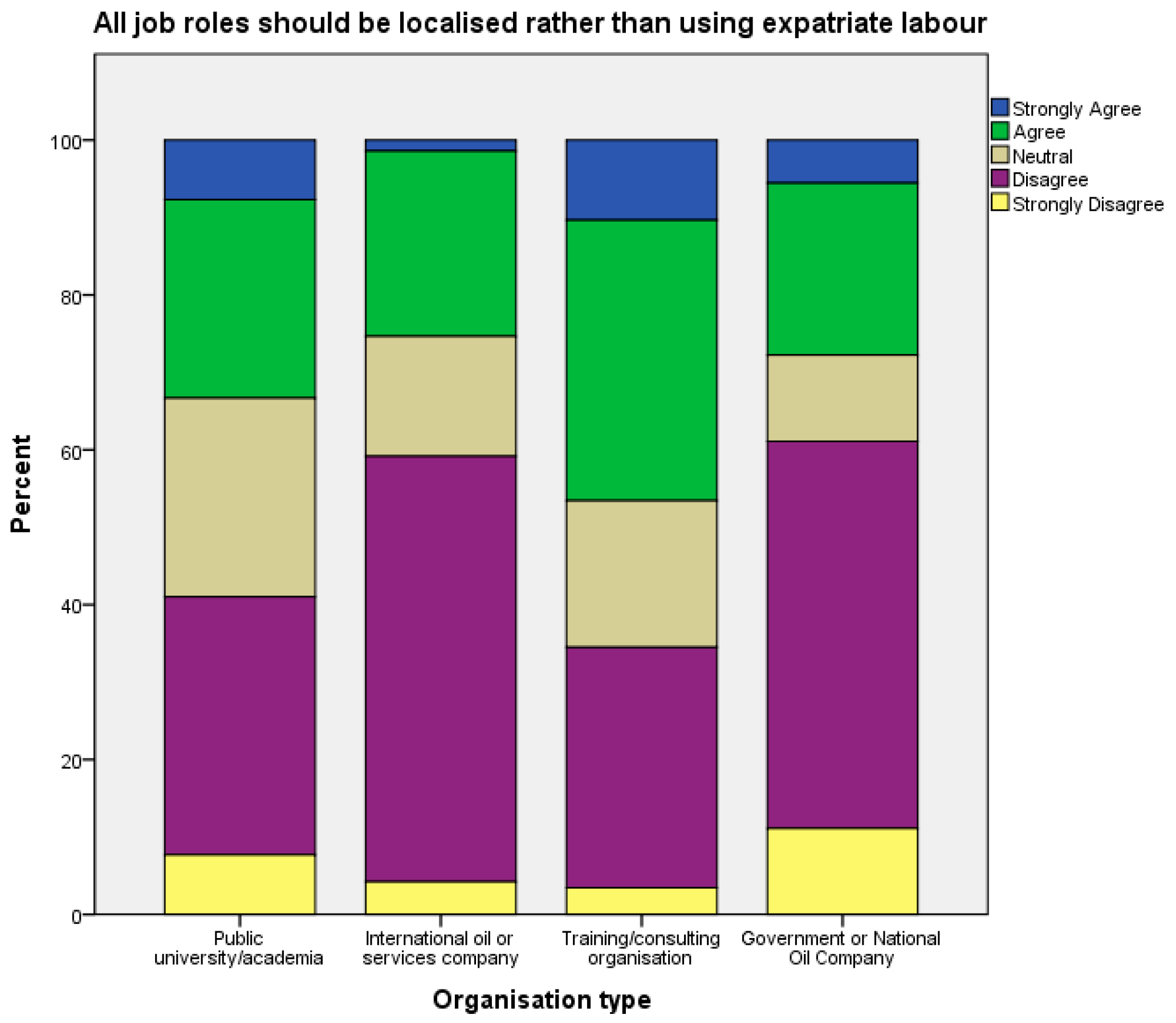
Two hundred and four (204) respondents answered this question. The median response was “Neutral”, whilst the most common occurring value was “Disagree”. The spread of results was dispersed (range = 4) and by removing the outliers the variability of results is quite low (interquartile range = 2). Overall, 5.9% (N = 12) strongly disagreed, 27.5% (N = 56) agreed, 17.6% (N = 36) were neutral, 43.1% (N = 88) disagreed and 5.9% (N = 12) strongly disagreed. There was a statistically significant difference between the four organizations’ about whether all job roles should be localized rather than using expatriate labour, H(3) = 10.67, p = 0.014, as shown in Figure 1. A post-hoc test using Dunn’s test with Bonferroni correction showed statistically significant differences occurred between training/consulting organizations and international oil or service companies, p = 0.024.
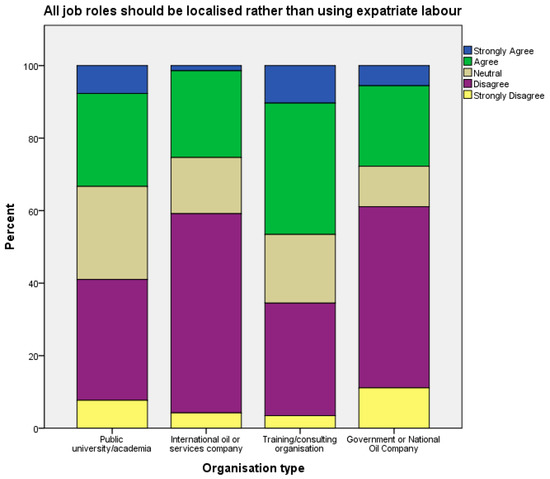
Figure 1.
Responses by organization type to “all job roles should be localized rather than using expatriate labour”.
Difference Two: National and Local Governments are Completely Aligned in Their National Development Strategies
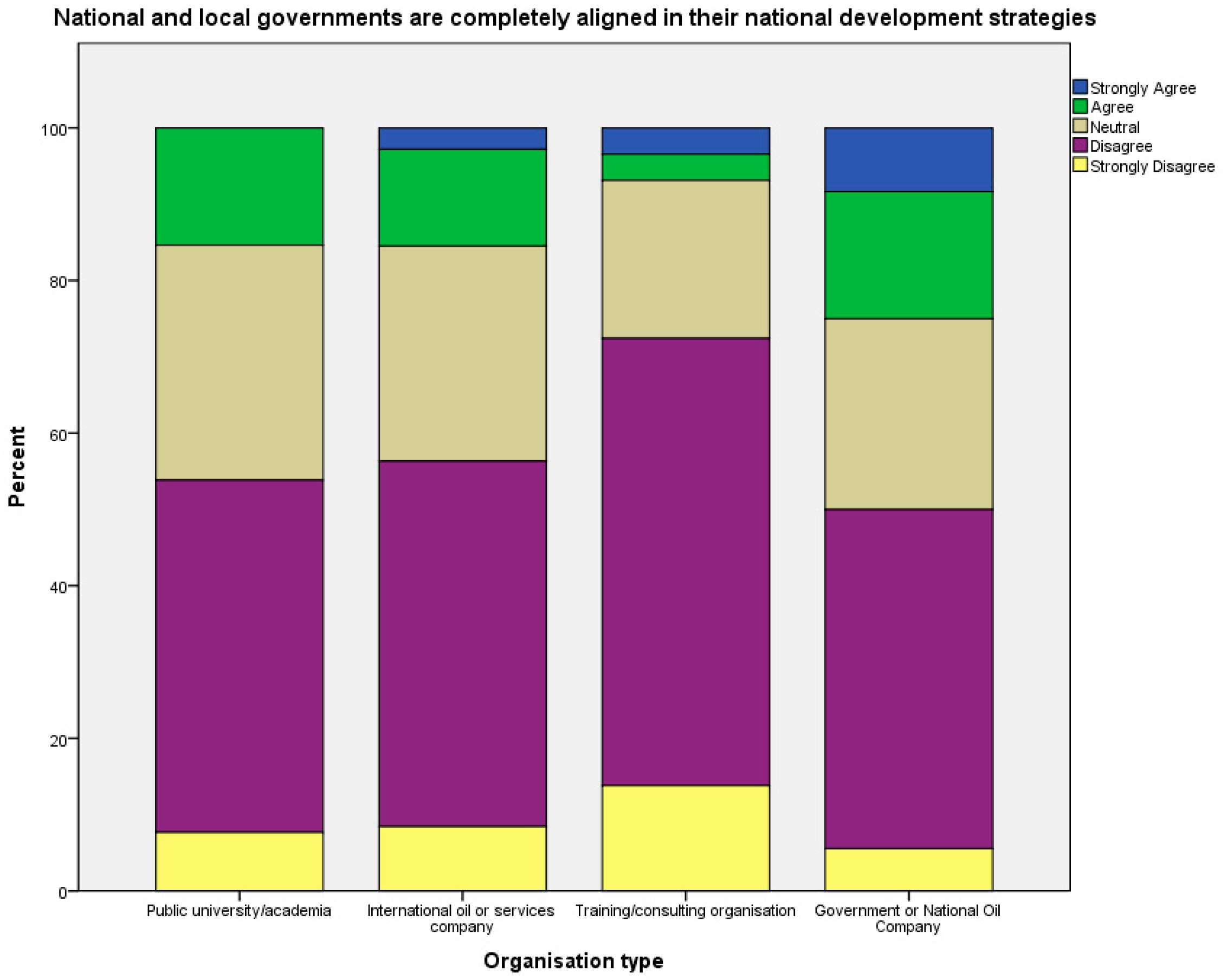
Two hundred and four (204) respondents answered this question. The median response was “Disagree” and the most common occurring value was “Disagree”. The spread of results was dispersed (range = 4) and by removing the outliers, the variability of results is low (interquartile range = 1). Overall, 3.4% (N = 7) strongly agreed, 11.3% (N = 23) agreed, 26.0% (N = 53) were neutral, 50.0% (N = 102) disagreed and 9.3% (N = 19) strongly disagreed. There was a statistically significant difference between the four organizations’ about whether national and local governments are completely aligned in their national development strategies, H(3) = 7.83, p = 0.050, as shown in Figure 2. A post-hoc test using Dunn’s test with Bonferroni correction showed no specific statistically significant differences between each organization when compared with one another.
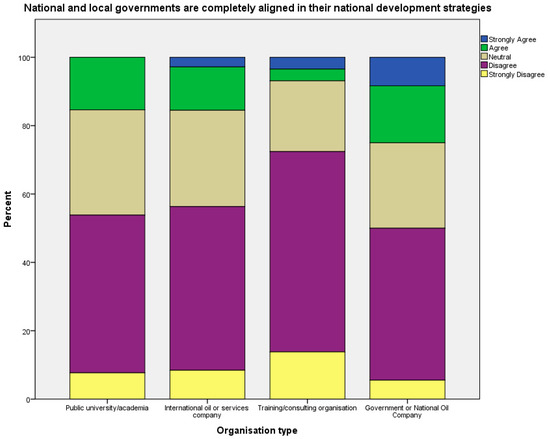
Figure 2.
Responses by organization type to “national and local governments are completely aligned in their national development strategies”.
Difference Three: Socio-Economic Benefits from Oil and Gas Projects are Evenly Distributed across the Economy
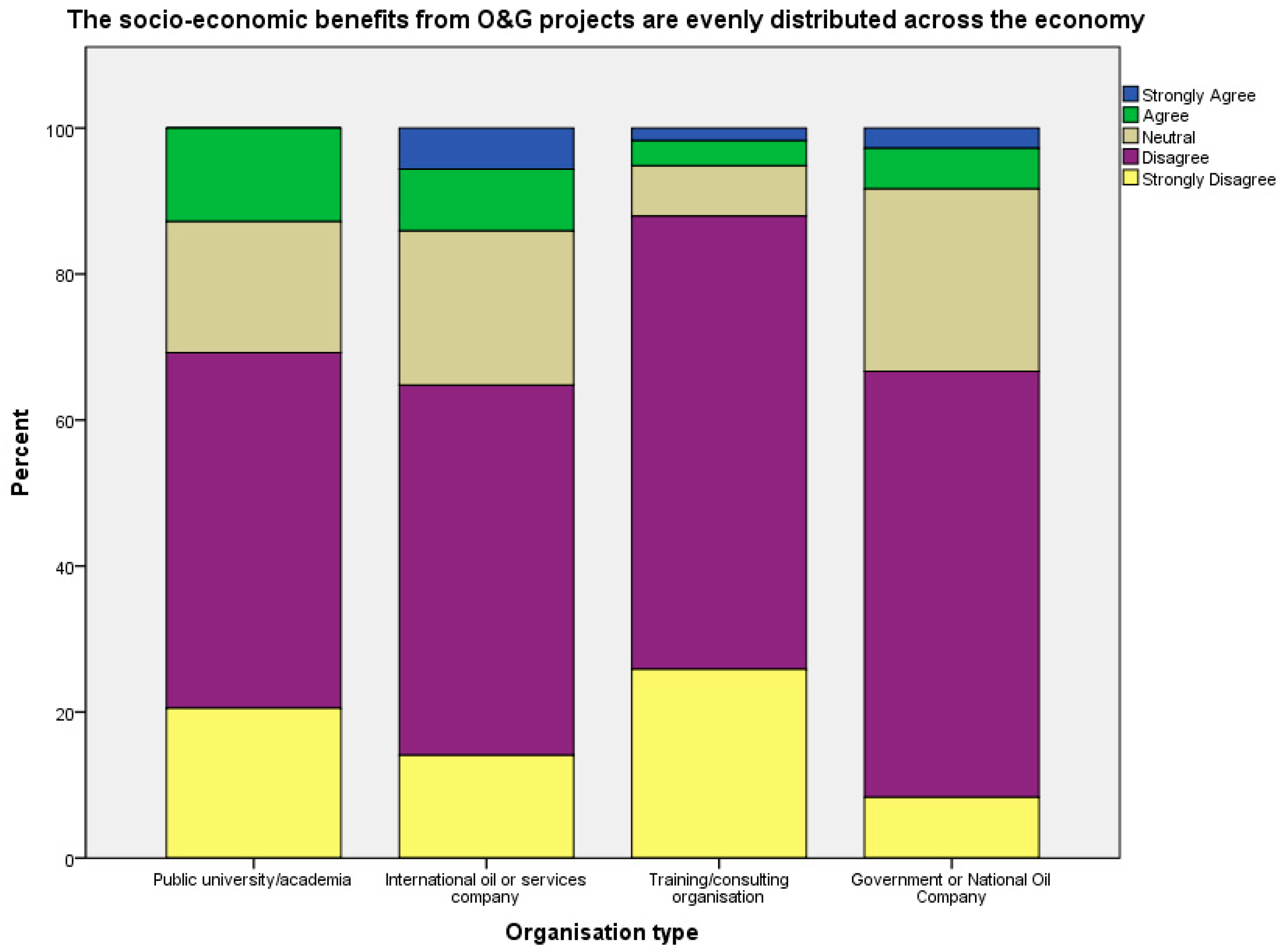
Two hundred and four (204) respondents answered this question. The median response was “Disagree”, and the most common occurring value was “Disagree”. The spread of results was dispersed (range = 4) and by removing the outliers, the variability of results is low (interquartile range = 1). Overall, 2.9% (N = 6) strongly agreed, 7.4% (N = 15) agreed, 17.2% (N = 35) were neutral, 54.9% (N = 112) disagreed and 17.6% (N = 36) strongly disagreed. There was a statistically significant difference between the four organizations’ about whether the socio-economic benefits from O&G projects are evenly distributed across the economy, H(3) = 10.85, p = 0.013, as shown in Figure 3. A post-hoc test using Dunn’s test with Bonferroni correction showed statistically significant differences between training/consulting organizations and international oil or service companies, p = 0.017.
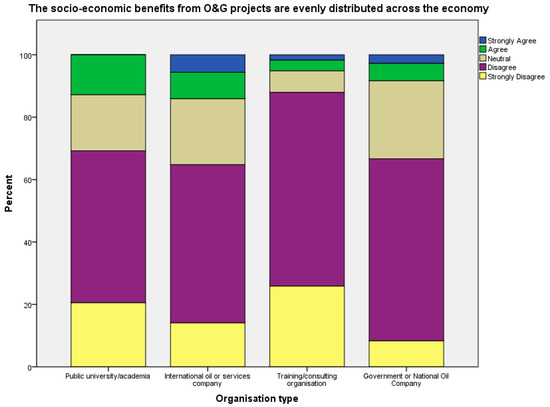
Figure 3.
Responses by organization type to “the socio-economic benefits from oil and gas projects are evenly distributed across the economy”.
Difference Four: Investing Early in Local Education Institutions Will Ensure Local People Are Trained to Industry Standards
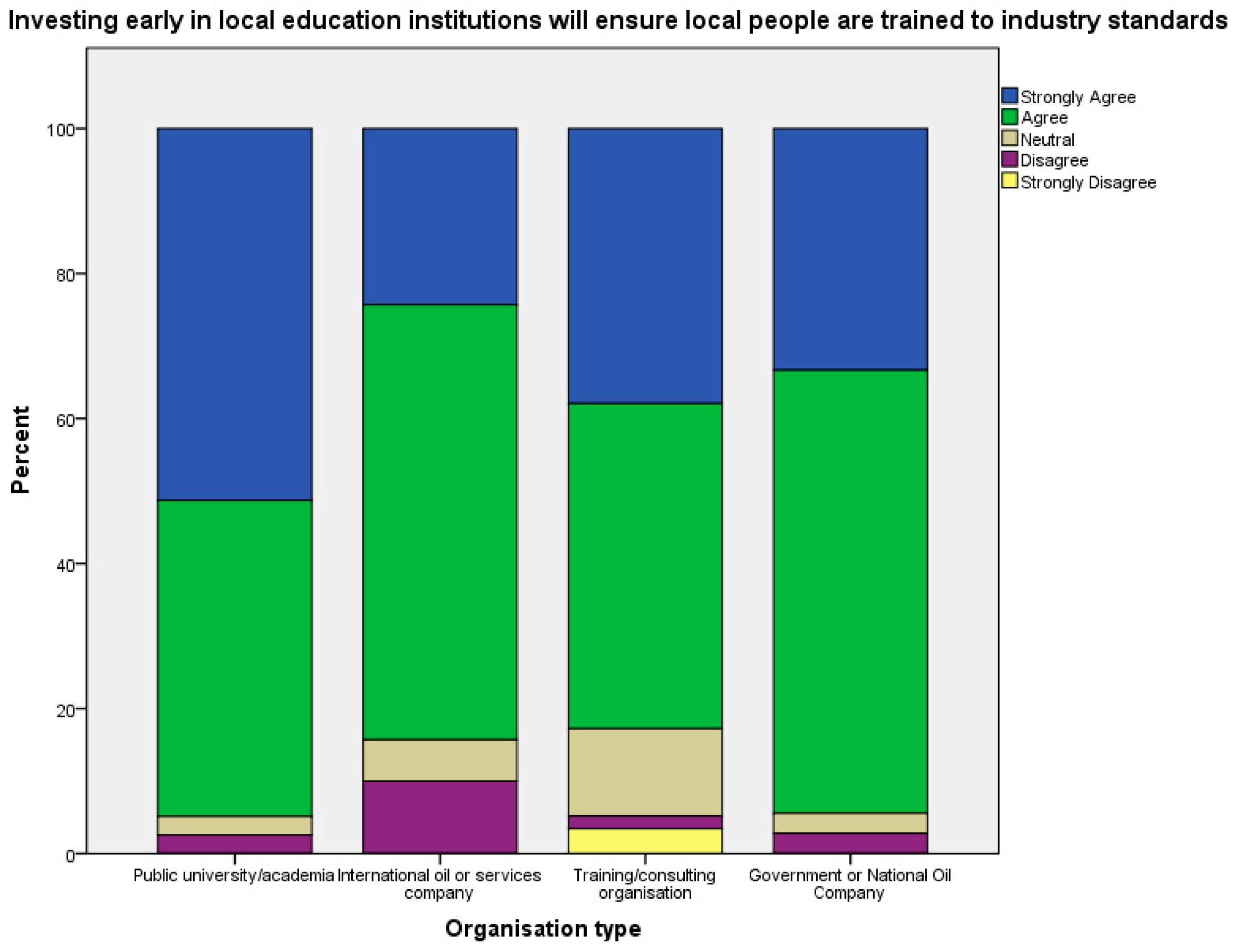
Two hundred and four (204) respondents answered this question. The median response was “Agree”, whilst the most common occurring value was “Agree”. The spread of results was highly dispersed (range = 5) and by removing the outliers, the variability of results was low (interquartile range = 1). Overall, 34.8% (N = 71) strongly agreed, 52.5% (N = 107) agreed, 6.4% (N = 13) were neutral, 4.9% (N = 10) disagreed and 1.0% (N = 2) strongly disagreed. There was a statistically significant difference between the four organizations’ about whether investing early in local education institutions will ensure local people are trained to industry standards, H(3) = 7.90, p = 0.048, as shown in Figure 4. A post-hoc test using Dunn’s test with Bonferroni correction showed statistically significant differences between public universities/academia and international oil or service companies, p = 0.031.
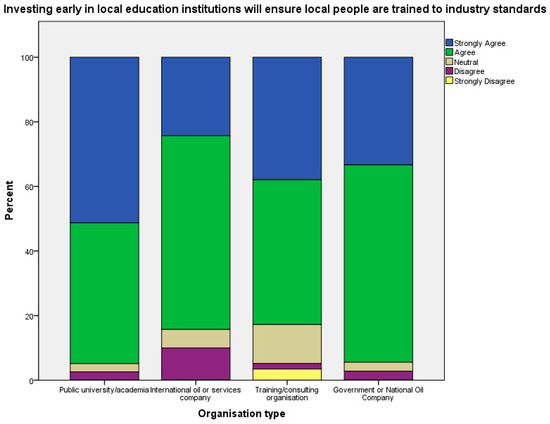
Figure 4.
Responses by organization type to “investing early in local education institutions will ensure local people are trained to industry standards”.
For the remaining 15 questions, the Kruskal-Wallis H test found no statistically significant differences in responses between the four different categories of organization The mode responses were therefore assessed to identify the most frequently occurring responses to questions. Observing all participants’ results, one question resulted in the mode response of ‘strongly agree’, ten questions in ‘agree’, six questions in “disagree”, two questions in “Neutral”, and there were no mode responses of “strongly disagree” within the questionnaire results.
5.2. Interviews
Eighty (80) Ghana-specific factors associated with JRL were found. 14 themes emerged and these were further categorized into four key overarching categories, ‘Government’ (theme 1), ‘Labour Market’ (themes 2–5), ‘Industry’ (themes 6–8) and ‘Multi-stakeholder’ (themes 9–14) presented in Table 2.
Table 2.
Themes by category affecting job role localization in Ghana.
Table 3, Table 4, Table 5, Table 6, Table 7, Table 8, Table 9, Table 10, Table 11, Table 12, Table 13, Table 14, Table 15 and Table 16 present the results for each theme, providing quotations from the interviews to describe the factors within each theme.
Table 3.
‘Government & legislation’ theme.
Table 4.
‘Common traits of the Ghanaian workforce’ theme.
Table 5.
‘Higher and vocational education & training’ theme.
Table 6.
‘Experience and time to competency’ theme.
Table 7.
‘Labour market challenges’ theme.
Table 8.
‘Expatriate employees’ theme.
Table 9.
‘Oil and gas job & supply chain opportunities’ theme.
Table 10.
‘Local community engagement’ theme.
Table 11.
‘Collaboration, communication & expectation management’ theme.
Table 12.
‘Culture and trust’ theme.
Table 13.
‘Localization of the workforce’ theme.
Table 14.
‘Impact of oil and gas in Ghana’ theme.
Table 15.
‘External international activities’ theme.
Table 16.
‘Local hiring in Ghana’ theme.
6. Results
6.1. Questionnaires
Questionnaires were used to investigate whether opinions about local content and localization issues differ between O&G companies, education institutions, training/consulting companies and governments. The objective was to identify differences and similarities of opinions amongst stakeholders in the O&G industry.
Only four of the 19 questions had statistically significant differences in responses between the different categories of organization. Despite different backgrounds, many held the same views, therefore it is possible to make generalisations based on the mode responses for the entire sample and for each of the different organization types. The differences and similarities offer some insight into the implications of implementing JRL.
Overall, respondents from the entire sample most frequently answered that not all job roles should be localized. However, there were statistically significant differences between the groups. Figure 1 shows that respondents from training/consulting organizations were more likely to reply that all job roles should be localized, which particularly differed from respondents from O&G companies. Within the literature, it is largely agreed that companies should “employ and train local staff to gradually replace expatriates with locals” [55]. However, there are multiple reasons why companies should not and cannot localize all job roles. Reasons for which range from a shortage of people with the required qualifications, training and experience within the local labour market and because companies benefit from expatriates sharing their knowledge with local workers and for their understanding of parent company corporate culture and strategy [35,56,57,58].
Overall, respondents from the entire sample answered that national and local governments’ development strategies are not aligned. However, there were statistically significant differences between the groups. Figure 2 shows that respondents from training/consulting organizations were most likely to respond that national and local governments’ development strategies are not aligned compared to respondents from other organization categories. Ref. [59] have recommended that local content policies should be underpinned by a national strategy, with “coordination between national government ministries and local governments” but the results would suggest this is not happening. Without this there is a risk of “conflicting regulations, increased administrative costs, delays in project execution and…rent-seeking behavior and corrupt practices” [60].
Overall, respondents from the entire sample most frequently answered that the economic benefit of O&G is often not evenly distributed across a country. However, there were statistically significant differences between the groups. Figure 3 shows that respondents from training/consulting organizations were more likely to respond that the economic benefits are not equally distributed compared to respondents from O&G companies. Existing theory suggests that O&G activities should create backwards, forwards and horizontal linkages to support cross-sector and national benefit [60,61]. Institutional strength, local content policy efficacy and effective long-term hydrocarbon wealth management strategies have been attributed to a country’s ability to distribute the benefits of O&G national [62,63].
Overall, respondents from the entire sample most frequently responded that investing early in local education institutions ensures that local people are trained to industry standards. However, there were statistically significant differences between the groups. Figure 4 shows that respondents from education institutions were more likely to reply that they strongly agreed that investing early in local education institutions ensures local people are trained to industry standards compared with respondents from O&G companies. Several existing studies have reported how education investments and capacity building initiatives as a result of O&G activities have advanced local education system capacity and local workforce capability [64,65,66]. Two exemplary case studies of successful O&G investments in local education systems to advance the domestic workforce exist in Libya and Trinidad and Tobago [67].
Although differences were not statistically significant, seven of the 19 questions had differences in mode responses depending on organization type. This suggests that there were some additional differences in opinions. For example, O&G companies and training/consulting companies felt more strongly than government or universities that expatriates are paid more than local people. As [56] suggested “expatriates continue to enjoy lucrative contracts and salary packages worth 60–80 per cent more than locals who do the same job”.
Whilst there were only four answers with statistically significant differences amongst the respondent groups, A high proportion of respondents felt that the greatest expectation amongst local people from O&G activities is employment, in particular respondents from education institutions. It is widely agreed that “local populations normally have high expectations regarding employment, even if these are unrealistic” [68]. Furthermore, that it is the responsibility of governments and industry to manage expectations of job opportunities [20,22,59,69]. There was agreement across the respondents that government and industry should improve their dissemination of information about local opportunities, as described in previous literature [55,70].
The survey was successful, with a very high return rate. However, the sample size was relatively small, with just 204 usable responses and two under-represented categories were removed. The results favored the opinions of O&G companies and training/consulting organizations, as these organizations were most represented. Whilst the Cronbach’s score suggested the questionnaire was reliable, the score was low. The responses to the Likert data meant that only non-probability tests could be used, whereas probability test would have been stronger. Other tests, such as Pearson’s chi-square test were applied to questions to test for associations, although, due to low sample size, it was necessary to use Fishers exact tests. As there were no statistically significant results, they were not included in the results section.
6.2. Interviews
Whilst different stakeholder groups responded in a common approach to the questionnaire. One qualitative response in the questionnaire said “each project location is different; each country is different, what works in one place will often not work in another”. As such, it was necessary to focus on the specifics of one country, in this case Ghana.
Semi-structured interviews and a group interview in Ghana to determine Ghanaian specific factors impacting JRL. Ghana was chosen as it is an example of a country where JRL is currently a major priority within the O&G sector. 80 Ghanaian specific factors were grouped into 14 broad themes, made up of four overarching categories of government, labour market, industry and multi-stakeholder.
6.2.1. Government Theme
Collier, P., & Goderis, B. (2008) [71] suggested that institutional strength, quality and transparency are necessary to avoid resource curse symptoms. Interviewees described that the new Ghanaian Government is pro-business and that good communication and differentiation between government agencies suggests that Ghana has robust institutional strength. However, the Government has a different strategy from the previous government, which has caused delays and uncertainty in decision making. This was exemplified by the new board within the Petroleum Commission. Despite this, interviewees described communication and differentiation between government agencies has led to good institutional strength.
In Ghana, the Petroleum Commission oversees and monitors all operating companies’ localization timelines, training and succession plans on a monthly and annual basis. However, concern was raised by interviewees over the Petroleum Commission’s understanding of the specific needs of particular job roles. The risks include putting the wrong local people into jobs and the Petroleum Commission declining expatriate work permits. As [48] and [56] recognized, pressure from government in succession targets can lead to promoting incompetent employees early. As a result, O&G companies face a major challenge to fit within the legal requirements of 90% localization within ten years of operation, a target which concerns O&G companies [10].
6.2.2. Labour Market Theme
In Ghana, interviewees said that the principal barrier to employing local people is the lack of experienced people within the labour market. Bhanugopan, R., & Fish, A. (2007) [56] also found that although local people may have the required education, they do not have the experience required to be hired in traditionally expatriate job roles. Marcel et al (2016) [59] stated how this is a common problem in new hydrocarbon producing countries. Interviewees explained that accessing offshore experience for technical staff is a challenge in Ghana. As such companies need to be prepared to review and reduce their experience requirements to meet localization targets. O&G companies in Ghana have been forced to bring in expatriates to do job roles where there is a gap, despite pressure from the Petroleum Commission. Many JRL studies have discussed the merits of employing expatriates in addition to local workers.
Cooke et al (2015) [72] found that “those with skills and education are often forced to seek employment abroad owing to the dearth of options domestically”. Finding top talent locally is a challenge when talent migrates internationally causing a brain drain locally [73,74,75,76]. Interviewees suggested a solution was to incentivize the Ghanaian diaspora to return. However, despite being passionate about returning to Ghana, accessing the diaspora is a challenge because companies refuse to pay international Ghanaians an international salary.
Several common traits of the Ghanaian workforce were expressed. Interviewees said that Ghanaians tended to be very respectful of those they consider to be senior in age or rank. Ghanaians were described as very positive, polite, committed, entrepreneurial and business minded who take pride in their work. Ghanaians were described as humble and deferential. However, they dislike confrontation, discussing failure, complications or errors. These characteristics are consistent with Aryee, S. (2004) [76] assessment of Ghanaians as a collectivist society, that have strong bonds and obligations to a group identity in kinship to an extended family, whilst emphasizing the importance of status differences.
There was a belief amongst interviewees that the Ghanaian Government could do more to prepare Ghanaians for industry—particularly for those with less education, youth and women [18,77].
6.2.3. Industry Theme
Interviewees raised the difference in salaries between expatriates and Ghanaian nationals as a major issue, with several interviewees referring to protests. Ghanaians were generally described as having a negative perception of expatriates who are seen as taking money away from Ghana back to their home country, as reported in other JRL studies [47,78,79]. Despite this, interviewees explained that within the O&G sector it is generally understood by Ghanaians that expatriates are required when no local person is available with the skillset required for highly technical roles.
Expatriates are viewed as disliking localization, as it requires them to train Ghanaians and to lose their job at the end of the succession period [57,58]. Briscoe, D., & Schuler, R. S. (2004) [80] described how such issues can lead to expatriate failure and disputes.
It was widely discussed that there are very limited job opportunities in Ghana’s O&G sector, as is commonplace within the O&G industry [81,82,83]. Additionally, standards of Ghanaian suppliers and workers often do not meet industry’s international expectations, previously reported by Ablo, A. (2015) [11]. Within the literature, it has been widely reported that O&G company standards can be a barrier to local content [70,84].
The working culture of Ghana is different to that of Europe. This is significant since the two leading O&G companies are European organizations. There is a requirement to adapt to local cultures by the Europeans as doing business in Ghana was described by the interviewees as challenging for outsiders. For example, the interviewees described that the principal method of advertising job roles in Ghana is in local newspapers, also reported by [76]. MNCs often replicate their head office practices which are often unsuitable for their African subsidiaries [85,86,87]. One interviewee said that “there are lots of complexities to the Ghanaian culture of working”. As a result, O&G companies must adapt their JRL strategies to the social norms, cultural dimensions and local business practices of the ‘national culture’ [88,89].
6.2.4. Multi-stakeholder Theme
There has commonly been discontent about the impact of O&G on livelihoods amongst local communities in the Western Region. Notably there have been signs of resource curse and ‘Dutch disease’ impacts, with housing and food prices increasing, and significant population growth as people come to the Western Region in search of jobs. As has been widely described in literature, whilst it is important that locally affected communities benefit, the whole nation must benefit from O&G [59,90].
A common issue raised in the interviews was a lack of collaboration and communication between the Government, industry and the education community. This is a necessity for local content to be successful according to many studies [59,68,69]. Miscommunication of jobs in Ghana’s O&G sector is a significant issue [20]. Interviewees reported poor communication regarding future job opportunities, with major expectations amongst Ghanaians of immediate and numerous jobs. This has been worsened by the media sensationalizing the industry and raising Ghanaian expectations [18,91].
Interviewees described issues of trust between different stakeholders. Notably associated with jobs, it was felt that Ghanaian people were perceived as having more a relaxed work ethic than their expatriate counterparts, as reported by [92].
The interviews were successful, with the aid of a flexible interview guide. However, there were several limitations. The interviewees were a mix of representatives with an interest in O&G in Ghana, which was believed to be a fair representation of key stakeholders across Ghana. Care was taken to try and avoid leading questions. The coding methodology used open, axial and selective coding techniques [93]. Nvivo software was used to understand key themes and statements. There was a risk of bias during the coding process to focus on those areas of interest to the researcher. Nvivo software was chosen for “recording and linking ideas in many ways, and for searching and exploring the patterns of data and ideas” [94]. Despite these strengths, Nvivo has been criticized for not addressing the validity and reliability of themes within the data [95]. Furthermore, computerization of qualitative data analysis risks the researcher becoming distanced from their data [96].
7. Conclusions
Opinions were gathered about local content and JRL issues from respondents with different backgrounds including O&G companies, education institutions, training and consulting companies and governments. National context specific factors which impact JRL in Ghana were identified.
A questionnaire about local content and localization issues was distributed to a sample of 330 experienced stakeholders. The objective was to identify similarities and differences of experiences and recommendations amongst different stakeholders associated with JRL within the global O&G industry. The hypothesis that different stakeholders respond differently was disproven. There were many areas in which all organization types responded in a common way, enabling generalisations to be made.
The results suggest that different stakeholders within the O&G sector more commonly agree about local content and localization issues than they disagree. There were some differences of opinion, notably about whether all job roles should be localized, the alignment of national and local governments, whether socio-economic benefits of O&G are evenly distributed nationally and whether early investment in local education institutions ensures local people are trained to industry standards.
A sample of 31 different stakeholders associated with Ghana’s O&G industry were interviewed. It was found that several factors affect JRL specific to the Ghanaian context. The results were characterized into 80 Ghanaian specific factors, which were grouped into 14 broad themes, and four overarching categories of government, labour market, industry and multi-stakeholder. These factors provided an in-depth illustration of the quantitative data from the initial questionnaire.
The overall results show the importance of understanding national context characteristics when developing JRL strategies. This study found that governments and O&G companies worldwide are seeing greater value in localization. When considering terms such as localization and local content, this study showed that ‘local’ is largely perceived as meaning ‘national’, and is not restricted to locally affected communities.
Effective JRL can have major benefits whilst addressing the values of governments, industry and local people. O&G companies however are unique in requiring very high technical standards of the workforce in order to avoid O&G catastrophes. This can be a highly significant barrier to JRL if people with the required competencies, skills and experience are not available within the local labour market. As O&G companies are increasingly encouraged to localize their workforces by host governments.
Local content policies therefore can stimulate local employment and economic growth. Within the realm of local content, there is a drive to increase local workforce participation within the industry. Whilst JRL can only have limited impact on national economies due to the low number of available jobs in the O&G sector, it remains a key aspect of local content strategies.
This study has found that different stakeholders largely agree about local content issues and that when developing local content strategies it has shown the need to consider national context factors that can affect JRL.
Supplementary Materials
The following are available online at https://www.mdpi.com/1996-1073/12/6/1154/s1, Table S1: Questionnaire, Table S2: Questions that showed no statistically significant differences in responses based on organization type.
Author Contributions
J.P. has performed the research presented in this paper. G.F. and A.K. have supervised the original work and reviewed this paper throughout.
Funding
This research received no external funding.
Conflicts of Interest
The authors declare no conflict of interest.
References
- Potter, C.C. Effective Localisation of the Workforce. J. Eur. Ind. Train. 1989, 13, 25–30. [Google Scholar] [CrossRef]
- Pegram, J.; Falcone, G.; Kolios, A. A Review of Job Role Localization in the Oil and Gas Industry. Energies 2018, 11, 2779. [Google Scholar] [CrossRef]
- Ablo, A.D.; Overå, R. Networks, trust and capital mobilisation: Challenges of embedded local entrepreneurial strategies in Ghana’s oil and gas industry. J. Mod. Afr. Stud. 2015, 53, 391–413. [Google Scholar] [CrossRef]
- Ovadia, J.S. Local content policies and petro-development in Sub-Saharan Africa: A comparative analysis. Resour. Policy 2016, 49, 20–30. [Google Scholar] [CrossRef]
- The Parliament of the Republic of Ghana. Petroleum Commission Act 821; Petroleum Commission: Accra, Ghana, 2011.
- The Parliament of the Republic of Ghana. Minerals and Mining Act 703; Petroleum Commission: Accra, Ghana, 2006.
- The Parliament of the Republic of Ghana. Minerals and Mining (General) Regulations L.I. 2173; Petroleum Commission: Accra, Ghana, 2012.
- The Parliament of the Republic of Ghana. Petroleum Commission (Local Content And Local Participation) Regulations; Petroleum Commission: Accra, Ghana, 2013.
- Eni. Cooperation Model; Eni: Rome, Italy, 2016. [Google Scholar]
- Arthur, P.; Arthur, E. Local Content and Private Sector Participation in Ghana’s Oil Industry: An Economic and Strategic Imperative. Afr. Today 2014, 61, 56–77, 136–137. [Google Scholar] [CrossRef]
- Ablo, A.D. Local content and participation in Ghana’s oil and gas industry: Can enterprise development make a difference? Extr. Ind. Soc. 2015, 2, 320–327. [Google Scholar] [CrossRef]
- Amorin, R.; Broni-Bediako, E. Major Challenges in Ghana’s Oil and Gas Discovery: Is Ghana Ready? ARPN J. Sci. Technol. 2013, 3, 2009–2013. [Google Scholar]
- Asafu-Adjaye, J. Oil production and Ghana’s economy: What can we expect? Ghana Policy J. 2010, 4, 35–49. [Google Scholar]
- Darkwah, A. Keeping hope alive: an analysis of training opportunities for Ghanaian youth in the emerging oil and gas industry. Int. Dev. Plan. Rev. 2013, 35, 119–134. [Google Scholar] [CrossRef]
- Graham, E.; Ackah, I.; Gyampo, R.E. Politics of oil and gas in Ghana. Insight on Africa 2016, 8, 131–141. [Google Scholar] [CrossRef]
- Gyampo, R.E. Saving Ghana from Its Oil: A Critical Assessment of Preparations so Far Made. Afr. Today 2011, 57, 49. [Google Scholar] [CrossRef]
- Obeng-Odoom, F. Measuring What? “Success” and “Failure” in Ghana’s Oil Industry. Soc. Nat. Resour. 2014, 27, 656–670. [Google Scholar] [CrossRef]
- Obeng-Odoom, F. Oil boom, human capital and economic development: Some recent evidence. Econ. Labour Relat. Rev. 2015, 26, 100–116. [Google Scholar] [CrossRef]
- Senoo, J.E.; Armah, S.E. Assessing the Effectiveness of Ghana’s Local Content Policy in the Oil and Gas Industry. J. Energy Econ. Dev. 2015, 1, 22–61. [Google Scholar]
- Plänitz, E.; Kuzu, D. Oil Production and the Transformation of Livelihoods of Communities in Ghana. Accra. 2015. Available online: library.fes.de/pdf-files/bueros/ghana/11295.pdf (accessed on 28 September 2017).
- Andrews, N. Community Expectations from Ghana’s New Oil Find: Conceptualizing Corporate Social Responsibility as a Grassroots-Oriented Process. Afr. Today 2014, 60, 55–75. [Google Scholar] [CrossRef]
- Osei-Tutu, J.A. Managing Expectations and Tensions in Ghana’s Oil-Rich Western Region; Governance of Africa’s Resources Programme; The South African Institute of International Affairs (SAIIA): Sub-Saharan Africa, Ghana, 2012.
- Waskow, D.; Welch, C. The Environmental, Social, and Human Rights Impacts of Oil Development. In Covering Oil: A Reporter’s Guide to Energy and Development. Lifting the Resource Curse; Tsalik, S., Schiffrin, A., Eds.; Open Society Institute, Initiative for Policy Dialogue: New York, NY, USA, 2005; pp. 101–129. [Google Scholar]
- CIA Ghana. Available online: https://www.cia.gov/library/publications/the-world-factbook/geos/gh.html (accessed on 15 December 2018).
- Agbola, F.W. Does human capital constrain the impact of foreign direct investment and remittances on economic growth in Ghana? Appl. Econ. 2013, 45, 2853–2862. [Google Scholar] [CrossRef]
- Amoako-Tuffour, J.; Aubynn, T.; Atta-Quayson, A. Local Content and Value Addition in Ghana’s Mineral, Oil, and Gas Sectors: is Ghana Getting it Right? African Center for Economic Transformation: Accra, Ghana, 2015. [Google Scholar]
- Quartey, P. Migration in Ghana, A Country Profile 2009; International Organization for Migration: Geneva, Switzerland, 2009. [Google Scholar]
- Harvey, M.G. Inpatriation training: The next challenge for international human resource management. Int. J. Intercult. Relat. 1997, 21, 393–428. [Google Scholar] [CrossRef]
- Eni Ghana. The Oil & Gas Sector as a Driver for Growth; Eni: Rome, Italy, 2016. [Google Scholar]
- Ministry of Energy. Local Content and Local Participation in Petroleum Activities—Policy Framework; Ministry of Energy: Accra, Ghana, 2010; p. 12.
- Valentine, G. Tell me about…: using interviews as a research methodology. In Methods in Human Geography: A Guide for Students Doing A Research Project; Flowerdew, R., Martin, D., Eds.; Pearson Education: Harlow, UK, 2005; pp. 110–126. ISBN 0582473217. [Google Scholar]
- Forstenlechner, I.; Madi, M.T.; Selim, H.M.; Rutledge, E.J. Emiratisation: Determining the factors that influence the recruitment decisions of employers in the UAE. Int. J. Hum. Resour. Manag. 2012, 23, 406–421. [Google Scholar] [CrossRef]
- Sadi, M.A.; Al-Buraey, M.A. A framework of the implementation process: The case of Saudization. Int. Manag. Rev. 2009, 5. [Google Scholar]
- Law, K.S.; Song, L.J.; Wong, C.S.; Chen, D. The antecedents and consequences of successful localization. J. Int. Bus. Stud. 2009, 40, 1359–1373. [Google Scholar] [CrossRef]
- Lam, S.S.K.; Yeung, J.C.K. Staff localization and environmental uncertainty on firm performance in China. Asia Pac. J. Manag. 2010, 27, 677–695. [Google Scholar] [CrossRef]
- Williams, J.; Bhanugopan, R.; Fish, A. Localization of human resources in the State of Qatar: Emerging issues and research agenda. Educ. Bus. Soc. Contemp. Middle East. Issues 2011, 4, 193–206. [Google Scholar] [CrossRef]
- Al-Lamki, S.M. The role of the private sector in Omanization: The case of the banking industry in the Sultanate of Oman. Int. J. Manag. 2005, 22, 176–188. [Google Scholar]
- Selmer, J. Staff localization and organizational characteristics: Western business operations in China. Asia Pac. Bus. Rev. 2003, 10, 43–57. [Google Scholar] [CrossRef]
- Fryxell, G.E.; Butler, J.; Choi, A. Successful localization programs in China: An important element in strategy implementation. J. World Bus. 2004, 39, 268–282. [Google Scholar] [CrossRef]
- Likert, R. A technique for the measurement of attitudes. Arch. Psychol. 1932, 22, 55. [Google Scholar]
- Jamieson, S. Likert scales: How to (ab)use them. Med. Educ. 2004, 38, 1217–1218. [Google Scholar] [CrossRef]
- Allen, I.; Seaman, C. Likert scales and data analyses. Qual. Prog. 2007, 40, 64. [Google Scholar]
- Boone, H.N.J.; Boone, D.A. Analyzing Likert data. J. Ext. 2012, 50, 30. [Google Scholar]
- Sullivan, G.M.; Artino, A.R. Analyzing and Interpreting Data From Likert-Type Scales. J. Grad. Med. Educ. 2013, 5, 541–542. [Google Scholar] [CrossRef]
- Field, A. Discovering Statistics Using SPSS; SAGE Publications: London, UK, 2009; Volume 58, ISBN 1847879071. [Google Scholar]
- Croasmun, J.T.; Ostrom, L. Using Likert-Type Scales in the Social Sciences. J. Adult Educ. 2011, 40, 19–22. [Google Scholar]
- Swailes, S.; Al Said, L.G.; Al Fahdi, S. Localisation policy in Oman: A psychological contracting interpretation. Int. J. Public Sect. Manag. 2012, 25, 357–372. [Google Scholar] [CrossRef]
- Fayol-Song, L. Reasons behind management localization in MNCs in China. In International Business in China: Understanding the Global Economic Crisis; Taylor, R., Ed.; Routledge: London, UK, 2013; pp. 58–74. ISBN 9780203722725. [Google Scholar]
- Rees, C.J.; Mamman, A.; Braik, A. Bin Emiratization as a strategic HRM change initiative: Case study evidence from a UAE petroleum company. Int. J. Hum. Resour. Manag. 2007, 18, 33–53. [Google Scholar] [CrossRef]
- Thomas, G. How to Do Your Research Project: A Guide for Students; SAGE Publications: London, UK, 2017. [Google Scholar]
- Manzano, A. The craft of interviewing in realist evaluation. Evaluation 2016, 22, 342–360. [Google Scholar] [CrossRef]
- Miles, M.B.; Huberman, A.M.; Saldana, J. Qualitative Data Analysis: A Methods Sourcebook, 3rd ed.; SAGE Publications: Thousand Oaks, CA, USA, 2013; ISBN 9781452257877. [Google Scholar]
- Babbie, E. The Practice of Social Research, 12th ed.; Cengage: Boston, MA, USA, 2009; ISBN 9780761962984. [Google Scholar]
- Denzin, N.K.; Lincoln, Y.S. The Sage Handbook of Qualitative Research; SAGE Publications: Thousand Oaks, CA, USA, 2011; ISBN 9781412957588. [Google Scholar]
- IPIECA. Local Content: A Guidance Document for the Oil and Gas Industry, 2nd ed.; IPIECA: London, UK, 2016. [Google Scholar]
- Bhanugopan, R.; Fish, A. Replacing Expatriates with Local Managers: An Exploratory Investigation into Obstacles to Localization in a Developing Country. Hum. Resour. Dev. Int. 2007, 10, 365–381. [Google Scholar] [CrossRef]
- Hailey, J.; Harry, W. International Human Resource Management: A European Perspective, 2nd ed.; Routledge: London, UK, 2008; ISBN 0203891392. [Google Scholar]
- Selmer, J. Expatriates’ hesitation and the localization of Western business operations in China. Int. J. Hum. Resour. Manag. 2004, 15, 1094–1107. [Google Scholar] [CrossRef]
- Marcel, V.; Tissot, R.; Paul, A.; Omonbude, E. A Local Content Decision Tree for Emerging Producers; Environment and Resources Department, New Petroleum Producers Discussion Group: London, UK, 2016. [Google Scholar]
- Tordo, S.; Warner, M.; Manzano, O.; Anouti, Y. Local Content Policies in the Oil and Gas Sector; World Bank: Washington, DC, USA, 2013; ISBN 978-0-8213-9931-6. [Google Scholar]
- Ayentimi, D.T.; Burgess, J.; Brown, K. Developing effective local content regulations in sub-Sahara Africa: The need for more effective policy alignment. Multinatl. Bus. Rev. 2016, 24, 354–374. [Google Scholar] [CrossRef]
- Kim, R.; Asta Lohde, L.; van Moorsel, T.; Rebolledo Dellepiane, M.A. Effects of Oil, Gas and Mining Investment on Jobs, Literature review & estimation tool for Ghana and Peru; International Finance Corporation (IFC): Washington, DC, USA, 2017. [Google Scholar]
- Lewin, M. Botswana’s Success: Good Governance, Good Policies, and Good Luck. In Yes, Africa Can: Success Stories from a Dynamic Continent; Chuhan-Pole, P., Angwafo, M., Eds.; World Bank: Washington, DC, USA, 2011; pp. 81–90. ISBN 978-0-8213-8745-0. [Google Scholar]
- Davis, G.A. Learning to love the Dutch disease: Evidence from the mineral economies. World Dev. 1995, 23, 1765–1779. [Google Scholar] [CrossRef]
- Sigam, C.; Garcia, L. Extractive Industries: Optimizing Value Retention In Host Countries; UNCTAD: Geneva, Switzerland; New York, NY, USA, 2012. [Google Scholar]
- Stijns, J.-P. Natural resource abundance and human capital accumulation. World Dev. 2006, 34, 1060–1083. [Google Scholar] [CrossRef]
- Playfoot, J.; Augustus, S.; Andrews, P. Education and Training for the Oil and Gas Industry: Localising Oil and Gas Operations (Volume Four); Elsevier: Amsterdam, The Netherlands; Kidlington, UK; Cambridge, MA, USA, 2017; ISBN 9780128009802. [Google Scholar]
- Mtegha, H.; Toigo, P. Paper 7: Leveraging Extractive Industries for Skills Development to Maximize Sustainable Growth and Employment; African Development Bank: Abidjan, Cote d’Ivoire, 2015. [Google Scholar]
- OECD. Collaborative Strategies for In-Country Shared Value Creation: Framework for Extractive Projects; OECD Development Policy Tools: Paris, France, 2016. [Google Scholar]
- Warner, M. Local Content in Procurement: Creating Local Jobs And Competitive Domestic Industries in Supply Chains; Greenleaf Publishing: Sheffield, UK, 2011; ISBN 9781906093648. [Google Scholar]
- Collier, P.; Goderis, B. Commodity Prices, Growth, and the Natural Resource Curse: Reconciling a Conundrum. SSRN Electron. J. 2008. [Google Scholar] [CrossRef]
- Cooke, F.L.; Wood, G.; Horwitz, F. Multinational firms from emerging economies in Africa: implications for research and practice in human resource management. Int. J. Hum. Resour. Manag. 2015, 26, 2653–2675. [Google Scholar] [CrossRef]
- Horwitz, F.M. An analysis of skills development in a transitional economy: The case of the South African labour market. Int. J. Hum. Resour. Manag. 2013, 24, 2435–2451. [Google Scholar] [CrossRef]
- Knight, J. Higher Education in Turmoil: The Changing World of Internationalization; Sense Publishers: Rotterdam, The Netherlands, 2008; ISBN 9789087905200. [Google Scholar]
- Macready, C.; Tucker, C. Who Goes Where and Why? An Overview and Analysis of Global Educational Mobility; IIE and AIFS Foundation: New York, NY, USA, 2011; ISBN 978-0-87206-342-6. [Google Scholar]
- Aryee, S. HRM in Ghana. In Managing Human Resources in Africa; Kamoche, K., Debrah, Y., Horwitz, F., Muuka, G.N., Eds.; Routledge: London, UK, 2004; pp. 121–134. ISBN 0415369487. [Google Scholar]
- Adusah-Karikari, A. Black gold in Ghana: Changing livelihoods for women in communities affected by oil production. Extr. Ind. Soc. 2015, 2, 24–32. [Google Scholar] [CrossRef]
- Hailey, J. Breaking through the glass ceiling. People Manag. 1996, 2, 32–34. [Google Scholar]
- Li, L.; Wang, X. The Strategy of Talent Localization in Multinational Corporations. Int. J. Bus. Manag. 2010, 5, 216–219. [Google Scholar] [CrossRef]
- Briscoe, D.; Schuler, R.S. International Human Resource Management: Policy and Practice for the Global Enterprise; Psychology Press: London, UK, 2004; Volume 5, ISBN 978-0415710534. [Google Scholar]
- Amundsen, I. Can Ghana Avoid the Resource Curse? In Governance of the Petroleum Sector in an Emerging Developing Country; Appiah-Adu, K., Ed.; Gower Publ. Ltd.: Farnham, UK, 2013; pp. 109–141. ISBN 978-1-4094-6308-5; 978-1-4094-6307-8. [Google Scholar]
- Ovadia, J.S. The dual nature of local content in Angola’s oil and gas industry: Development vs. elite accumulation. J. Contemp. African Stud. 2012, 30, 395–417. [Google Scholar] [CrossRef]
- Wise, H.; Shtylla, S. The Role of the Extractive Sector in Expanding Economic Opportunity. Corp. Soc. Responsib. Initiat. 2007, 52. [Google Scholar]
- Wilson, E.; Kuszewski, J. Shared Value, Shared Responsibility: A New Approach to Managing Contracting Chains in the Oil and Gas Sector; IIED: London, UK, 2011. [Google Scholar]
- Kamoche, K.N.; Debrah, Y.A.; Horwitz, F.M.; Muuka, G.N. Managing human resources in Africa; Routledge: London, UK; New York, NY, USA, 2004; ISBN 0415369487. [Google Scholar]
- Jackson, T. Cross-cultural management and the informal economy in sub-Saharan Africa: Implications for organization, employment and skills development. Int. J. Hum. Resour. Manag. 2012, 23, 2901–2916. [Google Scholar] [CrossRef]
- Horwitz, F.M. Managing Human Resources in Africa: Emergent Market Challenges. In The Routledge Companion to Strategic Human Resource Management; Storey, J., Wright, P.M., Ulrich, D., Eds.; Routledge: London, UK, 2009; pp. 462–477. [Google Scholar]
- Cunha, M.P.E.; Fortes, A.; Gomes, E.; Rego, A.; Rodrigues, F. Ambidextrous leadership, paradox and contingency: evidence from Angola. Int. J. Hum. Resour. Manag. 2016, 1–26. [Google Scholar] [CrossRef]
- Hofstede, G. Culture’s Consequences: International Differences in Work Related Values; SAGE Publications: Newbury Park, CA, USA; London, UK; New Delhi, India, 1980; ISBN 0803913060. [Google Scholar]
- Poruthiyil, P.V. Weaning Business Ethics from Strategic Economism: The Development Ethics Perspective. J. Bus. Ethics 2013, 116, 735–749. [Google Scholar] [CrossRef]
- Behrman, M.; Canonge, J.; Purcell, M.; Schiffrin, A. Watchdog or lapdog? A look at press coverage of the extractive sector in Nigeria, Ghana and Uganda. Ecquid Novi Afr. J. Stud. 2012, 33, 87–99. [Google Scholar] [CrossRef]
- Randeree, K. Strategy, Policy and Practice in the Nationalisation of Human Capital: “Project Emiratisation”. Res. Pract. Hum. Resour. Manag. 2009, 17, 71–91. [Google Scholar]
- Strauss, A.; Corbin, J. Basics of Qualitative Research: Techniques and Procedures for Developing Grounded Theory, 3rd ed.; SAGE Publications: Thousand Oaks, CA, USA, 2008; Volume 3, ISBN 9781412906449. [Google Scholar]
- Richards, L. Using NVivo in Qualitative Research; SAGE Publications: London, UK, 1999. [Google Scholar]
- Welsh, E. Dealing with data: Using NVivo in the qualitative data analysis process. Forum Qual. Sozialforschung/Forum Qual. Soc. Res. 2002, 3, 1–6. [Google Scholar]
- Bazeley, P.; Jackson, K. Qualitative Data Analysis with NVivo; SAGE Publications: London, UK, 2013; Volume 2, ISBN 9781412921411. [Google Scholar]
© 2019 by the authors. Licensee MDPI, Basel, Switzerland. This article is an open access article distributed under the terms and conditions of the Creative Commons Attribution (CC BY) license (http://creativecommons.org/licenses/by/4.0/).