


Abstract
The article pertains to the utilization of the application potential of MCDM/MCDA (Multi-Criteria Decision Making/Multi-Criteria Decision Analysis) methods in decision-making problems in the field of transport in light of sustainable development. The article consists of a theoretical and an empirical part. As part of the literature studies, a review was carried out on the latest applications of MCDM/MCDA methods for decision-making problems in the field of transport. In the empirical part, a multi-criteria analysis of the placement selection for a strip of expressway located in north-eastern Poland was carried out. For this purpose, a hybrid approach was used, consisting of three selected MCDM/MCDA methods: DEMATEL, REMBRANDT, and VIKOR. The ranking was compared with the results achieved in the EIA report of the investment and the results were obtained by using a different set of MCDM/MCDA methods that were proposed in the first part of the research, i.e., AHP, Fuzzy AHP, TOPSIS, and PROMETHEE. The performed multi-criteria analyses allowed for an eventual multi-dimensional evaluation of the most popular MCDM/MCDA methods currently applied in the field of transport.
1. Introduction
Transport is an important branch of the economy and science, in which the decisions made are often multi-criteria in character. The choice of the investment location, route for road infrastructure, and public transport development scenario are just some of the decision-making problems in the field of transport [1] that require considering multiple environmental, economic, and social factors according to the idea of sustainable transport. The concept of sustainable transport appeared almost parallel with the definition of sustainable development in the Report of the World Commission on Environment and Development: Our Common Future [2]. In the early 1990s, Daly [3] and Pearce [4] defined sustainable transport as transport with non-declining capital, in which the capital includes human capital, monetary capital, and natural capital. Multi-criteria decision-making support in the area of sustainable transport is significant due to the multitude of aspects that should be considered.
Multi-criteria decision-making support in the area of sustainable transport is significant due to the multitude of aspects that should be considered.
There is, after all, a clear relationship between the level of development of transport systems and the area’s economic development. Transport performs many functions in the economy: it is an essential instrument for the exchange of goods and services, it determines the distribution of investments, and it is also an important factor in the location of settlements. Transport also affects the development of other branches of the economy and is an essential factor in GDP growth. Sustainable development requires considering environmental issues in economic decisions. As a component of the economy significantly influencing the environment, transport requires paying particular attention to environmental issues. The social function of transport is also worth emphasizing. Efficient transport satisfies society’s communication needs and shapes the spatial availability of the necessary functions [5].
Among the main features of transport infrastructure, one should include: a long period of its implementation and operation; high capital demands with a long return-on-investment period; immobility; and the possibility for various external influences to exist (especially in the context of the natural environment) [5]. Due to the functions of transport in the modern world and its features, the decision-making process in this field is an important and responsible task that often requires multi-criteria analyses.
The main goal of this work is to perform a comparative analysis of the results obtained while applying various MCDM/MCDA methods to a selected decision-making problem in the field of transport. The specific objectives of the study pertain to:
- updating the review of the current applications of the MCDM/MCDA methods to the selected decision-making problems in the field of transport, along with indication of the latest trends;
- carrying out a multi-criteria analysis of design variants using a hybrid approach that includes the DEMATEL, REMBRANDT, and VIKOR methods;
- carrying out a comparative analysis of the results obtained with previous tests, which used a combination of the AHP, Fuzzy AHP, TOPSIS, and PROMETHEE methods; and
- an assessment of the methods applied in both studies in the context of their advantages, disadvantages, and limitations in solving contemporary problems in the field of transport.
The research questions the authors try to answer are as follows: (1) whether the assessment of road construction investment options differs with the use of several multi-criteria methods and (2) which of the MDCA methods are most helpful in assessing this type of decision problem.
Therefore, this paper is devoted to the study of the applicability potential of selected MCDM/MCDA methods in the field of transport. In the beginning, a review of the literature on the latest applications of the selected methods in various decision-making processes was performed. Then, computational examples were developed through a case study on routing an expressway section in north-eastern Poland. Finally, based on multi-criteria and comparative analyses, the selected methods that have been used most commonly in the field of transport were assessed in detail. They were used to select the variant of the expressway section in north-eastern Poland and compare the result of the analysis with the choice made in the analyzed environmental impact report.
In the available literature on the subject, you can find many items devoted to the analysis of the application potential of MCDM/MCDA methods in various areas of life and science (see, e.g., [6,7,8,9]). However, this work focuses only on decision-making problems in the field of transport: the most popular research topics have been identified and, on the basis of several dozen previous scientific papers, the most popular methods from the MCDM/MCDA family have been identified. In addition, a proprietary hybrid approach was proposed, supporting multi-criteria decision support in environmental impact assessments of transport investments.
2. Literature Review Materials and Methods
We considered a total of 52 scientific articles [10,11,12,13,14,15,16,17,18,19,20,21,22,23,24,25,26,27,28,29,30,31,32,33,34,35,36,37,38,39,40,41,42,43,44,45,46,47,48,49,50,51,52,53,54,55,56,57,58,59] in which MCDM/MCDA methods were applied to decision-making problems in the field of transport in 2020 and 2021 worldwide (Previous publications from 2000–2019 were analyzed in the first part of the paper: Broniewicz, E., Ogrodnik, K., 2020. Multi-criteria analysis of transport infrastructure projects, Transportation Research Part D: Transport and Environment 83, 102351, https://doi.org/10.1016/j.trd.2020.102351, accessed on 15 May 2021). Articles indexed in Scopus and Web of Science were considered, with the leading search criteria being the following keywords: MCDM, MCDA, and transport. Appendix A presents the types of MCDM/MCDA methods used, the research problem, and the temporal and territorial delimitation of the research. As in the previous study [1], six areas of activity related to transport infrastructure were identified: quality and safety of public transport, scenarios for the development of public transport systems, choice of investment location, road, air, rail and sea transport, and electric vehicles, among other areas of activity. It can be observed that between 2020 and 2021, AHP, TOPSIS, PROMETHEE, Fuzzy AHP, and DEA are still the most popular methods of multi-criteria decision making. There are also multiple new, hitherto unobserved multi-criteria decision-making methods such as CODAS, COMET, CRITIC, EDAS, MARCOS, PIPRECIA, and MEW PROMETHEE II, among others (see Appendix A).
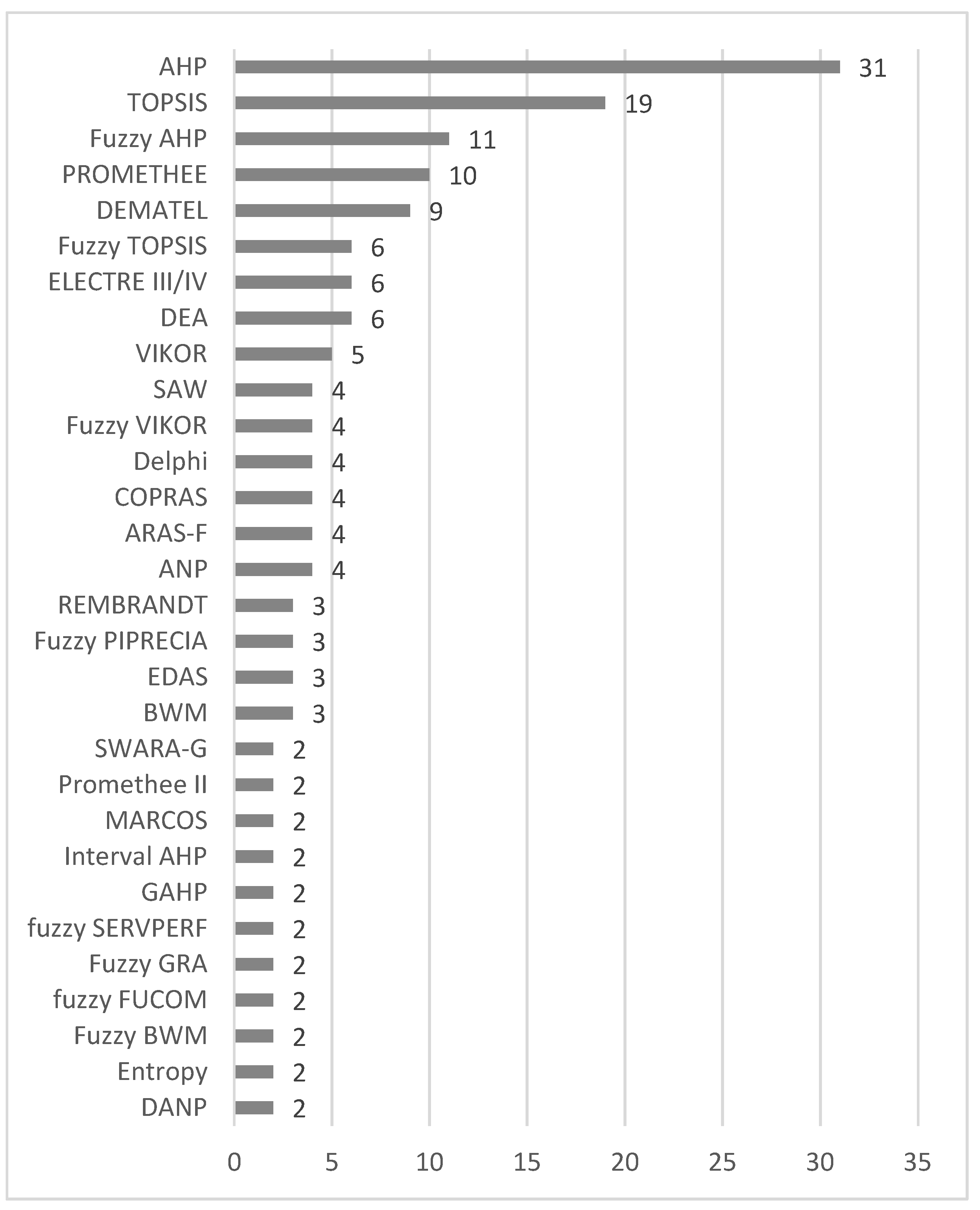
Data on multi-criteria decision-making methods were summarized to obtain a database from 2000 to 2021 (Appendix B). Figure 1 shows the methods that have been used in at least two studies over the past 20 years.
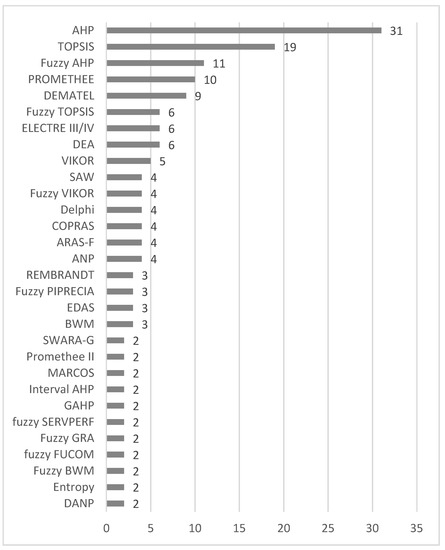
Figure 1.
The most popular MCDM/MCDA methods used in the field of transport between 2000 and 2021. Source: author’s work.
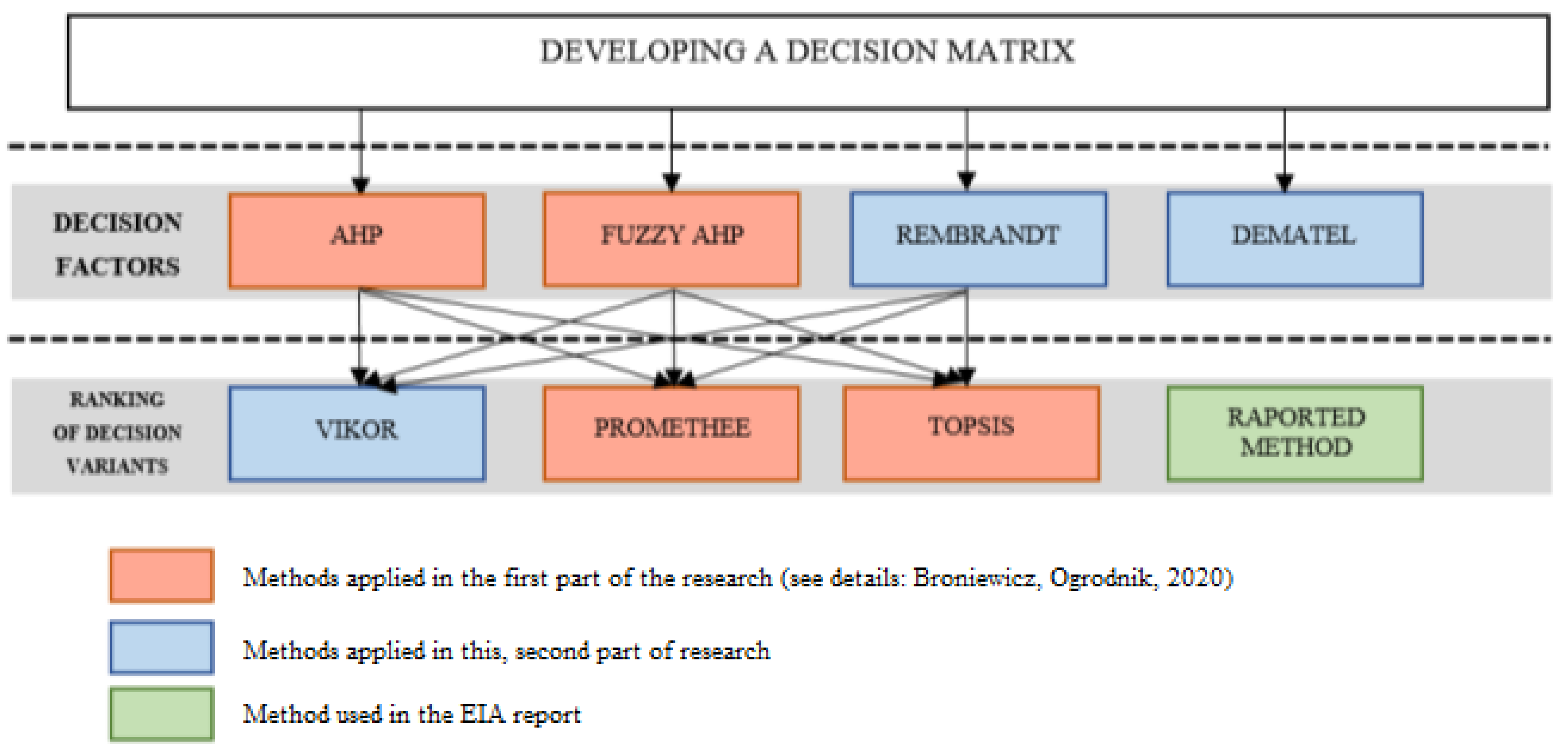
Based on the data in Figure 1, it can be observed that—in the last 20 years—the most frequently used MCDM/MCDA methods in the field of transport were the AHP, TOPSIS, and PROMETHEE methods. It should be emphasized that these exact methods were used in previous studies [1]. In the second part, a decision was made to use the selected methods included in the following items of the carried out review. The hybrid approach proposed in this article is the result of the literature review. In the case study, alternative methods were used to those from the first part of the study [1], which were also at the forefront of the MCDM/MCDA method ranking. A hybrid approach was again used including the following methods:
- DEMATEL; the method placed fifth in the ranking. This method makes it possible to perform dependency analyses at the level of decision factors, making it possible to conduct a multi-criteria analysis in a new dimension.
- VIKOR; the method was placed, along with other methods, in the seventh position, selected as an alternative to the TOPSIS method from the first research part.
- REMBRANDT; although this method was placed in a distant nineth place, it is one of the few methods enabling the weighting of decision factors. It was selected as an alternative to the AHP and Fuzzy AHP methods from the first part of the study.
3. Research Methods
Figure 2 shows the hybrid approach proposed in the article and the scope of multi-criteria and comparative analyses.
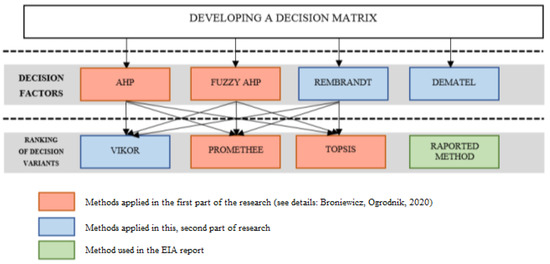
Figure 2.
The basis for the proposed hybrid approach. Source: author’s work.
3.1. DEMATEL Method (Decision-Making Trial and Evaluation Laboratory)
The DEMATEL method was developed in the second half of the 1970s in Switzerland. Generally, it allows for the analysis of cause-and-effect relationships at the level of decision factors. The algorithm of the classic DEMATEL method is relatively simple, as is the case with the AHP method, and is based on comparing factors in pairs using a point scale. The basic assumptions of the method’s algorithm are characterized below [60] (pp. 64–65) [61] (pp. 125–129) [62] (pp. 67–68) [7] (pp. 63–65). The first step in the DEMATEL method is to develop a matrix of direct relations. This matrix is created using a point scale. The classical scale (by Fontel and Gabus, the authors of the method) consists of the following five levels: 0 meaning no direct influence; 1 meaning low impact; 2 meaning medium impact; 3 meaning high impact; and 4 meaning very high impact. There are also other scales. An increased interest in fuzzy scales is observed (see, e.g., [63]). The assessment of the direct interrelationships between the elements is made in pairs (by a single decision-maker or a group of decision-makers). The effect of these comparisons is the so-called matrix of direct relations M. A matrix of direct relations is a square matrix in which the elements on the main diagonal are equal to 0.
In contrast, the other matrix elements show direct relations between the factors within a given pair. The next step in the DEMATEL method is the normalization of elements in the developed matrix of direct relations. The normalization procedure in the DEMATEL method consists of dividing the elements in the matrix of direct relations by the highest value of its row or column sums, thus creating a normalized matrix of direct relations M’. Then, the following formula creates a matrix of integral relations:
where N is the matrix of total relations, M′ is the normalized matrix of direct relations, and I is the unit matrix (the dimension that relates to the dimension of the direct relation matrix).
N = M′(I − M′)−1
The elements of the n matrix represent both direct and indirect relations between decision factors. The final stage in the DEMATEL method is the calculation of two key indicators, the so-called significance index and relation index. Based on their values, the final cause-and-effect diagram is created, illustrating both the activity of the decision factors and their nature in the created cause–effect chain. The factors with positive values of the relation index are causal, i.e., they have the most significant impact on the remaining elements in the data set under consideration. Conversely, factors with negative values of the dependency index affect the created cause–effect chain.
It is worth adding that the DEMATEL and AHP methods have common features including similar initial matrices, namely the matrix of comparisons and matrix of direct relations. Both matrices are square with the constant form of a diagonal (in the AHP comparison matrix, it is 1; in the DEMATEL matrix, the values on the main diagonal are 0). Both methods also utilize point scales [61]. Examples of approaches to linking the classic Saaty scale with the Fontel and Gabus scale (both classic and its modification) are presented in Table 1.

Table 1.
An example of how to combine the scales used in the family of AHP and DEMATEL methods.
Despite the possibility of transforming the initial comparison matrix within the AHP method onto the matrix of direct relations within the DEMATEL method, it should be noted that the procedure of comparing elements in the classic DEMATEL variant concerns the mutual relationships between factors, not the estimation of their importance. Therefore, a multi-criteria analysis using the classic DEMATEL method should be performed regardless of the pairwise comparison procedure present in the AHP method. As part of this article, a cause-and-effect chain of decision-making factors has been developed. It should be emphasized that this is the only multi-criteria analysis developed as part of the research, not related to the level of variants. The REMBRANDT method, an alternative to the AHP method, was used to estimate the weight of decision factors.
3.2. REMBRANDT Method
The REMBRANDT method (Ratio Estimation in Magnitudes or deciBells to Rate Alternatives which are Non-DominaTed) was developed in the Netherlands to respond to the selected solutions used in the AHP method that have been subject to criticism. Among the debatable elements of the algorithm of the AHP method, the authors Forman [66] and Moghtadernejad et al. [67] indicated, among others, that the independence of the examined elements, the measurable subjectivity within pairwise comparisons, or the difficulty in accounting for uncertainties related to judgments. Although the REMBRANDT method, similarly to the AHP method, enables the weighting of decision factors, there are significant technical differences between the methods [68,69,70]:
- in the REMBRANDT method, a logarithmic scale is used instead of a Saaty scale;
- a logarithmic method of least squares is used to derive scale vectors; and
- the geometric mean aggregation is used for the generalized evaluation of variants.
A comparison of the scales used in the AHP and REMBRANDT methods and the grades definition is presented in Table 2.
Table 2.
The classic Saaty scale and the scale used in the REMBRANDT method.
The first step in the REMBRANDT method is the comparing of pairs of elements at a given decision stage using a numerical scale. The grades are then converted into values on a geometric scale. The conversion is done according to the following formula [69]:
where γ is the ln and δij is the figure from the scale.
rij = exp(γδij)
In the second stage, a geometric mean for each row is calculated and then normalized to give the weight vector [68,69,71].
It should be emphasized that in this study, to be able to conduct a full-scale comparative analysis, the ratings from the initial comparison matrix in the AHP method were transformed into ratings that are in accordance with the REMBRANDT scale.
3.3. VIKOR Method
The VIKOR method (Serb. VIsekrzterijumska Optimizacija i Kompromisno Resenje) was developed in the 1990s and then disseminated thanks to the work of Opricovic and Tzeng [72], in which a comparative analysis of the VIKOR and TOPSIS methods (the latter being characterized by similar assumptions) was performed [70]. Similar to TOPSIS, the VIKOR method enables assessing decision alternatives based on their position to defined reference points [62]. The VIKOR method algorithm assumes the following calculation steps [70,72,73,74]. In the first stage, the best and worst grades are determined against the given criteria; these are so-called ideal and anti-ideal points. Then, for individual decision variants, the sum of the weighted, normalized distances from the ideal solution (metric S) and the maximum distance of the weighted, normalized assessment (metric R) are calculated. The lower the value of these metrics, the better. In the next step, the value of the comprehensive indicator is determined (metric Q) according to the following formula [72,73]:
where v is the weight of the strategy of “the majority of criteria”, Si is the S metric (the sum of the weighted, normalized distances of the i-variant from the ideal solution), and Ri is the R metric, the maximum weighted, normalized rating distance.
Three ranking lists constitute the results of the above calculations: variant evaluations in light of S, R, and Q metrics. The lower the values of these metrics, the higher the position in the rankings is awarded to a given variant. The final stage consists of comparing the rankings obtained in terms of an acceptable advantage and acceptable decision stability. Importantly, rankings in the VIKOR method can be carried out with different values of criteria weights, which enables the analysis of the impact of the weights of these criteria on the proposed compromise solution.
4. Case Study
This article once again takes advantage of the data from the report on the environmental impact of a project comprising the construction of an expressway and the construction of a national road in north-eastern Poland. The data was made available by the General Directorate for National Roads and Motorways, Bialystok Branch [75]. Detailed information on the decision-making factors and variants can be found in this article [1].
The planned project involves the construction of an expressway on the Choroszcz-Ploski section and a national road on the section between the towns of Kudrycze and Grabówka, together with the construction of the necessary technical infrastructure. The planned investment is essential for the economic development of this region of Poland. Additionally, it will contribute to improving the quality and safety of road traffic. This road belongs to the international transport corridor network. Six location variants were adopted for the analysis, including two variants of the expressway and three variants of the national road connected to it. The road route variants differ in the location and number of engineering structures [75]. The characteristics of the analyzed variants are presented in Table 3.
Table 3.
Variants’ characteristics.
4.1. Decomposing a Decision-Making Problem
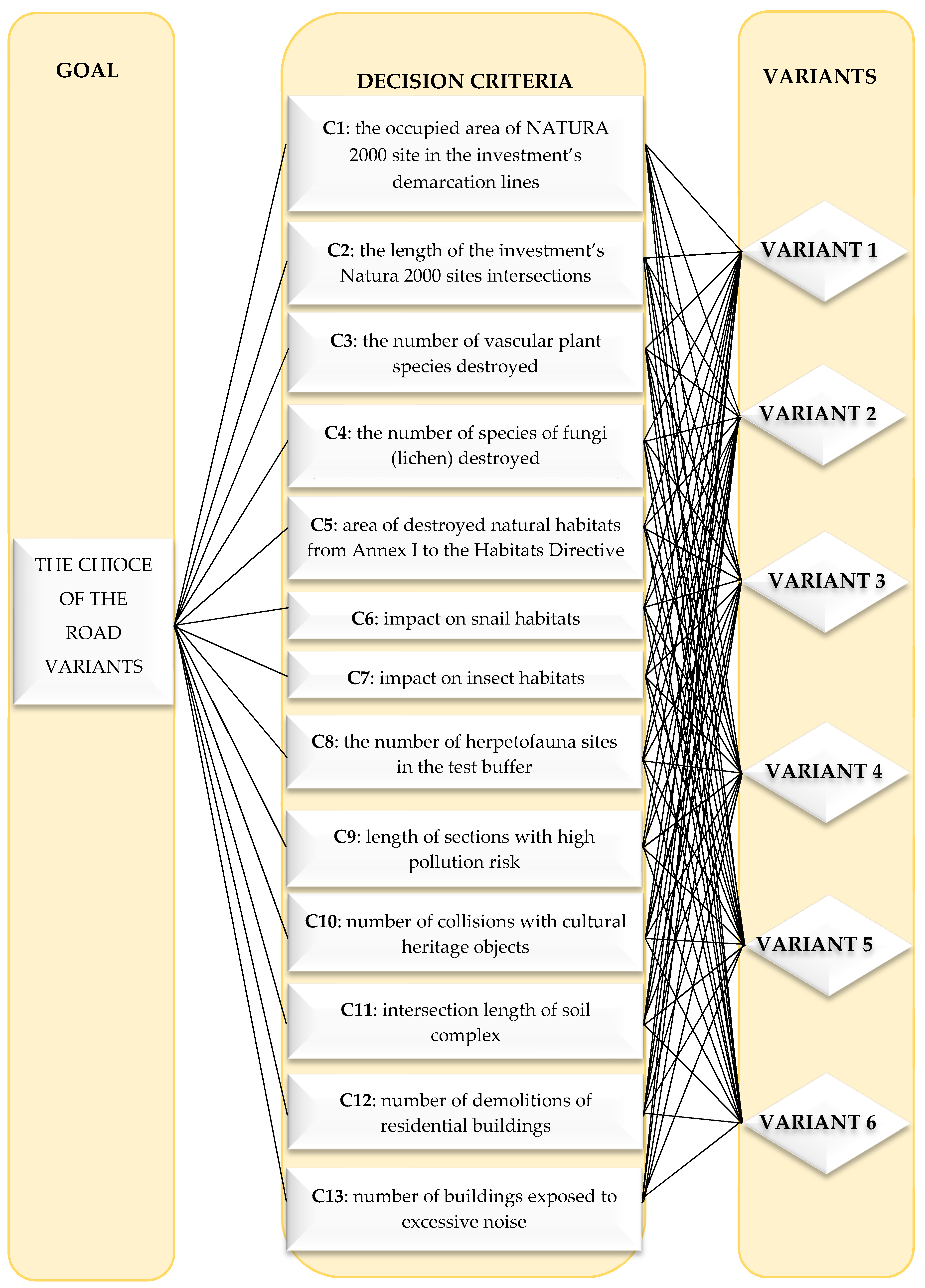
As part of this multi-criteria analysis, six different variants of the road route and 13 decision-making factors reflecting the impact of this investment on the environment and society at large were considered. The criteria for the evaluation of variants are each time individually selected depending on the nature and subject of the analysis. The decision criteria in this case study were adopted from the environmental impact report [75]. The hierarchical structure of the decision problem under consideration is shown in Figure 3.
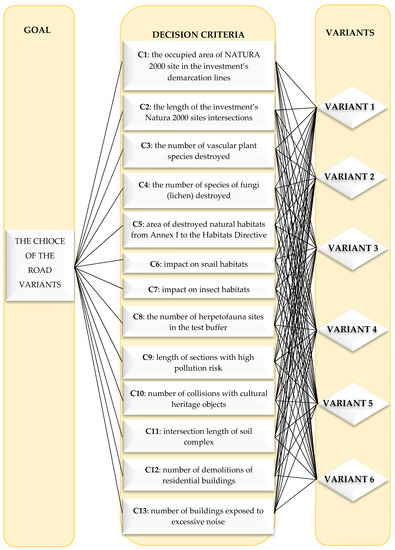
Figure 3.
Hierarchical structure tree. Source: author’s work based on [75].
4.2. Numerical Example
The results of the basic calculations performed using each of the selected methods are presented below: DEMATEL and then REMBRANDT, used to estimate the factor weights, which were later used with the VIKOR method.
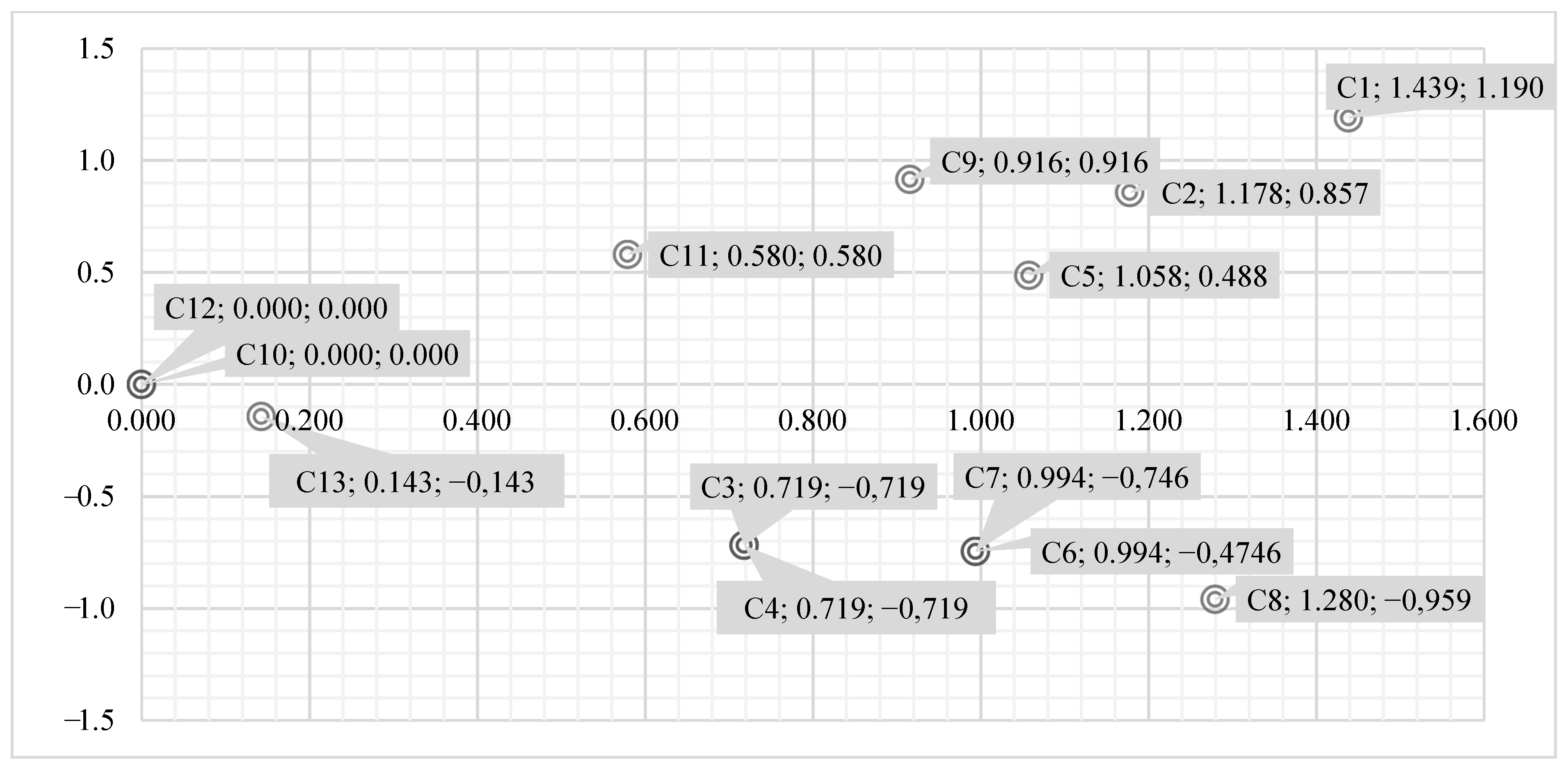
The first stage concerned the analysis of dependencies at the level of decision factors. First, the decision criteria were compared in pairs using the classic DEMATEL scale, obtaining the matrix of direct relations M (Table 4). Then, the grades were normalized (Table 5) and the matrix of total N relations was determined (Table 6), which allowed for the ranking of factors under consideration in the form of a cause-and-effect chain (Table 7 and Figure 4).
Table 4.
The matrix of direct relations for decision factors M (DEMATEL method).
Table 5.
Normalized matrix of direct relations M (DEMATEL method).
Table 6.
Matrix of total relations (direct and indirect) N with row and column sums (DEMATEL method).
Table 7.
The value of the position indicator and relation indicator (DEMATEL method).
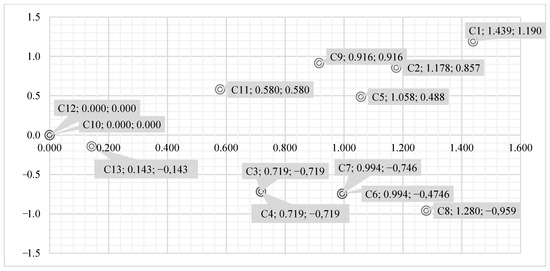
Figure 4.
Cause-and-effect diagram. Source: author’s work.
It should be emphasized that the classic DEMATEL method enables the analysis of dependencies (direct and indirect) between decision factors. This should not be identified directly with the weights of these factors. Therefore, a multi-criteria analysis using DEMATEL helps rank the factors in terms of their mutual relations to identify those that have the most significant impact on the others. In the case of the analyzed data set, the causal factors, i.e., the ones that have the most significant impact on the others, are: factors related to the location of NATURA 2000 areas pertaining to the planned investment (C1, C2, and C5), as well as linear factors, i.e., length sections with a high degree of pollution risk (C9) and the length of the intersection of the complex of soils 2 and 2z (C11). Conversely, the following factors were classified as the resultant of the impact of the above-mentioned criteria: the number of herpetofauna locations in the test buffer (C8); the impact on snail habitats (C6); the impact on the habitats of insects (C7); the number of vascular plant species destroyed (C3); the number of fungi (lichens) species destroyed (C4); and the number of buildings exposed to excessive noise (C13). Two factors remained neutral (C10 and C12), which may indicate their different nature. The classic DEMATEL method facilitates ordering at the level of decision factors and their analysis regarding their mutual interactions. Therefore, it can be an instrument supporting the selection of factors at the stage of the decomposition of the decision-making problem.
Alternatively, the REMBRANDT method was used to estimate the weights of the criteria. It should be noted that the matrix of comparisons in the REMBRANDT method Based on the primary comparison matrix of the AHP method (Table 8), which was used in the first part of the study [1], it was developed (Table 9). Then, according to Formula 2, the matrix elements were transformed into values on the geometric scale. The decision factor weights were estimated using the geometric mean and additive normalization (Table 10).
Table 8.
Matrix of comparisons, criteria weights, and consistency assessment estimated using the classical AHP method.
Table 9.
Decision factor comparison matrix (REMBRANDT method).
Table 10.
Transformed comparison matrix of decision factors: the geometric mean of the rows and weights of decision factors (REMBRANDT method).
The final stage focuses on developing a ranking of the considered decision variants in light of the defined criteria. For this purpose, the VIKOR method was used. In addition to the weights calculated by the REMBRANDT method, sets of weights estimated by the AHP and Fuzzy AHP methods were also used, finally obtaining three rankings (Table 11 and Table 12).
Table 11.
Initial data (VIKOR method).
Table 12.
The values of S, R, and Q metrics together with a ranking and verification of conditions.
4.3. Comparative Analysis
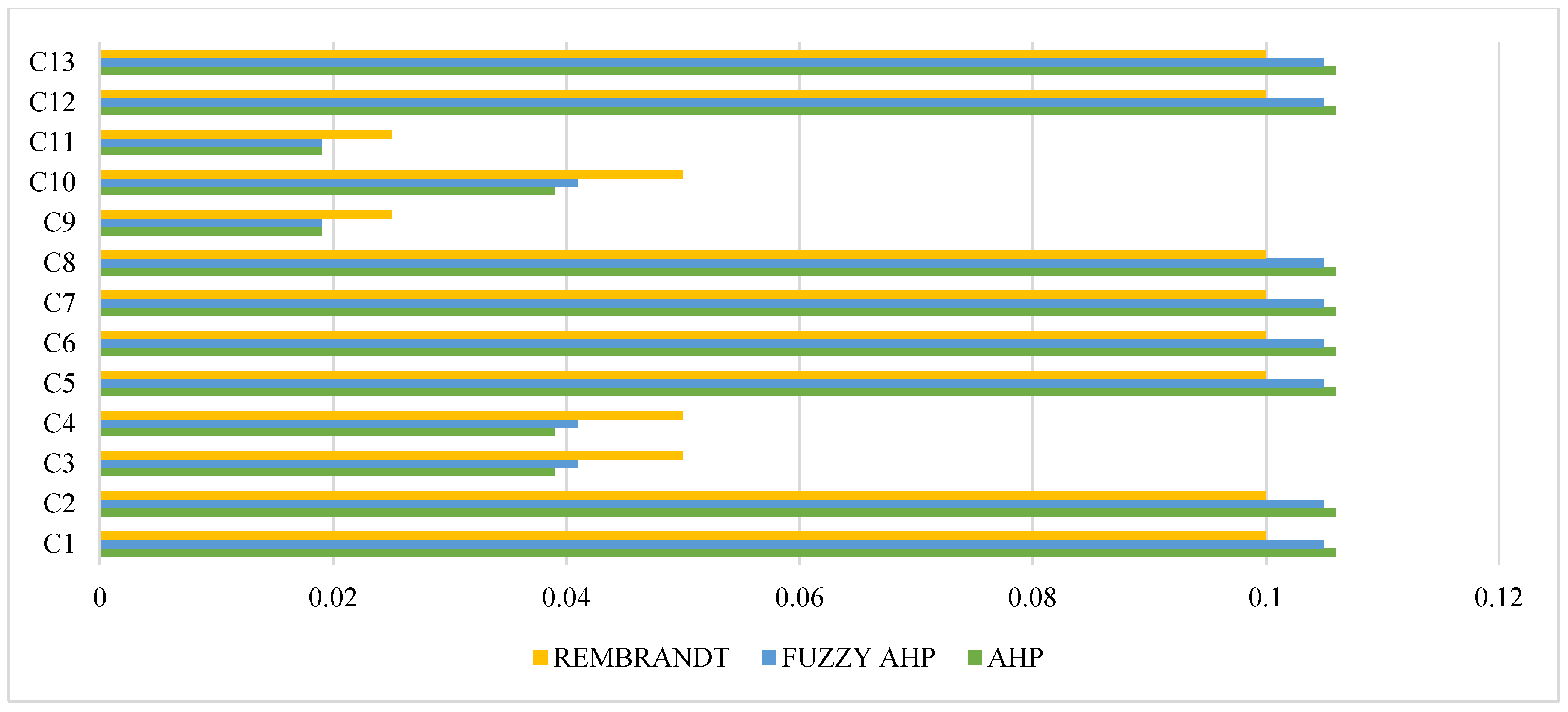
Figure 5 presents individual decision factors’ weights estimated using the following methods: AHP, Fuzzy AHP [1], and REMBRANDT. It should be emphasized that the starting point for the calculations was the AHP comparison matrix evaluations, which were then transformed according to the algorithm of the other two methods.
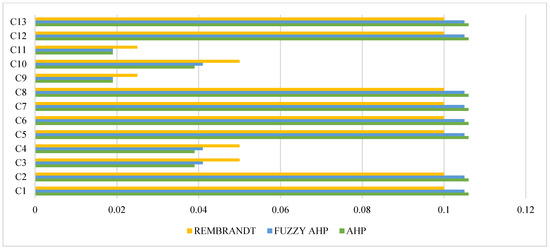
Figure 5.
Decision factor weights calculated using the AHP, Fuzzy AHP, and REMBRANDT methods. Source: author’s work.
Comparing the sets of weights estimated with the AHP, Fuzzy AHP, and REMBRANDT methods, it can be noticed that there are specific differences; however, the order of the factors in terms of their importance has not changed. It should be added, though, that the differences between the weights obtained with the AHP method and the weights estimated with the Fuzzy AHP method are much lower than the differences between the sets of AHP and REMBRANDT scales. Therefore, it can be concluded that the modifications proposed in the REMBRANDT method (mainly the form of the scale and the logarithmic method of least squares that is used to estimate the weight vector) have a greater overall impact on the final vector of the weights than the case with a transformation of a classic Saaty scale into a fuzzy triangular scale has (see also [68]).
The assessment of the impact that a change in the value of factor weights has on the final ranking of decision variants serves as yet another important element of the comparative analysis. Table 13 presents the final rankings of alternatives developed using the three MCDM/MCDA methods: TOPSIS, PROMETHEE, and VIKOR. Additionally, the ranking of variants developed as part of the environmental impact report for the investment in question was given as a reference point. A detailed description of the obtained rankings in terms of content is presented in [1].
Table 13.
Ranking of decision variants: summary list.
A change in the weighting of decision factors did not affect the final ranking of the variants. For both the TOPSIS and PROMETHEE methods, even after changing the set of weights, the final order did not change. Similar observations apply to the multi-criteria analysis performed using the VIKOR method. It should be emphasized that the final rankings of the decision variants presented in Table 13 are almost identical. However, in the case of receiving different rankings, it is recommended to use, for example, the rank similarity coefficient in decision-making problems (see [76]).
Significantly, the obtained rankings of the decision alternatives differ in regards to the first position. In the case of the method used in the report and the PROMETHEE method, which represents the family of methods based on the height difference, W3 arrived in the first place. However, among the methods based on reference points, identical rankings were obtained, with W2 in the first place. In the case of the rankings obtained using the TOPSIS method, the differences between the first and second place were negligible (e.g., with the use of weights calculated by using the classic AHP and the final index of W2 = 0.777 and W3 = 0.772). In contrast, in the rankings prepared using the VIKOR method, the difference between the first two places was higher and W2 met both the condition of “acceptable advantage” and “acceptable stability”.
It should be emphasized that the comparative analysis of the distance methods VIKOR and TOPSIS (especially in the context of the algorithms used) was the subject of previous research; see, e.g., [72,77].
5. Discussion and Conclusions
The performed multi-criteria analyses allowed to verify the choice of the course of the selected investment made as part of the report [75] and which made it possible to evaluate the usefulness of the selected MCDM/MCDA methods in the field of transport. Based on the performed calculations as well as the comparative analyses of the obtained results and their interpretations, Table 14 presents the evaluation of the MCDM/MCDA methods applied, their advantages/opportunities, and disadvantages/limitations, including the fields of application in the transport domain. It should be noted that, due to the growing popularity of MCDM/MCDA methods, they have already been studied in terms of their advantages and disadvantages (see, e.g., [8,78,79,80,81]). However, in the framework of this paper, the observations formulated by the authors concern the application of these methods in decision-making problems in the area of transport. Of course, despite such a narrower approach, selected comments on the usefulness of the selected methods can be considered universal.
Table 14.
Assessment of the most popular MCDM/MCDA methods used so far in the field of transport with their SWOT analysis and examples of applications.
Based on the literature studies and the conducted analyses, the following conclusions can be drawn:
- Multi-criteria decision support in the field of transport is invariably based mainly on the methods from the AHP, PROMETHEE, and TOPSIS family. This is primarily due to their universal nature, transparent and proven algorithms, and the available software to facilitate the performance of multi-dimensional analyses. However, each year, new methods not yet observed in the field of transport emerge, such as CODAS, COMET, CRITIC, EDAS, MARCOS, PIPRECIA, or MEW.
- In any multi-criteria analysis, the weighting of decision-making factors serves as a crucial stage, especially in investments in the field of transport, which are usually characterized by large dimensions and thus a large scale of potential impacts. Therefore, it seems appropriate to use methods that enable pairwise comparisons of factors as part of the expert research stage (AHP, Fuzzy AHP, or REMBRANDT).
- The DEMATEL method can serve as a support tool at the stage of selecting and analyzing decision factors. To increase objectivity, the analysis of dependencies can be successfully performed as part of expert interviews.
- When ranking decision alternatives, the number of multi-criteria methods available is significant. Concerning decision-making problems in the field of transport, especially in a situation where the considered alternatives are similar, it is recommended to use at least two methods.
Due to the dynamic development of MCDM/MCDA methods, the development of multi-criteria analyses in the field of transport with the use of other methods, especially the “youngest” methods which have so far been characterized by single implementations of the study, should be indicated among the future directions of development. Furthermore, it would be interesting to compare their usefulness with classic methods well known in theory and practice that dominate the developed application overview.
Author Contributions
Conceptualization, K.O. and E.B.; methodology, K.O.; writing, E.B. and K.O. Both authors have read and agreed to the published version of the manuscript.
Funding
The study was carried out as part of study number WZ/WB-IIL/6/2019 and WZ/WB-IIŚ/1/2020 at the Bialystok University of Technology and was financed by a subvention provided by the Minister of Science and Higher Education.
Data Availability Statement
Not applicable.
Conflicts of Interest
The authors declare no conflict of interest.
Appendix A
Table A1.
Compilation of the literature review on multi-criteria methods applied in transport-related projects in 2020–2021.
Table A1.
Compilation of the literature review on multi-criteria methods applied in transport-related projects in 2020–2021.
| Author (Year of Publication) | Location | MCDM/MCDA Methods Used | The Main Subject of the Research |
|---|---|---|---|
| Safety and Quality of Public Transport | |||
| Vavrek and Bečica (2020) [6] | Czech Republic | CV-TOPISIS | Evaluation of transport companies |
| Blagojević et al. (2020) [7] | Bosnia and Herzegovina | Fuzzy PIPRECIA and Entropy method | Safety evaluation of railway traffic |
| Damidavičius et al. (2020) [8] | Lithuania | COPRAS, TOPSIS, ARAS, and EDAS | Assessment of urban transport systems and their potential in terms of sustainable mobility |
| Zehmed and Jawab (2020) [9] | Fez, Morocco | Fuzzy SERVPERF and DEA | Quality of urban bus transport service |
| Kumar and Anbanandam (2020) [10] | India | Fuzzy Best–Worst method (FBWM) | Assessment of social sustainability indicators in the freight transport industry |
| Kumar and Anbanandam (2020A) [11] | India | Intuitionistic fuzzy AHP (IF-AHP) and IF-VICOR | Assessment of environmental sustainability indicators in the freight transport industry |
| Pamucar et al. (2020) [12] | Istanbul (Turkey) | Fuzzy Full Consistency Method-Dombi–Bonferroni (fuzzy FUCOM-D’Bonferroni) | Assessment of transport demand management measures |
| Kumar et al. (2020B) [13] | India | AHP, DEA, VICOR, and MPI | Assessment of the performance of public road transportation systems |
| Blagojević et al. (2021) [14] | Bosnia and Herzegovina | Fuzzy FUCOM, fuzzy PIPRECIA, and fuzzy MARCOS | Evaluation of safety degree at railway crossings |
| Karim and Jawab (2020) [15] | Morocco | DEA and fuzzy SERVPERF | Assessment of the quality of urban bus transport |
| Scenarios for the Development of Public Transport Systems | |||
| Kizielewicz and Dobryakova (2020) [16] | Poland | COMET (Characteristic Objects METhod) | The assessment of model electric scooters in cities |
| D’Orso et al. (2020) [17] | Spain | AHP | The optimal allocation of economic resources for identifying the actions in the transport sector |
| Ogrodnik (2020) [18] | Poland | PROMETHEE | Sustainable solutions for public transport and infrastructure |
| Hamurcu and Eren (2020) [19] | Kırıkkale, Turkey | TOPSIS | Prioritizing alternative public transportation projects |
| Kim et al. (2020) [20] | Korea | FAHP | Strategies for efficient use of Trans-Siberian Railway for multimodal transport |
| Görçün (2021) [21] | Istanbul, Turkey | CRITIC (CRiteria Importance Through Intercriteria Correlation) and EDAS (Evaluation based on Distance from Average Solution) | Evaluation of the selection of urban rail vehicles |
| Choice of Investment Location | |||
| Palczewski and Sałabun (2019) [22] | Poland | PROMETHEE II | Location of the airport |
| Akin and Kara (2020) [23] | Istanbul, Turkey | Additive value (AV) model | Location of intercity bus terminal |
| Ortega et al. (2020) [24] | Ecuador, Cuenca | Fuzzy AHP | Location of park-and-ride facility |
| Broniewicz and Ogrodnik (2020) [1] | Poland | AHP, Fuzzy AHP, TOPSIS, and PROMETHEE | Location of the expressway section |
| Tadic et al. (2020) [25] | Western Balkans region | AHP and CODAS | Dry port terminal location selection |
| Aljohani and Thompson (2020) [26] | Inner Melbourne, Australia | TOPSIS | Location of freight consolidation facility |
| Sukmanee et al. (2020) [27] | Thailand | Analytic Network Process (ANP) and Design Structure Matrix (DSM) | Location of dry port |
| Zagorskas and Turskis (2020) [28] | Kaunas, Lithuania | MEW, EDAS, ARAS, and SWARA | Location of new pedestrian bridges |
| Aksoy and Gursoy (2020) [29] | Turkey | AHP and ELECTRE | Locations of logistic villages |
| Muravev et al. (2020) [30] | China | DEMATEL–MAIRCA | Location optimization of international logistics centers |
| Ayub and Balogun (2021) [31] | Bandar Seri Iskandar Malaysia | AHP | Optimal bus-stop locations |
| Road, Air, Railway, and Sea Transport | |||
| Li et al. (2020) [32] | China | Best–Worst method (BWM) | Customers’ preferences for the main attributes that define the transport service |
| Shishegaran et al. (2020) [33] | Tehran, Iran | TOPSIS | Sustainability evaluation of scenarios transport network condition |
| Stokic et al. (2020) [34] | Belgrade, Serbia | Hybrid DANP–TOPSIS | Selection of the most suitable vehicle |
| Stoilova et al. (2020) [35] | Trans-European Transport Network (TEN-T) | SIMUS | Evaluation of railway network performance |
| Tolga and Durak (2020) [36] | Istanbul, Turkey | Fuzzy COPRAS | Evaluation of innovation projects in the air cargo sector |
| Lameira et al. (2020) [37] | the Amazon | AHP, DEMATEL, and ELECTRE | Evaluation and selection of the best river train in the Amazon region |
| Electric Vehicles | |||
| Shekhovtsov et al. (2020) [38] | Poland | VICOR and TOPSIS | Evaluation of electric bicycles |
| Kaya et al. (2020) [39] | Istanbul | VIKOR and PROMETHEE | Location of electric vehicle charging stations |
| Wilken et al. (2020) [40] | Germany | PROMETHEE | Comparison of electric vehicles with internal combustion engine vehicles |
| Cheng and Wei (2020) [41] | Beijing, China | AHP and DEA | Location selection of bike-sharing parking points |
| Other | |||
| Solecka et al. (2020) [42] | Krakow, Poland | Compensation-Conjunctive method (CC) | Adaptation of interchanges to the needs of people with reduced mobility |
| Dang and Yeo (2020) [43] | Vietnam | Fuzzy TOPSIS | Synchronization in developing transport infrastructures, such as between transport systems and dry port networks |
| Zapolskytė et al. (2020) [44] | Vilnius, Lithuania | AHP, COPRAS, TOPSIS, and SAW | Assessment of the level of development of infrastructure and transport services |
| Zagorskas and Turskis (2020) [45] | Vilnius, Lithuania | Additive Ratio ASsessment with Fuzzy (ARAS-F) | Ranking the priorities for development and the renewal of bicycle pathway segments |
| Galinska (2019) [46] | Poland | Promethee II | Selection of logistics operator |
| Pamucar et al. (2020) [47] | Romania | BWM and MARCOS | Prioritizing the alternatives of the hydrogen bus development |
| Liachovičius et al. (2020) [48] | Lithuania | SAW, COPRAS, TOPSIS, EDAS, and PROMETHEE | Business valuation of road freight transport companies |
| Ur Rehman and Ali (2021) [49] | China Pakistan Economic Corridor (CPEC) | Fuzzy-TOPSIS | Identification of China’s most optimal route for crude oil import |
| Kaska and Tolga (2021) [50] | Turkey | TOPSIS | Selection of software for a maritime organization |
| Koohathongsumrit and Meethom (2021) [51] | Thailand | AHP, DEA, and TOPSIS | Route selection in multimodal supply chains |
| Aghamohagheghi et al. (2001) [52] | Iran | Interval-valued pythagorean fuzzy set (IVPFS) | Assessment of sustainable transport projects |
| Ðalić et al. (2021) [53] | Bosnia and Herzegovina | Model based on the integration of fuzzy PIPRECIA, FUCOM, and MARCOS | Set of business strategies of the transport company |
| Risk Analysis | |||
| Cunha et al. (2021) [54] | Brazilian airports | MCDA-C | Analysis of risks related to airport runway maintenance |
| Erdoğan and Kaya (2020) [55] | Istanbul, Turkey | Fuzzy rule-based system FRBS and particle swarm optimization PSO | Evaluation of risks and failures of public transport systems |
| Bakioglu and Atahan (2021) [56] | Turkey | AHP, PF-TOPSIS, and PF-VIKOR | Risk prioritization in self-driving vehicles |
Appendix B
Table A2.
Summary of the methods’ application in selected areas associated with transport infrastructure in 2000–2021.
Table A2.
Summary of the methods’ application in selected areas associated with transport infrastructure in 2000–2021.
| Method | Safety snd Quality of Public Transport | Scenarios for the Development of the Public Transport System | Choice of Investment Location | Road, Air, Rail, and Sea Transport | Electric Vehicles | Other | Total |
|---|---|---|---|---|---|---|---|
| AHP | 7 | 6 | 5 | 6 | 1 | 6 | 31 |
| ANOVA | 1 | 0 | 0 | 0 | 0 | 0 | 1 |
| ANP | 0 | 1 | 1 | 0 | 0 | 2 | 4 |
| ARAS-F | 1 | 0 | 2 | 0 | 0 | 1 | 4 |
| AV | 0 | 0 | 1 | 0 | 0 | 0 | 1 |
| BWM | 0 | 0 | 0 | 2 | 0 | 1 | 3 |
| CC | 0 | 0 | 0 | 0 | 0 | 1 | 1 |
| CFA | 0 | 0 | 1 | 0 | 0 | 0 | 1 |
| CODAS | 0 | 0 | 1 | 0 | 0 | 0 | 1 |
| COMET | 0 | 1 | 0 | 0 | 0 | 0 | 1 |
| COPRAS | 2 | 0 | 0 | 0 | 0 | 2 | 4 |
| COPRAS-G | 0 | 1 | 0 | 0 | 0 | 0 | 1 |
| COSIMA | 0 | 0 | 0 | 1 | 0 | 0 | 1 |
| CRITIC | 0 | 1 | 0 | 0 | 0 | 0 | 1 |
| CV-TOPSIS | 1 | 0 | 0 | 0 | 0 | 0 | 1 |
| DANP | 0 | 0 | 0 | 2 | 0 | 0 | 2 |
| De Borda | 0 | 0 | 0 | 1 | 0 | 0 | 1 |
| DEA | 3 | 0 | 0 | 0 | 1 | 2 | 6 |
| Delphi | 2 | 0 | 1 | 0 | 0 | 1 | 4 |
| DEMATEL | 1 | 2 | 1 | 2 | 1 | 2 | 9 |
| DSM | 0 | 0 | 1 | 0 | 0 | 0 | 1 |
| EDAS | 1 | 0 | 1 | 0 | 0 | 1 | 3 |
| ELECTRE III/IV | 0 | 3 | 1 | 2 | 0 | 0 | 6 |
| Entropy | 2 | 0 | 0 | 0 | 0 | 0 | 2 |
| FARE | 1 | 0 | 0 | 0 | 0 | 0 | 1 |
| FSWARA | 0 | 0 | 0 | 1 | 0 | 0 | 1 |
| Fuzzy AHP | 3 | 2 | 2 | 2 | 0 | 2 | 11 |
| Fuzzy ANP | 0 | 0 | 1 | 0 | 0 | 0 | 1 |
| Fuzzy BWM | 1 | 0 | 0 | 1 | 0 | 0 | 2 |
| Fuzzy COPRAS | 0 | 0 | 0 | 1 | 0 | 0 | 1 |
| Fuzzy Delphi | 0 | 0 | 1 | 0 | 0 | 0 | 1 |
| Fuzzy DEMATEL | 0 | 0 | 0 | 0 | 0 | 1 | 1 |
| fuzzy FUCOM-D’Bonferroni | 1 | 0 | 0 | 0 | 0 | 1 | 2 |
| Fuzzy GRA | 1 | 1 | 0 | 0 | 0 | 0 | 2 |
| Fuzzy MARCOS | 1 | 0 | 0 | 0 | 0 | 0 | 1 |
| Fuzzy MULTIMOORA | 0 | 0 | 0 | 1 | 0 | 0 | 1 |
| Fuzzy particle swarm Optimisation PSO | 0 | 0 | 0 | 0 | 0 | 1 | 1 |
| Fuzzy PIPRECIA | 2 | 0 | 0 | 0 | 0 | 1 | 3 |
| Fuzzy SERVPERF | 2 | 0 | 0 | 0 | 0 | 0 | 2 |
| Fuzzy TOPSIS | 1 | 1 | 0 | 0 | 1 | 3 | 6 |
| Fuzzy VIKOR | 1 | 1 | 1 | 0 | 0 | 1 | 4 |
| GAHP | 1 | 0 | 0 | 1 | 0 | 0 | 2 |
| GRA | 1 | 0 | 0 | 0 | 0 | 0 | 1 |
| Hybrid DANP-TOPSIS | 0 | 0 | 0 | 1 | 0 | 0 | 1 |
| Interval AHP | 1 | 1 | 0 | 0 | 0 | 0 | 2 |
| IVPFS | 0 | 0 | 0 | 0 | 0 | 1 | 1 |
| MABAC | 0 | 0 | 0 | 1 | 0 | 0 | 1 |
| MACBETH | 0 | 0 | 1 | 0 | 0 | 0 | 1 |
| MARCOS | 0 | 0 | 0 | 0 | 0 | 2 | 2 |
| MAUT | 0 | 1 | 0 | 0 | 0 | 0 | 1 |
| MCDA-C | 0 | 0 | 0 | 0 | 0 | 1 | 1 |
| MEW | 0 | 0 | 1 | 0 | 0 | 0 | 1 |
| Modified rough AHP | 0 | 0 | 0 | 1 | 0 | 0 | 1 |
| Modified VIKOR | 0 | 0 | 0 | 1 | 0 | 0 | 1 |
| MPI | 1 | 0 | 0 | 0 | 0 | 0 | 1 |
| MULTIMOORA | 0 | 0 | 0 | 0 | 0 | 1 | 1 |
| PROMETHEE | 1 | 1 | 2 | 1 | 3 | 2 | 10 |
| Promethee II | 0 | 0 | 1 | 0 | 0 | 1 | 2 |
| REMBRANDT | 0 | 0 | 0 | 1 | 0 | 2 | 3 |
| ROC | 0 | 1 | 0 | 0 | 0 | 0 | 1 |
| SAW | 0 | 0 | 0 | 1 | 0 | 3 | 4 |
| SMARTER | 0 | 0 | 0 | 0 | 0 | 1 | 1 |
| Stochastic TOPSIS | 1 | 0 | 0 | 0 | 0 | 0 | 1 |
| SWARA-G | 0 | 1 | 1 | 0 | 0 | 0 | 2 |
| TOPSIS | 2 | 3 | 3 | 4 | 1 | 6 | 19 |
| VIKOR | 2 | 0 | 0 | 1 | 2 | 0 | 5 |
| WASPAS | 0 | 0 | 1 | 0 | 0 | 0 | 1 |
References
- Broniewicz, E.; Ogrodnik, K. Multi-criteria analysis of transport infrastructure projects. Transp. Res. Part D Transp. Environ. 2020, 83, 102351. [Google Scholar] [CrossRef]
- Brundtland Commission. Our Common Future, Report of the World Commission on Environment and Development; Brundtland Commission: Rio de Janeiro, Brazil, 1987. [Google Scholar]
- Daly, H.E. Allocation, Distribution, and Scale: Towards an Economics that is Efficient, Just, and Sustainable. Ecol. Econ. 1992, 6, 185–193. [Google Scholar] [CrossRef]
- Pearce, D.W.; Atkinson, G.D. Capital theory and the measurement of sustainable development: An indicator of “weak” sustainability. Ecol. Econ. 1993, 8, 103–108. [Google Scholar] [CrossRef]
- Urbanyi-Popiołek, I. Podstawy Organizacji i ekonomiki transportu–wybrane zagadnienia. In Ekonomiczne I Organizacyjne Aspekty Transportu, Urbanyi-Popiołek, I., Ed.; Wydawnictwo Uczelniane Wyższej Szkoły Gospodarki w Bydgoszczy: Bydgoszcz, Poland, 2013; pp. 9–27. (In Polish) [Google Scholar]
- Zavadskas, E.K.; Turskis, Z.; Kildienė, S. State of art surveys of overviews on MCDM/MADM methods. Technol. Econ. Dev. Econ. 2014, 20, 165–179. [Google Scholar] [CrossRef] [Green Version]
- Ogrodnik, K. The use of the DEMATEL method to analyze cause and effect relationships between sustainable development indicators. Ekonomia i Środowisko 2018, 4, 60–72. [Google Scholar]
- Kumar, A.; Sah, B.; Singh, A.R.; Deng, Y.; He, X.; Kumar, P.; Bansal, R. A review of multi criteria decision making (MCDM) towards sustainable renewable energy development. Renew. Sustain. Energy Rev. 2017, 69, 596–609. [Google Scholar] [CrossRef]
- Stojčić, M.; Zavadskas, E.K.; Pamučar, D.; Stević, Ž.; Mardani, A. Application of MCDM Methods in Sustainability Engineering: A Literature Review 2008–2018. Symmetry 2019, 11, 350. [Google Scholar] [CrossRef] [Green Version]
- Vavrek, R.; Bečica, J. Capital City as a Factor of Multi-Criteria Decision Analysis—Application on Transport Companies in the Czech Republic. Mathematics 2020, 8, 1765. [Google Scholar] [CrossRef]
- Blagojević, A.; Stević, Ž.; Marinković, D.; Kasalica, S.; Rajilić, S. A Novel Entropy-Fuzzy PIPRECIA-DEA Model for Safety Evaluation of Railway Traffic. Symmetry 2020, 12, 1479. [Google Scholar] [CrossRef]
- Damidavičius, J.; Burinskienė, M.; Antuchevičienė, J. Assessing Sustainable Mobility Measures Applying Multicriteria Decision Making Methods. Sustainability 2020, 12, 6067. [Google Scholar] [CrossRef]
- Zehmed, K.; Jawab, F. A Combined Approach Based on Fuzzy SERVPERF and DEA for Measuring and Benchmarking the Quality of Urban Bus Transport Service at the Route Level. Ind. Eng. Manag. Syst. 2020, 19, 442–459. [Google Scholar] [CrossRef]
- Kumar, A.; Anbanandam, R. An MCDM framework for assessment of social sustainability indicators of the freight transport industry under uncertainty. A multi-company perspective. J. Enterp. Inf. Manag. 2020, 33, 1023–1058. [Google Scholar] [CrossRef]
- Kumar, A.; Anbanandam, R. Environmentally responsible freight transport service providers’ assessment under data-driven information uncertainty. J. Enterp. Inf. Manag. 2020, 34, 506–542. [Google Scholar] [CrossRef]
- Pamucar, D.; Deveci, M.; Canıtez, F.; Bozanic, D. A fuzzy Full Consistency Method-Dombi-Bonferroni model for prioritizing transportation demand management measures. Appl. Soft Comput. 2020, 87, 105952. [Google Scholar] [CrossRef]
- Kumar, A.; Singh, G.; Vaidya, O.S. A Comparative Evaluation of Public Road Transportation Systems in India Using Multicriteria Decision-Making Techniques. J. Adv. Transp. 2020, 2020, 1–16. [Google Scholar] [CrossRef]
- Blagojević, A.; Kasalica, S.; Stević, Ž.; Tričković, G.; Pavelkić, V. Evaluation of Safety Degree at Railway Crossings in Order to Achieve Sustainable Traffic Management: A Novel Integrated Fuzzy MCDM Model. Sustainability 2021, 13, 832. [Google Scholar] [CrossRef]
- Kizielewicz, B.; Dobryakova, L. How to choose the optimal single-track vehicle to move in the city? Electric scooters study case. Procedia Comput. Sci. 2020, 176, 2243–2253. [Google Scholar] [CrossRef]
- D’Orso, G.; Migliore, M.; Peri, G.; Rizzo, G. Using AHP methodology for prioritizing the actions in the transport sector in the frame of SECAPs. In Proceedings of the 2020 IEEE International Conference on Environment and Electrical Engineering and 2020 IEEE Industrial and Commercial Power Systems Europe 2020, Madrid, Spain, 9–12 June 2020. [Google Scholar]
- Ogrodnik, K. Multi-criteria analysis of smart cities in Poland. Geogr. Pol. 2020, 93, 163–181. [Google Scholar] [CrossRef]
- Hamurcu, M.; Eren, T. Strategic Planning Based on Sustainability for Urban Transportation: An Application to Decision-Making. Sustainability 2020, 12, 3589. [Google Scholar] [CrossRef]
- Kim, G.-S.; Lee, S.-W.; Seo, Y.-J.; Kim, A.-R. Multimodal transportation via TSR for effective Northern logistics: Perspectives of Korean logistics companies. Marit. Bus. Rev. 2020, 5, 295–312. [Google Scholar] [CrossRef]
- Görçün, Ö.F. Evaluation of the selection of proper metro and tram vehicle for urban transportation by using a novel integrated MCDM approach. Sci. Prog. 2021, 104. [Google Scholar] [CrossRef] [PubMed]
- Palczewski, K.; Sałabun, W. Influence of various normalization methods in PROMETHEE II: An empirical study on the selection of the airport location. Procedia Comput. Sci. 2019, 159, 2051–2060. [Google Scholar] [CrossRef]
- Akin, D.; Kara, D. Multicriteria analysis of planned intercity bus terminals in the metropolitan city of Istanbul, Turkey. Transp. Res. Part A Policy Pr. 2020, 132, 465–489. [Google Scholar] [CrossRef]
- Ortega, J.; Tóth, J.; Moslem, S.; Péter, T.; Duleba, S. An Integrated Approach of Analytic Hierarchy Process and Triangular Fuzzy Sets for Analyzing the Park-and-Ride Facility Location Problem. Symmetry 2020, 12, 1225. [Google Scholar] [CrossRef]
- Tadić, S.; Krstić, M.; Roso, V.; Brnjac, N. Dry Port Terminal Location Selection by Applying the Hybrid Grey MCDM Model. Sustainability 2020, 12, 6983. [Google Scholar] [CrossRef]
- Aljohani, K.; Thompson, R.G. A multi-criteria spatial evaluation framework to optimise the siting of freight consolidation facilities in inner-city areas. Transp. Res. Part A Policy Pr. 2020, 138, 51–69. [Google Scholar] [CrossRef]
- Sukmanee, J.; Kesvarakul, R.; Janthong, N. Network Modeling with ANP to Determine the Appropriate Area for the Development of Dry Port in Thailand. Adv. Sci. Technol. Eng. Syst. J. 2020, 5, 676–683. [Google Scholar] [CrossRef]
- Zagorskas, J.; Turskis, Z. Setting priority list for construction works of bicycle path segments based on eckenrode rating and aras-f decision support method integrated in gis. Transport 2020, 35, 179–192. [Google Scholar] [CrossRef]
- Aksoy, B.; Gursoy, M. Evaluation of location selection process of logistics villages using Analytic Hierarchy Process and ELECTRE methods: A case study for Turkey. Sigma J. Eng. Nat. Sci.Sigma Muhendis. Bil. Derg. 2020, 38, 1897–1910. [Google Scholar]
- Muravev, D.; Hu, H.; Zhou, H.; Pamucar, D. Location Optimization of CR Express International Logistics Centers. Symmetry 2020, 12, 143. [Google Scholar] [CrossRef] [Green Version]
- Ayub, U.B.; Balogun, A.-L.B. Spatial Analysis for Sustainable Campus Transportation: A Case Study of UTP. Lect. Notes Civil Eng. 2021, 132, 870–882. [Google Scholar]
- Li, Q.; Rezaei, J.; Tavasszy, L.; Wiegmans, B.; Guo, J.; Tang, Y.; Peng, Q. Customers’ preferences for freight service attributes of China Railway Express. Transp. Res. Part A Policy Pract. 2020, 142, 225–236. [Google Scholar] [CrossRef]
- Shishegaran, A.; Shishegaran, A.; Mazzulla, G.; Forciniti, C. A Novel Approach for a Sustainability Evaluation of Developing System Interchange: The Case Study of the Sheikhfazolah-Yadegar Interchange, Tehran, Iran. Int. J. Environ. Res. Public Health 2020, 17, 435. [Google Scholar] [CrossRef] [PubMed] [Green Version]
- Stokic, M.; Vujanovic, D.; Sekulic, D. A New Comprehensive Approach for Efficient Road Vehicle Procurement Using Hybrid DANP-TOPSIS Method. Sustainability 2020, 12, 4044. [Google Scholar] [CrossRef]
- Stoilova, S.; Munier, N.; Kendra, M.; Skrúcaný, T. Multi-Criteria Evaluation of Railway Network Performance in Countries of the TEN-T Orient–East Med Corridor. Sustainability 2020, 12, 1482. [Google Scholar] [CrossRef] [Green Version]
- Tolga, A.C.; Durak, G. Valuating innovation projects in air cargo sector with fuzzy COPRAS, In Intelligent and Fuzzy Techniques in Big Data Analytics and Decision Making. INFUS 2019. Advances in Intelligent Systems and Computing 1029; Kahraman, C., Cebi, S., Cevik Onar, S., Oztaysi, B., Tolga, A., Sari, I., Eds.; Springer: Berlin/Heidelberg, Germany, 2020; pp. 702–710. [Google Scholar]
- Lameira, P.I.D.; Filgueiras, T.C.G.M.; Botter, R.C.; Saavedra, R.D.S. An Approach using Multicriteria Decision Methods to Barges Configuration for Pushed Convoys in the Amazon. Int. J. Inf. Technol. Decis. Mak. 2020, 19, 317–341. [Google Scholar] [CrossRef]
- Shekhovtsov, A.; Kozlov, V.; Nosov, V.; Sałabun, W. Efficiency of Methods for Determining the Relevance of Criteria in Sustainable Transport Problems: A Comparative Case Study. Sustainability 2020, 12, 7915. [Google Scholar] [CrossRef]
- Kaya, Ö.; Tortum, A.; Alemdar, K.D.; Çodur, M.Y. Site selection for EVCS in Istanbul by GIS and multi-criteria decision-making. Transp. Res. Part D Transp. Environ. 2020, 80, 102271. [Google Scholar] [CrossRef]
- Wilken, D.; Oswald, M.; Draheim, P.; Pade, C.; Brand, U.; Vogt, T. Multi-dimensional assessment of passenger cars: Comparison of electric vehicles with internal combustion engine vehicles. Procedia CIRP 2020, 90, 291–296. [Google Scholar] [CrossRef]
- Cheng, M.; Wei, W. An AHP-DEA Approach of the Bike-Sharing Spots Selection Problem in the Free-Floating Bike-Sharing System. Discret. Dyn. Nat. Soc. 2020, 2020, 1–15. [Google Scholar] [CrossRef]
- Solecka, K.; Hoy, K.N.; Deryło, A. Assessment of transport interchanges for the needs of people with reduced mobility. Travel Behav. Soc. 2020, 21, 48–56. [Google Scholar] [CrossRef]
- Dang, V.L.; Yeo, G.T. Finding the optimal order of priority for dry port construction: Case study in the North of Vietnam. Int. J. Shipp. Transp. Logist. 2020, 12, 597. [Google Scholar] [CrossRef]
- Zapolskytė, S.; Vabuolytė, V.; Burinskienė, M.; Antuchevičienė, J. Assessment of Sustainable Mobility by MCDM Methods in the Science and Technology Parks of Vilnius, Lithuania. Sustainability 2020, 12, 9947. [Google Scholar] [CrossRef]
- Zagorskas, J.; Turskis, Z. Location Preferences of New Pedestrian Bridges Based on Multi-Criteria Decision-Making and GIS-Based Estimation. Balt. J. Road Bridg. Eng. 2020, 15, 158–181. [Google Scholar] [CrossRef]
- Galińska, B. MCDM as the Tool of Intelligent Decision Making in Transport. Case Study Analysis. In Smart and Green Solutions for Transport Systems. TSTP 2019. Advances in Intelligent Systems and Computing 1091 AISC 2020; Sierpiński, G., Ed.; Springer: Berlin/Heidelberg, Germany, 2020; pp. 67–79. [Google Scholar]
- Pamucar, D.; Iordache, M.; Deveci, M.; Schitea, D.; Iordache, I. A new hybrid fuzzy multi-criteria decision methodology model for prioritizing the alternatives of the hydrogen bus development: A case study from Romania. Int. J. Hydrog. Energy 2020, 46, 29616–29637. [Google Scholar] [CrossRef]
- Liachovičius, E.; Skrickij, V.; Podviezko, A. MCDM Evaluation of Asset-Based Road Freight Transport Companies Using Key Drivers That Influence the Enterprise Value. Sustainability 2020, 12, 7259. [Google Scholar] [CrossRef]
- Rehman, O.U.; Ali, Y. Optimality study of China’s crude oil imports through China Pakistan economic corridor using fuzzy TOPSIS and Cost-Benefit analysis. Transp. Res. Part E Logist. Transp. Rev. 2021, 148, 102246. [Google Scholar] [CrossRef]
- Kaska, M.; Tolga, A.C. Blockchain Software Selection for a Maritime Organization with MCDM Method. In Intelligent and Fuzzy Techniques: Smart and Innovative Solutions. INFUS 2020. Advances in Intelligent Systems and Computing; Kahraman, C., Cevik Onar, S., Oztaysi, B., Sari, I., Cebi, S., Tolga, A., Eds.; Springer: Berlin/Heidelberg, Germany, 2021; Volume 1197. [Google Scholar]
- Koohathongsumrit, N.; Meethom, W. Route selection in multimodal transportation networks: A hybrid multiple criteria decision-making approach. J. Ind. Prod. Eng. 2021, 38, 171–185. [Google Scholar] [CrossRef]
- Aghamohagheghi, M.; Hashemi, S.M.; Tavakkoli-Moghaddam, R. An advanced decision support framework to assess sustainable transport projects using a new uncertainty modelling tool: Interval-valued Pythagorean trapezoidal fuzzy numbers. Iran. J. Fuzzy Syst. 2021, 18, 53–73. [Google Scholar]
- Ðalić, I.; . Stević, Z.; Ateljević, J.; Turskis, Z.; Zavadskas, E.K.; Mardani, A. A novel integrated MCDM-SWOT-TOWS model for the strategic decision analysis in transportation company. Mech. Eng. 2021, 32, 1–22. [Google Scholar]
- Cunha, D.A.; Andrade, M.; Prado, L.A.; Santana, L.O.; da Silv, M.P.G. RISK assessment in airport maintenance runway condition using MCDA-C. J. Air Transp. Manag. 2021, 90, 101948. [Google Scholar] [CrossRef]
- Erdoğan, M.; Kaya, I. A systematic approach to evaluate risks and failures of public transport systems with a real case study for bus rapid system in Istanbul. Sustain. Cities Soc. 2020, 53, 101951. [Google Scholar] [CrossRef]
- Bakioglu, G.; Atahan, A.O. AHP integrated TOPSIS and VIKOR methods with Pythagorean fuzzy sets to prioritize risks in self-driving vehicles. Appl. Soft Comput. 2021, 99, 106948. [Google Scholar] [CrossRef]
- Tamura, H.; Akazawa, K. Structural modeling and systems analysis of uneasy factors for realizing safe, secure and reliable society. J. Telecommun. Inf. Technol. 2005, 3, 64–72. [Google Scholar]
- Dytczak, M. Selected Methods for Multi-Criteria Decision Analysis in Civil Engineering; Oficyna Wydawnicza Politechniki Opolskiej: Opole, Poland, 2010. (In Polish) [Google Scholar]
- Michnik, J. Wielokryterialne Metody Wspomagania Decyzji W Procesie Innowacji; Wydawnictwo Uniwersytetu Ekonomicznego w Katowicach: Katowice, Poland, 2013. (In Polish) [Google Scholar]
- Si, S.-L.; You, X.-Y.; Liu, H.-C.; Zhang, P. DEMATEL Technique: A Systematic Review of the State-of-the-Art Literature on Methodologies and Applications. Math. Probl. Eng. 2018, 2018, 1–33. [Google Scholar] [CrossRef] [Green Version]
- Saaty, T.L. Decision making with the analytic hierarchy process. Int. J. Serv. Sci. 2008, 1, 83. [Google Scholar] [CrossRef] [Green Version]
- Ayhan, M.B. A Fuzzy Ahp Approach For Supplier Selection Problem: A Case Study In A Gearmotor Company. Int. J. Manag. Value Supply Chains 2013, 4, 11–23. [Google Scholar] [CrossRef]
- Forman, E.H. Facts and fictions about the analytic hierarchy process. Math. Comput. Model. 1993, 17, 19–26. [Google Scholar] [CrossRef]
- Moghtadernejad, S.; Chouinard, L.E.; Mirza, M.S. Multi-criteria decision-making methods for preliminary design of sustainable facades. J. Build. Eng. 2018, 19, 181–190. [Google Scholar] [CrossRef]
- Olson, D.L.; Fliedner, G.; Currie, K. Comparison of the REMBRANDT system with analytic hierarchy process. Eur. J. Oper. Res. 1995, 82, 522–539. [Google Scholar] [CrossRef]
- Górecka, D. Comparison of chosen methods for determining the weights of criteria for evaluating decision variants. In Zastosowania Badań Operacyjnych. Zarządzanie Projektami. Decyzje Finansowe, Logistyka; Konarzewska-Gubała, I., Ed.; Wydawnictwo Uniwersytetu Ekonomicznego we Wrocławiu: Wroclaw, Poland, 2011. (In Polish) [Google Scholar]
- Trzaskalik, T. Multicriteria decision support. Review of methods and applications. Sci. Pap. Silesian Univ. Technol Organ. Manag. Ser. 2014, 74, 239–263. [Google Scholar]
- Dachowski, R.; Gałek, K. Risk of Emergency Situations of Underground Objects in the Perspective of Multi-Criteria Decision Making. Arch. Civ. Eng. 2019, 65, 149–162. [Google Scholar] [CrossRef]
- Opricovic, S.; Tzeng, G.-H. Compromise solution by MCDM methods: A comparative analysis of VIKOR and TOPSIS. Eur. J. Oper. Res. 2004, 156, 445–455. [Google Scholar] [CrossRef]
- Kobryń, A. Wielokryterialne Wspomaganie Decyzji w Gospodarowaniu Przestrzenią; Difin: Warszawa, Poland, 2014. (In Polish) [Google Scholar]
- Pośpiech, E.; Mastalerz-Kodzis, A. Multi-criteria method choice to investment decision making. Zesz. Naukowe Politech. Śląskiej 2015, 86, 379–388. [Google Scholar]
- Environmental Impact Assessment Report: Construction of the S19 Road on the Section Choroszcz-Ploski along with the Construction of the Section of National Road No. 65 Kudrycze-Kuriany-Grabówka as well as the Construction, Extension and Reconstruction of Roads of Other Categories and the Necessary Technical Infrastructure; General Directorate for National Roads and Motorways, Department in Bialystok: Bialystok, Poland, 2018. (In Polish)
- Sałabun, W.; Urbaniak, K. A New Coefficient of Rankings Similarity in Decision-Making Problems. In Computational Science–ICCS 2020; Krzhizhanovskaya, V., Ed.; Springer: Berlin/Heidelberg, Germany, 2020; Volume 12138. [Google Scholar]
- Shekhovtsov, A.; Sałabun, W. A comparative case study of the VIKOR and TOPSIS rankings similarity. Procedia Comput. Sci. 2020, 176, 3730–3740. [Google Scholar] [CrossRef]
- Velasquez, M.; Hester, P.T. An Analysis of Multi-Criteria Decision Making Methods. Int. J. Op. Res. 2013, 10, 56–66. [Google Scholar]
- Mandic, K.; Bobar, V.; Delibašić, B. Modeling Interactions Among Criteria in MCDM Methods: A Review. In Proceedings of the International Conference on Decision Support System Technology, Belgrade, Serbia, 27–29 May 2015; pp. 98–109. [Google Scholar]
- Alsalem, M.; Zaidan, A.A.; Zaidan, B.B.; Hashim, M.; Albahri, O.S.; Hadi, A.; Mohammed, K.I. Systematic Review of an Automated Multiclass Detection and Classification System for Acute Leukaemia in Terms of Evaluation and Benchmarking, Open Challenges, Issues and Methodological Aspects. J. Med Syst. 2018, 42, 204. [Google Scholar] [CrossRef]
- Siksnelyte-Butkiene, I.; Zavadskas, E.K.; Streimikiene, D. Multi-Criteria Decision-Making (MCDM) for the Assessment of Renewable Energy Technologies in a Household: A Review. Energies 2020, 13, 1164. [Google Scholar] [CrossRef] [Green Version]
- Ghorbanzadeh, O.; Moslem, S.; Blaschke, T.; Duleba, S. Sustainable Urban Transport Planning Considering Different Stakeholder Groups by an Interval-AHP Decision Support Model. Sustainability 2018, 11, 9. [Google Scholar] [CrossRef] [Green Version]
- Nosal, K.; Solecka, K. Application of AHP Method for Multi-criteria Evaluation of Variants of the Integration of Urban Public Transport. Transp. Res. Procedia 2014, 3, 269–278. [Google Scholar] [CrossRef] [Green Version]
- Kiciński, M.; Solecka, K. Application of MCDA/MCDM methods for an integrated urban public transportation system–case study, city of Cracow. Arch. Transp. 2018, 46, 71–84. [Google Scholar] [CrossRef]
- Zavadskas, E.K.; Turskis, Z.; Bagočius, V. Multi-criteria selection of a deep-water port in the Eastern Baltic Sea. Appl. Soft Comput. 2015, 26, 180–192. [Google Scholar] [CrossRef]
- Nanda, S.; Singh, S. Evaluation of Factors Responsible for Road Accidents in India by Fuzzy AHP. In Networking Communication and Data Knowledge Engineering. Lecture Notes on Data Engineering and Communications Technologies 3; Perez, G., Mishra, K., Tiwari, S., Trivedi, M., Eds.; Springer: Singapore, 2018. [Google Scholar]
- Jimenez-Delgado, G.; Balmaceda-Castro, N.; Hernández-Palma, H.; de la Hoz-Franco, E.; García-Guiliany, J.; Martinez-Ventura, J. An Integrated Approach of Multiple Correspondences Analysis (MCA) and Fuzzy AHP Method for Occupational Health and Safety Performance Evaluation in the Land Cargo Transportation. In Digital Human Modeling and Applications in Health, Safety, Ergonomics and Risk Management. Human Body and Motion. HCII 2019. LectureNotes in Computer Science 11581; Duffy, V., Ed.; Springer: Berlin/Heidelberg, Germany, 2019. [Google Scholar]
- Barfod, M.B.; Jensen, A.V.; Leleur, S. Examination of Decision Support Systems for Composite CBA and MCDA Assessments of Transport Infrastructure Projects. In New State of MCDM in the 21st Century, Lecture Notes in Economics and Mathematical Systems; Shi, Y., Wang, S., Kou, G., Wallenius, J., Eds.; Springer: Berlin/Heidelberg, Germany, 2011; Volume 648, pp. 167–176. [Google Scholar]
- Cadena, B.P.C.; Magro, J.M.V. Setting the weights of sustainability criteria for the appraisal of transport projects. Transport 2015, 30, 298–306. [Google Scholar] [CrossRef] [Green Version]
- Liu, H.C.; You, X.Y.; Xue, Y.X.; Luan, X. Exploring critical factors influencing the diffusion of electric vehicles in China: A multi-stakeholder perspective. Res. Transp. Econ. 2017, 66, 46–58. [Google Scholar] [CrossRef]
- Komchornrit, K. The Selection of Dry Port Location by a Hybrid CFA-MACBETH-PROMETHEE Method: A Case Study of Southern Thailand. Asian J. Shipp. Logist. 2017, 33, 141–153. [Google Scholar] [CrossRef]
- Hsu, C.-C.; Liou, J.J.; Lo, H.-W.; Wang, Y.-C. Using a hybrid method for evaluating and improving the service quality of public bike-sharing systems. J. Clean. Prod. 2018, 202, 1131–1144. [Google Scholar] [CrossRef]
- Lambas, M.E.L.; Giuffrida, N.; Ignaccolo, M.; Inturri, G. Comparison between Bus Rapid Transit and Light-Rail Transit Systems: A Multi-Criteria Decision Analysis Approach. WIT Trans. Built Environ. 2017, 176, 143–154. [Google Scholar] [CrossRef] [Green Version]
- Deveci, M.; Canıtez, F.; Gökaşar, I. WASPAS and TOPSIS based interval type-2 fuzzy MCDM method for a selection of a car sharing station. Sustain. Cities Soc. 2018, 41, 777–791. [Google Scholar] [CrossRef]
Publisher’s Note: MDPI stays neutral with regard to jurisdictional claims in published maps and institutional affiliations. |
© 2021 by the authors. Licensee MDPI, Basel, Switzerland. This article is an open access article distributed under the terms and conditions of the Creative Commons Attribution (CC BY) license (https://creativecommons.org/licenses/by/4.0/).