


Abstract
Several high voltage condenser type OIP (oil impregnated paper) bushings used in the electrical industry are filled with dodecylbenzene, because of its ability to absorb hydrogen formed by corona partial discharges in the thick paper insulation of these pieces of equipment. Some of them form large quantities of ethane, raising the concern of overheating faults in their paper insulation, which may be risky for their safe operation in service. The article presents dissolved gas analysis results of oil samples taken from the bushings with high ethane formation, together with results of laboratory tests of stray gassing of dodecylbenzene performed according to CIGRE procedure. By using Duval Pentagon 2 it is possible to compare patterns in the laboratory and in bushings and evaluate the temperature range of possible defects. Stray gassing/overheating of dodecylbenzene in bushings within the stray gassing temperature range and whatever the possible other causes, is not a concern for their safe operation according to observations published by CIGRE.
1. Introduction
Many high voltage condenser type OIP (oil impregnated paper) bushings contain dodecylbenzene (DDB), an insulating, highly aromatic oil able to absorb the hydrogen radicals (H*) produced by corona partial discharges (PD) in gas-phase voids of thick layers of paper insulation in bushings resulting from insufficient paper drying and/or poor impregnation of oil in paper. The amount of H2 formed and of runaway corona PDs in trapped H2 bubbles is thus reduced.
H2 may also be produced in some bushings as a result of overheating of oil at relatively low temperatures (e.g., 120 °C) producing “stray gassing” (SG) of the oil. Very large quantities of such SG gases have been observed in some bushings in service filled with mineral oils [1,2]. They need to be identified precisely to distinguish them from corona PDs or faults of higher temperatures in paper, potentially more harmful for the bushings.
Very little is known about gassing and SG of DDB. In IEC 60599 [3], Section A.5.3, for example, it is only mentioned that “Gas compositions evolved from DDB are not the same as from mineral oil and DDB absorbs more gas than mineral oil”.
All electrical insulating oils tend to produce SG gases in service, in various amounts and patterns depending on the oil used [4]. SG of oil has been defined in CIGRE Technical Brochure # 296 [5] as “the formation of gases in electrical insulating oils heated at relatively low temperatures of 90 to 200 °C”. SG is due to the chemical instability of oil molecules after they have been submitted to refining procedures, such as for example hydrogen treatment to remove impurities and undesirable chemical structures in mineral oils. “Such treatments may oversaturate the hydrocarbon chains of mineral oil with hydrogen, which is then released as H2 gas, together with some C2H6 and CH4, when the oil is heated at various SG temperatures, or is in contact with oxygen” [6].
H2 gas formed by SG in bushings filled with mineral oils is often mistakenly attributed to corona PDs, sending false fault alarms of electrical faults to maintenance engineers. This may also be the case for bushings filled with DDB, despite recent reports in [6] Annex D.1 that H2 formed by corona PDs in mineral oils containing highly aromatic Jarylec additives (and therefore probably even more so for entirely aromatic DDB) is absorbed as hydrogen radicals, while H2 formed by thermal SG of these oils accumulates as dissolved H2 in oil.
The aim of this paper is to avoid misinterpretations of SG as corona PDs, by identifying with Duval Pentagon 2 the SG patterns of DDB oil in bushings and during laboratory SG tests. The SG patterns of inhibited and uninhibited mineral oils have been thus identified recently [7].
Duval Pentagon 2 is a graphical method [8,9,10,11,12,13,14,15] used in the new CIGRE and IEEE Gas Guides [6,16] for the interpretation of dissolved gas analysis (DGA) in transformers and other electrical equipment. Contrary to Triangles 1, 4, 5, Pentagon 2 uses the five hydrocarbon gases, so it allows to identify the principal fault. The secondary faults hidden behind the principal fault may then be identified with either Triangle 1, Triangle 5, or Triangle 4.
This paper is a “research” paper containing original experimental data developed at RWE, comparing the stray gassing (SG) of DDB oil during SG tests in the laboratory and in bushings of RWE in service. The conclusions arrived at in this paper have never been discussed nor presented anywhere before.
2. Materials and Methods
A schematic representation of the condenser type OIP (oil impregnated paper) bushings investigated in this paper is shown in Figure 1 [17,18,19,20]. These bushings are capacitance-graded type, oil impregnated type (OIP), provided for operation with the upper part in the open air and with the lower part immersed in the transformer oil, for installation with inclination up to 30° from the vertical. The main electrical insulation is given by a condenser body, made of a continuous sheet of pure kraft paper, wound around a tube or conductor rod.

Figure 1.
Schematic representation of the condenser type OIP (oil impregnated paper) bushings investigated in this paper.
During the winding, a sequence of aluminum foils, cylindrical shape, and coaxial disposition, is inserted between the layers of paper. These foils grade the best possible distribution of the radial and longitudinal electrical gradient between the conductor and the fixing flange, which is grounded. After the winding, the bushing is assembled and placed into an oven at 105 °C, treated under vacuum for a few days, and impregnated with degassed oil. The impregnation is made under pressure to obtain the best impregnation and to test the perfect tightness. After impregnation, the head of the bushing is filled with a nitrogen cushion.
The air side envelope is made of porcelain, brown color, with a creepage distance for very high-polluted atmosphere. More pieces of porcelain are used, epoxy glued, without gaskets in between. The oil side envelope is made of molded epoxy resin for bushings up to 420 kV. The epoxy resin is a bi-component type, i.e., consists of a resin base and a hardener, the charge material is quartz sand. The epoxy resin envelopes have shapes, thickness, and dimension tolerance not possible to achieve by porcelains, moreover they grant the possibility of making metal parts embedded in the mass itself. For bushings greater than 420 kV the oil side envelope is made of one piece of porcelain.
The metal components of the head are made of aluminum alloy casting and acts as an oil reservoir. The bushing head operates as an oil compensator and is provided by an oil indicator, prismatic glass type. The HV terminal can be made of aluminum or copper, depending on the rated current of the bushing. The aluminum one can be without any surface treatment or silver plated; the copper one is always tinned. Mechanical coupling among all the components is obtained by compression springs placed at the head of the bushing. Gaskets are made of Viton, a fluorocarbon rubber elastomer (FPM), o-ring type. They are compatible with all the fluids they are in contact with (bushing impregnating synthetic oil and transformer mineral oil).
The impregnation is made with synthetic oil dodecybenzene (DDB). This is an oil with high electrical and constant characteristics, long time experience in the cable field. DDB is made by a mixture of monoalkylbenzols, with lateral saturated chains. It has superior and constant dielectric qualities (non aging), high gas absorption under electrical field stress and high temperature, negligible toxicity, excellent biodegradability, full miscibility with transformer mineral oil, a very low pour point, and higher flash point, no PCB content. These characteristics make it better and preferable to mineral oil. Before the impregnation, oil is suitably dried, degassed, and filtered.
On the bushings flange, there is a valve for oil sampling. On the valve is screwed a metallic closing disc. To make the oil sampling it is necessary to dismantle this closing disc and to mount another one provided by a suitable connection. Oil sampling is done with a 150 mL glass syringe. Oil sampling should be done following strictly the bushing manufacturer’s procedures. The oil taken out has to be restored by adding the same quantity of degassed DDB through the tap located on the top of the bushing’s head, which must be closed immediately after the end of the operations.
Dissolved gas analysis (DGA) results were obtained from several bushings of RWE in service filled with DDB oil. Samples of DDB oil were taken from one unused RWE spare bushing and subjected to stray gassing tests in the laboratory of Doble-US. The SG procedure of CIGRE [5] was used, consisting of heating the oil in a syringe or a glass ampoule in an oven at different temperatures (between 90 and 200 °C) and during different periods of time (from 24 h to >164 h), in order to determine the SG conditions closest to results observed in the bushings in service.
Gases formed during SG tests and in bushings in service were plotted in Duval Pentagon 2 [8] for easier comparison of the gas patterns of DDB oil.
3. Results
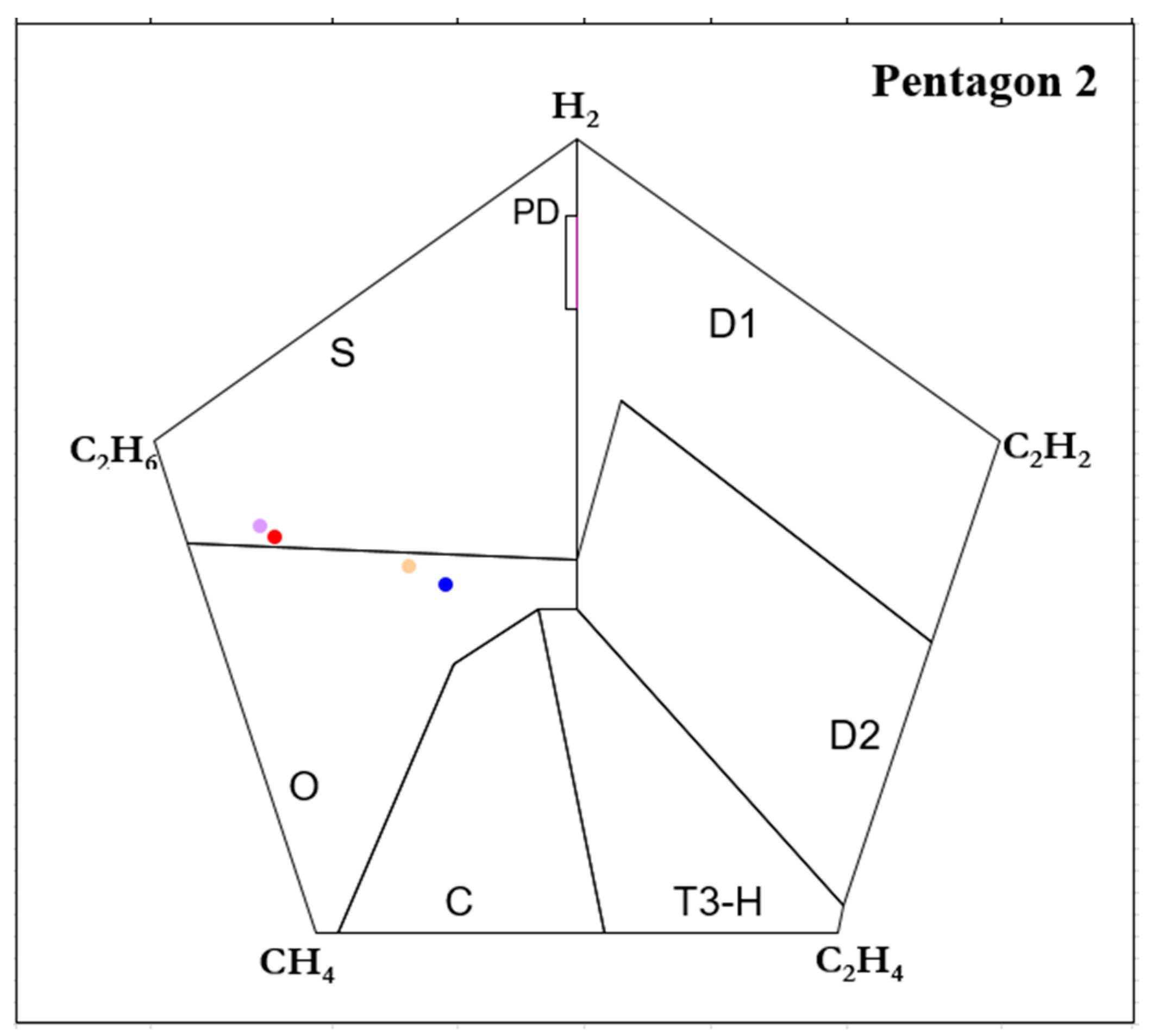
SG patterns of DDB oil during SG laboratory tests at 120 °C and 200 °C under air and N2 are indicated in Table 1 and Figure 2.

Table 1.
SG patterns of DDB oil during SG tests at 120 °C and 200 °C in the laboratory.
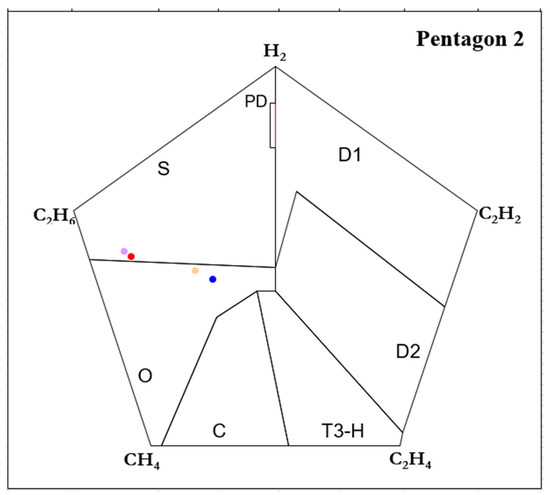
Figure 2.
SG patterns of DDB oil during SG tests at 120 °C and 200 °C in the laboratory.
Those at 120 °C occur in the same area of zone S of Pentagon 2, and at 200 °C in the same area of zone O. SG results under N2 are probably more representative of SG in bushings, in terms of amounts of gases formed, since bushings are operated under that gas, not under air.
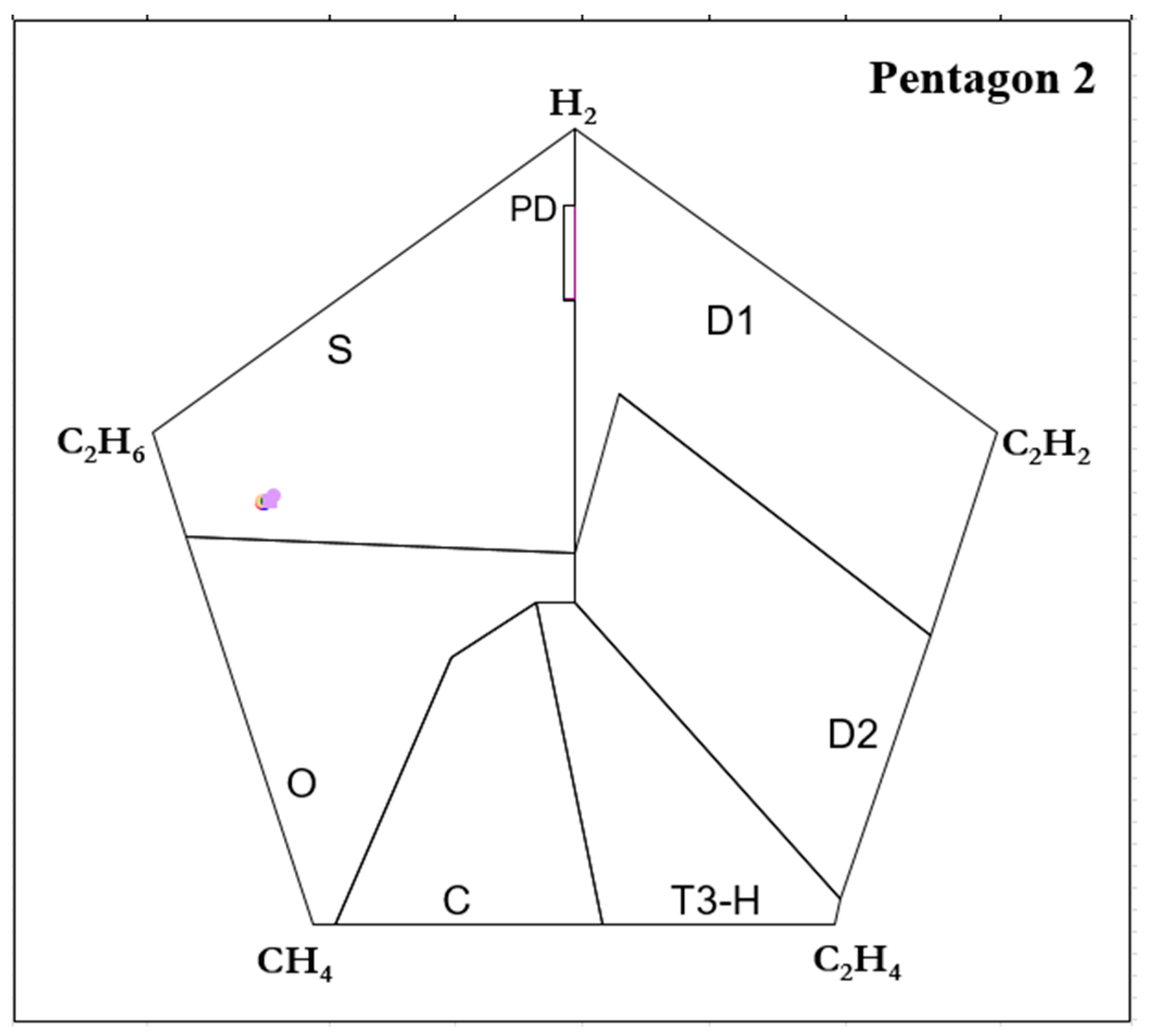
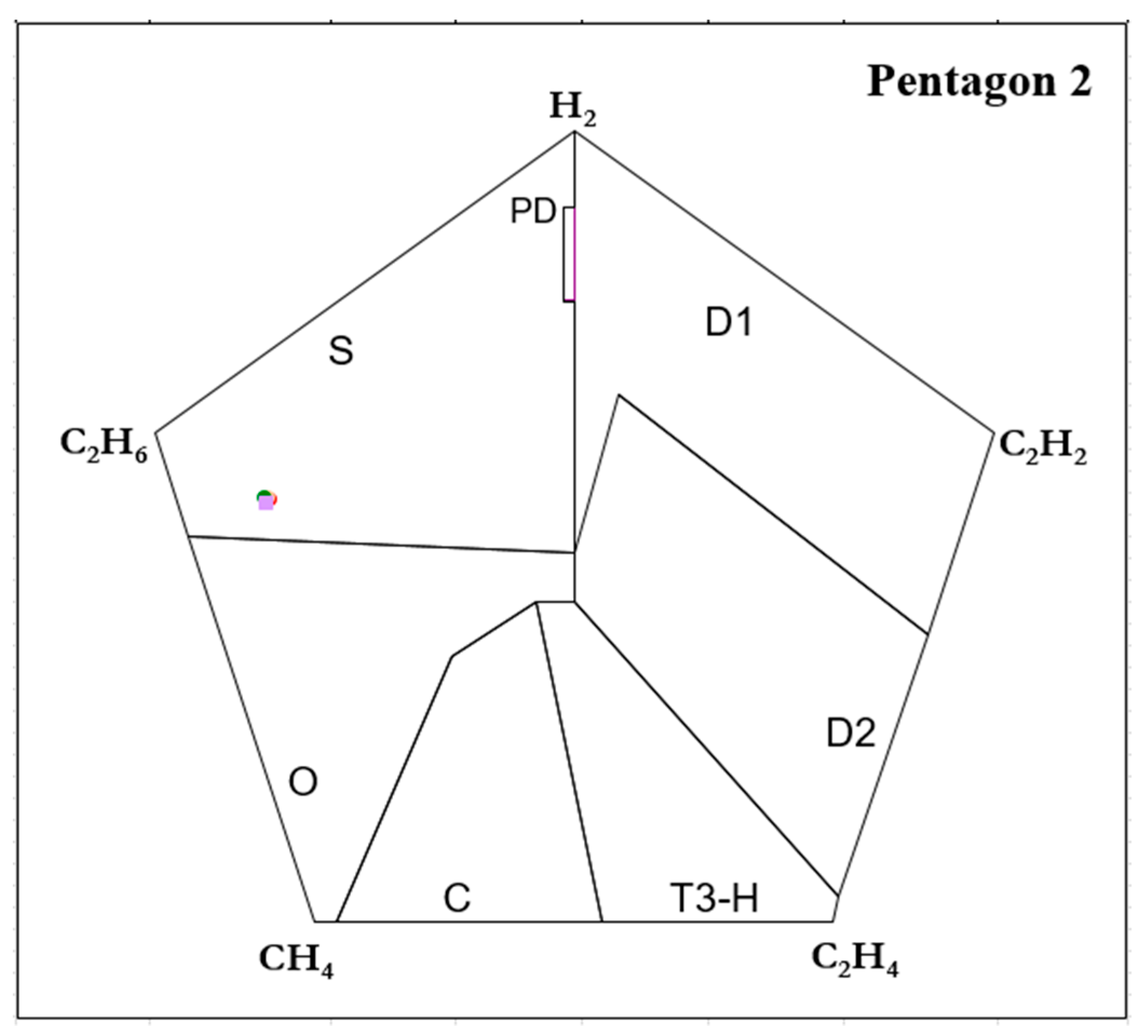
SG patterns of DDB oil in bushings of RWE in service are indicated in Table 2 and Figure 3 (bushing units 1–2) and in Table 3 and Figure 4 (bushing units 3–4). They all occur exactly in the same area of zone S of Pentagon 2.
Table 2.
SG patterns of DDB oil in bushings of RWE in service (units 1–2).
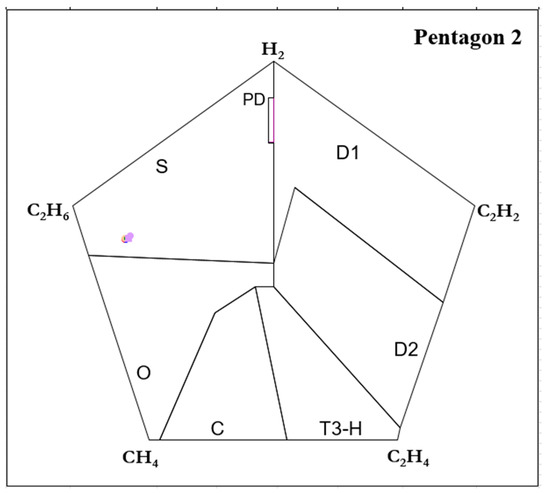
Figure 3.
SG patterns of DDB oil in bushings of RWE in service (units 1–2).
Table 3.
SG patterns of DDB oil in bushings of RWE in service (units 3–4).
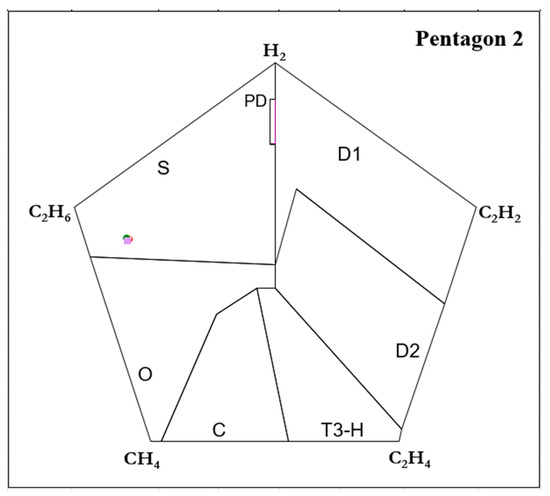
Figure 4.
SG patterns of DDB oil in bushings of RWE in service (units 3–4).
4. Discussion
A comparison of Figure 2, Figure 3 and Figure 4 shows that the SG patterns of DDB oil in the bushings of RWE in service are closest to those observed during SG tests in the laboratory at 120 °C. Gas formation in the bushings of RWE in service is therefore probably due to contact of DDB oil with a metal surface slightly overheated at this temperature, possibly at the end(s) of the central metal conductor of the bushing not covered with paper.
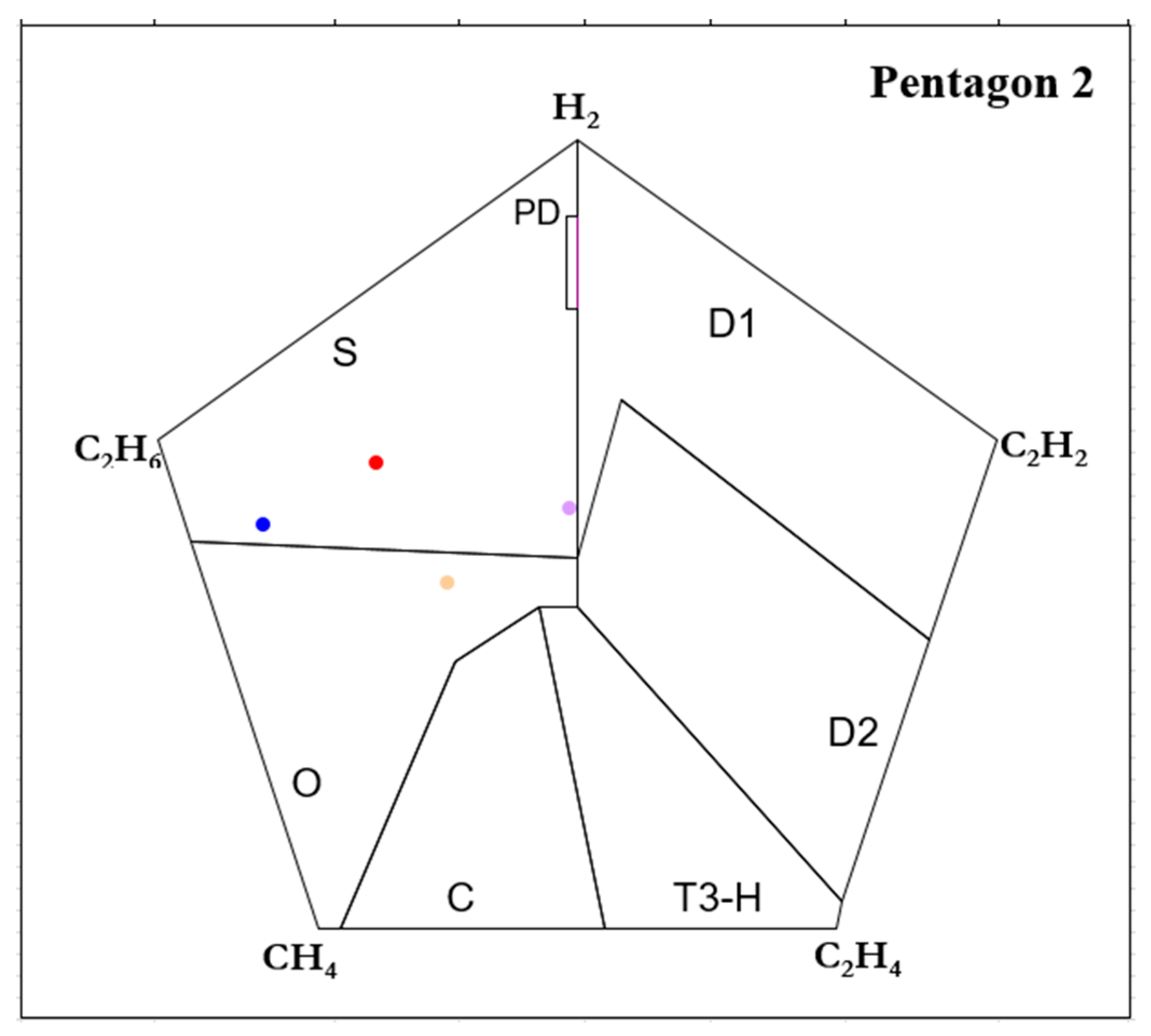
To confirm this temperature of 120 °C in the bushings, two additional SG tests were performed with DDB at 80 °C and 100 °C. All SG tests results performed at 80 °C, 100 °C, 120 °C, and 200 °C are indicated in Table 4 and Figure 5.
Table 4.
SG patterns of DDB oil during SG tests at 80 °C to 200 °C in the laboratory.
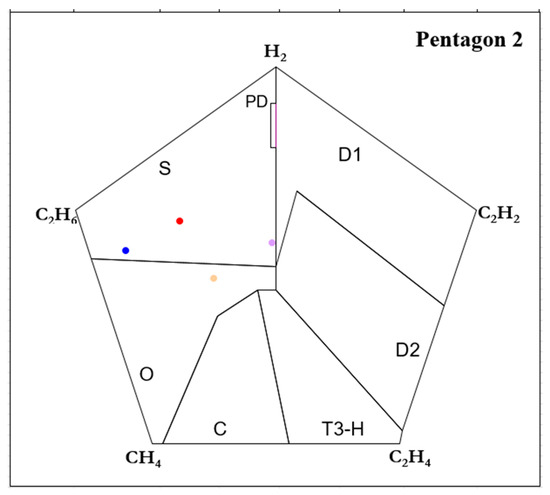
Figure 5.
SG patterns of DDB oil during SG tests at 80 °C to 200 °C in the laboratory.
Figure 5 can also be used to evaluate the temperature of overheating of metal surfaces in the future in other similar bushings filled with DDB. SG patterns of DDB appear to be intermediate between SG patterns of inhibited oils and uninhibited oils [7].
The 90% typical value of C2H6 in the twelve bushings of RWE in service is 534 ppm, compared to 336 ppm during SG tests at 120 °C during 164 h under N2. By comparison, the 90% typical value of C2H6 calculated in bushings filled with mineral oil is typically 202 ppm [6], compared to 150 ppm for mineral oil [7] during the same SG test. This means that the typical value of 534 ppm of C2H6 in DDB oil calculated above with twelve bushings is consistent with the typical value calculated with a much larger number of bushings filled with mineral oil.
Furthermore, it has been shown in [6] that gases due to SG in bushings and transformers may reach values much higher than typical values (thousands of ppm), without affecting their normal operation. So, such a typical gas concentration value of 534 ppm in bushings in service filled with DDB oil is not a concern.
5. Conclusions
The formation of C2H6 in bushings of RWE in service filled with DDB oil can be attributed to SG of the DDB oil in contact with a slightly overheated (120°) metal surface, possibly at the end(s) of the central metal conductor of the bushings. This overheating being in oil only, with no paper involved, can be seen as a minor concern, not affecting the normal operation of the bushings and utility using them.
This identification of SG patterns of DDB oil with Duval Pentagon 2 can be used as a reference for the interpretation of future results in similar bushings filled with DDB oil at RWE and elsewhere, and for litigations with bushings manufacturers and utility customers.
Author Contributions
Conceptualization, M.D. and C.E.; methodology, M.D.; investigation, M.D. and C.E.; writing—original draft preparation, M.D.; writing—review and editing, C.E.; project administration, C.E.; funding acquisition, C.E. and M.D. Both authors have read and agreed to the published version of the manuscript.
Funding
This research received no external funding.
Acknowledgments
Jerzy Buchacz is thanked for improving the quality of the Pentagons.
Conflicts of Interest
The authors declare no conflict of interest.
References
- Harichandranrav, S.; Das, J.; Tyagi, R.; Dixit, P.N. A novel approach for bushing fault diagnosis: Power grid india experience. In Proceedings of the CIGRE Conference, Paris, France, 26–31 August 2018. SC A2 Paper A2-208. [Google Scholar]
- Jonsson, L.; Meltzer, L.; Schonbor, N.; Persson, G.-O. Experimental evaluation of status of 400 KV shunt reactor bushings in the Swedish national grid. In Proceedings of the CIGRE Conference, Paris, France, 26–31 August 2018. SC A2 Paper A2-203. [Google Scholar]
- IEC Standard 60599. Mineral Oil Impregnated Electrical Equipment in Service—Guide to the Interpretation of Dissolved and Free Gases Analysis; International Electrotechnical Commission: Geneva, Switzerland, 2015. [Google Scholar]
- IEC Standard 60296. Fluids for Electrotechnical Applications. Mineral Insulating Oils for Electrical Insulation; International Electrotechnical Commission: Geneva, Switzerland, June 2020. [Google Scholar]
- CIGRE D1-01/A2.11. Recent Developments in DGA Interpretation; CIGRE Technical Brochure # 296, Convenor M. Duval; CIGRE: Paris, France, June 2006. [Google Scholar]
- CIGRE D1-01/A2.47. Advances in DGA Interpretation; CIGRE Technical Brochure # 771, Convenor M. Duval; CIGRE: Paris, France, July 2019. [Google Scholar]
- Duval, M.; Heizmann, T. Identification of stray gassing of inhibited and uninhibited mineral oils in transformers. Energies 2020, 13, 3886. [Google Scholar] [CrossRef]
- Duval, M.; Lamarre, C. The Duval pentagon–A new complementary tool for the interpretation of dissolved gas analysis in transformers. IEEE Electric. Insul. Mag. 2014, 30, 9–12. [Google Scholar]
- Duval, M. Use of Duval pentagons and triangles for the interpretation of dga in electrical equipment. In Proceedings of the TechCon North America Conference, Albuquerque, NM, USA, 23–25 February 2016. [Google Scholar]
- Duval, M. Interpretation of dissolved gas analysis in electrical equipment with duval triangles and pentagons. In Proceedings of the IEEE Transformer Committee Technical Presentation, Atlanta, GA, USA, 20–24 March 2016. [Google Scholar]
- Duval, M. Training track on dissolved gas analysis. In Proceedings of the TechCon North America Conference, Denver, CO, USA, 6–8 February 2018. [Google Scholar]
- Duval, M. Sixty years of dissolved gas analysis. In Proceedings of the TechCon SEAsia Conference, Manila, Philippines, 23–25 April 2018. [Google Scholar]
- Cheim, L.; Duval, M.; Haider, S. Combined Duval pentagons: A simplified approach. Energies 2020, 13, 2859. [Google Scholar] [CrossRef]
- Duval, M.; Cea de Ruano, M. Recent advances in DGA interpretation at CIGRE. In Proceedings of the TechCon AusNZ Conference, Sydney, Australia, 5–7 May 2021. [Google Scholar]
- Duval, M.; Cea de Ruano, M.; Amirouche, O. Practicing new DGA interpretation and graphical methods of CIGRE. In Proceedings of the International Conference of Doble Clients, Boston, MA, USA, 7–16 April 2021. [Google Scholar]
- IEEE Standard C57.104. Guide For The Interpretation Of Gases Generated In Mineral Oil-Immersed Transformers; IEEE Power and Energy Society: Piscataway, NJ, USA, 2019. [Google Scholar]
- Air to oil bushings series PNO voltage from 300 to 765 kV-Condenser Bushing. In Manual IS 2470GB; Passoni-Vila: Milano, Italy, 2008.
- Plus C Condenser Bushings, Manual; ABB: Alamo, TN, USA, 2013.
- PNO Condenser Bushings 123–1050 kV, Manual; Alstom Grid: Milano, Italy, 2018.
- Transformer Bushings Product Spectrum; Trench: St-Louis, France, 2021.



Publisher’s Note: MDPI stays neutral with regard to jurisdictional claims in published maps and institutional affiliations. |
© 2021 by the authors. Licensee MDPI, Basel, Switzerland. This article is an open access article distributed under the terms and conditions of the Creative Commons Attribution (CC BY) license (https://creativecommons.org/licenses/by/4.0/).