


Abstract
International Criticality Safety Benchmark Evaluation Project (ICSBEP) criticality analyses were conducted using the McCARD Monte Carlo code for 85 selected benchmark problems with 7 evaluated nuclear data libraries (ENDLs): ENDF/B-VII.1, ENDF/B-VIII.0, JENDL-4.0, JENDL-5.0, JEFF-3.3, TENDL-2021, and CENDL-3.2. Regarding the analyses, it was confirmed that the keff results are sensitive to the ENDL. It is noted that the new-version ENDLs show better performance in the fast benchmark cases, while on the other hand, there are no significant differences in keff among the different ENDLs in the thermal benchmark cases. The sensitivity of the keff results depending on the ENDL may impact nuclear core design parameters such as the shutdown margin, critical boron concentration, and power defects. This study and keff results will be a good reference in the development of new types of nuclear cores or new design codes.
Keywords:
Monte Carlo; McCARD; criticality analysis; ICSBEP; ENDF/B-VIII.0; ENDF/B-VII.1; JENDL-4.0; JENDL-5.0; TENDL-2021; CENDL-3.2; JEFF-3.3 1. Introduction
In various nuclear engineering applications, atomic and nuclear data are widely used as important and critical inputs to solve particle transport balance equations. Many research institutes have provided the nuclear data as evaluated nuclear data libraries (ENDLs) in a traditional ENDF-6 (evaluated nuclear data file) format, which are processed from measurements, compilations, and evaluations. The ENDF-6 format includes general information, resonance parameter data, reaction cross section, angular distribution, and their covariance data. The Cross Section Evaluation Working Group, organized by the United States (i.e., Brookhaven, Oak Ridge, and Argonne national Laboratories) and international nuclear societies, has released ENDF/B ENDLs. Among the versions in this series, ENDF/B-VII.1 [1] is widely used in particle transport simulation codes for nuclear reactor physics and core design analysis. An up-to-date version ENDF/B-VIII.0 [2], was released in February 2018. This version includes new evaluation data of the six nuclides (i.e., 1H, 16O, 56Fe, 235U, 238U, 239Pu) from the CIELO (Collaborative International Evaluation Library Organization) project. At the time of release, the neutron-reaction evaluation data for 557 materials in ENDF/B-VIII.0 were totally new or partially updated, including improved thermal neutron scattering data. Meanwhile, the Japan Atomic Energy Research Institute and Japanese Nuclear Data Committee (JNDC) have been continuously providing a series of Japanese Evaluated Nuclear Data Libraries (JENDLs), including JENDL-4.0 [3] released in May 2010 and an up-to-date version JENDL-5.0 [4] released in December 2021. In JENDL-5.0, the number of neutron sub-libraries was increased from 406 to 795 and the energy region was extended from 20 MeV to 200 MeV. Otherwise, the OECD (Organization for Economic Cooperation and Development)/NEA (Nuclear Energy Agency) Data Bank has coordinated the Joint Evaluated Fission and Fusion (JEFF) ENDL development for the last 35 years. Released in November 2017 JEFF-3.3 [5] provided 562 evaluations for neutron reactions. In another example, the Paul Scherrer Institute (PSI) and International Atomic Energy Agency nuclear data section developed a series of TENDL ENDLs. TENDL [6] provides the outputs of the TALYS code [7] to analyze and predict nuclear reactions. The latest version, TENDL-2021, provides 2813 evaluations for neutron reactions while ENDF/B-VIII.0 has 557 isotopic data files. And as a final example, the China Nuclear Data Center has released a series of Chinese general purpose Evaluated Nuclear Data Library (CENDL). CENDL-3.2 [8] is the latest release of CENDL, which has ENDF-6 formatted neutron reactions for 272 isotopes.
As stated above, a variety of ENDLs have been released and continuously updated by their providers around the world for use in various nuclear physics research and applications. To validate the newly developed ENDLs, the integral testing work has been performed using various benchmark problems. The International Criticality Safety Benchmark Evaluation Project (ICSBEP) [9] is one of the representative integral testing programs from critical experiments. The ICSBEP criticality analysis problems were classified by various fuel types and system spectrums. The ICSBEP handbook provides an overview of experiments, benchmark specifications, and some results for sample calculations by KENO-V in the SCALE code package [10], MCNP [11], and ONEDANT/TWODANT in the DANTSYS code package [12]. There are many studies and results for the ICSBEP benchmark problems with various ENDLs [13,14,15,16].
Recently, the Korea Atomic Energy Research Institute (KAERI) and King Abdullah City for Atomic and Renewable Energy (K.A.CARE) established the KAERI-K.A.CARE joint R&D center at KAERI to continue effective and close cooperation for the establishment of the National Nuclear Laboratory in Saudi Arabia. This center has carried out various joint R&D programs, an example of which is a project called “Application of a Monte-Carlo Neutron/Photon Transport Simulation Code for Advanced Shielding Design of Nuclear Reactors”. The main goal of this project is to train K.A.CARE engineers in a nuclear core shielding design analysis and to validate the McCARD [17] Monte Carlo (MC) code to be used for the advanced shielding design and analyses of new-type reactors. To validate the capability of the McCARD code for criticality analyses, KAERI and K.A.CARE engineers performed criticality analyses with the McCARD code and the up-to-date ENDLs.
In this study, seven ENDLs—ENDF/B-VII.1, ENDF/B-VIII.0, JENDL-4.0, JENDL-5.0, JEFF-3.3, TENDL-2021, and CENDL-3.2—were tested and examined by performing McCARD criticality analyses for selected ICSBEP benchmark problems. Section 2 briefly describes the configuration of the selected ICSBEP problems for criticality analysis and explains how to generate the continuous energy cross section from the raw ENDLs. Section 3 presents the results of the ICSBEP criticality analyses calculated by the McCARD MC code with the various ENDLs. The results are provided by categorizing the fuel fissile isotopes, fuel form, and system spectrum. A summary and conclusions are given in Section 4.
2. Evaluated Nuclear Data Libraries and ICSBEP Benchmarks for Criticality Analyses
2.1. Evaluated Nuclear Data Libraries
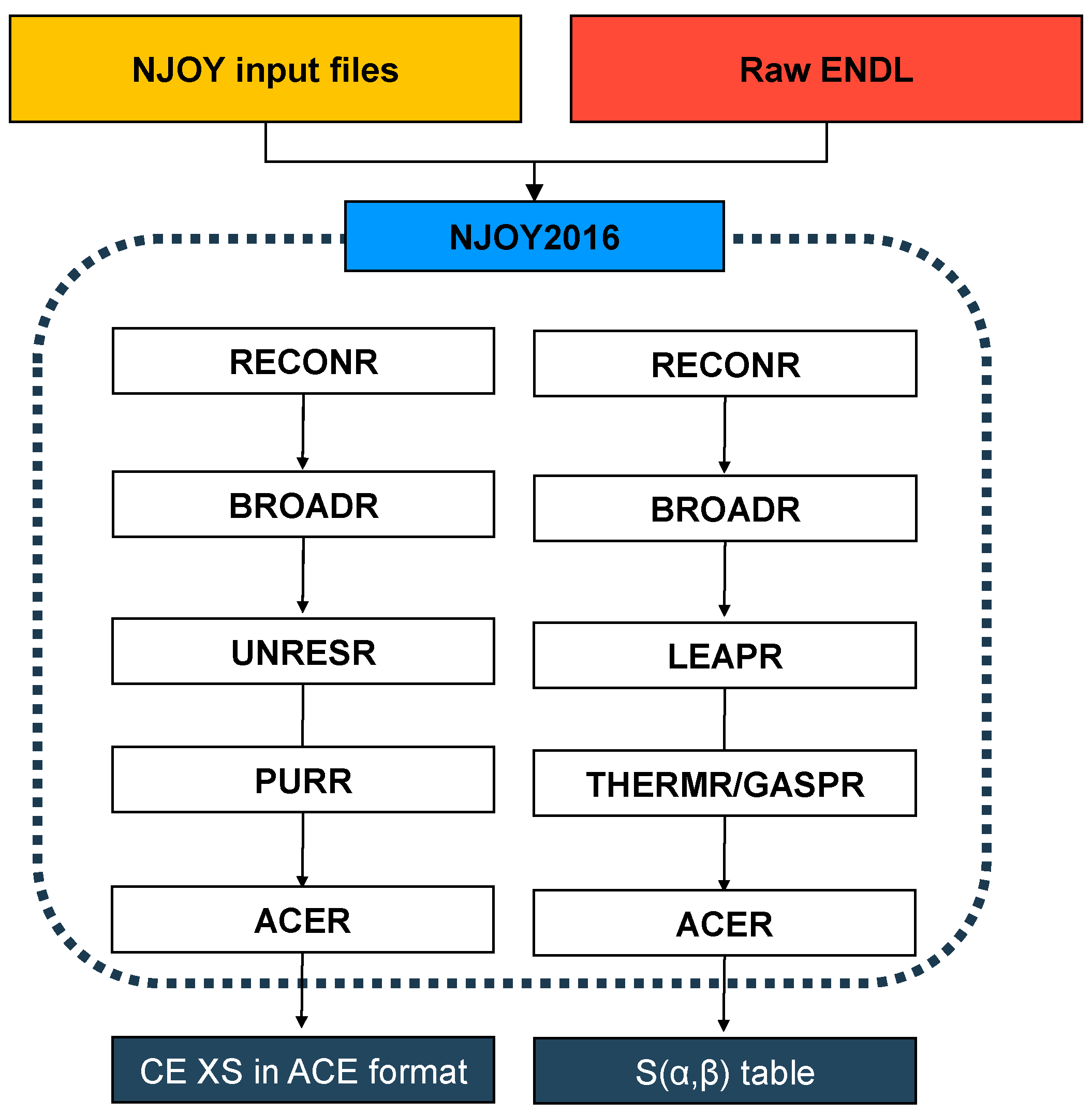
Various up-to-date evaluated nuclear data libraries are first prepared for the integral testing work via MC criticality analyses. First of all, the most up-to-date NJOY code [18] and its user inputs for all nuclides at three temperature points (300 K, 600 K, and 900 K) were prepared to process the raw ENDLs and to generate MC continuous energy cross section libraries in ACE format. Figure 1 shows the general flow chart of the ACE-formatted continuous-energy (CE) nuclear data library generation in the NJOY code. Neutron CE cross sections for each isotope are generated by the flow of the RECONR, BROADR, UNRESR, PURR, and ACER modules in NJOY, whereas the thermal scattering cross sections are generated by the RECONR, BROADR, LEAPR, THERMR, and ACER modules. The RECONR module reconstructs point-wise cross sections from ENDF resonance parameters and interpolation schemes, which are then processed into Doppler-broadens and thins point-wise cross sections by the BROADR module. The UNRESR and PURR modules generate effective self-shielded point-wise cross sections and probability tables in unresolved energy regions. For the thermal scattering cross section generation, LEAPR calculates the thermal scattering law while THERMR produces cross sections and energy-to-matrices for free or bound scattering in the thermal energy range. Lastly, the ACER module prepares libraries in ACE format for a CE MC code (e.g., MCNP, McCARD, RMC).
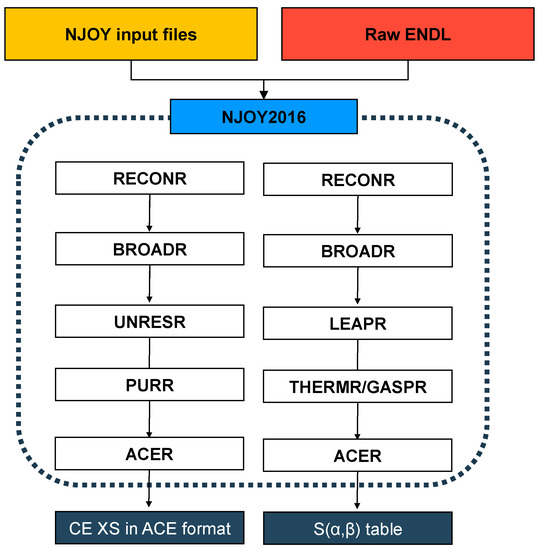
Figure 1.
A flowchart of Monte Carlo CE library generation in NJOY code.
Table 1 summarizes the newly generated Monte Carlo CE cross section libraries. In this study, only the five most often used thermal scattering cross sections (i.e., H in H2O, D in D2O, Be metal, Be in BeO, and C in graphite) were generated for all ENDLs. As shown in Table 1, there is no thermal scattering cross section data in CENDL-3.2 and only one thermal scattering cross section data in TENDL-2021. Accordingly, the lack of thermal scattering cross section data was substituted by ENDF/B-VIII.0. In general, the ENDF/B cross section library has been used all around the world in various research and fields, and among the ENDF/B versions, ENDF/B-VIII.0 is the latest version. According to this, we used the thermal scattering cross section data for the lack of other ENDL thermal scattering cross section data.

Table 1.
A summary of the generated Monte Carlo CE cross section libraries.
2.2. Selected International Criticality Benchmark Problems
To perform the integral testing work for criticality capability, 85 benchmark problems were selected from the ICSBEP handbook [9]. The 85 ICSBEP benchmarks were selected from the well-known relevant experiments (i.e., godiva, jezebel, flattop) or the problems that have the results by MCNP with various ENDLs. In general, they boil down to three criteria: fuel fissile isotope, fuel form, and system spectrum. Fuel fissile isotopes can be categorized into high-enriched uranium (HEU), low-enriched uranium (LEU), plutonium (PU), 233U (U233), and mixed composition (MIX). Fuel forms are defined as metal (MET), compound (COMP), and solution (SOL), and system spectrum is classified as fast (FAST) and thermal (THERMAL). The ICSBEP handbook provides the identification (ID) for each benchmark problem as a combination of the fuel isotope, fuel form, and spectrum type.
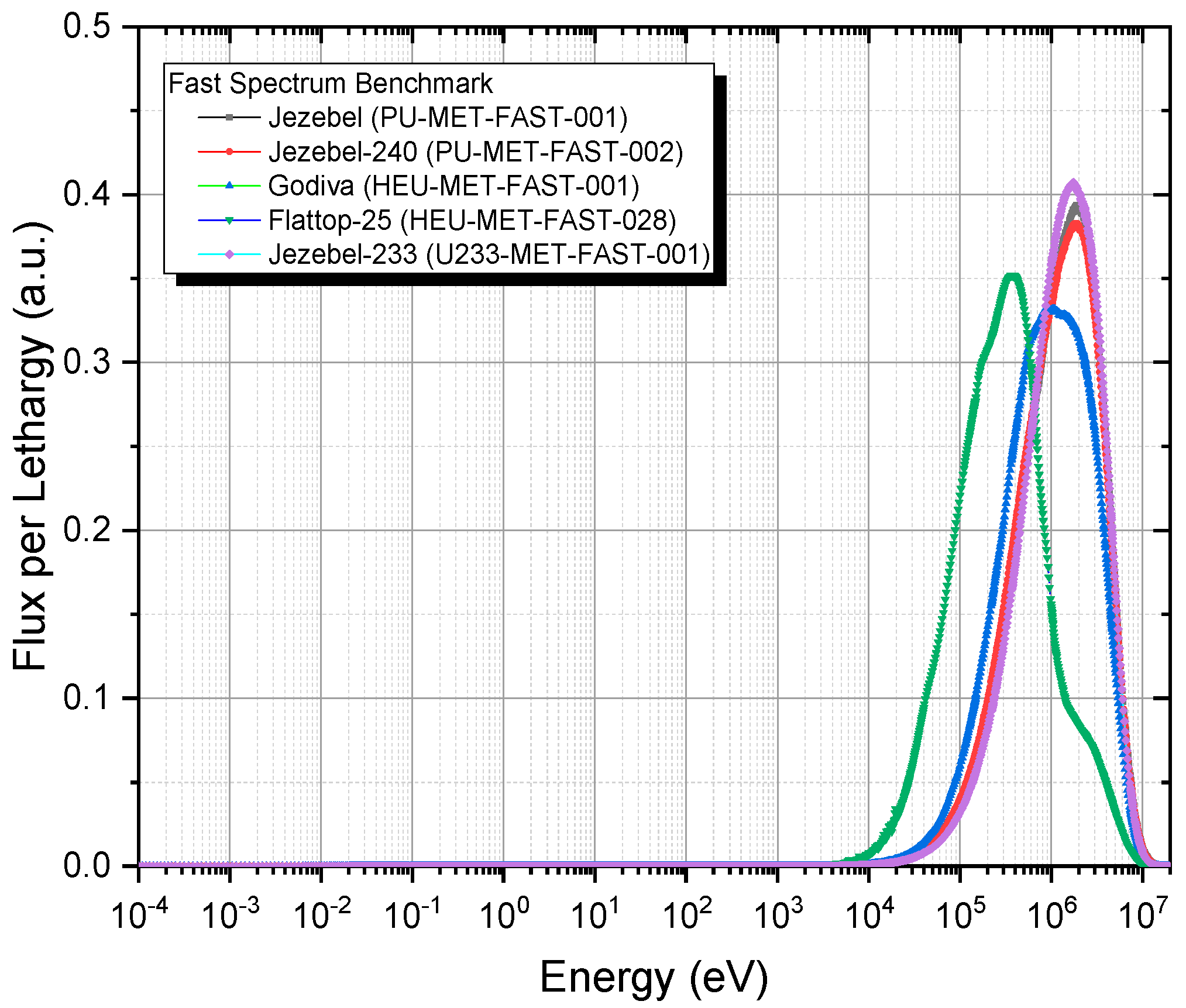
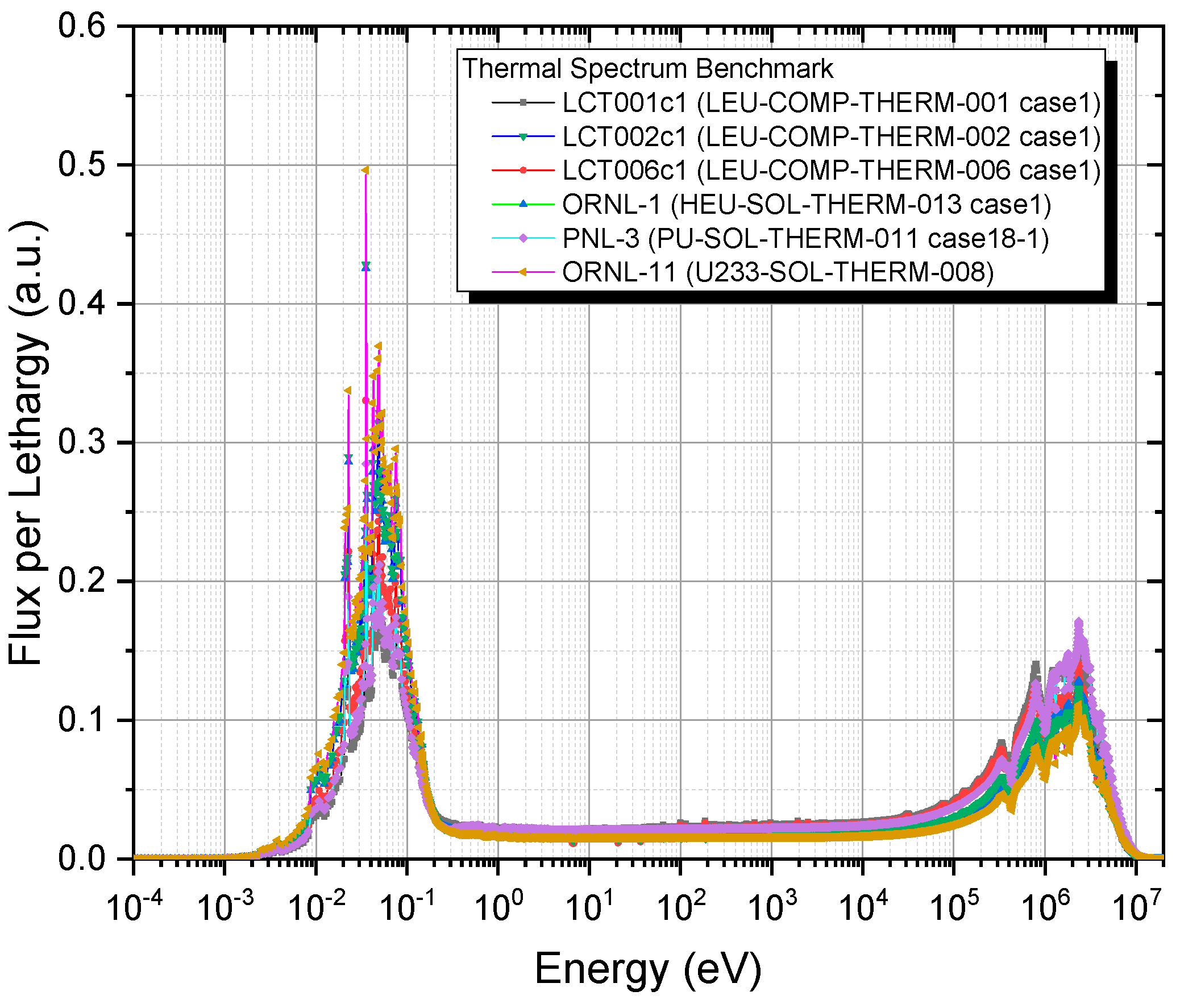
Table 2 lists the 85 selected ICSBEP benchmark problems, providing benchmark IDs, categories, reference keff, and short IDs for the sake of convenient reference. The McCARD inputs for each ICSBEP benchmark problem were prepared. All the McCARD calculations were performed by employing 10,000 neutron particles per cycle with 1000 active cycles and 50 inactive cycles. The initial neutron sources were uniformly distributed in the system boundary for MC eigenvalue calculations. Figure 2 and Figure 3 show the neutron energy spectra for five fast benchmarks (i.e., Jezebel, Jezebl-240, Godiva, Flattop-25, and Jezebel-233) and six thermal benchmarks (i.e., LCT001c1, LCT002c1, LCT006c1, ORNL-1, PNL-3, and ORNL-11), respectively. In the fast benchmarks, the energy spectra are similar to the energy distribution of neutrons from fission reactions. In the thermal benchmarks, the neutron energy spectra are attributed to neutron moderation or slowing-down. As shown in Table 2, the thermal scattering law (TSL) sub-library for light water was only used in this ICSBEP benchmark analyses.
Table 2.
A list of selected International Criticality Safety Benchmark Problems.
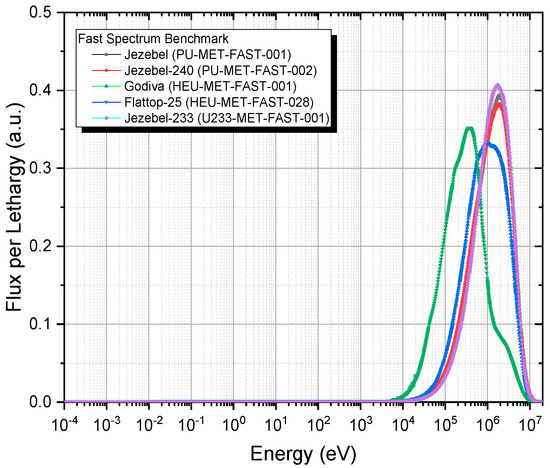
Figure 2.
Spectra of example fast benchmark problems.
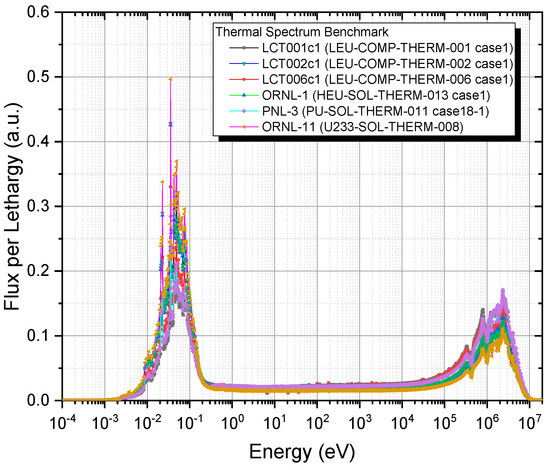
Figure 3.
Spectra of example thermal benchmark problems.
3. ICSBEP Criticality Benchmark Analyses by McCARD
3.1. Fast Criticality Benchmarks
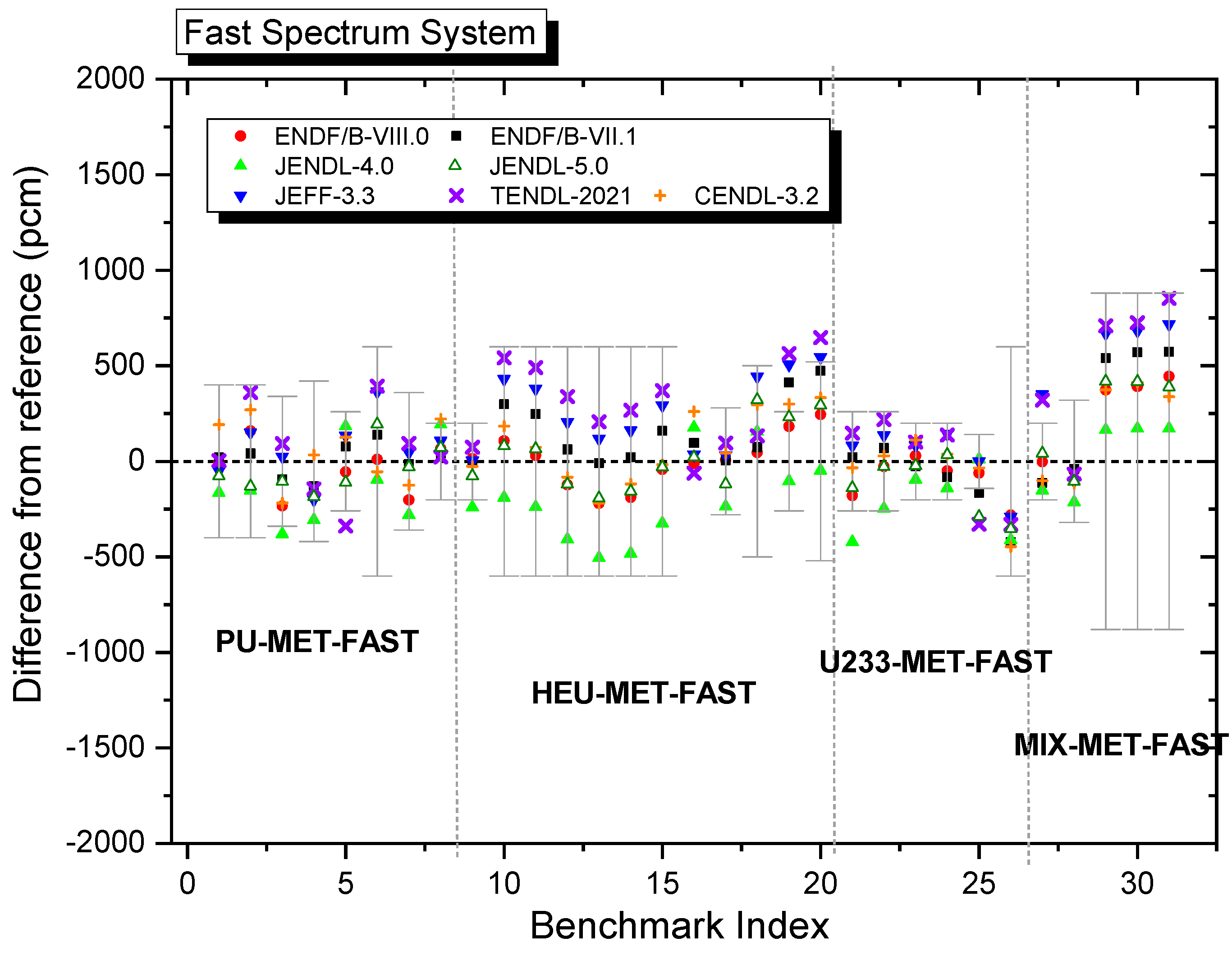
Table 3 shows the keff values calculated by McCARD with the seven ENDLs (ENDF/B-VII.1, ENDF/B-VIII.0, JENDL-4.0, JENDL-5.0, JEFF-3.3, TENDL-2021, and CENDl-3.2). Figure 4 plots the difference (Δρcal) between the calculated and experimental keff for the 31 fast benchmark problems calculated by
Table 3.
keff values for the fast benchmarks with the different evaluated nuclear data libraries.
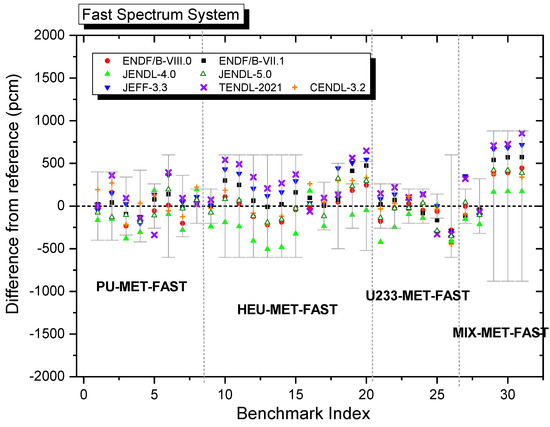
Figure 4.
The difference between calculated and experimental keff by ENDL for the ICSBEP fast benchmarks.
Here, kexp and kcal are the experimental and calculated keff for the i-th benchmark problem, respectively. The statistical uncertainties of the calculated keff are less than 10 pcm. Accordingly, error bars of the calculated keff are not marked in Figure 4 because they are relatively small compared to the uncertainties of the reference keff values. Overall, the values from JENDL-4.0 are lower than those from the other ENDLs whereas JEFF-3.3 and TENDL-2021 have higher values than the other ENDLs. For statistical analyses, root mean square (RMS) error and chi square (χ2) can be utilized as indicators to confirm the differences between the experimental and calculated keff. Typically, RMS error and chi square values can be calculated by
where σexp is the uncertainty of kexp provided from each benchmark document [9]. The number of benchmark problems is N.
Table 4 shows the RMS errors and chi square values for the 31 fast benchmark problems. It is observed that the new version ENDLs show better performance than the old versions in the fast benchmarks. The RMS error of ENDF/B-VII.1 is 244 pcm, whereas that of ENDF/B-VIII.0 is 179 pcm. The RMS error of JENDL-4.0 is 258 pcm compared to that of JENDL-5.0 at 199 pcm. It is noted that ENDF/B-VIII.0 has the smallest RMS error and chi square value among the ENDLs. In the 31 fast benchmarks, the average uncertainty of kexp is about 220 pcm.
Table 4.
RMS errors and chi square values of the 31 fast benchmarks for different evaluated nuclear data libraries.
3.2. Thermal Criticality Benchmarks
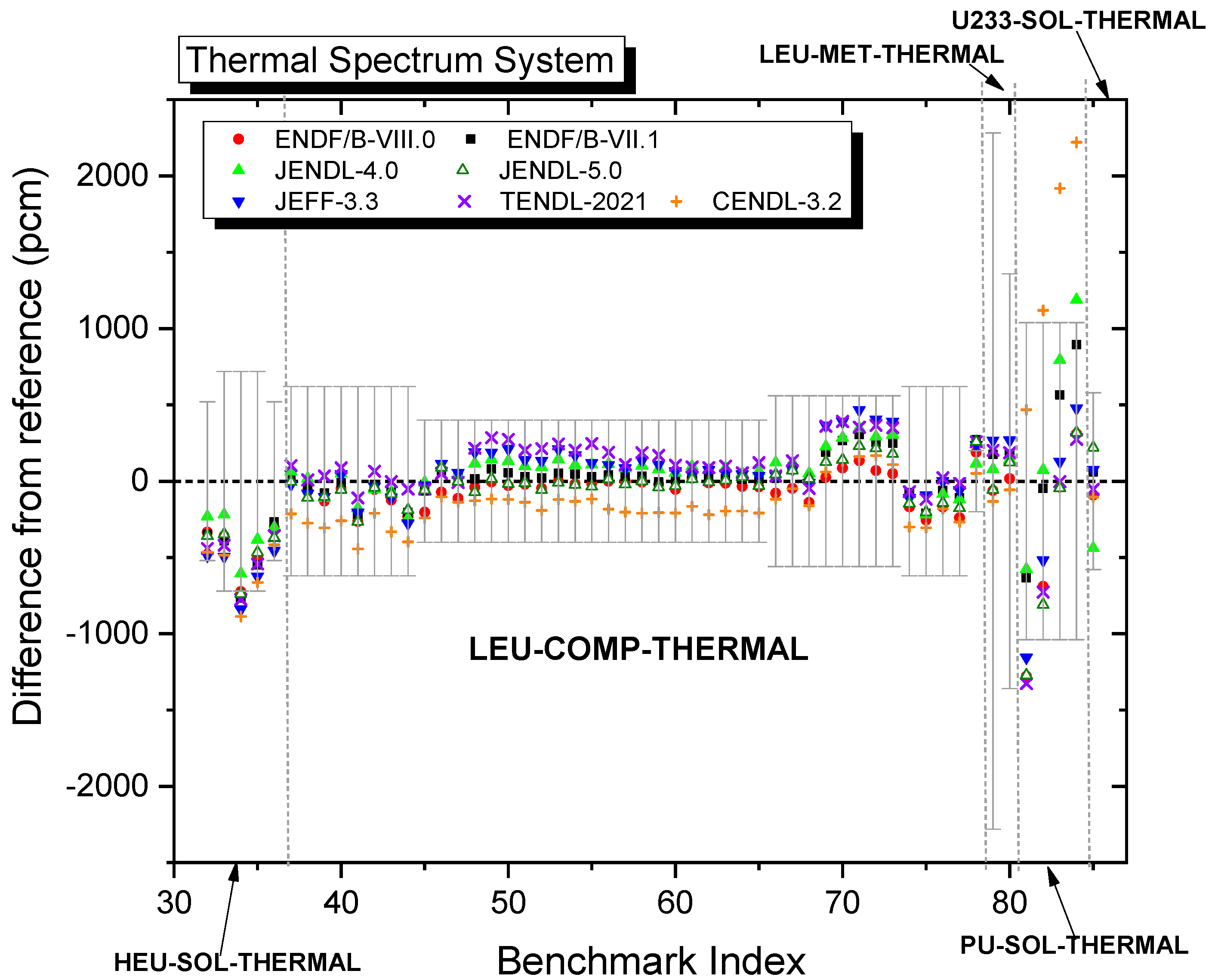
Table 5 presents the keff values calculated by McCARD for the 54 thermal benchmark problems, and Figure 5 shows the difference between the calculated and experimental keff. In the LEU-COMP-THERMAL cases, CENDL-3.2 showed lower results than the other ENDLs, whereas JEFF3.3 and TENDL-2021 showed relatively higher results. Table 6 shows the RMS errors and chi square values for the thermal benchmark problems. When excluding the PU-SOL-THERMAL cases, there were no significant differences in keff among the different ENDLs in the thermal benchmark cases. In the PU-SOL-THERML cases, the difference in keff ranged from −1327 pcm to 2220 pcm. In all thermal cases, RMS errors ranged from 252 pcm to 512 pcm, while the chi square values were from 0.72 to 1.24. In the 54 thermal benchmarks, the average uncertainty of kexp is about 297 pcm. However, for the thermal benchmarks excluding PU-SOL-THERMAL, RMS errors ranged from 180 pcm to 272 pcm and chi square values were from 0.63 to 0.96.
Table 5.
keff values for the thermal benchmarks with the different evaluated nuclear data libraries.
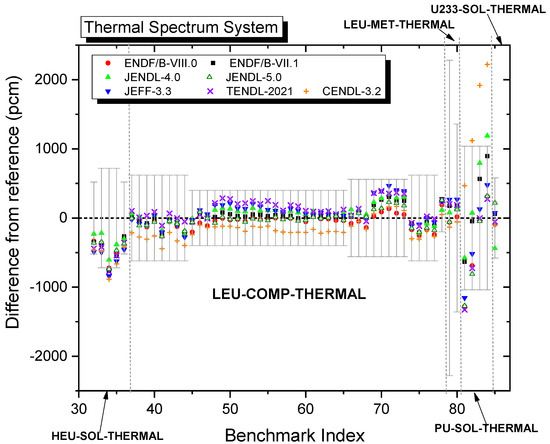
Figure 5.
The difference between calculated and experimental keff by ENDL for the ICSBEP thermal benchmarks.
Table 6.
RMS errors and chi square values of the 54 thermal benchmarks for different evaluated nuclear data libraries.
Regarding these results, it can be observed that there are no significant differences in keff between the new and old version ENDLs. The RMS error of ENDF/B-VII.1 is 252 pcm whereas that of ENDF/B-VIII.0 is 265 pcm. Similarly, the RMS error of JENDL-4.0 is 279 pcm while that of JENDL-5.0 is 274 pcm. In the same manner as the fast benchmark cases, the JEFF-3.3 results are very similar to the TENDL-2021 results; the RMS errors of JEFF-3.3 and TENDL-2021 are 308 pcm and 311 pcm, respectively. In the PU-SOL-THERMAL cases, there is wide disparity in keff among the ENDLs as shown in Figure 5 and Table 6. It is worth mentioning that the difference in the thermal 239Pu cross sections among the ENDLs affects the keff in the thermal spectrum system with fuels containing a significant fraction of plutonium.
3.3. Code-to-Code Comparison for ICSBEP Benchmarks
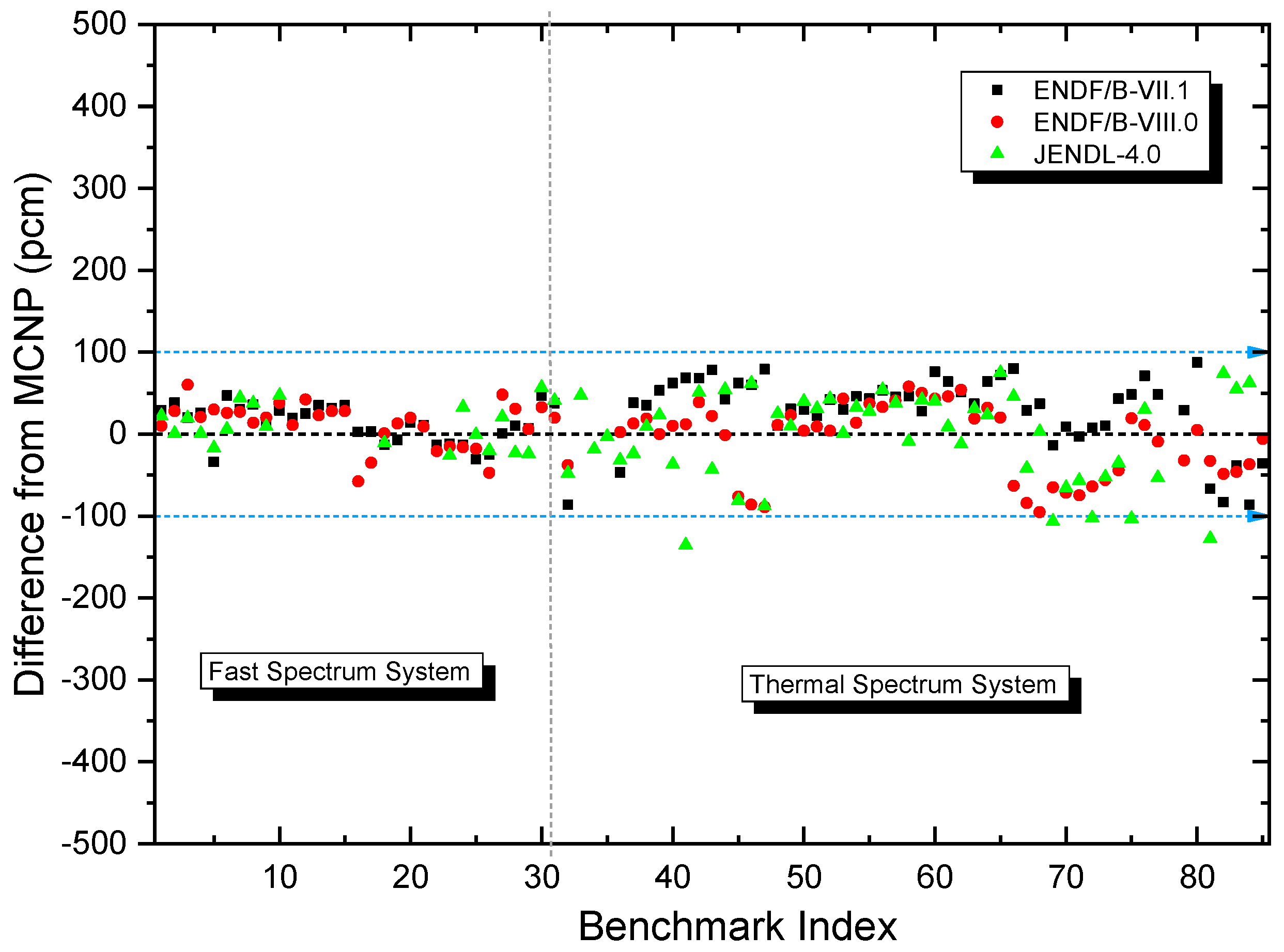
For code verification and validation, the McCARD results were compared to the MCNP results obtained from References [2,13] for the selected ICSBEP benchmark problems. Figure 6 shows the difference between keff values by the McCARD and MCNP calculations, and Table 7 summarizes the keff differences between the two codes for each benchmark category as RMS differences. The difference (ΔρMCNP) in keff between the McCARD and MCNP codes was calculated by
where kMcCARD and kMCNP are the keff by the McCARD and MCNP codes, respectively. In the fast benchmark cases, the RMS difference for ENDF/B-VII.1 was 26 pcm whereas those for ENDF/B-VIII.0 and JENDL-4.0 were 29 and 28 pcm, respectively. In the thermal benchmark cases, the RMS difference for ENDF/B-VII.1 was 53 pcm, while those for ENDF/B-VIII.0 and JENDL-4.0 were both 45 pcm. In the NJOY processing, the thermal scattering cross sections are sensitively affected by the thermal scattering law parameters, which are used in the LEAPR module. Accordingly, the difference between the thermal scattering cross sections used in the McCARD and MCNP calculations may have led to the increased RMS difference in the thermal benchmarks. In all benchmark cases, the RMS differences ranged from 40 pcm to 49 pcm. Considering that the statistical uncertainties of the MCNP results were less than 100 pcm, it was concluded that the keff results between McCARD and MCNP are in excellent agreement.
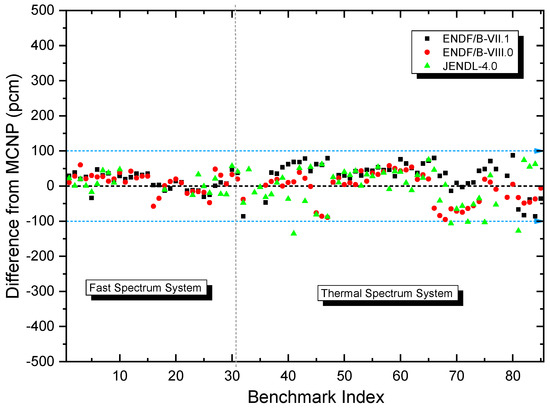
Figure 6.
The difference between keff values by McCARD and MCNP calculations for the selected ICSBEP benchmark problems.
Table 7.
The RMS difference between keff results by McCARD and MCNP calculations.
4. Uncertainty Analyses of Criticality in ICSBEP Benchmarks
4.1. Uncertainty of keff Due to Uncertainty of Cross Sections
This section was prepared to provide an understanding of the difference in keff among the ENDLs with their cross section covariance data. In general, the mean of MC estimates on a criticality (i.e., keff) and its variance can be expressed by
If one assumes that the total uncertainty on keff comes from statistical uncertainties of MC calculations and cross section uncertainties by their covariance data, Equation (6) can be rewritten as
The angular bracket in <keff> means the operator implying the expected value of a quantity on it. By the first-order Taylor expansion for <keff> about the mean values of nuclear reaction cross section, can be expressed by
is the -type microscopic cross section of isotope i for energy group g. Substituting Equation (8) into Equation (7), one can obtain
where
is the statistical contribution on the variance of keff whereas is commonly known as the sandwich equation for S/U analyses. is the cross section covariance matrix from each ENDL. The sensitivity coefficients can be calculated by the MC perturbation technique. This S/U analysis capability was already implemented in the McCARD code [19].
To examine the uncertainty in keff due to the uncertainties of the cross sections, the benchmark problems, which have the largest difference in keff among ENDLs, were selected for each category. According to it, the uncertainty quantification in keff for Jezebel-240, Flattop-25, LCT-006c1, and PNL-5 were performed with the covariance data in each ENDL. ENDF/B-VII.1, ENDF/B-VIII.0, JENDL-4.0, JENDL-5.0, JEFF-3.3, and TENDL-2021 provide the covariance data for ν and cross section on the MF31 and MF33 sections in each ENDL, whereas there is no covariance data in the CENDL-3.2.
Table 8 shows the error of keff from reference and the uncertainty in keff due to the uncertainty of cross sections (=) for each ENDLs by the McCARD S/U calculations. The standard deviations of the errors among ENDLs are 194 pcm, 265 pcm, 121 pcm, and 358 pcm for Jezebel-240, Flattop-25, LCT-006 c1, PNL-5 benchmarks, respectively. Overall, it is noted that the errors of keff are less than the uncertainties of keff by the covariance data from each ENDL except the PNL-5 case with JENDL-4.0. Regarding the results, it was observed that the cross section data used in the four benchmarks have instability or uncertainty, and this led to the error of keff from the reference.
Table 8.
Error of keff from reference and uncertainty of keff due to the uncertainty of cross sections for the four ICSBEP benchmarks.
Meanwhile, O. Cabellos et al. presented the uncertainties of keff from the covariance data of various ENDLs by NDaST in the ICSBEP benchmark suite [20]. In the HEU category, the averaged uncertainties in keff due to the 235U covariance data for ENDF/B-VIII.0, JENDL-3.3T4, ENDF/B-VII1, and JENDL-4.0 were 1012 pcm, 1190 pcm, 1345 pcm, and 679 pcm, whereas the averaged uncertainties of keff due to the 239Pu covariance data in the PU-SOL-THERM category were 1157 pcm, 967 pcm, 608 pcm, and 687 pcm. It was noted that they were very similar to the uncertainties of the Flattop-25 in the HEU category and the PNL-3 in the PU-SOL-THERM category by the McCARD code.
4.2. Quantitative Analysis for Group-Wise Reactivity
This section shows the results of the quantitative analyses for the reactivity differences between ENDF/B-VII.1 and the other ENDL. In the quantitative analysis, the differences in absorption and fission cross sections between ENDF/B-VII.1 and the other ENDL can be expressed by the reactivity differences in the “pcm” unit for each energy group. The reactivity differences due to the difference of the absorption and fission cross section between ENDF/B-VII.1 and the other ENDL can be calculated by
where
and means the ENDF/B-VII.1 and the other ENDL absorption cross section of isotope i for energy group g. and are the product of the number of neutrons by a fission () and the g-th group fission cross section of isotope i for ENDF/B-VII.1 and the other ENDL, respectively. The reactivity difference indicates the contribution of the difference in the cross section to the error in reactivity or criticality [21].
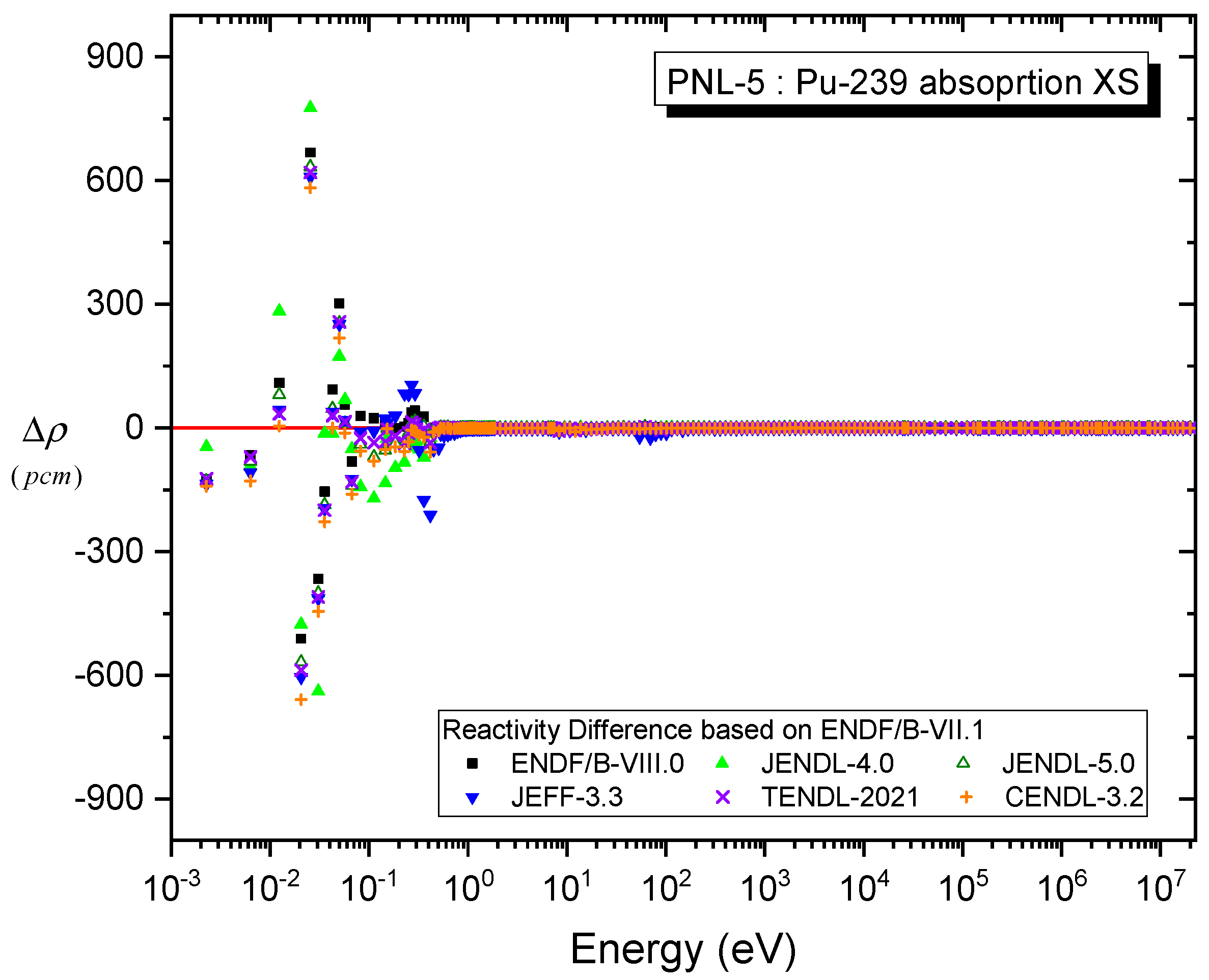
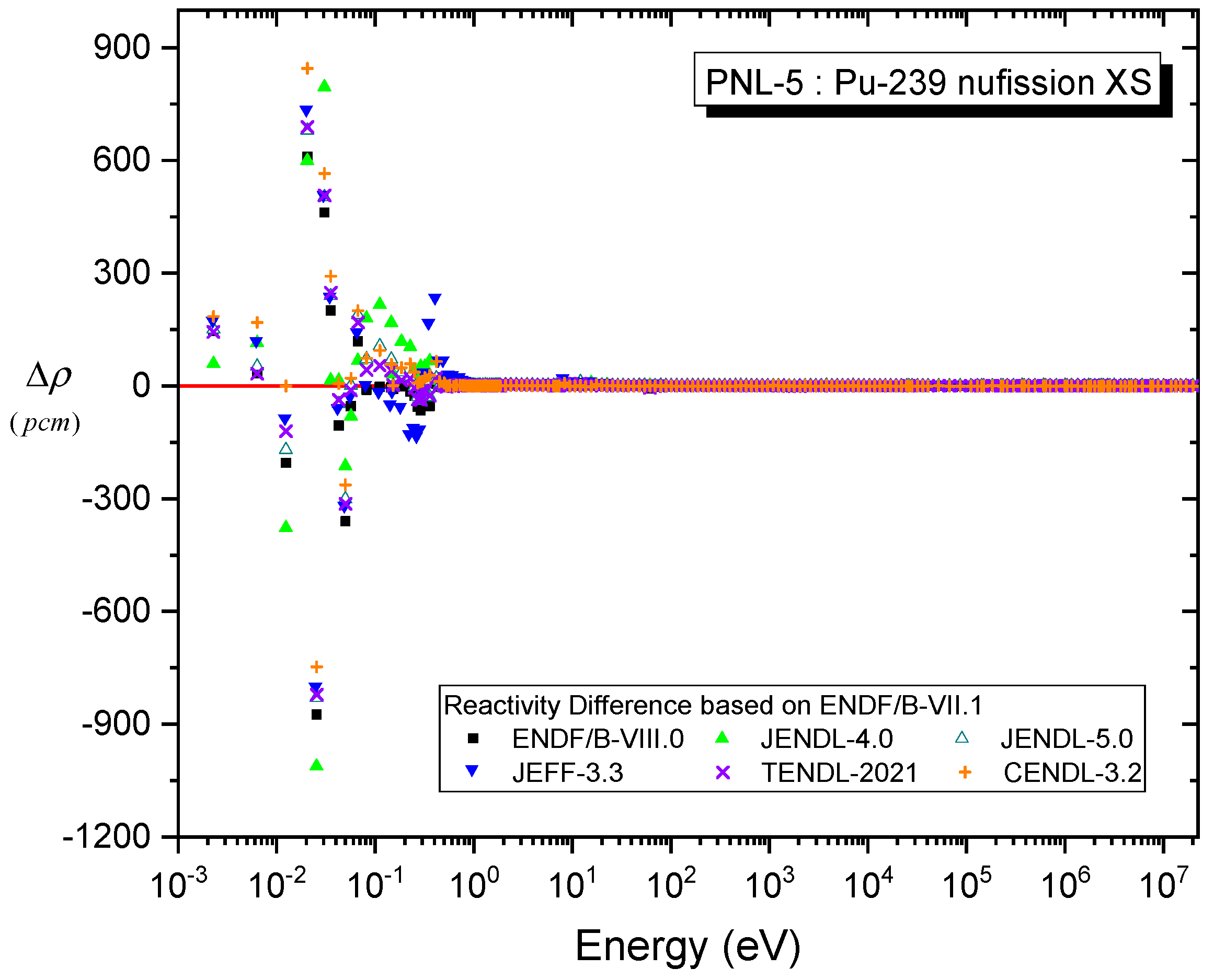
Figure 7 and Figure 8 show the reactivity difference due to the difference of 239Pu absorption and fission cross sections between ENDF/B-VII.1 and the other ENDLs for the PNL-5 benchmarks. The group-wise reactivity analyses due to the 239Pu cross section changes were conducted out because 239Pu is a major fuel isotope in the PNL-5 benchmark. The reactivity difference (ΔρE71) between ENDF/B-VII.1 and the other ENDL was calculated by
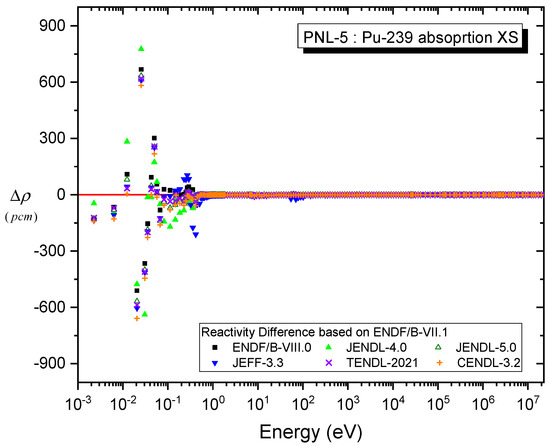
Figure 7.
The reactivity difference due to the difference of 239Pu absorption cross sections between ENDF/B-VII.1 and the other ENDL for PNL-5.
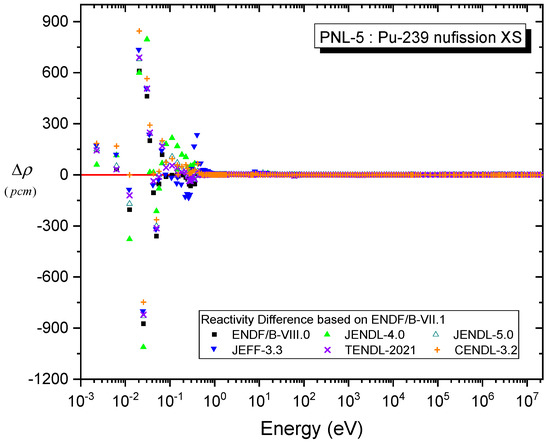
Figure 8.
The reactivity difference due to the difference of 239Pu fission cross sections between ENDF/B-VII.1 and the other ENDL for PNL-5.
kE71 and kOTR are the keff by ENDF/B-VII.1 and the other ENDL. Table 9 presents the sum of group-wise reactivity differences due to the 239Pu cross section changes. There are considerable reactivity differences due to the changes of 239Pu absorption and fission cross sections at the thermal energy ranges (10−3~1 eV). The individual group reactivity differences ranged from −1000 pcm to 900 pcm, but the group-wise reactivity differences due to absorption and fission cross section changes have the opposite sign. Therefore, the effects on the absorption and fission cross section changes were canceled out each other. It is observed that the sum of the reactivity changes by 239Pu cross sections ranged from −259 pcm to 288 pcm. Meanwhile, the total reactivity difference ranged from −1353 pcm to 610 pcm because the leakage effects and the reactivity changes by the other nuclides (240Pu, 1H, 16O, Fe, Ni, Cr) were considered in these total reactivity analyses. In the PNL-5 criticality analyses, the keff of ENDF/B-VIII.0, JENDL-5.0, JEFF-3.3, TENDL-2021 were less than ENDF/B-VII.1 whereas those of JENDL-4.0 and CENDL-3.2 were larger than ENDF/B-VII.1.
Table 9.
The sum of group-wise reactivity difference due to the difference of 239Pu fission cross sections between ENDF/B-VII.1 and the other ENDLs for PNL-5.
5. Conclusions
In this study, ICSBEP criticality analyses were conducted using the McCARD code for 85 selected benchmark problems with seven evaluated nuclear data libraries (ENDLs): ENDF/B-VII.1, ENDF/B-VIII.0, JENDL-4.0, JENDL-5.0, JEFF-3.3, TENDL-2021, and CENDL-3.2. To prepare some of the up-to-date ENDLs (i.e., ENDF/B-VIII.0, JENDL-5.0, JEFF-3.3, CENDL-3.2) for McCARD calculations, continuous energy nuclear data libraries in ACE format were generated by the NJOY code. Regarding the criticality analyses, it was noted that the keff results were sensitive to the ENDL. It is worth mentioning that the new version ENDLs showed better performance in the fast benchmark cases, while there were no significant differences in keff among the different ENDLs in the thermal benchmark cases. In all benchmark cases, the TENDL-2021 results were very similar to the JEFF-3.3 results because TENDL-2021 shared the raw nuclear data of the JEFF ENDL for 1,2,3H, 3,4He, 6,7Li, 10,11B, 7,9Be, 12,13C, 14,15N, 16,17,18O, 19F, 232Th, 233,235,238U and 239Pu isotopes.
The sensitivity of the keff results to the different ENDLs may impact certain nuclear core design parameters such as shutdown margin, critical boron concentration, and power defects. Consequently, nuclear core designers should consider this sensitivity to the ENDL as a margin of uncertainty. This study and keff results will be a good reference for the development of new types of nuclear cores or new design codes.
Author Contributions
Conceptualization, H.J.P.; methodology, H.J.P.; software, H.J.P. and S.H.C.; validation, H.J.P., M.A., S.H.C. and S.-A.Y.; formal analysis, H.J.P. and S.-A.Y.; investigation, H.J.P.; resources, H.J.P.; data curation, H.J.P.; writing—original draft preparation, H.J.P.; writing—review and editing, S.H.C.; visualization, H.J.P.; supervision, H.J.P.; project administration, S.H.C.; funding acquisition, H.J. and S.H.C. All authors have read and agreed to the published version of the manuscript.
Funding
This research was supported by KAERI and King Abdullah City for Atomic and Renewable Energy (K.A.CARE), Kingdom of Saudi Arabia, within the Joint Research and Development Center.
Conflicts of Interest
The authors declare no conflict of interest. The funders had no role in the design of the study; in the collection, analyses, or interpretation of data; in the writing of the manuscript, or in the decision to publish the results.
Abbreviations
| ENDL | Evaluated Nuclear Data Library |
| JAERI | Japan Atomic Energy Research Institute |
| JENDL | Japanese Evaluated Nuclear Data Library |
| JEFF | Joint Evaluated Fission and Fusion |
| CENDL | Chinese general purpose Evaluated Nuclear Data Library |
| ICSBEP | International Criticality Safety Benchmark Problem |
| RMS | Root Mean Square |
| LEU | Low-Enriched Uranium |
| HEU | High-Enriched Uranium |
| MET | Metal |
| COMP | Compound |
| SOL | Solution |
| TSL | Thermal Scattering Law |
References
- Chadwick, M.B.; Herman, M.; Obložinský, P.; Dunn, M.; Danon, Y.; Kahler, A.; Smith, D.; Pritychenko, B.; Arbanas, G.; Arcilla, R.; et al. ENDF/B-VII.1 Nuclear Data for Science and Technology: Cross Sections, Covariances, Fission Product Yields and Decay Data. Nucl. Data Sheets 2011, 112, 2887–2996. [Google Scholar] [CrossRef]
- Brown, D.A.; Chadwick, M.B.; Capote, R.; Kahler, A.C.; Trkov, A.; Herman, M.W.; Sonzogni, A.A.; Danon, Y.; Carlson, A.D.; Dunn, M.; et al. ENDF/B-VIII.0: The 8th Major Release of the Nuclear Reaction Data Library with CIELO-project Cross Sections, New Standards and Thermal Scattering Data. Nucl. Data Sheets 2018, 148, 1–142. [Google Scholar] [CrossRef]
- Shibata, K.; Iwamoto, O.; Nakagawa, T.; Iwamoto, N.; Ichihara, A.; Kunieda, S.; Chiba, S.; Furutaka, K.; Otuka, N.; Ohsawa, T.; et al. JENDL-4.0: A New Library for Nuclear Science and Engineering. J. Nucl. Sci. Technol. 2011, 48, 1–30. [Google Scholar] [CrossRef]
- Iwamoto, O.; Iwamoto, N.; Shibata, K.; Ichihara, A.; Kunieda, S.; Minato, F.; Nakayama, S. Status of JENDL. EPJ Web Conf. 2020, 239, 09002. [Google Scholar] [CrossRef]
- Plompen, A.J.M.; Cabellos, O.; Jean, C.D.S.; Fleming, M.; Algora, A.; Angelone, M.; Archier, P.; Bauge, E.; Bersillon, O.; Blokhin, A.; et al. The Joint Evaluated Fission and Fusion Nuclear Data Library, JEFF-3.3. Eur. Phys. J. A 2020, 56, 181. [Google Scholar] [CrossRef]
- Koning, A.J.; Rochman, D.; Sublet, J.-C.; Dzysiuk, N.; Fleming, M.; van der Marck, S. TENDL: Complete Nuclear Data Library for Innovative Nuclear Science and Technology. Nucl. Data Sheets 2019, 155, 1–55. [Google Scholar] [CrossRef]
- Koning, A.J.; Duijvestijn, M.C.; Hilaire, S. TALYS-1.0. In Proceedings of the International Conference on Nuclear Data for Science and Technology, Nice, France, 22–27 April 2007; Volume 211. [Google Scholar]
- Ge, Z.; Xu, R.; Wu, H.; Zhang, Y.; Chen, G.; Jin, Y.; Shu, N.; Chen, Y.; Tao, X.; Tian, Y.; et al. CENDL-3.2: The New Version of Chinese General Purpose Evaluated Nuclear Data Library. EPJ Web Conf. 2020, 239, 09001. [Google Scholar] [CrossRef]
- International Handbook of Evaluated Criticality Safety Benchmark Experiments; OECD Nuclear Energy Agency Report NEA/NSC/DOC(95)03; OECD Nuclear Energy Agency: Paris, France, 1998.
- Greene, N.M.; Petrie, L.M.; Westfall, R.M.; Bucholz, J.A.; Hermann, O.W.; Fraley, S.K. SCALE: A Modular Code System for Performing Standardized Computer Analyses for Licensing Evaluations; ORNL/TM-2005/39; U.S. Nuclear Regulatory Commission: Washington, DC, USA, 2005.
- MCNP. User Manual–Code Version 6.2; LA-UR-17-29981; Los Alamos National Security LLC: Los Alamos, MN, USA, 2017. [Google Scholar]
- Alcouffe, R.E.; Baker, R.S.; Brinkley, F.W.; Marr, D.R.; O’Dell, R.D.; Walters, W.F. DANTSYS: A Diffusion Accelerated Neutron Particle Transport Code System; LA-12969-M; Los Alamos National Lab.: Los Alamos, NM, USA, 1995.
- van der Marck, S.C. Benchmarking ENDF/B-VII.1, JENDL-4.0, and JEFF-3.1.1 with MCNP6. Nucl. Data Sheets 2012, 113, 2935–3005. [Google Scholar] [CrossRef]
- Park, H.J.; Kang, H.; Lee, H.C.; Cho, J.Y. Comparison of ENDF/B-VIII.0 and ENDF/B-VII.1 in Criticality, Depletion Benchmark, and Uncertainty Analyses by McCARD. Ann. Nucl. Energy 2019, 131, 443–459. [Google Scholar] [CrossRef]
- Zheng, L.; Huang, S.; Wang, K. Criticality Benchmarking of ENDF/B-VIII.0 and JEFF-3.3 Neutron Data Libraries with RMC code. Nucl. Eng. Technol. 2020, 52, 1917–1925. [Google Scholar] [CrossRef]
- Kim, K.-S.; Wieselquist, W.A. Neutronic Characteristics of ENDF/B-VIII.0 Compared to ENDF/B-VII.1 for Light-Water Reactor Analysis. J. Nucl. Eng. 2021, 2, 318–335. [Google Scholar] [CrossRef]
- Shim, H.J.; Han, B.-S.; Jung, J.-S.; Park, H.-J.; Kim, C.-H. McCARD: Monte Carlo Code for Advanced Reactor Design and Analysis. Nucl. Eng. Technol. 2012, 44, 161–176. [Google Scholar] [CrossRef]
- MacFarlane, R.E.; Muir, D.W.; Boicourt, R.M.; Kahler, A.C., III; Conlin, J.L. The NJOY Nuclear Data Processing System Version 2016; LA-UR-17-20093; Los Alamos National Lab.: Los Alamos, NM, USA, 2016.
- Park, H.J.; Shim, H.J.; Kim, C.H. Uncertainty Propagation in Monte Carlo Depletion Analysis. Nucl. Sci. Eng. 2011, 167, 196–208. [Google Scholar] [CrossRef]
- Cabellos, O.; Dyrda, J.; Soppera, N. Checking, Processing and Verification of Nuclear Data Covariances. EPJ Nucl. Sci. Technol. 2018, 4, 39. [Google Scholar] [CrossRef]
- Park, H.J.; Shim, H.J.; Joo, H.G.; Kim, C.H. Generation of Few-group Diffusion Theory Constants by Monte Carlo Code McCARD. Nucl. Sci. Eng. 2012, 172, 66–77. [Google Scholar] [CrossRef]
Publisher’s Note: MDPI stays neutral with regard to jurisdictional claims in published maps and institutional affiliations. |
© 2022 by the authors. Licensee MDPI, Basel, Switzerland. This article is an open access article distributed under the terms and conditions of the Creative Commons Attribution (CC BY) license (https://creativecommons.org/licenses/by/4.0/).