


Abstract
Short-term, automated car rental services, i.e., car sharing, are a solution that has been improving in urban transportation systems over the past few years. Due to the intensive expansion of the systems, service providers face increasing challenges in their competitiveness. One of them is to meet the customer expectations for the fleet of vehicles offered in the system. Although this aspect is noted primarily in the literature review on fleet optimization and management, there is a gap in research on the appropriate selection of vehicle models. In response, the article aimed to identify the vehicles best suited for car-sharing systems from the customer’s point of view. The selection of suitable vehicles was treated as a multi-criteria decision-making issue; therefore, the study used ELECTRE III—one of the multi-criteria decision-making methods. The work focuses on researching the opinions of users who rarely use car-sharing services in Poland. The most popular car models in 2021, equipped with internal combustion, hybrid, and electric engines, were selected for the analysis. The results indicate that the best suited cars are relatively large, spacious, and equipped with electric drive and represent the D segment of vehicles in Europe. In addition, these vehicles are to be equipped with a powerful engine, a spacious boot, and a fast battery charging time. Interestingly, small city cars, so far associated with car sharing, ranked the worst in the classification method. In addition, factors such as the warranty period associated with the quality of the vehicles, or the number of car doors, are not very important to users. The results support car-sharing operators in the process of selecting or modernizing a fleet of vehicles.
1. Introduction
Car-sharing systems, that is, short-term automated car rental services, are solutions that are becoming more and more popular around the world. The systems’ popularity and intensive development are mainly related to our high convenience and self-commissioning [1]. Furthermore, the systems also benefit from the fact that the vehicles of the systems have free access to parking lots within the operating zones of operation, and in most systems, it is possible to return the vehicle anywhere within the zones located in the city [2]. The great interest in car-sharing services also translates into international statistics. In 2020, the global car-sharing market exceeded USD 2 billion [3]. By 2027, the market value is projected to exceed USD 3 billion [4].
The significant development of car-sharing services in the world has led to many changes in the rules of their operation. For example, operators have made improvements in the operation and optimization of their systems, service management, and the implementation of new transport or area solutions to all innovations related to the COVID-19 pandemic, with a need to adapt the vehicle fleet to a higher level of safety for users [5,6,7,8]. All of these aspects are of great interest to scientists around the world. However, from the point of view of scientists, one issue is considered relatively often—the fleet of cars used in car sharing. When the international literature is analyzed, four main thematic areas can be distinguished from the point of view from which a car-sharing fleet is considered.
The first area concerns the relocation of vehicles. The relocation of vehicles is particularly important due to the limited parking space in cities [9]. The analysis and recommendations for the relocation of cars in systems are particularly important due to the functioning of various types of car-sharing systems on the market. These include [10,11,12,13,14]:
- Round-trip car-sharing (round-trip station-based, back-to-base car-sharing)—when the vehicle is rented and always returned to the same location—a dedicated parking space;
- Round-trip home zone-based—when the vehicle is rented and returned to specific zones of operation by the operator of a given system in the city;
- One-way (station-based car-sharing)—when the vehicle is rented, e.g., at point A, and is returned to another point, e.g., at point B, but limited only to the rental points established by the system operator;
- Free-floating car-sharing—when the vehicle is rented and returned anywhere in the city, within the entire area of operation of the car-sharing system.
Various forms of rentals and returns generate the need for a proper rotation of vehicles within the available zones, which is emphasized by Changaival et al., defining the placement of the vehicles as a fleet placement problem (FPP) [15]. Ströhle et al. showed a relationship between leveraging the customer’s flexibility for car sharing and fleet optimization, indicating that a customer’s flexibility in the range of 1 km allows a fleet reduction of 12% [16]. In turn, Monteiro et al. analyzed the distribution of the zones in car sharing and proved that settling more parking spaces and vehicles near each other is more effective than having parking spaces located in the city but distant from each other [17]. In turn, Lemme et al. focused on the creation of an optimization model to evaluate electric vehicles as an alternative to a fleet composition in station-based car-sharing systems, demonstrating that it is possible to rotate vehicles properly in zones; although, in the case of electric vehicles being implemented for the first time in a fleet, this should be checked in pilot programs due to the main disadvantage of vehicles, which is the economic dimension [18]. In turn, Carlier et al. proposed a programming-oriented mathematical approach and introduced a simple linear model based on total flow variables [19]. Their solution was based on three optimization criteria: maximizing the met car-sharing requirements while minimizing the vehicle fleet and relocation operations [19].
The second of the thematic areas dedicated to the fleet of cars in car-sharing systems is devoted to issues related to the size of the fleets owned in the systems. For example, Nourinejad and Roorda devoted their research to fleet size decision support and showed that the number of cars is related to specific user demand patterns [20]. In turn, Barrios and Godier simulated the appropriate number of vehicles to achieve a flexible car-sharing system, stressing that the periodic redistribution of vehicles, which is not carried out continuously, is of particular importance [21]. In comparison, Lu et al., conducting research on optimizing the profitability and quality of service in car-sharing systems under demand uncertainty, showed that exogenously given one-way car-sharing demand can increase car-sharing profitability under a given one-way and round-trip price difference and vehicle relocation cost, while an endogenously generated one-way demand, due to pricing and strategic customer behavior, may decrease car-sharing profitabilities [22].
The third area of fleet research is devoted to considering vehicles from car-sharing systems and their impact on economic and social issues. For example, Hui et al. considered the impact of car sharing on the willingness to postpone a car purchase, indicating that 50% of respondents in the Chinese city of Hangzhou will postpone their car purchases by participating in car sharing [23]. For comparison, Jain et al., in their research on the Australian city of Melbourne, showed that residents of densely populated inner suburbs used a shared car to avoid or delay owning a car, while residents of the middle suburbs used car sharing to avoid buying a second car [24].
In turn, Liao et al., who performed research in the Netherlands, obtained results that around 40% of the respondent’s car drivers indicated that they are willing to replace some of their private car trips with car sharing, and 20% indicated that they could abandon a planned purchase or lose a current car if car sharing becomes available near them [25].
Another identified research topic was devoted strictly to the use of alternatively powered vehicles and all pro-ecological solutions affecting the improvement in the level of sustainability of car-sharing systems. In this area, many research works were carried out. Many works have been devoted to the idea of alternative drives and eco-friendly issues, including the application of an alternative power supply for vehicles through the possibility of urban power electromobility from historical buildings, the use of vehicles-to-grid or research on the real energy consumption of vehicles that can be used in car-sharing services in urban conditions [26,27,28,29,30]. For example, Migliore et al. dealt with the definition of the environmental benefits related to car-sharing systems, indicating the possibility of achieving limits in pollutants emission by 25% for PM10 and 38% for CO2 [31]. Shaheen et al., examining the approach of system users to the fleet of alternatively powered vehicles, indicated that pairing shared electric or plug-in hybrid vehicles increased user sympathy for the use of car sharing [32]. In turn, Liao and Correia showed that electric vehicles in car sharing are mainly used for short trips, and their current users are mostly middle-aged men with relatively high incomes and education [33].
The last of the identified thematic groups is the research on the operational and technical aspects of a fleet of vehicles made available in car-sharing systems. In this area, together with our co-authors, we carried out various types of research aimed at identifying the main technical aspects that are important for the proper functioning of the services [34]. We also carried out research on the determination of the types of fleets used in car-sharing systems in Europe [35], as well as analyzing the type of vehicle tailored to the requirements of car-sharing system operators [36]. However, this research focused on the needs of the service providers and how this translated into business profitability, not on checking the real expectations of society. Noticing this research gap, the author proposed a research cycle devoted to the selection of vehicles for the car-sharing fleet from the point of view of various types of users. This article aimed to analyze the types of vehicles best suited to the needs of customers who rarely use car-sharing systems.
The research was proposed in a case study of a company operating in the Polish car-sharing services market. The Polish car-sharing market has not been selected by chance, as Poland is considered one of the fastest-growing shared-mobility markets [3]. Although car-sharing systems in Poland were relatively late compared to other European countries (in 2016), the market is considered dynamic and valuable [37,38]. At the highest stage of the development of the systems, 17 service providers offered car-sharing services in 250 Polish cities [38]. From a financial point of view, car-sharing services generated revenues of more than PLN 50 million in 2019 and more than PLN 100 million in 2021 [38]. In Poland, car-sharing services, despite many superlatives, have also suffered many failures. These included, in addition to the financial problems of the operators, an unsuitable vehicle fleet or the type of car-sharing services offered in cities [34,35,36]. In many cases, changes to the vehicle fleet appear only as pilots, such as the introduction of several electric vehicles [34,35,36]. In response to the appropriate adaptation of the vehicles to the needs of society using car sharing, our own research was proposed. The results of the research are presented in this article.
The work was divided into five chapters. The first section is an introduction with a review of the literature. In the second chapter, the research methodology is presented. The third chapter indicates the obtained research results, which are discussed in the fourth part of the article. The fifth chapter presents a summary, research limitations, and further research plans of the author.
2. Methodology
Choosing appropriate vehicle models for a car-sharing fleet is a multifaceted problem. In situations related to complex decision-making problems, one of the methods of support in analytical processes is the method of multi-criteria decision support, called Multiple-Criteria Decision Making (MCDM) or Multiple-Criteria Decision Analysis (MCDA). These methods can provide a wide range of tools to help identify the best options for the criteria under consideration or a full ranking of the possible solutions [39]. The methods are based on elements of knowledge in such fields as decision theory, mathematics, economics, computer science, or information systems [31]. The widespread interest in these methods is related to their wide utilitarianism [31]. Transport processes, due to their multi-criteria nature and complexity [40,41,42], seem to be an excellent application for MCDA methods. From the point of view of transport issues, multi-criteria decision support methods were used in selecting the Paris Metro project, car-sharing services in Shanghai, assessment of the state of transport in Istanbul, or air connections with Pittsburgh [43,44,45].
There are many different methods of multi-criteria decision support. According to the classification, the methods based on superiority ratios, function, utility, and aggregate measures can be distinguished [46,47,48,49]. One method that allows for making a detailed comparison of the analyzed criteria and, on its basis, obtaining a ranking of the solutions (given variants) chosen for analysis is the ELECTRE III method.
ELECTRE III is a method that derives from the French name Elimination Et Choix Traduisant la Realitè. It owes its popularity to the fact that among all the methods of the ELECTRE group, performing analyses with an indication of a ranked final ranking is possible [50]. The ELECTRE III method introduces parameters that determine the relationship between individual variants—the preference threshold, the equivalence threshold, and the veto threshold [51].
The ELECTRE III method is based on the use of society’s opinion to assess the importance of individual factors that influence the choice of a given variant [52]. Individual criteria in the ELECTRE III method may be strongly or slightly better than each other, respectively. Therefore, by using this method, it is possible to determine the insignificant or very significant differences between the analyzed variants [53]. The ELECTRE III method is based on a three-stage algorithm presented in Figure 1.
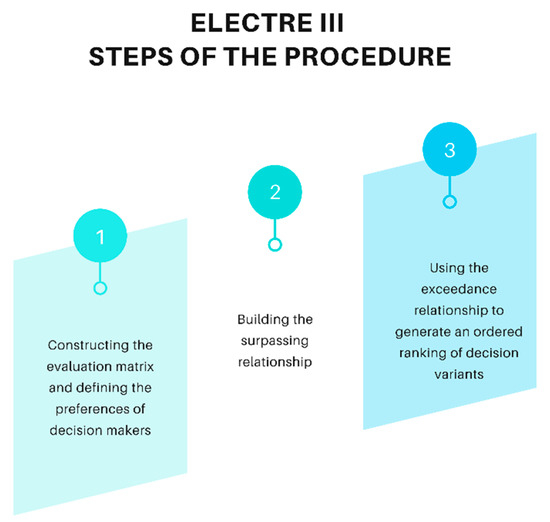
Figure 1.
ELECTRE III steps of the procedure.
In the first stage, it is necessary to identify the variants of the decision and then define a set of criteria that will be used to evaluate each of the variants [50,51,52,53,54,55]. For each of the criteria, a weight is determined, which is indicated by experts. The respondents compared each pair of criteria according to Saaty’s scale, giving grades from 1 to 9, where [46]:
- 1—same meaning;
- 2—very weak advantage;
- 3—weak advantage;
- 4—more than a weak advantage, less than strong;
- 5—strong advantage;
- 6—more than a strong advantage, less than very strong;
- 7—a very strong advantage;
- 8—more than a very strong advantage, less than an extreme;
- 9—extreme, total advantage.
Then, by comparing the two decision variants, the exceedance index was calculated [50,51,52,53,54,55].
In the second stage, using the calculated exceedance index, it was determined whether the first variant was better than the second due to the selected criterion. Consequently, the calculations of the compliance rate should be performed to obtain an answer with the level of advantage of one variant over the other in terms of all criteria [50,51,52,53,54,55]. The compliance rate is the sum of the criteria weights for which the evaluation value of one variant is greater than or equal to the evaluation value of the other variant [50,51,52,53,54,55].
In the third stage, an altitude difference matrix was created. The variants should be arranged sequentially, starting from their initial ordering using the classification procedures of ascending and descending distillation [50,51,52,53,54,55]. Both distillations rate the variants from best to worst [50,51,52,53,54,55]. Ascend distillation is a planning process that begins with selecting the best variant and placing it at the top of the ranking [50,51]. The best variant is selected one by one from the remaining variants and placed in the next position in the classification. This procedure is repeated until all possible variants have been analyzed [50,51]. Descend distillation is a planning process that begins with selecting the worst variant and placing it at the end of the ranking. Subsequently, similar to ascending distillation, further analyses should be performed, bearing in mind that in the subsequent iterations of the variants to be considered, the worst variant is always selected and placed in the next positions from the end ranking [53,54]. After the distillation has been completed, a final ranking is made.
The results are presented in the next chapter.
3. Calculation Procedure
The proposed study was carried out for the case study of one car-sharing company operating in the Polish area. The company currently has about 2000 vehicles, focusing on cars of one type: small-sized cars and urban hatchback cars equipped with three or five doors. The research aimed to analyze and indicate what type of fleet would be best suited to the needs of system users who rarely use rental cars, that is, from 5 to 10 times a year.
Twelve new vehicle models equipped with internal combustion, hybrid, and electric engines were selected for the study. The proposed models were chosen among the most popular cars in Europe in 2021, based on the Automotive News Europe report [56]. The car models selected for the analysis represented different vehicle classes (car segments). The car classes are car-scheme classifications used in Europe, standardized following ISO Standard 3833–1977. They categorize vehicles in terms of size and equipment. The standard distinguishes nine main classes marked with the letters A to M that characterize the type of vehicle. A detailed breakdown of the vehicle classes is presented in Table 1.

Table 1.
Characteristics of vehicle classes.
Among the car models included in the report, the focus was on the vehicles representing the four most popular car segments in Poland, which are the A, B, C, and D classes [57]. A list of the vehicle models included in the analysis is presented in Table 2.
Table 2.
Variants included in the analysis.
Following the methodology to proceed using the ELECTRE III method, the next step was to develop a set of criteria from which individual variants were evaluated. Due to the lack of literature devoted to analyzing the impact of the individual criteria on fleet selection, the factors were arbitrarily indicated. When defining the set of criteria, the desire was made to indicate the measurable factors directly related to the specification of individual vehicles. A set of factors is presented in Table 3.
Table 3.
Set of criteria considered during car-sharing fleet selection analysis.
The developed criteria were used for the analysis of the vehicles. Each of the vehicles considered in the analysis (variants presented in Table 2) was represented by the technical parameters that characterized them as corresponding to the assumed criteria. Therefore, the next step was to assign each of the criteria values of the individual parameters based on the technical specifications of the vehicles and the Euro NCAP reports. A detailed list is presented in Table 4.
Table 4.
Criteria values for individual car variants.
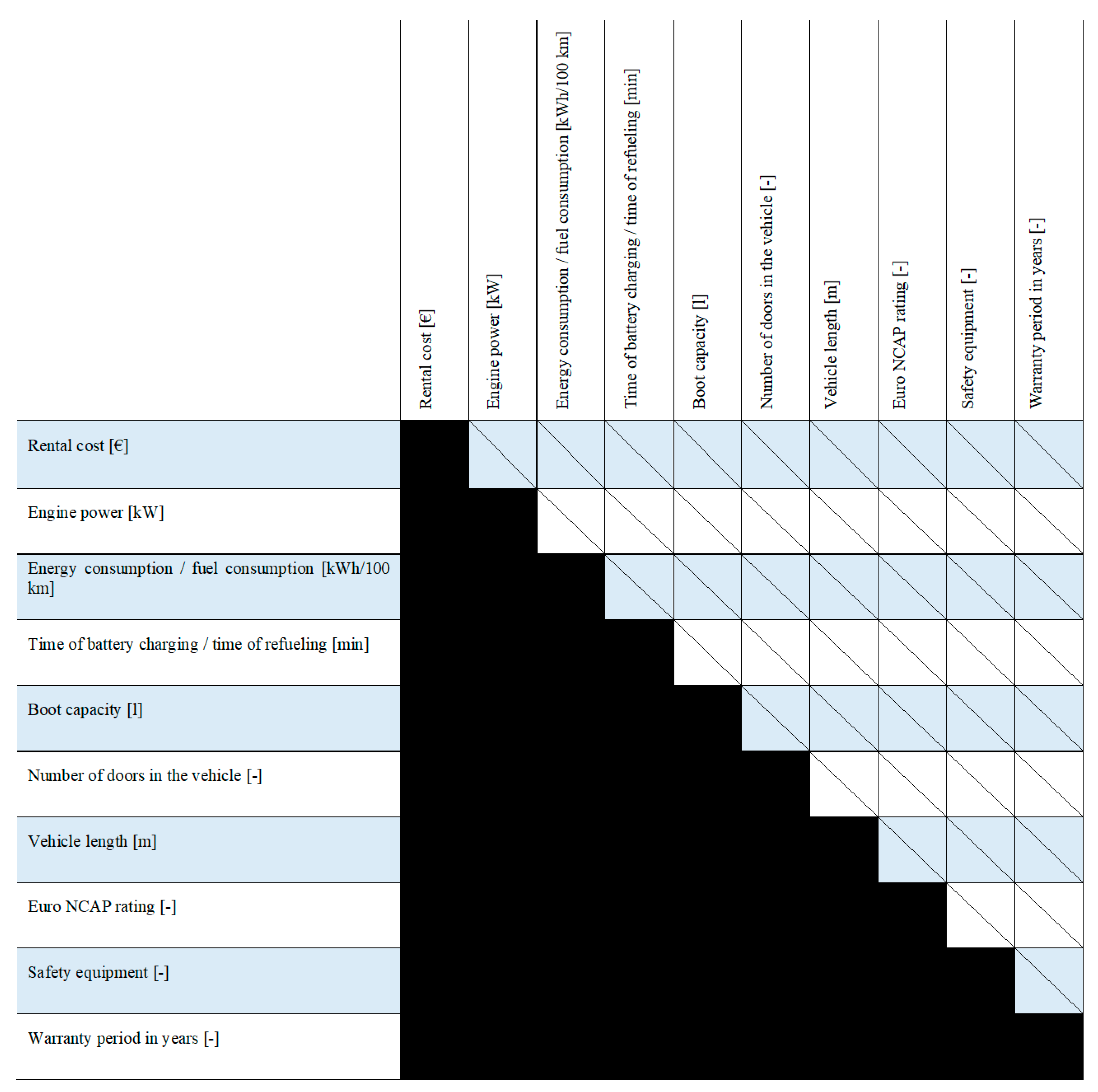
The next step was to establish the importance of the individual criteria when determining the vehicles by respondents. For this purpose, a survey was conducted among users of the car-sharing system. Among the users of the analyzed operator, 200 car-sharing users were selected for the study, who use the systems rarely, that is, from 5 to 10 times a year. The survey was conducted anonymously in June 2022. The respondents who participated in the survey represented a population of 200,000 users of the system of the analyzed enterprise. For the research sample, the confidence level was 95% (α = 0.95). The fraction size was 0.5, and the maximum error was estimated at 8%. The respondents filled in the questionnaire, which was made available via the internet using the Computer-Assisted Web Interview (CAWI) method. The questionnaire was fully anonymous and focused on obtaining only the answers needed to perform the ELECTRE III analyses, i.e., receiving pairwise comparisons of each of the criteria. The respondents assessed the importance of each criterion on Saaty’s scale, assigning values from 1 to 9 and entering them into the appropriate field of the matrix. The matrix of pairwise comparisons is shown in Figure 2.
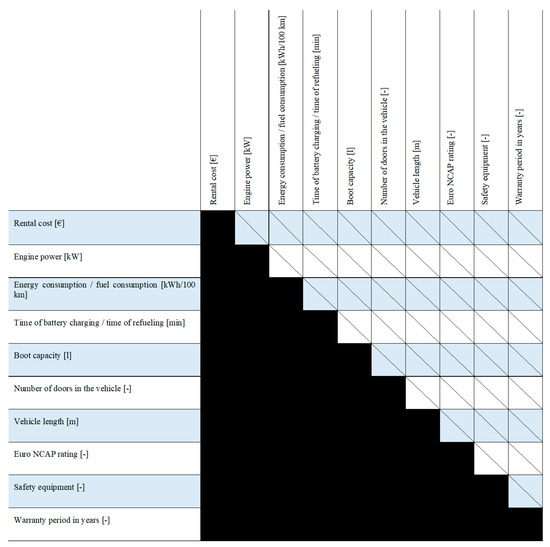
Figure 2.
Matrix of pairwise comparisons.
Based on the assessments given by the respondents, a list was created showing the average importance of each of the criteria. The score values were used for further analysis using the ELECTRE III method. The summary is presented in Table 5.
Table 5.
Weight values.
According to the ELECTRE III methodology, the next step was to determine the maximum difference in the criteria values, the equivalence threshold, the preference threshold, and the veto threshold. Detailed data are presented in Table 6.
Table 6.
The set of thresholds for equivalence, preference, and veto.
The next step, according to the ELECTRE III methodology, was to create the concordance matrix. The matrix is presented in the form of Table 7.
Table 7.
Concordance matrix values.
The next stage in the ELECTRE III method was to perform the ascending and descending distillations against each of the variants and create, in the final step, a dominance matrix. The dominance matrix is presented in Table 8.
Table 8.
Dominance matrix values.
The last step was to prepare the final ranking that presents the variants in terms of the preferences of experts and the adopted factors. The final ranking is presented in Table 9.
Table 9.
Final ranking.
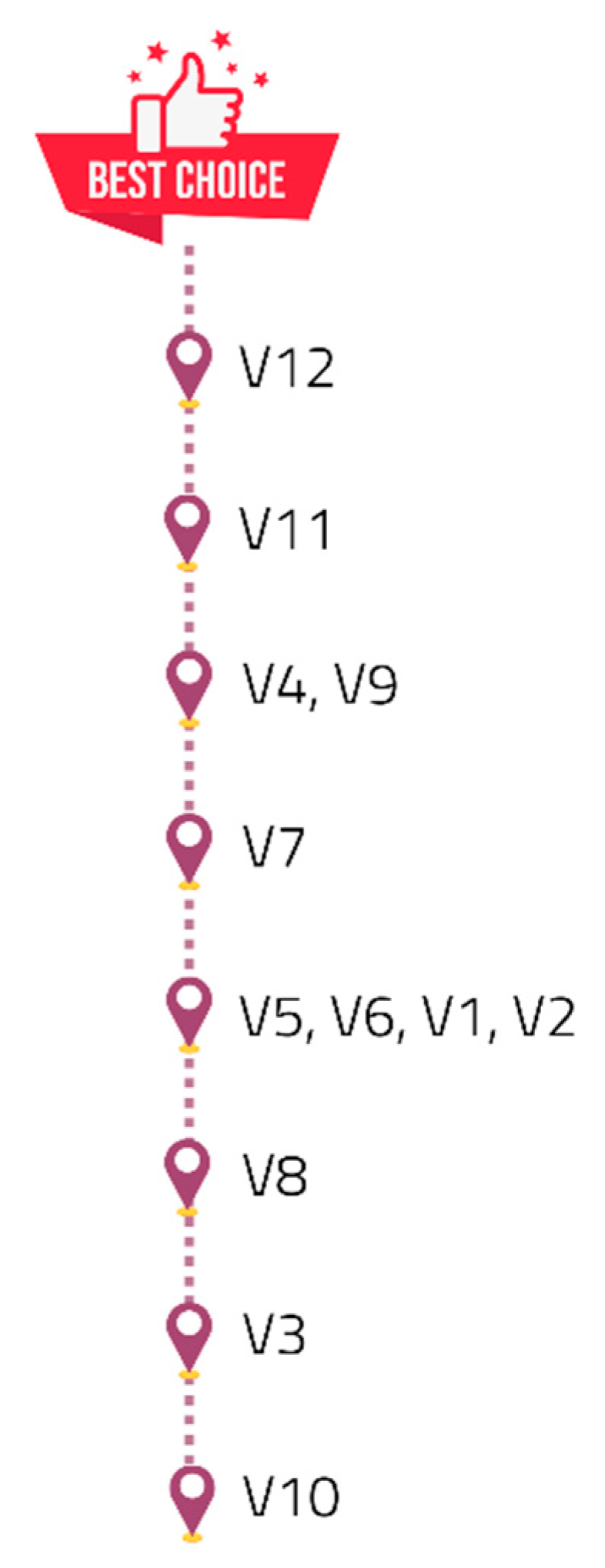
The graphical arrangement of the variants is shown in Figure 3.
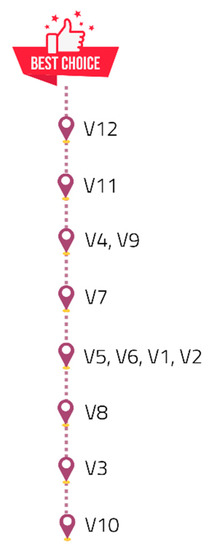
Figure 3.
Final ranking—graphic visualization.
4. Discussion
The research, carried out using the ELECTRE III multi-criteria decision support method, allowed us to draw a ranking of the vehicle models that meet the expectations of users who rarely use car-sharing systems. According to the results, the best model turned out to be the V12 car model. The selected model is a mid-range electric crossover passenger car. The V11 variant took second place, and the variants V4 and V9 ex aequo were third.
When analyzing the results in detail, in terms of the vehicle size, it should be stated that the main positions were taken by the models representing the class D cars, i.e., the segment that includes middle-class passenger cars, relatively large and comfortable family and sports cars. This class includes classic passenger cars with dimensions larger than compact ones, ensuring a relatively comfortable ride for five people on longer journeys. Interestingly, the vehicles representing the smallest class of cars, i.e., A, were ranked the worst.
From the point of view of vehicle propulsion, the fully electric vehicle was classified as the highest in the ranking. Second place was also taken by a car with this type of drive. In turn, the third and fourth places are represented by cars with hybrid drives. Interestingly, the last places in the ranking were also taken by electric cars (variants V3 and V10). Such results indicate that, for the respondents, it was especially for not the fact that the vehicles had alternative propulsion but the detailed parameters characterizing individual vehicles.
When analyzing the results obtained from the point of view of the importance of individual criteria for users, it should be mentioned that the most important issues were engine power, boot capacity, rental cost, battery charging/refueling time, and safety equipment. This may prove that people who rarely use car-sharing vehicles want to use relatively large, spacious, and comfortable vehicles equipped with large luggage spaces, in which it will be possible to charge the battery or refuel the car in the shortest possible time. In addition, safety equipment issues were also important. Therefore, placing vehicles such as the V10 and V8 variants in the last places is because these cars represent class A, have a small load space, and have low engine performance. Interestingly, the size of the car, its capacity, and the performance of the engine weighed heavily on the cost of renting a car. Factors that came in the last positions deserve special attention. These were issues, such as the warranty period that were deliberately included in the analysis, as it is usually associated with high-quality vehicles. Factors such as NCAP safety and the number of doors in the vehicle were equally low rated. Such factors may indicate that the respondents treat car-sharing vehicles as an additional, occasional means of getting around, which they usually use alone or with one additional passenger, disregarding the facilities needed by families, such as more doors. It is also worth paying attention to the safety issues that did not turn out to be of key importance to the respondents, perhaps because the vehicles are not used by them frequently.
5. Conclusions
In conclusion, the research conducted allowed us to achieve the goal of the work, which was to select vehicles for car-sharing systems from the point of view of users who rarely use the services. The research showed that the V12 model representing the D vehicle class, equipped with a high-performance electric motor, was the best solution. Furthermore, it should be emphasized that the vehicles with alternative drives were placed in the highest rankings. By taking into account the detailed expectations of users about the fleet, it should be noted that the most important criteria include engine power, boot capacity, rental cost, battery charging/time of refueling, and safety equipment. Therefore, the fleet preferred by users who rarely use car-sharing systems is relatively large, spacious, and comfortable, with vehicles equipped with high-performance engines. By comparing the results obtained with real business practices, it should be noted that the V12 variant car, which leads in the ranking, is the main model used in the German car-sharing model, WeShare, in Berlin or Hamburg [58]. Therefore, these vehicles are successfully used in urban conditions, as evidenced by their use in large metropolitan car-sharing.
An interesting finding was that small city vehicles were ranked the lowest. It should be mentioned that the idea of car-sharing services assumed that the vehicles used in the systems would be small city cars, whose task would be to free public space [59]. However, the results obtained show that this type of vehicle will not be the first choice among users who rarely use car-sharing systems. This is a valuable note for car-sharing service operators who, when planning to diversify their fleet, should pay attention to the real needs of their users. Of course, from the point of view of public space, small city cars will be the best solution due to their dimensions, but then it is worth undertaking detailed research on the needs of users. The analyzed example shows that in the case of users rarely using car-sharing systems, small vehicles would not be rented, and as a result, a large number of them would remain unrolled in the city, becoming unprofitable for the operator and occupying public space. Taking into account the users’ specific expectations, it can be assumed that if small vehicles were equipped with high-power engines and fast-charging batteries, they could significantly make gains in the final classification in the ranking. Furthermore, when considering the modernization of the vehicle fleet in the category of future rentals by rare users, the aspects of warranty, NCAP safety, or the number of doors should not be crucial. These considerations should provide important guidance to operators in their willingness to select other vehicles for their fleet than the models covered in this article.
This article has limitations. The main limitation was that the research only covered the Polish market. Moreover, they were devoted exclusively to a group of people who rarely use car-sharing systems. As there is no literature dedicated directly to the selection of the fleet of vehicles for car-sharing systems, the author did not refer to the research conducted by other authors in discussing the results.
In future work, the author plans to analyze other user groups to obtain the full range of user approaches to the vehicle fleet. In addition, the author plans to conduct research for countries other than Poland to compare users’ preferences in terms of the vehicle fleet.
Funding
Publication supported under the rector’s pro-quality grant. Silesian University of Technology, 12/010/RGJ22/1041.
Institutional Review Board Statement
According to our University Ethical Statement, following: the following shall be regarded as research requiring a favorable opinion from the Ethic Commission in the case of human research (based on document in polish: https://prawo.polsl.pl/Lists/Monitor/Attachments/7291/M.2021.501.Z.107.pdf (accessed on 21 March 2022): research in which persons with limited capacity to give informed or research on persons whose capacity to give informed or free consent to participate in research and who have a limited ability to refuse research before or during their implementation, in particular: children and adolescents under 12 years of age, persons with intellectual disabilities, persons whose consent to participate in the research may not be fully voluntary, prisoners, soldiers, police officers, employees of companies (when the survey is conducted at their workplace), persons who agree to participate in the research on the basis of false information about the purpose and course of the research (masking instruction, i.e., deception) or do not know at all that they are subjects (in so-called natural experiments); research in which persons particularly susceptible to psychological trauma and mental health disorders are to participate, mental health, in particular: mentally ill persons, victims of disasters, war trauma, etc., patients receiving treatment for psychotic disorders, family members of terminally or chronically ill patients; research involving active interference with human behavior aimed at changing it, research involving active intervention in human behavior aimed at changing that behavior without direct intervention in the functioning of the brain, e.g., cognitive training, psychotherapy psychocorrection, etc. (this also applies if the intended intervention is intended to benefit (this also applies when the intended intervention is to benefit the subject (e.g., to improve his/her memory); research concerning controversial issues (e.g., abortion, in vitro fertilization, death penalty) or requiring particular delicacy and caution (e.g., concerning religious beliefs or attitudes towards minority groups) minority groups); research that is prolonged, tiring, physically or mentally exhausting. Our research is not conducted on people meeting the mentioned condition. Any of the researched people, where any of them had limited capacity to be informed or any of them had been susceptible to psychological trauma and mental health disorders; the research did not concern the mentioned-above controversial issues; the research was not prolonged, tiring, physically or mentally exhausting.
Informed Consent Statement
Informed consent was obtained from all subjects involved in the study.
Data Availability Statement
The data presented in this study are available on request from the author.
Conflicts of Interest
The author declares no conflict of interest.
References
- Cantelmo, G.; Amini, R.E.; Monteiro, M.M.; Frenkel, A.; Lerner, O.; Tavory, S.S.; Galtzur, A.; Kamargianni, M.; Shiftan, Y.; Behrischi, C.; et al. Aligning Users’ and Stakeholders’ Needs: How Incentives Can Reshape the Carsharing Market. Transp. Policy 2022, 126, S0967070X22001901. [Google Scholar] [CrossRef]
- Jochem, P.; Frankenhauser, D.; Ewald, L.; Ensslen, A.; Fromm, H. Does Free-Floating Carsharing Reduce Private Vehicle Ownership? The Case of SHARE NOW in European Cities. Transp. Res. Part A Policy Pr. 2020, 141, 373–395. [Google Scholar] [CrossRef]
- Global Market Insights. Car Sharing Market Size by Model (P2P, Station-Based, Free-Floating), by Business Model (Round Trip, One Way), by Application (Business, Private), COVID-19 Impact Analysis, Regional Outlook, Application Potential, Price Trend, Competitive Market Share & Forecast, 2021–2027. Available online: https://www.gminsights.com/industry-analysis/carsharing-market (accessed on 12 July 2022).
- Globe Newswire. Car Sharing Market Trends 2021—Regional Statistics and Forecasts 2024|Europe, North America & APAC: Graphical Research. Available online: https://www.globenewswire.com/news-release/2021/02/03/2168780/0/en/Car-Sharing-Market-Trends-2021-Regional-Statistics-and-Forecasts-2024-Europe-North-America-APAC-Graphical-Research.html (accessed on 9 August 2022).
- Del Mar Alonso-Almeida, M. To Use or Not Use Car Sharing Mobility in the Ongoing COVID-19 Pandemic? Identifying Sharing Mobility Behaviour in Times of Crisis. Int. J. Environ. Res. Public Health 2022, 19, 3127. [Google Scholar] [CrossRef]
- Yao, Z.; Gendreau, M.; Li, M.; Ran, L.; Wang, Z. Service Operations of Electric Vehicle Carsharing Systems from the Perspectives of Supply and Demand: A Literature Review. Transp. Res. Part C Emerg. Technol. 2022, 140, 103702. [Google Scholar] [CrossRef]
- Aguilera-García, Á.; Gomez, J.; Antoniou, C.; Vassallo, J.M. Behavioral Factors Impacting Adoption and Frequency of Use of Carsharing: A Tale of Two European Cities. Transp. Policy 2022, 123, 55–72. [Google Scholar] [CrossRef]
- Vanheusden, W.; van Dalen, J.; Mingardo, G. Governance and Business Policy Impact on Carsharing Diffusion in European Cities. Transp. Res. Part D Transp. Environ. 2022, 108, 103312. [Google Scholar] [CrossRef]
- Friesen, M.; Mingardo, G. Is Parking in Europe Ready for Dynamic Pricing? A Reality Check for the Private Sector. Sustainability 2020, 12, 2732. [Google Scholar] [CrossRef]
- Ciari, F.; Bock, B.; Balmer, M. Modeling Station-Based and Free-Floating Carsharing Demand: A Test Case Study for Berlin, Germany; Emerging and Innovative Public Transport and Technologies, Transportation Research Board of the National Academies: Washington, DC, USA, 2014. [Google Scholar]
- Ferrero, F.; Perboli, G.; Rosano, M.; Vesco, A. Car-sharing services: An annotated review. Sustain. Cities Soc. 2018, 37, 501–518. [Google Scholar] [CrossRef]
- Nourinejad, M.; Roorda, M. Carsharing operations policies: A comparison between one-way and two-way systems. Transportation 2015, 42, 97–518. [Google Scholar] [CrossRef]
- Shaheen, S.; Chan, N.; Bansal, A.; Cohen, A. Shared Mobility—A Sustainability & Technologies Workshop, Definitions, Industry Developments and Early Understanding; University of California, Transportation Sustainability Research Center: Barkeley, CA, USA, 2015; pp. 1–30. [Google Scholar]
- Sprei, F.; Habibi, S.; Englund, C.; Pettersson, S.; Voronov, A.; Wedlin, J. Free-Floating Car-Sharing Electrification and Mode Displacement: Travel Time and Usage Patterns from 12 Cities in Europe and the United States. Transp. Res. Part D Transp. Environ. 2019, 71, 127–140. [Google Scholar] [CrossRef]
- Changaival, B.; Lavangnananda, K.; Danoy, G.; Kliazovich, D.; Guinand, F.; Brust, M.; Musial, J.; Bouvry, P. Optimization of Carsharing Fleet Placement in Round-Trip Carsharing Service. Appl. Sci. 2021, 11, 11393. [Google Scholar] [CrossRef]
- Ströhle, P.; Flath, C.M.; Gärttner, J. Leveraging Customer Flexibility for Car-Sharing Fleet Optimization. Transp. Sci. 2019, 53, 42–61. [Google Scholar] [CrossRef]
- Monteiro, C.M.; Machado, C.A.S.; de Oliveira Lage, M.; Berssaneti, F.T.; Davis, C.A.; Quintanilha, J.A. Optimization of Carsharing Fleet Size to Maximize the Number of Clients Served. Comput. Environ. Urban Syst. 2021, 87, 101623. [Google Scholar] [CrossRef]
- Lemme, R.F.F.; Arruda, E.F.; Bahiense, L. Optimization Model to Assess Electric Vehicles as an Alternative for Fleet Composition in Station-Based Car Sharing Systems. Transp. Res. Part D Transp. Environ. 2019, 67, 173–196. [Google Scholar] [CrossRef]
- Carlier, A.; Munier-Kordon, A.; Klaudel, W. Optimization of a one-way carsharing system with relocation operations. In Proceedings of the 10th International Conference on Modeling, Optimization and SIMulation MOSIM 2014, Nancy, France, 5–7 November 2014. [Google Scholar]
- Nourinejad, M.; Roorda, M.J. A dynamic carsharing decision support system. Transp. Res. Part E Logist. Transp. Rev. 2014, 66, 36–50. [Google Scholar] [CrossRef]
- Barrios, J.A.; Godier, J.D. Fleet Sizing for Flexible Carsharing Systems: Simulation-Based Approach. Transp. Res. Rec. 2014, 2416, 1–9. [Google Scholar] [CrossRef]
- Lu, M.; Chen, Z.; Shen, S. Optimizing the Profitability and Quality of Service in Carshare Systems Under Demand Uncertainty. Manuf. Serv. Oper. Manag. 2018, 20, 162–180. [Google Scholar] [CrossRef]
- Hui, Y.; Wang, Y.; Sun, Q.; Tang, L. The Impact of Car-Sharing on the Willingness to Postpone a Car Purchase: A Case Study in Hangzhou, China. J. Adv. Transp. 2019, 2019, 1–11. [Google Scholar] [CrossRef]
- Jain, T.; Rose, G.; Johnson, M. Changes in Private Car Ownership Associated with Car Sharing: Gauging Differences by Residential Location and Car Share Typology. Transportation 2022, 49, 503–527. [Google Scholar] [CrossRef]
- Liao, F.; Molin, E.; Timmermans, H.; van Wee, B. Carsharing: The Impact of System Characteristics on Its Potential to Replace Private Car Trips and Reduce Car Ownership. Transportation 2020, 47, 935–970. [Google Scholar] [CrossRef]
- Szałek, A.; Pielecha, I.; Cieslik, W. Fuel Cell Electric Vehicle (FCEV) Energy Flow Analysis in Real Driving Conditions (RDC). Energies 2021, 14, 5018. [Google Scholar] [CrossRef]
- Gschwendtner, C.; Krauss, K. Coupling Transport and Electricity: How Can Vehicle-to-Grid Boost the Attractiveness of Carsharing? Transp. Res. Part D Transp. Environ. 2022, 106, 103261. [Google Scholar] [CrossRef]
- Cieslik, W.; Szwajca, F.; Rosolski, S.; Rutkowski, M.; Pietrzak, K.; Wójtowicz, J. Historical Buildings Potential to Power Urban Electromobility: State-of-the-Art and Future Challenges for Nearly Zero Energy Buildings (nZEB) Microgrids. Energies 2022, 15, 6296. [Google Scholar] [CrossRef]
- Wielinski, G.; Trépanier, M.; Morency, C. Electric and Hybrid Car Use in a Free-Floating Carsharing System. Int. J. Sustain. Transp. 2017, 11, 161–169. [Google Scholar] [CrossRef]
- Pielecha, I.; Cieślik, W.; Szałek, A. Energy Recovery Potential through Regenerative Braking for a Hybrid Electric Vehicle in a Urban Conditions. IOP Conf. Ser. Earth Environ. Sci. 2019, 214, 012013. [Google Scholar] [CrossRef]
- Migliore, M.; D’Orso, G.; Caminiti, D. The environmental benefits of carsharing: The case study of Palermo. Transp. Res. Procedia 2020, 48, 2127–2139. [Google Scholar] [CrossRef]
- Shaheen, S.; Martin, E.; Totte, H. Zero-Emission Vehicle Exposure within U.S. Carsharing Fleets and Impacts on Sentiment toward Electric-Drive Vehicles. Transp. Policy 2020, 85, A23–A32. [Google Scholar] [CrossRef]
- Liao, F.; Correia, G. Electric Carsharing and Micromobility: A Literature Review on Their Usage Pattern, Demand, and Potential Impacts. Int. J. Sustain. Transp. 2022, 16, 269–286. [Google Scholar] [CrossRef]
- Turoń, K.; Kubik, A.; Łazarz, B.; Czech, P.; Stanik, Z. Car-sharing in the context of car operation. IOP Conf. Ser. Mater. Sci. Eng. 2018, 421, 032027. [Google Scholar] [CrossRef]
- Turoń, K.; Kubik, A.; Chen, F. Operational Aspects of Electric Vehicles from Car-Sharing Systems. Energies 2019, 12, 4614. [Google Scholar] [CrossRef]
- Turoń, K.; Kubik, A.; Chen, F. What Car for Car-Sharing? Conventional, Electric, Hybrid or Hydrogen Fleet? Analysis of the Vehicle Selection Criteria for Car-Sharing Systems. Energies 2022, 15, 4344. [Google Scholar] [CrossRef]
- Puzio, E. The development of shared mobility in Poland using the example of a city bike system. Res. Pap. Wrocław. Univ. Econ. 2020, 64, 162–170. [Google Scholar] [CrossRef]
- Statista. Forecast Revenues from Carsharing Services in Poland from 2019 to 2025. Available online: https://www.statista.com/statistics/1059362/poland-carsharing-revenues/ (accessed on 5 June 2022).
- Roy, B. How Outranking Relation Halps Multiple Criteria Decision Making; University of South Carolina Press: Columbia, SC, USA, 1973. [Google Scholar]
- Geneletti, D. Multi-Criteria Analysis. LIAISE Toolbox. Available online: http://beta.liaise-toolbox.eu/ia-methods/multi-criteria-analysis (accessed on 15 July 2022).
- Shaheen, S.; Cohen, A. Carsharing and Personal Vehicle Services: Worldwide Market Developments and Emerging Trends. Int. J. Sustain. Transp. 2013, 7, 5–34. [Google Scholar] [CrossRef]
- Shaheen, S.; Cohen, A. Innovative Mobility Carsharing Outlook Winter 2016: Carsharing Market Overview, Analysis, and Trends Innovative Mobility Carsharing Outlook—Winter 2016. Available online: http://innovativemobility.org/?project=innovative-mobility-carsharing-outlook-winter-2016 (accessed on 17 March 2018).
- Istanbul Metropolitan Municipality & Japan International Cooperation Agency, the Study on Integrated Urban Transport Master Plan for Istanbul Metropolitan Area in the Republic of Turkey. Available online: https://openjicareport.jica.go.jp/pdf/11965720_01.pdf (accessed on 5 June 2022).
- Li, W.; Li, Y.; Fan, J.; Deng, H. Siting of Carsharing Stations Based on Spatial Multi-Criteria Evaluation: A Case Study of Shanghai EVCARD. Sustainability 2017, 9, 152. [Google Scholar] [CrossRef]
- Jahan, A.; Edwards, K.L. Multi-criteria Decision-Making for Materials Selection. In Multi-Criteria Decision Analysis for Supporting the Selection of Engineering Materials in Product Design; Butterworth-Heinemann: Oxford, UK, 2013; pp. 31–41. [Google Scholar] [CrossRef]
- Awasthi, A.; Breuil, D.; Chauhan, S.S.; Parent, M.; Reveillere, T. A Multicriteria Decision Making Approach for Carsharing Stations Selection. J. Decis. Syst. 2007, 16, 57–78. [Google Scholar] [CrossRef]
- Saaty, T. How to make decision: The analytic hierarchy process. Eur. J. Oper. Res. 1990, 48, 9–26. [Google Scholar] [CrossRef]
- Kobryń, A. Wielokrotne Wspomaganie Decyzji w Gospodarowaniu Przestrzenią; Difin: Warszaw, Poland, 2014. [Google Scholar]
- Zlaugotne, B.; Zihare, L.; Balode, L.; Kalnbalkite, A.; Khabdullin, A.; Blumberga, D. Multi-Criteria Decision Analysis Methods Comparison. Environ. Clim. Technol. 2020, 24, 454–471. [Google Scholar] [CrossRef]
- Figueira, J.R.; Greco, S.; Roy, B.; Słowiński, R. ELECTRE methods: Main features and recent developments. In Handbook of Multicriteria Analysis; Springer: Berlin/Heidelberg, Germany, 2010; pp. 51–89. [Google Scholar]
- Norese, M.F. ELECTRE III as a support for participatory decision-making on the localisation of waste-treatment plants. Land Use Policy 2006, 23, 76–85. [Google Scholar] [CrossRef]
- La Scalia, G.; Micale, R.; Certa, A.; Enea, M. Ranking of shelf life models based on smart logistic unit using the ELECTRE III method. Int. J. Appl. Eng. Res. 2015, 10, 38009–38015. [Google Scholar]
- Saaty, R.W. The Analytic Hierarchy Process—What It Is and How It Is Used. Math. Model. 1987, 9, 161–176. [Google Scholar] [CrossRef]
- Battisti, F. ELECTRE III for Strategic Environmental Assessment: A “Phantom” Approach. Sustainability 2022, 14, 6221. [Google Scholar] [CrossRef]
- López, J.C.L.; Solares, E.; Figueira, J.R. An Evolutionary Approach for Inferring the Model Parameters of the Hierarchical Electre III Method. Inf. Sci. 2022, 607, 705–726. [Google Scholar] [CrossRef]
- Auto Magazine. Top 20: The Most Popular Models of the 20 Brands in Europe. Available online: https://magazynauto.pl/wiadomosci/top-20-najpopularniejsze-modele-20-marek-w-europie,aid,1335 (accessed on 10 July 2022).
- Auto World Portal. The Most Popular Car Classes in Poland. Available online: https://www.auto-swiat.pl/wiadomosci/aktualnosci/najpopularniejsze-klasy-samochodow-w-polsce/gmkcf8w (accessed on 23 August 2022).
- WeShare Car-Sharing Operator. Available online: https://www.we-share.io/en (accessed on 24 August 2022).
- Glotz-Richter, M. Car-Sharing—“Car-on-call” for reclaiming street space. Procedia—Soc. Behav. Sci. 2012, 48, 1454–1463. [Google Scholar] [CrossRef]
Publisher’s Note: MDPI stays neutral with regard to jurisdictional claims in published maps and institutional affiliations. |
© 2022 by the author. Licensee MDPI, Basel, Switzerland. This article is an open access article distributed under the terms and conditions of the Creative Commons Attribution (CC BY) license (https://creativecommons.org/licenses/by/4.0/).