


Abstract
The aim of our study is to delineate the characteristics of fluid flow comprising single-wall and multi-wall carbon nanotubes (SWCNTs and MWCNTs) along the surface of a Riga plate fixed in a porous environment. We carried out in-depth comparative analysis to depict the behavior of SWCNTs and MWCNTs when water and kerosene oil are used as base fluids. Homogeneous–heterogeneous reactions generated a significant impact on flow dynamics; furthermore, we also discuss the impact of viscous dissipation. We assembled numerical solutions for non-dimensionalized ordinary differential equations with the help of the shooting technique; moreover, by employing the same procedure, we report the conduct of dominating parameters on velocity, temperature, and concentration profiles. The results show highly desirable skin friction coefficient and Nusselt number values, which we exhibit in terms of tabular data.
1. Introduction
The use of carbon nanotubes (CNTs) is extensively applied in innumerable fields, such as air and water filtration, field emissions, catalyst support, biomedical applications, thermal materials, fibers, fabrics, etc. Carbon nanotubes are rolled graphene cylindrical sheets 0.7 nm to 50 nm in diameter. Graphene layers in the carbon nanotubes determine its characteristics, and Iijima [1] is credited to be the first who introduced carbon nanotubes. Younes et al. [2] discussed some relevant properties of nanofluids. Among the key features of a carbon nanotube (CNT) is its ability to incorporate with a stretching sheet [3], especially in heat generation/absorption and thermal radiation. Owing to their characteristics, CNTs were used to examine slip conditions and viscous dissipation for Darcy–Forchheimer flow, which revealed promising results for disk rotation [4]. This has highlighted new avenues for the application of CNTs, which has led to several other studies developing mathematical models to depict the influence of buoyancy force and suction on flow over a moving plate [5]. The application of magnetohydrodynamics (MHD) on a hybrid nanofluidic flow subject to convective conditions has various implications, as revealed by Ahmad et al. [6], who observed the influence on flow behavior when the fluid flows over a stretching sheet placed in a porous medium. With clear benefits, carbon nanoparticles have been applied in molecular dynamics [7], improving the efficiency related to the thermal changes of graphene nanotubes. Noranuar et al. [8] applied a magnetic field to a fluid flow due to non-coaxial disk rotation and used carbon nanotubes as nanoparticles in human blood. Their results are obtained via the Laplace transform technique. Several models have proved the application of carbon nanotubes, such as the Cattaneo–Christov model [9], which examined micropolar liquid and the behavior of streamlines for single- and multiple-walled carbon nanotubes. The use of magnetic nanofluid resulted in the resonance of carbon nanotubes, allowing for more useful results. [10]. Further advancements in the applications of carbon nanotubes have grabbed the attention of computational experts, who revolutionized the thermal features of a multi-wall carbon nanotube placed within a curly square enclosure [11], which they then analyzed by the Navier–Stokes equations, subject to specific Rosseland boundary conditions. This has convinced various other researchers to numerically explore the flow of ferro-fluid within carbon nanotubes over a stretched surface while taking into account the effects of Darcy–Forchheimer and mixed convection [12]. The significance of numerical representation further proved helpful in illustrating the thermal properties of nanofluid flow, which involve MWCNTs along with wall conditions [13]. The examination is carried out with the assistance of the classical differential transform method. In a more recent investigation, the optimal homotopy analysis method (OHAM) is applied to a CNT flow model for two stretching disks instead of one. The study also includes the effects of heat generation, joule heating and viscous dissipation [14]. Some of the relevant works are carried out in Refs. [15,16,17,18,19,20].
The importance of the Riga plate for the fluid flow has been explored in a variety of industrial procedures. Gallies and Lilausis [21] found a way to control the fluid flow by generating a Lorentz force acting parallel to the wall, resulting in magnetic and electric fields with the help of the Riga plate. This plate can be used for the radiation of a powerful agent, skin friction, and pressure drag allied with submarines because it abstains from the separation of the boundary layer. This unique practical application has generated interest among scientists examining the behavior of low-electrical-conductive liquids by considering the Lorentz force responsible for aiding or opposing the fluid flows. Classical MHD flows were established for liquids that have enhanced electrical conductivity fields, as they can be easily controlled in the presence of external magnetic fields with a strength of approximate of 1 Tesla; however, the same cannot be done for liquids with weak conductivity. For these liquids, the Riga plate being a strong external agent serves the purpose [22]. Furthermore, Pantokratoras [23] looked for the characteristics of Blasius and Sakiadis flow initiated by a Riga plate. Mallawi et al. [24] presented their research concerning the influence of double stratification and Cattaneo–Christov double flux on second-grade fluid flow due to a Riga plate. In continuation of these research outcomes, much effort was devoted on improving the heat transfer abilities of nano lubricants by considering a stationary/moving Riga plate and numerically analyzing the effects of mixed convection, thermal radiation, and slip boundary conditions [25]. Advancements in this direction revealed that an extended Riga wedge could address the stagnation point and activation energy features of tangent hyperbolic nanofluid flow, thereby introducing beneficial outcomes [26]. The significance of these results influenced further in-depth investigations for a MHD Newtonian fluid flow derived by a stretchy Riga sheet [27]. This analysis was obtained using the homotopy analysis method, which explained detailed aspects pertaining to Cattaneo–Christov flux and activation energy. Owing to this detailed analysis, it was therefore possible to theoretically uncover the mixed convection and radiation effects on Cattaneo–Christov nanofluid (fourth grade) flow towards a Riga surface [28]. Further improvements in understanding the behaviors of nanofluid were possible upon analyzing the impact of Nield and convective conditions, and viscous dissipation. Khan et al. [29] observed a melting phenomenon for third-grade nanofluidic flow along a Riga wall while considering the influence of radiation, a heat source/sink, and a binary chemical reaction for the flow model. Asogwa et al. [30] researched the roles of MHD, heat sinks, and Soret and Dufour effects for a Cassson fluid flow, which was altered due to an inclined Riga surface. Finally, the role of electromagnetic forces on SWCNT was critically analyzed by taking into account heat source/sink and slip effects for a flow towards a Riga plate, and the findings were expressed using RKF-45 method [31].
Chemical reactions, such as homogeneous and heterogeneous reactions, occur in many biochemical systems, and in combustion, catalysis, etc. Homogeneous reactions generally take place in fluid bulk, whereas the reactions occurring on catalytic surfaces are mostly heterogeneous reactions; therefore, the homogeneous reactions taking place in liquids, and the heterogeneous reactions occurring on catalytic surfaces, interact and produce different interactive species with numerous velocities. The changes originate both inside the liquids and the catalytic surfaces. Hence, it became possible to formulate a mathematical model that simultaneously considered the effects of homogeneous–heterogeneous reactions on boundary-layer flow in the vicinity of a stagnation point [32]. This analysis involves isothermal cubic kinetics for the modelling of homogeneous reactions, while the heterogeneous reactions retain first-order kinetics. In addition, Chaudhary and Merkin [33] extended their research and examined results concerning the loss of an auto-catalyst. The solutions close to the leading edge of the flat plate were numerically observed. Merkin [34] analyzed isothermal homogeneous–heterogeneous reactions for the flow over a plane surface. In light of these analyses, the Sutterby fluid flow with a rotating disk of varying thickness was considered and solved through the homotopy analysis method [35]. The outcomes were also influenced by homogeneous–heterogeneous reactions and thermal radiations. Considering the fact that concentration profiles behave differently for homogeneous and heterogeneous reactions, the relevant parameters were observed by Waqas et al. [36] by focusing the homogeneous–heterogeneous reactions and slip conditions for the flow of Walter’s B nanofluid. This led to the formulation of the idea of employing homogeneous–heterogeneous reactions (H-HR) and thermal radiations for Darcy–Forchheimer flow [37]. Eid et al. [38] applied H-HR for non-Newtonian fluid flow in the presence of a surface extending horizontally, and the features of thermal radiation and heat generation/absorptions were also a part of the study. Due to the significant outcomes gained by homogeneous–heterogeneous reactions, further recent studies involved the development of axisymmetric boundary-layer nanofluidic flow owing to a stretchable horizontal cylinder submerged in a non-Darcy porous medium and the homogeneous–heterogeneous reaction effects on the flow regime were taken under consideration [39]. The investigations performed by the Ayub et al. [40] include homogeneous and heterogeneous reactions appearing in a three-dimensional radiative nanofluidic flow surrounded by two rotatory stretching disks, with the additional effects of viscous dissipation along with Joule heating.
Extending the research discussed above, we intend to develop an understanding about the homogeneous–heterogeneous reactions that occur in a flow including carbon nanotubes along a Riga plate set in a porous medium. This has increased the novelty of this analysis, as the study outcome will have innumerable real-world physical applications, including in polymer production and ceramics, and in many other industries related to hydrometallurgy and food processing. In the current study, we also focus on the effects of viscous dissipation during heat transfer. Water and kerosene are accounted for as base fluids in the presence of single- and multi-wall carbon nanotubes. The shooting approach provides the solution for the considered dimensionless governing equations. The graphs display the behavior of admissible parameters, which are responsible for controlling the flow and a numerical calculation is executed for the skin friction coefficient, in addition to the Nusselt number.
2. Formulation
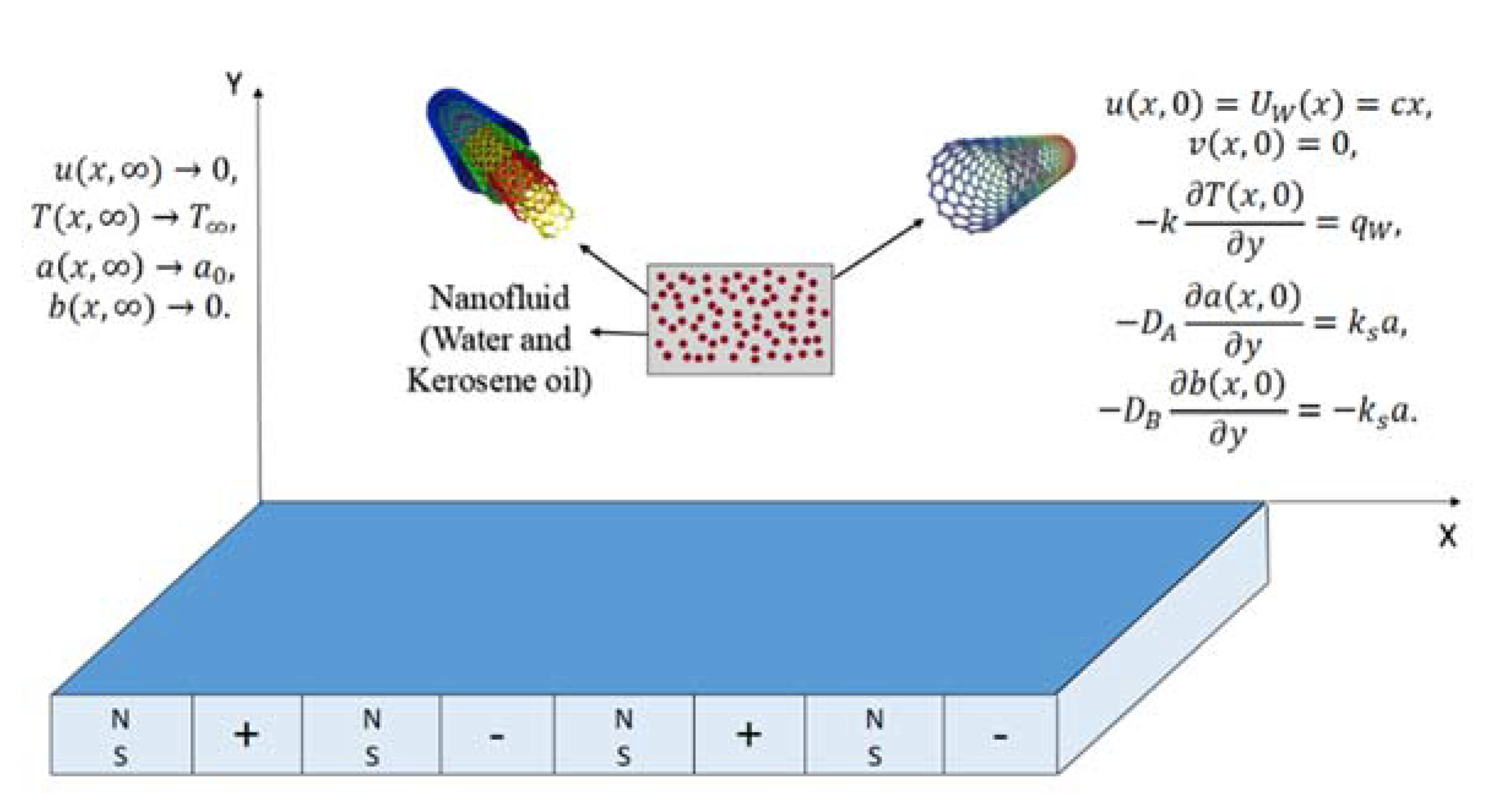
Let us deal with the nanofluidic fluid that is actuated due to the Riga plate (see Figure 1). The flow is passing through both single- and multi-walled carbon nanotubes, and the base fluid is chosen to be kerosene oil and water. The Riga plate is fixed in the direction of the x-coordinate, while the -coordinate remains perpendicular to the plate. The
element of viscous dissipation effects the system. For modifications in the
mass transfer rates, homogenous–heterogeneous reactions are taken into
consideration
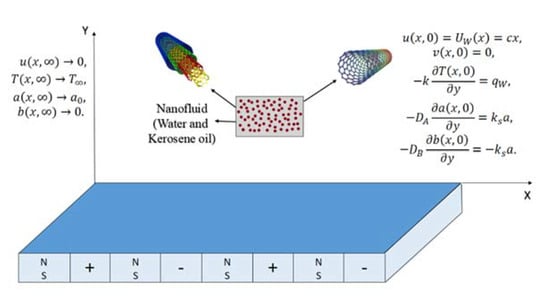
Figure 1.
Schematic diagram.
For homogeneous reactions, the isothermal cubic
autocatalysis is specified as:
at the same time, a single first-order isothermal
(heterogeneous) reaction occurring on the catalyst surface is recorded in the
following way:
The above expressions relate the homogeneous reactions with the heterogeneous reactions taking place in a boundary-layer flow. In these isothermal reactions, which exist far away from the plate, reactant possesses a consistent concentration in the absence of auto-catalyst in the external flow.
To proceed towards the construction of the problem, the system of equations is organized as:
In the above designed equations, , , and are noted as the velocity components along the , , and directions, respectively, symbolizes nanofluidic kinematic viscosity, is the Stefan Boltzmann constant, is the mean absorption constant, is the thermal conductivity of nanofluid, is the current density within electrodes, is the magnetization due to permanent magnets, indicates the width of the electrodes and magnets,
represents nanofluid density, is the thermal diffusivity of nanofluid, specifies the dynamic viscosity of the nanofluid, stands for the heat capacitance of the nanofluid, and are the concentrations of the chemical species
recognized as and , and indicate the respective diffusion coefficients
corresponding to the species and , and represent rate constants, is temperature of fluid, denotes ambient temperature and is the uniform concentration.
The earlier models of nanofluid were developed for rotational elliptical or spherical particles with small axial ratios, and these nanofluidic models fail to elaborate the space distribution characteristics regarding carbon nanotubes, as these nanotubes possess large axial ratios. This issue was resolved by introducing theoretical models for CNTs with large axial ratios. The significant properties of CNTs can be indicated through the characteristics of the base fluid and carbon nanotubes; furthermore, the solid carbon nanotube volume friction of the base fluid is displayed as:
where is nanoparticle volume fraction, and denote the thermal conductivities of the fluid
and the carbon nanotubes, and and characterize the densities of the fluid and
carbon nanotubes, respectively.
The transformations specified for this flow are:
The continuity equation is identically satisfied while Equations (2)–(5) transform as
where is the porous medium parameter, is the modified Hartman number, is the dimensionless parameter, is the Prandtl number, is the Eckert number, is the thermal radiation parameter, is the ratio of diffusion coefficients, is the Schmidt number, and and denote the measure of homogenous and heterogeneous reaction strength, respectively. The non-dimensionalized parameters are determined to be
The consideration that both chemical species and have diffusion coefficients with comparable sizes
implies the equivalence of the diffusion coefficients and , suggesting that . Thus, an important relation between and can be written as (Chaudhary and Merkin [32])
Accordingly, Equations (12) and (13) reduce to
which are then subjected to the following boundary conditions
Skin friction coefficient and local Nusselt number are characterized as:
with the wall shear stress and the wall heat flux given as
The dimensionless forms of these quantities are presented to be:
where stands for the local Reynolds number.
3. Solution Methodology
In the present analysis, the solution is achieved by implementing the shooting method approach. This technique assists in solving Equations (10), (11), and (17), along with the associated boundary conditions presented in (14) and (18). Proceeding with this method, the higher order equations in , and are transformed into new ODEs,
under the boundary conditions,
Next, initial guesses are made for the boundary conditions for , and
4. Discussion
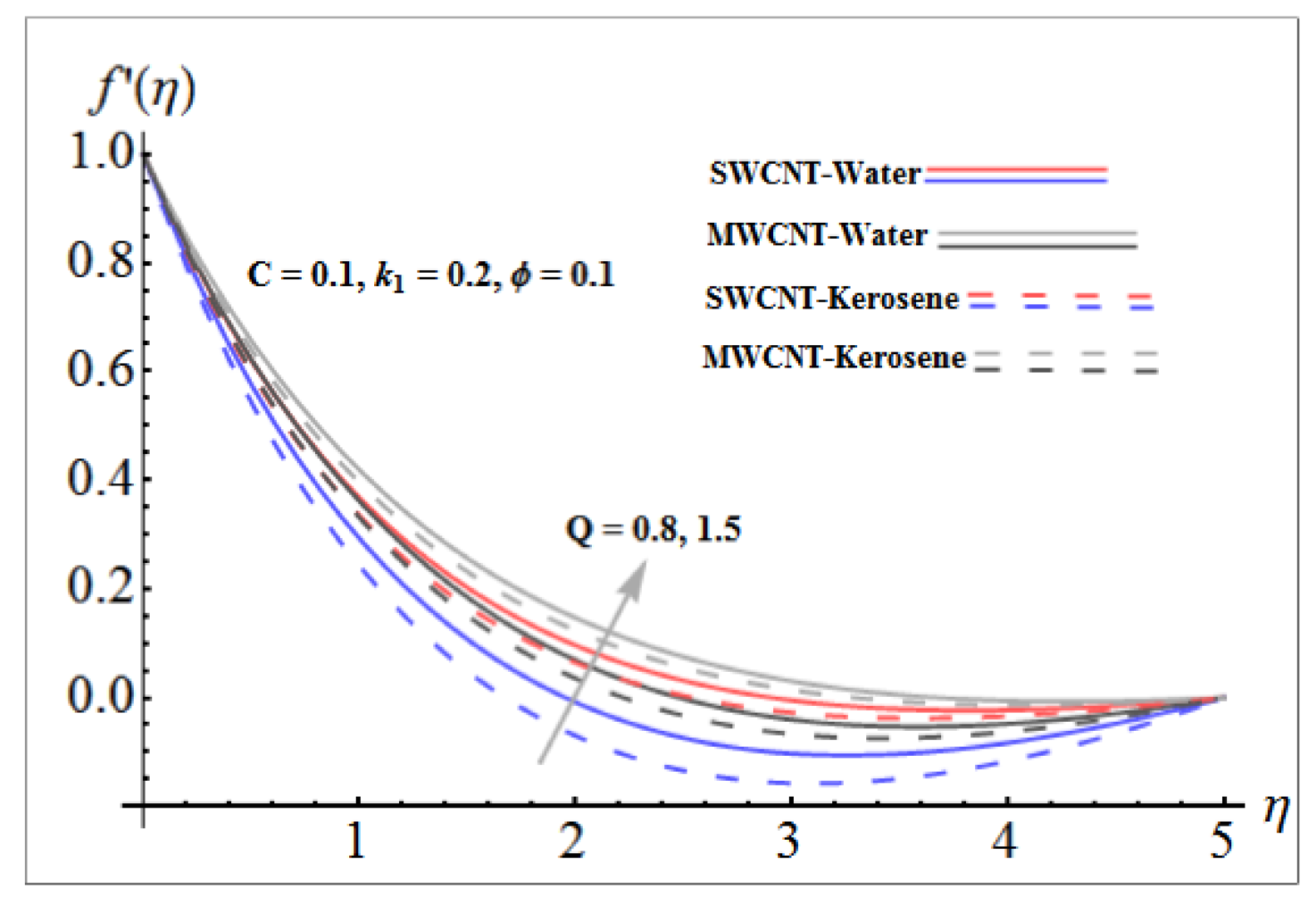
The occurrence of stretching surfaces in order to describe the boundary-layer phenomenon is one of the unique aspects that has enabled us to understand the performance of various physical parameters of nanofluids. Results have characteristically provided the evidence that variations in different parameters linked with the assumptions of the problem influence the velocity, temperature, and concentration profiles. Figure 2 reveals the behavior of the modified Hartmann number on the velocity profile corresponding to the cases
of both SWCNTs and MWCNTs, considering water and kerosene oil as base fluids. An
increase of the modified Hartmann number intensifies the velocity profile. This
is due to Lorentz force (surface parallel), which supports the flow in the
positive x-direction. Additionally, the velocity distribution for carbon–water
nanofluid dominates when compared with carbon–kerosene oil for both nanotubes cases.
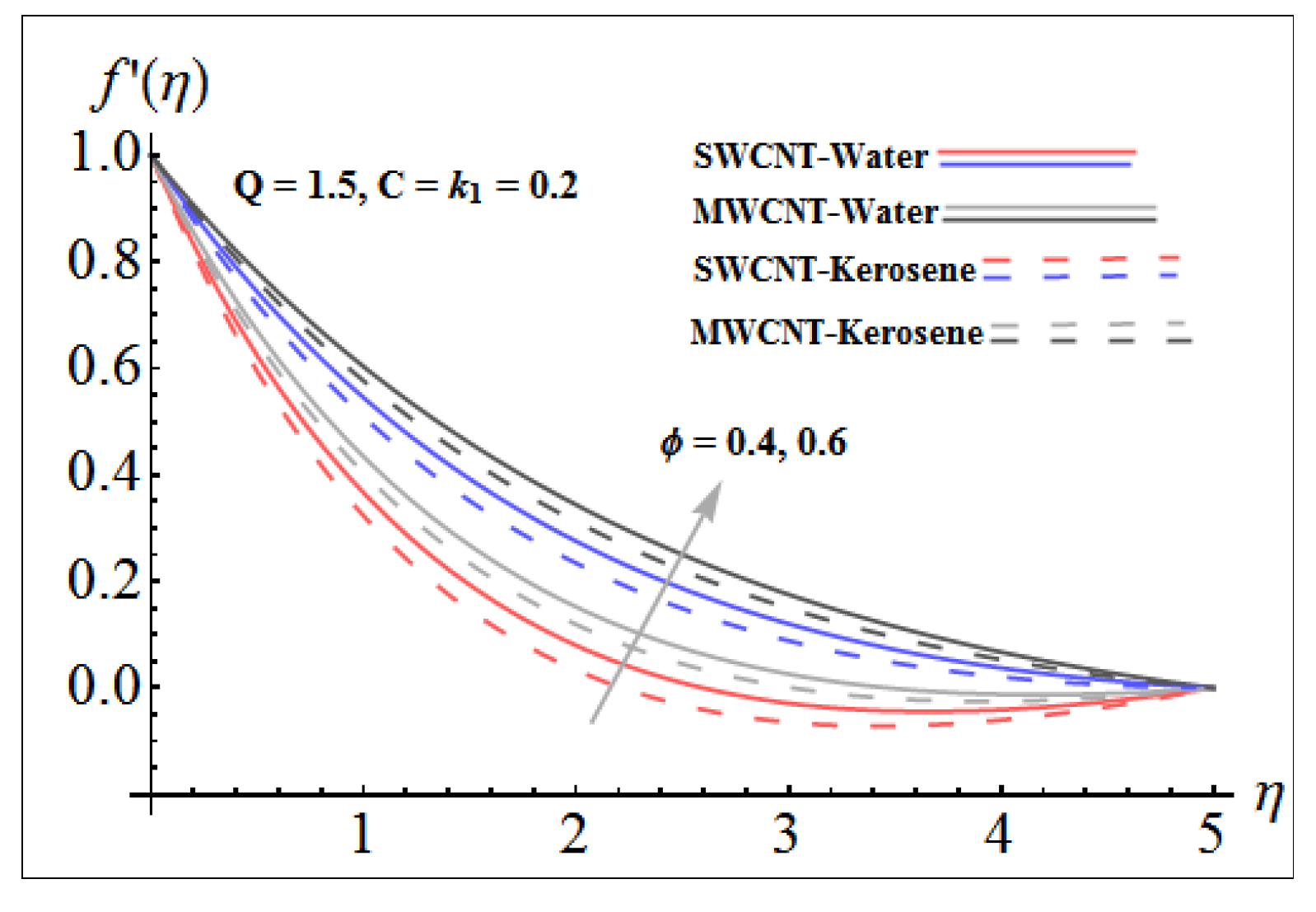
Figure 3 gives the illustration of the
nanoparticle volume fraction parameter behavior for the velocity profile. The plot
confirms that an increased nanoparticle volume fraction parameter raises the
velocity profile. In this fig., it is evident that the velocity profile in the
case of carbon–kerosene oil diminishes if compared with carbon–water nanofluid
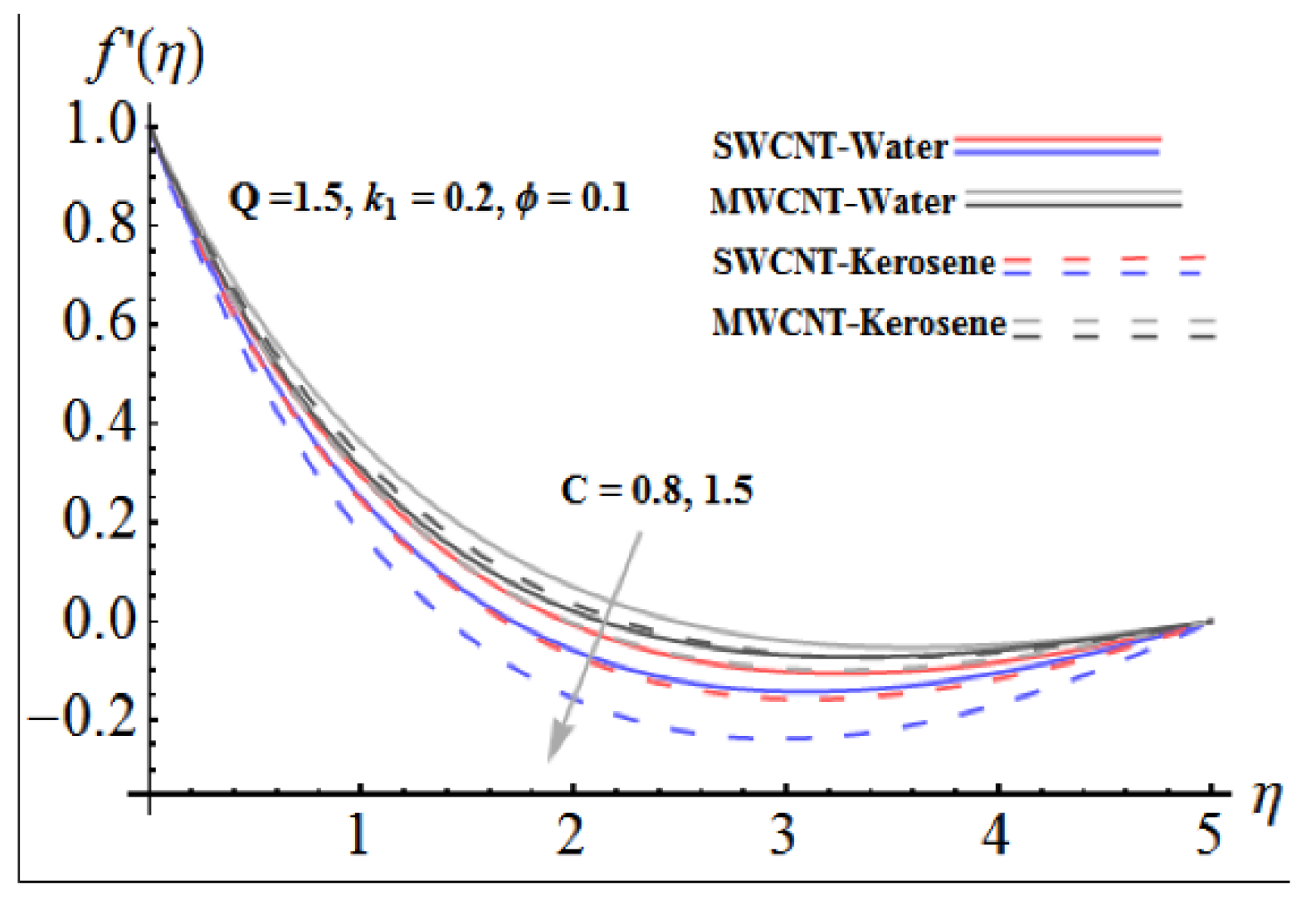
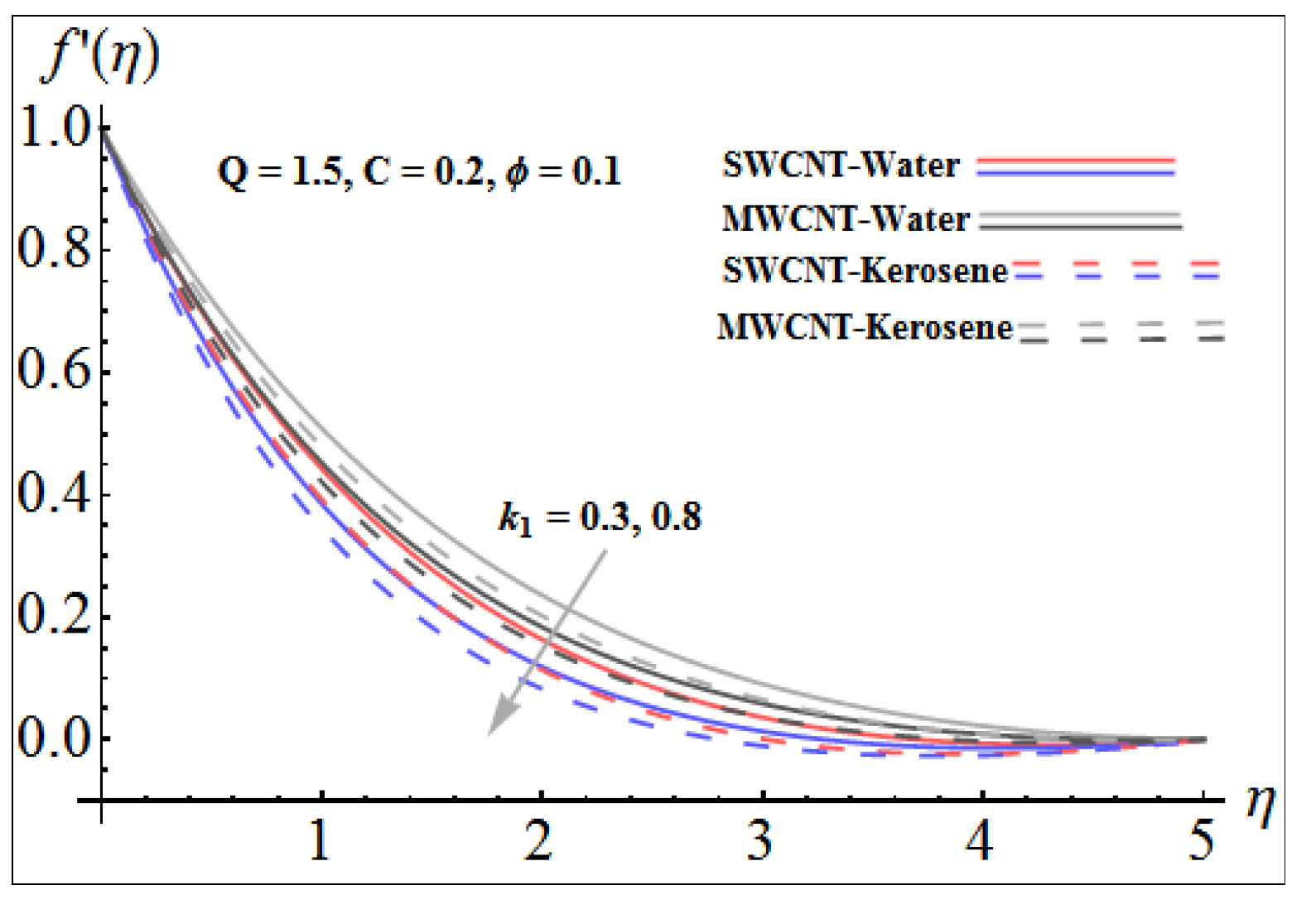
for both carbon nanotubes. Figure 4
depicts the influential behavior of dimensionless parameter for the velocity profile in the cases of carbon–water
and carbon–kerosene oil nanofluids. The dimensionless parameter causes the
reduction of the velocity profile. Figure 5
shows the characteristics of the porous medium parameter on the velocity profile for both considered carbon
nanofluids. The figure shows that the elevated values of the porous medium
parameter correspond to the smaller values of the velocity profile. The porous
medium induces resistance to the flow, which eventually causes the decay in
velocity profile. The carbon–water nanofluid shows an increasing behavior
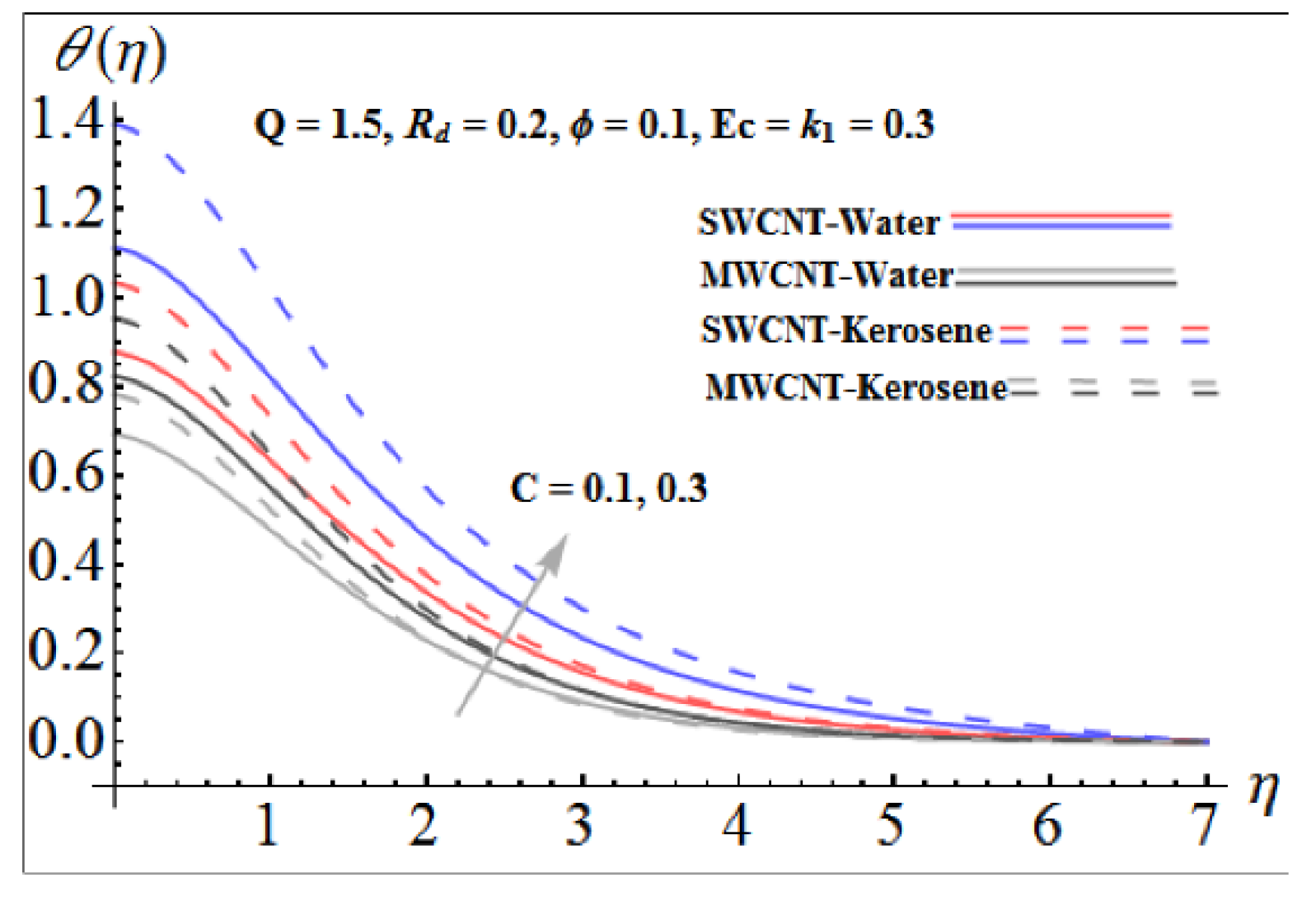
compared with carbon–kerosene oil for velocity distribution. Figure 6 specifies the action of the
dimensionless parameter on temperature profile. Increased values of the dimensionless
parameter are associated with an increase in temperature profile. The
temperature distribution for carbon–kerosene oil has a superior enhancing
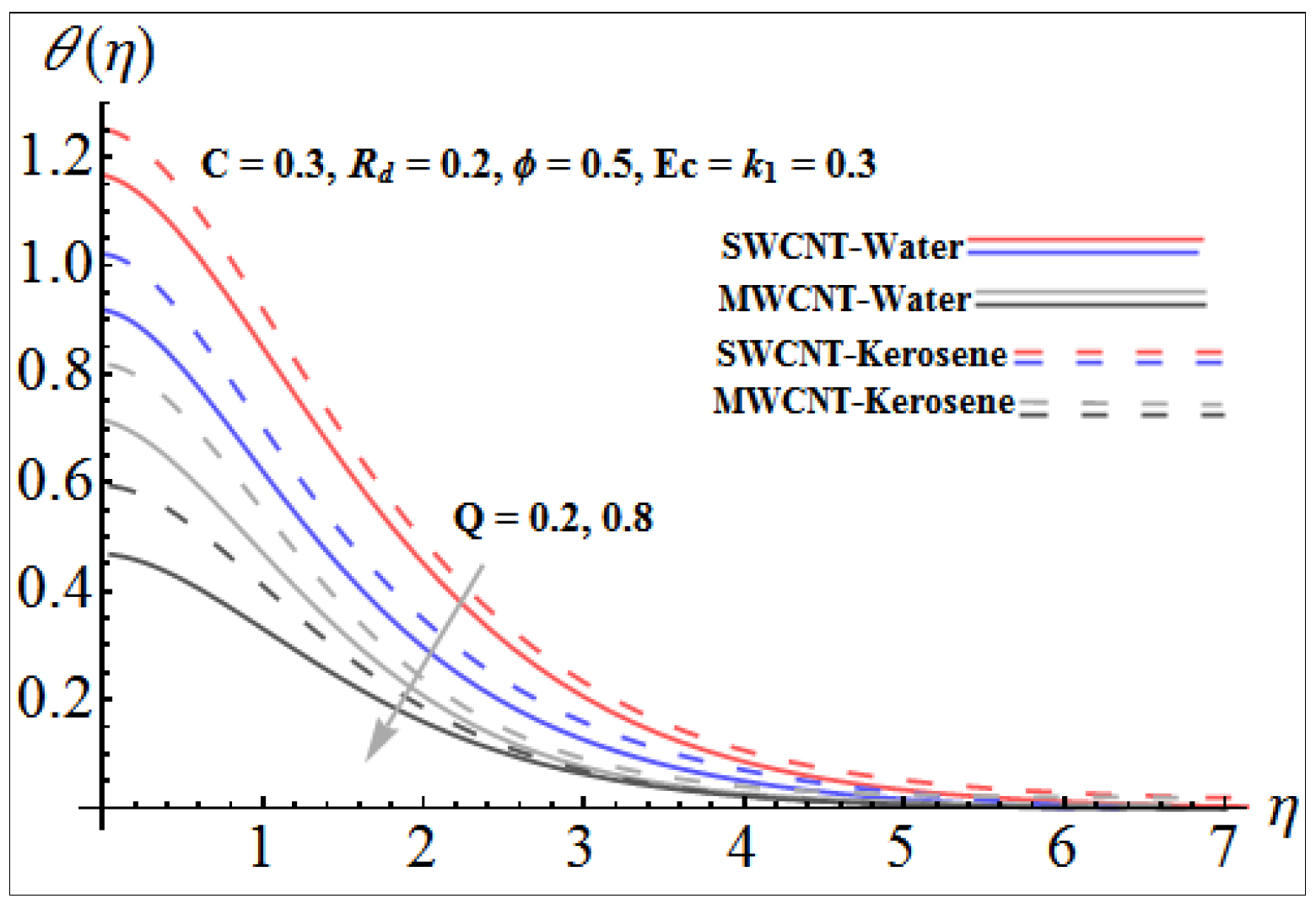
effect than the carbon–water nanofluid (considering both SWCNTs and MWCNTs). Figure 7 displays the behavior of the modified
Hartmann number on temperature profile. Higher values of the modified
Hartmann number are accompanied with a decline of temperature profile, while
temperature distribution for carbon–kerosene oil nanofluid dominates for both
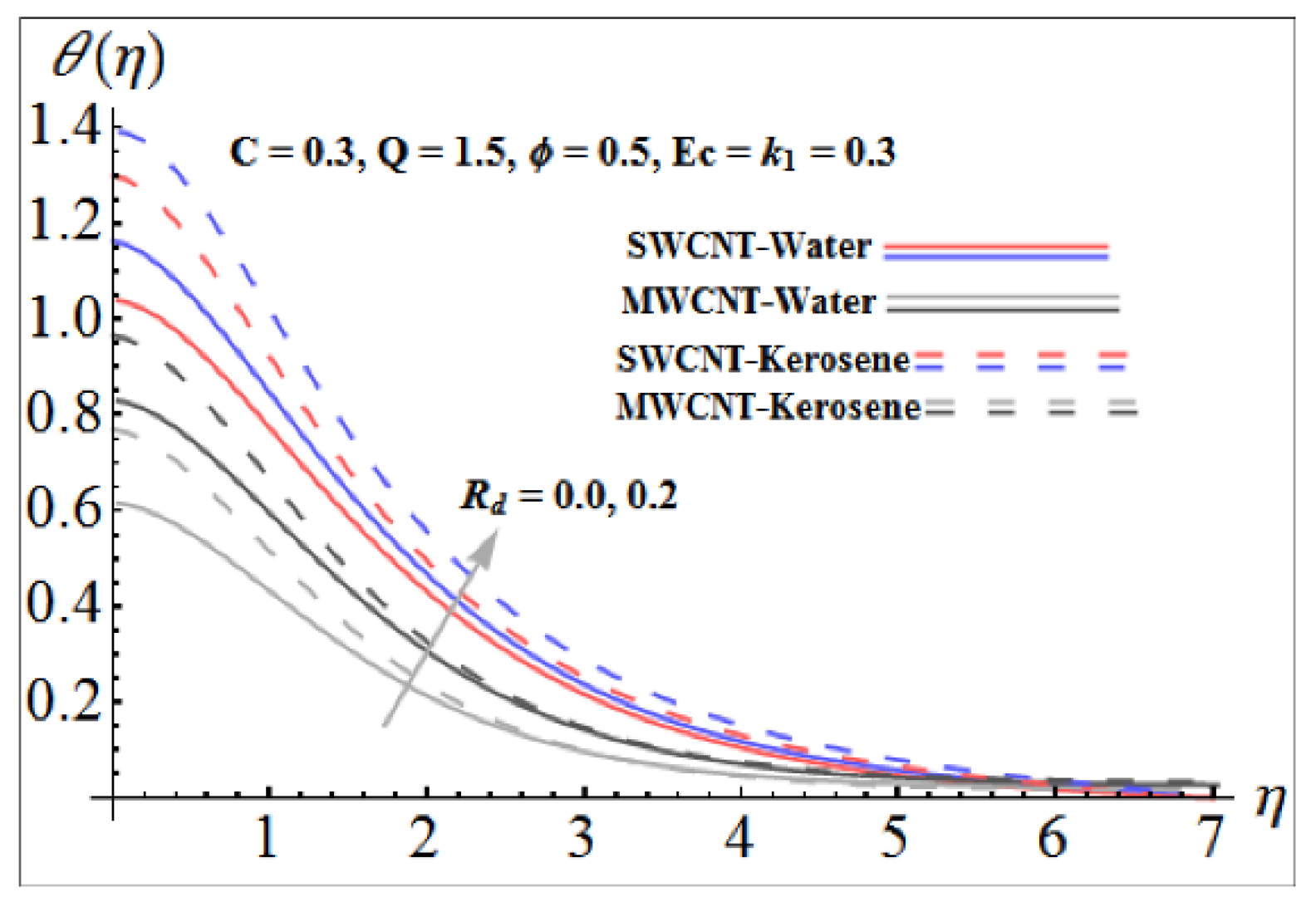
SWCNTs and MWCNTs compared with carbon–water nanofluids. Figure 8 shows the study of the thermal
radiation parameter on the temperature profile for carbon–water, as
well as carbon–kerosene oil nanofluids. The amplification of temperature
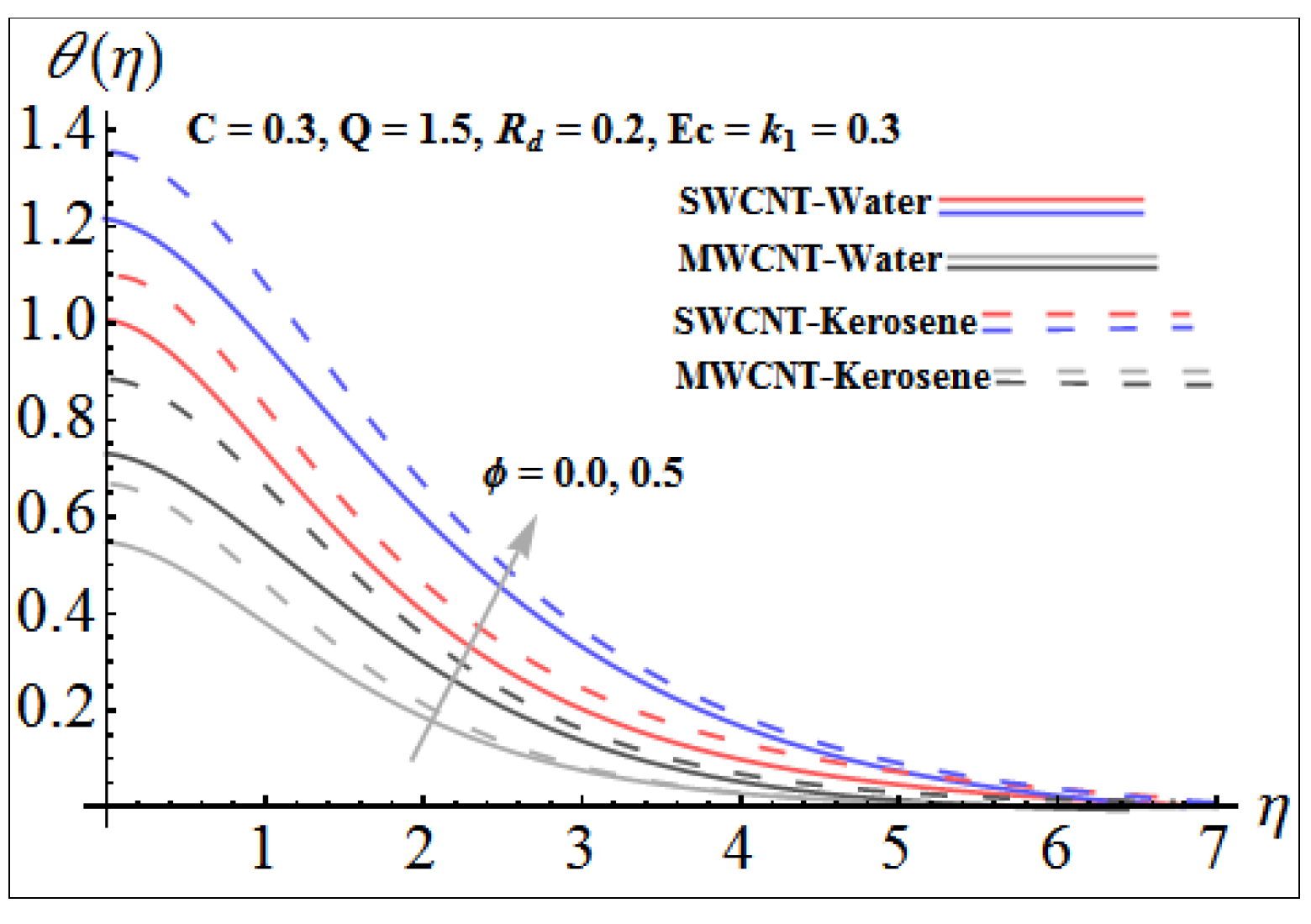
profile is seen when the thermal radiation parameter enhances. Figure 9 exhibits the behavior of the nanoparticle
volume fraction parameter corresponding to temperature profile, and the
results also take carbon–water and carbon–kerosene oil nanofluids into account.
With the increase of the nanoparticle volume fraction parameter, the temperature
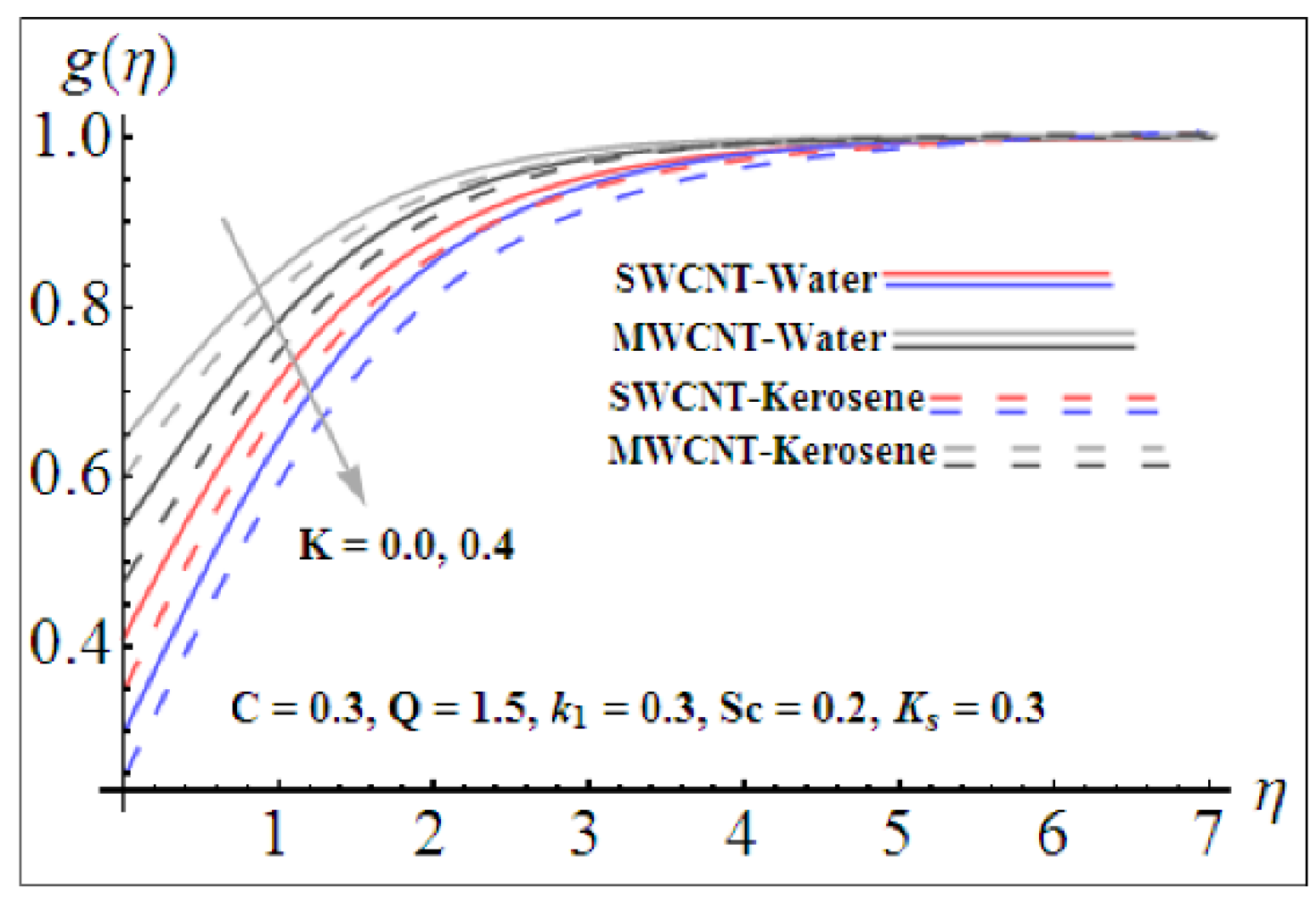
profile expands. Figure 10 shows the
strength of the homogeneous parameter on concentration profile when carbon–water and
carbon–kerosene oil nanofluids are under study. Larger values of the homogeneous
parameter are associated with a decay in concentration profile. The
concentration distribution of carbon–water nanofluid displays an increasing
behavior when compared with carbon–kerosene oil nanofluid for both carbon
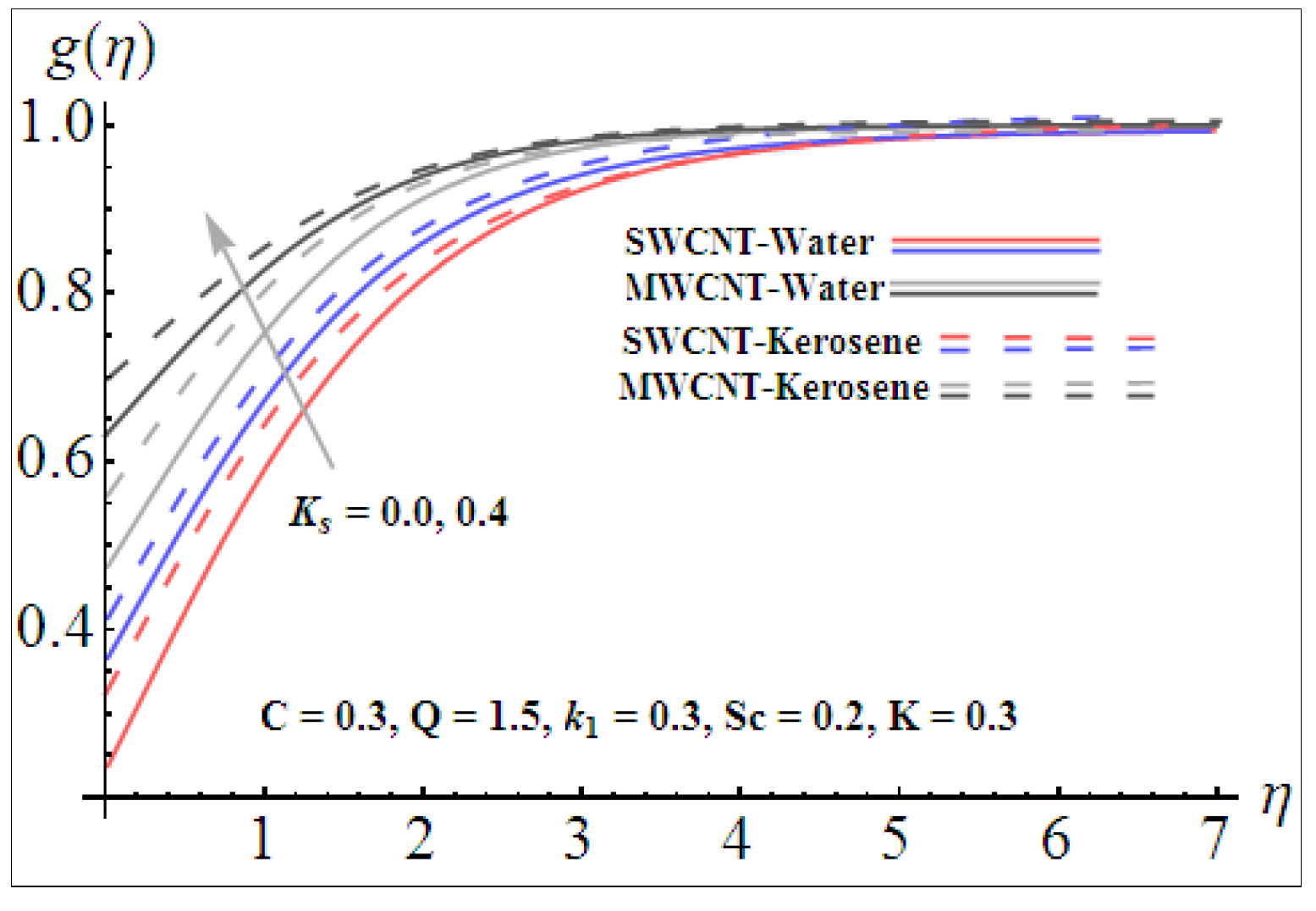
nanotubes. Figure 11 indicates the
strength of heterogeneous parameter for the concentration profile, which rises for
advanced values of Enhanced concentration profiles for carbon–kerosene
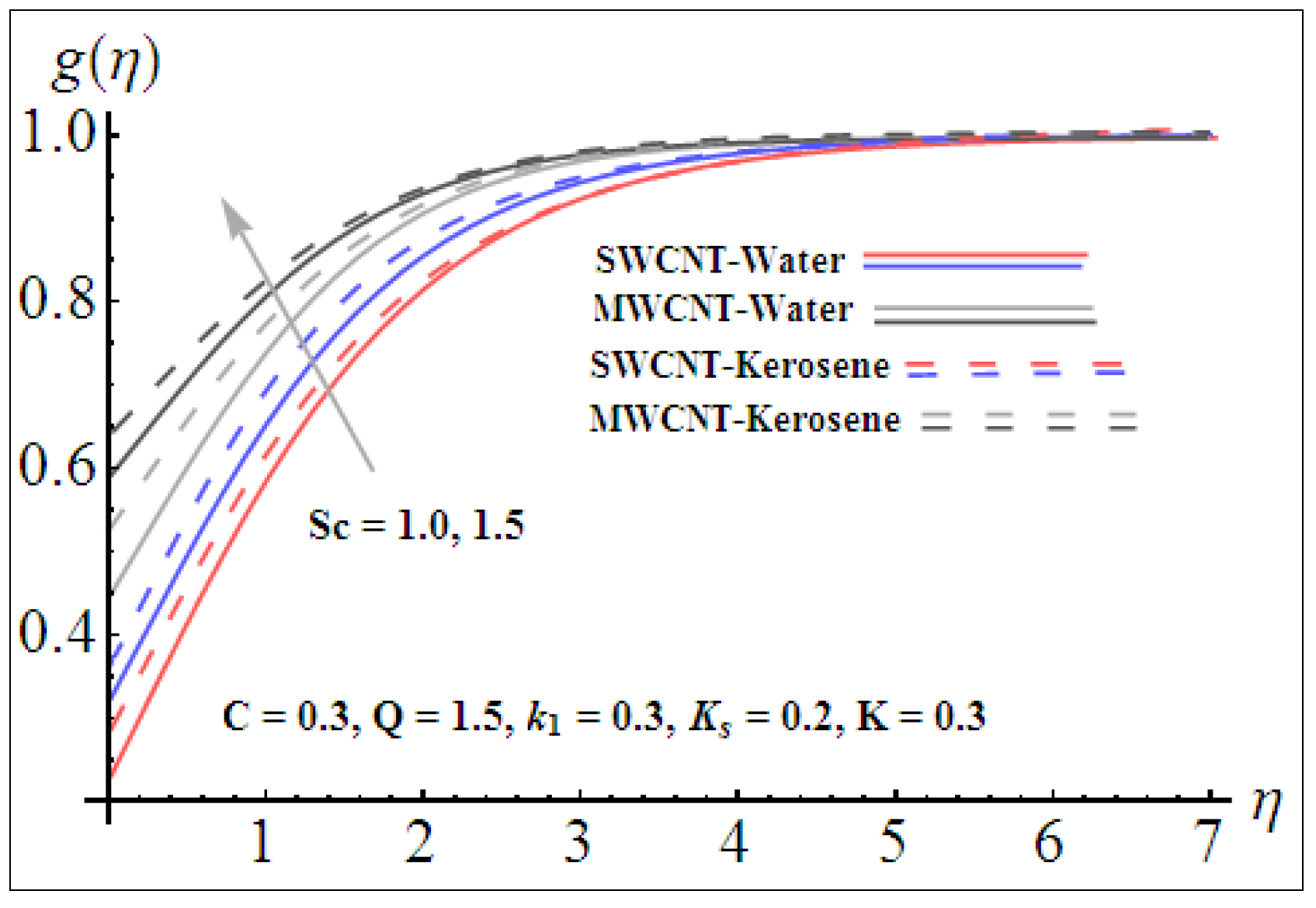
oil nanofluid are noticed when compared with carbon–water nanofluid. Figure 12 shows the outcome of the Schmidt
number on the concentration profile. By increasing the Schmidt
number, the increasing behavior of the concentration profile is detected. The Schmidt
number is interpreted to be the ratio of momentum to mass diffusivity;
therefore an enhanced Schmidt number results in a decrease of mass diffusivity,
which in turn triggers the concentration profile.
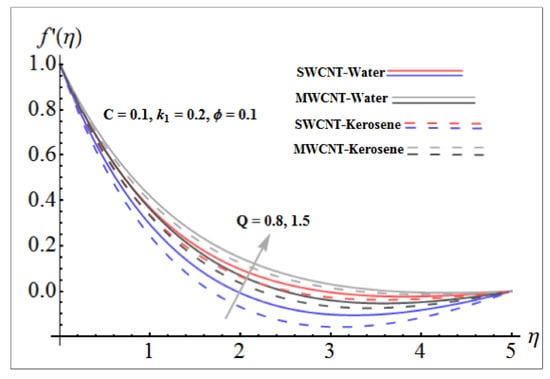
Figure 2.
Behavior of f′(η) for increased values of Q.
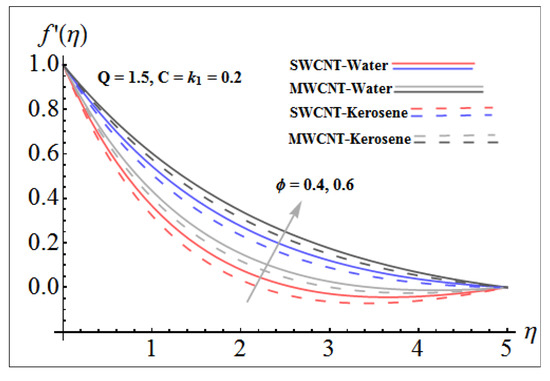
Figure 3.
Behavior of f′(η) for increased values of ϕ.
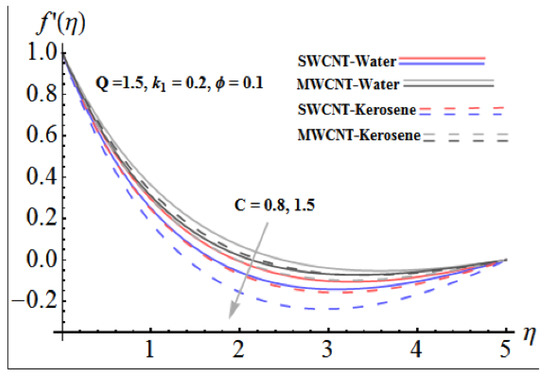
Figure 4.
Behavior of f′(η) for increased values of C.
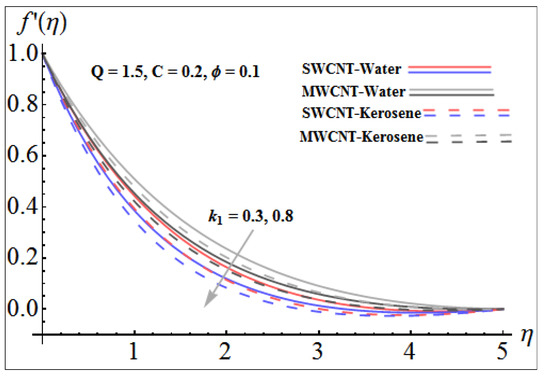
Figure 5.
Behavior of f′(η) for increased values of
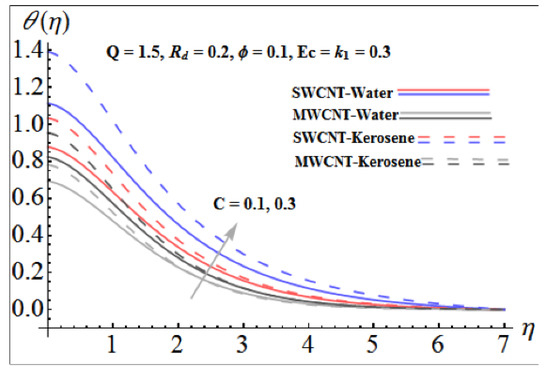
Figure 6.
Behavior of θ(η) for increased values of C.
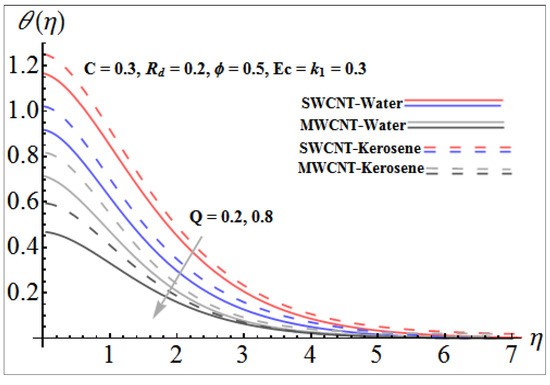
Figure 7.
Behavior of θ(η) for increased values of Q.
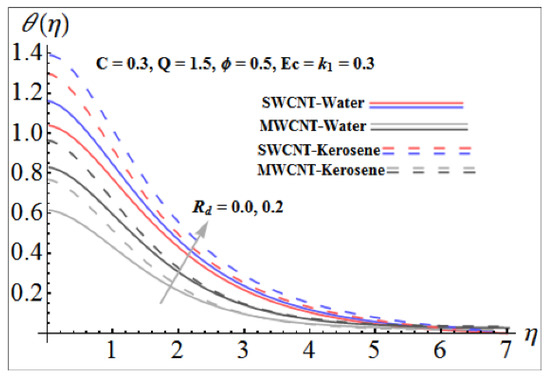
Figure 8.
Behavior of θ(η) for increased values of
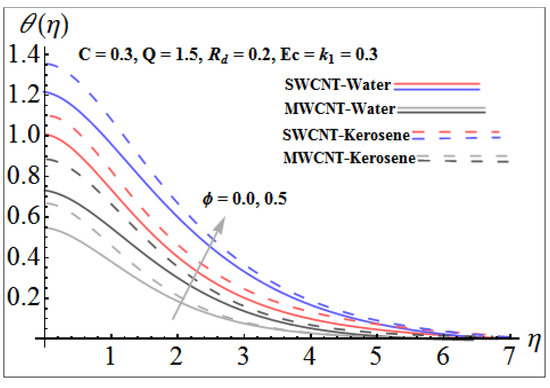
Figure 9.
Behavior of θ(η) for increased values of ϕ.
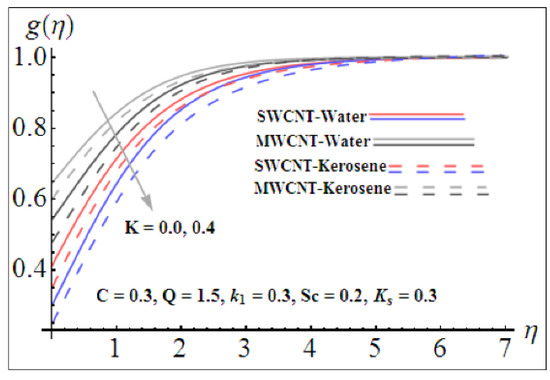
Figure 10.
Behavior of g(η) for increased values of K.
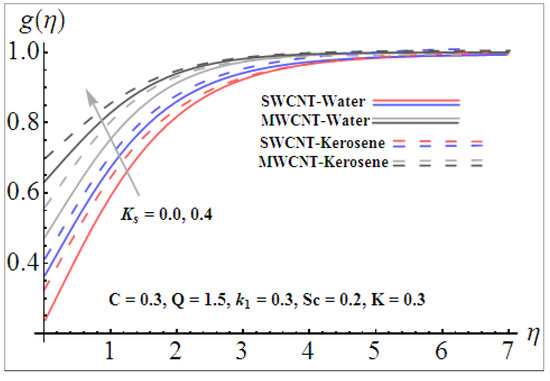
Figure 11.
Behavior of g(η) for increased values of
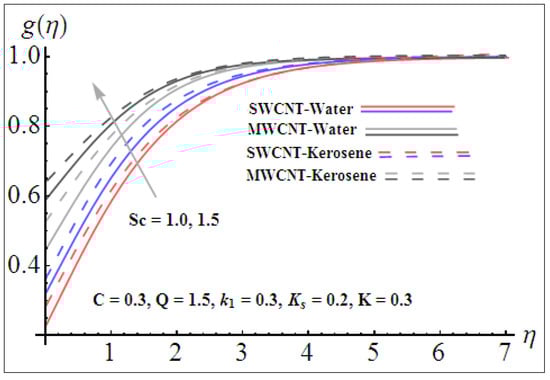
Figure 12.
Behavior of g(η) for increased values of Sc.
Table 1 shows the thermophysical properties (density, specific heat capacity, and thermal conductivity) of base fluid (water and kerosene oil) and carbon nanotubes. Table 2 specifies the impact of physical parameters on the skin friction coefficient for SWCNT–water, SWCNT–kerosene, MWCNT–water, and MWCNT–kerosene. The attained result highlights that the magnitude of the skin friction coefficient increases as , and increase for SWCNT–water, SWCNT–kerosene, MWCNT–water,
and MWCNT–kerosene. The skin friction coefficient is larger for SWCNTs when
compared with MWCNTs. Table 3 explores
the trend of notable parameters for the Nusselt number. Larger and result in an enhancement of the magnitude of the Nusselt
number for SWCNT–water, SWCNT–kerosene, MWCNT–water, and MWCNT–kerosene and a decrease
when the , and increase. The Nusselt number is higher for SWCNTs
for , and .

Table 1.
Thermophysical features of base fluid and nanoparticles (SWCNT and MWCNT) [41].
Table 2.
Numerical values of various parameters for skin friction coefficient.
Table 3.
Numerical values of various parameters for Nusselt number.
5. Closing Remarks
This study deals with fluid flow in carbon nanotubes along a stretchable Riga surface with the existence of homogeneous–heterogeneous reactions. Our notable observations are compiled as follows:
- The obtained results for SWCNT and MWCNT signify that flow acceleration depends on larger values of the modified Hartmann number and the nanoparticles volume fraction parameter ;
- We observed a considerable degree of resistance during flow when the values of the porous medium parameter are increased. We noticed the decreasing effect of the dimensionless parameter on the velocity profile in both types of carbon nanotubes;
- Single-walled carbon nanotubes possess a higher temperature distribution in comparison with multi-wall carbon nanotubes in cases of nanoparticles volume fraction , modified Hartmann number , dimensionless parameter , and thermal radiation parameter . This discovery can assist engineers in the thermal management of different devices;
- The concentration distribution experiences a reducing effect when the strength of the homogeneous parameter increases;
- With the ascent of heterogeneous parameter strength and Schmidt number , the concentration profiles increase for SWCNT and MWCNT. The increase in is related to the increase in the fluid’s kinematic viscosity;
- The skin friction coefficient increase causes additional sheer stress for all the elevated values of the significant parameters, while in case of the Nusselt number, an enhancing behavior is presented only for and , which are ultimately responsible for increased flow convection rates.
Author Contributions
Methodology and investigation, A.N. and A.S.; formal analysis, A.N., A.S., F.N. and M.U.F.; writing—original draft, A.N.; editing, A.S., F.N. and M.U.F. All authors have read and agreed to the published version of the manuscript.
Funding
This research received no external funding.
Institutional Review Board Statement
Not applicable.
Informed Consent Statement
Not applicable.
Data Availability Statement
Not applicable.
Conflicts of Interest
The authors declare no conflict of interest.
References
- Iijima, S. Helical microtubules of graphitic carbon. Nature 1991, 354, 56–58. [Google Scholar] [CrossRef]
- Younes, H.; Christensen, G.; Li, D.; Hong, H.; Ghaferi, G.G. Thermal conductivity of nanofluids. J. Nanofluids. 2015, 4, 107–132. [Google Scholar] [CrossRef]
- Valipour, P.; Moradi, R.; Aski, F.S. CNT-water nanofluid thermal radiation heat transfer over a stretching sheet considering heat generation. J. Mol. Liq. 2017, 237, 242–246. [Google Scholar] [CrossRef]
- Sadiq, M.A.; Haider, F.; Hayat, T.; Alsaedi, A. Partial slip in Darcy-Forchheimer carbon nanotubes flow by rotating disk. Int. Commun. Heat Mass Transf. 2020, 116, 104641. [Google Scholar] [CrossRef]
- Anuar, N.S.; Bachok, N.; Arifin, N.; Rosali, H. Role of multiple solutions in flow of nanofluids with carbon nanotubes over a vertical permeable moving plate. Alex. Eng. J. 2020, 59, 763–773. [Google Scholar] [CrossRef]
- Ahmad, F.; Abdal, S.; Ayed, H.; Hussain, S.; Salim, S.; Almatroud, A.O. The improved thermal efficiency of Maxwell hybrid nanofluid comprising of graphene oxide plus silver / kerosene oil over stretching sheet. Case Stud. Therm. Eng. 2021, 27, 101257. [Google Scholar] [CrossRef]
- Li, D.; Mahmoud, M.Z.; Suksatan, W.; Kuznetsova, M.; Abed, A.M.; Hekmatifar, M.; Toghraie, D.; Sabetvand, R. Thermal behavior of water base-fluid in the presence of graphene nanosheets and carbon nanotubes: A molecular dynamics simulation. Case Stud. Therm. Eng. 2021, 28, 101669. [Google Scholar] [CrossRef]
- Noranuar, W.N.N.; Mohamad, A.Q.; Shafie, S.; Khan, I.; Jiann, L.Y.; Ilias, M.R. Non-coaxial rotation flow of MHD Casson nanofluid carbon nanotubes past a moving disk with porosity effect. Ain Shams Eng. J. 2021, 12, 4099–4110. [Google Scholar] [CrossRef]
- Reddy, M.G.; Kumar, K.G. Cattaneo-Christov heat flux feature on carbon nanotubes filled with micropolar liquid over a melting surface: A stream line study. Int. Commun. Heat Mass Transf. 2021, 122, 105142. [Google Scholar] [CrossRef]
- Mahmoudpour, E.; Esmaeili, M. Nonlinear free and forced vibration of carbon nanotubes conveying magnetic nanoflow and subjected to a longitudinal magnetic field using stress-driven nonlocal integral model. Thin-Walled Struct. 2021, 166, 108134. [Google Scholar] [CrossRef]
- Ganesh, N.V.; Al-Mdallal, Q.M.; Öztop, H.F.; Kalaivanan, R. Analysis of natural convection for a Casson-based multiwall carbon nanotube nanofluid in a partially heated wavy enclosure with a circular obstacle in the presence of thermal radiation. J. Adv. Res. 2022, 39, 167–185. [Google Scholar] [CrossRef] [PubMed]
- Alzahrani, F.; Khan, M.I. Analysis of Wu’s slip and CNTs (single and multi-wall carbon nanotubes) in Darcy-Forchheimer mixed convective nanofluid flow with magnetic dipole: Intelligent nano-coating simulation. Mater. Sci. Eng. B 2022, 277, 115586. [Google Scholar] [CrossRef]
- Yinusa, A.; Sobamowo, M.; Adelaja, A. Thermal analysis of nanofluidic flow through multi-walled carbon nanotubes subjected to perfectly and imperfectly bonded wall conditions. Chem. Thermodyn. Therm. Anal. 2022, 5, 100028. [Google Scholar] [CrossRef]
- Zubair, G.; Shoaib, M.; Khan, M.I.; Naz, I.; Althobaiti, A.; Raja, M.A.Z.; Jameel, M.; Galal, A.M. Intelligent supervised learning for viscous fluid submerged in water based carbon nanotubes with irreversibility concept. Int. Commun. Heat Mass Transf. 2022, 130, 105790. [Google Scholar] [CrossRef]
- Younes, H.; Mao, M.; Murshed, S.S.; Lou, D.; Hong, H.; Peterson, G. Nanofluids: Key parameters to enhance thermal conductivity and its applications. Appl. Therm. Eng. 2022, 207, 118202. [Google Scholar] [CrossRef]
- Azam, M.; Abbas, N.; Kumar, K.G.; Wali, S. Transient bioconvection and activation energy impacts on Casson nanofluid with gyrotactic microorganisms and nonlinear radiation. Waves Random Complex Media 2022, 1–20. [Google Scholar] [CrossRef]
- Azam, M.; Mabood, F.; Khan, M. Bioconvection and activation energy dynamisms on radiative sutterby melting nanomaterial with gyrotactic microorganism. Case Stud. Therm. Eng. 2021, 30, 101749. [Google Scholar] [CrossRef]
- Azam, M. Bioconvection and nonlinear thermal extrusion in development of chemically reactive sutterby nano-material due to gyrotactic microorganisms. Int. Commun. Heat Mass Transf. 2022, 130, 105820. [Google Scholar] [CrossRef]
- Azam, M. Effects of Cattaneo-Christov heat flux and nonlinear thermal radiation on MHD Maxwell nanofluid with Arrhenius activation energy. Case Stud. Therm. Eng. 2022, 34, 102048. [Google Scholar] [CrossRef]
- Sahu, S.K.; Shaw, S.; Thatoi, D.N.; Azam, M.; Nayak, M.K. Darcy-Forchheimer flow behavior and thermal inferences with SWCNT/MWCNT suspensions due to shrinking rotating disk*. Waves Random Complex Media 2022, 1–29. [Google Scholar] [CrossRef]
- Gailitis, A.; Lielausis, O. On a possibility to reduce the hydrodynamic resistance of a plate in an electrolyte. Appl. Magnetohydrodyn Rep. Phys. Inst. 1961, 12, 143–146. [Google Scholar]
- Pantokratoras, A.; Magyari, E. EMHD free-convection boundary-layer flow from a Riga-plate. J. Eng. Math. 2009, 64, 303–315. [Google Scholar] [CrossRef]
- Pantokratoras, A. The Blasius and Sakiadis flow along a riga-plate. Prog. Comput. Fluid Dyn. An Int. J. 2011, 11, 329–333. [Google Scholar] [CrossRef]
- Mallawi, F.; Bhuvaneswari, M.; Sivasankaran, S.; Eswaramoorthi, S. Impact of double-stratification on convective flow of a non-Newtonian liquid in a Riga plate with Cattaneo-Christov double-flux and thermal radiation. Ain Shams Eng. J. 2021, 12, 969–981. [Google Scholar] [CrossRef]
- Nayak, M.K.; Mehmood, R.; Muhammad, T.; Khan, A.U.; Waqas, H. Entropy minimization in mixed convective Falkner-Skan flow of ZnO-SAE50 nanolubricant over stationary/moving Riga plate. Case Stud. Therm. Eng. 2021, 26, 101176. [Google Scholar] [CrossRef]
- Abdal, S.; Siddique, I.; Alshomrani, A.S.; Jarad, F.; Din, I.S.U.; Afzal, S. Significance of chemical reaction with activation energy for Riga wedge flow of tangent hyperbolic nanofluid in existence of heat source. Case Stud. Therm. Eng. 2021, 28, 101542. [Google Scholar] [CrossRef]
- Li, Y.-X.; Shah, F.; Khan, M.I.; Chinram, R.; Elmasry, Y.; Sun, T.-C. Dynamics of Cattaneo-Christov Double Diffusion (CCDD) and arrhenius activation law on mixed convective flow towards a stretched Riga device. Chaos, Solitons Fractals 2021, 148, 111010. [Google Scholar] [CrossRef]
- Shah, F.; Hayat, T.; Alsaedi, A. Entropy optimization in a fourth grade nanofluid flow over a stretchable Riga wall with thermal radiation and viscous dissipation. Int. Commun. Heat Mass Transf. 2021, 127, 105398. [Google Scholar] [CrossRef]
- Khan, S.A.; Hayat, T.; Alsaedi, A. Melting heat in entropy optimized flow of third grade nanomaterials with radiation by a Riga plate. J. Energy Storage 2022, 45, 103713. [Google Scholar] [CrossRef]
- Asogwa, K.K.; Alsulami, M.D.; Prasannakumara, B.C.; Muhammad, T. Double diffusive convection and cross diffusion effects on Casson fluid over a Lorentz force driven Riga plate in a porous medium with heat sink: An analytical approach. Int. Commun. Heat Mass Transf. 2022, 131, 105761. [Google Scholar] [CrossRef]
- Madhukesh, J.; Ramesh, G.; Aly, E.H.; Chamkha, A.J. Dynamics of water conveying SWCNT nanoparticles and swimming microorganisms over a Riga plate subject to heat source/sink. Alex. Eng. J. 2022, 61, 2418–2429. [Google Scholar] [CrossRef]
- Chaudhary, M.A.; Merkin, J.H. A simple isothermal model for homogeneous heterogenous reactions in boundary-layer flow I. Equal diffusivities. Fluid Dyn. Res. 1995, 16, 311–333. [Google Scholar] [CrossRef]
- Chaudhary, M.A.; Merkin, J.H. A simple isothermal model for homogeneous heterogenous reactions in boundary-layer flow II. Unequal diffusivities. Fluid Dyn. Res. 1995, 16, 335–359. [Google Scholar] [CrossRef]
- Merkin, J. A model for isothermal homogeneous-heterogeneous reactions in boundary-layer flow. Math. Comput. Model. 1996, 24, 125–136. [Google Scholar] [CrossRef]
- Hayat, T.; Masood, F.; Qayyum, S.; Alsaedi, A. Sutterby fluid flow subject to homogeneous–heterogeneous reactions and nonlinear radiation. Phys. A Stat. Mech. Appl. 2020, 544, 123439. [Google Scholar] [CrossRef]
- Waqas, H.; Khan, S.U.; Khan, M.I.; Alzahrani, F.; Qayyum, S. Study of homogeneous--heterogeneous reactions in bioconvection stagnation pointslip flow of Walter’s-B nanofluid with nonlinear thermal radiation and activation energy. Int. Commun. Heat Mass Transf. 2021, 129, 105729. [Google Scholar] [CrossRef]
- Li, Y.-X.; Qayyum, S.; Khan, M.I.; Elmasry, Y.; Chu, Y.-M. Motion of hybrid nanofluid (MnZnFe2O4−NiZnFe2O4−H2O) with homogeneous-heterogeneous reaction: Marangoni convection. Math. Comput. Simul. 2021, 190, 1379–1391. [Google Scholar] [CrossRef]
- Eid, M.R.; Mahny, K.; Al-Hossainy, A.F. Homogeneous-heterogeneous catalysis on electromagnetic radiative Prandtl fluid flow: Darcy-Forchheimer substance scheme. Surf. Interfaces 2021, 24, 101119. [Google Scholar] [CrossRef]
- Pattnaik, P.; Mishra, S.; Bég, O.A.; Khan, U.F.; Umavathi, J. Axisymmetric radiative titanium dioxide magnetic nanofluid flow on a stretching cylinder with homogeneous/heterogeneous reactions in Darcy-Forchheimer porous media: Intelligent nanocoating simulation. Mater. Sci. Eng. B 2022, 277, 115589. [Google Scholar] [CrossRef]
- Ayub, A.; Sabir, Z.; Shah, S.Z.H.; Wahab, H.A.; Sadat, R.; Ali, M.R. Effects of homogeneous-heterogeneous and Lorentz forces on 3-D radiative magnetized cross nanofluid using two rotating disks. Int. Commun. Heat Mass Transf. 2022, 130, 105778. [Google Scholar] [CrossRef]
- Hussain, Z.; Hayat, T.; Alsaedi, A.; Ahmed, B. Darcy Forhheimer aspects for CNTs nanofluid past a stretching cylinder; using Keller box method. Results Phys. 2018, 11, 801–816. [Google Scholar] [CrossRef]
Publisher’s Note: MDPI stays neutral with regard to jurisdictional claims in published maps and institutional affiliations. |
© 2022 by the authors. Licensee MDPI, Basel, Switzerland. This article is an open access article distributed under the terms and conditions of the Creative Commons Attribution (CC BY) license (https://creativecommons.org/licenses/by/4.0/).