


Abstract
The European Commission introduced a package of measures to accelerate the shift to low-carbon energy transition in Europe. In 2014, EU member states agreed to reduce greenhouse gas emissions by at least 40% by 2030 compared to 1990 levels. The binding greenhouse gas emission targets for Member States from 2021 to 2030 for the transport, buildings, agriculture, waste, and land-use and forestry sectors were established. EU Member States should decide on their own how to meet the agreed upon 2030 target and implement climate-change-mitigation measures. All EU MSs have committed to prepare national energy and climate plans based on regulation on the governance of the energy union and climate action (EU)2018/1999, agreed as part of the Clean Energy for All Europeans package approved in 2019. The national plans outline how the EU Member States intend to implement the GHG reduction target by increasing their in energy efficiency, use of renewables, greenhouse-gas-emission reductions, interconnections, and research and innovation. This paper analyzes the energy and climate plans of the Baltic States and systematizes the main climate-change-mitigation policies in the energy sector targeting the household sector. The background of energy and climate planning is provided from a theoretical point of view, encompassing regional, local, and national energy and climate plans. The diffusion levels of renewables in the Baltic States were determined and the energy-climatic-friendly policies followed, by them, they were identified.
1. Introduction
The European Commission (EC) launched the Europe 2020 Strategy in 2010, promoting smart, sustainable, and inclusive growth in the region. Then this ten-year strategy was followed by the Green Deal [1] and Sustainable Development Goals [2], aiming at a continuation of this expired strategy. Recently, countries are attempting to meet the green attributes of their economy, especially in the context of today’s global energy crisis and economic uncertainty. This unstable socioeconomic situation is also challenging due to the prolongation of the COVID-19 pandemic or Russia invasion of Ukraine. Both of these globally-affected situations induced significant changes in the patterns applied to energy demand, production, and consumption energy sector [3,4]; the development of renewable energy [5]; the targets of greenhouse gas (GHG) emissions reduction, as well as the unavoidable need to follow the global trend of energy production downsizing [6,7].
The negative impact of the COVID-19 pandemic came out as a big problem in the second half of 2021, mainly due to high increases in energy prices and the subsequent steady increase in energy prices after the Russian invasion in Ukraine. Therefore, the main measures of energy consumers’ alleviation from this economic burden were presented by EC and referred to the development of renewable energy resources, increase of energy efficiency, and reduction of climate emissions in alignment of finding new energy suppliers [8].
The ten-year Europe 2020 Strategy sets targets for climate change and energy for the EU region as a whole and for each country individually. Therefore, each one of the EU member states can achieve the EU climate and energy targets for 2020 and 2030 by instrumenting the National Energy and Climate Plan (NECP). However, while the NECP is considered to be the most important instrument for member states to achieve the aforesaid targets, there is currently no comparative assessment of the achievements of NECPs targets implementation in 2020 at the relevant literature. This paper seeks to evaluate the countries achievements to implement the climate change and energy targets linked to household’s sector based on an analysis of the NECPs of selected member states—in this case, the Baltic States. Indeed, as far as the authors are aware, this is the first time a study has jointly examined and integrated the three main research fields of climate, renewable energy, and households, when considering the energy production situation in the Baltic States.
The article is divided into several subsections. The second section is the literature review of scientific studies dealing with energy and climate plans. The third section presents methods and data. The fourth section presents case-study analysis results. The fifth section provides a discussion, and, finally, the conclusions of the research are presented in the section sixth.
2. Literature Review
The National Energy and Climate Plan (NECP) is referring to the adaptation of the EU directives of each EU member state while considering that spatial planning is important to achieve 2030 targets and considering the fact that renewable energy sources (RES) support the technical potential of all types of land-use utilization. NECP also concerns those local governance and municipalities’ actions to be undertaken, such as municipal development plans, long-term plans, significant barriers identification, and improvement opportunities available toward renewable energy use, while understanding the practical implications entailed at developing renewable-energy projects [9].
The implementation of NECP becomes more complicated for those heavily fossil-based economies that are steering for greener alternatives for electricity production; thus, socioeconomic impacts and technological shifts are unavoidable in the near future [10]. This fuel-type shift at a national level is not rational or straightforward, since there are countries among the EU in which a fossil fuel such as lignite has been the predominant power source for Greece for more than one century of electrification [10]. It was proven that even though lignite power production is the certain contributor of the Greek economy, investing in renewables is appreciated as an important opportunity for value added and job creation, but it is also a source of social opposition among all geographically dispersed renewable-based units, mainly photovoltaic plants, wind farms, small hydro units [10]. Another spectrum of critique issues refers to the absence of key determinants of energy planning, such as risk analysis of alternative scenarios, energy mix strategic planning being based on the energy mix and energy storage, undermining of energy savings at the transport and buildings sectors, and the future/forecasted energy prices. Subsequently, it is plausible for a delay of this transition for some years to be reported, enabling strategic energy planners and designers to be prepared while considering the most sustainable paths for that transition, such as the utilization of more alternatives (especially renewables) as the best available option recently [11].
Another critical issue of NECP applicability is whether national power system resources are characterized by adequacy and optimum operation, possibly considered through a thorough long-term scenario-based analysis investigating under what ways the electricity generation mix, the capacity/flexibility/adequacy of the power system, the economic viability of various fast-response resources, and other promising technical solutions are all evolved in order to cope with the regulatory framework implications generated [12]. Such research offered new challenges for the operation of the whole/national power system and simultaneously proposed new opportunities for system operators and energy companies to gain the multiple benefits prospected [12].
From a technological point of view, NECPs are associated with challenging variable renewable electricity (VRE) targets in the EU. VRE was designed to sustain a high-peak-to-average output, while also balancing the lost value of curtailment over the extra costs of higher Simultaneous Non-Synchronous Penetration (SNSP). In a similar study, marginal spilled wind can be higher than the average, thus creating a potentially significant market distortion to reduce the value of adding further VRE [13].
From a methodological point of view, it is noteworthy to better understand the EU’s policies for energy and climate, as that of Börzel’s theoretical framework utilization on Europeanisation, while examining Green Deal responses, strategies, and compliance among EU Member States [14]. Such a final version of NECPs proved a considerable variation in Member States’ strategies. Indeed, regardless of this diversification of EU Member States’ responses, the majority of the critical components are partially addressed, while other components are not discussed. The causality of these classification changes is attributed to the fact that the internal environments of EU Member States sustain stakeholders of different response paces and interests regarding environment, climate, and energy [14].
From a geographical point of view, it can be stressed that the fulfillment of the Paris Agreement at the EU demands the achievement of ambitious climate and energy targets, having the utmost importance target to energy efficiency. Therefore, in the relevant literature, a multi-perspective approach has been designed for an optimal energy-efficiency portfolio, caring to meet the criteria of a balanced, realistic, and cost-optimal energy-efficiency policy portfolio of an NECP extended framework. In such a design, the relevant constraints are technical limitations, socioeconomic disputes, particularities, and political priorities. The latter is mainly declared its financial limitations toward the fulfillment of EE targets into national (Member States’) contexts having varied potentials of advancing cost effectiveness comparing to existing EU-derived policies [15].
A representative geographical coverage, mainly within EU countries, in which the NECP has been reported in the literature refers to a wide plethora of relevant studies from Germany [16], Austria [17], Poland [18], Spain [19], Belgium [20], Italy [21], and the United Kingdom (UK) [22]. The evaluation of different emission reduction measures under discussion is framed by the decarbonization, energy efficiency (expresses in terms of energy savings), and renewables’ deployment. In this multidimensional context, the EU member states are recommended to meet their carbon dioxide/energy/climate-changes reduction goals through (a) decarbonization, (b) energy efficiency, (c) supply security, (d) market integration, and (e) research and development (R&D). Into this general framework of interventions and policies, there should be shorter and exclusively adopted targets, such as (a) emission-reduction targets’ achievement in the transport sector, (b) funding and innovation of the policies selected, (c) financial opportunities of economic development including taxation and economic instruments toward achieving realistic and feasible targets, and (d) technological and industrial policies that are suitable to generate jobs and economic development in the contexts of households and community cohesion [16,17,18,19,20,21,22]. The constraints and the preconditions of proposed interventions toward NECPs’ effectiveness are plentiful and are concerning various key issues, such as (a) statutory advisory councils on energy and climate policies in the European Commission (EC); (b) dispersed NGOs and consulting bodies making proposals for meeting the formal standards imposed by the EU framework; and (c) an adequate capacity of the public administration that can confront the bureaucratic obsolete and dysfunctional NECP approaches of the EU with more flexible, smart, and targeted ones [16,17,18,19,20,21,22].
In our study, the research status of the Baltic States and Latvia was presented in alignment with the three main research fields of climate, renewable energy, and households, supporting the main academic views, the literature-focused research achievements, and the debates generated due to existing problems and the possible causality of disputes reported. Indeed, in the EU, the Baltic States, and Latvia, there is a broad spectrum of defining power industry, including the area and the content, the varied social life, and the economic existence, as well as the comfort and the safety provision. This study covered a wide spectrum of operational interest, including heat/thermal energy, transport/fuel, electricity, and energy resources. Therefore, a wider frame of synergy types (a) between renewables and conventional generation (small-scale synergies) and (b) among energy sectors and power industry (large-scale synergies) were considered to achieve the dimensions of national energy and climate plans, also revealing significant outcomes of economic importance, such as findings in efficiency and competitiveness of costs [23]. In the same geographical context, Latvia’s NECP2030 identified the activities and the policy measures regarding their type and the ways of impacting on the energy users’ choices and actions, since both choices and actions play a decisive role of Latvia’s NECP2030 achievement. In a more detailed analysis, the Latvia’s NECP2030 was organized into 12 activity groups, with each encompassing one or more activity clusters with activities and measures which influence differently the use of RES. It was reported that, due to the recommendation of stringent measures to effectively achieve certain policy goals, there were four activity groups identified for whom the activities might not be sufficient [24].
A holistic overview of the existing literature production in the fields of climate, renewable energy, and households for all the Baltic States is presented in Table 1.

Table 1.
Literature overview of climate change, renewables, and household sectors in the Baltic States.
3. Methods and Data
Systematic review of NECP based on content analysis and comparative assessment of RES targets and planned and implemented policies to promote RES in households in selected EU Member States. The additional climate-change mitigation and energy policy documents in selected countries were reviewed to fill up the gap of information on RES targets and their implementation results and jointly examine planned and implemented policies presented in NECP of selected countries, thus ensuring the consistency of review. The case study of three Baltic States was conducted based on a content analysis and a comparative assessment of the Estonian, Latvian, and Lithuanian NECP and other related policy documents aiming at RES promotion in the household sector.
The selected case study of Baltic states included the countries of Estonia, Latvia, and Lithuania. These countries are situated in Eastern Europe and joined the EU in 2004. The main feature of this group of countries is that they were former Soviet Union Member States and regained independence after the collapse of the Soviet Union in 1990. These countries are neighbors to each other in the same geographical area and retain common/shared cultural and socioeconomic experiences from their soviet past and transition toward the EU.
The situational characteristics among the three selected Baltic States of Estonia, Latvia, and Lithuania were compared, identifying the causalities of these differences and proposing policy recommendations that are in alignment with the EU criteria of accession.
A comparative assessment was conducted in association with the case study of three Baltic States. This comparable assessment consisted of the following steps: RES and other related targets of the countries were compared; the trends of RES and the implementation of other targets were compared and discussed by identifying the similarities and the differences, as well as their reasoning; the critical review of the implemented and planned climate-change mitigation and RES-promotion policies in households was performed; and policy recommendations were developed.
The strength of the applied comparative assessment was its simplicity and easiness of both involving quantitative data in the analysis and deploying a qualitative interpretation and systematic analysis of the outcomes derived. The limits of the comparative assessment are also related to the fact that the high degree of simplification and subjectivity make the analysis rigid to be adapted to evolving/rapidly changing data having also liquefied economic characteristics. To some extent, this is a common analysis and planning constraint among countries experiencing transitional characteristics in their economies.
4. Case Study Results
4.1. Comparative Assessment of Climate and Energy Targets Set in NECP
The main targets for GHG-emission reduction, RES, and energy efficiency that are linked to households’ energy consumption set for year 2020 and 2030 in the NECP of Lithuania, Latvia, and Estonia are presented in Table 2. The target set for the EU is also presented in Table 2 by identifying the benchmark countries have to follow.
Table 2.
National and EU energy and climate targets for 2020 and 2030.
As one can see from Table 2, the main targets set in the NECPs of the Baltic States linked to the household sector are as follows:
- GHG reduction targets under the Doha amendment to the Kyoto protocol and Paris Agreement, compared to the 1990 level;
- GHG reduction targets outside of the EU Emissions Trading System compared to the 2005 level;
- Share of renewables in gross final energy consumption;
- Use of renewables in transport;
- Energy-efficiency targets (primary energy consumption and final energy consumption).
In Table 2, factual data regarding the implementation of targets set for 2020 are given for the Baltic States.
The Effort Sharing legislation has set the annual GHG targets for Member States for the periods 2013–2020 and 2021–2030. These targets are set for sectors not included in the EU Emissions Trading System, such as transport, buildings, agriculture, and waste. National targets are set to deliver a reduction of around 10% in total EU emissions from the sectors covered by 2020 and of 30% by 2030, compared with 2005 levels. The Baltic States have set different GHG-emission-reduction targets outside of the EU Emission Trading Scheme System for 2020 and 2030. Estonia set the lowest GHG-reduction target for 2020, at 13%; Lithuanian set it at 15%, and Latvia at 17%.
In regard to RES targets, Latvia is distinguished with very ambitious targets for the share of renewables in gross final energy consumption for 2020 and 2030, respectively, at 40% and 50%. At the same time, targets for RES in 2020 and 2030 set by Lithuania (23% and 45%) and Estonia (25% and 42%) are quite similar and more ambitious though EU RES targets in final energy consumption for 2020 and 2030 (20% and 32%).
For the use of renewables in transport, the Baltic States have set different targets in their NECPs. Lithuania committed to achieve 10% in 2020 and 15% in 2030 of renewable energy usage in transport, and Estonia committed 10% and 14%, respectively. Latvia has set the least ambitious targets for renewable energy usage in transport: 10% for 2020 and 7% for 2030.
Energy-efficiency-improvement targets in the Baltic States are set for primary and final energy consumption in 2020 and 2030 by taking into account the requirement to achieve 20% (2020) and 32.5% (2030) of final energy savings. Although the Baltic States had set the same target as the EU for 2020, i.e., 10%, only Lithuania and Estonia have set the same targets as EU the for 2030, i.e., 14%; Latvia has set just a 7% target for RES usage in transport for 2030.
4.2. Comparative Assessment of Implementation of Main Targets
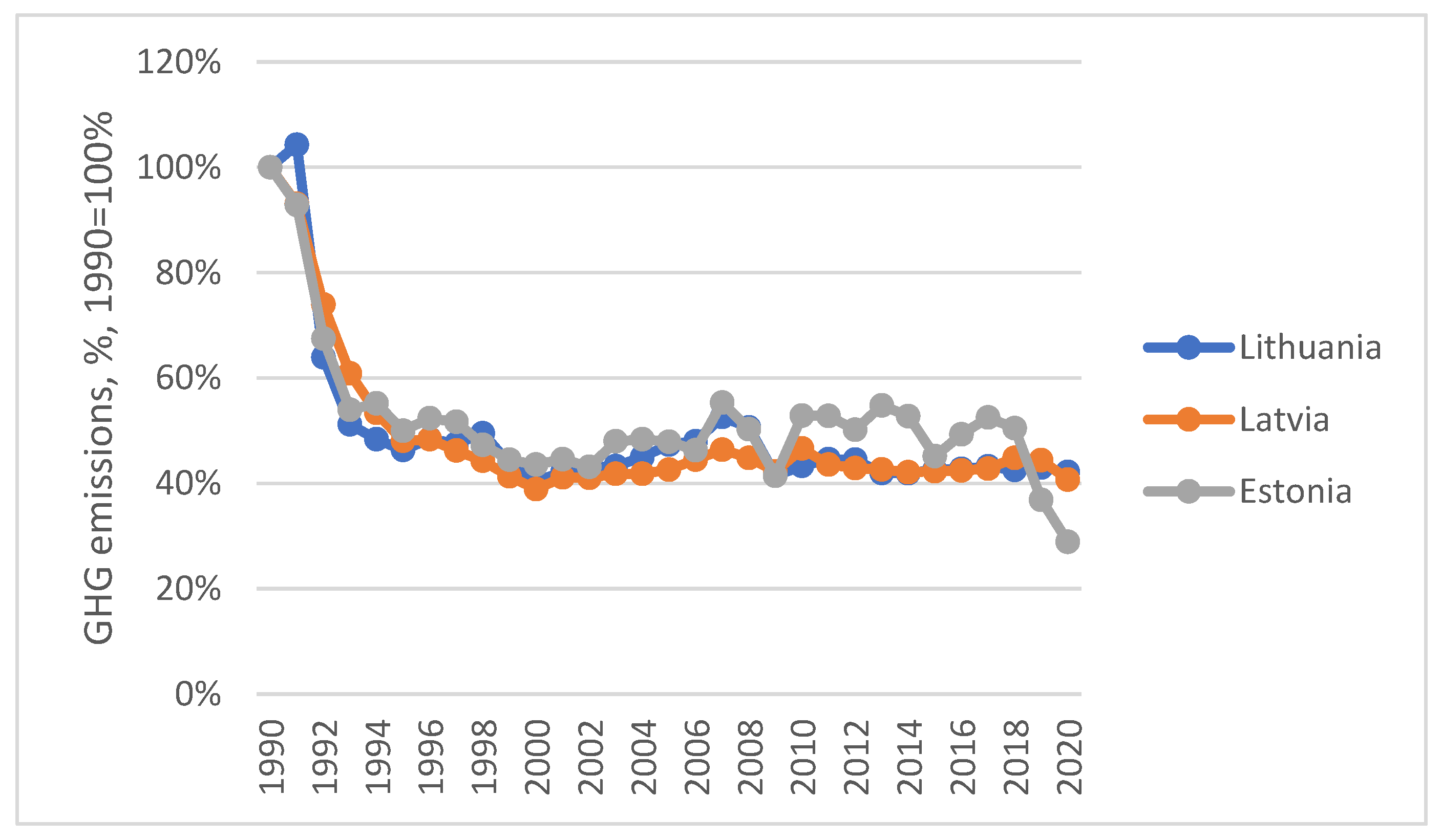
The results achieved of Baltic States in GHG emission reduction are presented in Figure 1.
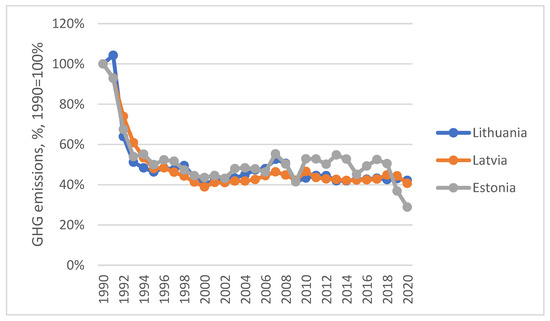
Figure 1.
GHG emission reduction, %, 1990 = 100%. Source: Created by authors. Based on Reference [44].
As one can see, in Figure 1, in 2020, Estonia reached a significant GHG-emission-reduction level, and the total GHG emissions of the country was just 29% of the 1990 level, meaning that it was reduced by more than 70%. In Latvia and Lithuania, the GHG emissions in 2020 made 42–43% of total GHG emissions in 1990, meaning that they were reduced by almost 60% compared to the base year’s level. These results of total GHG-emission reduction achieved by the Baltics provide significant overachievement of the EU target set for 2020, i.e., 20% of GHG emission reduction, in comparison with the level in 1990, as Baltic States have established the same GHG-emission-reduction target for 2020 as the EU (20%). In Figure 2, the dynamics of the share of renewable energy in gross final energy of the Baltic States are provided.
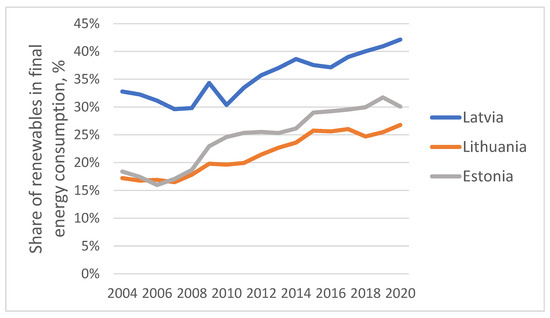
Figure 2.
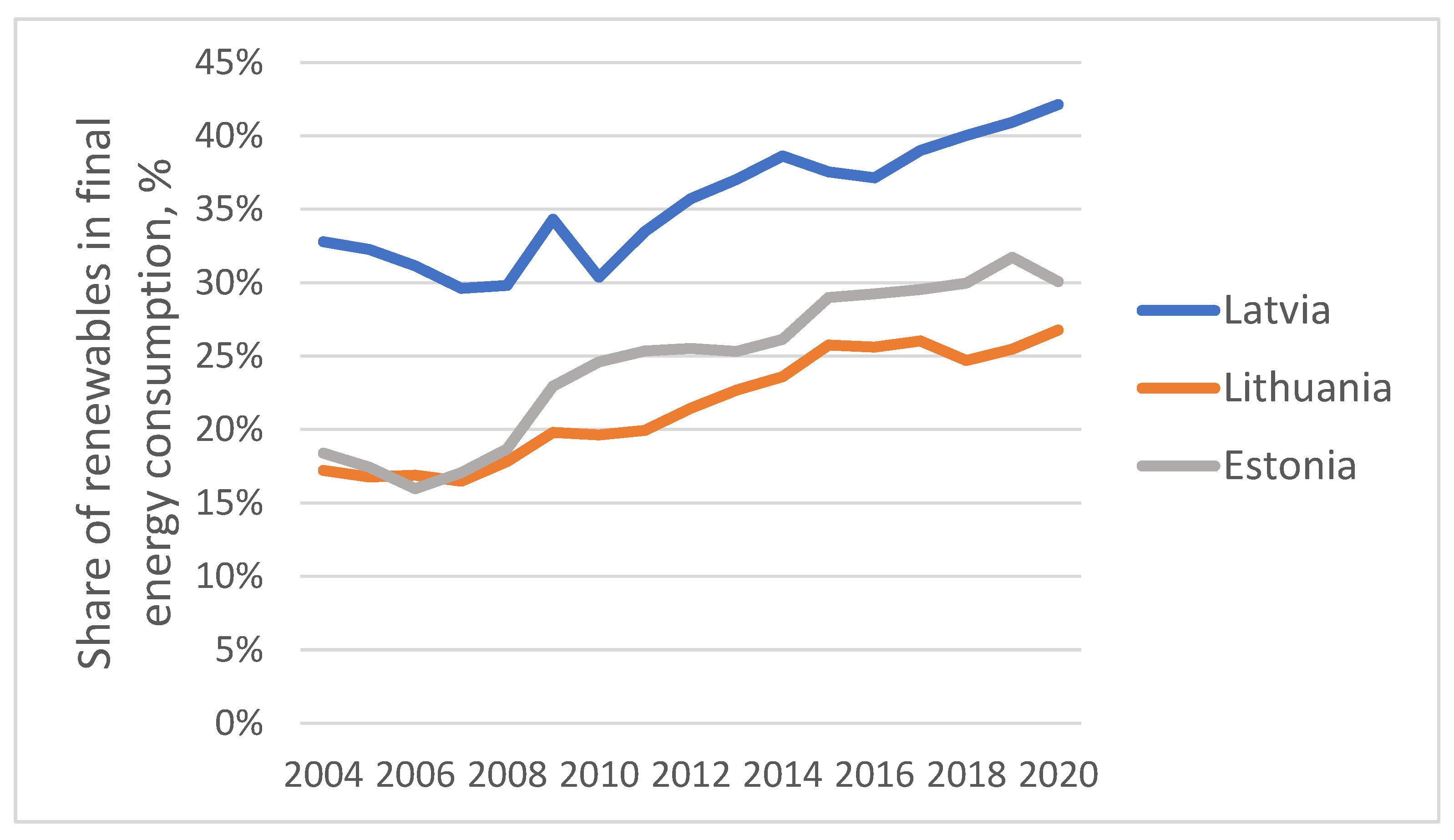
Dynamics of the share of renewables in gross final energy consumption in Baltics. Source: Created by authors. Based on Reference [44].
Latvia reached the highest share of renewables in gross final energy consumption in 2020—42%. Compared with the target set in Latvia’s NECP, i.e., 40%, the country exceeded the set target in 2020. Estonia set the share of RES in gross final energy consumption at 25%, and in 2020, the country exceeded its target, as the share of RES in final energy consumption was 30% in Estonia. Lithuania had set a RES target for 2020 of 23%, and in 2020, it achieved 27% of RES in gross final energy consumption. Therefore, all Baltic States exceeded their main RES penetration target for 2020. In Figure 3 the dynamics of the share of renewables in transport in Baltics is provided.
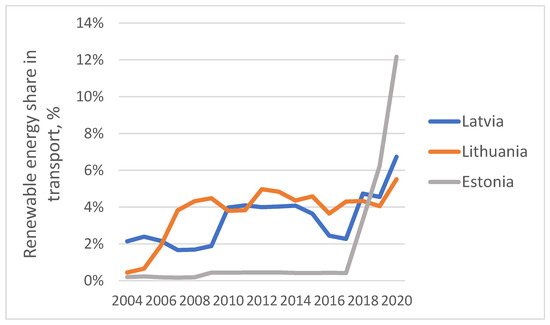
Figure 3.
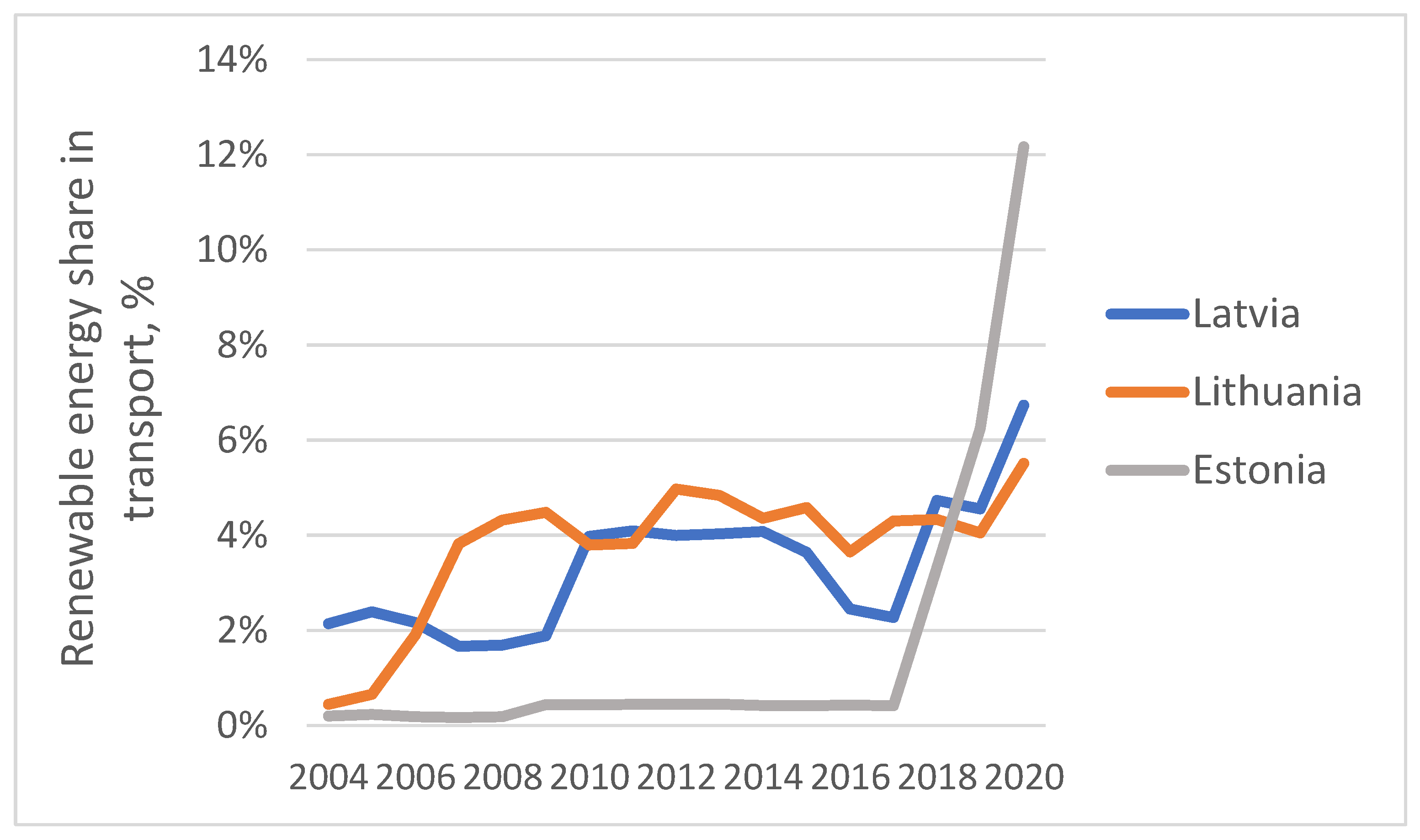
Dynamics of the share of renewables in transport in Baltics. Source: Created by authors. Based on Reference [44].
Estonia is distinguished from other Baltic States by having a very high achievement of RES usage in transport in 2020, i.e., 12%. Latvia reached 6.7% of renewable energy use in transport, and Lithuania reached 5.5%. The Baltic States have set the same target as the EU for 2020, i.e., 10%; therefore, Latvia and Lithuania underachieved their renewable energy targets in transport in 2020. At the same time, Estonia overachieved its target for 2020. For the year 2030 the EU, Lithuania, and Estonia have set a 14% target -while Latvia has set just a 7% target- for the share of renewables in transport. In Figure 4, the dynamics of the energy-efficiency indicators in the Baltics are provided.
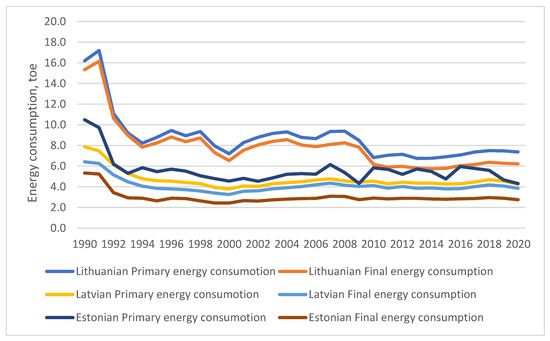
Figure 4.
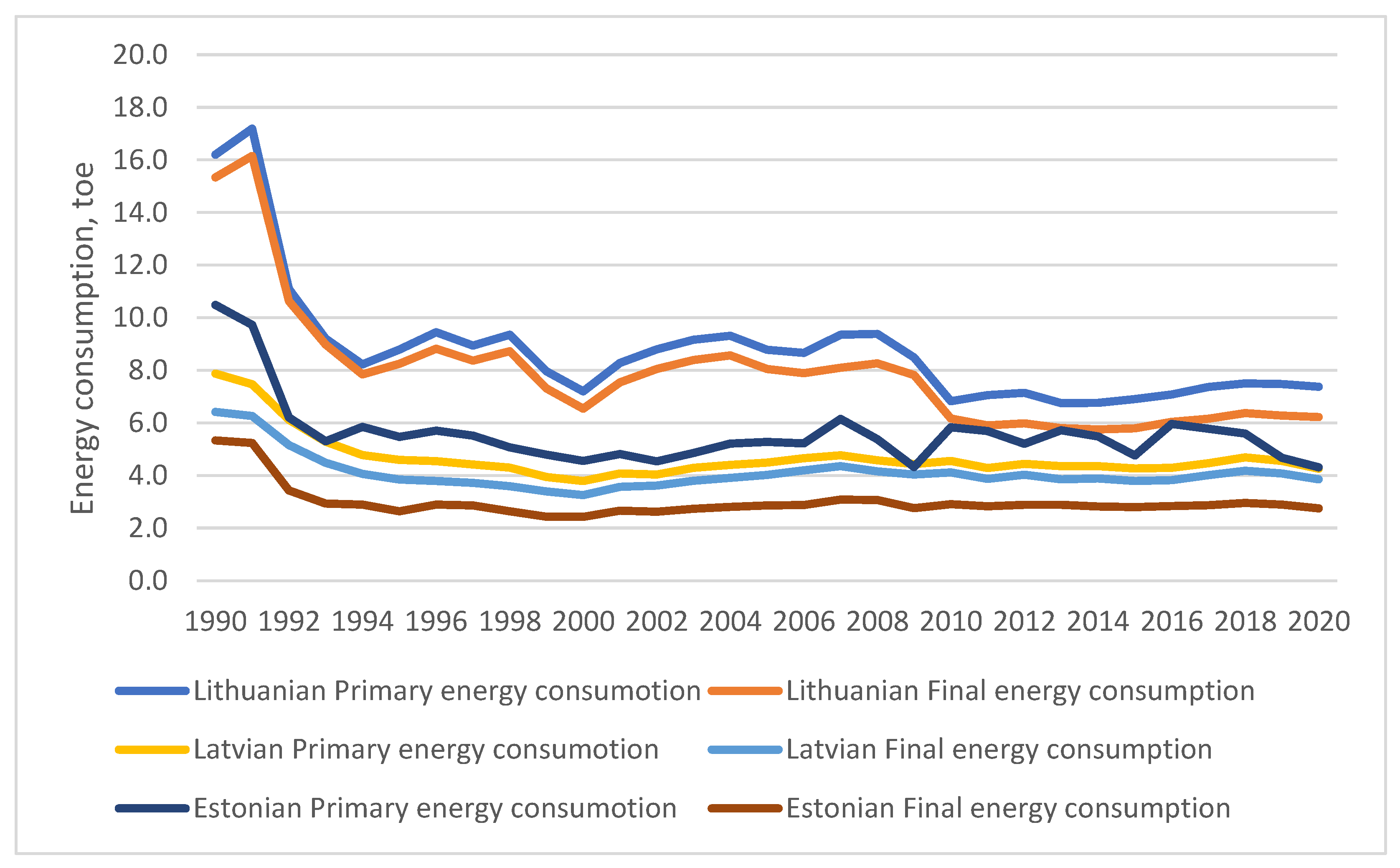
Profile of energy efficiency improvement indicators in Baltics during 1990–2020. Source: Created by authors. Based on Reference [44].
Comparing Baltic States in terms of their targets and their achievement in energy efficiency improvement in 2020, it is possible to state that just Lithuania did not achieved the energy-efficiency-improvement target in 2020. Latvia and Estonia overachieved their energy-efficiency-improvement targets for 2020 in terms of primary and final energy consumption.
Lithuania has set an NECP energy-efficiency-improvement target for 2020 for primary energy consumption of 6 Mtoe and for final energy consumption of 4.3 Mtoe; however, in reality, in 2020, Lithuanian’s primary energy consumption was 7.4 Mtoe, and its final energy consumption was 6.2 Mtoe or 23% higher for primary energy consumption and 44% higher for final energy consumption. Estonia overachieved just energy-efficiency improvement-targets in 2020 for primary consumption by 50%, as the actual final energy consumption in 2020 was the same as target set in the NECP (2.8 Mtoe). Latvia has overachieved both targets for energy-efficiency improvement by 20% for primary energy consumption and by 13% for final energy consumption.
4.3. Analysis of Climate Change Mitigation and RES Promotion Policies in Households
The main policies and measures to promote RES in the electricity sector set for the NECP include GHG-emission reduction in the household sector presented in the NECP of Baltic States cover policy measures to promote RES in electricity sector, district heat, and transport sector. When comparing RES promotion measures in the electricity sector among Baltic States, one can notice that Latvia has a limited set of policies and measures to promote RES in the electricity sector, even though the country reached the highest share of RES in electricity generation in 2020, i.e., 42% (twice higher than EU target), and has also set for 2030 a target (50%) almost twice as high as the EU’s target, i.e., 32%. This is due the fact that Latvia has a high share of hydro in electricity generation due to abundant hydro resources from the river Daugava, thus distinguishing this country from other Baltic States. The country does not need many policies and measures to increase its share of RES in the gross final energy consumption in 2030, as it already reached 42% in 2020 [41]. In our per-country analysis regarding existing policies and measures to promote RES in the electricity sector set for NECP, the following was revealed:
In Lithuania, the main existing policies and measures to promote RES in transport are mandatory blending of biofuels into mineral fuels and excise duty for biofuels. Lithuania has set many planned policies and measures to support RES in transport after 2020. They include provisions on operating costs of generation II biodiesel through mandatory blending; financing generation II bioethanol production facilities; investments for biomethane plant facilities; purchasing provision of public, utility, or other commercial vehicles fueled by compressed natural and/or biomethane gas; and operators’ obligation of natural gas stations while supplying gas for direct consumption in transport [42]. Other promotional and RES-affiliated policies can include co-generation plants using localized and RES renewables, primarily for Vilnius and Kaunas; upgrading/replacing worn biofuel boilers with RES technologies (mainly solar technologies, heat pumps, and heat storage) as that of heating installations in households, homes, and district heating; and using heat from waste generated by industrial deployment of RES (70% electricity, 30% heat), as well as the modernization of the heat metering system [42].
In Latvia, just a few policies and measures were identified to promote RES in transport in NECP: reducing of the use of private vehicles by optimizing movement of public transport and other modes of transport and promoting increasing RES quantities in vehicles. The promotion of such vehicles by biogas purification facilities and the extensive biomethane use should be related to long-term sharing of RES in public and commercial transport [41]; promotion of RES in district heating, while ensuring reduction in energy consumption and increasing the use of RES in DH (district heating); and improvement of energy efficiency in LH (local heating) and individual heating in regard to meeting a more efficient use of the heating system and its technologies used [41].
In Estonia, the main policies to promote RES in district heating are renewable energy support and support for efficient heat and power cogeneration and development of heating sector, focusing on boiler houses and heating networks at district and local heating systems [43]. Estonia is distinguished from other Baltic States by its very high share of RES in transport due to domestic-waste-based biomethane usage. Estonia’s existing measures to promote RES in the transport sector are increasing the share of biofuels in the transport sector and support for purchasing electric vehicles. Planned measures are quite ambitious though; in 2020, the country has achieved a very high share of RES in transportation, including electrification of railways, and electrification of ferries [43].
Though Latvia and Lithuania have underachieved their RES targets in the transport sector for 2020, just Lithuania was planning in NECP many additional policies and measures to promote RES in transport after 2020.
5. Discussion
The draft NECPs were assessed by the European Commission in June 2019 [45]. Subsequently, the NECPs’ goal for 2030 [46] is to achieve changes in the use of energy with a possibly better impact on climate and environment [17]. However, when examining NECPs’ operation and success, we cannot examine these things in way that is as detached from the EU’s energy/climate goals for 2020 and 2030 [45]. Therefore, NECPs are viewed in the light of a long-term “climate neutral” vision for 2050. On the national level, we can evaluate how successful or not individual EU Member States can be at achieving the EU’s 2020 targets and how they can best achieve 2030 goals. In this context, there is some criticism of the planning process required by the Regulation on the Governance of the EU. Therefore, it is technically most feasible for expert contributors originated only from those countries who have assessed their respective (national) energy/climate plans, as these are the nine EU countries (reference year 2019): Austria, Belgium, France, Germany, Italy, the Netherlands, Poland, Spain, and the UK [45].
In the Baltic States, the NECP2030 synergies between climate policies and strategic domains can be deployed through applying the Climate Policy Integration (CPI) approach. CPI was defined as integration of activities to mitigate climate change and adaptation activities at all policymaking levels and stages. In such a way, other policy sectors and commitments can reduce or prevent contradictions between climate policy and goals and policies and goals of other sectors. NECP2030 aims at guiding policies and policy instruments that achieve changes in production and utilize the energy resources of sustainable economic orientation and joint functionality in alignment with climate goals. The NECP2030 policy measures have been organized into 12 activity groups. However, it should be signified that there are policies that are not synergistic with climate policy or are even of a competitive nature vis-a-vis climate policy [47].
Based on the aforementioned analysis, a critical point is that each EU Member State demands its own responsibility to prepare a NECP and to set achievable climate targets, while performing meaningful measures and policies to achieve these set targets. Annex 4 of the Latvian NECP2030 provided such an integrated overview of policies and measures to achieve the climate targets. The NECP actually does not provide information on the impact of the policies or which measures are more important and which are of low significance. Similarly, the measures in Annex 4 of the NECP were not determined by industry experts but by ministry officials. The NECP impacts were described by the depth of measures’ effectiveness and the developmental stage. In such a way, the assessment of how energy policies are impacting on the effectiveness of the policy and the level of development is realistic by using relevant indicators. In this context, it is widely accepted and commonly recognized that multicriteria analysis and composite index method can be utilized as the most suitable methods to measure the promotion of energy efficiency in a variety of socioeconomic sectors, including the construction sector (built environment) [48,49,50,51]. However, low-impact measures were comprehensive horizontal measures, such as measures related to the principle of “energy efficiency first” and review of energy-efficiency obligation schemes. The feature of such NECPs’ indicators showed high sustainability rates in which possible side effects and transparency of policies can be interrelated [52,53,54,55,56].
Another important finding on the NECPs’ feasibility and functionality is defined by the components of energy-sustainability strategies, such as energy sufficiency, energy efficiency, and renewable energies, especially in urban facilities at the built environment. In such an analysis, the investigation of the depth and effectiveness of the European governments follow this strategy, it can be approached by conducting a systematic analysis of all available European NECPs and Long-Term Strategies (LTSs). Therefore, the collection and grouping of such NECPs’ sufficiency-related policy measures enables the determination of those differences, or convergences, among the countries filed. In such a study, it was reported that most sufficiency policies are driven to the transport sector, when classifying also modal-shift policies to change the service quality of transport as sufficiency policies. Moreover, the types of sufficiency policy instruments are considerably varied from one sector to the other. For instance, research has been directed/attributed to financial incentives and fiscal instruments in the transportation sector, information has been directed/attributed to the construction sector, and financial incentive/tax instruments have been directed/attributed to cross-sectoral application. In such an analysis, regulatory instruments play a minor role in the sufficiency policy in the NECP’s EU Member States. Similar to energy efficiency, energy sufficiency is mainly referred to as micro-level individual behavior change; nevertheless, NECPs are not considered as policy actions that enable societal change, yet [57].
6. Conclusions
Based on the theoretical overview and the research findings of this study, it can be denoted that the implementation level of the EU’s setting of targets enabled researchers and planners to monitor the progress and to rank countries’ effort and fulfillment of commitments in seeking sustainable, smart, and inclusive growth in a measurable manner. In this respect, our study did not only take into account the level of achievement of the target, but also investigated NECPs abiding policies and measures among the three selected EU member states: Estonia, Latvia, and Lithuania. Such an approach allowed us to assess the national efforts and the progress of strategies devoted to achieve climate change and energy goals for selected sectors. The analysis of implementation of the objectives not only reflected on the national efforts, but also served as a supporting tool for the further development of policies and measures with a positive environmental footprint, especially those targeting to reduce GHG emissions.
In 2020, the Baltic States achieved significant GHG-emission reductions and total GHG emissions; for example, Estonia reduced the total GHG emissions more than 70% and Latvia by almost 60% compared to the base year (1990) level, even though other countries set just 20% reduction targets for this year.
The Baltic States have exceeded their targets for renewables in gross final energy consumption in 2020. Latvia set the target of 40% but reached 42% in 2020. Estonia set its target to 25% but reached 30% in the same year. Lithuania set its target to 23% but achieved 27% of RES in gross final energy consumption.
Estonia is distinguished from other Baltic States with very high achievements of RES usage in transport in 2020, i.e., 12%. Latvia reached 6.7%, and Lithuania reached 5.5% of renewable energy use in transport. The Baltic States set the same target as the EU for 2020, i.e., 10%; therefore, Latvia and Lithuania underachieved, and Estonia overachieved their renewable-energy targets in transport in 2020.
When comparing Baltic States in terms of their achievement of energy-efficiency-improvement targets in 2020, one can notice that just Lithuania has not achieved energy-efficiency-improvement targets in 2020. Latvia and Estonia overachieved their energy-efficiency-improvement targets for 2020 in terms of primary and final energy consumption.
When comparing policies and measures to promote RES in sectors linked to households in the Baltic States, one can notice that Latvia distinguished less developed planned policies and measures to promote RES after 2020, especially in the electricity sector. As the country is in a very good position in the achievement of all targets set for 2020 in NECP, the planned measures are mainly a continuation of successful policies implemented up to 2020. In addition, Latvia has a very high share of RES in electricity generation due to plenty of hydro resources and does not need additional measures to promote RES in the electricity sector.
Lithuania and Latvia are experiencing problems in regard to the implementation of RES targets set for the transport sector, thus fostering many additional policies to promote RES in transport, such as for the support of the following: use of natural and biomethane types of gas, especially for vehicles of public and commercial use; the expansion of natural gas stations, supplying gas for direct consumption in transport; operating costs of generation II biodiesel through mandatory blending; support for financing generation II bioethanol production facilities; and investment support for biomethane plant facilities.
Estonia significantly exceeded RES targets in the transport sector due to domestic waste-based biomethane usage; the country is planning to implement further polices and measures such as the transition of public transport to biomethane and electricity, the development of railway infrastructure, and the electrification of railways and ferries.
Lithuania is the only country among the Baltic States that has not implemented the energy-efficiency-improvement targets set for 2020; therefore, more policies and measures should be developed to promote energy-efficiency improvement in the country, especially in the residential sector, where a huge energy-saving potential exists due to the slow paths of energy renovation of residential buildings.
The performed research has also limitations, since the study did not assess the national output, which can directly determine the effort required to meet climate change and energy goals. Therefore, further research is needed to include a comprehensive assessment of countries’ capacity to meet such goals.
Author Contributions
The contribution of all authors is equal. All authors have read and agreed to the published version of the manuscript.
Funding
This research received no external funding.
Institutional Review Board Statement
Not applicable.
Informed Consent Statement
Not applicable.
Data Availability Statement
Not applicable.
Acknowledgments
The authors express gratitude to the reviewers, who contributed to the improvement of the paper.
Conflicts of Interest
The authors declare no conflict of interest.
References
- European Commission. Communication from the Commission to the European Parliament, the Council, the European Economic and Social Committee and the Committee of the Regions. The European Green Deal. Brussels, 11.12.2019, COM (2019) 640 Final. Available online: https://www.elni.org/fileadmin/elni/dokumente/Green_Deal-Sustainable_Products_Policy_2019-12-18_engl_fin.pdf (accessed on 29 April 2022).
- United Nations. Transforming our world: The 2030 Agenda for Sustainable Development. A/RES/70/1. 2015. 41p. Available online: https://sustainabledevelopment.un.org/content/documents/21252030%20Agenda%20for%20Sustainable%20Development%20web.pdf (accessed on 29 April 2022).
- Krarti, M.; Aldubyan, M. Review analysis of COVID-19 impact on electricity demand for residential buildings. Renew. Sustain. Energy Rev. 2021, 143, 110888. [Google Scholar] [CrossRef]
- Streimikiene, D.; Lekavičius, V.; Baležentis, T.; Kyriakopoulos, G.L.; Abrhám, J. Climate change mitigation policies targeting households and addressing energy poverty in European Union. Energies 2020, 13, 3389. [Google Scholar] [CrossRef]
- Siksnelyte-Butkiene, I.; Streimikiene, D.; Balezentis, T. Addressing sustainability issues in transition to carbon-neutral sustainable society with multi-criteria analysis. Energy 2022, 254A, 124218. [Google Scholar] [CrossRef]
- Kumar, A.; Singh, P.; Raizada, P.; Hussain, C.M. Impact of COVID-19 on greenhouse gases emissions: A critical review. Sci. Total Environ. 2022, 806, 150349. [Google Scholar] [CrossRef] [PubMed]
- Liu, Z.; Deng, Z.; Davis, S.J.; Giron, C.; Ciais, P. Monitoring global carbon emissions in 2021. Nat. Rev. Earth Environ. 2022, 3, 217–219. [Google Scholar] [CrossRef]
- European Commission. REPowerEU: Joint European Action for More Affordable, Secure and Sustainable Energy. Communication from the Commission to the European Parliament, the European Council, the Council, the European Economic and Social Committee and the Committee of the Regions 2022, Strasbourg, 8.3.2022, COM (2022) 108 Final. Available online: https://eur-lex.europa.eu/legal-content/EN/TXT/?uri=celex:52022DC0108 (accessed on 26 May 2022).
- Geissler, S.; Arevalo-Arizaga, A.; Radlbauer, D.; Wallisch, P. Linking the National Energy and Climate Plan with Municipal Spatial Planning and Supporting Sustainable Investment in Renewable Energy Sources in Austria. Energies 2022, 15, 645. [Google Scholar] [CrossRef]
- Stamopoulos, D.; Dimas, P.; Sebos, I.; Tsakanikas, A. Does investing in renewable energy sources contribute to growth? A preliminary study on Greece’s national energy and climate plan. Energies 2021, 14, 8537. [Google Scholar] [CrossRef]
- Zervas, E.; Vatikiotis, L.; Gareiou, Z.; Manika, S.; Herrero-Martin, R. Assessment of the Greek national plan of energy and climate change—Critical remarks. Sustainability 2021, 13, 13143. [Google Scholar] [CrossRef]
- Simoglou, C.K.; Biskas, P.N. Assessment of the impact of the National Energy and Climate Plan on the Greek power system resource adequacy and operation. Electr. Power Syst. Res. 2021, 194, 107113. [Google Scholar] [CrossRef]
- Newbery, D. National Energy and Climate Plans for the island of Ireland: Wind curtailment, interconnectors and storage. Energy Policy 2021, 158, 112513. [Google Scholar] [CrossRef]
- Maris, G.; Flouros, F. The green deal, national energy and climate plans in Europe: Member states’ compliance and strategies. Adm. Sci. 2021, 11, 75. [Google Scholar] [CrossRef]
- Gkonis, N.; Arsenopoulos, A.; Stamatiou, A.; Doukas, H. Multi-perspective design of energy efficiency policies under the framework of national energy and climate action plans. Energy Policy 2020, 140, 111401. [Google Scholar] [CrossRef]
- Buchmann, M.; Kusznir, J.; Brunekreeft, G. Assessment of the drafted German integrated National Energy and Climate Plan. Econ. Policy Energy Environ. 2019, 2019, 85–96. [Google Scholar] [CrossRef]
- Haas, R. On the draft of the Austrian national energy and climate plan. Econ. Policy Energy Environ. 2019, 2019, 43–55. [Google Scholar] [CrossRef]
- Pluta, M.; Suwała, W.; Wyrwa, A. Review of the Polish integrated national energy and climate draft plan 2021–2030. Econ. Policy Energy Environ. 2019, 2019, 149–160. [Google Scholar] [CrossRef]
- Linares, P. The Spanish national energy and climate plan. Econ. Policy Energy Environ. 2019, 2019, 161–172. [Google Scholar] [CrossRef]
- Laes, E.; Verbruggen, A. Meta-review of Belgium’s integrated National Energy and Climate draft Plan 2021–2030. Econ. Policy Energy Environ. 2019, 2019, 57–72. [Google Scholar] [CrossRef]
- De Paoli, L. The Italian draft National Energy-Climate Plan. Econ. Policy Energy Environ. 2019, 2019, 97–118. [Google Scholar] [CrossRef]
- Thomas, S. The UK national energy and climate plan. Econ. Policy Energy Environ. 2019, 2019, 173–179. [Google Scholar] [CrossRef]
- Zigurs, A.; Balodis, M.; Ivanova, P.; Locmelis, K.; Sarma, U. National Energy and Climate Plans: Importance of Synergy. Latv. J. Phys. Tech. Sci. 2019, 56, 3–16. [Google Scholar] [CrossRef]
- Aboltins, R.; Jaunzems, D.; Pubule, J.; Blumberga, D. Are hugs, carrots and sticks essential for energy policy: A study of Latvia’s national energy and climate plan. Environ. Clim. Technol. 2020, 24, 309–324. [Google Scholar] [CrossRef]
- Reinhart, V.; Fonte, C.C.; Hoffmann, P.; Bechtel, B.; Rechid, D.; Boehner, J. Comparison of ESA climate change initiative land cover to CORINE land cover over Eastern Europe and the Baltic States from a regional climate modeling perspective. Int. J. Appl. Earth Obs. Geoinf. 2021, 94, 102221. [Google Scholar] [CrossRef]
- Pogumirskis, M.; Sīle, T.; Seņņikovs, J.; Bethers, U. PCA analysis of wind direction climate in the Baltic States. Tellus Ser. A Dyn. Meteorol. Oceanogr. 2021, 73, 1–16. [Google Scholar] [CrossRef]
- Keessen, A. What states can do to adapt to climate change in the Baltic Sea. Mar. Policy 2018, 98, 295–300. [Google Scholar] [CrossRef]
- Bethere, L.; Sennikovs, J.; Bethers, U. Climate indices for the Baltic States from principal component analysis. Earth Syst. Dyn. 2017, 8, 951–962. [Google Scholar] [CrossRef]
- Roos, I.; Soosaar, S.; Volkova, A.; Streimikene, D. Greenhouse gas emission reduction perspectives in the Baltic States in frames of EU energy and climate policy. Renew. Sustain. Energy Rev. 2012, 16, 2133–2146. [Google Scholar] [CrossRef]
- Feistel, R.; Nausch, G.; Wasmund, N. State and Evolution of the Baltic Sea, 1952–2005: A Detailed 50-Year Survey of Meteorology and Climate, Physics, Chemistry, Biology, and Marine Environment. State and Evolution of the Baltic Sea, 1952–2005: A Detailed 50-Year Survey of Meteorology and Climate, Physics, Chemistry, Biology, and Marine Environment; John Wiley & Sons, Inc.: Hoboken, NJ, USA, 2008; 703p. [Google Scholar] [CrossRef]
- Reihan, A.; Koltsova, T.; Kriauciuniene, J.; Lizuma, L.; Meilutyte-Barauskiene, D. Changes in water discharges of the Baltic States rivers in the 20th century and its relation to climate change. Nord. Hydrol. 2007, 38, 401–412. [Google Scholar] [CrossRef]
- Streimikiene, D.; Ciegis, R.; Pusinaite, R. Review of climate policies in the Baltic States. Nat. Resour. Forum 2006, 30, 280–293. [Google Scholar] [CrossRef]
- Miškinis, V.; Galinis, A.; Konstantinavičiūtė, I.; Lekavičius, V.; Neniškis, E. The role of renewable energy sources in dynamics of energy-related GHG emissions in the baltic states. Sustainability 2021, 13, 10215. [Google Scholar] [CrossRef]
- Strielkowski, W.; Tarkhanova, E.; Baburina, N.; Streimikis, J. Corporate social responsibility and the renewable energy development in the baltic states. Sustainability 2021, 13, 9860. [Google Scholar] [CrossRef]
- Lu, J.; Ren, L.; Yao, S.; Rong, D.; Skare, M.; Streimikis, J. Renewable energy barriers and coping strategies: Evidence from the Baltic States. Sustain. Dev. 2020, 28, 352–367. [Google Scholar] [CrossRef]
- Štreimikienė, D.; Mikalauskienė, A.; Atkočiūnienė, Z.; Mikalauskas, I. Renewable energy strategies of the Baltic States. Energy Environ. 2019, 30, 363–381. [Google Scholar] [CrossRef]
- Streimikiene, D.; Mikalauskiene, A. Application of flexible Kyoto mechanisms for renewable energy projects in Baltic States. Renew. Sustain. Energy Rev. 2007, 11, 753–775. [Google Scholar] [CrossRef]
- Streimikiene, D.; Klevas, V. Promotion of renewable energy in Baltic States. Renew. Sustain. Energy Rev. 2007, 11, 672–687. [Google Scholar] [CrossRef]
- Liobikienė, G.; Brizga, J. Sustainable Consumption in the Baltic States: The Carbon Footprint in the Household Sector. Sustainability 2022, 14, 1567. [Google Scholar] [CrossRef]
- Brizga, J.; Feng, K.; Hubacek, K. Household carbon footprints in the Baltic States: A global multi-regional input–output analysis from 1995 to 2011. Appl. Energy 2017, 189, 780–788. [Google Scholar] [CrossRef]
- Latvia’s National Energy and Climate Plan, 2021–2030, Riga. 2020. Available online: https://energy.ec.europa.eu/system/files/2020-04/lv_final_necp_main_en_0.pdf (accessed on 17 February 2022).
- (Lithuanian) National Energy and Climate Action Plan of the Republic of Lithuania for 2021–2030, Vilnius. 2020. Available online: https://energy.ec.europa.eu/system/files/2022-08/lt_final_necp_main_en.pdf (accessed on 17 February 2022).
- Estonia’s 2030 National Energy and Climate Plan (NECP 2030), Tallin 2019. Available online: https://energy.ec.europa.eu/system/files/2022-08/ee_final_necp_main_en.pdf (accessed on 17 February 2022).
- EUROSTAT. Energy Statistical Country Datasheets 2022-08 for Public Use. 2022. Available online: https://ec.europa.eu/info/news/eu-energy-datasheets-latest-data-now-available-2020-feb-24_en (accessed on 17 February 2022).
- De Paoli, L.; Geoffron, P. Introduction: A Critical Overview of the European National Energy and Climate Plans. Econ. Policy Energy Environ. 2019, 2019, 31–41. [Google Scholar] [CrossRef]
- National Energy and Climate Plan 2021–2030 (NECP 2030). Portugal. December 2019. Available online: https://ec.europa.eu/energy/sites/ener/files/documents/pt_final_necp_main_en.pdf (accessed on 17 February 2022).
- Aboltins, R.; Jaunzems, D. Identifying Key Challenges of the National Energy and Climate Plan through Climate Policy Integration Approach. Environ. Clim. Technol. 2021, 25, 1043–1060. [Google Scholar] [CrossRef]
- Doulos, L.T.; Tsangrassoulis, A. The Future of Interior Lighting Is Here. Sustainability 2022, 14, 7044. [Google Scholar] [CrossRef]
- Madias, E.-N.D.; Doulos, L.T.; Kontaxis, P.A.; Topalis, F.V. Multicriteria decision aid analysis for the optimum performance of an ambient light sensor: Methodology and case study. Oper. Res. Int. J. 2022, 22, 1333–1361. [Google Scholar] [CrossRef]
- Samiou, A.Ι.; Doulos, L.Τ.; Zerefos, S. Daylighting and artificial lighting criteria that promote performance and optical comfort in preschool classrooms. Energy Build. 2022, 258, 111819. [Google Scholar] [CrossRef]
- Pallis, P.; Braimakis, K.; Roumpedakis, T.C.; Varvagiannis, E.; Karellas, S.; Doulos, L.T.; Katsaros, M.; Vourliotis, P. Energy and economic performance assessment of efficiency measures in zero-energy office buildings in Greece. Build. Environ. 2021, 206, 108378. [Google Scholar] [CrossRef]
- Ntanos, S.; Kyriakopoulos, G.L.; Arabatzis, G.; Palios, V.; Chalikias, M. Environmental behavior of secondary education students: A case study at central Greece. Sustainability 2018, 10, 1663. [Google Scholar] [CrossRef]
- Balode, L.; Dolge, K.; Lund, P.D.; Blumberga, D. How to assess policy impact in national energy and climate plans. Environ. Clim. Technol. 2021, 25, 405–421. [Google Scholar] [CrossRef]
- Streimikiene, D.; Kyriakopoulos, G.L.; Lekavicius, V.; Siksnelyte-Butkiene, I. Energy Poverty and Low Carbon just Energy Transition: Comparative Study in Lithuania and Greece. Soc. Indic. Res. 2021, 158, 319–371. [Google Scholar] [CrossRef]
- Koutroumanidis, T.; Zafeiriou, E.; Arabatzis, G. Asymmetry in price transmission between the producer and the consumer prices in the wood sector and the role of imports: The case of Greece. For. Policy Econ. 2009, 11, 56–64. [Google Scholar] [CrossRef]
- Arabatzis, G.; Aggelopoulos, S.; Tsiantikoudis, S. Rural development and LEADER + in Greece: Evaluation of local action groups. Int. J. Food Agric. Environ. 2010, 8, 302–307. [Google Scholar]
- Zell-Ziegler, C.; Thema, J.; Best, B.; Wiese, F.; Lage, J.; Schmidt, A.; Toulouse, E.; Stagl, S. Enough? The role of sufficiency in European energy and climate plans. Energy Policy 2021, 157, 112483. [Google Scholar] [CrossRef]
Publisher’s Note: MDPI stays neutral with regard to jurisdictional claims in published maps and institutional affiliations. |
© 2022 by the authors. Licensee MDPI, Basel, Switzerland. This article is an open access article distributed under the terms and conditions of the Creative Commons Attribution (CC BY) license (https://creativecommons.org/licenses/by/4.0/).