


Abstract
In the context of policies promoting renewable energies for decarbonization, energy transition and the development of energy communities, photovoltaic systems require special attention. Even for these systems, it is legitimate to inquire about the correlation, currently carried out through life cycle analysis, between benefits and environmental impacts. To maintain long-term productivity levels and ensure the proper functioning of the system, maintenance interventions are necessary. While these interventions guarantee performance, they also have repercussions for the environment. This study aims to assess the environmental impacts caused by ordinary and extraordinary maintenance interventions, taking into account specific factors, during the 30-year operational phase. To evaluate these impacts, this study verifies the feasibility of using data from Environmental Product Declaration (EPD) and the Product Category Rules (PCR) as reference. The initial results highlight, on the one hand, among the main issues, the importance that all EPDs attribute to the impacts caused by water consumption during the use phase of the PV modules, and on the other hand, some critical issues mainly due to the lack of data relating to the installation site necessary for the correct planning of maintenance activities. Finally, the study presents some reflections for a potential recalibration of the PCR and their associated EPDs.
1. Introduction
According to the VI Report of the Intergovernmental Panel on Climate Change (IPCC), the constant rise in temperatures makes it increasingly difficult to plan a development model capable of resisting the impact of climate change; for this reason, the decisions taken from today onwards will profoundly influence both the current situation and those of future generations to come. Decisions must therefore be the result of radical and shared choices regarding values and world vision [1]. Climate, ecosystems and society are interconnected; for this reason, achieving carbon neutrality by 2050 is a major technical–economic, social and cultural challenge, and it requires a series of shared actions among all stakeholders. The key lies in integrating adaptation and mitigation strategies to climate change in all production sectors—industry, transport, energy, agriculture and construction—and implementing them in the territory through sustainable planning and management capable of facilitating the adoption of low-carbon lifestyles, not only promoting environmental benefits but also improving overall health and well-being. Through environmental communication to citizens, it is possible to encourage sustainable choices and behaviors.
As for the construction sector, since energy used in buildings is responsible for 30–40% of resource consumption and polluting emissions, in 2021, the EU published the directive on the energy performance of buildings in an attempt to define the path towards the nearly zero energy buildings goal by 2050 [2].
In buildings and civil engineering works, it is also necessary to comply with the issues of sustainability, aligning with some specific technical regulations [3] and with the Environmental Declarations of Construction Products [4].
With these inputs, given the peculiarity of the building sector, each design choice will have repercussions on all phases of the building process; in particular, consideration will be given to the operational phase, to be planned and evaluated from a life cycle perspective. The importance of the operation phase, and the extensive range of needs to be met, has given rise to a complex series of specific skills included under the umbrella of facility management [5,6].
During the operational phase, maintenance work is generally divided into two macro areas: ordinary, which includes all work of a predictable and therefore programmable nature that will recur periodically over the useful life of the facility; and extraordinary maintenance, which refers to interventions made necessary by an extraordinary event. Ordinary maintenance activities during the life cycle include corrective and minor preventive maintenance (routine and fault prevention operations) [7]. Extraordinary maintenance activities include significant improvement and preventive maintenance—types of non-recurring and high-cost interventions, compared to the replacement value of the asset and the annual costs of ordinary maintenance of the same (such as, for example, overhauls, which generally increase the value of the systems and/or extend their useful life) [7]. The ever-increasing attention paid, in particular, to the operation phase determines, in parallel, an equal importance of the “centrality of the project design” and of the relative modalities for its elaboration; in summary: how to design the building–plant system for its maintainability, and consequently, how to plan maintenance to guarantee technical quality and environmental sustainability in the predetermined life cycle of the work carried out. In this scenario, the role of energy production plants from renewable sources in buildings is very important. In order to evaluate the environmental sustainability of these systems, it is legitimate to ask how much energy and raw materials the system took to be built, installed, used and dismissed compared to the energy they were able to produce in its whole life and, contextually, how many polluting emissions they released into the environment. This kind of evaluation can be calculated with a life cycle assessment (LCA) [8,9,10]. The procedure is currently the basis of the Environmental Product Declarations (EPDs) which are, in turn, elaborated according to standard methods defined by the Product Category Rules (PCRs).
The Environmental Product Declaration is a standardized document foreseen by the policies of the European Community; the document contains information on the environmental impact of a product consistent with international standards (so-called Type III EPDs) [11] determined and quantified on the basis of an LCA, based on the requirements of ISO 14040 [8] and ISO 14044 [9] and on the framework of the Product Category Rules regarding the category-specific requirements of the product analyzed.
The PCRs define a set of rules to ensure that, for each individual product belonging to a given category, a uniform approach is taken when performing the LCA and when the subsequent EPD is created. The PCRs are prepared by a promoter, submitted to public investigation and approved to be used and then periodically reviewed through a public investigation process, open to all EPD program stakeholders. The EPD, following validation by a third party, will be registered with the logo and published in the International EPD System.
The document is reviewed every 5 years or on market input, to be adapted if necessary. The goal of an EPD is to inform and communicate with stakeholders about a product’s environmental impact; companies often use EPDs for commercial purposes. The results of an EPD are expressed on a detailed list of indicators declared for each stage of the construction product from the sourcing/supply of raw materials to the end of life [4,12]. Each EPD scheme follows the rules of the International EPD® System; there are also recalibrated schemes according to national regulations.
Comparison of the environmental performance of construction products using EPD data to enable reliable results should be based on their use on construction sites, preferably at the building scale and not at the product scale, using the same functional unit, the same database, similar modeling hypotheses and the same time reference. The user of the EPD should therefore check these parameters; otherwise, there is a risk of obtaining misleading results.
Talking about photovoltaic systems—the subject of this study—requires great attention to the environmental impacts of maintenance during the operational phase to provide reliable results regarding the energy and environmental benefits deriving from their use in buildings. To this aim, this study investigates the feasibility of using EPD as data sources for assessing these impacts [13,14].
2. Materials and Methods
With the aim of quantifying the impact that the operational phase has in the life cycle analysis of PV modules, by using EPDs as a data source, the methodology is structured as follows:
- (a)
- Analysis of the most recurring causes of PV module malfunctions and the interventions necessary to maintain the performance defined by the project over time;
- (b)
- Analysis of the PCR of the PV modules;
- (c)
- Check the Modeling requirements of modules B1 to B7 in the use stage;
- (d)
- Review of the LCA results of modules B1 to B7 of a significant sample of EPDs;
- (e)
- Analysis of the feasibility of using EPDs as a data source for the evaluation of the environmental impacts caused by maintenance activities;
- (f)
- Estimation of the impact of maintenance activities throughout the entire life cycle.
2.1. Recurring Causes of PV Module Malfunction vs. Ordinary and Extraordinary Maintenance
The main maintenance activities have been identified along with the adverse effects on PV systems in cases of maintenance neglect, the required intervention frequency for effectiveness and the equipment and resources (energy and materials) needed.
About twenty years of continuous growth in the photovoltaic energy sector has simultaneously prompted a search for best practices to manage the maintenance, extend the useful life of the system and improve its efficiency in converting solar energy into electricity, which has economic and environmental implications. The main ordinary and extraordinary maintenance tasks on photovoltaic systems and how they affect their longevity and their environmental performance are described below [15,16].
Ordinary maintenance includes interventions necessary to counteract or delay, as much as possible, the inevitable (physiological) degradation of a PV system’s performance and efficiency.
Environmental factors, such as temperature, humidity and UV radiation, are the main factors affecting the aging of PV modules. To assess the extended functionality and ascertain the reliability of various types of PV modules in different climatic contexts, it is necessary to use outdoor performance data. Nevertheless, this requires a waiting period of 25 years. Consequently, accelerated stress tests (AT), conducted within a laboratory setting to emulate diverse field conditions, have been formulated [17].
Regarding the rate of degradation (RD) of PV modules, a constant decline in performance over time is often assumed; data collected in the field suggest, however, a non-linear behavior, which requires reliable identification and calculation methods [18].
To obtain more accurate data, the implementation of synthetic datasets is, at present, a valid alternative [19].
Among ordinary maintenance interventions, there is surface cleaning. The absorbing surface of the modules may incur several causes of fouling, depending on the geographical area of installation of the PV modules, such as solid particles present as aerosols in the atmosphere, sand, soot, dry leaves, bird droppings or other materials and, in general, all substances suspended in the atmosphere subject to deposition phenomena. Also, diesel soot, present in cities and concentrated areas such as at bus depots, and may require frequent cleaning. Cleaning is necessary in order to avoid downgrading the module performance due to partial shading (with risks related to potential damage to the inverter due to potential overloads) but also possible corrosion phenomena due to permanent deposits.
The reduction in the performance of PV modules caused by the deposition and accumulation of dust is directly proportional to the thickness of the layer of pollution, with an average decrease in maximum power of 3% per year [20].
The statistics suggest that the lack of cleaning of photovoltaic modules can lead to an efficiency loss of 15–20%; a “mundane” problem like dust can actually reduce efficiency by up to 7% [21]. Associated with the cleaning of surfaces is the phenomenon known as “Hot Spot”, which involves the overheating of shaded or, indeed, dirty cells (and is also due to module production defects). The shaded cell ceases to function, while the other cells continue to operate, causing reverse polarization in the shaded one. The current passing through the cell subsequently generates a temperature increase. Unfortunately, this effect has a cascading impact on the entire system. In more critical cases, it can lead to the disconnection of solder joints and even trigger a fire. A decrease in the system’s energy production is an initial signal of this phenomenon. To identify these critical issues, thermal analysis is necessary.
Surface cleaning interventions must be carried out, taking into account the fragility of module surfaces; generally, a low-pressure hydro clean machine is used. Regarding the cleaning interval, research studies have demonstrated that this depends on environmental conditions, including the soiling rate [22].
An innovative method has been developed to analyze the best cleaning strategies depending on net soiling in different seasons and in different environmental conditions worldwide. In a humid, subtropical location, for example, weekly cleaning is recommended during winter and post-monsoon seasons and once a month during the pre-monsoon and SW monsoon seasons [23].
The performance of the numerous PV modules that can potentially be installed in urban areas decreases due to soiling. In the city of Rome (Italy), for example, power losses can raise up to 3.5 to 4.0% toward the end of the summer (28–29 July); consequently, if modules are cleaning on those dates, soiling losses drop from 2.1–2.4% to less than 1% [24].
In climatic areas similar to those of the Mediterranean, the results of a study highlight that the optimum cleaning frequency increases with time of operation [25].
Among the necessary equipment for surface cleaning are demineralized water with low mineral content to prevent mineral deposits on the modules; non-rinse and non-persistent active substance detergents suitable for cleaning to avoid leaving residues that could affect module efficiency; high-pressure rotating brushes for removing dirt and debris from the modules; and telescopic roller brushes with extended reach (up to 6 m), which are useful for reaching and cleaning modules in difficult to access areas.
Currently, waterless cleaning methods to remove dust from solar installations are in the experimental phase, involving robots, drones, sensors and self-cleaning modules (equipped with electrodes embedded directly in the glass covering the module). The results of automating cleaning with robots claims 80% water savings compared to manual cleaning [21]. It is important to note that these methods have not been considered in this article in the environmental assessments.
Other controls to be conducted at regular intervals include checking and tightening the anchor bolts of the modules to the structure, inspecting the integrity of the glass, examining cables and all junction boxes, conducting function tests on the circuit breakers and verifying the plant’s production in accordance with the instantaneous irradiation.
Extraordinary maintenance includes the replacement of the main malfunctioning, damaged or underperforming system components.
Among extraordinary maintenance interventions, there are (a) checks relating to the plant’s electrical circuit, i.e., of the inverter, power electronic components (circuit breakers, relays), fuses, junction boxes; (b) replacement of electrical components damaged due to a current or voltage overload (in the simplest cases, the elements to be replaced are the overvoltage or overcurrent breaking safety devices (e.g., fuses)); (c) replacement of modules, whether in full or in part, due to “pathological” causes as follows:
- Discoloration: The so-called snail trail effect has an impact on photovoltaic module performances and energy production. Generally, snail trails indicate the presence of cell cracks [26]. Snail tracks can influence the daily energy production of PV modules by around 68% and 88% compared to undamaged PV modules. These percentages are the result of various tests, such as the indoor electroluminescence (EL) test, according to which there is a strong correlation between the appearance of the phenomenon and microcracks in photovoltaic cells and the consequent 29% reduction in energy production [27].
- Delamination involves the detachment of the central layer’s ethylene vinyl acetate (EVA) and the photovoltaic cells from the external glass or the backsheet. This results in a loss of insulation and can lead to module overheating. In cases where detachment creates internal air bubbles, moisture could penetrate the module and oxidize the photovoltaic cells. The main causes of delamination are poor workmanship quality and module wear; this phenomenon necessitates the replacement of the modules [28]. Delamination can also depend on the type of additives used in the EVA foil [29].
- Potential-induced degradation (PID) involves the degradation of the photovoltaic effect and the depowering of the cells. When there is an electron leakage dispersing towards the ground through the module’s frame, it generates leakage current. Both crystalline and thin-film cell modules are susceptible to this degradation. The performance decline, between 12.6% and 18.7% [30], can be reversible (polarization) or irreversible (electro corrosion). This issue was more widespread in PV modules produced before 2013, while currently manufactured modules incorporate integrated anti-PID solutions. These solutions, in addition to module replacement, also include repair processes involving subjecting the strings to a high positive voltage relative to the ground during the nighttime hours. This reverses the direction of parasitic leakage currents that occur during the daytime operation of the system.
Another potential extraordinary refurbishment intervention, not included in this study for the purpose of estimating environmental impacts, is the addition of batteries or modules in parallel to increase the system’s power output or its electrical energy storage capacity (in the form of chemical energy). These interventions require careful planning, as potential imbalances in characteristic and performance values between “new and clean” modules and worn ones may risk compromising the system’s integrity.
Lastly, among the causes of degradation, it is essential to mention climate change and extreme events such as large-sized hailstorms that can irreversibly damage the modules. These issues could be mitigated, for example, by using different types of glass or installing anti-hail protection nets.
2.2. Analysis of the PCR of the PV Modules
The PCR, as previously mentioned, describes the operations to be considered during the LCA study related to an EPD. The proposed elements come from a technology review aimed at determining the environmental aspects relevant to drafting a PCR, and they represent guidelines with which to facilitate the retrieval of information and the creation of an LCA model of the product or system being studied. The requirements of data quality and completeness must be maintained and guaranteed.
The PCR of the PV modules is a document that has been prepared for use within the EPDItaly Program, in accordance with EPDItaly Regulations and refers to the electricity produced by photovoltaic modules [31]. The proponent of the PCR EPDItaly014—Photovoltaic modules was ENEL, an Italian multinational energy company (electricity and gas sectors), and will be valid until 15 March 2024. The PCR includes photovoltaic plants for domestic/residential or industrial applications of any size, stand-alone or grid-connected, consisting of one or more modules and/or strings. An EPD can be developed for electricity generated by plants that use the following PV modules (including in combination): monocrystalline, polycrystalline and amorphous silicon modules.
For the product category analyzed by this PCR, the functional unit (FU) (the product category unit to be referred to when determining environmental impacts) is 1 kWh, and a constant fixed reference service life (RSL) of 30 years is assumed.
In order to report the environmental impacts generated by the PV module during its life cycle in the functional unit, energy year and total energy produced by the plant during the reference service life need to be calculated.
According to the PCR, concerning system boundaries, EPDItaly Regulations specify that the life cycle stages must be segmented in three stages: upstream, core and downstream. According to EN 15804, life cycle stages must be segmented in four stages: product, construction process, use, end of life. Both EPDItaly Regulations and EN 15804 include 16 modules and 1 module related to the analysis of benefits and loads beyond the system boundary (Table 1).

Table 1.
Life cycle stages included in the LCA study according to the PCR EPD Italy014 and EN 15804.
As specified in Table 1, the environmental information contained in the EPDs is articulated into the following modules (Figure 1):
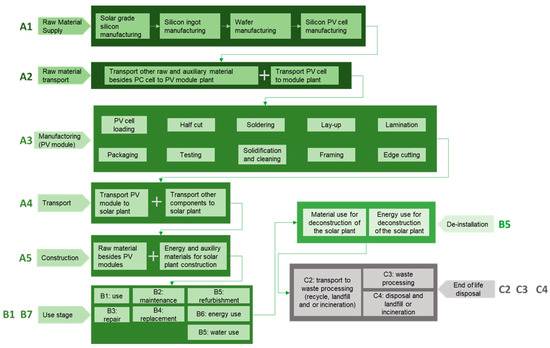
Figure 1.
Sequence and correlations between the modules of the life cycle analysis of the PV panels.
A1—Raw material supply including processing of secondary material input;
A2—Transport of raw material and secondary material to the manufacturer;
A3—Manufacture of the PV module, and all upstream processes from cradle to gate;
A4—Transport of PV module to the site installation;
A5—The PV module installation/construction and associated waste;
B1—Use of the installed PV module;
B2—Maintenance of the PV module;
B3—Repair of the PV module;
B4—Replacement of the PV module;
B5—Refurbishment of the PV modules;
B6—Operational energy;
B7—Operational water use;
C1—Disassembly of the PV module from a building;
C2—Transport to waste processing facility or to final disposal;
C3—Waste processing operations for reuse, recovery or recycling;
C4—Final disposal of end-of-life.
And for benefits and loads beyond the system boundary:
D—reuse/recovery/recycling potential evaluated as net impacts and benefits.
2.3. Check of the Modeling Requirements of Modules B1 to B7 for the Assessment of the Environmental Impacts
Ordinary and extraordinary maintenance can lengthen the useful life and performance of the PV system, but only if supported by careful planning. First, however, the correct design, installation and quality of the modules must be guaranteed.
As mentioned above, both ordinary and extraordinary maintenance have an environmental impact that must be accurately assessed. To estimate these impacts, in addition to the precise identification of maintenance activities during the usage phase required to ensure performance, it is necessary to develop scenarios and make assumptions.
The purpose is to provide the most-accurate possible indication of the impact that the usage phase has (or could have) in LCA assessments of PV modules.
Following the identification of the ordinary and extraordinary maintenance activities—to be carried out during the use phase—necessary to guarantee the performance of the system over time, the corresponding LCAs are developed by referring to the modeling requirements of the EPD modules involved in this phase, i.e., from B1 to B7 [32] (Table 2).
Table 2.
Modeling requirements of the modules B1 to B7. Source: authors’ elaborations on BRE data [32].
Despite the strong dependence among the environmental impacts caused during the use phase of the PV modules and the characteristics of the installation site, it is still possible to make some general considerations valid for all the contexts.
Regarding the cleaning interventions of the PV modules, the associated environmental impacts are related to the consumption of demineralized water per m2 [33]. The ever-expanding photovoltaic sector consumes large quantities of water, which is why increasingly efficient solutions will need to be developed to sustainably reduce its water footprint [21].
Some studies report values for water consumption ranging from 1 to 10 L/m2 of the system area [15,34].
Other impacts are caused by the equipment required for the cleaning interventions. Although EPDs for these products have not yet been developed, some general considerations can still be made at this stage.
Regarding the energy consumption of a pressure washer with a power rating between 1.3 kW and 1.8 kW, it should be calculated taking into account the operating time. In cases where the electrical energy for operation comes from the PV system, the environmental impacts can be considered negligible. Instead, it will be necessary to calculate the impacts caused by the manufacturing of the pressure washer itself.
The duration of operation also depends on the surface area of the modules. Disposal, however, involves the transportation of primarily recyclable waste, while energy consumption during the operational phase could potentially be provided by the same PV system.
The impact of pressure washers should be calculated based on an appropriate functional unit that takes into account its durability relative to the lifespan of PV modules. Similar considerations apply to the LCA of detergents, additives, monitoring systems, instruments for thermographic analysis, etc. Finally, to take into account the influence that end-of-life and waste management have on the environmental impact assessment of the use phase, the modeling requirements of the related modules, described below, are also necessary (Table 3).
Table 3.
Modeling requirements of the modules C1 to C4. Source: authors’ elaborations on BRE [32] data.
2.4. Review of the LCA Results of Modules B1 to B7 of a Significant Sample of EPDs
In order to evaluate the type of data contained in modules B1 to B7 of the EPD related to the use stage, a survey was conducted on a significant sample of EPDs. For the purposes of this study, for each EPD (identified with a code), the information collected and analyzed concerns the following: type of PV modules, factory site, type and version of the LCA software, database for the life cycle inventory (LCI), characterization factors for the life cycle impact assessment (LCIA), functional unit (FU) and reference service life (RSL), system boundaries and key assumptions for use and maintenance are presented in Table 4.
Table 4.
Summary table of data contained in the EPDs analyzed related to the modules B1 to B7 of the use stage of the PV modules.
3. Application Case of the Methodology
As an illustrative example, we have analyzed the EPD of solar monocrystalline silicon PV modules (see n.10 Table 4) [39] and the EPD of bifacial monocrystalline silicon photovoltaic PV modules (see n.11 Table 4) [40] in more detail.
3.1. EPD of Solar Monocrystalline Silicon PV Modules with Aggegated Data
This type of PV module has the following technical specifications: power output range (W): 440–460; dimensions: 2094 × 1038 (mm); module efficiency (%): 20.7. The system efficiency is 0.797; therefore, the loss of the system is assumed to be 20% [39].
In order to carry out the LCA study, in this EPD, the following main assumptions were made: electricity used during the PV plant operation is assumed to be powered by the plant itself; water used for cleaning the PV modules is assumed to be 0.2 L per module per time and two times per year; the replacement of inverter is assumed to be one inverter/2 years during RSL (30 years).
In this EPD, the LCA results related to the modules (B1 to B7) are aggregated together with those of manufacturing (A3), transport (A4), installation (A5), disassembling (C1) and transport at end of life (C2) (Table 5).
Table 5.
LCA results of core-stream-stage modules of solar mono crystalline silicon PV modules. Environmental impacts related to the manual cleaning of PV modules’ surfaces (B7) and the replacement of the inverter are data aggregated with data of modules A3, A4, A5, B1, B2, B3, B4, B5, B6, C1 and C2.
Aggregated data in core stream modules only allow us to state that greenhouse gas emissions, net freshwater consumption, WDP, ozone depletion and acidification resulting only from cleaning surfaces and for the replacement of the inverter are lower than the impacts reported in Table 5.
3.2. EPD of Bifacial Monocrystalline Silicon Photovoltaic (PV) Modules with Disaggegated Data
This type of PV module has the following technical specifications: power output range (W): 440–605; dimensions (mm): 2132 × 1084; cell size (mm): 166 × 166; cell arrangement: 144; module efficiency: (%) 27.1 [40].
In order to carry out the LCA study, in this EPD, the following main assumptions were made: module use (B1), maintenance (B2), repair (B3), replacement (B4), refurbishment (B5) and operational energy use (B6) are considered to be completely non-impacting, regarding that the product do not requires any type of modification; the operational water use (B7) for manual cleaning PV modules is 9.091 kg/m2.
The first-year power degradation of the PV modules under analysis in this EPD is no more than 2%, and their subsequent annual power degradation is no more than 0.45%.
In this EPD, the results of the assessment of the individual modules A3, A4, A5, B1, B2, B3, B4, B5, B6, B7, C1 and C2, related to the core stream, are disaggregate data for each single module (Table 6).
Table 6.
LCA results of module B7 in core stream of bifacial monocrystalline silicon PV modules.
The disaggregated data allow us to assess the impacts caused by water consumption in module (B7). The impacts are reported in Table 6.
Regarding the replacement of the inverter, it is not possible to identify the impacts with certainty since they should have been included in module B2 or B4, but this EPD n.11 declares these modules with zero impacts.
4. Results/Discussion
From the analysis of the EPD samples, it emerges that they all refer to monocrystalline silicon PV modules (three double-glass, two bifacial single-glass and one bifacial double-glass).
All EPDs use the same software for environmental analysis and the same LCI database (even if in different versions).
As regards the life cycle impact assessment (LCIA), none EPDs refer to the methodology reported EN 15804 and Traci 2; seven EPDs refer to the methodology reported in EN 15804; and two EPDs use the characterization factors reported in NPCR 029 version 1.2 and 2.
As regards to the functional unit (FU); 13 EPDs use 1 kWh as reference and 5 EPDs use 1 Wp; in 16 EPDs, the reference service life (RSL) is 30 years; and in 2 EPDs the reference service life (RSL) is 25 years.
For 9 EPDs, all the individual modules attributable to the respective three stages present the results with aggregate data.
Thirteen EPDs include hypotheses relating to water consumption for cleaning the PV modules (although three of these EPDs do not quantify them). Water consumption assumptions vary from 0.12 L/m2 to 9 L/m2.
The replacement of the inverters at the end of their life after 15 years is assumed in seven EPDs. PV modules are assumed to be replaced in two EPDs: by 3% in one EPD and 20 pieces (pcs)/year in the other one (Table 7).
Table 7.
Summary table of the hypotheses contained in the sample of EPDs analyzed relating to water consumption for cleaning the PV modules, replacing the PV modules and replacing the inverter.
From the detailed analysis of the two EPDs, it emerges that in the case of EPD n.10, with the results data in the form of aggregate data, which include impacts from processes like transport and end of waste, without separating them from the data related to water consumption, it is not possible to trace the results of the individual modules B1, B2, B3, B4, B5, B6 and B7.
In the case of EPD n.11, with the results data in the form of disaggregated data, it is possible to quantify the impacts for each individual module. For example, is possible to identify the impacts in (B7) operational water consumption using the scenario that the power plant is installed in Rome (Italy) and that the water consumption for cleaning the PV modules is 9 L/m2. Unfortunately, however, these data cannot be generalized to other contexts. Furthermore, these data are the result of an underestimated assumption of the annual power degradation (0.45%) [24].
Additionally, neither EPDs include impacts caused by inverter replacement. In this respect, it should be emphasized, with regards to the inverter, that at present, it is not possible to directly sum the data from the EPD of the inverter with the EPDs of the PV modules since the functional unit in the inverter’s EPD is a single power inverter unit (1 piece of inverter) and the functional unit of the PV modules is 1 kWh of AC power output.
For this reason, and to still have an indicative value of the impacts caused by the replacement of the inverter, it could be assumed that the impact of the inverter in the LCA of the PV modules varies from 9% to 16% [41].
5. Conclusions
The aim of this work was to verify the feasibility of using the data contained in the EPDs of PV modules as a data source for the evaluation of the environmental impacts caused by maintenance, replacement, repair, refurbishment and operational water consumption during the use phase.
From the results obtained, it emerges that for “products” such as PV modules whose performance over time depends strongly on the characteristics of the context in which they are installed, the data extractable from the EPDs cannot be generalized to other contexts.
It is necessary to know the place where the system will be installed precisely.
The EPDs, on the other hand, contain generalizable data—provided by manufacturers—relating to the production process of PV modules, and also data for the disassembly phase.
As regards waste management, the EPDs do not quantify the impacts but provide useful indications and references for the correct management of waste.
Modules B1 to B7 analyzed in this study should, similarly to what happens for the modules in end-of-life and waste management (C1 to C4), provide indications and references to the designer for their quantification; they do not, instead, as currently happens, request them from the producers.
The impacts caused by the inverter should always be part of the contents of the EPD of the PV modules as well as a reasonable hypothesis of the partial replacement of the modules in 30 years (at least 3%).
The numerous variables to consider make it difficult to generalize, in different contexts, the results of EPDs modeled according to a single hypothesis; therefore, type III EPDs should be structured taking into account the phases controlled by the producers, providing indications about the calculations to be performed in order, subsequently, to add data relating to transport, cleaning, replacement and waste management.
The interest in maintenance activities and the analysis of the usage phase has also allowed for some reflections on EPDs, highlighting the need for the promotion of a “widespread culture of EPDs”. Furthermore, more accurate results could be obtained if EPDs for the numerous products associated with PV systems were published, not just for PV modules. It would be advisable to develop PCR for the entire system, not just the modules, using the same functional unit for the LCA study of all components.
To facilitate reading and assessments, EPDs could present results in the form of disaggregated data, homogenizing activities to be attributed to upstream, core and downstream stages. Additionally, to ensure better control of the end-of-life phase, PCR could require the producer, with the necessary verification, to be responsible for end-of-life management activities for the modules. Currently, the downstream module includes relevant processes that are outside the control of the producer, such as waste processing (C3) and the final disposal of wastes (C4).
Even if EPDs do not allow for direct product comparisons, they provide the necessary information for the assessment of buildings and construction works in a holistic approach, taking into account design options, climate conditions and other constraints throughout the construction life cycle. In this context, it would be desirable, given the maturity of the industry, to have an LCA benchmark classification for classes, similar to what has been done for the energy certification of buildings.
Finally, future research developments could explore a digitalization approach aimed at managing the complex information available in EPDs.
Facility management can also be integrated with building information modeling (BIM) to optimize asset maintenance processes and ensure more efficient management of the life cycle of a facility. In this case, it is referred to as BIM facility management [42,43].
Enabled by the Internet of Things (IoT), predictive maintenance allows for the prevention of defects and breakdowns by optimizing processes.
Author Contributions
Conceptualization, G.P. and A.S.S.; methodology, G.P. and A.S.S.; software, G.P. and A.S.S.; validation, G.P. and A.S.S.; formal analysis, G.P. and A.S.S.; investigation, G.P. and A.S.S.; resources, G.P. and A.S.S.; data curation, G.P. and A.S.S.; writing—original draft preparation, G.P. and A.S.S.; writing—review and editing, G.P. and A.S.S.; visualization, G.P. and A.S.S.; supervision, G.P. and A.S.S.; project administration, G.P. and A.S.S. All authors have read and agreed to the published version of the manuscript.
Funding
This research received no external funding.
Data Availability Statement
Data are contained within the article.
Conflicts of Interest
The authors declare no conflicts of interest.
References
- IPCC 2023, AR6 Synthesis Report: Climate Change 2023. Available online: https://www.ipcc.ch/report/sixth-assessment-report-cycle/ (accessed on 15 October 2023).
- European Commission. Proposal for a Directive of the European Parliament and of the Council on the Energy Performance of Buildings (Recast) COM/2021/802 Final. 2021. Available online: https://eur-lex.europa.eu/legal-content/EN/TXT/?uri=CELEX%3A52021PC0802&qid=1641802763889 (accessed on 15 October 2023).
- ISO 21930:2017; Sustainability in Buildings and Civil Engineering Works—Core Rules for Environmental Product Declarations of Construction Products and Services. International Organization for Standardization: Geneva, Switzerland, 2017.
- EN 15804:2012+A2:2019; Sustainability of Construction Works—Environmental Product Declarations—Core Rules for the Product Category of Construction Products. UNI: Rome, Italy, 2019. Available online: https://store.uni.com/en-15804-2012-a2-2019 (accessed on 15 October 2023).
- ISO 41001:2018; Facility Management Systems—Requirements with Guidance for Use. International Organization for Standardization: Geneva, Switzerland, 2018. Available online: https://www.iso.org/obp/ui/en/#iso:std:iso:41001:ed-1:v1:en (accessed on 15 October 2023).
- ISO 41011: 2017; Facility Management—Vocabulary. International Organization for Standardization: Geneva, Switzerland, 2017. Available online: https://www.iso.org/obp/ui/en/#iso:std:iso:41011:ed-1:v1:en (accessed on 15 October 2023).
- UNI 11063: 2017; Manutenzione—Definizioni di Manutenzione Ordinaria e Straordinaria. UNI: Rome, Italy, 2017. Available online: https://store.uni.com/uni-11063-2017 (accessed on 15 October 2023).
- ISO 14040:2006+A1:2020; Environmental Management. Life Cycle Assessment. Principles and Framework. International Organization for Standardization: Geneva, Switzerland, 2020. Available online: https://www.iso.org/standard/76121.html (accessed on 15 October 2023).
- ISO 14044:2006/Amd2:2020; Environmental Management. Life Cycle Assessment. Requirements and Guidelines. International Organization for Standardization: Geneva, Switzerland, 2020. Available online: https://www.iso.org/standard/76122.html (accessed on 17 January 2024).
- ISO/TS 14074:2022(en); Environmental Management. Life Cycle Assessment. Principles, Requirements and Guidelines for Normalization, Weighting and Interpretation. International Organization for Standardization: Geneva, Switzerland, 2022. Available online: https://www.iso.org/standard/61117.html (accessed on 17 January 2024).
- ISO 14025:2006(en); Environmental Labels and Declarations—Type III Environmental Declarations—Principles and Procedures. International Organization for Standardization: Geneva, Switzerland, 2006. Available online: https://www.iso.org/obp/ui/en/#iso:std:iso:14025:ed-1:v1:en (accessed on 15 October 2023).
- EN 15804:2012+A2:2019/AC:2021; Sustainability of Construction Works. Core Rules for the Product Category of Construction Products. Comite Europeen de Normalisation: Belgium, Brussels, 2021. Available online: https://infostore.saiglobal.com/en-us/standards/en-15804-2012-a2-2019-ac-2021-337631_saig_cen_cen_3041301/ (accessed on 15 October 2023).
- Del Rosario, P.; Palumbo, E.; Traverso, M. Environmental Product Declarations as Data Source for the Environmental Assessment of Buildings in the Context of Level(s) and DGNB: How Feasible Is Their Adoption? Sustainability 2021, 13, 6143. [Google Scholar] [CrossRef]
- Strazza, C.; Del Borghi, A.; Magrassi, F.; Gallo, M. Using environmental product declaration as source of data for life cycle assessment: A case study. J. Clean. Prod. 2016, 112, 333–342. [Google Scholar] [CrossRef]
- NREL National Renewable Energy Laboratory; Best Practices Working Group. Best Practices for Operation and Maintenance of Photovoltaic and Energy Storage Systems, 3rd ed.; NREL/TP-7A40-73822; National Renewable Energy Laboratory: Golden, CO, USA, 2018. Available online: https://www.nrel.gov/docs/fy19osti/73822.pdf (accessed on 15 October 2023).
- IEA. Report IEA-PVPS T13-25:2022 Task 13 Reliability and Performance of Photovoltaic Systems Guidelines for Operation and Maintenance of Photovoltaic Power Plants in Different Climates 2022. Available online: https://iea-pvps.org/wp-content/uploads/2022/11/IEA-PVPS-Report-T13-25-2022-OandM-Guidelines.pdf (accessed on 15 October 2023).
- Kim, J.; Rabelo, M.; Padi, S.P.; Yousuf, H.; Cho, E.-C.; Yi, J. A Review of the Degradation of Photovoltaic Modules for Life Expectancy. Energies 2021, 14, 4278. [Google Scholar] [CrossRef]
- Theristis, M.; Livera, A.; Micheli, L.; Jones, C.B.; Makrides, G.; Georghiou, G.E.; Stein, J.S. Nonlinear Photovoltaic Degradation Rates: Modeling and Comparison Against Conventional Methods. IEEE J. Photovolt. 2020, 10, 1112–1118. [Google Scholar] [CrossRef]
- Theristis, M.; Livera, A.; Micheli, L.; Ascencio-Vasquez, J.; Makrides, G.; Georghiou, G.E.; Stein, J.S. Comparative Analysis of Change-Point Techniques for Nonlinear Photovoltaic Performance Degradation Rate Estimations. IEEE J. Photovolt. 2021, 11, 1511–1518. [Google Scholar] [CrossRef]
- Klugmann-Radziemska, E. Degradation of electrical performance of a crystalline photovoltaic module due to dust deposition in northern Poland. Renew. Energy 2015, 78, 418–426. [Google Scholar] [CrossRef]
- Panat, S.; Varanasi, K.K. Electrostatic dust removal using adsorbed moisture–assisted charge induction for sustainable operation of solar panels. Sci. Adv. 2022, 8, eabm0078. [Google Scholar] [CrossRef] [PubMed]
- Zahedi, R.; Ranjbaran, P.; Gharehpetian, G.B.; Mohammadi, F.; Ahmadiahangar, R. Cleaning of Floating Photovoltaic Systems: A Critical Review on Approaches from Technical and Economic Perspectives. Energies 2021, 14, 2018. [Google Scholar] [CrossRef]
- Brahma, H.; Pant, S.; Micheli, L.; Smestad, G.P.; Sarmah, N. Effect of Environmental Factors on Photovoltaic Soiling: Experimental and Statistical Analysis. Energies 2023, 16, 45. [Google Scholar] [CrossRef]
- Micheli, L. Monitoring and Modelling Photovoltaic Soiling in an Urban Environment. In Proceedings of the 2023 IEEE International Conference on Environment and Electrical Engineering and 2023 IEEE Industrial and Commercial Power Systems Europe (EEEIC/I&CPS Europe), Madrid, Spain, 6–9 June 2023; pp. 1–4. [Google Scholar] [CrossRef]
- Micheli, L.; Theristis, M.; Talavera, D.L.; Almonacid, F.; Stein, J.S.; Fernández, E.F. Photovoltaic cleaning frequency optimization under different degradation rate patterns. Renew. Energy 2020, 166, 136–146. [Google Scholar] [CrossRef]
- Meyer, S.; Richter, S.; Timmel, S.; Gläser, M.; Werner, M.; Swatek, S.; Hagendorf, C. Snail Trails: Root Cause Analysis and Test Procedures. Energy Procedia 2013, 38, 498–505. [Google Scholar] [CrossRef]
- Dolara, A.; Lazaroiu, G.C.; Leva, S.; Manzolini, G.; Votta, L. Snail Trails and Cell Microcrack Impact on PV Module Maximum Power and Energy Production. IEEE J. Photovolt. 2016, 6, 1269–1277. [Google Scholar] [CrossRef]
- Wohlgemuth, J.H.; Hacke, P.; Bosco, N.; Miller, D.C.; Kempe, M.D.; Kurtz, S.R. Assessing the Causes of Encapsulant Delamination in PV Modules. In Proceedings of the 2016 IEEE 43rd Photovoltaic Specialists Conference (PVSC), Portland, OR, USA, 5–10 June 2016; pp. 248–254. [Google Scholar] [CrossRef]
- Jentsch, A.; Eichhorn, K.-J.; Voit, B. Influence of typical stabilizers on the aging behavior of EVA foils for photovoltaic applications during artificial UV-weathering. Polym. Test. 2015, 44, 242–247. [Google Scholar] [CrossRef]
- Kwembur, I.M.; McCleland, J.C.; van Dyk, E.; Vorster, F.J. Detection of Potential Induced Degradation in mono and multi-crystalline silicon photovoltaic modules. Phys. B Condens. Matter 2019, 581, 411938. [Google Scholar] [CrossRef]
- ENEL. 2022 PCR for PV Panel: EPDItaly 014–rel. 1.1. Available online: https://www.epditaly.it/en/pcr_/pcr-for-pv-panel-epditaly-014/ (accessed on 15 October 2023).
- BRE Group. BRE Global Product Category Rules (PCR) For Type III EPD of Construction Products to EN 15804+A2 PN 514 Rev 3.0. 2018. Available online: https://it.scribd.com/document/692337244/PN514-BRE-EN-15804-PCR (accessed on 17 January 2024).
- Pfister, S.; Koehler, A.; Hellweg, S. Assessing the Environmental Impacts of Freshwater Consumption in LCA. Environ. Sci. Technol. 2009, 43, 4098–4104. [Google Scholar] [CrossRef] [PubMed]
- Zhang, D.; Liu, C.; Yu, K.; Yan, C.; Shen, Y.; An, Z.; Jing, J. Droplet cleaning method and water consumption analysis for superhydrophobic solar photovoltaic glass. Sol. Energy 2022, 235, 94–104. [Google Scholar] [CrossRef]
- PVCycle. Rapporto Annuale 2022 PV Cycle Italia. 2022. Available online: https://pvcyclegroup.it/wp-content/uploads/2023/07/PV-CYCLE-ITALIA_Rapporto-annuale-2022-1-1.pdf (accessed on 20 November 2023).
- Directive 19/EU of the European Parliament and of the Council of 4 July 2012 on Waste Electrical and Electronic Equipment (WEEE) (Recast). Available online: https://eur-lex.europa.eu/legal-content/EN/TXT/PDF/?uri=CELEX:32012L0019 (accessed on 20 November 2023).
- IEA. End-of-Life Management of Photovoltaic Panels: Trends in PV Module Recycling Technologies. 2018. Available online: https://iea-pvps.org/wp-content/uploads/2020/01/End_of_Life_Management_of_Photovoltaic_Panels_Trends_in_PV_Module_Recycling_Technologies_by_task_12.pdf (accessed on 20 November 2023).
- Fiandra, V.; Sannino, L. RT/2023/5/ENEA Analysis Report on Photovoltaic waste as source of valuable materials. In Overview on the Current Material Recovery Approaches; Department of Energy Technologies and Renewable Sources Photovoltaic and Smart Devices Division Innovative Devices Laboratory Portici Research Center, ENEA: Frascati, Italy, 2023. [Google Scholar]
- EPD Italy. 2022 Mono-Crystalline Silicon PV Modules, Registration Number MR-EPDITALY0057. Available online: https://www.epditaly.it/epd/lr4-72hbd-lr5-72hbd-lr5-72hph-lr572hibd-lr5-72hih-lr5-54hph-lr5-54hih-lr5-54hib/ (accessed on 15 October 2023).
- EPD Italy. Bi-Facial Mono-Crystalline Silicon Photovoltaic (PV) Modules, Registration Number EPDITALY0341. 2022. Available online: https://www.epditaly.it/en/epd/bi-facial-mono-crystalline-silicon-photovoltaic-pv-modules/ (accessed on 15 October 2023).
- Dodd, N.; Espinosa, N. Preparatory Study for Solar Photovoltaic Modules, Inverters and Systems—Task 4 Technical Analysis Including End-of-Life; European Commission, Joint Research Centre: Belgium, Brussels, 2018; Available online: https://susproc.jrc.ec.europa.eu/product-bureau/sites/default/files/contentype/product_group_documents/1581689975/DraftReport_Task5.pdf (accessed on 15 October 2023).
- Agostinelli, S.; Cumo, F.; Marzo, R.; Muzi, F. Digital Construction Strategy for Project Management Optimization in a Building Renovation Site: Machine Learning and Big Data Analysis. In Lecture Notes in Civil Engineering; Springer: Cham, Switzerland, 2023; Volume 306, pp. 20–35. [Google Scholar] [CrossRef]
- Muzi, F.; Marzo, R.; Nardi, F. Digital Information Management in the Built Environment: Data-Driven Approaches for Building Process Optimization. In Technological Imagination in the Green and Digital Transition; The Urban Book Series; Springer: Cham, Switzerland, 2023; pp. 123–132. [Google Scholar] [CrossRef]
Disclaimer/Publisher’s Note: The statements, opinions and data contained in all publications are solely those of the individual author(s) and contributor(s) and not of MDPI and/or the editor(s). MDPI and/or the editor(s) disclaim responsibility for any injury to people or property resulting from any ideas, methods, instructions or products referred to in the content. |
© 2024 by the authors. Licensee MDPI, Basel, Switzerland. This article is an open access article distributed under the terms and conditions of the Creative Commons Attribution (CC BY) license (https://creativecommons.org/licenses/by/4.0/).