


Abstract
This review paper synthesizes the recent advancements in voltage regulation techniques for active distribution networks (ADNs), particularly in contexts with high renewable energy source (RES) penetration, using photovoltaics (PVs) as a highlighted example. It covers a comprehensive analysis of various innovative strategies and optimization algorithms aimed at mitigating voltage fluctuations, optimizing network performance, and integrating smart technologies like smart inverters and energy storage systems (ESSs). The review highlights key developments in decentralized control algorithms, multi-objective optimization techniques, and the integration of advanced technologies such as soft open points (SOPs) to enhance grid stability and efficiency. The paper categorizes these strategies into two main types: analytical methods and computational methods. In conclusion, this review underscores the critical need for advanced analytical and computational methods in the voltage regulation of ADNs with high renewable energy penetration levels, highlighting the potential for significant improvements in grid stability and efficiency.
1. Introduction
The evolving dynamics of power distribution systems, increasingly influenced by the integration of RESs, have necessitated innovative strategies for voltage regulation in active distribution networks (ADNs). This review paper delves deeply into various methodologies that have emerged to address the challenges posed by high photovoltaic (PV) penetration and other renewable energy sources (RESs), with a particular focus on two primary types of optimization methods: analytical methods and computational methods.
1.1. Review Methodology
This literature review aims to synthesize recent research related to voltage optimization techniques in active distribution networks, specifically focused on analytical and computational methods. The key questions that guided the paper selection process are:
- What are the recent techniques used for voltage regulation in distribution grids with a high penetration of renewable energy sources?
- How are the analytical and computational optimization methods applied to manage voltage fluctuations and improve network efficiency?
- What are some of the current limitations and challenges in this research domain?
Analytical methods are crucial in understanding and solving optimization problems within power systems. These methods involve mathematical formulations and theoretical frameworks that provide insights into the fundamental principles governing system operations. They are instrumental in devising control strategies for voltage regulation, power flow management, and loss minimization in a more deterministic manner. This review explores how analytical methods are applied to develop algorithms for reactive power control, voltage stability assessment, and the efficient dispatch of PV inverters in distribution networks.
In contrast, computational methods have gained prominence with the advent of advanced computing technologies and the increasing complexity of power networks. These methods cover a wide range of algorithms and heuristic approaches, including genetic algorithms (GAs), particle swarm optimization (PSO), and other metaheuristic methods. Computational methods are particularly effective in dealing with the non-linear, multi-objective, and often stochastic nature of modern power systems. They offer robust solutions for real-time control and optimization in scenarios where traditional analytical approaches may fall short because of the high fluctuations and unpredictability of RESs.
Analytical techniques based on mathematical modeling and deterministic analysis as well as computational data-driven methods offer complementary strengths for addressing the multifaceted voltage regulation challenges in modern distribution systems. Hence, this review accentuates both categories of optimization approaches from the recent literature.
1.2. Keywords and Search Strategy
The primary keywords used in our database searches included voltage optimization, voltage regulation, voltage control, active distribution networks, renewable energy integration, photovoltaic (PV) systems, analytical optimization methods, and computational optimization methods. These keywords were carefully selected to capture the essence of the research domain, focusing on innovative strategies for managing the complexities introduced by the high penetration of RESs in ADNs.
The paper selection methodology involved keyword-based searches on databases like IEEE Xplore, ScienceDirect, and SpringerLink to filter for peer-reviewed articles from the past 5–10 years. Specific exclusion criteria included gray literature sources without rigorous analysis, centralized control techniques lacking optimization algorithms, and solutions tailored for transmission grid operations. Out of the 86 cited references, 41 papers employ analytical optimization strategies, while 45 leverage various computational methods like metaheuristics and machine learning. This indicates the nearly equal prominence given to both methodologies in contemporary research on voltage control for distribution systems. Figure 1 presents a timeline graph depicting the distribution of the cited papers by their year of publication over the previous decade. Among the 86 references cited, 79 have clearly identifiable publication years. The graph highlights that the first paper dates back to 2010, with a significant majority of the papers being published from 2016 onward. The rapidly increasing publications over the past 5 years, with a peak in 2019, provides quantitative evidence for the growing relevance and importance of voltage optimization techniques in active distribution networks. It validates the need for a comprehensive literature review synthesizing the latest advancements in this area to guide future research.
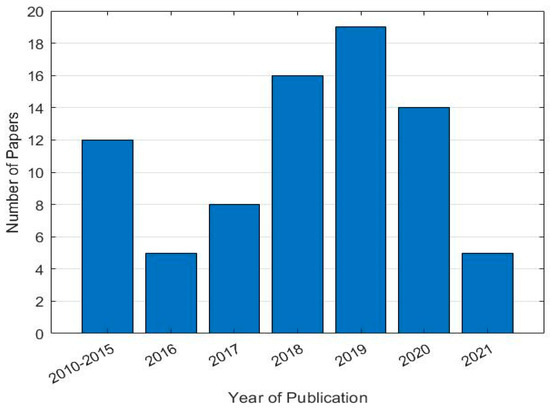
Figure 1.
Distribution of cited papers by year of publication.
The filtered papers provide the basis for a targeted synthesis of diverse voltage regulation techniques that offer promising capabilities like decentralized control, enhanced integration of renewable sources, and reduced power losses. But they also outline key limitations and gaps in translating these solutions to large-scale practical implementations. The summarized insights aim to direct future explorations in this crucial area of power distribution optimization to address grid stability and efficiency challenges.
1.3. Technological Innovations in Voltage Regulation
Smart inverters represent a significant area of focus within both analytical and computational optimization frameworks. These devices not only convert solar energy into grid-compatible power but also play a pivotal role in providing dynamic voltage support and reactive power compensation where the output reactive power of a smart inverter follows the Volt/Var and power capability curves in Figure 2.
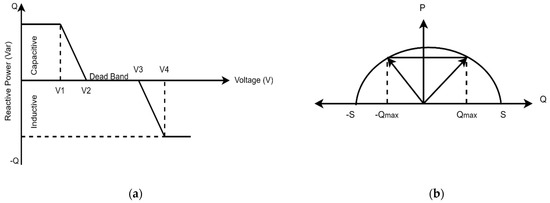
Figure 2.
PV smart inverter curve: (a) Volt/Var curve; (b) power capability curve.
This review examines various studies that utilize both analytical and computational methods to enhance the functionality of smart inverters in power distribution systems. Another critical aspect of this review is the integration and optimization of battery energy storage systems (BESSs) in conjunction with smart PV inverters. The coordination between these systems is essential for managing the intermittency of renewable sources and maintaining grid stability. This paper reviews different bi-level optimization methods and metaheuristic algorithms that leverage the capabilities of BESSs and PV inverters, highlighting how analytical and computational approaches can be combined for effective voltage regulation.
Furthermore, the paper discusses decentralized control algorithms, emphasizing the shift from traditional centralized methods to more efficient, localized control strategies. These algorithms, developed using both analytical and computational methods, demonstrate their effectiveness in managing voltage deviations and reducing line losses in complex power systems with high PV penetration.
Advancements in multi-objective optimization techniques, particularly Multi-Objective Particle Swarm Optimization (MOPSO), are also a significant focus of this review. These techniques address the complexities introduced by high levels of RES penetration, aiming to balance operational efficiency with system stability and reliability. Studies employing these methods showcase significant improvements in reducing power losses, minimizing voltage deviations, and optimizing the operation of various grid components such as on-load tap changers (OLTCs) and shunt capacitors (SCs).
Lastly, the paper explores the impact of sophisticated control mechanisms like soft open points (SOPs) and distributed static compensators (DSTATCOMs) in enhancing grid functionality. These technologies contribute to improved voltage profiles, reductions in power losses, and better management of the challenges posed by the integration of rooftop PV systems in low-voltage distribution networks.
In summary, this review paper provides a comprehensive analysis of the advanced strategies and methodologies in voltage regulation for ADNs, underlining the importance of both the analytical and computational methods. By exploring the applications of these two optimization approaches, the review highlights the significant advancements in managing the complexities introduced by renewable energy integration, setting a foundation for future developments in efficient and resilient power grid management.
2. Voltage Related Optimization Methods
2.1. Analytical Methods
2.1.1. Robust Optimization
Voltage levels can be maintained within acceptable limits through the control of reactive power, which can be produced or absorbed by PV inverters. In [1], the author presents a decentralized method for reactive power control in PV-integrated distribution networks. Utilizing linear decision rules based on a PV real power output, the approach uses an adjustable robust optimization framework, employing convex quadratic programming to ensure optimal voltage and power loss management. Demonstrated as more effective than traditional local control methods via Monte Carlo simulations, this approach offers a practical, robust solution for modern grid management with renewable energy integration; however, its dependency on accurate PV output predictions might reduce the method’s effectiveness. Reference [2] presents an innovative approach to integrating PV systems into voltage and reactive power (Volt/Var) control in distribution networks. Adhering to the new IEEE 1547-2018 standard [3], this method involves formulating local decision rules for PV inverters, allowing them to adjust reactive power based on real power output. The paper introduces two techniques for determining these rules: one based on linear programming for minimizing voltage deviations and another based on closed-form solutions from distributionally robust chance constraints. Demonstrated through simulations on networks with up to 3146 nodes, the approach effectively reduces voltage violations but with a minimal increase in network power losses. The authors in [4] propose a novel decentralized algorithm for power flow optimization in active distribution grids with high Distributed Energy Resource (DER) integration. This approach, known as Increment-Exchange-Based Decentralized Mult-objective Optimal Power Flow (MO-OPF), addresses the complexities of coordinating network operators and DER owners. The key innovation lies in its ability to solve the MO-OPF problem in a decentralized manner without compromising private DER data. The algorithm is based on quadratic functions of coupling variables’ increments, facilitating efficient and privacy-preserving interactions between stakeholders. Demonstrated through simulations on IEEE 33-bus and a real 266-bus distribution systems, the method shows its effectiveness in providing distributed Pareto optimal solutions, offering a scalable and privacy-conscious solution for optimizing power distribution in grids with significant DER penetration. To address the challenges in voltage and VAR control within distribution networks heavily integrated with PV sources, the paper in [5] introduces a multi-objective adaptive robust optimization (MOARO) approach, focusing on minimizing voltage deviations and power losses in the presence of high PV penetration. This approach is notable for its robustness in handling the uncertainties inherent in such networks. The effectiveness of this method is validated through extensive simulations on the IEEE 123-bus system, showcasing its efficiency and robustness. A comparative analysis with other multi-objective programming algorithms highlights the superiority of the proposed method in operational robustness and efficiency. This paper contributes significantly to the field of power systems, offering an innovative solution for managing complex challenges in high PV-penetrated distribution networks. A robust optimization method is proposed in [6] for controlling the active and reactive power injections of distributed generators (DGs) in coordination with transformers’ OLTCs. The mixed-integer linear programming (MILP) problem formulation accounts for uncertainties in the network admittance matrix and utilizes sensitivity coefficients for optimization. In contrast, the paper in [7] addresses voltage regulation in similar systems but emphasizes robust optimization under the uncertainties of DGs and load variations. This paper uses a mixed-integer non-linear programming (MINP) approach and validates its methodology on a modified IEEE 123-bus system, demonstrating effective voltage control despite uncertain and fluctuating generation and load conditions.
2.1.2. Advanced Optimization Techniques in Power Systems
The Alternating Direction Method of Multipliers (ADMM) is a powerful optimization technique that combines elements of dual decomposition and augmented Lagrangian methods for solving complex problems. It is particularly effective for solving large-scale optimization problems that can be decomposed into smaller, more manageable subproblems. The ADMM achieves this by breaking down the original problem into parts, solving each part separately, and then iteratively refining these solutions to converge to an optimal solution. This method is well suited for distributed optimization problems common in power systems, where it can significantly reduce computational burdens and handle communication constraints effectively. Several studies have effectively employed the ADMM in optimizing power distribution systems. Reference [8] presents a distributed approach for Conservation Voltage Reduction (CVR) in distribution systems with a high PV penetration. It introduces a multi-objective optimization model that coordinates the operation of PV inverters with traditional voltage regulation devices using a modified ADMM to address non-convex optimization challenges, ensuring quality solutions and computational efficiency. In [9], a convex quadratic program (QP) optimization model for both balanced and unbalanced systems is developed, utilizing the ADMM for distributed optimization. The model, suitable for large-scale applications, includes a two-timescale architecture for controlling DERs. Its simplicity and linear constraints ease computation, though its static nature can limit effectiveness in dynamic scenarios. The paper in [10] proposes a novel linearized voltage model for AC optimal power flow (AC-OPF) problems, leading to a tractable quadratically constrained quadratic program (QCQP), further simplified under certain conditions. The Scalable Optimal Inverter Dispatch (SOID) algorithm, which uses the ADMM for distributed implementation, efficiently adjusts the inverter dispatch to reduce power losses and effectively correct voltage deviations. Further, the author in [11] introduces a method for optimally setting transformer tap positions in distribution systems using a rank-constrained semidefinite program (SDP). The ADMM is applied to solve this relaxed SDP, demonstrating its effectiveness through case studies on single- and three-phase distribution systems, showcasing advantages over centralized methods. The work in [12] develops decentralized methods for optimal power setpoints in residential PV inverters, also employing the ADMM. This paper addresses conventional PV inverter limitations by incorporating voltage regulation and network loss minimization, demonstrating the adaptability and efficiency of the ADMM in tackling various distributed optimization challenges in power systems. Another utilizing of the ADMM but with an energy storage system (ESS) is introduced in [13]; the paper proposes a multi-objective procedure that considers various ancillary services provided by ESSs, such as voltage support and network loss minimization, along with minimizing the cost of energy from the external grid and managing congestion.
2.1.3. Advanced Hierarchical and Predictive Control
The paper in [14] introduces a groundbreaking approach to optimal power flow (OPF) in power systems, emphasizing real-time application. The authors propose a multi-stage quadratic flexible OPF (MQFOPF) framework, characterized by an object-oriented device modeling approach. This methodology allows for the seamless integration of various power system devices, enhancing the flexibility of the OPF process. A key innovation of the paper is the development of an efficient Sequential Linear Programming (SLP) algorithm, designed to solve the OPF problem in real time using a rolling horizon scheme. This scheme takes into account changing forecasts, enabling a dynamic optimization of the power system’s operations. The effectiveness of this framework is demonstrated through a case study on a real distribution feeder, showcasing its potential in managing power systems with diverse and evolving requirements. The paper also acknowledges opportunities for further optimization, particularly in improving the speed and convergence quality of the SLP algorithm. The recent advancements in voltage regulation techniques for ADNs are well captured in several innovative studies. Study [15] proposes real-time Volt/Var control using two stages. The first stage schedules OLTCs and capacitor banks (CBs), while the second stage uses a data-driven method to assess voltage violation risks and control the dispatch of electric vehicles (EVs). Additionally, a rule-based strategy is employed for coordinating PVs and CBs, enhancing the reactive power reserve, while in [16], the study introduces a double-timescale voltage control scheme using model predictive control (MPC) in distribution networks with DGs. The slow timescale control aims to rectify long-term voltage deviations, while the fast timescale control efficiently manages rapid voltage fluctuations and maximizes renewable energy capture. The control problem is solved using a sophisticated branch-and-bound algorithm, with an ADMM-based solver for mixed-integer quadratic programming (MIQP) problems. Reference [17] introduces a novel strategy for reactive power and voltage optimization over multi-periods, featuring a decoupling rolling approach. This approach accounts for the strong time-based interconnections between different devices, including PVs and OLTCs. The strategy employs Bender’s decomposition algorithm to separate the mixed-integer voltage optimization model into a master problem which addresses long-period subproblems for OLTCs, and multiple short-period subproblems for PV power. Utilizing MPC, these subproblems are then modified into a series of rolling subproblems within the time window, facilitating an efficient and smooth transition from the existing state to the optimal state. The paper focuses on achieving fast computation and effective voltage regulation by employing a simplified discrete equation for the adjustments of the OLTC tap and utilizing a linearized sensitivity matrix between the power and voltage.
2.1.4. Soft Open Point (SOP) Utilization in Voltage Regulation
A soft open point (SOP) is a power electronic device that is fully controllable. It has the capability to precisely manage the active power transfer between the interconnected feeders on each side and provide certain reactive power and voltage support as shown in Figure 3. The paper [18] introduces a method for addressing voltage and reactive power challenges in ADNs with high DG penetration. This method centers around the use of SOPs, which offer more precise and real-time control compared to traditional voltage regulation devices.
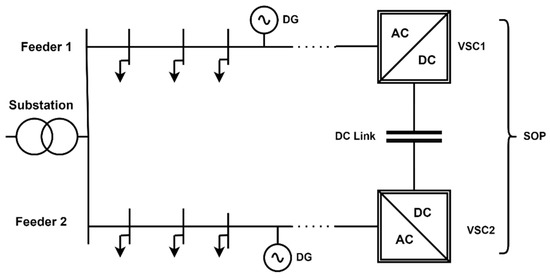
Figure 3.
Network with SOP connection.
The paper’s key contribution is a time-series optimization model that coordinates SOPs with traditional regulation devices like OLTCs and CBs. This model, which aims to minimize operational costs and eliminate voltage violations, employs linearization and conic relaxation techniques to transform the complex MINP problem into a more tractable mixed-integer second-order cone programming (MISOCP) model. Reference [19] proposes the innovative Phase-Changing Soft Open Point (PC-SOP) to address three-phase imbalances in distribution networks, often exacerbated by unevenly distributed generation. The PC-SOP connects soft open points in a novel way to control active and reactive power, balancing the power flow among phases. Key contributions include developing an optimized operational strategy for unbalanced ADNs that combines SOP regulation, ESS dispatch, and DG curtailment. This approach effectively reduces power losses and improves voltage regulation. The paper transforms the complex optimization problem into a more tractable second-order cone programming (SOCP) model.
In [20], a novel approach is presented to address voltage violations in networks with high DG integration. The strategy combines decentralized and local control of SOPs to effectively manage voltage fluctuations. Key features include a locally tuned Q/V control curve for intra-area reactive power regulation, reducing system complexity and communication needs. Additionally, decentralized coordination regulates active power transmission among areas, accommodating DG output fluctuations. The study in [21] focuses on using SOPs in networks with high distributed generation. The paper introduces a Jacobian matrix-based sensitivity method to determine SOP operating regions under varying load and generation conditions. Three optimization objectives are considered: voltage profile improvement, balancing line utilization, and minimizing energy losses. The study provides a graphical representation of SOP operating regions and quantifies the impacts of different optimization objectives, aiding Distribution Network Operators in SOP control and operation. For fully utilizing the regulation ability of SOPs, a robust optimization method is proposed in [22]. This method involves a two-stage adjustable robust optimization model that generates robust operation strategies for SOPs. These strategies aim to reduce voltage violations and minimize power losses in ADNs. The robust optimization model is formulated as a SOCP to improve accuracy and computational efficiency. However, the effectiveness of the model relies on accurately predicting the uncertainties associated with PV generation. Any inaccuracies in these predictions could impact the performance of the SOPs. A two-stage optimization method for distribution networks based on an integration of energy storage with SOPs is proposed in [23]. The first stage involves day-ahead optimization using interval optimization (IO) for optimizing the OLTC and the state of charge (SOC) selections of the BESS in every Energy Storage Integrated Soft Open Point (E-SOP). In the second one, an intra-day optimization model is utilized, which is based on the rolling optimization algorithm. This model is designed to optimize both the active and reactive power across each side of the E-SOP, as well as manage the charging and discharging power of the BESS within each E-SOP. The approach aims to reduce comprehensive operating costs, control nodal voltage within desired ranges, and improve voltage profiles and load-balancing indexes in distribution networks with high levels of DGs. The authors in [24] propose a novel voltage regulation framework utilizing SOPs and reactive powers of DG inverters. The approach is based on linearized DistFlow equations, creating a biconvex problem that minimizes voltage deviations through a coordinated scheme for SOPs and DGs. This problem can be efficiently solved by an alternative convex search algorithm. The paper’s contributions include modeling various types of SOPs and power electronic devices as nodal or line variables in a universal voltage regulation model, offering coordinated reactive power support in distribution systems. Papers [25,26] explore innovative strategies for voltage regulation in ADNs in the context of increasing DG penetration. Paper [25] introduces a combined strategy, where the active power of SOPs is centrally adjusted using global network information, complemented by local reactive power control based on real-time data. This approach aims to effectively manage voltage profiles and reduce power losses, employing convex relaxation to simplify the optimization model, while [26], in contrast, proposes a decentralized strategy using the ADMM algorithm. This method optimizes the transmission power of SOPs across network partitions, achieving near-global optimal solutions without heavy computational demands. Both strategies underscore the critical role of SOPs in enhancing operational flexibility and voltage stability in ADNs, each employing distinct methodologies to navigate the challenges posed by high DG integration.
2.1.5. Local and Coordinated Voltage Control
Paper [27] proposes a coordinated local control strategy for integrating DGs based on RESs into distribution networks. It emphasizes a collaborative approach between distribution system operators and independent power producers for voltage regulation and maximizing active power production. The control method, formulated as a non-linear constrained optimization problem, is solved using Sequential Quadratic Programming (SQP). The coordination of two voltage control algorithms is proposed in [28], where the first one is based on control rules and the other on utilizing optimization. The paper compares the network effects and costs of both algorithms and discusses their practical implementation issues. This approach offers a cost-effective solution to the traditional method of network reinforcement for mitigating voltage rise issues due to distributed generation integration. The authors in [29] present a novel two-stage optimization method to regulate voltage in unbalanced distribution networks with DGs, like solar power. It focuses on the coordination between OLTCs and Static Var Compensators (SVCs). The method’s efficiency is demonstrated by its ability to solve problems that were previously unsolvable due to computational burdens, completing tasks in less than 10 min that could take over 8 h. This is achieved through a two-stage process: a one-day-ahead optimization using the forecasted load and generation values, followed by a real-time local optimization based on the current load and generation.
2.1.6. Convexification and Relaxation
Paper [30] presents a multi-objective optimization problem for optimally allocating Dispersed Storage Systems (DSSs) in ADNs. This study aims to find the optimal balance between technical and economic goals, addressing congestion in feeders and lines, network losses, network voltage deviations, and costs associated with supplying loads, alongside the stochastic nature of load demands and renewables productions. To address these challenges, it uses a convex formulation of an AC-OPF problem which is then structured as an MISOCP problem. A novel method for managing voltage control in ADNs with high DG integration is proposed in [31]. This approach involves a centralized model for tuning the parameters of local control curves of DG inverters, focusing on optimizing reactive and curtailed active power based on local voltage measurements. Utilizing MISOCP, the method effectively converts complex MINP challenges into more tractable problems. This paper makes a significant contribution by offering an innovative solution for enhancing voltage control and reducing power losses in ADNs, emphasizing the crucial role of DG inverters in modern power systems. While the centralized-based method for parameter tuning is effective, its complexity might increase significantly with the scale of the network, potentially impacting its applicability in very large or complex distribution systems. In contrast, paper [32] introduces an Optimal Tap Control (OTC) method to regulate OLTCs by minimizing voltage profile deviations and reducing the number of tap operations. This method employs a linearization technique to convexify the optimization problem, allowing it to be solved efficiently at operational timescales. The study in [33] introduces an optimization method that integrates VAR optimization with network reconfiguration to minimize power losses and prevent voltage violations. This approach involves formulating reactive power of DGs, VAR compensators, tap-changer positions, and branch states as decision variables in an MISOCP model. The method successfully transforms a non-convex three-phase model into this format using techniques like second-order cone relaxation and piecewise linearization, including a detailed linearization of the typically neglected non-linear transformer model. This developed method showcases substantial improvements in reducing network losses and mitigating voltage violations, positioning it as an effective tool for active distribution network management. Reference [34] introduces an innovative approach to optimizing energy dispatch in distributed PV systems, aimed at enhancing Advanced Distribution Management Systems (ADMSs). The study proposes a convex optimization model that controls smart inverters in distributed PV systems for voltage regulation and conservation voltage reduction. This model, which employs a linearized power flow and the gradient projection algorithm, is tested on an open-source ADMS platform, demonstrating its effectiveness in improving grid operations. The paper also outlines a control architecture for coordinating smart inverter outputs, supported by simulations that validate the approach. Paper [35] presents a novel approach to voltage regulation in networks with a high penetration of DERs. It formulates the issue as an optimization program to minimize network losses, considering constraints on bus voltage, power injections, and transmission line limits. The paper establishes conditions for solving this problem through convex relaxation and semidefinite programming. A key contribution is the development of a distributed algorithm that is robust against communication failures and efficient for large-scale networks.
2.1.7. Other Optimization Frameworks
The authors in [36] propose a novel approach using simplified linear equations to represent the characteristics of voltage control devices. This approach involves formulating the voltage equations of the distribution network using QP, which incorporates the control ranges of voltage devices and operating voltage ranges of the network. The method utilizes MIQP for deriving optimal solutions. The results were compared with the optimal results of a global search method and were almost identical to the optimal solution; however, the use of simplified linear equations may not capture the full complexity of real-world distribution networks, especially under varying load and generation conditions. A probabilistic optimization strategy for the effective use of PV generators in voltage regulation of distribution networks is introduced in [37]. This strategy incorporates probabilistic scenarios of PV output into a constrained optimal load flow planning analysis, aiming to minimize a voltage deviation index that reflects the quality of voltage regulation. The novel aspect of this approach lies in using the PV generators, such as capacitors and inductors, scheduling their reactive power compensation monthly to be in sync with the high-voltage/medium-voltage (HV/MV) substation OLTC settings. A key feature of this strategy is its independence from a communication infrastructure and the absence of feedback voltage control. In [38], an innovative optimization strategy that controls both the reactive and real power of single-phase PV inverters is presented. This approach aims to enhance voltage profiles and voltage balance while reducing network losses and the costs associated with generation. The authors formulate a multi-objective OPF problem, solved using a global SQP method. The paper in [39] presents a multi-objective optimization approach, which can effectively coordinate the reactive power provided by smart inverters and tap operations of OLTCs in multi-phase unbalanced distribution networks. The primary objectives are to reduce voltage deviations and the number of OLTC tap actions. The paper introduces a novel linearization method for power flow equations, which helps to convexify the optimization problem, ensuring convergence and reducing computational costs. This approach is modeled and solved using MILP. In [40], a framework for optimizing distribution systems using linearized power flow equations is proposed. The optimization addresses control variables such as adjustable capacitors, voltage regulators (VRs), and configurations of the system to achieve objectives like loss minimization and voltage profile improvement. The problem is formulated as MIQP, which guarantees optimal solutions. The framework incorporates system operational constraints including feeder capacities, drops in voltage levels, and switching operations. Key advantages of the proposed method include its general applicability to distribution system optimization, efficient solution algorithms, known optimality gaps providing effective stop criteria, and realistic load modeling accounting for voltage dependency. However, the use of linearized power flow equations, while simplifying the optimization process, might not capture all the non-linear dynamics of real-world distribution systems, potentially affecting the accuracy of the optimization results. Reference [41] presents a sophisticated approach to managing and controlling distributed generation in electric distribution systems. It introduces a two-stage short-term scheduling procedure, integrating a day-ahead scheduler and an intra-day scheduler, to optimize the production of various energy and control resources, including embedded generators, reactive power compensators, and transformers with on-load tap changers. The day-ahead scheduler plans the distribution of resources for the next day, while the intra-day scheduler adjusts these plans every 15 min based on the operational requirements and constraints of the network. The intra-day scheduler employs the MILP algorithm to solve a non-linear multi-objective optimization problem, with linearization achieved using sensitivity coefficients derived from three-phase power flow calculations. A decentralized control algorithm in [42] is presented for optimizing reactive power in electrical distribution networks with PV sources. The main focus of the paper is on developing a control strategy that minimizes voltage deviations and line losses by optimally dispatching the reactive power of PV inverters. This is achieved by correlating the optimal reactive power dispatch with locally measurable quantities, such as node voltage, reactive power consumption, and PV generation. The paper demonstrates that a near-optimal local control strategy, derived from global optimization problem solutions under various operating conditions, performs effectively. It closely matches central optimal solutions and shows potential for real-time voltage control in complex power systems with high PV penetration. However, there is still a need for further research in more general scenarios, including varying levels of PV penetration and different line characteristics.
2.2. Computational Method
2.2.1. Heuristic Optimization Methods
Recent advancements in voltage regulation for ADNs with high PV penetration have led to innovative strategies to minimize voltage fluctuations and optimize network performance. Paper [43] introduces a method based on worst-case voltage scenarios (WCVSs) using MINP. This approach, which coordinates CBs, OLTCs, and PV plants, aims to minimize operational losses, limit voltage variations, and reduce the flow of reactive power through OLTCs, and decrease the number of switch operations in substation CBs. Similarly, the research detailed in [44] proposes a centralized–decentralized voltage regulation method, considering the optimization of substations while regulating voltage variations. Both papers employ multi-objective MINP models and solve them utilizing the non-dominated sorting genetic algorithm II (NSGA-II). Additionally, they incorporate decision-making algorithms to choose optimal solutions from the Pareto front. These studies emphasize the importance of sophisticated optimization techniques in improving the stability and efficiency of power distribution networks in the era of renewable energy integration.
Several papers emphasize the effectiveness of GAs in optimizing power distribution systems with smart inverters. Reference [45] proposes a multi-objective genetic algorithm to optimize smart inverter Volt/Var curves for voltage regulation and loss minimization. Tested on an IEEE 13-node feeder model, optimized curves reduced system losses and improved voltage profiles compared to a baseline curve. Minimizing the reactive power injection showed a more significant loss reduction than absorption minimization. However, only one PV system size/location is evaluated; thus, the optimization results could vary for different PV sizes and distributions on the network. In [46], the author presents a novel co-optimization technique using a GA for managing voltage fluctuations in power distribution networks with high PV penetration. This technique integrates individual optimization algorithms for Load Tap-Changing (LTC) transformers, SCs, and smart inverters to determine their optimal settings. The primary goal is to minimize system power losses while optimizing the smart inverter power factor settings and ensuring conservative voltage reduction. In [47], a novel algorithm, utilizing GAs, to optimize the parameters of Volt/Var curves in smart inverters is introduced. This optimization aims to enhance the performance of distributed generation systems. The key objectives of the algorithm include minimizing voltage deviations, reducing network losses, and limiting the peak of reactive power. The algorithm addresses various limitations of previous studies by incorporating a multi-objective optimization function that adjusts Volt/Var curve parameters, considering service transformers’ effects, and analyzing system improvements based on the number of parameters optimized. The approach also evaluates the implementation of optimized Volt/Var curves during practical periods and assesses suitable Volt/Var curves for clustered photovoltaic generators. Study [48] introduces a deep reinforcement learning (DRL)-based algorithm for coordinating multiple smart inverters. This approach balances voltage regulation and reactive power utilization, adapting to varying conditions without the need for extensive network model knowledge. It demonstrates near-optimal performance in maintaining grid voltage limits and significantly reducing PV production curtailment.
A coordination between BESS and smart PV inverters is proposed in [49]. The study introduces a voltage management approach with two controlling stages: using BESS and smart PV inverters’ reactive power injection capabilities. The core of this strategy is a bi-level optimization method, leveraging metaheuristic optimization algorithms (MOAs) such as Social Spider Optimization (SSO), Particle Swarm Optimization (PSO), and Cuckoo Search Optimization (CSO). This approach regulates voltage levels by managing the BESS charging and discharging rates. The method aims to increase the utilization of energy from PVs and wind resources, along with enhancing voltage profiles. A notable aspect of this research is its consideration of uncertainties in PV system generation, integrating PV generation forecasts to enhance the decision-making process for BESS operation. The results demonstrate that appropriate coordination between BESSs and smart PV inverters can significantly enhance distribution system operations, enabling a seamless integration of PVs and wind energy. However, employing three different MOAs for which there is no comprehensive comparison in the literature means that this lack of comparative data might impact the ability to fully assess the effectiveness of these algorithms in the specific context of electrical distribution systems with high renewable integrations. The paper in [50] presents a novel optimization technique known as Locust Search (LS) for addressing the Optimal Capacitor Placement (OCP) issue in radial distribution networks. This problem, characterized by its complexity due to high multi-modality, discontinuity, and non-linearity, involves strategically installing capacitor banks within electrical distribution systems. Proper allocation of these banks can significantly improve the feeder’s voltage profile and reduce power losses, leading to substantial energy savings and cost reductions. The LS algorithm, inspired by swarm optimization, was tested on several IEEE radial distribution test systems and compared against other techniques. The results indicate that the LS-based method effectively addresses the OCP problem, demonstrating high accuracy and robustness in optimizing capacitor placement for improved network performance.
Reference [51] introduces a novel approach to enhance voltage control in distribution systems by utilizing end-user reactive-power-capable devices. This integration is aimed at providing substantial support to the grid’s voltage profile. The study develops a Centralized Support Distributed Voltage Control (CSDVC) algorithm that decomposes the distribution system into different areas using ε-decomposition. It identifies Q-C buses, or candidate buses, which are optimal for reactive power injection. The approach calculates the optimum reactive power injection for each of these candidate buses in every area, along with the necessary tap position of the regulator, using a GA. The CSDVC algorithm is particularly designed to address inaccuracies in load forecasting and potential faults in control area centers, ensuring secure and reliable reactive power control. This advanced technique exhibits potential for application in current electrical distribution systems. However, the use of end users as reactive power support introduces uncertainty due to their stochastic behavior. Changes in consumption patterns can lead to insufficient reactive power in local regions, posing challenges for maintaining voltage stability. Additionally, if a local control center fails, the entire control system for that region may become inoperable. An optimization model using the Grey Wolf Optimization (GWO) heuristic search method is proposed in [52]. This model aims to coordinate various distribution controllers, including tap-changing transformers, capacitors, and PV inverters, to minimize voltage deviations and ensure that all voltages stay within specified limits. The effectiveness of the GWO method was compared with other heuristic-based optimization methods: Differential Evolution and Harmony Search. The results from simulations indicated that the GWO method was effective in managing voltage fluctuations and maintaining operational limits in these distribution networks. Another work using the coordination between PV inverters and the tap position of OLTCs in the distribution network is presented in [53] as a schedule method. This scheduling is based on a pattern search optimization algorithm, which utilizes predicted load demand and PV active power generation. The primary objectives are to reduce bus voltage deviations and minimize the losses of the network while keeping the number of tap operations within a predefined limit. Additionally, the paper includes a stochastic analysis to assess the effectiveness of this optimal scheduling method in the presence of inaccurate forecasting in load demand and PV generation, highlighting the robustness of the work approach under uncertain conditions.
2.2.2. SOPs and PSO Algorithm in Voltage Regulation
Paper [54] proposes a novel control method for regulating voltages in unbalanced three-phase electrical distribution systems. This method addresses a constrained optimization problem that aims to minimize voltage deviations and maximize the active power output of DERs. The harmony search algorithm is employed to solve this optimization problem. To demonstrate the efficacy of this approach, the IEEE 13-bus distribution test system was modified and tested in three scenarios: (a) a system controlled only by voltage regulators, (b) a system controlled solely by DERs, and (c) a system controlled by both voltage regulators and DERs. The simulation results indicate that systems with a combination of voltage regulators and DER controls achieve a better voltage profile, highlighting the potential of integrating DERs into voltage regulation strategies for improved system performance. The parameters of the harmony search algorithm are carefully selected, and the convergence criterion is based on the change in the best objective function value. However, setting these parameters and determining the appropriate convergence criteria can be challenging and may impact the efficiency and accuracy of the algorithm.
The use of SOPs and the PSO algorithm as key tools for addressing the challenges in electrical distribution networks has been a common thread in several research papers, especially in the context of high levels of DGs and the integration of RESs, such as PV systems and wind turbines. In [55], a multi-objective optimization framework is proposed. This framework leverages SOPs—advanced power electronic devices adept at managing precise active and reactive power flows. The research employs an enhanced version of the PSO algorithm, the MOPSO, combined with a local search technique, the Taxi-cab method. This approach aims to optimize various operational aspects, including power loss reduction, feeder load balancing, and voltage profile improvement, demonstrating its effectiveness in a 69-bus distribution network. Similarly, reference [56] investigates the complexities in distribution networks arising from renewable energy integration. It identifies key issues like overvoltage, load imbalances, and fluctuating power outputs, proposing the installation of SOPs. The PSO algorithm is utilized to determine the optimal operating parameters for SOPs, focusing on minimizing bus voltage deviations and total line losses. Moreover, in [57], the enhancement of ADNs through the integration of DG units is discussed. The paper aims to improve energy efficiency by reducing power system losses and optimizing voltage profiles while adhering to system constraints. The methodology involves network reconfiguration, including strategic control over the quantity, size, and placement of DG units and the use of SOPs for advanced power flow control. Once again, a modified PSO algorithm is employed to determine the best system configuration, encompassing the optimal sizing and positioning of DG units and the allocation and dimensioning of SOPs. Additionally, paper [58] explores the integration of DG units and the control of SOPs in ADNs. This study aims to enhance system efficiency by reducing power losses, improving voltage profiles, and balancing feeder loads. It presents a strategy for reconfiguring the network through the optimal determination of the number, location, and size of DGs and optimally managing SOP operations. A Modified Particle Swarm Optimizer (MPSO) is used as a crucial tool for handling the variables involved. The paper in [59] introduces a Mutation Fuzzy Adaptive Particle Swarm Optimization (MF-APSO) algorithm to solve the multi-objective optimization problem, effectively balancing the mitigation of overvoltage issues and reduction in total line losses. The methodology is demonstrated using numerical results, showing that the proposed multi-objective optimization method outperforms conventional methods, enabling an enhanced utilization of high-penetration PV systems with reduced power curtailment due to improved voltage regulation and line-loss minimization.
On the other hand, ESSs have become pivotal in voltage optimization within power networks; especially in the context of integrating RESs, PSO plays a key role in these developments. Reference [60] proposes a two-stage methodology to optimize reactive voltage control in distribution networks with PVs and ESSs. It addresses the challenge of voltage control due to the unpredictability of DGs by combining network reconfiguration with reactive resources. The first stage involves finding an optimal network topology with minimal line losses and reconfiguration, while the second stage determines the output of reactive power devices for each hour, including PV inverters and energy storage devices. In [61], the study introduces an improved particle swarm optimization (I-PSO) method for optimizing both active and reactive power of the BESS to mitigate voltage fluctuations. This approach is demonstrated to be more effective than the standard PV smoothing mode. In [62], the author introduces an improved MOPSO algorithm for determining the optimal capacity and locations of ESSs. The algorithm aims to minimize voltage deviations and ESS capacity costs. A novel two-stage majorization configuration model to optimize a hybrid energy storage system (HESS) in ADNs is presented in [63]. The model specifically addresses the challenges posed by volatile energy sources like wind and solar. By integrating both lead–acid batteries and supercapacitors, the study aims to balance costs, network losses, and node voltage deviations. The unique aspect of this paper is the use of a revised MOPSO approach to solve capacity configuration challenges, further enhanced by a quantum particle swarm optimization with a chaotic mechanism for operational optimization. Reference [64] integrates the reactive power control function of PV inverters with the charge/discharge characteristics of ESSs to optimize voltage deviations. The study employs an improved adaptive PSO algorithm based on distributed information, demonstrating through simulations that this methodology more effectively improves voltage deviations in distribution networks compared to existing reactive power optimization strategies. This approach highlights the potential of coordinated control strategies in managing voltage issues in modern power systems with significant renewable energy integration. However, in grids where such storage systems are not widely deployed or are of limited capacity, the effectiveness of the approach could be reduced.
Papers [65,66] both employ the NSGA-II genetic algorithm for optimizing ESSs in ADNs, whereas paper [65] focuses on reducing power losses and voltage violation risks through extended reactive power optimization, considering the output of PV storage systems. In contrast, the paper in [66] aims at optimal placement and capacity sizing of battery storage systems, targeting overall cost, load, and voltage fluctuation reduction.
Recent research employs diverse optimization algorithms to effectively manage voltage stability and efficiency in power networks with varying levels of renewable energy integration. The study in [67] introduces decentralized optimization methods as an alternative to traditional centralized methods, overcoming challenges like high computational costs and data privacy concerns. The study focuses on optimizing the operation of voltage regulators and energy storage devices through decentralized coordination. It employs two methods: the Advanced Arithmetic Optimizer algorithm and the Profile Steering approach, aiming to improve the reliability and efficiency of optimization processes while minimizing communication and computational costs. In [68], the paper explores optimal sizing and siting of DG units to improve voltage profiles and reduce power losses. It also examines the role of BESSs in peak shaving. The paper utilizes a Harris Hawks Optimization (HHO) algorithm for finding near-optimal solutions, tested on 33- and 141-bus distribution test systems. The paper in [69] introduces a method for voltage regulation in distribution networks using BESS units. It focuses on optimizing BESS unit operation in networks with high solar PV penetration. The method uses sparse optimization techniques for minimal unit engagement and power output variation. A distributed Lagrangian primal-dual sub-gradient algorithm is employed for decentralized decision making. A stochastic multi-objective framework for daily control of Volt/Var in distribution networks is proposed in [70]. The objective is to lower power losses, minimize voltage deviations, reduce the costs of energy, and decrease overall emissions. The approach incorporates uncertainties in hourly demand, wind energy, and solar radiation within a scenario-driven probabilistic model and utilizes an evolutionary algorithm through a Modified Teaching–Learning Algorithm (MTLA) to solve the MINP problem.
2.2.3. Multi-Objective Optimization
Recent advancements in active distribution network optimization emphasize the integration of sophisticated multi-objective optimization techniques, particularly MOPSO, focusing on managing the complexities introduced by high RES penetration levels. In [71], the author proposes a novel approach for Volt/Var optimization in ADNs with RESs. This approach employs a two-timescale multi-objective coordinated control system, focusing on minimizing power losses and reducing the number of control actions required for OLTCs and SCs over a 24 h period. The paper introduces a three-step method, including local search, global search, and user preference to address the multi-objective MINP problem. The optimization is performed every 6 h, considering the variability in day-ahead predications of RESs, and every 15 min for the reactive power control of RESs, explicitly accounting for RES uncertainties. The strategy employs a group-based MOPSO for global search and the Interior Point Method (IPM) for local search and real-time optimization. The efficacy of this methodology is demonstrated using the IEEE 33-bus distribution network, showcasing significant improvements in power loss reduction and effective voltage regulation in the presence of RES uncertainties. Similarly, reference [72] presents a comprehensive approach to reactive power control in ADNs. This approach involves formulating a multi-objective mixed-integer non-linear optimization problem focusing on reducing active power losses and minimizing voltage deviations. The solution employs a group-based MOPSO and fuzzy logic to find Pareto optimal solutions and select a preferred compromise solution. A composite load model, including plug-in electric vehicles, static induction motors, and ZIP loads, is used to better represent load behaviour. Further, in [73], the application of MOPSO is employed for an optimal reactive power dispatch (ORPD) strategy. This strategy focuses on reducing active power losses and minimizing voltage deviations by effectively coordinating OLTC transformers, CBs, and DGs. The paper highlights the efficacy of the MOPSO algorithm in handling non-linear functions, continuous and discrete variables, and multiple constraints. By utilizing this method, the authors demonstrate improved active power loss reduction and voltage profile optimization in distribution systems, offering a valuable contribution to the field of smart grid technology and renewable energy integration. In [74], the paper introduces a multi-stage, multi-objective Volt/Var control strategy incorporating high solar PV penetration in smart grids. It focuses on enhancing energy efficiency through CVR in distribution networks. The strategy comprises a dual approach: a slow timescale control for planning and a fast timescale control for real-time operations. In the planning stage, the paper employs a Discrete Multi-Objective Particle Swarm Optimization (DMOPSO) for stochastic multi-objective Volt/Var optimization, addressing uncertainties and inaccuracies in predicting load demand and PV generation. For real-time operations, it utilizes an adaptive Volt/Var droop-controlled approach to manage voltage fluctuations induced by sudden variations in PV output. The research demonstrates significant improvements in reducing peak demand, daily energy demand, and system losses, offering a comprehensive control strategy for modern power systems with significant renewable energy integration. A mathematical model for reactive power regulation based on MPC is presented in [75]. The model proposes a multiple-timescale optimal reactive voltage control method, specifically designed to lower the impact of uncertainties from wind and photovoltaic energy sources on voltage control. To validate this approach, the study employs the IEEE 57-node system integrated with RESs. The efficiency of the model is exhibited using the Whale Optimization Algorithm combined with Simulated Annealing (WOASA). The results from this approach show that the multiple-timescale control method significantly enhances the operational safety of the power grid and effectively leverages the potential of reactive power regulation.
Paper [76] proposes a novel Volt/Var (VV) co-optimization strategy for managing the challenges of PV integration in low-voltage distribution networks. It addresses the limitations of traditional models that assume a single voltage level and balanced networks. The study introduces a three-stage approach, coordinating the operation of medium-voltage switched capacitors and low-voltage PV inverters, to improve voltage profiles and reduce power losses, and solved by employing improved direct load flow and MPSO methods.
The work in [77] investigates the impact of integrating DSTATCOMs and PV units in Tala City, Egypt’s distribution network. Using an improved sine cosine algorithm, the study assesses the network at varying PV penetration levels and optimizes the placement of DSTATCOMs and PV units to minimize power losses and improve voltage stability. The results show significant enhancements in power loss reduction and system stability when combining PV units with DSTATCOMs, demonstrating the effectiveness of this integrated approach.
2.2.4. Control and Optimization Integration
Reference [78] introduces a two-stage optimization strategy to manage voltage fluctuations and minimize power losses in distribution systems with high PV penetration. The first stage involves a day-ahead optimal strategy focused on minimizing total voltage deviations and power losses, constrained by the maximum allowable operations of OLTCs and SCs. The second stage involves real-time inverter reactive power control to adjust for the uncertainties in PV output and load demand. This stage utilizes an artificial neural network (ANN) to estimate system states. Both optimization problems are formulated as non-linear problems and are solved using direct search algorithms. The effectiveness of this method is validated using a Hardware-In-the-Loop (HIL) simulation platform on a modified IEEE 34-node test feeder.
The increasing integration of RESs into power systems has led to the advent of advanced technologies like smart inverters, which are instrumental in maintaining voltage stability and efficiency. Smart inverters, primarily used in PV systems, convert the variable direct current (DC) output of solar panels into a grid-compatible alternating current (AC). Beyond this basic function, they are increasingly recognized for their capability to provide dynamic voltage support and reactive power compensation as shown in Figure 1, which are essential for stabilizing the grid amidst the variable nature of solar energy. In light of this context, paper [79] addresses a critical aspect of modern power distribution systems: the coordination of these smart inverters with traditional Volt/Var control (VVC) devices. The paper proposes a coordinated methodology for Volt/Var optimization (VVO) that combines the rapid response capabilities of smart inverters with the established functionality of traditional VVC devices including shunt capacitor banks (SCBs), OLTCs, and VRs. This approach is aimed at effectively managing voltage fluctuations that occur because of the variable nature of RESs, changes in network configurations, and varying load demands. The methodology encompasses both centralized and local control algorithms with an objective to reduce the total cost of operating, while considering CVR and the voltage deviation of nodes. Additionally, the study examines the influence of a BESS on the overall system performance. To tackle this multi-objective optimization challenge, the fuzzy decision-making technique and ϵ-constraint method are applied. The efficiency of the proposed VVO methodology is verified through its application to a well-known 33-bus distribution system, showcasing significant improvements in energy consumption efficiency, reduction in OLTC switching operations, and voltage stabilization. The subsequent study, ref. [80], focuses on enhancing distribution system performance by optimizing the Volt/Var function in smart inverters. This method addresses voltage deviations caused by DG connections, aiming to reduce voltage deviations and minimize the loss of lines without affecting the distributed generation output. The algorithm’s effectiveness is demonstrated through a case study on the South Korean distribution system, confirming significant improvement in system performance through optimized smart inverter settings. The author in [81] addresses the challenges of increased line losses and voltage deviations in distribution networks due to high PV and EV penetration. The study proposes new reactive power regulation methods, utilizing the potential of PVs and EVs, to alleviate these challenges. It establishes reactive power regulation models for PVs and EVs, along with methods to evaluate their reactive power-adjustable capacity dynamically. The paper employs five different algorithms for optimization, with deep learning used to approximate the optimization objectives of minimizing line losses and voltage deviations. The results demonstrate the effectiveness of deep learning in accurately fitting the Pareto front achieved by intelligent algorithms in practical applications.
2.2.5. Other Optimization Techniques
Using the Sparrow Search Algorithm (SSA), the study in [82] coordinates OLTCs, VRs, smart inverter settings, and switched capacitor banks to optimize the unbalance and variation in voltage. The approach addresses individual phase voltage regulation, considering the operational dynamics of these devices and the unbalanced load conditions. The results show significant improvements in voltage variation and unbalance, demonstrating the efficacy of the SSA in optimizing the system’s performance. In [83], the study employs probability distribution models to estimate power generation and network load demands, considering the fluctuations in load, along with the variability in solar radiation and wind speed. It utilizes the Open Distribution System Simulator (OpenDSS) for modeling ADNs and aims to reduce network voltage deviations and minimize power losses. The paper introduces numerous novel metamodel-based global optimization (MBGO) methods, comparing them with traditional metaheuristic global optimization (GO) methods to identify their respective advantages, limitations, and weaknesses. Simulations on different bus systems demonstrate that MBGO methods are more suited for small- and medium-scale ADNs, while metaheuristic GO algorithms perform better in large-scale ADNs with simpler objective functions. In [84], a multi-objective hierarchically coordinated VVC method that utilizes droop-controlled PV inverters is proposed. The approach is designed to reduce the voltage deviations and power losses through the optimization of reactive power setpoints and droop control functions in PV inverters. It includes a comprehensive modeling of the droop control characteristics of PV inverters, including voltage ranges and droop slope gradients. To tackle the random variations in PV power generation, the paper applies Taguchi’s orthogonal array testing technique. The effectiveness of this method is demonstrated through tests on two distribution systems, showing improved control performance compared to existing methods. The papers in [85,86,87] highlight innovative methods and algorithms to optimize and control ADNs, ensuring the stable operation and efficient integration of renewable energy sources. In [85], the author proposes a technique using big bang–big crunch (BB-BC) optimization and reactive power compensation to control voltage profiles in distribution systems, thereby avoiding active power curtailment in DGs. The method involves optimizing regulator taps and reactive power contributions of capacitors and DGs, implemented by a central control unit for effective voltage management and increased DG penetration. On the other hand, the paper in [86] presents a scheme for their optimal placement in distribution networks to enhance system performance. The strategy employs the artificial bee colony (ABC) optimization approach, focusing on reducing voltage deviations, power losses, and line loadings, contributing to improved voltage profiles and network functionality. The paper in [87] proposes a strategy for optimal voltage control in distribution networks, coordinating various distributed equipment like transformers, voltage regulators, and compensators. The strategy uses a GA to manage operations effectively, tested on a network model with photovoltaic generation to validate its efficacy in voltage control.
3. Discussions on Optimization Strategies, Methods, and Practicality
The integration of RESs, especially PV systems, into power distribution networks introduces a complex blend of opportunities and challenges in voltage regulation and system stability. This paper’s exploration of various optimization strategies and technologies provides an insight into the evolving landscape of active distribution network management.
3.1. Common Trends: Objectives, Algorithms, Architectures, and Benchmark Case Studies
In analyzing the various analytical and computational techniques applied for voltage regulation, some key commonalities emerge in the optimization objectives and algorithms adopted across studies reflecting contemporary research priorities. The cumulative percentages provided in the analysis reflect the proportion of papers focusing on specific optimization objectives, algorithms, architectures, and test systems offering insights into the research trends and focal points within the domain.
3.1.1. Objectives Analysis
- (a)
- Voltage Deviation Minimization
Minimizing voltage deviations, emphasized by 64% of the studies, underscores the critical importance of stability in power systems. This focus reflects the pivotal role that voltage stability plays in ensuring the reliable operation of electrical devices and maintaining the integrity of the power grid. The significant attention on this objective demonstrates an ongoing effort within the research community to enhance grid reliability and performance under varying load conditions.
- (b)
- Active Power Loss Reduction
The fact that around 53% of the studies target the reduction in active power loss is indicative of a broader push toward efficiency in power distribution. By minimizing losses, utilities can achieve significant energy savings and reduce operational costs, which is essential in the context of growing energy demands and the push for sustainable energy practices.
- (c)
- Correlation Between Voltage and Loss Reduction
The fact that there is about a 44% overlap between papers focusing on minimizing voltage deviations and reducing power losses indicates a significant intersection in research objectives, demonstrating that nearly half of the studies in this domain consider these two issues concurrently. This overlap highlights the intertwined nature of voltage stability and efficiency in power systems, where addressing one often contributes to improvements in the other.
- (d)
- Conservation Voltage Reduction
Although less emphasized, the fact that 12% of the papers focus on conservation voltage reduction (CVR) signifies an interest in demand-side management strategies. CVR can be an effective tool for reducing peak demand, thereby enhancing the overall efficiency of the power system and potentially deferring the need for new generation capacity.
3.1.2. Algorithm Analysis
- (a)
- Metaheuristic Algorithms
Over 67% of papers leverage metaheuristic algorithms for handling complex, non-convex problems. The popularity of metaheuristic algorithms, including Particle Swarm Optimization (PSO), Genetic Algorithm (GA), and Multi-Objective PSO (MOPSO), reflects their flexibility in navigating complex, multi-dimensional search spaces. These algorithms are well suited for optimizing non-linear, multi-objective problems characteristic of voltage regulation tasks, where trade-offs between different objectives might need to be carefully balanced.
- (b)
- Convex Optimization
Almost 32% of the papers apply convex relaxation/convexification techniques. The use of convex optimization techniques, such as Second-Order Cone Programming (SOCP), Semidefinite Programming (SDP), and the Alternating Direction Method of Multipliers (ADMM), points to a methodological approach aimed at simplifying complex optimization problems. By reformulating or approximating non-linear, non-convex problems as convex ones, researchers can leverage powerful mathematical tools to find globally optimal solutions more efficiently.
3.1.3. Benchmark Case Studies
A number of benchmark case studies are recurrently used within the literature, including IEEE bus systems (e.g., IEEE 33-bus and IEEE 69-bus) and real-world network models. However, the IEEE 33-node feeder and IEEE 123-node feeder models are frequently adopted benchmarks to compare voltage regulation techniques. These case studies serve as common grounds for validating and comparing the effectiveness of different optimization strategies.
3.1.4. Common Optimization Architecture
Recent studies have increasingly focused on decentralized and distributed optimization approaches, highlighting a shift toward more scalable and resilient voltage regulation solutions that can better accommodate the distributed nature of renewable energy resources. However, the centralized optimization at a system level still adopts architecture. The performance of centralized optimization strategies relies heavily on having accurate system data and forecasts. A few papers do analyze the impact of uncertainties and inaccuracies in the inputs [22,43,71,78]. The lack of studies analyzing the impact of false or uncertain data represents a gap in validating the real-world performance of the proposed centralized optimization schemes. More research is likely required to enhance optimization robustness under data inaccuracies.
3.2. Efficiency and Application: Analytical vs. Computational Methods in Voltage Optimization
A detailed comparison between analytical and computational methodologies is presented, focusing on the advantages, limitations, key applications, and, notably, their time efficiency and processing speed. Outlined in Table 1, the analysis illuminates the distinct capabilities and performance of both approaches in addressing voltage optimization challenges in active distribution networks. This evaluation aims to assist researchers and practitioners in selecting the most suitable technique based on the problem’s complexity, available computational resources, and time constraints.

Table 1.
Efficiency and application comparison of analytical and computational techniques.
3.3. Voltage Optimization Techniques: A Research Taxonomy
The taxonomy of the reviewed papers as shown in Table 2 provides a structured overview of research spanning references [1,2,4,5,6,7,8,9,10,11,12,13,14,15,16,17,18,19,20,21,22,23,24,25,26,27,28,29,30,31,32,33,34,35,36,37,38,39,40,41,42,43,44,45,46,47,48,49,50,51,52,53,54,55,56,57,58,59,60,61,62,63,64,65,66,67,68,69,70,71,72,73,74,75,76,77,78,79,80,81,82,83,84,85,86,87] on voltage optimization in ADNs. It details diverse strategies, from analytical to computational, highlighting their impact on grid stability and the integration of RESs. This section outlines key methods, their benefits, and limitations, offering insights for future research and practical applications in enhancing power system resilience and efficiency.
Table 2.
Taxonomy of reviewed papers.
3.4. Approach Methods: An Overview
Decentralized control algorithms emerge as a significant theme, demonstrating considerable potential in managing voltage fluctuations and reducing line losses in networks with high PV penetration levels. These algorithms offer an alternative to centralized control methods, which can be limited by computational complexities and data privacy concerns. The decentralized approach, utilizing local measurements and decision making, shows promise for real-time voltage control and system optimization. However, their effectiveness heavily relies on the accuracy of local measurements and the speed of decision making. Future systems should incorporate edge computing technologies to bolster the real-time processing capabilities of decentralized frameworks.
Smart inverters have emerged as a pivotal technology in grid management, providing dynamic voltage support and reactive power compensation. The increasing capabilities of these inverters, particularly when combined with BESSs, enable more efficient management of the variable nature of solar energy. The paper highlights various optimization methods that leverage these technologies, underscoring their critical role in enhancing grid resilience and stability. We believe that the next generation of smart inverters should integrate machine learning algorithms for predictive control, adapting to grid conditions dynamically. This integration not only improves voltage regulation but also optimizes energy storage usage, paving the way for a more resilient grid.
Another key aspect is the application of both computational and analytical optimization methods. Computational methods like GAs and PSOs provide robust solutions for the complex, multi-objective problems typical of modern power systems. Conversely, analytical methods offer deterministic approaches, essential for understanding fundamental operational principles and developing theoretical control strategies. However, the practical application of analytical methods might be constrained by simplifications and assumptions. In contrast, computational methods, especially those employing artificial intelligence and machine learning, present promising solutions to these constraints by adapting to the complexities of real-world scenarios.
The review underlines the significance of multi-objective optimization techniques in balancing various operational goals, such as minimizing power loss, maintaining voltage stability, and optimizing renewable energy utilization. These techniques, especially MOPSO, are instrumental in addressing the intricacies introduced by high RES penetration levels. However, the advancement of multi-objective optimization techniques, especially those incorporating environmental and economic objectives, is critical. Future research should explore optimization frameworks that integrate a cost analysis and carbon footprint assessment to support decision making.
Moreover, despite technological advancements, challenges remain, particularly in terms of scalability and adaptability to diverse and dynamic grid conditions. Overcoming these challenges requires a holistic approach that considers not just technological solutions but also regulatory frameworks, market mechanisms, and infrastructure upgrades. Additionally, the development of standardized protocols for grid management systems will facilitate the integration of new technologies and enhance system adaptability.
Practical implementation issues, including economic, scalability, and regulatory factors, also need careful consideration. Theoretical and simulation-based studies, while promising, may encounter various barriers in real-world applications. Navigating these economic and regulatory challenges is crucial for the successful deployment of these strategies.
In conclusion, the paper navigates through a spectrum of optimization strategies employed for voltage regulation in active distribution networks with high renewable energy penetration. Table 3 outlines different approaches, from robust optimization to customized techniques, each with specific merits and limitations. It highlights the diversity of strategies in managing voltage within power systems, emphasizing the balance between effectiveness and the challenges posed by dynamic grid conditions. This summary aims to provide a clear comparison, aiding in the identification of suitable methods for addressing voltage regulation challenges.
Table 3.
Approach methods: advantages and disadvantages.
3.5. Future Directions and Emerging Technologies
The analysis of current strategies and methodologies in voltage regulation within ADNs with high penetration of PVs and RESs underscores the complexity and evolving nature of modern power systems. The reliance on metaheuristic and convex optimization algorithms has demonstrated substantial success in navigating these complexities. However, this focus also signals the necessity for ongoing innovation and adaptation in algorithm development to meet future challenges and opportunities. Below are key areas for future directions and emerging technologies in voltage regulation:
- Hybrid Optimization Techniques
The exploration of hybrid optimization techniques represents a significant opportunity for advancing voltage regulation strategies. Combining the strengths of analytical models and computational algorithms could yield more effective and efficient solutions. Such hybrid methods would benefit from the precision and theoretical foundations of analytical models while harnessing the flexibility and adaptability of computational algorithms, especially in dealing with non-linear dynamic problems in ADNs.
- 2.
- Impact of Emerging Technologies
Emerging technologies, including blockchain and the Internet of Things (IoT), hold the potential to dramatically transform voltage regulation practices. Blockchain technology could offer secure, transparent, and efficient mechanisms for energy transactions and data management within ADNs, facilitating better demand response and distributed energy resource management. Similarly, the IoT could enhance grid monitoring and control capabilities, providing real-time data for more responsive and adaptive voltage regulation strategies.
- 3.
- Conservation Voltage Reduction (CVR)
The relatively low emphasis on CVR in the current research suggests room for expanded exploration, especially in relation to demand response and integrated demand-side management strategies. Enhancing the focus on CVR could lead to more sophisticated approaches for managing energy demand, contributing to overall grid efficiency and stability.
- 4.
- Integration of Advanced AI and ML Techniques
The integration of advanced Artificial Intelligence (AI) and Machine Learning (ML) techniques into voltage regulation strategies offers a promising avenue for future research. AI and ML can provide powerful tools for predicting grid behavior, optimizing energy distribution, and managing the integration of RESs. These technologies can enhance the robustness and adaptability of voltage regulation methods, allowing for more effective management of complex and dynamic grid environments.
In conclusion, while current strategies for voltage regulation in ADNs have shown significant promise, the continuous evolution of grid technologies and energy sources necessitates further research and development. By focusing on hybrid optimization techniques, leveraging emerging technologies, expanding the scope of CVR, integrating advanced AI and ML, and adopting comprehensive grid management strategies, future research can ensure the successful integration of PVs and RESs into a more efficient, resilient, and adaptable power system.
4. Conclusions
The advancements in voltage regulation for ADNs underscore the increasing importance of sophisticated, multi-objective optimization techniques and the integration of smart grid technologies. The reviewed methods demonstrate significant improvements in voltage profile management, loss minimization, and operational efficiency, particularly in networks with high PV and EV penetration. Notably, the integration of RESs, coupled with innovative control strategies and optimization algorithms, offers promising solutions for future grid management. However, challenges remain, particularly in terms of the scalability of these solutions and their adaptability to diverse and dynamic grid conditions. Future research should focus on enhancing the robustness of these strategies, further integrating artificial intelligence and machine learning techniques, and exploring more comprehensive approaches to grid management that encompass the full spectrum of RESs and advanced grid technologies. This proposed structure provides a concise, yet comprehensive overview of the key findings and methodologies discussed in the paper, while also setting a direction for future research and development in the field.
Funding
This research received no external funding.
Data Availability Statement
Not applicable.
Acknowledgments
The first author would like to extend his gratitude to the Royal Commission for Jubail and Yanbu (RCJY) for sponsoring his postgraduate studies at the University of Glasgow, UK.
Conflicts of Interest
The authors declare no conflict of interest.
References
- Jabr, R.A. Linear decision rules for control of reactive power by distributed photovoltaic generators. IEEE Trans. Power Syst. 2017, 33, 2165–2174. [Google Scholar] [CrossRef]
- Jabr, R.A. Robust Volt/VAr Control with Photovoltaics. IEEE Trans. Power Syst. 2019, 34, 2401–2408. [Google Scholar] [CrossRef]
- IEEE PES Industry Technical Support Task Force. IEEE 1547-2018; Impact of IEEE 1547 Standard on Smart Inverters. IEEE: Piscataway, NJ, USA, May 2018.
- Lu, W.; Liu, M.; Liu, Q. Increment-Exchange-Based Decentralized Multiobjective Optimal Power Flow for Active Distribution Grids. IEEE Syst. J. 2020, 14, 3695–3704. [Google Scholar] [CrossRef]
- Zhang, C.; Xu, Y.; Dong, Z.Y.; Zhang, R. Multi-Objective Adaptive Robust Voltage/VAR Control for High-PV Penetrated Distribution Networks. IEEE Trans. Smart Grid 2020, 11, 5288–5300. [Google Scholar] [CrossRef]
- Christakou, K.; Paolone, M.; Abur, A. Voltage Control in Active Distribution Networks under Uncertainty in the System Model: A Robust Optimization Approach. IEEE Trans. Smart Grid 2018, 9, 5631–5642. [Google Scholar] [CrossRef]
- Daratha, N.; Das, B.; Sharma, J. Robust voltage regulation in unbalanced radial distribution system under uncertainty of distributed generation and loads. Int. J. Electr. Power Energy Syst. 2015, 73, 516–527. [Google Scholar] [CrossRef]
- Zhang, Q.; Dehghanpour, K.; Wang, Z. Distributed CVR in Unbalanced Distribution Systems with PV Penetration. IEEE Trans. Smart Grid 2019, 10, 5308–5319. [Google Scholar] [CrossRef]
- Robbins, B.A.; Dominguez-Garcia, A.D. Optimal Reactive Power Dispatch for Voltage Regulation in Unbalanced Distribution Systems. IEEE Trans. Power Syst. 2016, 31, 2903–2913. [Google Scholar] [CrossRef]
- Guggilam, S.S.; Dall’Anese, E.; Chen, Y.C.; Dhople, S.V.; Giannakis, G.B. Scalable Optimization Methods for Distribution Networks with High PV Integration. IEEE Trans. Smart Grid 2016, 7, 2061–2070. [Google Scholar] [CrossRef]
- Robbins, B.A.; Zhu, H.; Domínguez-García, A.D. Optimal tap setting of voltage regulation transformers in unbalanced distribution systems. IEEE Trans. Power Syst. 2015, 31, 256–267. [Google Scholar] [CrossRef]
- Dall’Anese, E.; Dhople, S.V.; Johnson, B.B.; Giannakis, G.B. Decentralized Optimal Dispatch of Photovoltaic Inverters in Residential Distribution Systems. IEEE Trans. Energy Convers. 2014, 29, 957–967. [Google Scholar] [CrossRef]
- Nick, M.; Cherkaoui, R.; Paolone, M. Optimal siting and sizing of distributed energy storage systems via alternating direction method of multipliers. Int. J. Electr. Power Energy Syst. 2015, 72, 33–39. [Google Scholar] [CrossRef]
- Zhong, C.; Meliopoulos, A.P.S.; Xie, B.; Xie, J.; Liu, K. Multi-Stage Quadratic Flexible Optimal Power Flow with a Rolling Horizon. IEEE Trans. Smart Grid 2021, 12, 3128–3137. [Google Scholar] [CrossRef]
- Sun, X.; Qiu, J.; Zhao, J. Real-Time Volt/Var Control in Active Distribution Networks with Data-Driven Partition Method. IEEE Trans. Power Syst. 2021, 36, 2448–2461. [Google Scholar] [CrossRef]
- Guo, Y.; Wu, Q.; Gao, H.; Huang, S.; Zhou, B.; Li, C. Double-Time-Scale Coordinated Voltage Control in Active Distribution Networks Based on MPC. IEEE Trans. Sustain. Energy 2020, 11, 294–303. [Google Scholar] [CrossRef]
- Ge, X.; Shen, L.; Zheng, C.; Li, P.; Dou, X. A Decoupling Rolling Multi-Period Power and Voltage Optimization Strategy in Active Distribution Networks. Energies 2020, 13, 5789. [Google Scholar] [CrossRef]
- Li, P.; Ji, H.; Wang, C.; Zhao, J.; Song, G.; Ding, F.; Wu, J. Coordinated control method of voltage and reactive power for active distribution networks based on soft open point. IEEE Trans. Sustain. Energy 2017, 8, 1430–1442. [Google Scholar] [CrossRef]
- Lou, C.; Yang, J.; Li, T.; Vega-Fuentes, E. New phase-changing soft open point and impacts on optimising unbalanced power distribution networks. IET Gener. Transm. Distrib. 2020, 14, 5685–5696. [Google Scholar] [CrossRef]
- Li, P.; Ji, H.; Yu, H.; Zhao, J.; Wang, C.; Song, G.; Wu, J. Combined decentralized and local voltage control strategy of soft open points in active distribution networks. Appl. Energy 2019, 241, 613–624. [Google Scholar] [CrossRef]
- Long, C.; Wu, J.; Thomas, L.; Jenkins, N. Optimal operation of soft open points in medium voltage electrical distribution networks with distributed generation. Appl. Energy 2016, 184, 427–437. [Google Scholar] [CrossRef]
- Ji, H.; Wang, C.; Li, P.; Ding, F.; Wu, J. Robust Operation of Soft Open Points in Active Distribution Networks with High Penetration of Photovoltaic Integration. IEEE Trans. Sustain. Energy 2019, 10, 280–289. [Google Scholar] [CrossRef]
- Hu, R.; Wang, W.; Wu, X.; Chen, Z.; Ma, W. Interval optimization based coordinated control for distribution networks with energy storage integrated soft open points. Int. J. Electr. Power Energy Syst. 2022, 136, 107725. [Google Scholar] [CrossRef]
- Zheng, Y.; Song, Y.; Hill, D.J. A general coordinated voltage regulation method in distribution networks with soft open points. Int. J. Electr. Power Energy Syst. 2020, 116, 105571. [Google Scholar] [CrossRef]
- Li, P.; Ji, H.; Song, G.; Yao, M.; Wang, C.; Wu, J. A combined central and local voltage control strategy of soft open points in active distribution networks. Energy Procedia 2019, 158, 2524–2529. [Google Scholar] [CrossRef]
- Ji, H.; Yu, H.; Song, G.; Li, P.; Wang, C.; Wu, J. A decentralized voltage control strategy of soft open points in active distribution networks. Energy Procedia 2019, 159, 412–417. [Google Scholar] [CrossRef]
- Calderaro, V.; Galdi, V.; Lamberti, F.; Piccolo, A. A Smart Strategy for Voltage Control Ancillary Service in Distribution Networks. IEEE Trans. Power Syst. 2015, 30, 494–502. [Google Scholar] [CrossRef]
- Kulmala, A.; Repo, S.; Jarventausta, P. Coordinated Voltage Control in Distribution Networks Including Several Distributed Energy Resources. IEEE Trans. Smart Grid 2014, 5, 2010–2020. [Google Scholar] [CrossRef]
- Daratha, N.; Das, B.; Sharma, J. Coordination between OLTC and SVC for Voltage Regulation in Unbalanced Distribution System Distributed Generation. IEEE Trans. Power Syst. 2014, 29, 289–299. [Google Scholar] [CrossRef]
- Nick, M.; Cherkaoui, R.; Paolone, M. Optimal Allocation of Dispersed Energy Storage Systems in Active Distribution Networks for Energy Balance and Grid Support. IEEE Trans. Power Syst. 2014, 29, 2300–2310. [Google Scholar] [CrossRef]
- Ji, H.; Wang, C.; Li, P.; Zhao, J.; Song, G.; Ding, F.; Wu, J. A centralized-based method to determine the local voltage control strategies of distributed generator operation in active distribution networks. Appl. Energy 2018, 228, 2024–2036. [Google Scholar] [CrossRef]
- Li, C.; Disfani, V.R.; Pecenak, Z.K.; Mohajeryami, S.; Kleissl, J. Optimal OLTC voltage control scheme to enable high solar penetrations. Electr. Power Syst. Res. 2018, 160, 318–326. [Google Scholar] [CrossRef]
- Tian, Z.; Wu, W.; Zhang, B.; Bose, A. Mixed-integer second-order cone programing model for VAR optimisation and network reconfiguration in active distribution networks. IET Gener. Transm. Distrib. 2016, 10, 1938–1946. [Google Scholar] [CrossRef]
- Ding, F.; Zhang, Y.; Simpson, J.; Bernstein, A.; Vadari, S. Optimal Energy Dispatch of Distributed PVs for the Next Generation of Distribution Management Systems. IEEE Open Access J. Power Energy 2020, 7, 287–295. [Google Scholar] [CrossRef]
- Zhang, B.; Lam, A.Y.; Dominguez-Garcia, A.D.; Tse, D. An Optimal and Distributed Method for Voltage Regulation in Power Distribution Systems. IEEE Trans. Power Syst. 2015, 30, 1714–1726. [Google Scholar] [CrossRef]
- Go, S.-I.; Yun, S.-Y.; Ahn, S.-J.; Choi, J.-H. Voltage and Reactive Power Optimization Using a Simplified Linear Equations at Distribution Networks with DG. Energies 2020, 13, 3334. [Google Scholar] [CrossRef]
- Ammar, M.; Sharaf, A.M. Optimized Use of PV Distributed Generation in Voltage Regulation: A Probabilistic Formulation. IEEE Trans. Ind. Inform. 2019, 15, 247–256. [Google Scholar] [CrossRef]
- Su, X.; Masoum, M.A.S.; Wolfs, P.J. Optimal PV Inverter Reactive Power Control and Real Power Curtailment to Improve Performance of Unbalanced Four-Wire LV Distribution Networks. IEEE Trans. Sustain. Energy 2014, 5, 967–977. [Google Scholar] [CrossRef]
- Li, C.; Disfani, V.R.; Haghi, H.V.; Kleissl, J. Coordination of OLTC and smart inverters for optimal voltage regulation of unbalanced distribution networks. Electr. Power Syst. Res. 2020, 187, 106498. [Google Scholar] [CrossRef]
- Ahmadi, H.; Marti, J.R. Distribution System Optimization Based on a Linear Power-Flow Formulation. IEEE Trans. Power Deliv. 2015, 30, 25–33. [Google Scholar] [CrossRef]
- Borghetti, A.; Bosetti, M.; Grillo, S.; Massucco, S.; Nucci, C.A.; Paolone, M.; Silvestro, F. Short-Term Scheduling and Control of Active Distribution Systems with High Penetration of Renewable Resources. IEEE Syst. J. 2010, 4, 313–322. [Google Scholar] [CrossRef]
- Kundu, S.; Backhaus, S.; Hiskens, I.A. Distributed control of reactive power from photovoltaic inverters. In Proceedings of the 2013 IEEE International Symposium on Circuits and Systems (ISCAS), Beijing, China, 19–23 May 2013; IEEE: Piscataway, NJ, USA, 2023. [Google Scholar]
- Ma, W.; Wang, W.; Chen, Z.; Hu, R. A centralized voltage regulation method for distribution networks containing high penetrations of photovoltaic power. Int. J. Electr. Power Energy Syst. 2021, 129, 106852. [Google Scholar] [CrossRef]
- Ma, W.; Wang, W.; Chen, Z.; Wu, X.; Hu, R.; Tang, F.; Zhang, W. Voltage regulation methods for active distribution networks considering the reactive power optimization of substations. Appl. Energy 2021, 284, 116347. [Google Scholar] [CrossRef]
- Jafari, M.; Olowu, T.O.; Sarwat, A.I. Optimal smart inverters volt-var curve selection with a multi-objective volt-var optimization using evolutionary algorithm approach. In Proceedings of the 2018 North American Power Symposium (NAPS), Fargo, ND, USA, 9–11 September 2018; IEEE: Piscataway, NJ, USA, 2018. [Google Scholar]
- Olowu, T.O.; Jafari, M.; Sarwat, A.I. A multi-objective optimization technique for volt-var control with high pv penetration using genetic algorithm. In Proceedings of the 2018 North American Power Symposium (NAPS), Fargo, ND, USA, 9–11 September 2018; IEEE: Piscataway, NJ, USA, 2018. [Google Scholar]
- Lee, H.; Kim, J.-C.; Cho, S.-M. Optimal Volt–Var Curve Setting of a Smart Inverter for Improving Its Performance in a Distribution System. IEEE Access 2020, 8, 157931–157945. [Google Scholar] [CrossRef]
- Li, C.; Chen, Y.-A.; Jin, C.; Sharma, R.; Kleissl, J. Online PV Smart Inverter Coordination using Deep Deterministic Policy Gradient. Electr. Power Syst. Res. 2022, 209, 107988. [Google Scholar] [CrossRef]
- Alrashidi, M.; Rahman, S. A bi-level optimization method for voltage control in distribution networks using batteries and smart inverters with high wind and photovoltaic penetrations. Int. J. Electr. Power Energy Syst. 2023, 151, 109217. [Google Scholar] [CrossRef]
- Diaz, P.; Perez-Cisneros, M.; Cuevas, E.; Camarena, O.; Martinez, F.A.F.; Gonzalez, A. A Swarm Approach for Improving Voltage Profiles and Reduce Power Loss on Electrical Distribution Networks. IEEE Access 2018, 6, 49498–49512. [Google Scholar] [CrossRef]
- Abessi, A.; Vahidinasab, V.; Ghazizadeh, M.S. Centralized Support Distributed Voltage Control by Using End-Users as Reactive Power Support. IEEE Trans. Smart Grid 2016, 7, 178–188. [Google Scholar] [CrossRef]
- Ceylan, O.; Liu, G.; Tomsovic, K. Coordinated distribution network control of tap changer transformers, capacitors and PV inverters. Electr. Eng. 2017, 100, 1133–1146. [Google Scholar] [CrossRef]
- Chen, Y.; Strothers, M.; Benigni, A. Day-ahead optimal scheduling of PV inverters and OLTC in distribution feeders. In Proceedings of the 2016 IEEE Power and Energy Society General Meeting (PESGM), Boston, MA, USA, 17–21 July 2016; IEEE: Piscataway, NJ, USA, 2016. [Google Scholar]
- Ceylan, O.; Liu, G.; Xu, Y.; Tomsovic, K. Distribution system voltage regulation by distributed energy resources. In Proceedings of the 2014 North American power symposium (NAPS), Pullman, WA, USA, 7–9 September 2014; IEEE: Piscataway, NJ, USA, 2014. [Google Scholar]
- Qi, Q.; Wu, J.; Long, C. Multi-objective operation optimization of an electrical distribution network with soft open point. Appl. Energy 2017, 208, 734–744. [Google Scholar] [CrossRef]
- Han, C.; Song, S.; Yoo, Y.; Lee, J.; Jang, G.; Yoon, M. Optimal operation of soft-open points for high penetrated distributed generations on distribution networks. In Proceedings of the 2019 10th International Conference on Power Electronics and ECCE Asia (ICPE 2019-ECCE Asia), Busan, Republic of Korea, 27–30 May 2019; IEEE: Piscataway, NJ, USA, 2019. [Google Scholar]
- Shafik, M.B.; Chen, H.; Rashed, G.I.; El-Sehiemy, R.A.; Elkadeem, M.R.; Wang, S. Adequate Topology for Efficient Energy Resources Utilization of Active Distribution Networks Equipped With Soft Open Points. IEEE Access 2019, 7, 99003–99016. [Google Scholar] [CrossRef]
- Shafik, M.; Rashed, G.; Chen, H.; Elkadeem, M.; Wang, S. Reconfiguration strategy for active distribution networks with soft open points. In Proceedings of the 2019 14th IEEE Conference on Industrial Electronics and Applications (ICIEA), Xi’an, China, 19–21 June 2019; IEEE: Piscataway, NJ, USA, 2019. [Google Scholar]
- Yang, H.-T.; Liao, J.-T. MF-APSO-Based Multiobjective Optimization for PV System Reactive Power Regulation. IEEE Trans. Sustain. Energy 2015, 6, 1346–1355. [Google Scholar] [CrossRef]
- Huang, G.; Wu, H.; Feng, Z.; Ding, Y.; Wang, J. Day-ahead reactive-voltage optimization for active distribution network with energy storage. In Proceedings of the 2021 3rd International Conference on Electrical Engineering and Control Technologies (CEECT), Macau, China, 16–18 December 2021; pp. 170–174. [Google Scholar]
- Tantrapon, K.; Jirapong, P.; Thararak, P. Mitigating microgrid voltage fluctuation using battery energy storage system with improved particle swarm optimization. Energy Rep. 2020, 6, 724–730. [Google Scholar] [CrossRef]
- Li, Q.; Zhou, F.; Guo, F.; Fan, F.; Huang, Z. Optimized Energy Storage System Configuration for Voltage Regulation of Distribution Network With PV Access. Front. Energy Res. 2021, 9, 641518. [Google Scholar] [CrossRef]
- Lei, G.; Huang, Y.; Dai, N.; Cai, L.; Deng, L.; Li, S.; He, C. Optimization Strategy of Hybrid Configuration for Volatility Energy Storage System in ADN. Processes 2022, 10, 1844. [Google Scholar] [CrossRef]
- Shaoyun, G.; Zhengyang, X.; Hong, L.; Mengyi, L.; Zan, Y.; Chenghao, Z. Coordinated voltage control for active distribution network considering the impact of energy storage. Energy Procedia 2019, 158, 1122–1127. [Google Scholar] [CrossRef]
- Li, H.; Hong, C.; Yang, Y.; Yi, Y.; Chen, X.; Zhang, Y. Multi-objective extended reactive power optimization in distribution network with photovoltaic-storage systems. In Proceedings of the 2016 IEEE International Conference on Power System Technology (POWERCON), Wollongong, NSW, Australia, 28 September–1 October 2016; IEEE: Piscataway, NJ, USA, 2016. [Google Scholar]
- Su, R.; He, G.; Su, S.; Duan, Y.; Cheng, J.; Chen, H.; Wang, K.; Zhang, C. Optimal placement and capacity sizing of energy storage systems via NSGA-II in active distribution network. Front. Energy Res. 2023, 10, 1073194. [Google Scholar] [CrossRef]
- Ahmadi, B.; Giraldo, J.S.; Hoogsteen, G.; Gerards, M.E.; Hurink, J.L. A multi-objective decentralized optimization for voltage regulators and energy storage devices in active distribution systems. Int. J. Electr. Power Energy Syst. 2023, 153, 109330. [Google Scholar] [CrossRef]
- Ahmadi, B.; Ceylan, O.; Ozdemir, A. Voltage profile improving and peak shaving using multi-type distributed generators and battery energy storage systems in distribution networks. In Proceedings of the 2020 55th International Universities Power Engineering Conference (UPEC), Turin, Italy, 1–4 September 2020; IEEE: Piscataway, NJ, USA, 2020. [Google Scholar]
- Zhang, Y.; Li, J.; Meng, K.; Dong, Z.Y.; Yu, Z.; Wong, K. Voltage regulation in distribution network using battery storage units via distributed optimization. In Proceedings of the 2016 IEEE International Conference on Power System Technology (POWERCON), Wollongong, NSW, Australia, 28 September–1 October 2016; IEEE: Piscataway, NJ, USA, 2016. [Google Scholar]
- Niknam, T.; Zare, M.; Aghaei, J. Scenario-Based Multiobjective Volt/Var Control in Distribution Networks Including Renewable Energy Sources. IEEE Trans. Power Deliv. 2012, 27, 2004–2019. [Google Scholar] [CrossRef]
- Jin, D.; Chiang, H.-D.; Li, P. Two-Timescale Multi-Objective Coordinated Volt/Var Optimization for Active Distribution Networks. IEEE Trans. Power Syst. 2019, 34, 4418–4428. [Google Scholar] [CrossRef]
- Jin, D.; Chiang, H.-D. Multi-objective look-ahead reactive power control for active distribution networks with composite loads. In Proceedings of the 2018 IEEE Power & Energy Society General Meeting (PESGM), Portland, OR, USA, 5–10 August 2018; IEEE: Piscataway, NJ, USA, 2018. [Google Scholar]
- Sidea, D.O.; Picioroaga, I.I.; Tudose, A.M.; Bulac, C.; Tristiu, I. Multi-objective particle swarm optimization applied on the optimal reactive power dispatch in electrical distribution systems. In Proceedings of the 2020 International Conference and Exposition on Electrical and Power Engineering (EPE), Iasi, Romania, 22–23 October 2020; IEEE: Piscataway, NJ, USA, 2020. [Google Scholar]
- Singh, S.; Pamshetti, V.B.; Thakur, A.K. Multistage Multiobjective Volt/VAR Control for Smart Grid-Enabled CVR with Solar PV Penetration. IEEE Syst. J. 2021, 15, 2767–2778. [Google Scholar] [CrossRef]
- Sun, R.; Shu, Y.; Lv, Z.; Chen, B.; Wei, Z. Research on the multiple timescale reactive power optimization of receiving power grid based on model predictive control. In Proceedings of the 2020 12th IEEE PES Asia-Pacific Power and Energy Engineering Conference (APPEEC), Nanjing, China, 20–23 September 2020; IEEE: Piscataway, NJ, USA, 2020. [Google Scholar]
- Su, X.; Liu, J.; Tian, S.; Ling, P.; Fu, Y.; Wei, S.; SiMa, C. A multi-stage coordinated volt-Var optimization for integrated and unbalanced radial distribution networks. Energies 2020, 13, 4877. [Google Scholar] [CrossRef]
- Ramadan, A.; Ebeed, M.; Kamel, S. Performance assessment of a realistic egyptian distribution network including PV penetration with DSTATCOM. In Proceedings of the 2019 International Conference on Innovative Trends in Computer Engineering (ITCE), Aswan, Egypt, 2–4 February 2019; IEEE: Piscataway, NJ, USA, 2019. [Google Scholar]
- Chen, Y.; Luckey, B.; Wigmore, J.; Davidson, M.; Benigni, A. Real-time volt/var optimization for distribution systems with photovoltaic integration. In Proceedings of the IECON 2017-43rd Annual Conference of the IEEE Industrial Electronics Society, Beijing, China, 29 October–1 November 2017; IEEE: Piscataway, NJ, USA, 2017. [Google Scholar]
- Pamshetti, V.B.; Singh, S.P. Optimal coordination of PV smart inverter and traditional volt-VAR control devices for energy cost savings and voltage regulation. Int. Trans. Electr. Energy Syst. 2019, 29, e12042. [Google Scholar] [CrossRef]
- Lee, H.-J.; Yoon, K.-H.; Shin, J.-W.; Kim, J.-C.; Cho, S.-M. Optimal Parameters of Volt–Var Function in Smart Inverters for Improving System Performance. Energies 2020, 13, 2294. [Google Scholar] [CrossRef]
- Wu, R.; Liu, S. Deep Learning Based Muti-Objective Reactive Power Optimization of Distribution Network with PV and EVs. Sensors 2022, 22, 4321. [Google Scholar] [CrossRef]
- Lee, Y.-D.; Lin, W.-C.; Jiang, J.-L.; Cai, J.-H.; Huang, W.-T.; Yao, K.-C. Optimal Individual Phase Voltage Regulation Strategies in Active Distribution Networks with High PV Penetration Using the Sparrow Search Algorithm. Energies 2021, 14, 8370. [Google Scholar] [CrossRef]
- Xiao, H.; Pei, W.; Dong, Z.; Kong, L.; Wang, D. Application and Comparison of Metaheuristic and New Metamodel Based Global Optimization Methods to the Optimal Operation of Active Distribution Networks. Energies 2018, 11, 85. [Google Scholar] [CrossRef]
- Xu, R.; Zhang, C.; Xu, Y.; Dong, Z.; Zhang, R. Multi-Objective Hierarchically-Coordinated Volt/Var Control for Active Distribution Networks with Droop-Controlled PV Inverters. IEEE Trans. Smart Grid 2022, 13, 998–1011. [Google Scholar] [CrossRef]
- Othman, M.M.; Ahmed, M.H.; Salama, M.M.A. A Coordinated Real-Time Voltage Control Approach for Increasing the Penetration of Distributed Generation. IEEE Syst. J. 2020, 14, 699–707. [Google Scholar] [CrossRef]
- Das, C.K.; Bass, O.; Kothapalli, G.; Mahmoud, T.S.; Habibi, D. Optimal placement of distributed energy storage systems in distribution networks using artificial bee colony algorithm. Appl. Energy 2018, 232, 212–228. [Google Scholar] [CrossRef]
- Senjyu, T.; Miyazato, Y.; Yona, A.; Urasaki, N.; Funabashi, T. Optimal Distribution Voltage Control and Coordination with Distributed Generation. IEEE Trans. Power Deliv. 2008, 23, 1236–1242. [Google Scholar] [CrossRef]
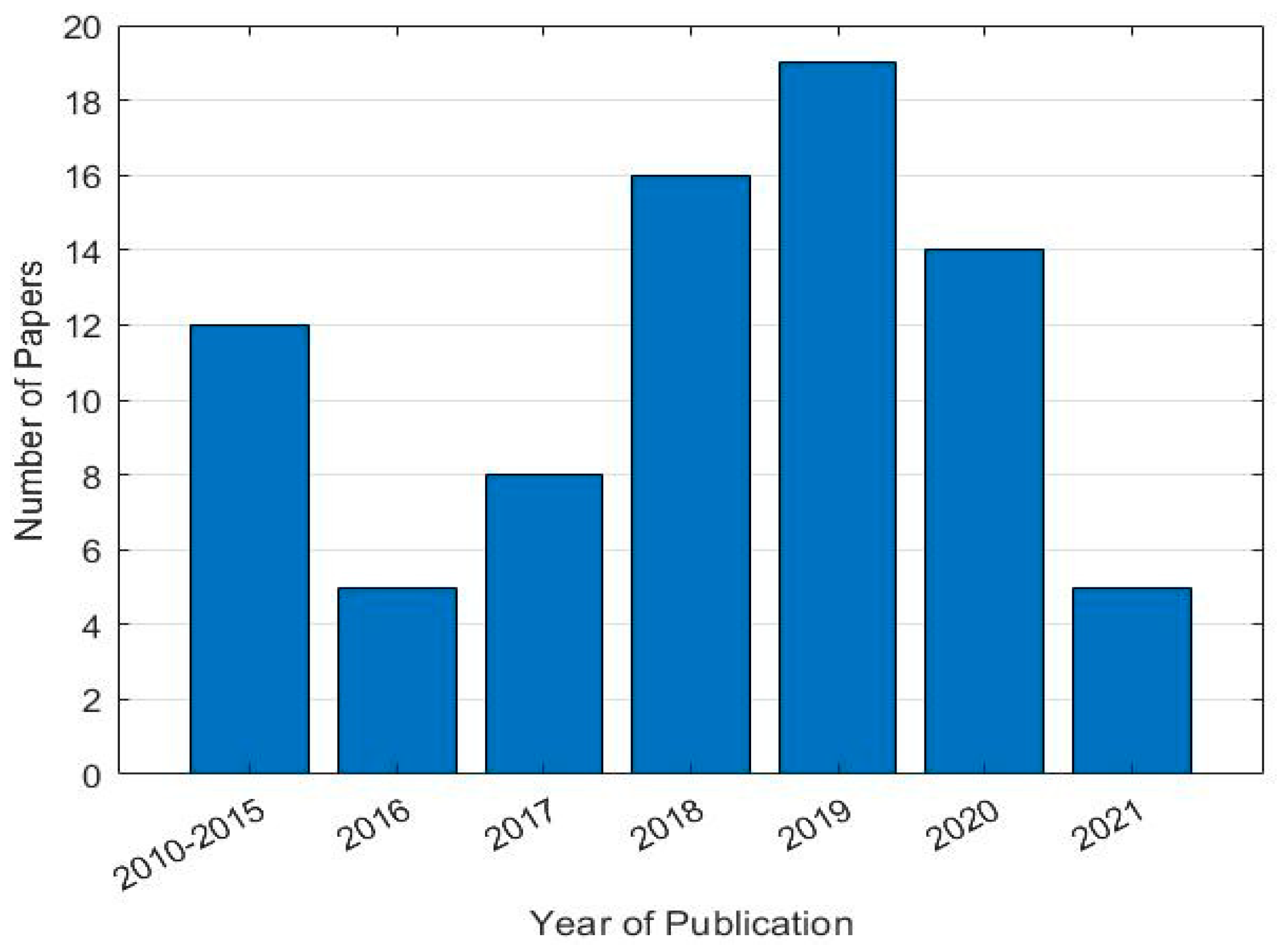
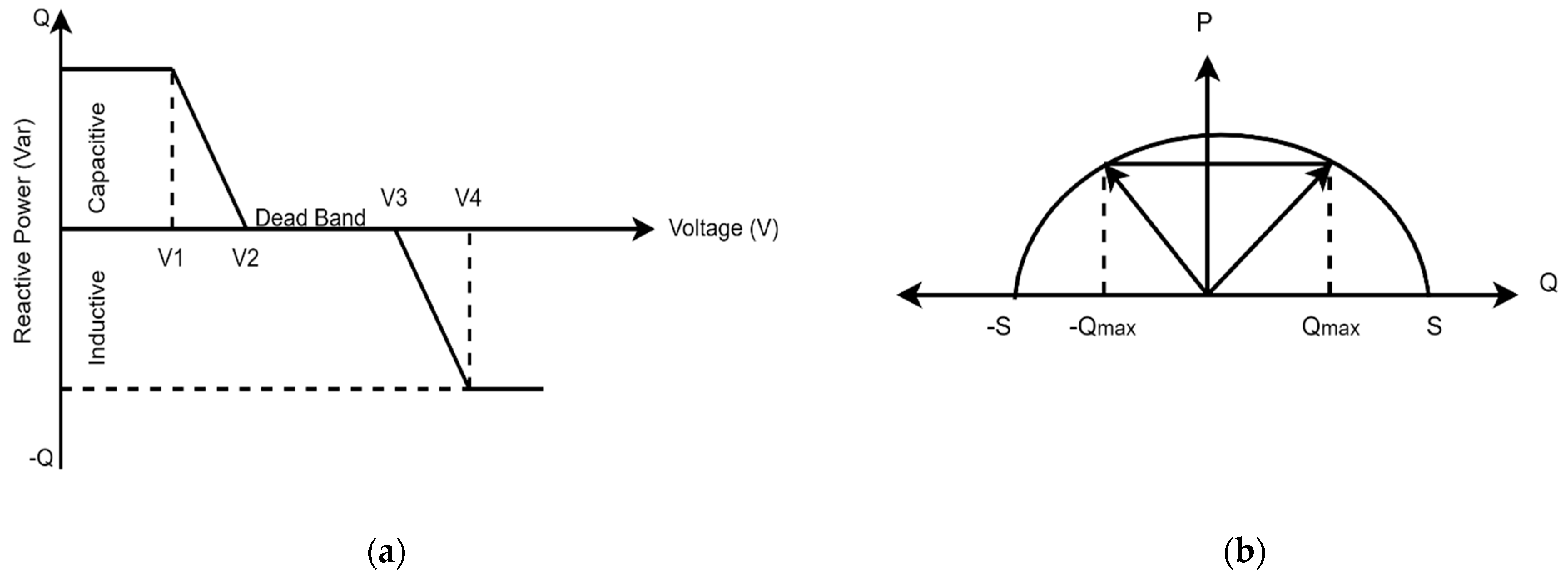
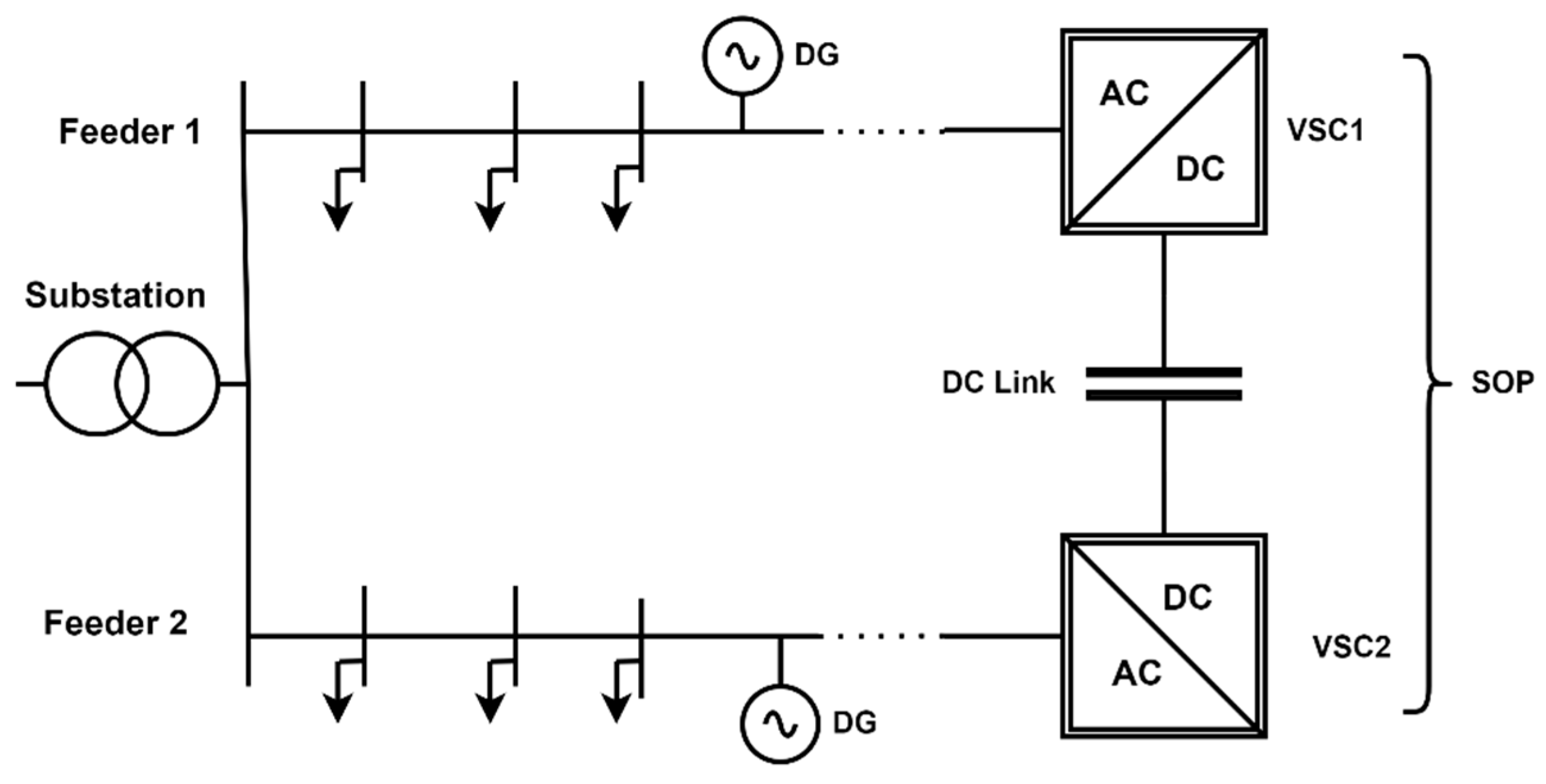
Disclaimer/Publisher’s Note: The statements, opinions and data contained in all publications are solely those of the individual author(s) and contributor(s) and not of MDPI and/or the editor(s). MDPI and/or the editor(s) disclaim responsibility for any injury to people or property resulting from any ideas, methods, instructions or products referred to in the content. |
© 2024 by the authors. Licensee MDPI, Basel, Switzerland. This article is an open access article distributed under the terms and conditions of the Creative Commons Attribution (CC BY) license (https://creativecommons.org/licenses/by/4.0/).