


Abstract
This article examines the comprehensive assessment of the environmental and economic performance and social significance of wastewater treatment plants (WWTPs), using a company in Western Kazakhstan as an example. During the analysis of the treatment plant’s performance, the potential for using activated sludge as an alternative energy source was explored. Initially, it was found that activated sludge could be used as boiler fuel at the treatment plant. In the future, after drying the sludge, it could be used to replace coal at combined heat and power plants (CHPs) when production is set up. The article analyzes international research and modern approaches to sustainable water use and municipal and industrial wastewater treatment. The paper examines the role of wastewater treatment facilities in minimizing anthropogenic impacts on ecosystems and reducing production costs. It also assesses the prospects for greening protected areas and the social impact of modernizing the region’s infrastructure. The research aims to optimize wastewater treatment facilities through the conservation of resources, water reuse and the use of energy-saving technologies. Practical recommendations have been developed to improve the efficiency and sustainability of wastewater treatment plants, taking into account the climatic conditions of Western Kazakhstan. Water conservation is a goal of sustainable development. Conserving water resources through high-efficiency treatment plants will save natural water, which is also the goal of this study. The article’s materials may be useful for specialists in water management, environmental policy, environmental design, and regional planning.
1. Introduction
In the context of global climate change, urban population growth, and increasing water resource pressures, wastewater treatment plants (WWTPs) are becoming increasingly important as a means of sustainable environmental and social infrastructure. An effective wastewater treatment system not only reduces the anthropogenic impact on the environment but also provides the foundation for maintaining public health, developing the urban environment, and improving quality of life [1,2].
Current research suggests the need to transform existing wastewater disposal systems toward resource- and energy-saving solutions, including the reuse of treated wastewater, the recovery of heat, energy, and organic matter from sewage sludge, and carbon footprint reduction [3,4]. The “from wastewater treatment to water resource recovery” approach is becoming a key focus for industry development [5,6].
When planning the construction, reconstruction and modernization of treatment facilities, not only the technical and environmental aspects of the issue are most often considered, but also the social importance of their work, including issues of employment of the local population and how the population will exist next to such enterprises [7].
Despite the existence of a large number of studies devoted to wastewater treatment technologies [8,9,10,11,12,13,14,15], in the actual practice of many countries, including the Republic of Kazakhstan, there are still difficulties with the introduction of an integrated approach that combines environmental, economic and social problems of wastewater treatment plants [6,7,16].
This problem is especially relevant for regions where the technological structure of water treatment and wastewater disposal enterprises is morally and physically outdated, and the introduction of energy-efficient and resource-saving technologies and solutions is difficult due to limited funding and insufficient personnel qualifications [3,17,18,19].
Therefore, this problem is very serious, and research into modern approaches to improving wastewater treatment facilities and applying best international practices to Kazakhstan’s regional conditions is particularly important and relevant. This paper examines the reconstruction experience of one of the region’s municipal enterprises, which treats the city’s domestic and industrial wastewater.
The purpose of this work is to analyze the current state and prospects for the development of wastewater disposal systems in Western Kazakhstan, as well as to develop recommendations that make it possible to consider wastewater treatment plants as resource-saving technologies and to reduce environmental risks in the region under consideration. The potential for using activated sludge as a fuel was explored for the first time.
Sludge from wastewater treatment plants can be used as raw material for fuel production. For example, it is possible to produce biodiesel from sludge and sewage. This fuel is considered to be quite environmentally friendly.
After dehydration, the sludge can be processed into briquetted solid fuel. It can be used for municipal and domestic purposes, as well as in industrial solid fuel boilers. One option is to add wastewater treatment plant sludge to the fuel. This will help the fuel ignite faster. Within the national framework, a study of the wastewater treatment system in western Kazakhstan is being conducted for the first time. Currently, the problem of wastewater treatment facilities in Western Kazakhstan is quite acute. Most of the treatment facilities are outdated and require major repairs or complete replacement. The worn-out networks and equipment cannot cope with the volume of wastewater from cities and industrial facilities and do not provide the required level of treatment.
Insufficient wastewater treatment creates many problems and inconveniences for the population, such as the presence of unpleasant odors; public health problems (spread of infectious diseases); deterioration of drinking water quality; destruction of ecosystems [20,21]. Stormwater discharges can generate unpleasant odors, posing no direct health hazard but creating psychological discomfort. The problem of unpleasant odors from wastewater treatment plants is primarily due to several factors, including illegal wastewater discharges, inefficient wastewater treatment plant operation, and unpleasant odors associated with sewage sludge processing. The main sources of odors include hydrogen sulfide, ammonia, and volatile organic compounds (VOCs).
Furthermore, exposure to pollutants emitted by wastewater treatment plants can have direct and indirect impacts on public health [22]. Global research shows that inadequate wastewater treatment and ineffective aeration systems can release compounds capable of causing allergic reactions, respiratory diseases, and dermatological disorders into the atmosphere and water bodies when wastewater is discharged [2,23]. Elevated concentrations of ammonia, hydrogen sulfide, and volatile organic compounds (VOCs) negatively impact the respiratory system and can also lead to chronic intoxication with prolonged exposure. In addition to physiological factors, psychophysiological effects on humans play a significant role. Persistent unpleasant odors emanating from wastewater treatment plants (WWTPs) create feelings of discomfort, anxiety, and irritability in the population, which is supported by data on the effects of odorous pollutants on the human nervous system [24]. Unpleasant odors from WWTPs can spread over long distances, especially in calm, warm weather. Prolonged exposure to even low concentrations of hydrogen sulfide can cause headaches, sleep disturbances, decreased concentration, and a deterioration in overall psycho-emotional state. Thus, the problem of unpleasant odors from wastewater treatment plants extends beyond sanitary and hygienic factors, exerting a complex impact on the physical, mental, and social well-being of the population [2,23,24]. This underscores the need for a comprehensive approach to the modernization and reconstruction of wastewater treatment plants, where environmental and engineering solutions must be accompanied by measures to reduce psychosocial risks for the population. It is important to compare regional practices in Western Kazakhstan with global trends in this industry, including the transition to the concept of zero carbon emissions [25,26,27], the use of biogas [28,29,30] and the digitalization of management processes [13,31,32,33]. A number of studies have been conducted by national scientists on the issue of cleaning, but it is relevant at the present time [34,35,36,37].
The scientific novelty of this study lies in its comprehensive assessment of the performance of regional wastewater treatment plants in Western Kazakhstan in terms of environmental efficiency, social significance, and resource potential.
This provides a number of important benefits, such as water conservation, which is particularly beneficial for the arid and windy regions of Western Kazakhstan, where traditional irrigation methods are often ineffective.
An additional novelty is the comparison of regional practices in Western Kazakhstan with global trends in this sector, as well as the exploration of the possibility of using wastewater treatment plant sludge as fuel.
2. Materials and Methods
The subject of this article is a municipal wastewater treatment facility located in Western Kazakhstan. The facility receives, treats, and disinfects domestic and industrial wastewater from municipal and industrial facilities. Therefore, the facility is strategically important for servicing the region’s public utilities.
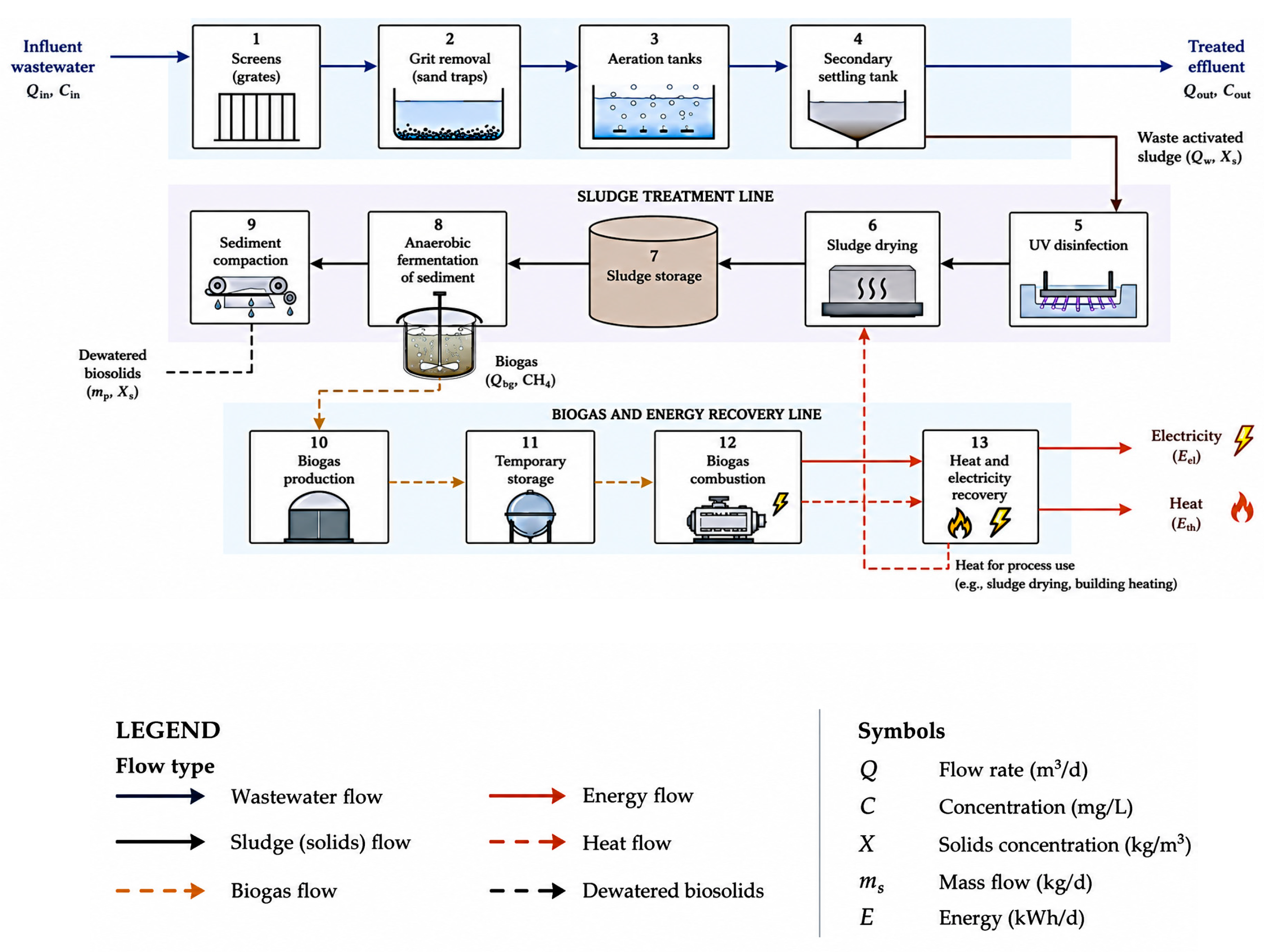
The plant’s process flow includes mechanical, biological, post-treatment, and wastewater disinfection, as well as the processing and disposal of the resulting sludge. Mechanical treatment is accomplished using screens, sand traps, and primary settling tanks. The biological stage consists of aeration tanks and secondary settling tanks, which remove organic matter, nitrogen, and phosphorus. After the biological treatment unit, the wastewater undergoes post-treatment and is fed to an ultraviolet disinfection unit (UV), after which it is discharged into a regulated water body. A distinctive feature of the facility under study is its extensive wastewater sludge treatment complex, including gravity thickeners, thickened and digested sludge tanks, first- and second-stage digesters, a sulfur removal unit, a gas tank, a system for burning excess biogas, and a cogeneration unit for electricity and heat production. The facility also includes a sludge drying building and a temporary storage area for processed material. The design solutions are aimed at the efficient use of sludge—producing biogas and generating energy savings—which aligns with global trends toward zero-waste and energy-efficient wastewater treatment systems [3,17,38,39]. In the event of an emergency shutdown of the mechanical dewatering plant, a mixture of raw sludge and excess activated sludge is discharged to emergency sludge pads, which ensures the stability of the technological process.
The wastewater treatment process at the plant occurs as follows:
The capacity of the wastewater treatment facilities is 130,000 m3/day. Actual inflow (actual average volume of domestic and industrial wastewater intake) is 61,111.506 m3/day.
Wastewater from the city sewer network is directed into the receiving chamber of the screen building, where the mechanical treatment process begins. First, the wastewater passes through large screens with openings of approximately 70 mm, which retain large debris and solids. Next, the flow is directed through smaller stepped screens with openings of approximately 7 mm, providing finer filtration.
After this, the wastewater enters longitudinal aerated sand traps, where mineral particles—sand and other heavy impurities—are precipitated, and light floating substances are removed. The wastewater, freed from coarse contaminants, is sent through a distribution chamber to primary settling tanks, where suspended solids are removed and the flow is clarified. After the mechanical stage, the clarified wastewater is fed to the biological treatment unit.
Bioreactors, consisting of nitrification and denitrification zones, decompose organic matter and nitrogen compounds and biologically and chemically remove phosphorus. The sludge mixture is then sent to secondary settling tanks, where activated sludge is separated from the purified water.
Biologically treated wastewater enters the post-treatment and disinfection unit, where it undergoes microfiltration and ultraviolet treatment. The treated water is then collected in a pumping station reservoir, from where it is pumped to a stabilization pond or discharged into a water body.
Excess activated sludge generated during biological treatment is returned to the system—some of it is recycled, and the remainder is sent to primary settling tanks. To improve sedimentation efficiency, a coagulant is added to the sludge, which facilitates more complete removal of suspended solids.
From the primary settling tanks, the mixed sludge is pumped through a pumping station into gravity thickeners, where it is thickened and its volume is reduced by removing excess moisture. The sludge is then sent to a hydrodynamic disintegration unit, where the cellular structures of the microorganisms are destroyed, increasing the efficiency of subsequent fermentation.
At the same time, substrates imported from industrial facilities are received at a separate station and subjected to thermal disintegration. The resulting compacted and disintegrated materials are collected in a tank, from where they are pumped to the technical building of the sludge processing unit.
The sludge is then heated and sent to the first-stage digesters, where pre-fermentation occurs. The resulting hydrolyzed sludge is returned to the technical building for cooling to approximately 37 °C, after which it is fed to the second-stage digesters, where mesophilic fermentation occurs.
After the fermentation process is complete, the digested sludge is sent to a storage tank, where it accumulates before further processing. From the tank, the sludge is returned to the technical building and dewatered in centrifuges, significantly reducing its moisture content and preparing it for further use or disposal. During anaerobic digestion, biogas is produced in the digesters, which collects at the top of the chambers. It then undergoes dehydration and sulfur removal in the sulfur removal unit, after which it is accumulated in a membrane gas holder. The accumulated biogas is used in cogeneration units, which simultaneously generate heat and electrical energy.
A portion of the generated electricity is used to power the wastewater treatment plant’s process equipment, increasing its energy independence. The generated heat is used to maintain optimal temperatures in the digesters, and excess heat is used to heat the plant’s buildings during cold periods or to dry the treated sludge during warmer months. Excess biogas not used in the cogeneration units is fed to a safe incineration system.
Thus, the implementation of wastewater sludge digestion technologies followed by biogas utilization represents an effective way to conserve resources and green wastewater treatment facilities. The resulting biogas serves as a valuable energy resource, allowing for partial or complete coverage of the facility’s energy needs, reducing electricity and heat costs, and reducing the carbon footprint by reducing greenhouse gas emissions.
Furthermore, dehydrated and stabilized sludge after fermentation possesses agrochemical value [40] and, after receiving a certificate of conformity, can be used as an organic fertilizer for landscaping sanitary protection zones and reclaiming disturbed lands. This application not only allows for the efficient disposal of wastewater treatment waste but also returns beneficial nutrients to the biosphere, promoting the restoration of soil fertility and improving the ecological state of the environment.
Alternative methods of using sludge were investigated:
- -
- as a fertilizer;
- -
- as fuel.
Both options are feasible. However, given the significant fuel demand, the use of sludge as fuel must be considered.
Research methods. The study was conducted on the basis of:
- -
- analysis of the environment in the area where the enterprise is located;
- -
- studying global experience in wastewater treatment;
- -
- analysis of enterprise process flow charts;
- -
- operational control data;
- -
- results of laboratory tests of wastewater before and after treatment;
- -
- regulatory documents (Sanitary Rules and Regulations, State standard (SS), Building codes and regulations).
The environmental situation in the western region of the Republic of Kazakhstan is generally challenging due to the large number of oil and gas industry facilities, which pollute the soil with heavy and even toxic metals, oil spills, and other pollutants. In the area where the facilities are located, the main sources of air pollution are industrial plants, such as metallurgical plants and mineral extraction and processing facilities, as well as motor vehicles. Wastewater pollution is caused not only by industrial emissions but also by municipal discharges, including sewage containing elevated levels of hydrogen sulfide.
World experience in wastewater treatment consists of membrane technologies such as ultrafiltration, nanofiltration, reverse osmosis [41,42], dynamic membranes for organic extraction and increased purification efficiency [43].
Biological treatment is the use of activated sludge, biofilters, membrane bioreactors, and anaerobic systems [44,45,46,47]. In global wastewater treatment plant operations, technologies based on the use of activated sludge occupy a leading position. This method has been used for quite some time and has proven itself to be a highly effective means of biodegrading toxins and removing nutrients. A key advantage of this technology is its ability to retain biomass and prevent its penetration into soils [48].
Creation of artificial wetlands and stabilization ponds [48,49,50,51], which are used in rural areas, small towns, resorts and in the countries of Asia and Africa [52,53].
Chemical methods such as coagulation, flocculation, adsorption on activated carbon, ozonation, hydrogen peroxide, and ion exchange are used. Wastewater treatment mechanisms are based on a combination of sorption processes, electrostatic forces, and bridging. These factors ensure the effective removal of pollutants and a reduction in the overall chemical load on the environment. Dye coagulation is achieved through the interaction of high-molecular polymers and protonated amino groups, which facilitates the binding and precipitation of substances [28].
Wastewater treatment with microalgae. This method is used to remove nitrogen, phosphorus, and CO2, as well as to produce biomass from sewage sludge. Microalgae technologies are based on the principle of spatial cell localization. This approach assumes that living microorganisms, under the influence of natural or artificial factors, are deprived of their ability to move freely and are retained in a specific zone of the system’s aquatic environment [29].
To assess the treatment efficiency, a comparative analysis of the quality indicators of wastewater at the inlet and outlet of the treatment plant was carried out.
The control parameters for the composition of wastewater at this plant are suspended solids, biochemical oxygen demand (BOD5), chemical oxygen demand (COD), ammonium nitrogen, phosphates, surfactants (SAS), petroleum products, sulfates, chlorides and iron.
Sampling was carried out at the inlet and outlet of the wastewater treatment plant in accordance with the requirements of SS 31861–2012 [30], and analysis was carried out in accordance with SS 31940–2012 [54] and SS 33045–2014 [55].
Wastewater analysis was carried out using an analyzer. The analyzer used for chemical monitoring of wastewater is an automated device designed to quickly determine the composition of water and the concentrations of pollutants.
Wastewater samples were collected at two control points of the treatment process: at the inlet, after treatment, and before the discharge of treated water. A total of 18 samples were analyzed. Sampling was conducted quarterly, allowing for seasonal variability in wastewater composition. Each analysis was performed in three independent replicates, after which average values were calculated. Results are presented as mean ± standard deviation (MSD). The relative standard deviation of the results did not exceed 5%. The number and frequency of samples ensured representativeness of the results and allowed for changes in wastewater composition due to seasonal and operational factors.
The “Endress + Hauser Liquiline System” (Germany) orthophosphate analyzer was used for continuous wastewater quality monitoring. The instrument operates based on a colorimetric (photometric) method utilizing the molybdenum blue reaction. The analyzer measures orthophosphate (PO4-P) concentrations in the 0.05–10 mg/L range with a maximum intrinsic error of ±2%. The automated analysis cycle comprises sample collection, reagent dosing, photometric measurement, data processing, and data transmission to the process control system.
The analyzer’s operation includes several sequential stages:
- The device takes a sample. This can occur either continuously, with the wastewater flow passing through the instrument’s measuring chamber, or in batches, using an automatic sampler. At this stage, the analyzer’s task is to obtain a representative sample reflecting the actual composition of the wastewater.
- The sample is prepared for measurement. It is typically filtered to remove large suspended particles, brought to the required temperature, and mixed with reagents required for specific types of analysis. This preparation ensures stable measurements and improves the accuracy of chemical determinations.
- A chemical reaction is initiated in the sample. Added reagents interact with certain contaminants—for example, metal ions, nitrogen compounds, or organic substances. This reaction can change the solution’s color, transparency, acidity, or electrical conductivity. These changes serve as indicators by which the device determines the concentration of certain substances.
The next step is to measure the parameters. Analyzers use various methods: photometric, electrochemical, spectral, or a combination of these. They record changes in the optical, electrical, or physical properties of a solution and convert them into quantitative data.
The device then processes the data. A built-in microprocessor compares measured values with calibration curves and converts recorded changes into pollutant concentrations. The results are displayed on the screen, stored in the device’s memory, or transmitted to an automated environmental monitoring system. If exceeded limits are detected, the device can generate warning signals. Modern analyzers are equipped with automatic maintenance functions. They can flush measuring chambers, clean sensors, monitor reagent consumption, and perform self-diagnostics. This reduces the risk of errors and ensures stable long-term operation of the equipment.
Thus, the wastewater chemical analyzer is an intelligent system that automates the entire analysis cycle: from sample collection to obtaining accurate quantitative data. Its use enables the timely detection of contaminants, ensures wastewater quality control, and maintains environmental safety at facilities.
The plant discharges treated wastewater into a river. The state service measures the chemical composition of the water in this body of water. The results are presented in Table 1.
Table 1.
Total capacity of treatment facilities.
Assessment of atmospheric air quality. European odor unit (ouE/m3): the amount of odorous substance(s) which, when diluted with 1 m3 of neutral gas under normal conditions, produces a physiological response equivalent to that produced by one European Odor Reference Mass (EROM) diluted with 1 m3 of neutral gas under normal conditions [56].
To assess the effectiveness of treatment facilities based on their impact on atmospheric air, extensive research on the correlation of odors and pollutant concentrations allowed us to identify hydrogen sulfide as a marker substance for odor impact. Hydrogen sulfide was used as an odor marker.
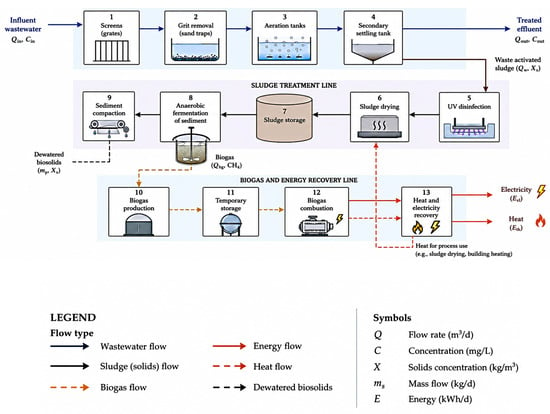
A GANK-4 device was used to measure hydrogen sulfide parameters. This device is designed to automatically measure gas concentrations in atmospheric air (Figure 1). The device operates on the following principle:
Figure 1.
Technological scheme of the sewage treatment plant (drawing by the author).
- -
- Sample collection. The device draws a small amount of air or gas through a tube.
- -
- Analysis. There are sensors inside that react to different gases.
- -
- Concentration measurement. Each sensor produces an electrical signal that depends on the amount of a given gas in the mixture.
- -
- Data processing. The device’s electronic system converts these signals into human-readable numbers—for example, “CO2 content = 0.04%.”
- -
- Results display. Everything is shown on the screen or recorded in the device’s memory.
To assess the effectiveness of the treatment facilities, a comprehensive approach was used, including a comparative analysis of operational, environmental, and economic indicators. Based on laboratory monitoring data, actual pollutant concentrations were compared with maximum permissible values established by sanitary norms and standards of the Republic of Kazakhstan and international recommendations [30,54,55,56,57].
To use activated sludge as fuel, it is necessary to dry the sludge.
Characteristics of the composition of sewage sludge
Sewage sludge is a complex system consisting of numerous components, including organic, mineral, and biological constituents. Its composition is determined by the nature of the incoming wastewater, the treatment technology, and the sludge processing regimes.
Chemical composition of sewage sludge
The bulk of the sludge’s dry matter (up to 60–80%) consists of organic compounds, which include proteins, fats, carbohydrates, and products of the biochemical decomposition of organic contaminants. The mineral component (20–40%) includes calcium, magnesium, and iron compounds, as well as phosphates, carbonates, and silicate impurities.
The sediment also contains biogenic elements:
- -
- nitrogen (in organic and ammonium forms),
- -
- phosphorus (in the form of phosphates).
This determines its value as a fertilizer for agricultural and landscaping needs.
Depending on the composition of the incoming wastewater, pollutants such as:
- -
- heavy metals (zinc, copper, lead, cadmium),
- -
- petroleum products,
- -
- surfactants,
- -
- difficult to oxidize organic compounds.
Biological composition of sewage sludge
The sediment contains a high concentration of microorganisms that form activated sludge. These are primarily bacteria, which mediate biological oxidation processes. Additionally, protozoa (ciliates, amoebae), fungi, and other microorganisms are present, which help stabilize organic matter.
Based on the technological scheme of the enterprise and the analysis of the composition of the incoming wastewater, given in Table 2 of the article, the composition of the resulting wastewater sludge was determined.
Table 2.
Evaluation of the composition of wastewater sludge from the enterprise under study.
Helminth content is not allowed in sludge from treatment plants for fertilizers, but is allowed for fuel.
Drying of sediment.
Sludge treatment plant.
The installation is designed for drying dewatered sludge entering the wastewater treatment plant.
The sludge entering the drying process has the following characteristics:
- -
- The daily amount of dewatered sludge from the treatment plant is 100 tons/day.
- -
- Humidity–70%
The installation consists of the following lines:
- -
- drying: two ES1900 drying lines operating in parallel and processing dewatered sludge.
The drying process is carried out in a closed loop to ensure high efficiency. Diathermic oil is used as a heat transfer fluid. A heat recovery system, utilizing excess enthalpy from the process gas to produce hot water, will also be supplied as part of this section.
Auxiliary section: The drying system is supplemented by an auxiliary section, consisting of equipment that ensures the proper operation of the unit. Specifically, this section includes a gas cleaning unit, a compressor, and boilers with burners.
To ensure the required guaranteed evaporation capacity, the unit has the following characteristics, shown in Table 3.
Table 3.
Installation characteristics.
An option for using methane gas. Biogas Production and Utilization System: Sludge treatment using closed fermentation chambers enables biogas production, while recycling more than half of the sludge’s biological content. The sludge can also be used as a mineral byproduct for agricultural purposes, for soil rehabilitation, and for urban landscaping, while generating electricity in cogeneration units. Recovered heat is used to maintain the temperature in the fermentation chambers, and excess heat can be used for sludge treatment and for heating wastewater treatment facilities.
The objects of biogas synthesis and use include:
- -
- Sulfur removal unit
- -
- Gas holder;
- -
- Excess biogas combustion system;
- -
- Biofilter
- -
- Cogeneration plant.
Sulfur has a detrimental effect on biogas-consuming equipment, such as boilers and cogeneration unit engines. Biogas produced in separate closed fermentation chambers contains a small amount of sulfur, which must be removed. The desulfurization system will combine elemental sulfur with iron. The used turf will be replaced periodically. The purified biogas will be sent to a biogas storage tank, or gas holder.
Gas holder.
The purpose of the tank is to store (retain) the produced biogas and maintain the appropriate pressure in the biogas network (similar to a hydrophore in a water supply network). The proposed design utilizes a gas holder with two membranes, operated by an elastic membrane, and pumps that inject air between the two membranes. This design maintains constant pressure within the biogas production system. The tank is installed on its own foundation and is equipped with safety valves and individual lightning protection. Excess Biogas Incineration System (No. 30). The gas flare is a component of the biogas equipment and will be used to incinerate any potential excess biogas. The facility is a single tower-shaped unit, ready for installation, equipped with all necessary installation equipment and automation.
The energy unit will be a single-story building located near the fermentation chambers within the complex of facilities for the economic use of sludge and biogas.
To cover the thermal loads of the plant’s consumers (sludge heating heat exchangers and the sludge processing unit), the project includes the installation of three containerized cogeneration units powered by biogas. These units will serve as the primary source of heat and electricity. Electric generators at the plant will use the produced biogas to generate electricity. It should be noted that only a portion of the energy contained in the biogas will be converted into electricity.
The obtained data indicate significant variability in the chemical composition depending on the origin of the sediment and the technology of its processing.
The sediment contains sodium oxides (Na2O) and sulfur compounds, with concentrations ranging from 0.5–4.7% and 1.5–7.5%, respectively. The presence of these components impacts thermal processing, as they can promote the formation of low-melting compounds and increase the risk of slagging and ash deposits on the surfaces of heat-exchange equipment.
Zinc oxide (ZnO) content ranges from 0.1% to 0.3%, while copper oxide (CuO) does not exceed 0.3%, indicating the presence of anthropogenic heavy metals in the sediment. Higher concentrations are typical of nickel and chromium compounds: NiO content reaches 3.4%, and Cr2O3 3.1%, depending on the sediment type. These elements may limit the potential for further use of the ash, as they require monitoring of their migration and potential environmental impact.
The highest nickel concentrations are found in activated sludge, while chromium content is highest in primary sedimentation sludge. After anaerobic digestion of the primary sludge and activated sludge mixture, the concentrations of the individual components tend to equalize due to the mixing of various sludge fractions and changes in their mineral composition during stabilization.
Sludge from wastewater treatment plants has sufficient energy potential to be used as an alternative fuel after preliminary dewatering and drying. Co-firing sludge with traditional fuels or biomass, as well as its use in high-temperature industrial processes such as cement production, is considered the most efficient.
3. Results
The environmental and economic efficiency of the enterprise was assessed taking into account the following indicators:
- -
- environmental (degree of removal of pollutants, purification coefficient for BOD5 and COD);
- -
- social (number of populations served, staff employment, contribution to improving the quality of life and sanitary condition of the territory).
One of the significant factors in the operation of wastewater treatment plants (WWTPs) is maintaining the sanitary protection zone (SPZ), which is necessary to prevent the negative impact of odors and chemical pollutants on populated areas. In accordance with the sanitary standards of the Republic of Kazakhstan, for treatment plants with a capacity of over 50,000 m3/day, the standard SPZ is 500 m.
The area of the sanitary protection zone is determined by the formula:
where S is the area of the sanitary protection zone, m2; r is the radius of the zone, m.
S = π × r2,
SSPZ = 3.14 × 5002 = 785,000 m2 = 78.5 hectares.
Thus, the area of the sanitary protection zone of the wastewater treatment plant is 78.5 hectares.
Landscaping of sanitary protection zones is a key measure to reduce the negative impact of industrial enterprises on the environment and populated areas. In Western Kazakhstan, landscaping not only serves sanitary and hygienic purposes but also has a protective function, preventing wind erosion and dust emissions and improving the microclimate of adjacent areas.
The main goal of landscaping the sanitary protection zone is to create an effective green barrier capable of trapping dust, gaseous emissions, aerosols, and odors, as well as reducing noise levels. Additionally, green spaces contribute to:
- -
- stabilization of soil cover;
- -
- regulation of air temperature and humidity near the industrial site;
- -
- creating favorable conditions for the employees of the enterprise and nearby settlements.
The climatic and soil conditions of Western Kazakhstan require a special approach to selecting plant species and managing green spaces [58]. Given the region’s arid climate, landscaping in this region must be based on principles of adaptability, drought tolerance, and longevity.
Features to consider when designing landscaping:
- -
- limited precipitation and high evaporation;
- -
- frequent winds, including dust storms;
- -
- increased soil salinity in certain areas;
- -
- continental climate with large temperature differences.
The results of wastewater treatment efficiency are shown in Table 4.
Table 4.
Wastewater treatment efficiency.
Thus, the purified water meets the quality standards for water bodies used for cultural and domestic purposes and can be used for irrigation and re-water supply.
The calculated characteristics of wastewater before and after treatment at the WWTP are given in Table 5.
Table 5.
Wastewater parameters before and after treatment.
As can be seen from Table 5, the efficiency of the WWTP is quite high, and the degree of wastewater treatment corresponds to the quality of water bodies for cultural and domestic purposes, enabling the organization operating the wastewater treatment plant to use this water for irrigating green spaces, as well as to offer this water to enterprises in the region for secondary use for technological needs.
The analysis showed that the water in the river is within normal limits for most components. Table 6 shows that the indicators in the water body correspond to the quality standards for water for cultural and domestic purposes; however, chromium (VI) exceeds the maximum permissible concentration. Ammonium-nitrogen levels are slightly exceeded (by ~15%), organic pollution is low (BOD5, COD are within normal limits), petroleum products and surfactants are in safe quantities, salt composition (chlorides, sulfates) is within natural limits, and nutrients (nitrates, nitrites, phosphorus) are minimal. This means that water discharged after treatment to the wastewater treatment plant will not degrade the water quality in the reservoir.
Table 6.
Chemical composition of water in a water body.
Concentrations at the sanitary protection zone boundary in summer and winter ranged from 0.0009 to 0.0012 mg/m3, which were below the regulatory limits but slightly above the human odor perception threshold (0.0007 mg/m3). Consequently, odor impact is minimal.
During the study, one-time atmospheric air measurements were taken at the 500 m boundary of the plant’s sanitary protection zone (SPZ) and at the boundary of the residential area to measure hydrogen sulfide content. The results of the summer and winter atmospheric air measurements at the SPZ boundary and within the WWTP’s territory are presented in Table 7.
Table 7.
Results of atmospheric air measurements.
Based on the results of measurements at the boundary of the sanitary protection zone of the treatment plant, it is clear that the concentrations of hydrogen sulfide in the atmospheric air correspond to the standard values.
Sludge from treatment plants, after drying, can be used as an additive to fuel or as fuel itself.
In particular, the following applications as fuel are possible:
- -
- Fuel briquettes or pellets made from dewatered sludge. Can be combined with other organic waste;
- -
- Methane gas release during sludge fermentation;
Sludge waste from sewage treatment typically contains household fats and components, which also contribute to the combustion process (Table 8).
Table 8.
Composition of sludge for fuel.
Fuel quality requires a minimum amount of minerals (low ash content). In sewage sludge, organic matter accounts for 65–75% of the total fuel composition. This organic component ensures combustion and calorific value. A disadvantage is that the sludge generated during wastewater treatment also contains approximately 25–35% minerals, which do not burn. However, this can be reduced through treatment or balanced by reducing the organic content.
4. Discussion
The results obtained during the study confirm the high environmental efficiency of the modern wastewater treatment complex, including advanced biological treatment and disinfection. The use of anaerobic sludge digestion ensures the plant’s energy self-sufficiency and aligns with global trends in sustainable water use.
The results of the analysis of treated wastewater show that after mechanical and biological treatment, the water quality improves significantly, and the content of the main pollutants decreases to values that allow it to be considered as an additional source of water for irrigation. The suspended solids concentration is reduced from 515 to 10 mg/L, corresponding to a purification efficiency of 98.1%. The residual concentration does not exceed the established standard and significantly reduces the load on the water body or water reuse system. Biochemical oxygen demand (BOD5) decreased from 620 to 3 mg/L, with a treatment efficiency of 99.5%, indicating virtually complete removal of easily oxidizable organic matter. A similar trend is observed for chemical oxygen demand (COD), whose concentration decreased from 845 to 30 mg/L, with a treatment efficiency of 96.5%. The results confirm the high efficiency of biological treatment and reduce the oxygen load on the water body. The ammonium nitrogen content is reduced from 52.9 to 1.0 mg/L, with a removal efficiency of 98.1%. This indicates effective nitrification processes in the aeration tanks and prevents the release of ammonium nitrogen compounds into the environment, which can contribute to the intensive growth of algae and deteriorate water quality. High efficiency was also achieved in phosphate removal. Phosphate concentrations were reduced from 8.5 to 0.1 mg/L, corresponding to a 98.8% removal efficiency. Simultaneously, synthetic surfactant concentrations were reduced from 4.0 to 0.1 mg/L, resulting in a 97.5% removal efficiency. The purification process virtually completely removes petroleum products. Their content is reduced from 2.5 to 0.05 mg/L, corresponding to a purification efficiency of 98.0% and minimizing the negative impact on the water body. Sulfate concentrations are reduced from 170 to 105 mg/L, with an efficiency of 38.2%, and chloride levels are reduced from 288 to 278 mg/L, with an efficiency of only 3.5%. Residual sulfate and chloride levels comply with established standards. The concentration of total iron after purification is 0.2 mg/L, which also does not exceed the maximum permissible concentration (0.3 mg/L), despite the absence of a pronounced effect on reducing this indicator.
After treatment, the content of most pollutants meets established regulatory requirements, significantly reducing the impact on the water body. Furthermore, the achieved quality indicators of the treated water allow for its reuse for industrial purposes and irrigation of green spaces, provided sanitary and hygienic requirements are met, regular production monitoring is conducted, and microbiological parameters are assessed.
Odor impact, one of the key social problems of wastewater treatment plants, is minimal at the studied facility and significantly below maximum permissible levels. This confirms the correctness of the process flow diagram and the adequate operation of the aeration and sludge treatment units.
Landscaping the sanitary protection zone, especially with the use of an adaptive subsurface irrigation system, is an important socio-ecological component. The proposed system allows for water conservation, which is particularly important for arid Western Kazakhstan.
Social impact: The construction of new wastewater treatment facilities will contribute to improving the environmental and sanitary-epidemiological situation in the region, will have a positive impact on improving public health, and will create new jobs, which, in turn, will improve the economic situation in the region.
A major problem associated with wastewater sludge in wastewater treatment plants can be solved by using dewatered sludge as fuel.
5. Conclusions
The studied wastewater treatment plant demonstrates a high degree of wastewater purification (96–99%), ensuring compliance with the standards for water bodies for cultural and domestic purposes.
Concentrations of pollutants in the atmospheric air at the boundary of the sanitary protection zone are below the standard values and odor perception thresholds.
The detected excess of chromium (VI) in the receiving water body is not related to the activities of the enterprise and requires additional monitoring by industrial sources.
The sludge treatment complex, including two-stage digestion and biogas utilization, reduces energy costs and minimizes the carbon footprint.
This article proposes and substantiates a subsurface capillary irrigation system that reduces water consumption by more than 40% and improves the survival rate of greenery. A multi-tiered landscaping scheme for the sanitary protection zone (SPZ) has been developed that reduces dust concentrations and noise levels and improves the microclimate.
One of the environmental problems associated with wastewater treatment plant sludge is being addressed. The sludge can be used as fuel.
Sewage sludge generated at wastewater treatment plants has considerable energy potential and can be regarded as an alternative fuel after appropriate dewatering and drying. The higher heating value of dry sewage sludge typically ranges from 10 to 20 MJ/kg, which is comparable to that of low-grade coal and certain types of biomass. Its energy content is primarily determined by the organic matter content but decreases significantly with increasing moisture content. One of the main characteristics of sewage sludge is its high ash content, which generally ranges from 25 to 55 wt.% on a dry basis. The sulfur content of dry sewage sludge typically ranges from 0.5 to 3.0 wt.%, while the chlorine content varies between 0.02 and 0.11 wt.%. Although the chlorine concentration is relatively low, the combined presence of sulfur, sodium, and potassium compounds promotes the formation of low-melting salts, thereby increasing the risks of slagging, fouling, and high-temperature corrosion of combustion equipment. Another important limitation associated with the use of sewage sludge as a fuel is the presence of heavy metals. Typical concentrations include zinc (440–1300 mg/kg), copper (140–630 mg/kg), chromium (19–110 mg/kg), nickel (16–49 mg/kg), lead (21–130 mg/kg), cadmium (0.6–3.3 mg/kg), mercury (0.3–2.5 mg/kg), and arsenic (5–9 mg/kg). During thermal conversion, most heavy metals are retained in the bottom ash or fly ash, whereas more volatile elements, particularly mercury and cadmium, may partially volatilize and enter the flue gas. Therefore, efficient air pollution control systems are essential to minimize environmental emissions. The combustion of sewage sludge may produce emissions of CO2, CO, nitrogen oxides (NOx), sulfur dioxide (SO2), hydrogen chloride (HCl), particulate matter (PM), and trace amounts of heavy metals. Under unfavorable combustion conditions, chlorinated organic compounds may also promote the formation of dioxins and furans. Consequently, energy recovery from sewage sludge should be accompanied by advanced flue gas cleaning technologies capable of removing acidic gases, particulate matter, and toxic trace elements.
Overall, sewage sludge possesses sufficient calorific value to be utilized as an alternative fuel. The most promising applications include co-combustion with coal or biomass, which improves energy recovery while reducing the environmental impacts associated with sludge disposal.
There is immense interest in advancements in by-product utilization technologies that support renewable energy sources and circular industrial processes [59]. It is possible to implement such an approach on the object under study in the article.
The practical recommendations proposed in the article can be used in the modernization of wastewater treatment plants in Western Kazakhstan.
Author Contributions
Conceptualization, N.Z., D.A. and K.S.; methodology, Y.T., N.T., D.A. and R.M.; validation, V.T., V.M., I.S.-F. and L.K.; formal analysis, R.M., N.G. and N.T.; investigation, N.Z., Y.T., N.T., D.A., R.M., A.N. and N.G.; resources, V.T., V.M., L.K. and K.S.; data curation, N.T., A.N. and N.G.; writing—original draft preparation, N.Z., D.A., R.M. and N.G.; writing—review and editing, Y.T., I.S.-F., V.T., V.M. and K.S.; visualization, N.T., A.N. and N.G.; supervision, N.Z., Y.T. and K.S.; project administration, D.A. and K.S.; funding acquisition, N.Z., D.A. and K.S. All authors have read and agreed to the published version of the manuscript.
Funding
This research was funded within the framework and by AGH University of Krakow, Mickiewicza 30 Ave., 30-059 Krakow, Poland (NIP: PL6750001923).
Data Availability Statement
The original contributions presented in this study are included in the article. Further inquiries can be directed to the corresponding authors.
Acknowledgments
This research was funded by the Committee of Science of the Ministry of Science and Higher Education of the Republic of Kazakhstan (Grant No. BR24993009).
Conflicts of Interest
Author Vadim Tseshkovskiy was employed by “Biosphere Kazakhstan” SIC LLP. Author Vladimir Matonin was employed by the “ECOEXPERT” LLP. The remaining authors declare that the research was conducted in the absence of any commercial or financial relationships that could be construed as a potential conflict of interest.
Abbreviations
The following abbreviations are used in this manuscript:
| WWTPs | wastewater treatment plants |
| VOCs | volatile organic compounds |
| SPZ | sanitary protection zone |
| BOD5 | biochemical oxygen demand |
| COD | chemical oxygen demand |
References
- Silva, J.A. Wastewater Treatment and Reuse for Sustainable Water Resources Management: A Systematic Literature Review. Sustainability 2023, 15, 10940. [Google Scholar] [CrossRef] [Scilit]
- Kesari, K.K.; Soni, R.; Jamal, Q.M.S.; Tripathi, P.; Lal, J.A.; Jha, N.K.; Siddiqui, M.H.; Kumar, P.; Tripathi, V.; Ruokolainen, J. Wastewater Treatment and Reuse: A Review of its Applications and Health Implications. Water Air Soil. Pollut. 2021, 5, 208–232. [Google Scholar] [CrossRef] [Scilit]
- Poblete, I.B.S.; Araujo, O.d.Q.F.; de Medeiros, J.L. Sewage-Water Treatment and Sewage-Sludge Management with Power Production as Bioenergy with Carbon Capture System: A Review. Processes 2022, 10, 788. [Google Scholar] [CrossRef] [Scilit]
- Du, R.; Li, C.; Liu, Q.; Fan, J.; Peng, Y. A review of enhanced municipal wastewater treatment through energy savings and carbon recovery to reduce discharge and CO2 footprint. Bioresour. Technol. 2022, 364, 128135. [Google Scholar] [CrossRef] [Scilit] [PubMed]
- Tseshkovskaya, Y.; Tsoy, N.; Tseshkovskiy, V.; Ibrayev, M.; Zamaliyev, N.; Akhmatnurov, D.; Mussin, R.; Ganyukov, N.; Zakharov, A.; Skrzypkowski, K.; et al. Research Progress of Environmental Studies of a Mining Facility for Land Restoration (Using the Example of a Mining Enterprise in the Karaganda Region). Resources 2025, 14, 144. [Google Scholar] [CrossRef] [Scilit]
- Faragò, M.; Damgaard, A.; Madsen, J.A.; Andersen, J.K.; Thornberg, D.; Andersen, M.H.; Rygaard, M. From wastewater treatment to water resource recovery: Environmental and economic impacts of full-scale implementation. Water Res. 2021, 204, 117554. [Google Scholar] [CrossRef] [Scilit] [PubMed]
- Khateeb, M.; Hassan, G.K.; El-Liethy, M.A.; El-Khatib, K.M.; Abdel-Shafy, H.I.; Hu, A.; Gad, M. Sustainable municipal wastewater treatment using an innovative integrated compact unit: Microbial communities, parasite removal, and techno-economic analysis. Ann. Microbiol. 2023, 73, 35. [Google Scholar] [CrossRef] [Scilit]
- Chen, Y.; Lin, M.; Zhuang, D. Wastewater treatment and emerging contaminants: Bibliometric analysis. Chemosphere 2022, 297, 133932. [Google Scholar] [CrossRef] [Scilit] [PubMed]
- Demin, V.F.; Abeuov, E.A.; Akhmatnurov, D.R.; Mussin, R.A.; Zamaliyev, N.M. Technology for the Use of Malleable Anchors with Mixed Bonding in Operational Workings. Ugol’ 2025, 100–105. [Google Scholar] [CrossRef]
- Razman, K.K.; Hanafiah, M.M.; Ramli, A.N.; Harun, S.N. Industrial wastewater treatment methods employed in Southeast Asian countries. IOP Conf. Ser. Earth Environ. Sci. 2023, 1167, 012020. [Google Scholar] [CrossRef] [Scilit]
- Kato, S.; Kansha, Y. Comprehensive review of industrial wastewater treatment techniques. Environ. Sci. Pollut. Res. 2024, 31, 51064–51097. [Google Scholar] [CrossRef] [Scilit] [PubMed]
- Nishat, A.; Yusuf, M.; Qadir, A.; Ezaier, Y.; Vambol, V.; Khan, M.I.; Ben Moussa, S.; Kamyab, H.; Sehgal, S.S.; Prakash, C.; et al. Wastewater treatment: A short assessment on available techniques. Alex. Eng. J. 2023, 76, 505–516. [Google Scholar] [CrossRef] [Scilit]
- Wang, Y.; Cheng, Y.; Liu, H.; Guo, Q.; Dai, C.; Zhao, M.; Liu, D. A Review on Applications of Artificial Intelligence in Wastewater Treatment. Sustainability 2023, 15, 13557. [Google Scholar] [CrossRef] [Scilit]
- Fernandes, J.; Ramisio, P.J.; Puga, H. A Comprehensive Review on Various Phases of Wastewater Technologies: Trends and Future Perspectives. Eng 2024, 5, 2633–2661. [Google Scholar] [CrossRef] [Scilit]
- Mussin, R.; Akhmatnurov, D.; Zamaliyev, N.; Tseshkovskaya, Y.; Tsoy, N.; Zakharov, A.; Tseshkovskiy, V.; Ganyukov, N.; Skrzypkowski, K.; Zagórski, K.; et al. Potential Use of Methane Gas from Municipal Waste Storage Facilities: A Case Study of the Karaganda Region. Energies 2026, 19, 2726. [Google Scholar] [CrossRef] [Scilit]
- Samaraweera, S.A.P.T.; Najim, M.M.M.; Alotaibi, B.A.; Traore, A. Impacts of a partially connected wastewater treatment plant on the water quality of stormwater drains used as an irrigation source. Front. Environ. Sci. 2024, 12, 1412717. [Google Scholar] [CrossRef] [Scilit]
- Lima, D.; Li, L.; Appleby, G. A Review of Renewable Energy Technologies in Municipal Wastewater Treatment Plants (WWTPs). Energies 2024, 17, 6084. [Google Scholar] [CrossRef] [Scilit]
- Sattarova, G.; Spatayev, N.; Ponomareva, M.; Mussin, R.; Zamaliyev, N.; Akhmatnurov, D.; Ganyukov, N.; Reshetnyakov, E.; Andras, S.; Skrzypkowski, K.; et al. The Aerodynamic Drag Coefficient Effect on the Working Area Ventilation Status. Appl. Sci. 2026, 16, 4155. [Google Scholar] [CrossRef] [Scilit]
- Antonelli, M.; Turolla, A.; Ficara, E.; Lema, J.; Canziani, R.; Malpei, F. Editorial: Ecotechnologies for Wastewater Treatment–Impacting the environment with innovation in wastewater treatment. Water Sci. Technol. 2022, 86, iii. [Google Scholar] [CrossRef] [Scilit] [PubMed]
- Nikolaeva, A.V. The problem of wastewater pollution, main causes and consequences. Bull. Sci. 2025, 5, 605–609. [Google Scholar]
- Nkuna, S.G.; Olwal, T.O.; Chowdhury, S.D.; Ndambuki, J.M. A review of wastewater sludge-to-energy generation focused on thermochemical technologies: An improved technological, economical and socio-environmental aspect. Clean Waste Syst. 2024, 7, 100130. [Google Scholar] [CrossRef] [Scilit]
- Chen, Z.; Wang, D.; Dao, G.; Shi, Q.; Yu, T.; Guo, F.; Wu, G. Environmental impact of the effluents discharging from full-scale wastewater treatment plants evaluated by a hybrid fuzzy approach. Sci. Total Environ. 2021, 790, 148212. [Google Scholar] [CrossRef] [Scilit] [PubMed]
- Polus, M.; Mucha, Z. Microbiological quality of atmospheric air at sewage treatment plants operating with different treatment technologies. Desalin. Water Treat. 2025, 324, 101483. [Google Scholar] [CrossRef] [Scilit]
- Akhmatnurov, D.; Zamaliyev, N.; Mussin, R.; Demin, V.; Tolovkhan, B.; Ganyukov, N.; Skrzypkowski, K.; Korzeniowski, W.; Stasica, J.; Rak, Z. Geomechanical Modeling of the Northern Katpar Deposit (Kazakhstan): Assessing the Impact of Rock Mass Disturbance on Stability Safety Factor. Mining 2025, 5, 73. [Google Scholar] [CrossRef] [Scilit]
- Zhang, C.; Zhao, G.; Jiao, Y.; Quan, B.; Lu, W.; Su, P.; Tang, Y.; Wang, J.; Wu, M.; Xiao, N.; et al. Critical analysis on the transformation and upgrading strategy of Chinese municipal wastewater treatment plants: Towards sustainable water remediation and zero carbon emissions. Sci. Total Environ. 2023, 896, 165201. [Google Scholar] [CrossRef] [Scilit] [PubMed]
- Maktabifard, M.; Al-Hazmi, H.E.; Szulc, P.; Mousavizadegan, M.; Xu, X.; Zaborowska, E.; Li, X.; Mąkinia, J. Net-zero carbon condition in wastewater treatment plants: A systematic review of mitigation strategies and challenges. Renew. Sustain. Energy Rev. 2023, 185, 113638. [Google Scholar] [CrossRef] [Scilit]
- Kacprzak, M.; Baran, J.; Fijalkowski, K. Emerging sewage sludge treatment technologies for land carbon sequestration: A comprehensive review. J. Mater. Cycles Waste Manag. 2025, 27, 2866–2886. [Google Scholar] [CrossRef] [Scilit]
- Shamo, M.; Hassan, N. A review on techniques for the cleaning of wastewater. GSC Adv. Res. Rev. 2024, 18, 118–128. [Google Scholar] [CrossRef] [Scilit]
- Severo, I.A.; Azevedo, O.G.d.A.; da Silva, P.A.S.; Jacob-Furlan, B.; Mariano, A.B.; Ordonez, J.C.; Vargas, J.V.C. Wastewater treatment process using immobilized microalgae. Water Sci. Technol. 2024, 90, 1306–1320. [Google Scholar] [CrossRef] [Scilit] [PubMed]
- GOST 31861-2012; WATER General Requirements for Sampling. Federal Agency for Technical Regulation and Metrology: Moscow, Russia, 2012.
- Stańczyk, J.; Burszta-Adamiak, E.; Kajewska-Szkudlarek, J.; Kurkiewicz, R.; Przerwa, A. Intelligent sewage discharge control in a wastewater treatment plant during rainfall periods. Urban Water J. 2023, 20, 380–393. [Google Scholar] [CrossRef] [Scilit]
- Baarimah, A.O.; Bazel, M.A.; Alaloul, W.S.; Alazaiza, M.Y.; Al-Zghoul, T.M.; Almuhaya, B.; Khan, A.; Mushtaha, A.W. Artificial intelligence in wastewater treatment: Research trends and future perspectives through bibliometric analysis. Case Stud. Chem. Environ. Eng. 2024, 10, 100926. [Google Scholar] [CrossRef] [Scilit]
- Fels, A.E.A.E.; Mandi, L.; Kammoun, A.; Ouazzani, N.; Monga, O.; Hbid, M.L. Artificial Intelligence and Wastewater Treatment: A Global Scientific Perspective through Text Mining. Water 2023, 15, 3487. [Google Scholar] [CrossRef] [Scilit]
- Abdykadyrov, A.; Abdullayev, S.; Kuttybayeva, A.; Marxuly, S.; Izbairova, A.; Altayeva, Z.; Ermanova, D. Wastewater Treatment Technologies Using Electrical Discharge after Processing of Mineral Raw Materials. Min. Miner. Depos. 2025, 19, 121–131. [Google Scholar] [CrossRef] [Scilit]
- Jetimov, M.A.; Ybraimzhanova, L.K.; Kambarova, E.A.; Mamanova, S.A. Efficiency of Industrial Wastewater Treatment Using Natural Bentonite Sorbents. Eng. J. Satbayev Univ. 2024, 146, 33–38. [Google Scholar] [CrossRef] [Scilit]
- Mussina, U.; Kurbanova, L.; Tussupova, B.; Bizhanova, G.; Sarsenbayev, S. Development of the Coagulant Obtaining Technology from Substandard Bauxite of Kazakhstan for Wastewater Treatment. Eng. J. Satbayev Univ. 2025, 147, 24–30. [Google Scholar] [CrossRef] [Scilit]
- Altaibayev, B.; Tussupbayev, N.; Kenzhetaev, Z.; Baigenzhenov, O.; Khabiyev, A.; Tyulyubayev, Z.; Leksin, A. Research on Purification of Tailings Solutions from Metal Impurities at Lead Dust Processing Enterprises. Min. Miner. Depos. 2024, 18, 126–134. [Google Scholar] [CrossRef] [Scilit]
- Kehrein, P.; van Loosdrecht, M.; Osseweijer, P.; Garfí, M.; Dewulf, J.; Posada, J. A critical review of resource recovery from municipal wastewater treatment plants–market supply potentials, technologies and bottlenecks. Environ. Sci. Water Res. Technol. 2020, 6, 877–910. [Google Scholar] [CrossRef] [Scilit]
- Gupta, A.S.; Khatiwada, D. Investigating the sustainability of biogas recovery systems in wastewater treatment plants- A circular bioeconomy approach. Renew. Sustain. Energy Rev. 2024, 199, 114447. [Google Scholar] [CrossRef] [Scilit]
- Nizametdinov, F.; Nizametdinov, R.; Akhmatnurov, D.; Zamaliyev, N.; Mussin, R.; Ganyukov, N.; Skrzypkowski, K.; Korzeniowski, W.; Stasica, J.; Rak, Z. Geomechanical Basis for Assessing Open-Pit Slope Stability in High-Altitude Gold Mining. Appl. Sci. 2025, 15, 8372. [Google Scholar] [CrossRef] [Scilit]
- Kamalesh, R.; Karishma, S.; Saravanan, A.; Yaashikaa, P. Emerging breakthroughs in membrane filtration techniques and their application in agricultural wastewater treatment: Reusability aspects. Sustain. Chem. Environ. 2024, 8, 100183. [Google Scholar] [CrossRef] [Scilit]
- Ma, J.; Wang, Z.; Xu, Y.; Wang, Q.; Wu, Z.; Grasmick, A. Organic matter recovery from municipal wastewater by using dynamic membrane separation process. Chem. Eng. J. 2013, 219, 190–199. [Google Scholar] [CrossRef] [Scilit]
- Shamshad, J.; Rehman, R.U. Innovative approaches to sustainable wastewater treatment: A comprehensive exploration of conventional and emerging technologies. Environ. Sci. Adv. 2025, 4, 189–222. [Google Scholar] [CrossRef] [Scilit]
- Lu, D.; Song, Y.; Yang, Z.; Li, H. Research progress and perspective on sludge anaerobic digestion technology: A bibliometric analysis. Water Sci. Technol. 2024, 89, 2311–2325. [Google Scholar] [CrossRef] [Scilit] [PubMed]
- Cen, X.; Li, J.; Jiang, G.; Zheng, M. A critical review of chemical uses in urban sewer systems. Water Res. 2023, 240, 120108. [Google Scholar] [CrossRef] [Scilit] [PubMed]
- Sha, C.; Shen, S.; Zhang, J.; Zhou, C.; Lu, X.; Zhang, H. A Review of Strategies and Technologies for Sustainable Decentralized Wastewater Treatment. Water 2024, 16, 3003. [Google Scholar] [CrossRef] [Scilit]
- Valipoor, A.; Kelterer, P.; Saracevic, E.; Kreuzinger, N.; Krampe, J.; Parravicini, V. Critical review on end-of-pipe technologies for nitrous oxide removal as part of a novel comprehensive concept for greenhouse gas emission mitigation at wastewater treatment plants. Water Sci. Technol. 2025, 92, 732–751. [Google Scholar] [CrossRef] [Scilit] [PubMed]
- Yang, Y.; Wang, L.; Xiang, F.; Zhao, L.; Qiao, Z. Activated Sludge Microbial Community and Treatment Performance of Wastewater Treatment Plants in Industrial and Municipal Zones. Int. J. Environ. Res. Public Health 2020, 17, 436. [Google Scholar] [CrossRef] [Scilit] [PubMed]
- Chen, P.; Zhao, W.; Chen, D.; Huang, Z.; Zhang, C.; Zheng, X. Research Progress on Integrated Treatment Technologies of Rural Domestic Sewage: A Review. Water 2022, 14, 2439. [Google Scholar] [CrossRef] [Scilit]
- Narayan, M.; Solanki, P.; Srivastava, R.K. Treatment of Sewage (Domestic Wastewater or Municipal Wastewater) and Electricity Production by Integrating Constructed Wetland with Microbial Fuel Cell. In Sewage; InTech: London, UK, 2018. [Google Scholar] [CrossRef] [Scilit]
- Zamaliyev, N.M.; Mussin, R.A.; Akhmatnurov, D.R.; Rabatuly, M.; Ganyukov, N. Prospects and Challenges of Advance Methane Extraction from Coal Seams of the Karaganda Coal Basin. Ugol’ 2025, 1197, 100–105. [Google Scholar] [CrossRef] [Scilit]
- Ali, A.F.; Gujiba, U.K. Household wastewater management in sub-Saharan Africa: A review. Discov. Water 2024, 4, 6. [Google Scholar] [CrossRef] [Scilit]
- Machnicka, A.; Grübel, K. The effect of pre-treatment and anaerobic digestion for pathogens reduction in agricultural utilization of sewage sludge. Environ. Sci. Pollut. Res. 2023, 30, 13801–13810. [Google Scholar] [CrossRef] [Scilit] [PubMed]
- GOST 31940-2012; WATER Methods for Determining Sulfate Content. Federal Agency for Technical Regulation and Metrology: Moscow, Russia, 2012.
- GOST 33045-2014 (ISO 6777:1984 NEQ); Water Methods for Determination of Nitrogen-Containing Substances. ISO: Geneva, Switzerland, 1984.
- GOST 32673-2014; Rules for Establishing Standards and Control of Emissions of Fauce-Powdered Substances into the Atmosphere. Federal Agency for Technical Regulation and Metrology: Moscow, Russia, 2014.
- Mussin, R.A.; Zamaliyev, N.M.; Akhmatnurov, D.R.; Abramson, K.M.; Grekov, A.A.; Baisagov, Y.Z. Flowmeter for Operational Prediction of Sudden Outbursts and Detection of Leaks Through Stoppings in Fire-Hazardous Coal Seams. Patent No. 37945, 5 February 2025. [Google Scholar]
- Tsoy, N.K.; Tseshkovskaya, Y.A.; Oralova, A.T.; Zakharov, A.M.; Obukhov, Y.D. Biological Method for Fixing Dust-Producingsurfaces. Patent No. 10529, 8 May 2025. [Google Scholar]
- Kiskira, K.; Plakantonaki, S.; Gerolimas, N.; Kalkanis, K.; Sfyroera, E.; Coelho, F.; Priniotakis, G. Life Cycle Optimization of Circular Industrial Processes: Advances in By-Product Recovery for Renewable Energy Applications. Clean Technol. 2026, 8, 5. [Google Scholar] [CrossRef] [Scilit]

Disclaimer/Publisher’s Note: The statements, opinions and data contained in all publications are solely those of the individual author(s) and contributor(s) and not of MDPI and/or the editor(s). MDPI and/or the editor(s) disclaim responsibility for any injury to people or property resulting from any ideas, methods, instructions or products referred to in the content. |
© 2026 by the authors. Licensee MDPI, Basel, Switzerland. This article is an open access article distributed under the terms and conditions of the Creative Commons Attribution (CC BY) license.