


Abstract
Parsing is a key task in computer science, with applications in compilers, natural language processing, syntactic pattern matching, and formal language theory. With the recent development of deep learning techniques, several artificial intelligence applications, especially in natural language processing, have combined traditional parsing methods with neural networks to drive the search in the parsing space, resulting in hybrid architectures using both symbolic and distributed representations. In this article, we show that existing symbolic parsing algorithms for context-free languages can cross the border and be entirely formulated over distributed representations. To this end, we introduce a version of the traditional Cocke–Younger–Kasami (CYK) algorithm, called distributed (D)-CYK, which is entirely defined over distributed representations. D-CYK uses matrix multiplication on real number matrices of a size independent of the length of the input string. These operations are compatible with recurrent neural networks. Preliminary experiments show that D-CYK approximates the original CYK algorithm. By showing that CYK can be entirely performed on distributed representations, we open the way to the definition of recurrent layer neural networks that can process general context-free languages.
1. Introduction
In computer science, parsing is defined as the process of identifying one or more syntactic structures for an input string, according to some underlying formal grammar specifying the syntax of the reference language. Most important applications where parsing is exploited are compilers for programming languages, natural language processing, markup languages, syntactic pattern matching, and data structures in general. In the large majority of cases, the underlying grammar is a context-free grammar (CFG), and the syntactic structure is represented as a parse tree; for definitions, see for instance [1], Chapter 5.
Parsing algorithms based on CFGs have a long tradition in computer science, starting as early as in 1960s. These algorithms can be grouped into two broad classes, depending on whether they can deal with ambiguous grammars or not, where a grammar is called ambiguous if it can assign more than one parse tree to some of its generated strings. For non-ambiguous grammars, specialized techniques such as LLand LR [2] can efficiently parse input in linear time. These algorithms are typically exploited within compilers for programming languages [3]. On the other hand, general parsing methods have been developed for ambiguous CFGs that construct compact representations, called parse forests, of all possible parse trees assigned by the underlying grammar to the input string. These algorithms use dynamic programming techniques and run in polynomial time in the length of the input string; see for instance [4] for an overview. Parsing algorithms for ambiguous CFGs are widespread in areas such as natural language processing, where different parse trees are associated with different semantic interpretations [5].
The Cocke–Younger–Kasami algorithm (CYK) [6,7,8] was the first parsing method for ambiguous CFGs to be discovered. This algorithm is at the core of many common algorithms for natural language parsing, where it is used in combination with probabilistic methods and other machine learning techniques to estimate the probabilities for grammar rules based on large datasets [9], as well as to produce a parse forest of all parse trees for an input string and retrieve the trees having the overall highest probability [10].
With the recent development of deep learning techniques in artificial intelligence [11], natural language parsing has switched to so-called distributed representations, in which linguistic information is encoded into real number vectors and processing is carried out by means of matrix multiplication operations. Distributed vectors can capture a large number of syntactic and semantic information, allowing linguistic meaningful generalizations and resulting in improved parsing accuracy. Neural network parsers have then been developed, running a neural network on the top of some parsing algorithm for ambiguous CFGs, as the CYK algorithm introduced above. A more detailed discussion of this approach is reported in Section 2.
As described above, neural network parsers based on CFGs are hybrid architectures, where a neural network using distributed representations is exploited to drive the search in a space defined according to some symbolic grammar and some discrete data structure, as for instance the parsing table used by the already mentioned CYK algorithm. In these architectures, the high-level, human-readable, symbolic representation is therefore kept separate from the low-level distributed representation. In this article, we attempt to show that traditional parsing algorithms can cross the border of distributed representations and can be entirely reformulated in terms of matrix multiplication operations. More precisely, the contributions of our work can be stated as follows:
- We propose a distributed version of the CYK algorithm, called D-CYK, that works solely on the basis of distributed representations and matrix multiplication;
- We show how to implement D-CYK by means of a standard recurrent neural network.
We also run some preliminary experiments on artificial CFGs, showing that D-CYK is effective at mimicking CYK for small size grammars and strings. Our work therefore opens the way to the design of parsing algorithms that are entirely based on neural networks, without any auxiliary symbolic data structures.
More technically, our main result is achieved by transforming the parsing table at the base of the CYK algorithm, introduced in Section 3.1, into two square matrices of fixed size, defined over real numbers, in such a way that the basic operations of the CYK algorithm can be implemented using matrix multiplications. Implementations of the CYK algorithm using matrix multiplications are well known in the literature [12,13], but they use symbolic representations, while in our proposal, grammar symbols, as well as constituent indices are all encoded into real numbers and in a distributed way. A second, important difference is that in the standard CYK algorithm, the parsing table has size , with n the length of the input string, while our D-CYK manipulates matrices of size , where d depends on the distributed representation only. This means that, to some extent, we can parse input strings of different lengths without changing the matrix size in the D-CYK algorithm. We are not aware of any parsing algorithm for CFGs having such a property. This is the crucial property that allows us to implement the D-CYK algorithm using recurrent neural networks, without the addition of any symbolic data structure.
2. Related Work
Early attempts to formulate context-free parsing within the framework of neural networks can be found in [14,15]. Fanty [14] proposed a feed-forward network whose connections reflect the structure of the rules in the CFG and whose activations directly encode the content of the CYK table, introduced in Section 3.1, viewed as an and-or graph. The number of parameters of the network therefore depends on the length of the input string. Inhibition connections in combination with ranking are used to resolve disambiguation. Nijholt [15] generalized this approach to CFGs that are not in Chomsky normal form, by proposing a network that mimics the content of the parse table as constructed by the Earleyalgorithm [16], a second standard parsing method based on CFGs. In both of these early approaches, the grammar is represented by the topology of the network, and there is no use for distributed representation for encoding the rules of the grammar or parsing information.
Natural language processing is perhaps the area where most research has been carried out in order to develop neural network parsers based on general CFGs, following the recent development of deep learning techniques. These approaches can be roughly divided into two classes: approaches that use a neural network to drive a push-down automaton implementing the CFG of interest and approaches that enrich a CFG with a neural network and then parse using a CYK-like algorithm. Approaches based on a push-down automaton include Henderson [17], which is the first successful demonstration of the use of neural networks in large-scale parsing experiments with CFGs. This work exploits a specialization of recurrent neural networks, called simple synchrony networks, to compute a probability for each step in a push-down automaton implementing the CFG of interest. Each action of the automaton is conditioned on all previous parsing steps, without making any specific hard-wired independence assumption. In this way, the parser is able to compute a representation of the entire derivation history. The parser is then run in combination with beam search and other pruning strategies. Similarly, Chen and Manning [18] ran a push-down automaton and used a feed-forward neural network to drive a greedy search through the parsing space. This results in a fast and compact parser; however, the parser is not able to represent the entire parsing history. Watanabe and Sumita [19] used a shift-reduce parser for CFGs with binary and unary nodes, combined with beam search. The parser employs a recurrent neural network to compute a distributed representation for the parsing history based on unlimited portions of the stack and the input queue. Dyer et al. [20] extended long short-term memory networks (a specialization of recurrent neural networks) to a stack data structure and used these to drive the actions of a push-down automaton in a greedy mode. The neural network then provides a distributed representation of all of the stack content, the entire portion of the string still to be read, and all of the parsing actions taken so far.
Approaches based on a generative grammar include Socher et al. [21], who introduced compositional vector grammars that combine a probabilistic CFG and a recurrent neural network. The formalism uses a dual representation of nodes as discrete categories and real-valued vectors, where the latter are computed by applying the neural network weights on the basis of the specific syntactic categories at hand. In this way, each constituent is associated with a distributed representation potentially encoding its entire derivation history. The parsing algorithm is based on the CYK method combined with a beam search strategy and applies the neural network component in a second pass to rerank the obtained derivations. Dyer et al. [22] introduced a formalism called recurrent neural network grammars, which is a probabilistic generative model based on CFGs, in which rewriting is parameterized using recurrent neural networks that condition on the entire syntactic derivation history. The authors introduced learning algorithms for recurrent neural network grammars and developed a parser incorporating top-down information.
All of the above approaches use a mix of symbolic methods and distributed representations obtained by means of neural networks. One notable exception to this trend can be found in [23], where parsing was viewed as a sequence-to-sequence problem. The authors represented parse trees in a linearized form and exploited a long short-term memory network, which first encodes the input string w into an internal representation and then uses an attention mechanism over w to decode into a linearized tree for w. This approach is entirely based on distributed representation and matrix multiplication; no auxiliary symbolic data structure is used. Despite the fact that Vinyals et al. [23] achieved state-of-the-art performance in natural language parsing, there is still a theoretical issue with the use of recurrent neural networks for context-free language parsing. Weiss et al. [24] and Suzgun et al. [25] showed that a long short-term memory network can process languages structurally richer than regular languages, but cannot achieve the full generative power of the class of context-free languages.
In contrast with the hybrid architectures presented above, our proposal is entirely based on a neural network architecture and on a distributed representation, entirely giving up the use of auxiliary discrete data structures and symbolic representations. Furthermore, in contrast with the sequence-to-sequence approach, our proposal is a faithful implementation of the CYK algorithm and can in principle achieve the full generative power of the class of context-free languages.
3. Preliminaries
In this section, we introduce the basics about the CYK algorithm and overview a class of distributed representations called holographic reduced representation.
3.1. CYK Algorithm
The CYK algorithm is a classical algorithm for recognition/parsing based on context-free grammars (CFGs), using dynamic programming. We provide here a brief description of the algorithm in order to introduce the notation used in later sections; we closely follow the presentation in [4], and we assume the reader is familiar with the formalism of CFG ([1], Chapter 5). The algorithm requires CFGs in Chomsky normal form, where each rule has the form or , where A, B, and C are nonterminal symbols and a is a terminal symbol. We write R to denote the set of all rules of the grammar and to denote the set of all its nonterminals.
Given an input string , , where each is an alphabet symbol, the algorithm uses a two-dimensional table P of size , where each entry stores a set of nonterminals representing partial parses of the input string. More precisely, for , a nonterminal A belongs to set if and only if there exists a parse tree with root A generating the substring of w. Thus, w can be parsed if the initial nonterminal of the grammar S is added to . Algorithm 1 shows how table P is populated. P is first initialized using unary rules, at Line 3. Then, each entry is filled at Line 11 by looking at pairs and and by using binary rules.
| Algorithm 1 CYK(string , rule set R) return table P. |
|
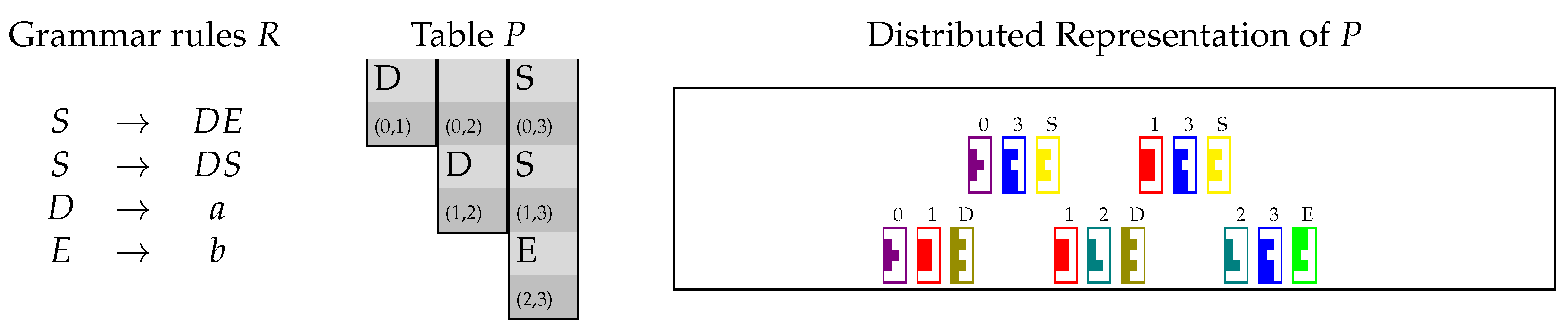
A running example is presented in Figure 1, showing a set R of grammar rules along with the table P produced by the algorithm when processing the input string (the right part of this figure should be ignored by now). For instance, S is added to , since , , and . Since , we conclude that w can be generated by the grammar.
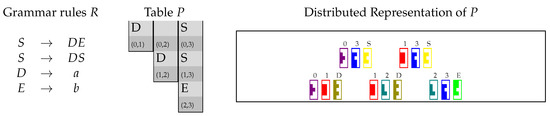
Figure 1.
A simple context-free grammar (CFG), the Cocke–Younger–Kasami (CYK) parsing table P for the input string as constructed by Algorithm 1, and the “distributed” representation of P in Tetris-like notation.
3.2. Distributed Representations with Holographic Reduced Representations
Holographic reduced representations (HRRs), introduced in [26] and extended in [27], are distributed representations well suited for our aim of encoding the two-dimensional parsing table P of the CYK algorithm and for implementing the operation of selecting the content of its cells . In the following, we introduce the operations we use, along with a graphical way to represent their properties. The graphical representation is based on Tetris-like pieces.
These HRRs represent sequences of symbols in vectors by composing vectors of symbols in the sequences. Hence, these representations offer an encoder and a decoder for sequences in vectors. The encoder and the decoder are not learned, but rely on the statistical properties of random vectors and the properties of a basic operation for composing vectors. The basic operation is circular convolution [26], extended to shuffled circular convolution in [27], which is non-commutative and, then, alleviates the problem of confusing sequences with the same symbols in different order.
The starting point of a distributed representation and, hence, of HRR is how to encode symbols into vectors: symbol a is encoded using a random vector drawn from a multivariate normal distribution . These are used as basis vectors for the Johnson–Lindenstrauss transform [28], as well as for random indexing [29]. The main property of these random vectors is the following:
In this paper, we use the matrix representation of the shuffled circular convolution introduced in [27]. In this way, symbols are represented in a way where composition is just matrix multiplication and the inverse operation is matrix transposition. Given the above symbol encoding, we can define a basic operation and its approximate inverse . These operations take as input a symbol and provide a matrix in and are the basis for our encoding and decoding. The first operation is defined as:
where is a permutation matrix to obtain the shuffling [27] and is the circulant matrix of the vector , that is:
while is the circular shifting of i positions of the vector . Circulant matrices are used to describe circular convolution. In fact, where is circular convolution. This operation has a nice approximated inverse in:
We then have:
since is a permutation matrix and therefore and since:
due to the fact that and are circulant matrices based on random vectors ; hence, if both and , and otherwise. Finally, the permutation matrix is used to enforce non-commutativity in the matrix product such as .
With the and operations at hand, we can now encode and decode strings, that is finite sequences of symbols. As an example, the string can be represented as the matrix product . In fact, we can check that starts with a, but not with b or with c, since we have , which is different from , while and . Knowing that starts with a, we can also check that the second symbol in is b, since is different from . Finally, knowing that starts with , we can check that the string ends in c, since .
Using the above operations, we can also encode sets of strings. For instance, the string set is represented as the sum of matrix products . We can then test whether by computing the matrix product , meaning that the answer is positive. Similarly, is false, since . We can also test whether there is any string in starting with a, by computing and providing a positive answer since the result is different from .
Not only can our operations be used to encode sets, as described above; they can also be used to encode multiple sets, that is they can keep a count of the number of occurrences of a given symbol/string within a collection. For instance, consider the multi-set consisting of two occurrences of symbol a. This can be encoded by means of the sum . In fact, we can test the number of occurrences of symbol a in the multi-set using the product .
Our operations have the nice property of deleting symbols in a chain of matrix multiplication if the opposed symbols are contiguous. In fact, two contiguous opposed symbols become the identity matrix, which is invariant with respect to matrix multiplication. This behavior seems to be similar to what happens for the Tetris game where pieces delete lines when shapes complement holes in lines. Hence, to visualize the encoding and decoding implemented by the above operations, we will use a graphical representation based on Tetris. Symbols under the above operations are represented as Tetris pieces: for example,
 . In this way strings are sequences of pieces; for example,
 encodes (equivalently, ). Then, like in Tetris, elements with complementary shapes are canceled out and removed from a sequence; for example, if
 is applied to the left of
 , the result is
 as
as
 disappears. Sets of strings (sums of matrix products) are represented in boxes, as for instance:
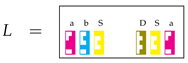 which encodes set (equivalently, ). In addition to the usual Tetris rules, we assume here that an element with a certain shape will select from a box only elements with the complementary shape facing it. For instance, if
 is applied to the left of the above box L, the result is the new box:
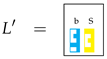 as
as  selects
  but not
. In this way strings are sequences of pieces; for example,
encodes (equivalently, ). Then, like in Tetris, elements with complementary shapes are canceled out and removed from a sequence; for example, if
is applied to the left of
, the result is
as
disappears. Sets of strings (sums of matrix products) are represented in boxes, as for instance:
is applied to the left of the above box L, the result is the new box:
selects but not With the encoding introduced above and with the Tetris metaphor, we can describe our model to encode P tables as matrices of real numbers, and we can implement CFG rule applications by means of matrix multiplication, as discussed in the next section.
4. The CYK Algorithm on Distributed Representations
The distributed CYK algorithm (D-CYK) is our version of the CYK algorithm running over distributed representations and using matrix algebra. As the traditional CYK, our algorithm recognizes whether or not a string w can be generated by a CFG with a set of rules R in Chomsky normal form. Yet, unlike the traditional CYK algorithm, the parsing table P and the rule set R are encoded through matrices in , using the distributed representation of Section 3.2, and rule application is obtained with matrix algebra. Here, d is some fixed natural number independent of the length of w.
In this section, we describe how the D-CYK algorithm encodes:
- (i)
- the table P by means of two matrices and ;
- (ii)
- the unary rules in R by means of a matrix for each nonterminal symbol ; and
- (iii)
- the binary rules in R by means of matrices for each .
We also specify the steps of the D-CYK algorithm and illustrate its execution using the running example of Figure 1.
4.1. Encoding the Table P in matrices and
The table P of the CYK algorithm can be seen as a collection of triples , where A is a nonterminal symbol from the grammar. More precisely, the collection of triples contains element if and only if . Given the representation of Section 3.2, the table P is then encoded by means of two matrices and in . The reason why we need two different matrices to encode P will become apparent later on, in Section 4.3. Matrices and contain the collection of triples in distributed representation. More precisely, each triple is encoded as:
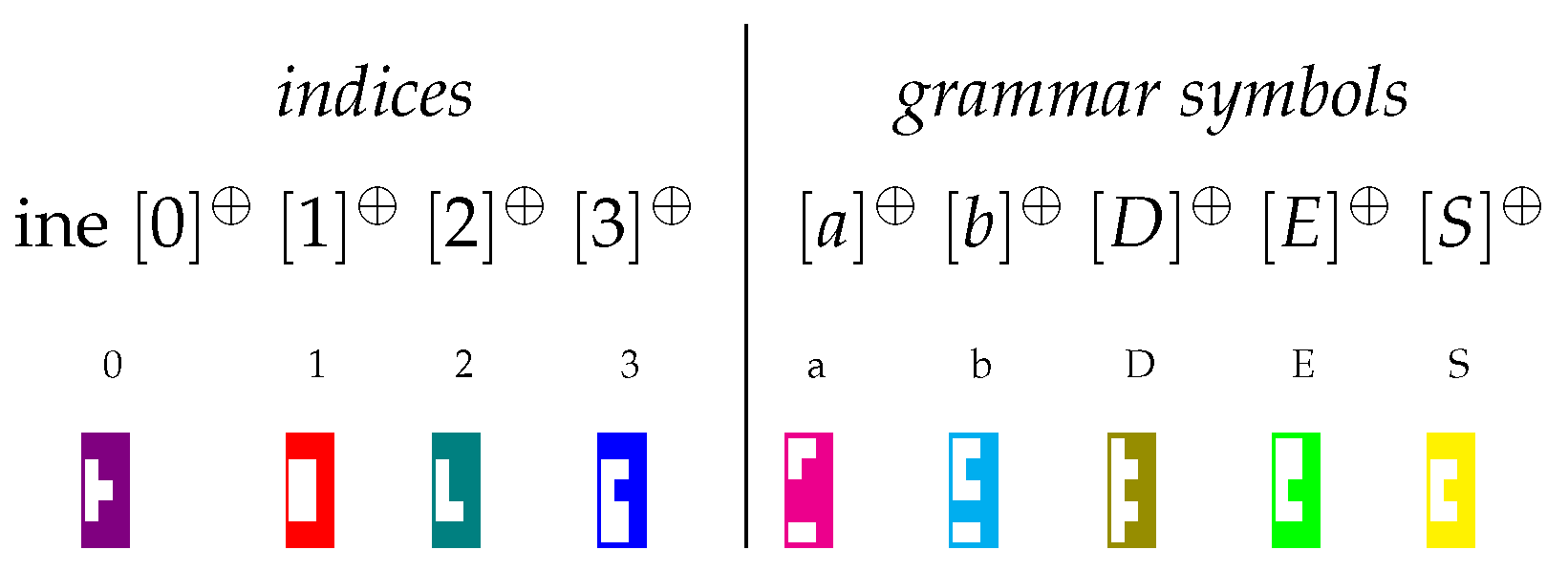
Then, matrix is the sum of all elements , encoding the collection of all triples from P. Similarly, is the sum of all elements . To visualize this representation, the matrix of our running example is represented in the Tetris-like notation in Figure 1, where we used the pieces in Figure 2.
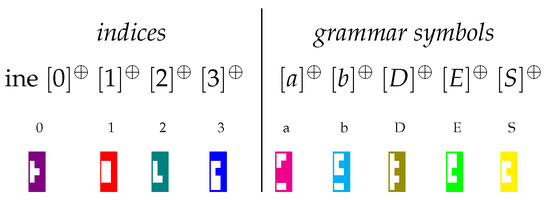
Figure 2.
Tetris-like graphical representation for the pieces for symbols in our running example.
4.2. Encoding and Using Unary Rules
The CYK algorithm uses symbols from the input string and unary rules to fill in cells , as seen in Algorithm 1. We simulate this step in our D-CYK using our distributed representation and matrix operations.
D-CYK represents each input token using a dedicated matrix , defined as:
For processing unary rules, we use the first part of the D-CYK algorithm, called D-CYK_unary and reported in Algorithm 2. D-CYK_unary takes and produces matrices and encoding nonterminal symbols resulting from the application of unary rules.
| Algorithm 2 D-CYK_unary(string , matrices ) return and |
|
In D-CYK_unary, we also use matrices , for each in the left-hand side of some unary rule. These matrices are conceived of to detect the applicability to matrix of the rules of the form , where a is some alphabet symbol. Matrix is defined as:
where R is the set of rules of the grammar. The operation involving and , which detects whether some rule is applicable at position of the input string, is (Line 4 in Algorithm 2):
where is a sigmoid function . In fact, extracts the distributed representation of terminal symbol . Then:
is reinforced by the subsequent use of the sigmoid function. Hence, if some unary rule with left-hand side symbol A is applicable, the resulting matrix is approximately the identity matrix ; otherwise, the resulting matrix is approximately the zero matrix . Then, the operations at Lines 5 and 6:
add a non-zero matrix to both and only if unary rules for A are matched by matrix encoding the input string w.
We describe the application of D-CYK_unary using the running example in Figure 1 and the Tetris-like representation. The two unary rules and are represented as and , that is:
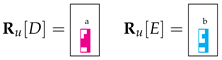 in the Tetris-like form. Given the input string , the matrix is:
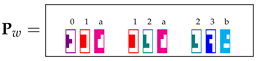
We focus on the application of rule to cell of the parsing table, represented through matrices and , respectively. At Steps 4 and 5 of Algorithm 2, taken together, we have:

The part of the assignment can be expressed as:
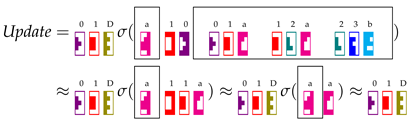
This results in the insertion of the distributed representation of triple in . A symmetrical operation is carried out to update . After the application of matrices and at each cell , the matrices and provide the following values:


4.3. Encoding and Using Binary Rules
To complete the specification of algorithm D-CYK, we describe here how to encode binary rules in such a way that these rules can fire over the distributed representation of table P through operations in our matrix algebra. We introduce the second part of the algorithm, called D-CYK_binary and specified in Algorithm 3, and we clarify why both and , introduced in Section 4.1, are needed.
| Algorithm 3 D-CYK_binary(, rules for each A) return |
|
Binary rules in R with nonterminal symbol A in the left-hand side are all encoded in a matrix in . is conceived of for defining matrix operations that detect if rules of the form , for some B and C, fire in position , given and . This operation results in a nearly identity matrix for a specific position if at least one rule coded in fires in position over positions and , for any value of k. This in turn will enable the insertion of new symbols in and , for later steps.
To define , we encode the right-hand side of each binary rule in R as . All the right-hand sides of binary rules with symbol A in the left-hand side are then collected in matrix :
Algorithm 3 uses these rules to determine whether a symbol A can fire in a position for any k. The key part is Line 4 of Algorithm 3:
Matrix selects elements in and according to rules for A. Matrices and have been designed in such a way that, after the nonterminal symbols in the selected elements have been annihilated, the associated spans and merge into span . Finally, the terms are meant to check whether the span has survived. If this is the case, the resulting matrix will be very close to , with n depending on the number of merges that have produced the span ; otherwise, the resulting matrix will be very close to the null matrix . To remove from the resulting matrix the potential n factor, we use the sigmoid function . Finally, we apply an element-wise multiplication with , which is helpful in removing noise.
Albeit that it is not the focus of our study, it is important to observe the computational complexity of the core part of D-CYK since it was reduced to where n is the length of the input and is the cardinality of the set of non-terminal symbols. The computational complexity of the CKY in Algorithm 1 is where is the size of the grammar. The reduction in complexity is justified by the fact that we regard as a constant the parameter d associated with the distributed representation, and by the fact that the inner loop in Algorithm 1 starting in Line 8 is absorbed by the matrix operations in Lines 4-6 of Algorithm 3. Yet, this reduction in complexity is paid with the approximation of the results introduced by these matrix operations over the distributed representation of the CYK matrix.
To visualize the behavior of the algorithm D-CYK_binary and the effect of using , we use again the running example of Figure 1. The only nonterminal with binary rules is S, and matrix is:
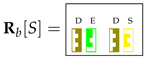
Let us focus on the position . The operation is the following:
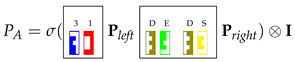 where and are as in Equations (3) and (4). We can then write:
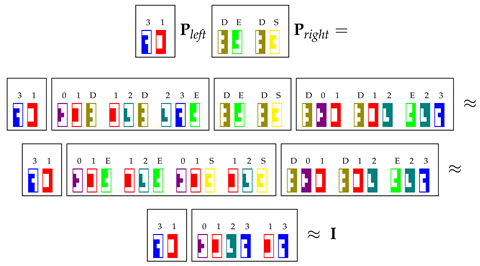
Then, this operation detects that S is active in position .
With this second part of the algorithm, CYK is reduced to D-CYK, which works with distributed representations and matrix operations compliant with neural networks.
5. Interpreting D-CYK as a Recurrent Neural Network
Recurrent neural networks (RNNs) are used in the analysis of unbounded length sequences. RNNs exploit the notion of internal state and can be viewed as a special kind of dynamic, non-linear system. In this section, we assume the reader is familiar with the definition of RNN; for an introduction, see for instance [30], Section 8.4. In what follows, we describe an interpretation of our D-CYK algorithm as an RNN. This will show that our D-CKY opens the possibility of implementing RNN organized according to a CYK algorithm.
5.1. Building Recurrent Blocks
We start by considering the core part of the D-CYK algorithm, that is Algorithm 3. Let , , be our input string. In order to simulate the two outermost for-cycles in Algorithm 3, the input to the recurrent neural network is a sequence of pairs:
The token at position t in the input sequence is denoted in what follows.
Recall from Section 3.2 that, for each index i, we have . We can implement Algorithm 3 through an RNN as follows. We rename matrix as . We then define recurrent blocks for each nonterminal symbol :
Blocks for different nonterminals are then combined for the next step:
Here, encodes matrix , and encodes matrix from Algorithm 3, after the first iterations of the innermost for-cycle in Algorithm 3. Matrices and are taken from the output of Algorithm 2.
Finally, Algorithm 2 can be directly implemented by tagging each token from w using unary rules from R and by subsequently encoding the tag and the associated indices i and in our distributed form.
5.2. Decoding Phase
The decoding phase is based on the specification of Algorithm 4 reported in Section 6. Let be the matrix obtained from Equation (9) after the entire input sequence has been processed by the network in Section 5.1. We apply a simple, memory-less forward layer:
to the sequence:
where is initialized with rows representing the nonterminal symbols in a distributed way.
6. Experiments
The aim of this section is to evaluate the D-CYK algorithm by assessing how close it comes to the traditional CYK algorithm, that is how similar the parsing tables produced by the two algorithms are. For this purpose, we use artificial, ambiguous CFGs. Hence, understanding how good D-CYK is at selecting the best syntactic interpretation in an NLP setting is out of the scope of this study.
6.1. Experimental Setup
We experiment with five different CFGs in Chomsky normal form, named with . Table 1 reports some elementary statistics about these grammars. Each is obtained from by adding new rules and new nonterminal symbols, so that the language generated by is always included in the language generated by . More precisely, expands over by adding unary rules only; all remaining grammars expand over by adding binary rules only. Grammars are directly encoded in and as described in Equations (1) and (5). These parameters are not learned, but set. We test each with the same set of 2000 strings obtained by randomly generating strings of various lengths using .

Table 1.
Chomsky normal form grammars used in the experiments. We report the total number of rules and the number of binary rules.
As we want to understand whether D-CYK is able to reproduce the original CYK, we use Algorithm 4 to decode into a set of triples of the form . This set represents the parsing table computed by algorithm D-CYK, as already described in Section 4.1.
| Algorithm 4 Dec() return table P |
|
Set and the set of triples representing the parse table P obtained by applying the traditional CYK algorithm on the same grammar and string are then compared by evaluating precision and recall, considering P as the oracle, and combining the two scores in the usual way into the -measure (). measures how much the decoding of matrix is similar to the original parsing table P. We experiment with six different dimensions d for matrix : 100, 1000, 2000, 3000, 4000, 5000, and 6000.
6.2. Results and Discussion
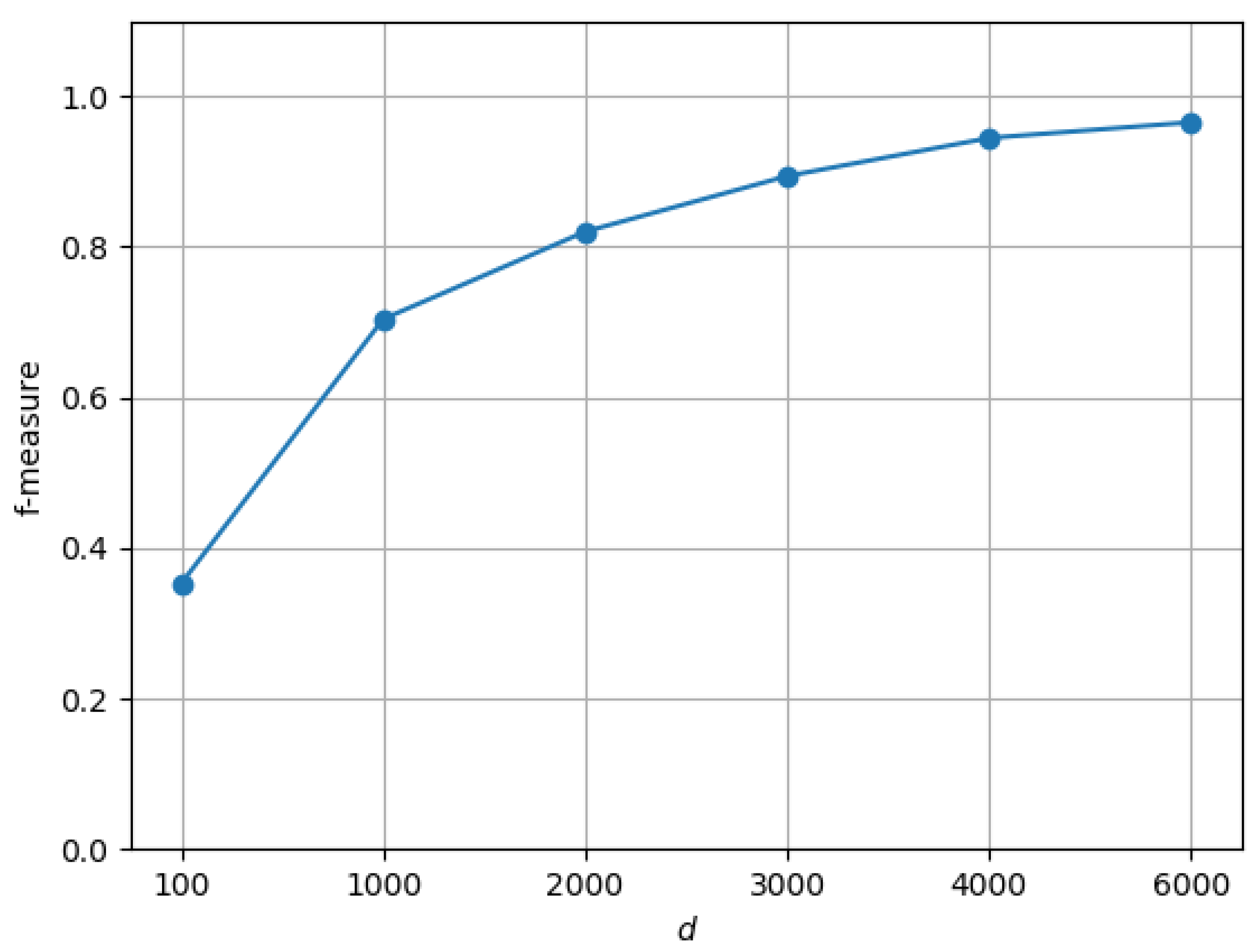
For grammar and for strings of length , Figure 3 shows that, as the dimension d of matrix increases, D-CYK can approximate more precisely the information computed by the traditional CYK algorithm, as attested by the increase of measure . The increase of is mainly due to an improvement in precision, while recall is substantially stable.
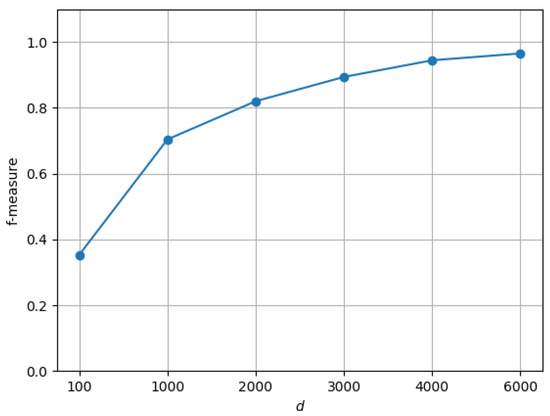
Figure 3.
vs. dimension d on strings with length and grammar .
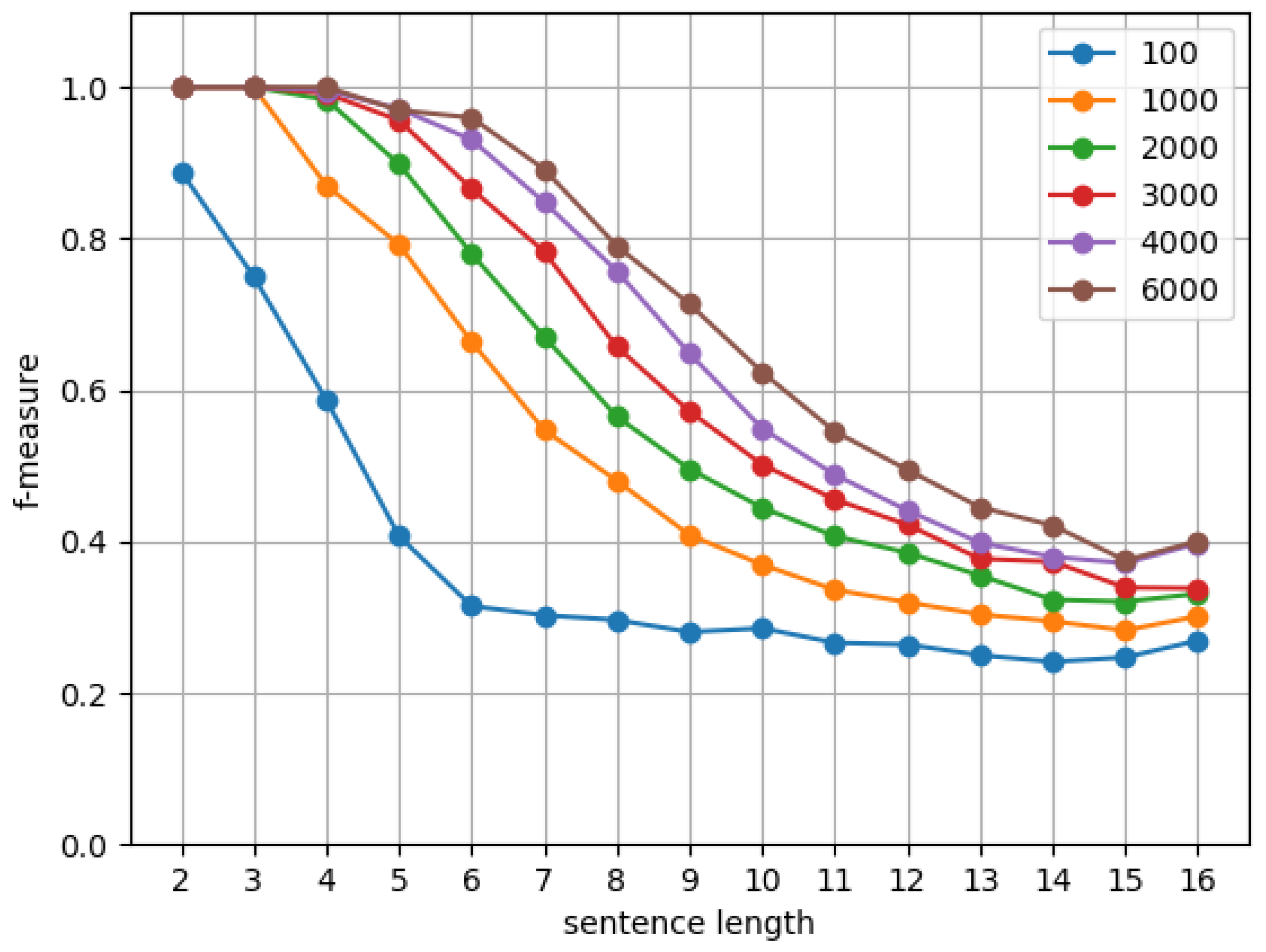
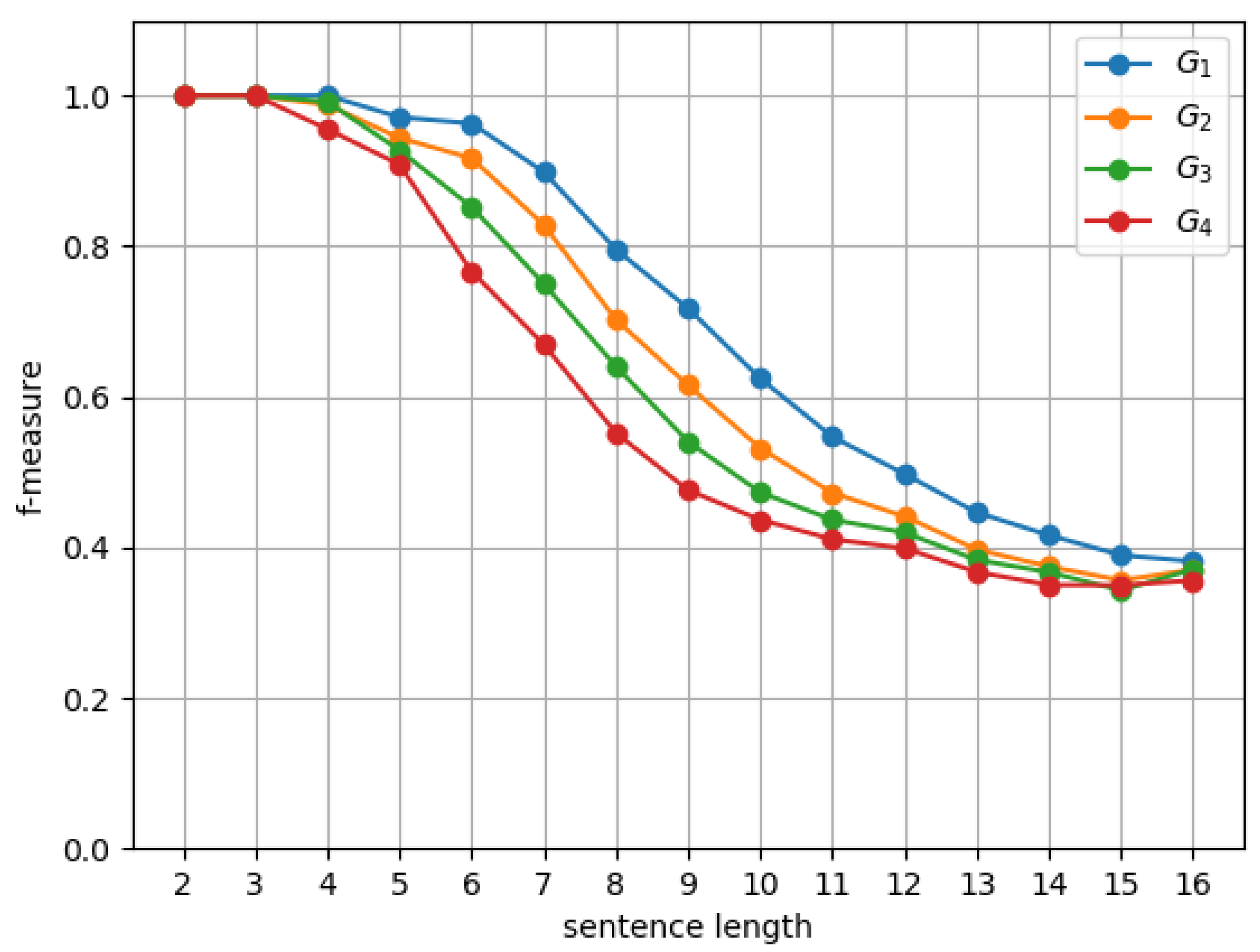
On the downside, the length of the input string affects the accuracy of D-CYK. This is seen in Figure 4, reporting several tests on grammar for different dimensions d. Even for our highest dimension , there is a 20% drop in accuracy, as measured by , for strings of length eight. The size of the grammar is also a major problem. In fact, the accuracy of the D-CYK algorithm is affected by the number of rules/nonterminals for increasingly larger grammars to , as shown in Figure 5.
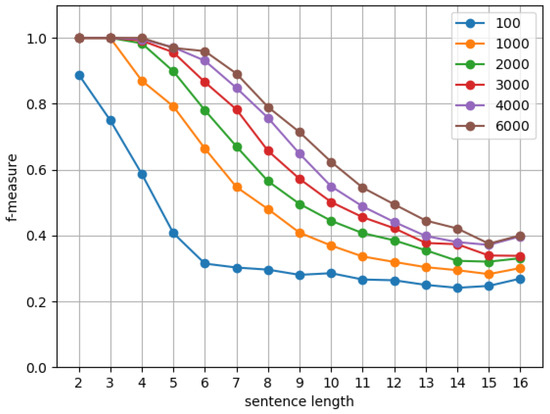
Figure 4.
vs. string length for different dimensions d on grammar .
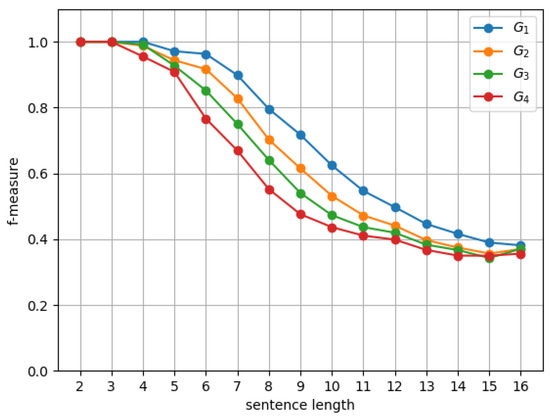
Figure 5.
vs. length of strings with grammars , , and .
In addition to these results, we also experimented with a seq2seqmodel based on LSTM by considering the task as the production of the sequence of symbols in the CKY matrix from the input sequence. We prepared an additional dataset of 2000 examples for training. However, the neural network did not produce significative results. For this reason, we omitted the table here. The task is too complex to be learned by a trivial seq2seq model.
7. Conclusions and Future Work
At present, the predominance of symbolic, grammar-based algorithms for parsing of natural language has been successfully challenged by neural networks, which are based on distributed representations. However, Weiss et al. [24] and Suzgun et al. [25] showed the limitations of recurrent neural networks in capturing context-free languages in their full generality, when the input string is provided in plain form. Following this line of investigation, in this short article, we make a first step toward the definition of neural networks that can process context-free languages. We introduce the D-CYK algorithm, which is a distributed version of CYK, a classical parsing algorithm for context-free languages. We also show how to implement D-CYK by means of a recurrent neural network, based on the unfolding of the input string into tokens that encode the search space of all possible constituents. Preliminary experiments show that, to some extent, D-CYK can simulate CYK in the new setting of distributed representations.
In this work, we exploited holographic reduced representations, a specific distributed representation. In future work, we intend to explore alternative distributed representations, possibly using training, for use with our D-CYK algorithm. Neural networks are a tremendous opportunity to develop novel solutions for known tasks. Our proposal opens the avenue of revitalizing symbolic parsing methods in the framework of neural networks for NLP and for other areas working with parsing algorithms and grammars along with neural networks [31,32]. In fact, D-CYK is the first step towards the definition of a “completely distributed CYK algorithm” that builds trees in distributed representations during the computation, and it fosters the definition of recurrent layers of CYK-informed neural networks.
Author Contributions
Conceptualization, F.M.Z.; formal analysis, G.S.; software, G.C.; writing—original draft, F.M.Z. and G.S. All authors have read and agreed to the published version of the manuscript.
Funding
This research received no external funding.
Conflicts of Interest
The authors declare no conflict of interest.
References
- Hopcroft, J.E.; Motwani, R.; Ullman, J.D. Introduction to Automata Theory, Languages, and Computation, 2nd ed.; Addison-Wesley: Reading, MA, USA, 2001. [Google Scholar]
- Sippu, S.; Soisalon-Soininen, E. Parsing Theory: LR(k) and LL(k) Parsing; Springer: Berlin, Germany, 1990; Volume 2. [Google Scholar]
- Aho, A.V.; Lam, M.S.; Sethi, R.; Ullman, J.D. Compilers: Principles, Techniques, and Tools, 2nd ed.; Addison-Wesley Longman Publishing Co., Inc.: Reading, MA, USA, 2006. [Google Scholar]
- Graham, S.L.; Harrison, M.A. Parsing of General Context Free Languages. In Advances in Computers; Academic Press: New York, NY, USA, 1976; Volume 14, pp. 77–185. [Google Scholar]
- Nederhof, M.; Satta, G. Theory of Parsing. In The Handbook of Computational Linguistics and Natural Language Processing; Clark, A., Fox, C., Lappin, S., Eds.; Wiley: Hoboken, NJ, USA, 2010; Chapter 4; pp. 105–130. [Google Scholar]
- Cocke, J. Programming Languages and Their Compilers: Preliminary Notes; Courant Institute of Mathematical Sciences, New York University: New York, NY, USA, 1969. [Google Scholar]
- Younger, D.H. Recognition and parsing of context-free languages in time (n3). Inf. Control 1967, 10, 189–208. [Google Scholar] [CrossRef]
- Kasami, T. An eFficient Recognition And Syntax-Analysis Algorithm For Context-Free Languages; Technical Report; Air Force Cambridge Research Lab: Bedford, MA, USA, 1965. [Google Scholar]
- Charniak, E. Statistical Language Learning, 1st ed.; MIT Press: Cambridge, MA, USA, 1996. [Google Scholar]
- Huang, L.; Chiang, D. Better k-best Parsing. In Proceedings of the Ninth International Workshop on Parsing Technology, Association for Computational Linguistics, Vancouver, BC, Cananda, 9–10 October 2005; pp. 53–64. [Google Scholar]
- Goodfellow, I.; Bengio, Y.; Courville, A. Deep Learning; The MIT Press: Cambridge, MA, USA, 2016. [Google Scholar]
- Valiant, L.G. General Context-Free Recognition in Less Than Cubic Time. J. Comput. Syst. Sci. 1975, 10, 308–315. [Google Scholar] [CrossRef]
- Graham, S.L.; Harrison, M.A.; Ruzzo, W.L. An Improved Context-Free Recognizer. ACM Trans. Program. Lang. Syst. 1980, 2, 415–462. [Google Scholar] [CrossRef]
- Fanty, M.A. Context-Free Parsing with Connectionist Networks; American Institute of Physics Conference Series; American Institute of Physics: College Park, MD, USA, 1986; Volume 151, pp. 140–145. [Google Scholar] [CrossRef]
- Nijholt, A. Meta-parsing in neural networks. In Cybernetics and Systems ’90; Trappl, R., Ed.; World Scientific: Vienna, Austria, 1990; pp. 969–976. [Google Scholar]
- Earley, J. An Efficient Context-free Parsing Algorithm. Commun. ACM 1970, 13, 94–102. [Google Scholar] [CrossRef]
- Henderson, J. Inducing History Representations for Broad Coverage Statistical Parsing. In Proceedings of the 2003 Human Language Technology Conference of the North American Chapter of the Association for Computational Linguistics, Edmonton, AB, Canada, 27 May–1 June 2003; pp. 103–110. [Google Scholar]
- Chen, D.; Manning, C.D. A Fast and Accurate Dependency Parser using Neural Networks. In Proceedings of the 2014 Conference on Empirical Methods in Natural Language Processing, EMNLP, Doha, Qatar, 25–29 October 2014; pp. 740–750. [Google Scholar]
- Watanabe, T.; Sumita, E. Transition-based Neural Constituent Parsing. In Proceedings of the 53rd Annual Meeting of the Association for Computational Linguistics and the 7th International Joint Conference on Natural Language Processing (Volume 1: Long Papers), 26–31 July 2015; pp. 1169–1179. [Google Scholar] [CrossRef]
- Dyer, C.; Ballesteros, M.; Ling, W.; Matthews, A.; Smith, N.A. Transition-Based Dependency Parsing with Stack Long Short-Term Memory. In Proceedings of the 53rd Annual Meeting of the Association for Computational Linguistics and the 7th International Joint Conference on Natural Language Processing (Volume 1: Long Papers), Beijing, China, 26–31 July 2015; pp. 334–343. [Google Scholar] [CrossRef]
- Socher, R.; Bauer, J.; Manning, C.D.; Ng, A.Y. Parsing with Compositional Vector Grammars. In Proceedings of the 51st Annual Meeting of the Association for Computational Linguistics (Volume 1: Long Papers), Sofia, Bulgaria, 4–9 August 2013; pp. 455–465. [Google Scholar]
- Dyer, C.; Kuncoro, A.; Ballesteros, M.; Smith, N.A. Recurrent Neural Network Grammars. In Proceedings of the NAACL HLT 2016, the 2016 Conference of the North American Chapter of the Association for Computational Linguistics: Human Language Technologies, San Diego, CA, USA, 12–17 June 2016; pp. 199–209. [Google Scholar]
- Vinyals, O.; Kaiser, L.; Koo, T.; Petrov, S.; Sutskever, I.; Hinton, G. Grammar as a Foreign Language. arXiv 2014, arXiv:1412.7449v3. [Google Scholar] [CrossRef]
- Weiss, G.; Goldberg, Y.; Yahav, E. On the Practical Computational Power of Finite Precision RNNs for Language Recognition. In Proceedings of the 56th Annual Meeting of the Association for Computational Linguistics (Volume 2: Short Papers), Melbourne, Australia, 15–20 July 2018; pp. 740–745. [Google Scholar] [CrossRef]
- Suzgun, M.; Belinkov, Y.; Shieber, S.; Gehrmann, S. LSTM Networks Can Perform Dynamic Counting. In Proceedings of the Workshop on Deep Learning and Formal Languages: Building Bridges, Association for Computational Linguistics, Florence, Italy, 28 July–2 August 2019; pp. 44–54. [Google Scholar] [CrossRef]
- Plate, T.A. Holographic Reduced Representations. IEEE Trans. Neural Netw. 1995, 6, 623–641. [Google Scholar] [CrossRef] [PubMed]
- Zanzotto, F.; Dell’Arciprete, L. Distributed tree kernels. In Proceedings of the International Conference on Machine Learning, Edinburgh, UK, 26 June–1 July 2012; pp. 193–200. [Google Scholar]
- Johnson, W.B.; Lindenstrauss, J. Extensions of Lipschitz mappings into a Hilbert space. Contemp. Math. 1984, 26, 189–206. [Google Scholar] [CrossRef]
- Sahlgren, M. An Introduction to Random Indexing. In Proceedings of the Methods and Applications of Semantic Indexing Workshop at the 7th International Conference on Terminology and Knowledge Engineering, Copenhagen, Denmark, 16 August 2005; pp. 1–9. [Google Scholar]
- Zhang, A.; Lipton, Z.C.; Li, M.; Smola, A.J. Dive into Deep Learning. Corwin. 2020. Available online: https://d2l.ai (accessed on 14 October 2020).
- Do, D.T.; Le, T.Q.T.; Le, N.Q.K. Using deep neural networks and biological subwords to detect protein S-sulfenylation sites. Brief. Bioinform. 2020, bbaa128. [Google Scholar] [CrossRef] [PubMed]
- Le, N.Q.K.; Yapp, E.K.Y.; Nagasundaram, N.; Yeh, H.Y. Classifying Promoters by Interpreting the Hidden Information of DNA Sequences via Deep Learning and Combination of Continuous FastText N-Grams. Front. Bioeng. Biotechnol. 2019, 7, 305. [Google Scholar] [CrossRef] [PubMed]
Publisher’s Note: MDPI stays neutral with regard to jurisdictional claims in published maps and institutional affiliations. |
© 2020 by the authors. Licensee MDPI, Basel, Switzerland. This article is an open access article distributed under the terms and conditions of the Creative Commons Attribution (CC BY) license (http://creativecommons.org/licenses/by/4.0/).