


Abstract
The aim of this article is to present a procedure for the factorization and exact solution of boundary value problems for a class of n-th order linear Fredholm integro-differential equations with multipoint and integral boundary conditions. We use the theory of the extensions of linear operators in Banach spaces and establish conditions for the decomposition of the integro-differential operator into two lower-order integro-differential operators. We also create solvability criteria and derive the unique solution in closed form. Two example problems for an ordinary and a partial intergro-differential equation respectively are solved.
Keywords:
integro-differential equations; factorization; nonlocal boundary value problems; integral conditions; multipoint conditions; decomposition of operators; exact solution MSC:
45J05; 45K05; 47G20
1. Introduction
Integro-differential equations arise in many areas in sciences and engineering. For example, Fredholm and Volterra integro-differential equations are used in [1,2,3] for modeling neural networks; Fredholm integro-differential equations are utilized in [4,5] to model the response of plates and shells in the theory of elasticity; Volterra integro-differential equations are employed in [6,7,8] to simulate thermal problems in the glass-forming process, drug concentrations in pharmacokinetics, and Hepatitis B Virus infection in medicine, respectively.
This paper is concerned with the factorization and exact solution of boundary value problems for a class of n-th order Fredholm integro-differential equations of the second type with nonlocal boundary conditions. Closed form solutions are apparently preferred in all cases [9], but they cannot be accomplished for many real-life problems due to their mathematical complexities. For the exact solution of linear Fredholm integro-differential equations the direct computation method can be used, but its application is limited to special cases where the kernel is separable, and the integrals involved are evaluated analytically [10]. Instead, approximate numerical methods are used. For the solution of integro-differential equations various approximate methods have been developed, see [11,12,13,14,15,16,17] and many others. Higher order integro-differential equations are often encountered in modeling and there have been the subject of numerous investigations [18,19,20,21]. When model accuracy is very important then boundary conditions must be nonlocal, i.e., involving combinations of various points and integrals. For instance, the necessity of integral conditions in certain models of epidemics and population growth and the effects when simplifying them are explained in [22]. Nonlocal boundary value problems for integro-differential equations have received much attention recently, see [23,24,25,26,27,28] and the references therein. Factorization methods are very important in constructing exact solutions, but their applicability is confined to certain kinds of operators and moreover they cannot be universal for all problems. They have been studied extensively for decomposing differential operators [29,30,31,32,33] and very little in factoring integro-differential operators [34,35,36,37]. Here, we continue the work in [35,36,37] and present a method for factorizing and solving yet another type of boundary value problems.
Specifically, in [35], in a Hilbert space H, the authors studied the factorability of the linear operator of the type
into , where are two lower-order linear operators, and the unique solvability of the boundary value problem . The linear operators are correct, i.e., are bijective and the associated inverse operators are bounded on H, the operator is densely defined on H, the vectors and the elements are linearly independent, , and is unknown. In [36], the exact solution of the boundary value problem
in a Banach space X was investigated. The linear operator is a self-composition of the operator ,
where is a maximal n-th order linear ordinary differential operator, , is a vector of m linear bounded functionals on X, are vectors of bounded linear boundary functionals, N is a constant matrix, , and is unknown. The paper [37] deals with the decomposition and the exact solution of the boundary value problem
where is a linear operator, are linear differential operators of order n and , respectively, , are vectors of linear bounded functionals on X, , and .
The strict assumptions that were made and the requirement that the operators must be known in advance in [35] are restrictive in implementing the factorization technique in solving practical boundary value problems. On the other hand, the formulation in Banach space in [36,37] for solving the corresponding two problems above has been proved more convenient. Here, we generalize the results in [35] in Banach space and at the same time loosen the requirements. Further, we provide a step by step procedure for the factorization and solution of the boundary value problem.
In particular, in a Banach space X of complex valued functions of x defined on the region , we consider the following boundary value problem
where is a linear operator with its domain specified by the prescribed multipoint and integral conditions, is a bijective linear differential operator of order n defined on the same domain as the operator B, is a bijective linear differential operator of order whose domain is determined by some multipoint and integral conditions, are known kernel functions, is an input function and is the unknown function. We first examine under which conditions this problem can be decomposed into two simpler boundary value problems and then by solving these lower-order problems we derive its unique solution in closed form.
In addition, we investigate the factorization and solution of the boundary value problem
which is a special case of the boundary value problem (1).
The paper is organized as follows. Some preliminaries are given in Section 2. Next, the main results are presented in Section 3. In Section 4, two examples problems, one for ordinary and one for partial integro-differential equations, are solved to elucidate the implementation and highlight the efficiency of the procedure. Finally, in Section 5 some conclusions are given.
2. Materials and Methods
For the rest of the paper, we assume that the kernels are separable, i.e.,
where , and write the integro-differential Equation (1) in the symbolic form
where the vectors of functions
and the vectors of functionals, for ,
It is noted that denotes the matrix
where the element is the value of the functional on the element . It is easy to show that for an constant matrix N,
We recall that a linear operator is injective if for every , implies . The operator T is surjective if . If T is both injective and surjective, then the operator is called bijective and there be the inverse operator defined by if and only if for each . The operator T is said to be correct if it is bijective and the inverse operator is bounded on X. The problem is correct if the operator T is correct.
Finally, we will use several times the following Theorem, which has been shown in [21] and it is recalled here but with a different notation tailored to the needs of the present article.
Theorem 1.
Let X be a complex Banach space, a bijective linear operator, , , and the linear operator
Then the following statements are true:
- (i)
- The operator T is bijective on X if and only ifand the unique solution to boundary value problem , for any , is given by the formula
- (ii)
- If in addition the operator is bounded on X, then T is correct.
3. Main Results
First, we show the following two Lemmas which we will need to prove the main Theorem below.
Lemma 1.
Let the linear integro-differential operator be defined by
where is a linear differential operator of order n, is a linear differential operator of order with , , , and , .
If there exist a linear differential operator of order such that
and a vector satisfying the equation
then the operator B can be decomposed into
where the two linear integro-differential operators are defined by
Proof.
Moreover, we have
Further,
which completes the proof. □
Lemma 2.
Let the -order linear differential operator be a bijective operator, and . Then the operator
is bijective on X if and only if
In this case, the unique solution of the integro-differential equation
where , is given by
Proof.
It can be shown easily by applying Theorem 1. □
Theorem 2.
Let the linear integro-differential operator be defined by
where is a linear differential operator of order n, is a bijective linear differential operator of order with , , , and , . Let there be a bijective linear differential operator of order such that
Then the following statements are true.
- (i)
- Ifthen the operator B can be factorized into where the two linear integro-differential operators are defined bywhere
- (ii)
- If there exists a vector satisfying the equationthen the operator B is bijective if and only ifIn this case, the unique solution to the boundary value problemis given by
Proof.
(i) If Equation (10) holds, then from Lemma 2 it is implied that the operator defined in (12) is bijective and that the unique solution of the boundary value problem is given in (13). Then, from Lemma 1 it follows that the operator B can be decomposed into where the operators and are given in (11) and (12), respectively.
(ii) From Lemma (1) it is deduced that with and given by (11) and (12), respectively, and . Substituting into (8), we have
where
By applying Theorem 1, the operator B is bijective if and only if
Multiplying from the right the elements of the second column by and adding to the corresponding elements of the first column, we obtain
So we proved that the operator B is bijective if and only if the two conditions in (15) are fulfilled.
By means of Lemma 1 the boundary value problem (16) degenerates to where the operators and are given in (11) and (12), respectively. We set and factor the problem to two simpler boundary value problems
From Lemma 2 it follows that both operators and are bijective. Thus, we first solve the boundary value problem in (19) by using Theorem 1 to obtain
and then substitute into (18) and solve again by Theorem 1 to obtain
This completes the proof. □
The boundary value problem in (2) can be factorized and solved in a similar manner. For this, we state the following Lemma and Theorem, which are analogous to Lemma 1 and Theorem 2, respectively, and can be proved in a similar way.
Lemma 3.
Let the linear integro-differential operator be defined by
where is a linear differential operator of order n, , , and , . If there exists a vector satisfying the equation
then the operator B can be decomposed into
where the two linear integro-differential operators are defined by
Theorem 3.
Let the linear integro-differential operator be defined by
where is a bijective linear differential operator of order n, , , and , . Then the following statements are true.
- (i)
- Ifthen the operator B can be factorized into where the two linear integro-differential operators are defined byand
- (ii)
- If there exists a vector satisfying the equationthen the operator B is bijective if and only ifIn this case, the unique solution to the boundary value problemis given by
Finally, in Listing 1, we present the steps to be followed in factoring and solving the boundary value problem (16).
| Listing 1. Steps for factoring and solving the boundary value problem Bu = f in (16). |
|
4. Examples
To show the application and the effectiveness of the method described in the previous Section, we solve two illustrative example boundary value problems. First, an ordinary integro-differential equation with nonlocal boundary conditions is considered. Next, an integro-partial differential equation with integral conditions is factorized and solved in closed form.
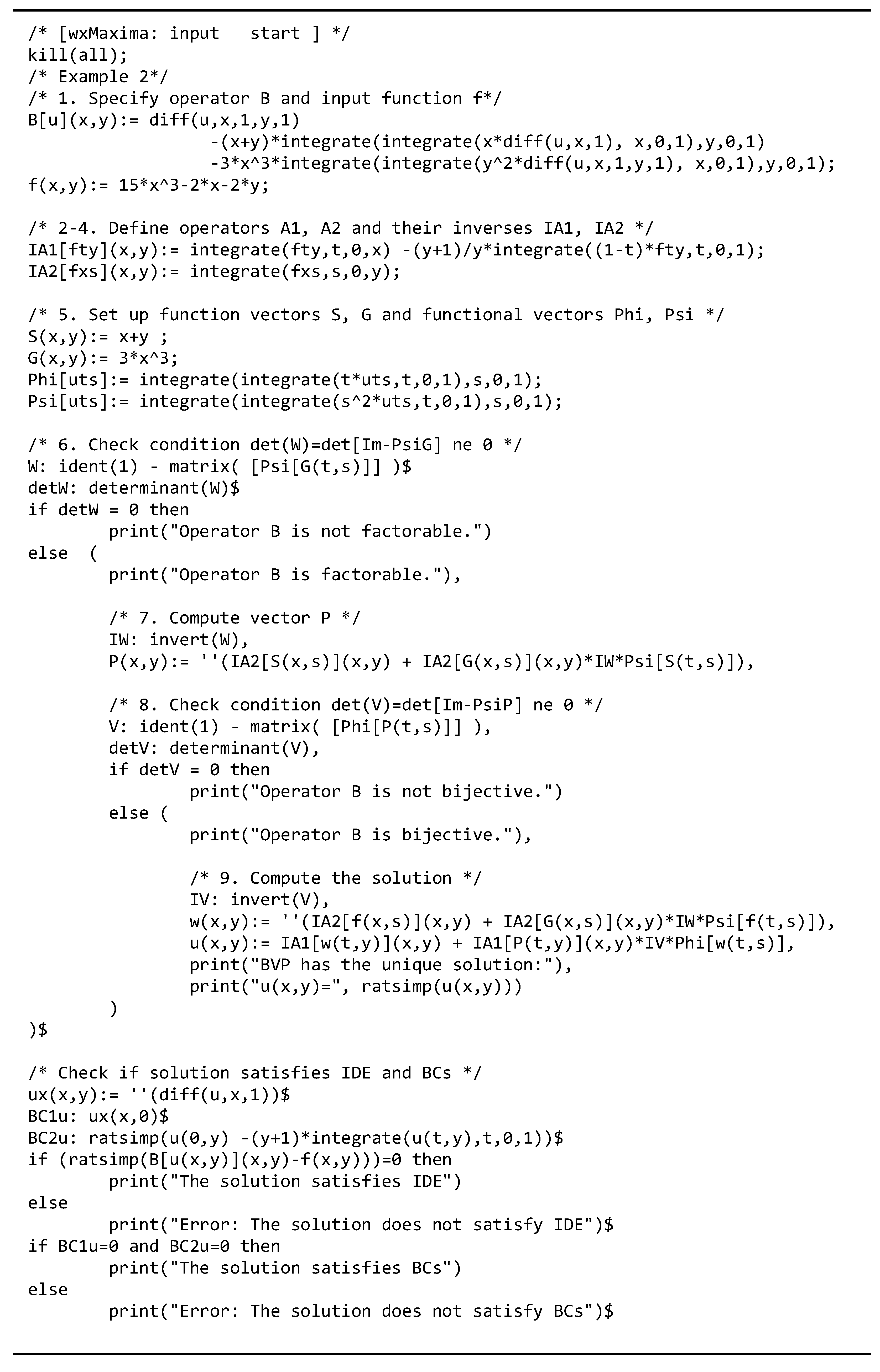
In the Appendix A, we present the implementation of the procedure in the open source software Maxima.
Example 1.
Consider the ordinary integro-differential equation
subject to nonlocal boundary conditions
for any .
- 1.
- According to procedure in Listing 1, we take and define the operator by
- 2.
- Further, we define the operators of order and , respectively, as
- 3.
- The operator is determined by requiringwhich implies that
- 4.
- The operators and are known to be correct and their inverses for any are given by
- 5.
- For , we set up the vectors
- 6.
- We compute
- 7.
- By utilizing (13), we find
- 8.
- Finally, we compute
- 9.
- From (22)–(25) it is implied that all requirements of Theorem 2 are satisfied and therefore the given boundary value problem (20), (21) can be factorized and its unique solution may be obtained by substituting into (17).As an illustration, for the unique solution turns out to be
Example 2.
Let now the partial integro-differential equation
along with the boundary conditions
where and .
Following the steps described in Listing 1, we have:
- 1.
- Take and define the operator as
- 2.
- Next, we define the operators of order and , respectively, by
- 3.
- The operator of order is determined by the requirement thatwhich yields
- 4.
- The operator is correct if and only if in which case its inverse is given byand the operator is correct with its inverse given by
- 5.
- We take and set up the vectors
- 6.
- We compute
- 7.
- Consequently, from (13) we obtain
- 8.
- We also compute
- 9.
5. Discussion
Factorization techniques have been known for long time and have been used extensively for studying and solving linear and nonlinear differential equations. They are very efficacious and useful whenever they can be applied.
In this paper, an attempt was made to extend the applicability of factorization methods to boundary value problems for a category of linear Fredholm type integro-differential equations with nonlocal boundary conditions. It is found that factoring the corresponding integro-differential operator is more difficult than the decomposition of analogous differential operators. It requires the solution of two lower-order integro-differential equations.
The proposed technique was tested and found to be very successful in solving exact boundary value problems for both ordinary and partial integro-differential equations. As it is the case with factorization methods, its application is limited to certain classes of integro-differential equations.
The main contribution of the paper is Theorems 2 and 3, and the procedure in Listing Section 3 which can be implemented to any software of symbolic computations.
The method can be advanced and extended further to include more types of integro-differential operators.
Author Contributions
Conceptualization, E.P. and I.N.P.; formal analysis, E.P. and I.N.P.; writing—original draft preparation, I.N.P.; writing—review and editing, E.P. All authors have read and agreed to the published version of the manuscript.
Funding
This research received no external funding.
Institutional Review Board Statement
Not applicable.
Informed Consent Statement
Not applicable.
Data Availability Statement
Not applicable.
Acknowledgments
The authors would like to thank the anonymous reviewers for their valuable suggestions and comments.
Conflicts of Interest
The authors declare no conflict of interest.
Appendix A
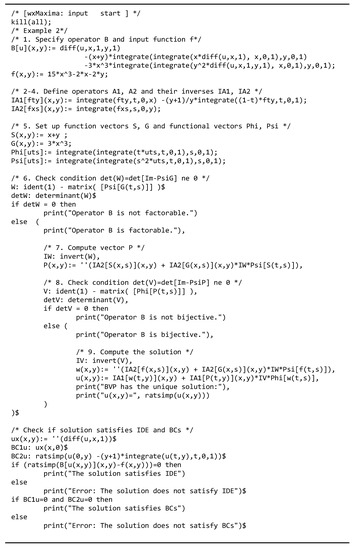
Listing A1.
Implementation in the open source software Maxima.
Listing A1.
Implementation in the open source software Maxima.
References
- Jackiewicz, Z.; Rahman, M.; Welfert, B. Numerical solution of a Fredholm integro-differential equation modelling neural networks. Appl. Numer. Math. 2006, 56, 423–432. [Google Scholar] [CrossRef]
- Lou, X.; Cui, B. Passivity analysis of integro-differential neural networks with time-varying delays. Neurocomputing 2007, 70, 1071–1078. [Google Scholar] [CrossRef]
- Guo, Y. Global asymptotic stability analysis for integro-differential systems modeling neural networks with delays. Z. Angew. Math. Phys. 2010, 61, 971–978. [Google Scholar] [CrossRef]
- Fradlin, B.N.; Tsykunov, F.A. On the development of the method of integro-differential equations in the theory of plates and shells. Sov. Appl. Mech. 1967, 3, 8–12. [Google Scholar] [CrossRef]
- Kostin, G.V.; Saurin, V.V. Integro-differential approach to solving problems of linear elasticity theory. Dokl. Phys. 2005, 50, 535–538. [Google Scholar] [CrossRef]
- Minakov, A.A.; Schick, C. Integro-differential equation for the non-equilibrium thermal response of glass-forming materials: Analytical solutions. Symmetry 2021, 13, 256. [Google Scholar] [CrossRef]
- Gillespie, W.R. Generalized pharmacokinetic modeling for drugs with nonlinear binding: I. Theoretical framework. J. Pharmacokinet. Biopharm. 1993, 21, 99–124. [Google Scholar] [CrossRef]
- Volinsky, I. Stability Analysis of a Mathematical Model of Hepatitis B Virus with Unbounded Memory Control on the Immune System in the Neighborhood of the Equilibrium Free Point. Symmetry 2021, 13, 1437. [Google Scholar] [CrossRef]
- Aslami, M.; Akimov, P.A. Analytical solution for beams with multipoint boundary conditions on two-parameter elastic foundations. Arch. Civ. Mech. Eng. 2016, 16, 668–677. [Google Scholar] [CrossRef]
- Wazwaz, A.M. Linear and Nonlinear Integral Equations, 3rd ed.; Springer: Berlin/Heidelberg, Germany, 2011. [Google Scholar] [CrossRef]
- Adomian, G.; Rach, R. On linear and nonlinear integro-differential equations. J. Math. Anal. Appl. 1986, 113, 199–201. [Google Scholar] [CrossRef]
- Brunner, H. The numerical treatment of ordinary and partial Volterra integro-differential equations. In Proceedings of the First International Colloquium on Numerical Analysis, Plovdiv, Bulgaria, 13–17 August 1992; De Gruyter: Berlin, Germany; Boston, MA, USA, 1993; pp. 13–26. [Google Scholar] [CrossRef]
- Bahuguna, D.; Ujlayan, A.; Pandey, D.N. A comparative study of numerical methods for solving an integro-differential equation. Comput. Math. Appl. 2009, 57, 1485–1493. [Google Scholar] [CrossRef]
- Liaqat, A.; Saeed, I.; Taza, G. A simple algorithm for exact solutions of systems of linear and nonlinear integro-differential equations. Appl. Math. Comput. 2017, 307, 311–320. [Google Scholar] [CrossRef]
- Ahmed, S.A.; Elzaki, T.M. On the comparative study integro–Differential equations using difference numerical methods. J. King Saud Univ.–Sci. 2020, 32, 84–89. [Google Scholar] [CrossRef]
- Căruntu, B.; Paşca, M.S. Approximate Solutions for a Class of Nonlinear Fredholm and Volterra Integro-Differential Equations Using the Polynomial Least Squares Method. Mathematics 2021, 9, 2692. [Google Scholar] [CrossRef]
- Providas, E. Approximate solution of Fredholm integral and integro-differential equations with non-separable kernels. In Approximation and Computation in Science and Engineering, Springer Optimization and Its Applications 180; Daras, N.J., Rassias, T.M., Eds.; Springer: Cham, Switzerland, 2021; pp. 697–712. [Google Scholar] [CrossRef]
- Agarwal, R.P. Boundary value problems for higher order integro-differential equations. Nonlinear Anal. Theory Methods Appl. 1983, 7, 259–270. [Google Scholar] [CrossRef]
- Wazwaz, A.M. A reliable algorithm for solving boundary value problems for higher-order integro-differential equations. Appl. Math. Comput. 2001, 118, 327–342. [Google Scholar] [CrossRef]
- Noeiaghdam, S. Numerical solution of nth-order Fredholm integro-differential equations by integral mean value theorem method. Int. J. Pure Appl. Math. 2015, 99, 277–287. [Google Scholar] [CrossRef][Green Version]
- Providas, E.; Parasidis, I.N. On the solution of some higher-order integro-differential equations of special form. Vestn. Samara Univ. Nat. Sci. Ser. 2020, 26, 14–22. [Google Scholar] [CrossRef]
- Busenberg, S.; Cooke, K.L. The effect of integral conditions in certain equations modelling epidemics and population growth. J. Math. Biol. 1980, 10, 13–32. [Google Scholar] [CrossRef]
- Popov, N.S. Nonlocal integro-differential problems of multi-dimensional wave processes. J. Phys. Conf. Ser. 2019, 1268, 012060. [Google Scholar] [CrossRef]
- Baiburin, M.M.; Providas, E. Exact solution to systems of linear first-order integro-differential equations with multipoint and integral conditions. In Mathematical Analysis and Applications, Springer Optimization and Its Applications 154; Rassias, T.M., Pardalos, P.M., Eds.; Springer: Cham, Switzerland, 2019; pp. 1–16. [Google Scholar] [CrossRef]
- Parasidis, I.N.; Providas, E. Exact solutions to problems with perturbed differential and boundary operators. In Analysis and Operator Theory, Springer Optimization and Its Applications 146; Springer: Cham, Switzerland, 2019; pp. 301–317. [Google Scholar] [CrossRef]
- Yuldashev, T.K. Nonlocal boundary value problem for a nonlinear Fredholm integro-differential equation with degenerate kernel. Diff. Equ. 2018, 54, 1646–1653. [Google Scholar] [CrossRef]
- Yuldashev, T.K. Determining of Coefficients and the Classical Solvability of a Nonlocal Boundary-Value Problem for the Benney–Luke Integro-Differential Equation with Degenerate Kernel. J. Math. Sci. 2021, 254, 793–807. [Google Scholar] [CrossRef]
- Ghasemi, M.; Fardi, M.; Moradi, E. A Reproducing kernel method for solving systems of integro-differential equations with nonlocal boundary conditions. Iran. J. Sci. Technol. Trans. Sci. 2021, 45, 1375–1382. [Google Scholar] [CrossRef]
- Infeld, L.; Hull, T.E. The factorization method. Rev. Mod. Phys. 1951, 23, 21–68. [Google Scholar] [CrossRef]
- Tsarev, S. Symbolic manipulation of integrodifferential expressions and factorization of linear ordinary differential operators over transcendental extensions of a differential field. In Proceedings of the 1997 International Symposium on Symbolic and Algebraic Computation, ISSAC ’97, New York, NY, USA, 21–23 July 1997; pp. 310–315. [Google Scholar] [CrossRef]
- Robin, W. Operator factorization and the solution of second-order linear ordinary differential equations. Int. J. Math. Educ. Sci. Technol. 2007, 38, 189–211. [Google Scholar] [CrossRef]
- Schwarz, F. Decomposition of ordinary differential equations. Bull. Math. Sci. 2017, 7, 575–613. [Google Scholar] [CrossRef]
- Providas, E. Factorization and Solution of Linear and Nonlinear Second Order Differential Equations with Variable Coefficients and Mixed Conditions. In Nonlinear Analysis, Differential Equations, and Applications. Springer Optimization and Its Applications 173; Rassias, T.M., Ed.; Springer: Cham, Switzerland, 2021; pp. 397–414. [Google Scholar] [CrossRef]
- Khachatryan, K.A. Solvability of a class of integro-differential equations of first order with variable coefficients. Math. Notes 2008, 83, 851–857. [Google Scholar] [CrossRef]
- Parasidis, I.N.; Providas, E.; Tsekrekos, P.C. Factorization of linear operators and some eigenvalue problems of special operators. Vestn. Bashkir. Univ. 2012, 17, 830–839. [Google Scholar]
- Vassiliev, N.N.; Parasidis, I.N.; Providas, E. Exact solution method for Fredholm integro-differential equations with multipoint and integral boundary conditions. Part 2. Decomposition-extension method for squared operators. Inf. Control. Syst. 2019, 2, 2–9. [Google Scholar] [CrossRef]
- Parasidis, I.N.; Providas, E. Factorization method for solving nonlocal boundary value problems in Banach space. J. Karaganda Univ. Math. Ser. 2021, 3, 76–85. [Google Scholar] [CrossRef]
Publisher’s Note: MDPI stays neutral with regard to jurisdictional claims in published maps and institutional affiliations. |
© 2021 by the authors. Licensee MDPI, Basel, Switzerland. This article is an open access article distributed under the terms and conditions of the Creative Commons Attribution (CC BY) license (https://creativecommons.org/licenses/by/4.0/).