


Abstract
Opportunistic ad hoc networks are characterized by intermittent and infrastructure-less connectivity among mobile nodes. Because of the lack of up-to-date network topology information and frequent link failures, geographic routing utilizes location information and adopts the store–carry–forward data delivery model to relay messages in a delay-tolerant manner. This paper proposes a message-forwarding policy based on movement patterns (MPMF). First, one- and two-hop location information in a geographic neighborhood is exploited to select relay nodes moving closer to a destination node. Message-forwarding decisions are made by referring to selected relay nodes’ weight values obtained by calculating the contact frequency of each node with the destination node. Second, when relays in the vicinity of a message-carrying node are not qualified due to the sparse node density and nodal motion status, the destination’s movement and the location information of a one-hop relay are jointly utilized to improve the message-forwarding decision. If the one-hop relay is not closer to the destination node or moving away from it, its centrality value in the network is used instead. Based on both synthetic and real mobility scenarios, the simulation results show that the proposed policy performs incomparable efforts to some typical routing policies, such as Epidemic, PRoPHETv2, temporal closeness and centrality-based (TCCB), transient community-based (TC), and geographic-based spray-and-relay (GSaR) routing policies.
1. Introduction
The existence of end-to-end connectivity becomes infeasible in opportunistic ad hoc networks (OppNets) [1], where message forwarding services suffer from frequent disruption, sparse connectivity, and limited device capability. Unlike vehicular ad hoc networks (VANETs) [2,3] that broadcast data in confined and dense areas, OppNets are characterized by lower node density, intermittent connectivity, and infrastructure-less connectivity among mobile devices. Alternatively, the research in OppNets often employs the “store carry-and-forward” message delivery model: nodes can store messages in local buffers and carry them during movement, until any appropriate forwarding opportunities come out. Because OppNets cannot maintain up-to-date network topology information against frequent link disconnections, geographic routing techniques are employed to convey the message distribution in OppNets. Functionally, geographic routing is based on the location information of mobile devices to relay messages. It allows messages to approach and eventually reach a target node without relying on topology information [4,5,6,7].
Due to the unpredictable nature of contacts between mobile nodes in OppNets, a majority of geographic routing policies replicate a message multiple times to increase the possibility that a target node receives that message. Generally, message replication is performed by either finding better candidate nodes capable of delivering messages to a target node or spraying a limited number of copies of a message in a network. The former policies use utility metrics to evaluate the nodal delivery potential, control replication, and find better candidate nodes to increase message delivery [6,8,9]. The latter policies assume that a sufficient number of nodes in a network move at higher speeds and in a large coverage area, encounter more nodes, and expedite message delivery to a target node [4,5]. Despite many efforts in selecting the best candidate node, the concerns of spreading messages toward the direction of a destination node as accurately as possible and the destination’s movement are still not well addressed yet for efficient message delivery in OppNets. When OppNets are characterized by the presence of a low node density, it is challenging to deal with the local maximum: a message carrier continues to carry its message in the absence of a better candidate node.
Previous studies employed utility-based [9,10,11,12,13] policies to exploit contact properties, such as contact duration, contact frequency, shorter residual contact time with a target node, etc., to find better candidate nodes. Utility calculated by these policies is commonly referred to as delivery probability (DP) or centrality/temporal closeness with respect to any particular destination. For example, Zhou et al. [9] used the duration and frequency of contacts between node pairs to deduce their respective temporal closeness. A node with a higher temporal centrality, calculated by taking all nodes into account or a higher future temporal closeness with a destination, was selected as the next candidate node. Li et al. [12] proposed a social energy-based routing (SEBAR) protocol based on the concept of a social energy metric. A node with multiple encounters can have higher social energy and be considered a better candidate node. Though these policies can obtain accurate DP or centrality/temporal closeness, they cannot predict if selected nodes are moving toward destinations. This is because the DP or centrality/temporal closeness estimate cannot timely reflect the movement behavior among neighbor nodes in geographic proximity. Additionally, in the absence of a better candidate node, the local maximum remains unresolved.
Exploiting the movement information of mobile nodes using geographic information can be beneficial in spraying a limited number of copies of a message toward a direction where a destination likely stays. Some geographic-based routing policies considered the movement range of a destination, the location and speed of a node, and the distance for selecting a candidate node to replicate a message with a limited number of copies in a network [4,5,8,14]. In a study by Cao et al. [14], the historical geographic information, including locations and moving speeds, was used to estimate a movement range of a destination, and messages were replicated by two-phase routing policies. Cao et al. [5] considered both homogeneous and heterogeneous scenarios with identical mobility patterns and mobility in restricted areas. Nodal moving speed, distance, and direction were considered in the homogeneous case. In the heterogeneous case, visiting preferences were also used in replicating a message with a limited number of copies. In the literature, most of the geographic routing policies have considered stationary target nodes and used only one-hop nodal information when selecting a candidate node despite using historical information for the movement range of the destination. However, some studies suggested that exploring two-hop neighborhood information can facilitate a good performance in a network where nodes move randomly [6,15,16]. Moreover, nodes moving closer to the destination do not indicate that they have frequent contacts with destinations in OppNets.
In this paper, we integrate movement information inside a range of one- and two-hop transmission distances and a weighted form of DP estimate for the relay node selection in OppNets. Comprehensively, the location information of the one-hop relay, the destination node’s moving direction, and the centrality value of a node are utilized to enhance the performance of a successful delivery ratio and reduce messaging overhead in OppNets. Accordingly, we propose a message-forwarding policy based on movement patterns, named MPMF for brevity, for efficient message distribution in OppNets. Our intention is threefold:
- All the location information regarding one-hop and two-hop relays and moving directions of two-hop relays with respect to any particular message-carrying node is exploited to select relay nodes moving closer to a destination node. Assuming high node density in the vicinity of a message-carrying node, one- and two-hop nodal information is thus leveraged to improve message forwarding.
- A combined weight measure is obtained using the DP values of one-hop and two-hop relays and the moving direction of the two-hop relay. This combined weight is compared with a threshold of weight value to take a message-forwarding decision.
- In the absence of two-hop relays, one-hop location information and the moving direction of the target node are exploited. This case is considered when fewer nodes are scattered in some geographic proximity. To resolve this case, the one-hop node’s centrality, which measures the node’s ability to communicate with other nodes in a network, is used to address the local maximum problem.
We conduct an extensive simulation under two synthetic datasets, TVCM [17] and NCCU [18], to examine the efficiency of our proposed policy. The comparative results show that the proposed policy attains a comparable delivery rate with a lower cost than the Epidemic [19], geographic-based spray-and-relay (GSaR) [4], PRoPHETv2 [10], transient community-based (TC) [20], and temporal closeness and centrality-based (TCCB) [9] policies. Under TVCM, the proposed policy can achieve higher delivery rates of 10, 44, 17, 54, and 45% as compared with the Epidemic, PRoPHETv2, TCCB, TC, and GSaR policies. With a larger scale of the node population under the TVCM mobility model, our policy can achieve a comparable delivery rate at a very low cost. For example, when the number of nodes is 100, the proposed policy can achieve higher delivery rates of 11 and 9% as compared to the TCCB and TC policies and is only 9.5, 6, and 5% lower to those of the Epidemic, PROPHETv2, and GSaR policies. Conversely, when the number of nodes is 150, the delivery rate of our proposed policy is 6.4 and 10% higher to the TCCB and TC policies and is only 20, 9, and 24% lower to those of the Epidemic, PROPHETv2, and GSaR policies. However, in both cases, our policy keeps a significantly lower overhead. Under the NCCU trace, the delivery rate of our proposed policy is 12% higher to the GSaR policy and is only 3, 6, 2, and 4% lower to those of the Epidemic, PRoPHETv2, TC, and TCCB policies. However, our proposed policy has a much lower transmission overhead than other policies.
The rest of this paper is organized as follows. Section 2 describes a concise review of the prior studies on routing in OppNets. Section 3 describes the system model. Section 4 describes the relay selection, and Section 5 discusses the proposed message-forwarding policy. Section 6 examines the relative performance under extensive simulation. The conclusion is given in Section 7.
2. Related Work
This section reviews prior research on routing policies toward maximizing the successful message delivery and minimizing message overhead in OppNets. We first discuss routing policies that replicate a message with a limited number of copies, mention policies that find the best candidate nodes to replicate a message, and then briefly describe our proposed policy.
When spraying a limited number of copies of a message in a network, most policies assume a sufficient number of nodes in a network move at higher speeds and cover a large area. Therefore, they are likely to encounter more nodes and expedite the message delivery to a target node [4,5,21,22,23]. Spyropoulos et al. [22] considered spraying a limited number of copies of a message with the help of relays with diverse characteristics and mobility patterns. For example, nodes that have recently seen the destination, nodes that have high mobility and encounter many nodes, and nodes with unique contacts in different periods can replicate the message. However, Sandulescu et al. [24] pointed out that Spyropoulos et al. [22] did not consider the transmission bandwidth between mobile nodes when transferring a message. Similarly, Nelson et al. [21] used the past encounter rate as a metric to decide the number of replicas of a given message which would be sent to other nodes. Vasco et al. [23] selected a nearest relay to the destination node to receive a message by using the location information of the destination and all the nodes in its vicinity. Cao et al. [4], however, stated that Vasco et al. [23] require additional map topology information and to consider the stationary destination. With historical information such as location, speed, and time duration, Cao et al. [4] estimated the movement range of a destination and sprayed a limited number of copies of a message toward that range. However, Cao et al. [4] assumed encounter rates between mobile nodes to be identical and considered a stationary target node.
Finding better candidate nodes is usually achieved by maintaining some utility or fitness function by nodes. This utility or fitness function is then used as a metric to relay messages [9,12,13,25]. Xie et al. [25] considered meeting time to deduce the conditional meeting probability of nodes. The global centrality, i.e., the ability of a node to communicate with other nodes in a network, and predictability of meeting the destination node were used to select the best candidate node. Bi et al. [13] collected contact information to compute social ties such as the number of common nodes between a node pair and selected relays with strong social ties with the destination node. However, the local maximum problem remains unresolved in [13,25]. Forwarding a message to a node with a higher delivery chance does not mean that it is moving closer to the destination. In a study by Tao et al. [26], a node with a higher source-to-destination probability or higher global activeness was selected as the next candidate node. Based on the nodes’ contact patterns, the activeness and probability of reaching the destination were calculated. Though finding better candidate nodes can improve the message delivery service, a message replica may be transmitted multiple times, loop around the network, and induce more messaging overhead in a network [22]. This situation can be avoided by creating a limited number of copies of a message in a network.
The preceding literature presents significant efforts for message forwarding in OppNets. Our proposed policy adopts controlled replication and sprays a limited number of copies of a message in the network. Additionally, relays are selected by considering their location information, encounter frequency with the destination, moving direction of the destination, and centrality. Therefore, our policy exploits both the geographic information and contact frequency of relays to enhance the message delivery in OppNets.
3. System Model
This section specifies the system model and geometric angle formation at one- and two-hop distances.
3.1. OppNets Environment
Let mobile nodes in the network have access to the Global Positioning System (GPS) to obtain their respective real-time geographic information, including moving direction and current location. Mobile nodes move independently in an area with m, and each node has a fixed transmission range of r meters. A contact is established when two nodes move in a mutual transmission range. If two nodes contact each other, the routing decision is made based on the relative opportunity of delivering a message to the target node. A relay node in a neighboring area can be appointed to carry a message if its moving direction is toward the destination and its weighted utility value, e.g., the estimate of delivery probability, DP, exceeds a specific threshold value, or its centrality is higher than the current message-carrying node.
3.2. Geometric Angle Formation
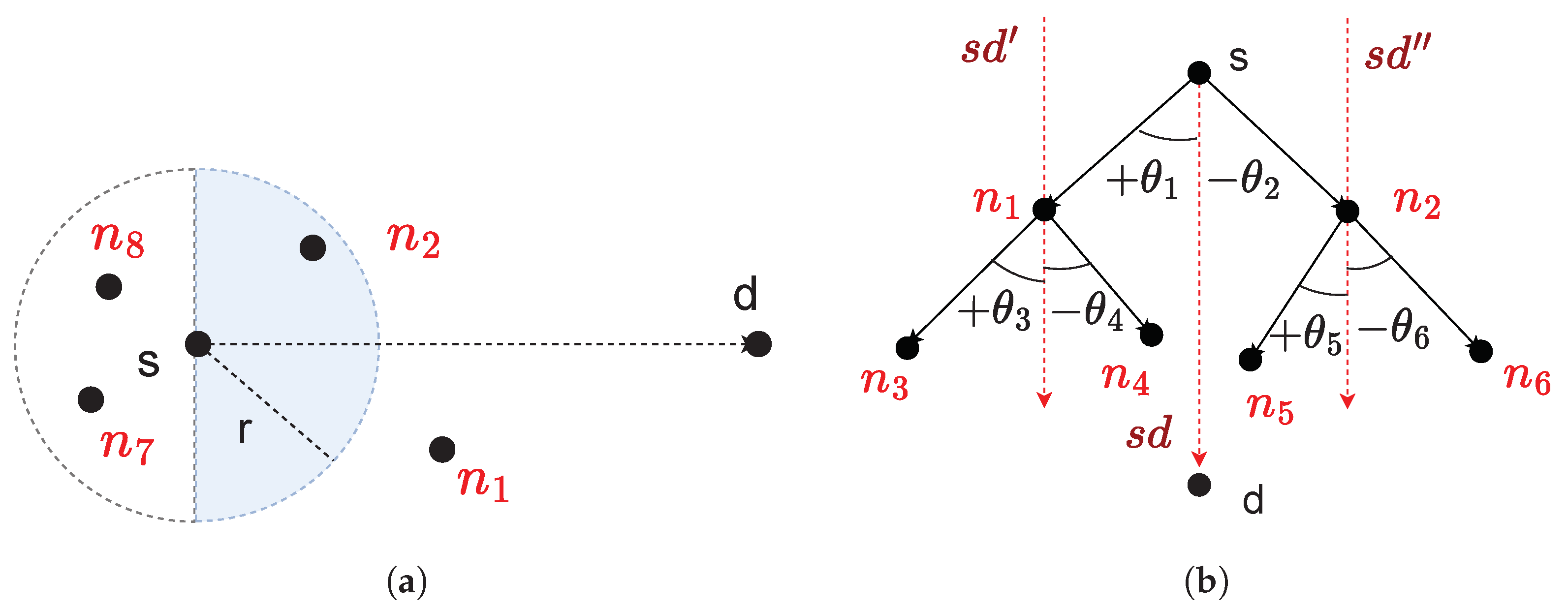
The message-forwarding mechanism uses relay nodes to send messages from a source node s to a destination node d. Figure 1. illustrates an idea of probing and selecting a relay at one- and two-hop transmission distances from a message-carrying node. Several referential lines , , and show directional information and angle calculation. To select a one-hop relay, only the front direction with respect to d is scanned, as shown in Figure 1a. Thus, only and will be considered by relay selection and nodes and will be ignored. The scanning process helps in filtering relay nodes in a broadcast coverage and avoids redundant message overhead to other nodes in the backward direction. To select one- and two-hop relays, we measure the geometric angle at each of the one- and two-hop distances, as described in the following two steps.
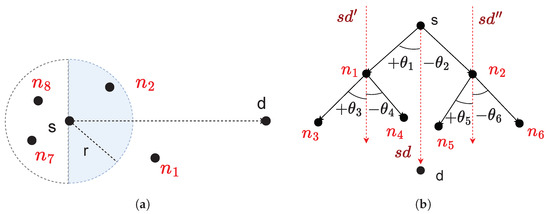
Figure 1.
(a) Front-side scanning with respect to a destination node, and (b) geometric angle formation at one- and two-hop distance.
First, the one-hop geometric angle, also known as the first offset angle, indicates that the angle of the first relay relative to is calculated. As Figure 1b depicts, two signs + and − are used to indicate the clockwise and counterclockwise direction with reference to , respectively. Then, and with respect to are two geometric angles formed at a one-hop distance. To determine the sign of any offset angle , the outer product of the vectors is used. For example, given and , will determine the sign of .
Second, to select a two-hop relay, the sum of the first offset angle and the two-hop offset angle is calculated, which is denoted as . For instance, by referring to Figure 1b, there are for s, , and , and for s, , and . Similarly, other examples are for s, , and , and for s, , and . Note that and are formed with respect to the , while and are formed with respect to the .
With the above two cases, it is seen that the relay selection involves the use of threshold values, which will be further discussed in the next section. According to the relay scanning and angle formulation in one- and two-hop neighborhood areas, we develop a routing policy for message forwarding in OppNets.
4. Scheme Design: MPMF
Section 4.1 gives the design abstraction, and Section 4.2 discusses relay selection policies.
4.1. Design Abstraction
The message-forwarding policy based on movement patterns (MPMF) considers the following cases when selecting a relay node for receiving a message:
- The MPMF policy decides the best relay that is one out from a candidate set of one- or two-hop relay nodes which are moving closer to the destination and have frequent contacts with the destination node. If the candidate node is found, any message-carrying node should forward the messages in buffer to this candidate node as it is going to leave beyond the coverage of a two-hop distance and move closer to the destination.
- In presence of only one-hop relay with respect to a message-carrying node, a one-hop relay node is selected by considering its location and destination’s movement. A message-carrying node considers the destination’s and one-hop relay’s moving direction to take a forwarding decision. If the one-hop relay and the destination node are both moving in the same direction, the one-hop relay can be selected as a candidate node.
- An additional metric, i.e., centrality of a node, is used to avoid the situation that a message-carrying node continually carries its message if the one-hop relay is not moving toward the destination node. The centrality metric measures the ability of a node to communicate with other nodes in a network. A relay node with a higher centrality implies its effectiveness to deliver messages to the destination node and can be considered the best candidate node for the next message-forwarding action.
4.2. Relay Selection
Section 4.2.1 describes the summation angle measurement and weight calculation along a two-hop distance. Section 4.2.2 specifies summation angle measurement at one-hop distance, moving direction of the destination node, and handling the local maximum problem.
4.2.1. Case 1
When a message-carrying node encounters more than one relay at the one-hop distance in some geographic proximity, it looks for another relay beyond the coverage of one-hop distance to relay a message. When no candidate nodes are found qualified to receive this message, the message-carrying node holds this message in the hope of encountering more nodes in the near future. In this case, the location information of one-hop and two-hop relays with respect to the message-carrying node, their DP’s weight value, and the direction in which the two-hop relay moves are exploited to select the best relay nodes to carry a message. The steps involved are discussed as follows.
- 1.
- Summation angle measurement: The summation angle is used to indicate whether a relay node’s position is closer to a destination node.
- 2.
- DP’s weighting calculation in one-hop and two-hop distance levels: A relay node with more frequent contacts with a destination node will have a higher weight.
- 3.
- To select relay nodes, both one- and two-hop relays should be closer to the destination, their DP’s weight value calculated by considering their respective contact frequency with the destination should be higher, and the moving direction of the two-hop relay should be closer to the destination node.
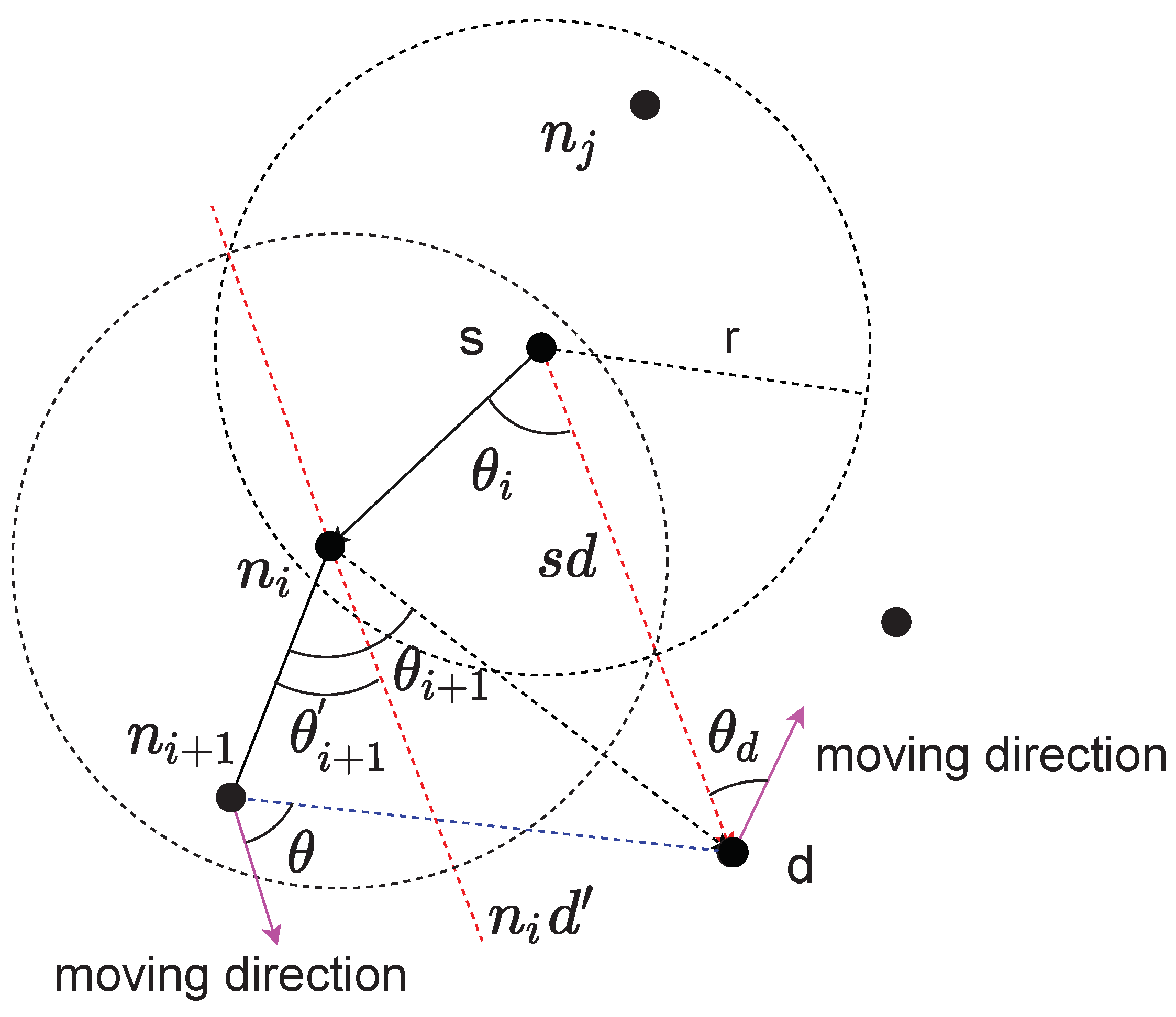
Figure 2 illustrates a scenario to ease exposition of the MPMF. Nodes and are in one-hop transmission range of s. Node is in one-hop transmission range of , as well as two-hop transmission range of s.
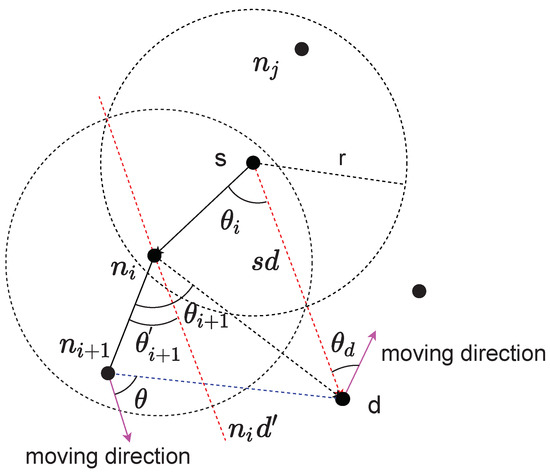
Figure 2.
Two-hop based routing between s, , and .
Given that lies at a one-hop distance from s and forms the first offset angle with respect to and , then is calculated by using (1).
In (1), and are Euclidean vectors, and represents an inner product. Let be at one-hop distance from and two-hop distance from s; then, two second offset angles at the two-hop distance and with respect to and , and and are formed. Because a smaller geometric angle with respect to d implies that a node is moving toward the destination, then the first threshold value for one-hop relay selection is . The condition for two-hop relay follows by checking first, and then for . Note that and are calculated by replacing and with and and and in (1), respectively. Provided that is true, then at the two-hop distance, if and , the MPMF policy goes to the next phase, as follows.
Let and denote the respective DP values of the one-hop and the two-hop with respect to d. With and , a primary weighted DP form is given as
where and are calculated using (3) as a result of PRoPHET [10].
where and represent the current and previous DP values with respect to two nodes and , and the value is an initial constant. Here, for example, we have , and . If and have not contacted for a certain period, their DP values will decay and be updated by (4).
where is an aging coefficient, and k denotes the number of expired time units after the last update of this DP value. Although the aging of is ongoing after the last contact, can still be increased by any other node with and as:
where is a parameter with value .
Let be a directional vector of , then a new is calculated with respect to and . With , a secondary weighted form is given as
If the resulting is greater than a specific , and will be selected as candidate nodes to receive a message from s. First, will receive from s and then replicate it to . The above relay node selection can be written as follows:
In (8), if both and , , and , then both and will receive . In the case of , s will look for another one-hop neighbor node and then repeat the above procedure to determine the next relay node. If no neighbor nodes can satisfy this selection policy, the original node keeps carrying the message during moving in OppNets.
4.2.2. Case 2
To select a one-hop relay node, its location and destination’s movement can be exploited to take a forwarding decision. This situation arises when a message-carrying node encounters only one-hop relay node during a message transfer session.
Let s encounters at any time instant. Without other node at the one-hop distance from s, is calculated according to (1). Let be a directional vector of d. Given the next location of d is known to s, then is calculated with respect to and . For the two geometric angles, i.e., and , the conditions for one-hop relay selection are that and and and d are moving in the same direction. The value obtained in determines whether both the nodes are moving in the same direction or not. If , the nodes are moving in the same direction.
Node s will continue to carry its messages when is not moving in the direction of d. The message delivery services may suffer if s continues to keep the message without forwarding it because of the absence of better candidate nodes. Therefore, when a one- and two-hop relay does not qualify for receiving a message, a centrality metric value is used instead. Let the inter-contact between and follow an exponential distribution with a meeting rate [27], where is calculated by corresponding to u inter-contact time samples, i.e., between and in a given time span t. The contact probability between and within time t is given by . Given N nodes in the network, the average probability that a node randomly contacts within t is given by (9).
In (9), two nodes can compare their respective centrality values. A message-carrying node compares its centrality with the one-hop relay node. If its centrality value is smaller, the relay node will receive a message from the message-carrying node. The above relay selection can be written as follows:
Note that in (9), t is replaced by the current time-to-live of to compute the centrality.
5. Message Forwarding
This section discusses the message-forwarding policies in MPMF. Section 5.1 presents the procedural description of the MPMF. Section 5.2 gives the time complexity of the MPMF based on Algorithm 1.
| Algorithm 1: Message Forwarding Policy. |
 |
5.1. Message Forwarding in MPMF
The message-forwarding policy decides the maximum number of message replicas of a message that a selected one-hop relay or one- and two-hop relays can further replicate. Let an initial value L indicate the maximum number of replicas that can be created for a message in the network. We consider the following cases when deciding the number of replicas that a selected relay node can replicate.
- 1.
- Assuming that a message-carrying node encounters more than one node at the one-hop distance, i.e., case 1, the MPMF considers both one- and two-hop relays to receive only one message copy. Let s be the message-carrying node and create a new message for d. When a one-hop relay receives this message copy from s, it replicates this message to the two-hop-selected relay node. Node s then updates the remaining message copies, denoted as for the transferred message in its buffer, and both the one- and two-hop relays update in their respective buffers for the same message. Both nodes will transfer this message to the d only. However, s can continue to replicate the message to any encountered node until and then wait for d to transfer the message directly.
- 2.
- In the presence of only one relay at one-hop distance, i.e., case 2, a one-hop relay receives half of the remaining copies to distribute in the network. When s forwards a message to a one-hop relay, both s and the one-hop relay update copies for the message in their respective buffers. Then, both nodes can replicate this message further to other encountered nodes and reduce . When , the replication stops, and a relay node waits for the destination node to transfer the message.
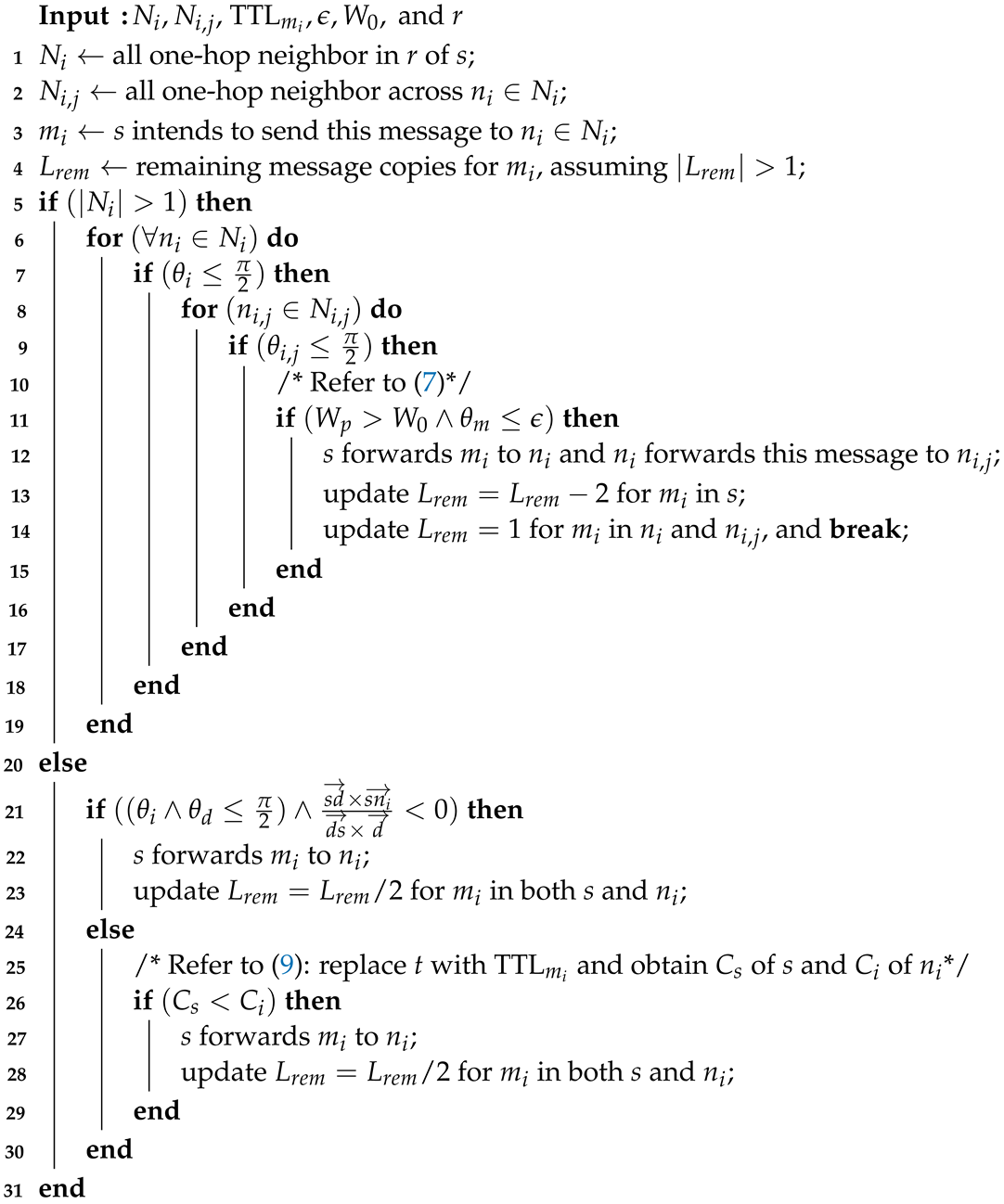
Let denote a set of one-hop neighbor nodes in r of the message-carrying node s and denote a set of one-hop neighbor nodes of . Any is at the two-hop distance from s. Suppose s contains with a remaining time-to-live period, denoted as TTL. With the information of location and the vector of every node in and , s and can compute and , respectively. To transfer to , s applies the MPMF message scheduling, as specified in Algorithm 1. This algorithm consists of two sub-routines: two-hop message forwarding and one-hop message forwarding. In the sub-routine of two-hop message forwarding, receives from s and then replicates it to . In the sub-routine of one-hop message forwarding, only receives from s.
Regarding the two-hop message forwarding, the summation angle is checked inside each iteration of a for-loop procedure (lines 6–19), while is checked inside each iteration of a for-loop procedure (8–17). If s has more than one neighbor node in its vicinity as line 5, it seeks to filter out neighbor nodes that are moving away from d and select with , as lines 6–7. In lines 8–9, a two-hop relay is selected by calculating the summation angle . Provided that , , and , will receive from s and transfer it to as lines 9–12. After the message transfer, s will update 2 and both and will update 1 for in their respective buffers, as lines 13–14.
Regarding the sub-routine of one-hop message forwarding, if the number of nodes in equals to 1, then the summation angles and , directional vectors, and centrality values of and d are compared (lines 21–30). If both and are less or equal to , will receive from s when and d move in the same direction, as lines 21–22. If and d are moving away from each other, then the centrality of s and is checked. If , will receive from s, as lines 26–27. In both the cases, s and update 2 for , as lines 23 and 28.
In summary, Algorithm 1 presents a novel relay selection and message forwarding based on one- and two-hop neighborhood information. Correspondingly, its pseudo-procedure comprises of three functions, i.e., summation angle at one- and two-hop, one-hop and destination’s movement, and centrality of a relay to select best one-hop relay or one- and two-hop relay nodes to receive messages. Therefore, the proposed policy can be implemented and will be examined with others in the next section.
5.2. Complexity
The analysis of time complexity for the message-forwarding policy comprises two parts according to Algorithm 1. First, it is to determine a one-hop relay from and a two-hop relay from by calculating the summation angle of one- and two-hop relays, the two-hop relay’s moving direction, and the combined weight and two-hop offset angle. Second, it shall select a one-hop relay by determining the geometric angle of the one-hop relay and destination node, the one-hop relay’s and the destination’s moving directions, and the centrality of the one-hop relay and destination node.
The time complexity for the first part will be . As referring to Algorithm 1, is checked inside each iteration of a for-loop procedure (lines 6–19), and is checked inside each iteration of a for-loop procedure (8–17); the complexity in the worst case will be . For the second part, the time complexity will be . Therefore, the overall time complexity of Algorithm 1 is .
6. Performance Evaluation
Section 6.1 mentions the OppNet environment establishment based on the ONE simulation platform and describes the comparative experiments and performance metrics. Section 6.2 describes the performance examination on the essential factors of the MPMF policy. Section 6.3 describes the relative performance between Epidemic [19], GSaR [4], TCCB [9], TC [20], and PRoPHETv2 [10].
6.1. Simulation Setting and Performance Metrics
This section describes the simulation platform, different mobility scenarios, experimental cases for performance study, and evaluation metrics.
6.1.1. Simulation Model and Node Mobility Scenarios
The OppNet research commonly uses the Opportunistic Networking Environment (ONE) [28] simulator to investigate the routing and buffer management policies. The ONE simulator provides configurable functions to model the data networking and store–carry–forward message delivery without the need for physical-layer modeling, such as signaling and media access control. The ONE platform executes the primary agents, so-called nodes. Each node is assigned a set of primitive attributes, including radio interface, storage, message routing, movement, energy consumption, etc. Given a node population, they follow a defined mobility scenario to move on a given network map.
Our simulation employs two mobility scenarios for the behavior of node movement: the real trace-based dataset of National Chengchi University (NCCU) [18] and the time-variant community mobility model (TVCM) [17]. Both mobility scenarios are scripted into the configurations of the nodes’ movement, which are managed by the ONE simulator
- The TVCM model is proposed to capture the realistic mobility characteristics observed from various WLANs, so it is suitable for the simulation of MANET and OppNets. In a TVCM-specific mobility scenario, 50, 100, and 150 mobile nodes move in an area of 1500 × 1500 m. Each node was randomly assigned to several community homes on a plane during the simulation. The simulation time was divided into equal time slots. The nodes moved in random waypoint trips in each time slot with a probability p of staying inside or (returning to) their homes and a probability of roaming outside their homes. By assigning different probabilities to each node, a wide range of heterogeneous node behavior can be reproduced.
- The NCCU dataset is a real trace dataset collected at the National Chengchi University campus. These data were collected using an Android app installed on the smartphones of students attending NCCU, Taiwan. The trace contains the data of GPS, Wi-Fi access points, and Bluetooth devices connected in physical communication proximity. The trace was collected from 115 students moving in 3764 × 3420 m over 15 days. The NCCU real dataset is available [29].
The output trace file of the above mobility models contains a series of mobile trajectory records, each of which indicates the data of the time stamp, x-position, and y-position with respect to the two-dimension position of any particular node at different time moments. Table 1 shows the simulation parameters and their values used in the simulation. Specifically, the ONE simulator imports a mobility scenario script, i.e., a simple text-based configuration file, which contains various parameters of the simulation model, user interface, event generation, report parameters, etc. The ONE simulator will output a message statistics report module gathering the overall performance statistics, such as the number of created messages, the number of messages that have been delivered, the number of messages that have been relayed, etc.

Table 1.
Simulation Parameters.
For both NCCU and TVCM, the configuration file contains a chronological list of location records that describe the waypoint locations of mobile nodes in the Cartesian coordinate system at a time dimension. During the simulation, the ONE simulator continues to vary the next waypoint location of each node by referring to the sequence of generated records in the trace file. For each node, the movement speed between two locations is set in a range of 0.5 to 1.5 m/s. In addition, the ONE simulator provides different functional modules to access the up-to-date information of the node’s current position, movement path, neighbors, etc. Given a node pair of source and destination nodes, the source node generates a new message of 100 KB per 300 s. When two nodes appear in the mutual transmission range, they can transfer messages with each other. The ONE simulator runs both mobility scenarios for 24 h.
6.1.2. Experimental Cases
Our study examines the relative performance between the MPMF, Epidemic, GSaR, TCCB, TC, and PRoPHETv2 routing policies in OppNets. The performance results by the variances of the TTL period are investigated. Epidemic duplicates a message copy to each encountered node. PRoPHETv2 calculates the DP estimates of directly encountered nodes with the destination and avoids blind replication. GSaR uses historical information such as location, speed, and time duration to estimate the movement range of the destination node and sprays a limited number of copies of a message in the network. TCCB exploits the social contact patterns from the temporal perspective. It predicts temporal closeness by considering the average time span of a node pair, i.e., the duration plus inter-contact time between two nodes in a network. TC computes the probability/possibility of a node that will appear in a destination community, so as to forward a message in a network. Communities are formed by exploiting pairwise contacts, where the regular appearance of a contact pattern between a node pair is emphasized. All the MPMF, PRoPHETv2, GSaR, TCCB, TC, and Epidemic policies adopt the FIFO dropping policy as a plain comparative base.
6.1.3. Evaluation Metrics
With the message statistics report by the ONE simulator, we can calculate the number of created messages, number of messages that have been delivered, number of messages that have been relayed, average delay of messages, and average number of hops a message has passed. Accordingly, four performance metrics, successful delivery rate, transmission overhead ratio, average latency, and average hop count, are examined.
Let be the number of original messages that are generated by source nodes, be the number of distinct messages delivered to the destinations in the network, and be the total number of times by forwarding messages between any two relay nodes in a network.
- Successful message delivery rate: This metric indicates the rate of the number of original messages created in the network to the number of distinct messages that were successfully received by their destinations during the simulation. With and , the measure turns out to the value of .
- Transmission overhead ratio: This metric is the ratio of the total times any original messages and replicas were transferred between intermediate nodes to the total amount of distinct messages received by their destinations during the simulation. With and , the overhead ratio is given as .
- Latency: This metric indicates the duration from the time instance which a message is generated by a source node to the time instance which the message is successfully received by its destination.
- Hop count: This measure is equal to the number of hops that a message has passed through during its delivery to the destination.
6.2. Sensitivity to MPMF’s Factors of , , L, and
This section inspects the performance sensitivity of the delivery rate and transmission overhead ratio against three MPMF-specific coefficients, including the parameter in (7), the threshold of the weight value , the threshold of the sum of the geometric angles at one- and two-hop distances in (8), and each message’s initial copy number L. A smaller value of indicates that one- and two-hop nodes closer to the destination node are considered as candidate nodes. A larger value of implies that one-hop relay frequently contacting the destination and two-hop relay closer to and frequently contacting the destination are selected as candidate nodes. A larger value of L indicates that an original message will be replicated at most L times. After extensive simulation under TVCM and NCCU, we obtain the appropriate values of , , L, and used for the performance comparison among Epidemic, PRoPHETv2, GSaR, TC, and TCCB.
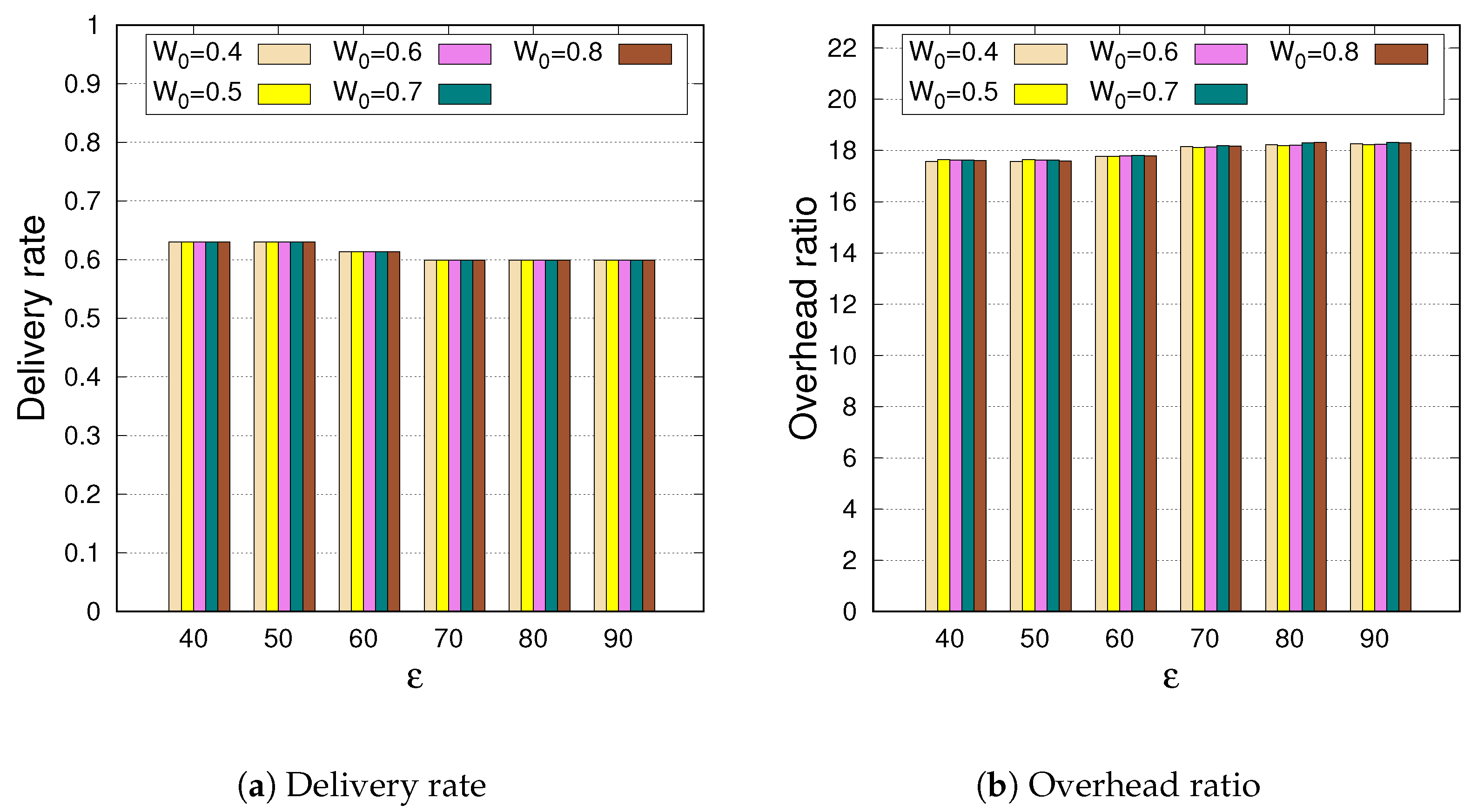
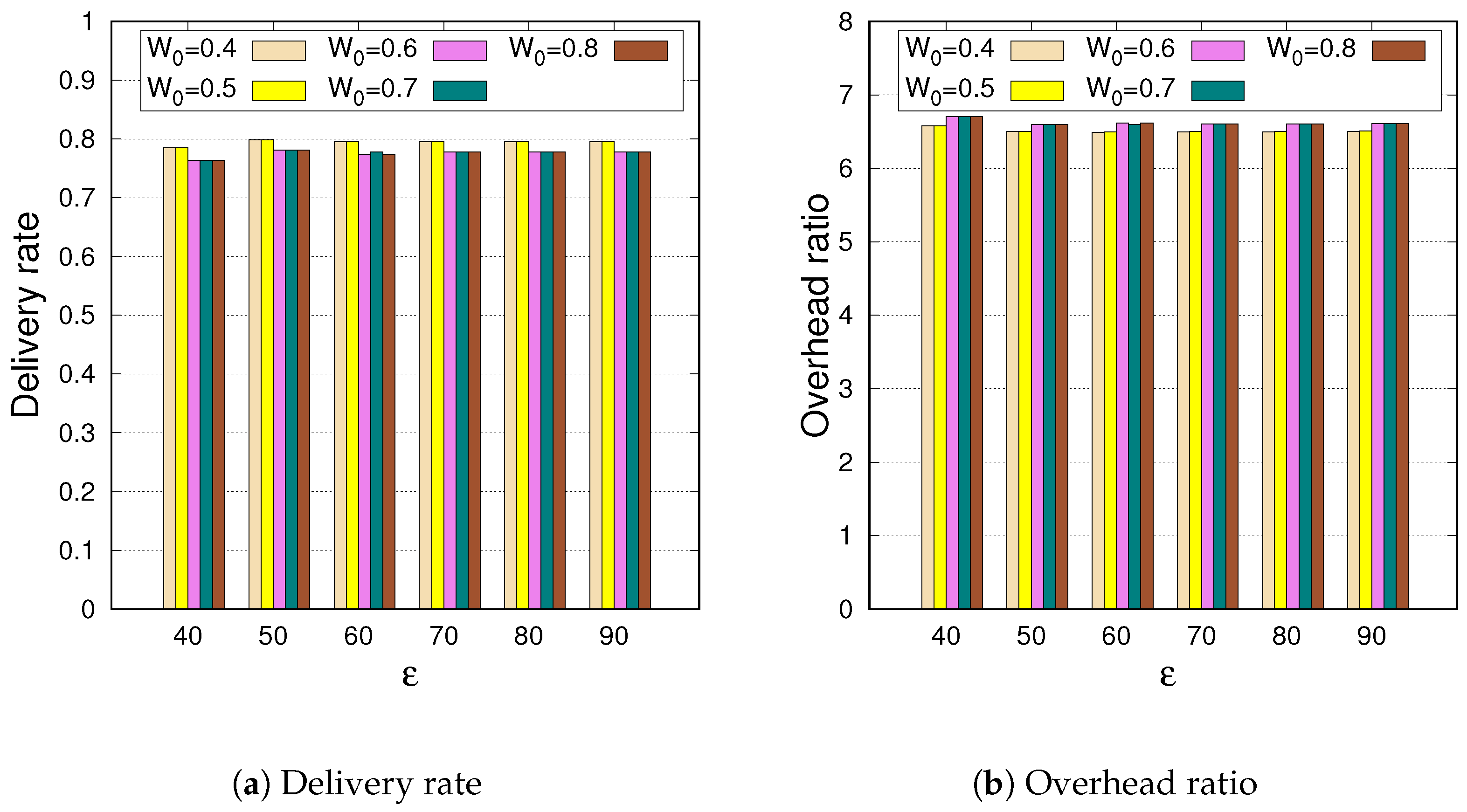
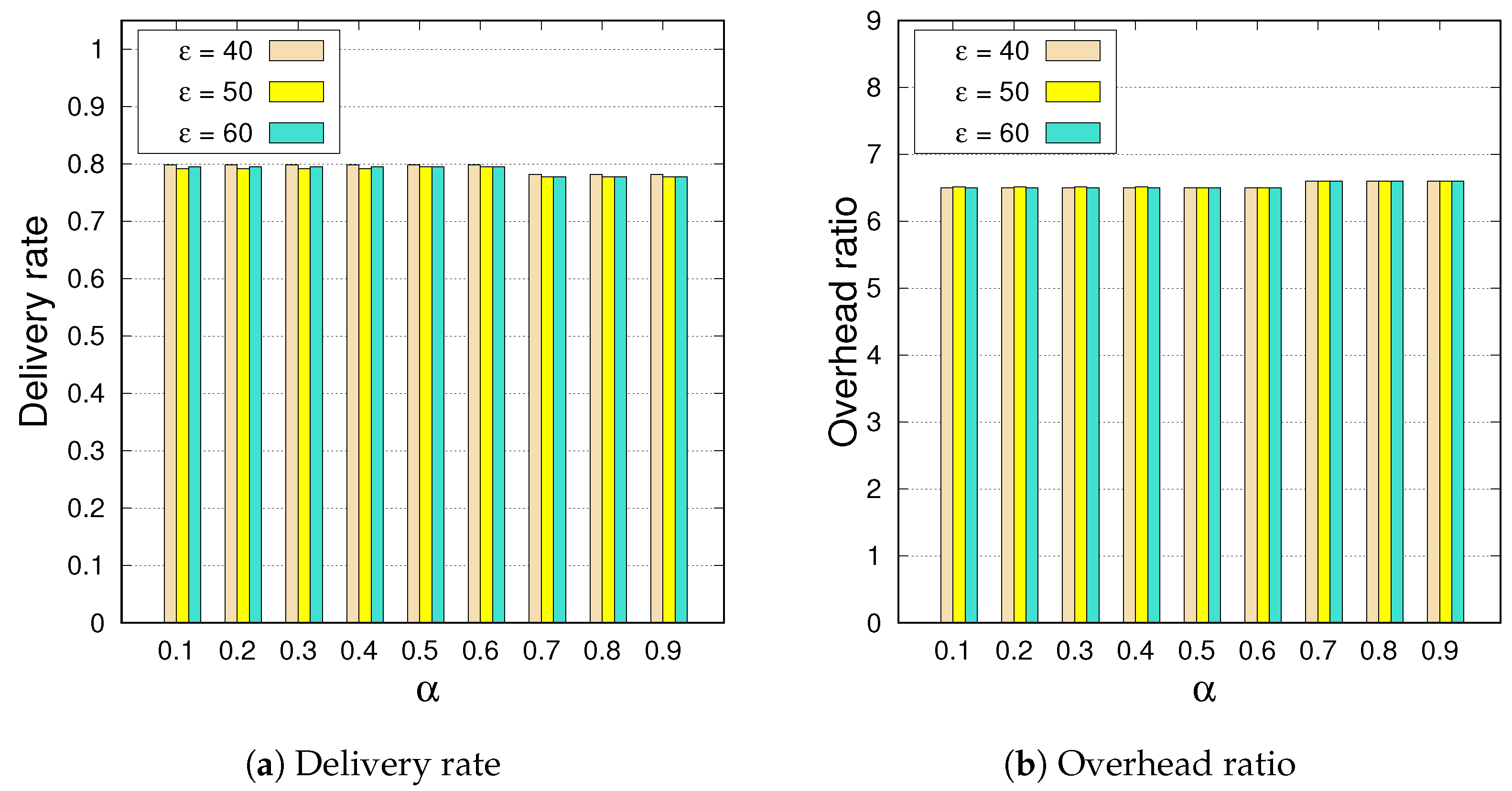
Figure 3 and Figure 4 depict the influence of and on the performance of the MPMF under TVCM and NCCU. In TVCM, the threshold affects the delivery rate and overhead ratio, while the change in has a minor effect on the overhead ratio. In NCCU, the threshold affects the delivery rate and overhead ratio, while the change in has a minor effect on the delivery rate. In TVCM, with the incremental values of from 40 to 60, the delivery ratio decreases while the overhead ratio increases. The delivery rate and overhead ratio remain almost the same for 70. When is smaller than 60 in TVCM, the nodes moving closer to the destination node are selected as the candidate nodes, then the possibility of delivering messages earlier increases, which considerably effects the delivery rate and overhead ratio. Compared with TVCM, NCCU has a higher node population distributed in a large area. Thus, the variation of shows little effect on the delivery rate and overhead ratio. In Figure 4, as increases from 0.5 to 0.6, the delivery rate decreases while the overhead ratio increases. However, as increases from 0.6 to 0.8, the delivery rate and the overhead ratio remain the same.
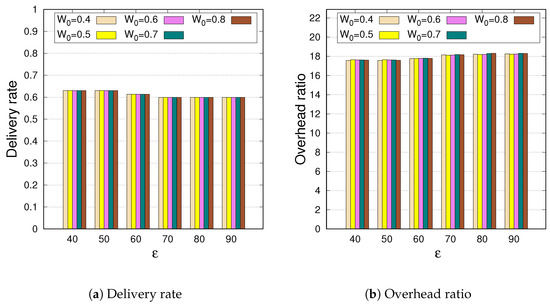
Figure 3.
Results by MPMF with different values of and under TVCM trace (TTL = 5 h and buffer size = 10 MB).
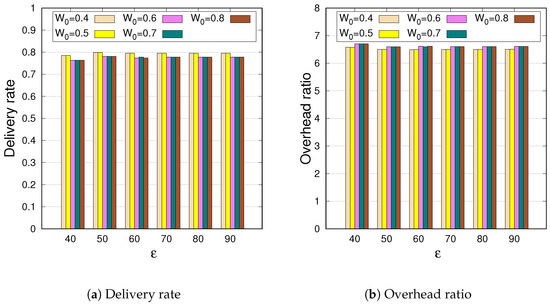
Figure 4.
Results by MPMF with different values of and under NCCU trace (TTL = 5 h and buffer size = 10 MB).
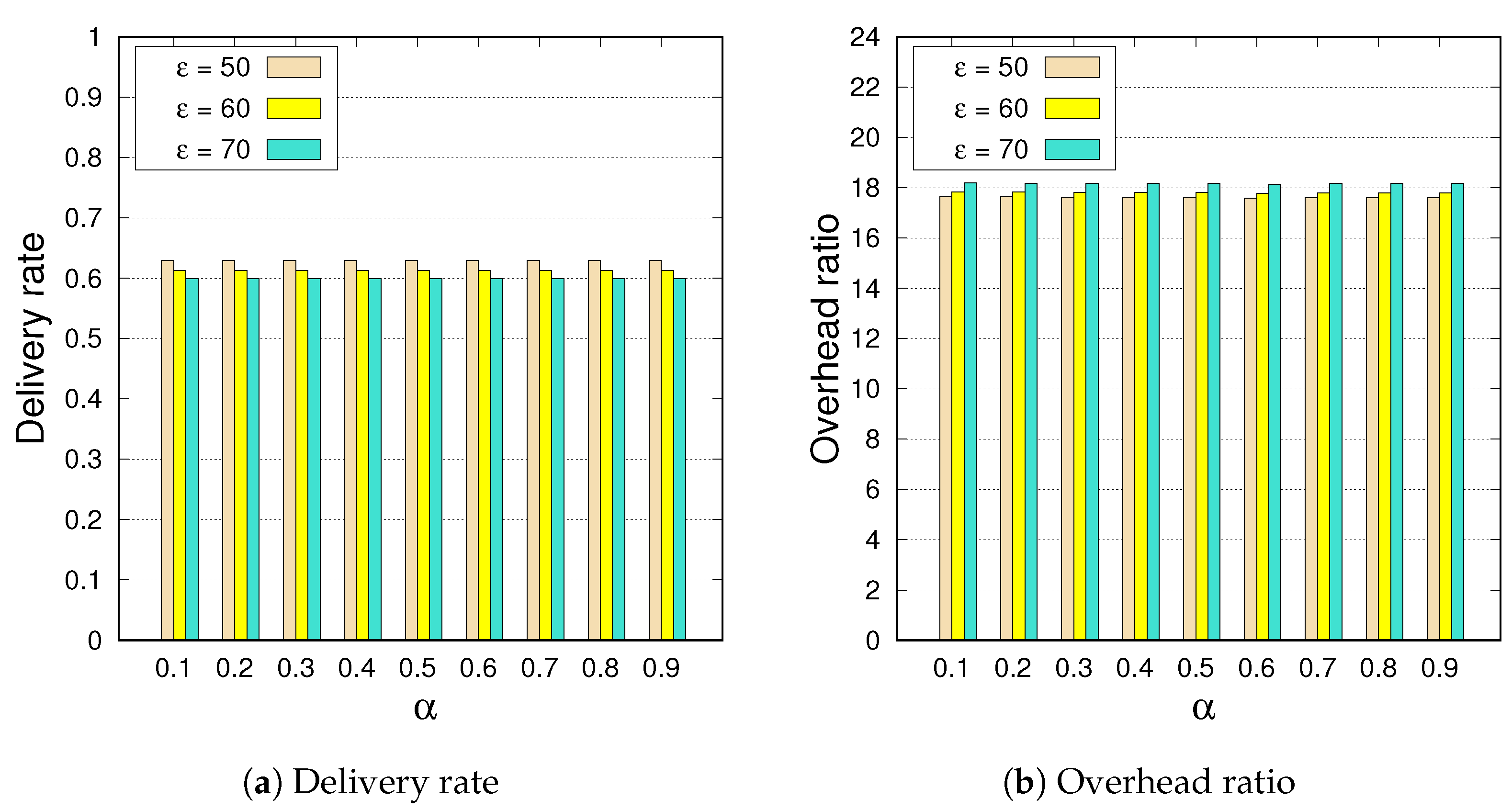
Figure 5 and Figure 6 depict the influence of and on the performance of the MPMF under TVCM and NCCU. Given the buffer size of 10 MB on each node and message TTL 5 h, Figure 5 exhibits that the delivery rate decreases and the overhead ratio increases as increases from 50 to 70. However, the variation of does not affect the results of either delivery rate or overhead ratio. In Figure 6, as increases from 0.6 to 0.9, the delivery rate decreases while the overhead ratio increases.
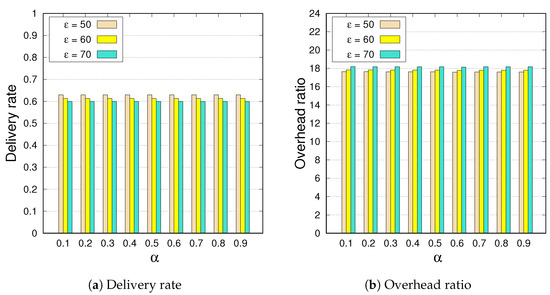
Figure 5.
Results by MPMF with different values of and under TVCM trace (TTL = 5 h and buffer size = 10 MB).
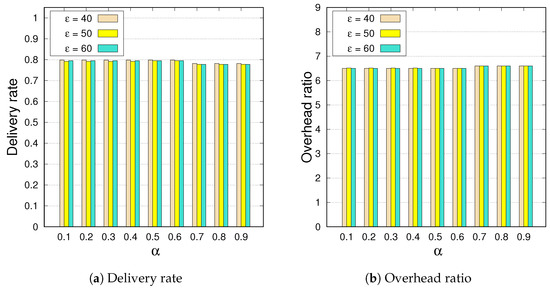
Figure 6.
Results by MPMF with different values of and under NCCU trace (TTL = 5 h and buffer size = 10 MB).
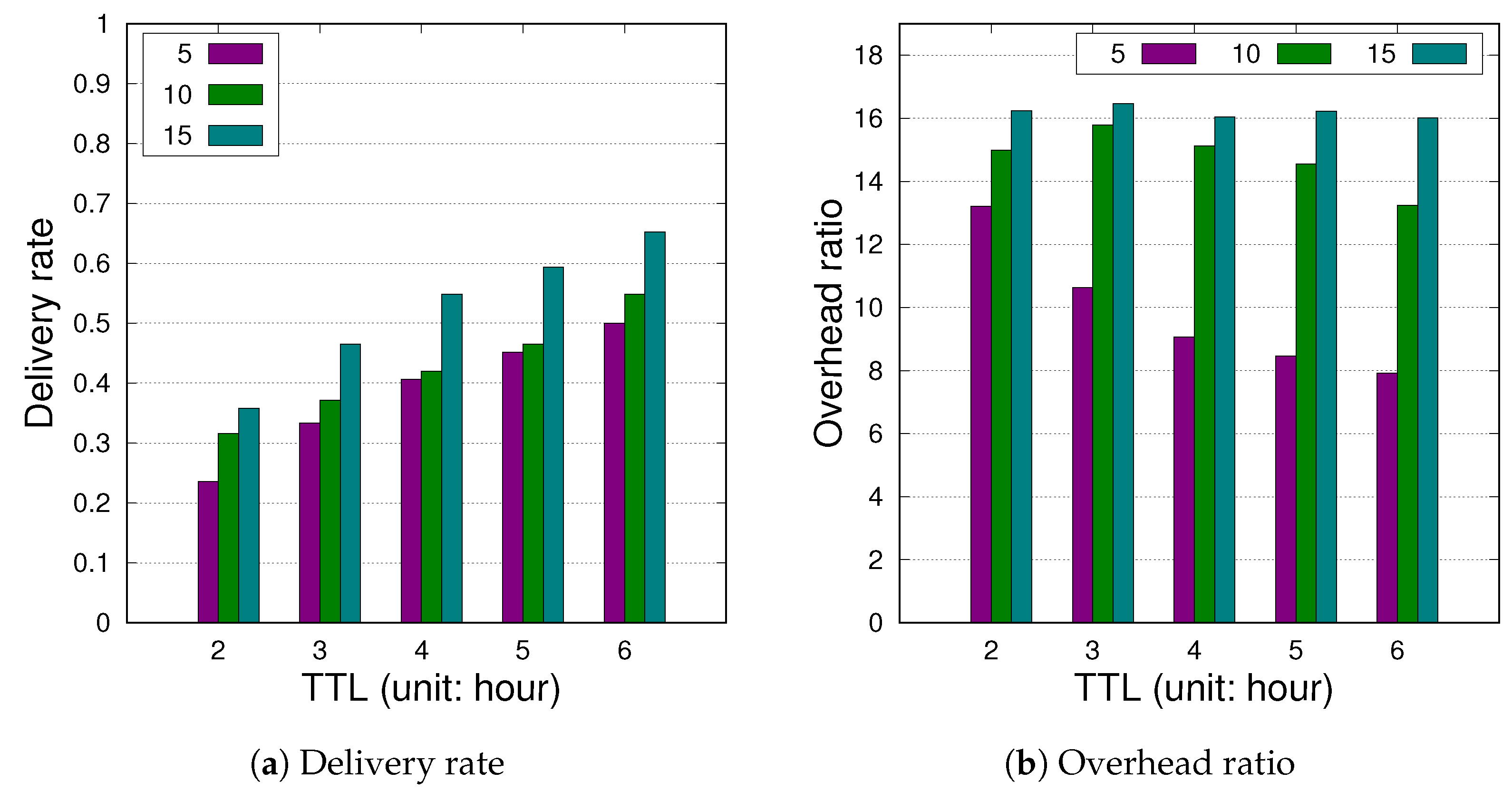
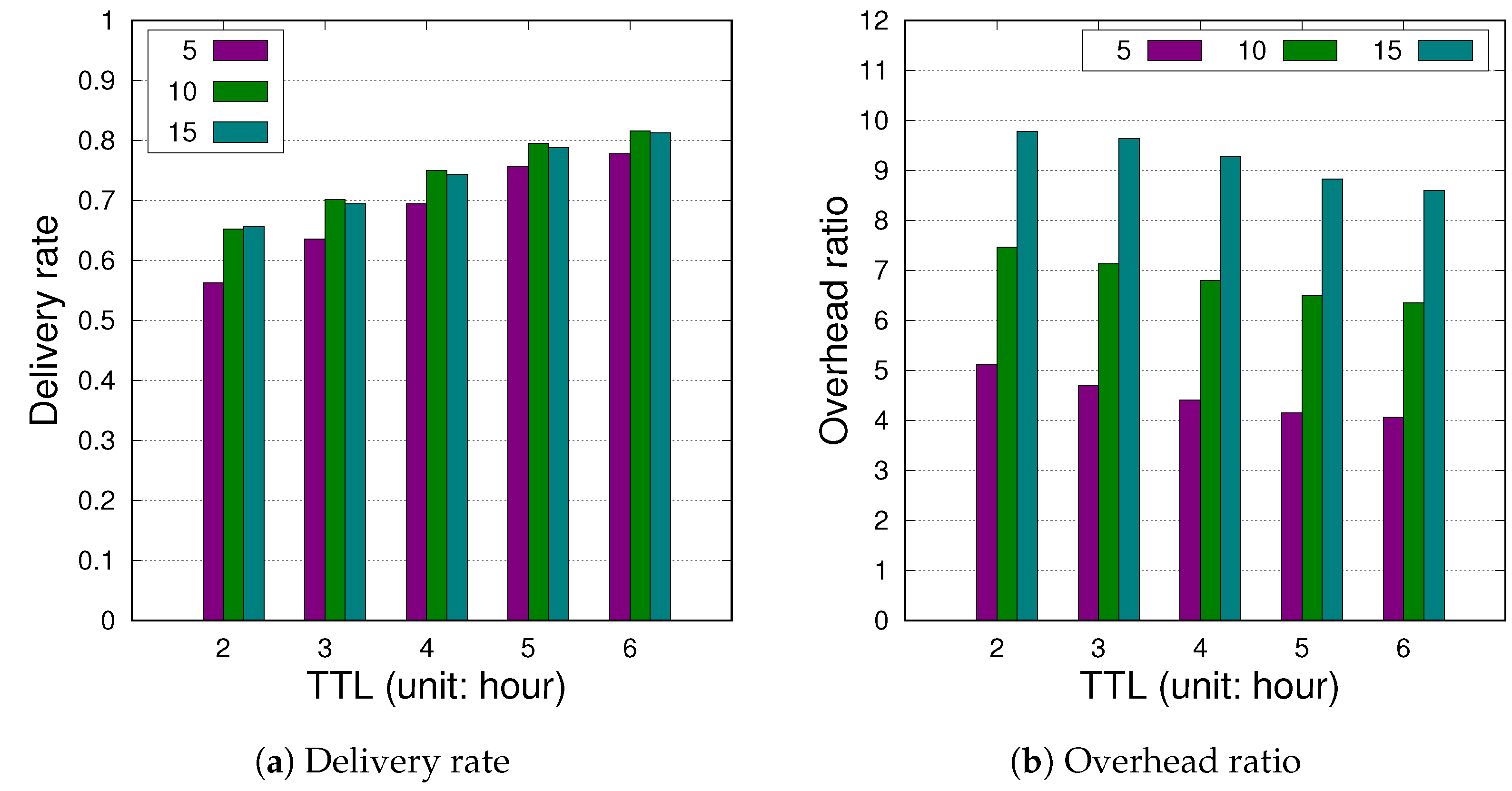
Figure 7 and Figure 8 display the influence of L with respect to the variance of the TTL values in the range of [2, 6] h under TVCM and NCCU. Given the buffer size of 10 MB on each node, the results in Figure 7 exhibit that both the delivery rate and overhead ratio increase as L increases from 5 to 15 regardless of the TTL values. The overhead ratio increases as L increases from 5 to 15 in Figure 8, whereas the delivery rate increases as L increases from 5 to 10. However, for 15, the delivery rate decreases for the TTL from 3 to 6. A buffer overflow possibly occurs more times with the limited buffer and higher node population in NCCU. It is noted that the overhead ratio is more sensitive to the incremental TTL values. This is because with a larger L value, more pending messages in the finite buffer capacity could be replaced frequently, thereby causing higher transmission overhead, as shown in Figure 7b and Figure 8b.
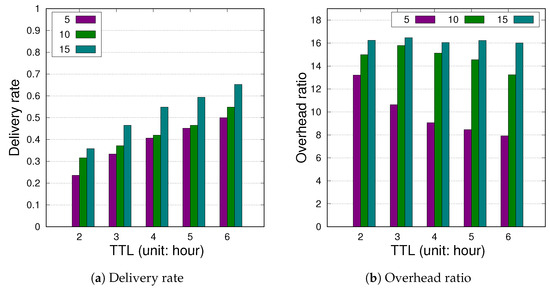
Figure 7.
Results by MPMF with different values of L and TTL under TVCM trace (buffer size = 10 MB).
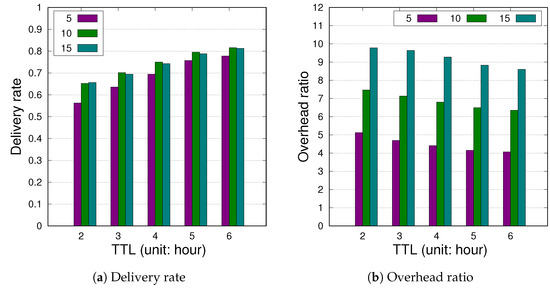
Figure 8.
Results by MPMF with different values of L and TTL under NCCU trace (buffer size = 10 MB).
In summary, the above findings point out that the relay node selected by the MPMF with a smaller and can facilitate the message distribution at the higher delivery rate and lower overhead ratio, as displayed in Figure 3, Figure 4, Figure 5 and Figure 6. Therefore, in order to strike a better performance, it is beneficial to take 50, 0.6, and 0.5 in TVCM and 60, 0.5, and 0.6 in NCCU. With the performance results against the quantity of L, as shown in Figure 7 and Figure 8, it is unnecessary to maximize the L value, but a moderate value is applicable to sustain the transmission overhead ratio while the delivery rate is maintained. Thus, 10 will be used in the following experimental cases.
6.3. Results by Epidemic, GSaR, TCCB, TC, and PRoPHETv2
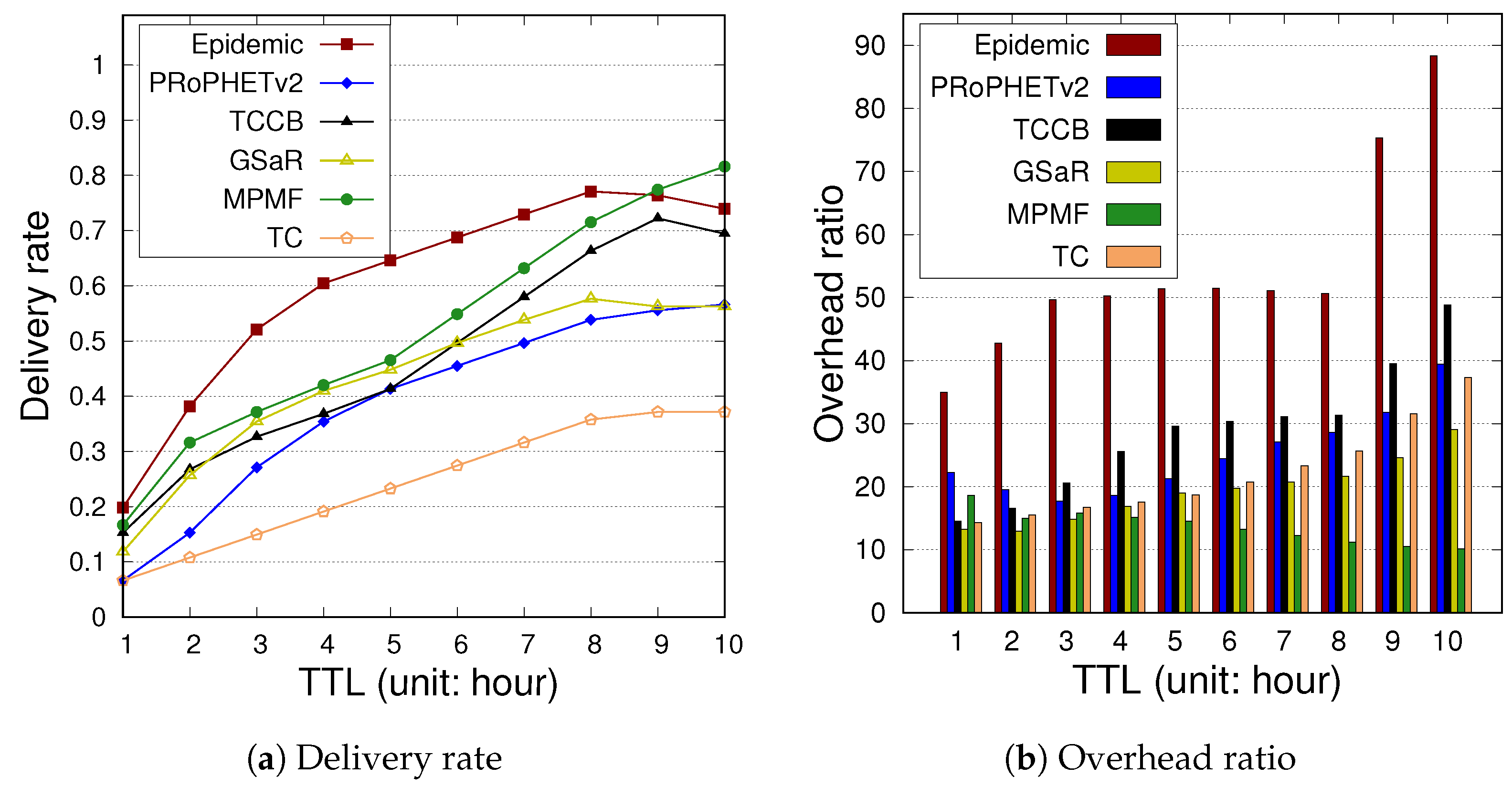
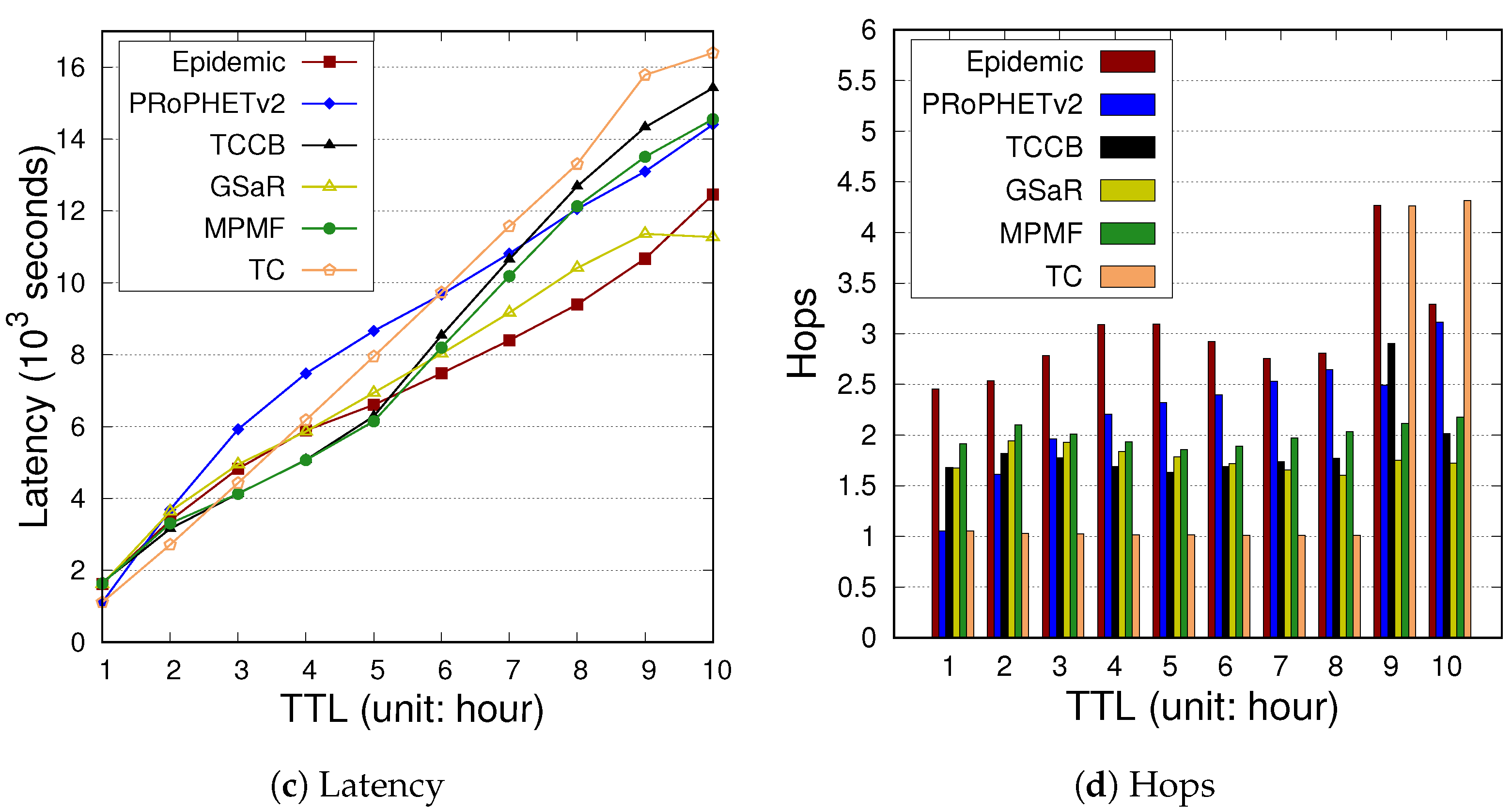
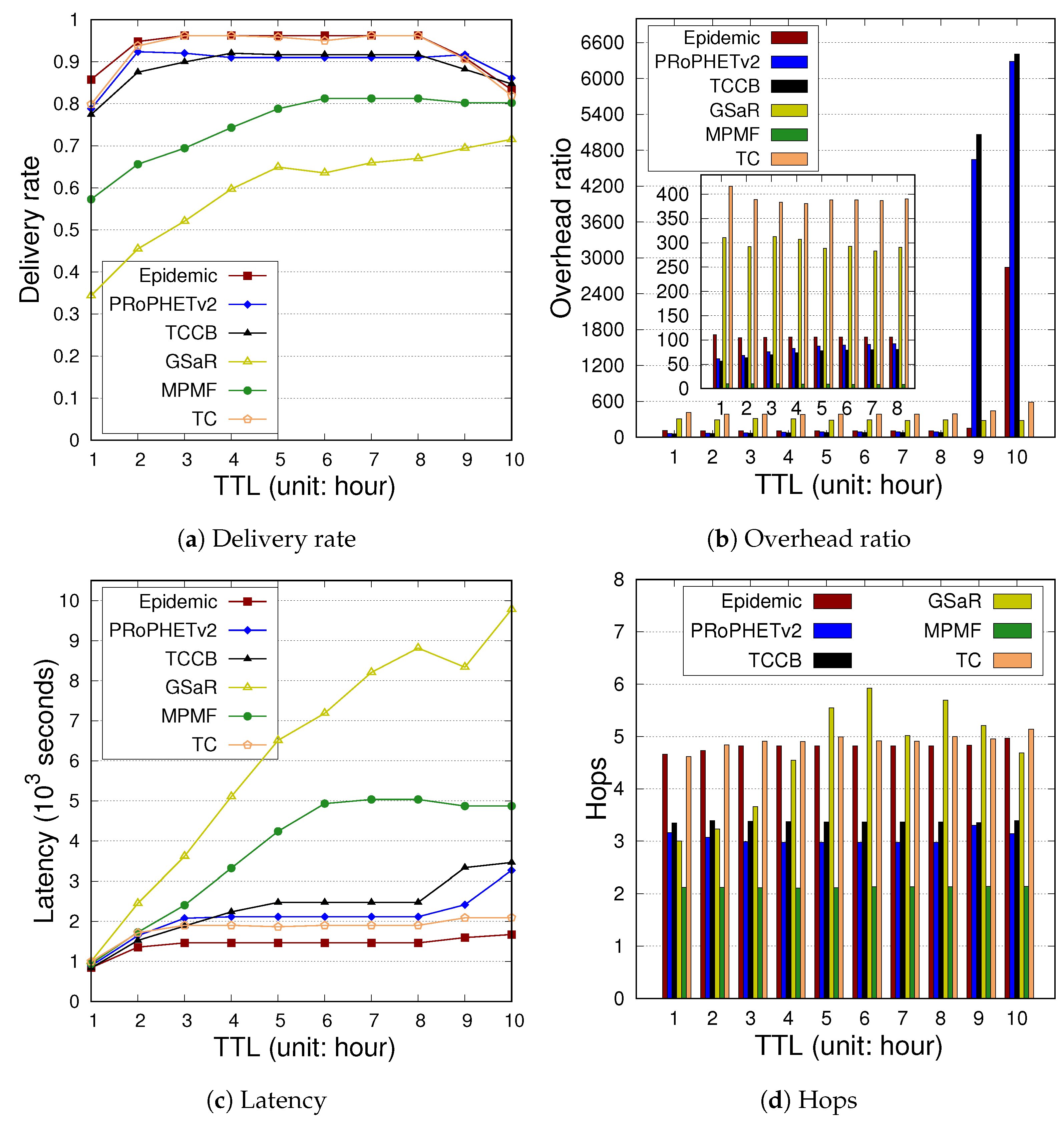
This section presents the relative performance of the MPMF in comparison with the Epidemic, PRoPHETv2, GSaR, TC, and TCCB routing policies. As Figure 9, Figure 10 and Figure 11 depict, the performance results are examined in a linear yardstick of TTL = [1, 2, …, 10] h under TVCM and NCCU. In Section 6.3.1, we first consider the node population N = 50 in TVCM and N = 116 in NCCU, and in Section 6.3.2, we consider N = 100 and 150 in the TVCM case. Note that because NCCU is a real-life trace collected on a university campus, the node population is fixed. In Section 6.3.3, we evaluate other performance metrics, including the average time a message takes in a buffer and the amount of messages dropped, relayed, and aborted when TTL = [1, 3, 5, 7, 10] h.
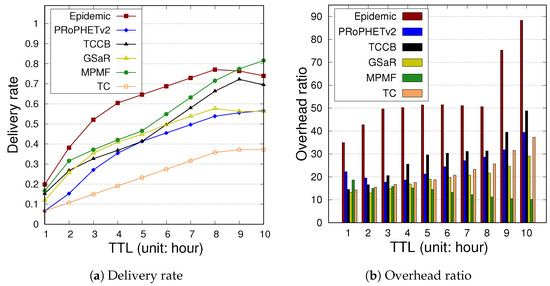
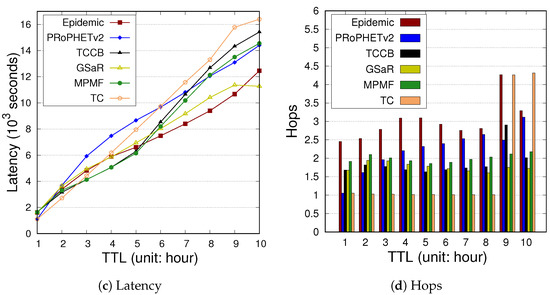
Figure 9.
Performance comparison of MPMF in TVCM trace ( = 0.6, L = 10, = 50, = 0.5, and buffer size = 10 MB).
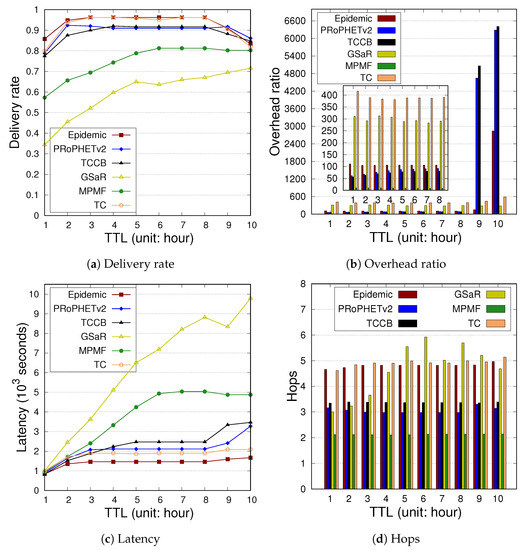
Figure 10.
Performance comparison of MPMF in NCCU trace ( = 0.5, L = 10, = 60, = 0.6, and buffer size = 10 MB).
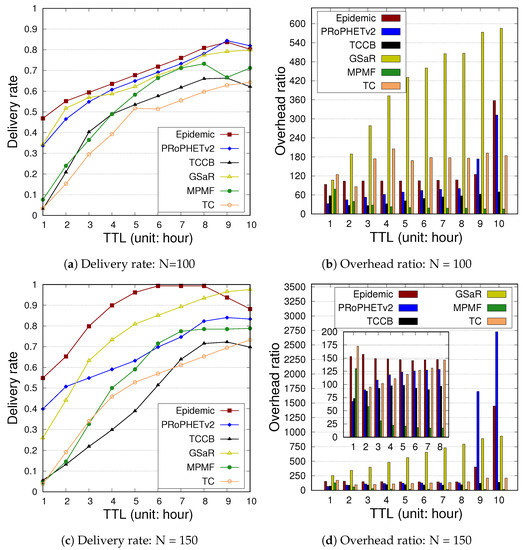
Figure 11.
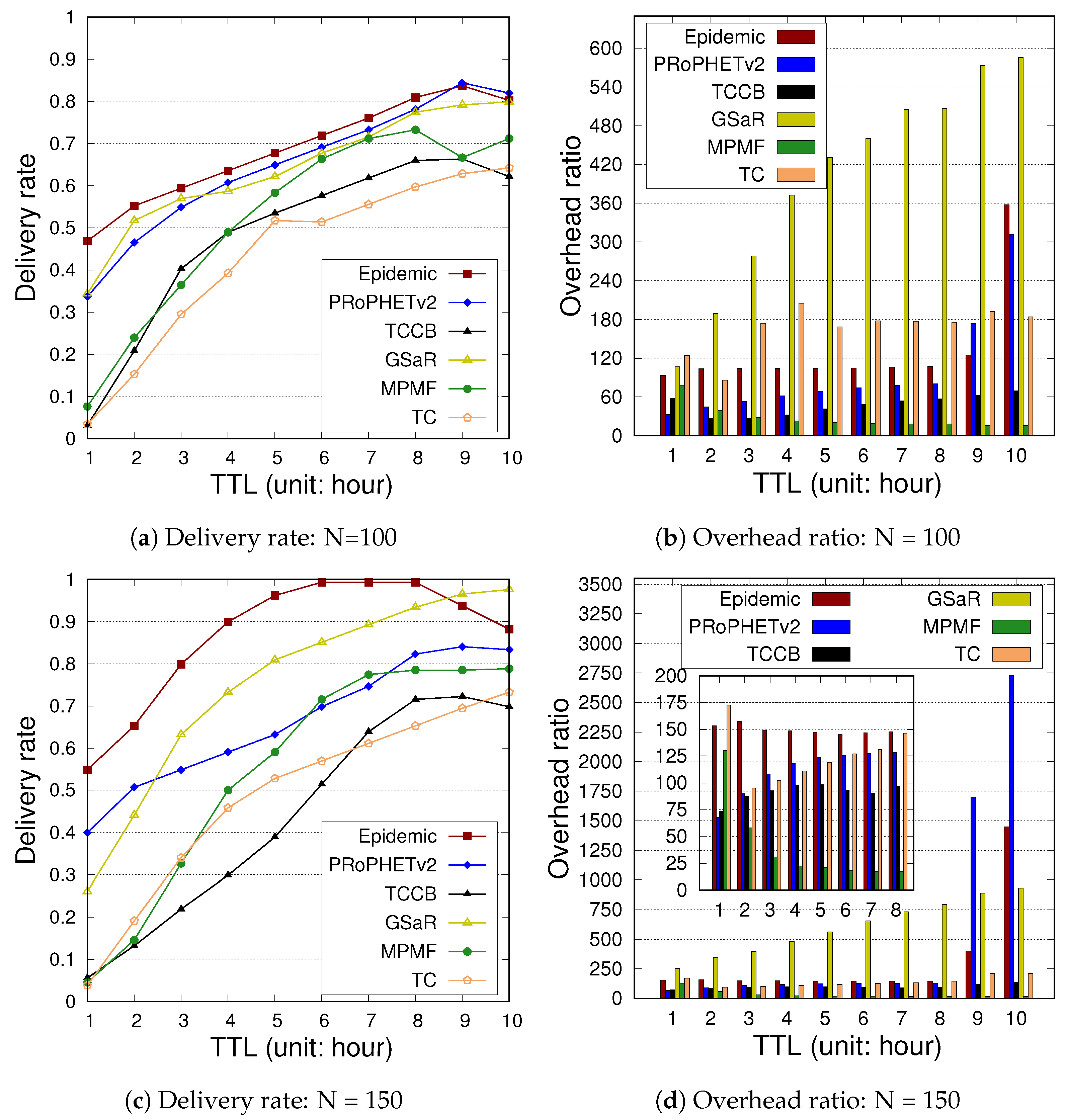
Performance comparison of MPMF in TVCM trace ( = 0.5, L = 20, = 60, = 0.6, and buffer size = 10 MB).
6.3.1. Case (a)
Figure 9 depicts that all the policies can increase the successful delivery rate with a longer TTL period. Epidemic and TCCB unboundedly replicate messages to the encountered nodes, thereby inducing more message traffic. When the TTL > 8 h in Epidemic and GSaR and the TTL > 9 h in the TCCB, the delivery rate decreases, as shown in Figure 9a. However, in the MPMF, it continues to increase when the TTL > 8 h. In Figure 9b, when the TTL > 3 h, the MPMF has a lower overhead ratio compared with the other policies. In Figure 9c, Epidemic outperforms the other policies regarding average latency. However, as depicted in Figure 9d, it has a higher average hop count (hops) in comparison with the other polices. Relatively, TC attains the lowest delivery rate when compared with all the other policies.
Both the MPMF and GSaR consider the location information and spray a limited number of copies of a message in the network, while PRoPHETv2 considers the DP estimates of directly encountered nodes with the destination and generates more messages than the MPMF and GSaR. Epidemic performs in a flooding-like message replication, and with a sufficient buffer and lower TTL, it can have a high delivery rate but induce more overhead. Likewise, the TCCB considers temporal closeness with the destination or higher centrality in the network to take a forwarding decision. It cannot avoid repeatedly replicating messages to other nodes in closer social relationships, resulting in a considerable overhead ratio. In TC, a message is forwarded when a message-carrying node and an encountered node belong to the same group/community, or if the encountered node has better data forwarding capabilities.
With a longer TTL period, the MPMF will hold messages longer on nodes and induce a limited amount of message replicating and relaying operations. Thus, a buffer overflow can be mitigated so that messages can reach their destinations at higher chances. Although both GSaR and MPMF replicate a message with a limited number of copies to nodes moving closer to the destination, GSaR fails to achieve a sound performance. In GSaR, when a message-carrying node encounters a relay closer to a destination and can deliver a message earlier, it replicates the message to this relay and deletes that message from its buffer. The policy of deleting messages possibly degrades the performance of message delivery. With only one copy left for a message, GSaR will still replicate the message. Those buffer replacement operations possibly cause other messages to be removed and induce more overhead in the network. While TCCB uses temporal closeness and centrality to avoid blind replication, its overhead ratio becomes lower than Epidemic. Epidemic policy replicating a message multiple times increases the possibility that one of the message copies is successfully delivered within the shortest time. At the same time, creating more copies increases the average hop count. This observation is apparent from Figure 9c,d, where Epidemic has a lower latency when the TTL = 5 → 9 h and a higher value of hops for TTL = 1 → 10 h. For the MPMF, a limited number of copies are replicated for each message, which results in lower hop counts than Epidemic and PRoPHETv2. Conversely, messages with a longer TTL remain in the buffer for a longer time, resulting in higher latency. In TC, when a message-carrying node has not encountered other nodes with higher relaying capabilities in some time period, it removes the message from its buffer. By this way, fewer copies of the message are relayed in the network, resulting in lower delivery rate and overhead ratio.
Figure 10 depicts the comparative results under the NCCU trace. As the results in Figure 10a indicate, Epidemic, TCCB, TC, and PRoPHETv2 perform better. However, as depicted in Figure 10b, the overhead ratio is higher and drastically increases as TTL > 8 h. GSaR induces more overhead ratio and a lower delivery rate when the TTL increases from 1 to 8. As depicted in Figure 10c,d, both latency and hops in GSaR are higher as compared with other policies. In the case of NCCU with a higher node density, nodes have higher chances of contacting other nodes. A message replicated more times can induce higher hops. In GSaR, the policy of deleting a message probably decreases the chances of reaching the message earlier to the destination and thus causes higher latency.
Because Epidemic, TCCB, TC, and PRoPHETv2 do not use control-based replication, their replication policies in the NCCU trace generate many message copies for long-TTL messages, which results in a higher overhead ratio. Figure 10c depicts that PRoPHETv2, TC, and TCCB have lower latency because of many messages created in both the policies. With a higher node population in NCCU, more communities are formed in TC. As a result, the amount of message forwarding increases, resulting in a higher overhead ratio and delivery rate. There is an interesting case as TTL > 8 h in Figure 10b. Both PRoPHETv2 and TCCB have huge overhead. This is possibly due to buffer replacement operations frequently occurring by comparing Epidemic with PRoPHETv2 and TCCB. Older messages in Epidemic are replaced frequently, and the number of replicas created for such messages is less than those in the PRoPHETv2 and TCCB cases. In PRoPHETv2 and TCCB, messages with a higher TTL have higher chances of remaining in the buffer, and with a higher node population, older message are replicated more times. Although the node population is higher in NCCU, the MPMF creates fixed replicas for each message. As depicted in Figure 10, the delivery rate in the case of MPMF is similar for long-TTL messages as compared with other policies. In addition, the MPMF induces a minimal overhead ratio as in Figure 10b.
6.3.2. Case (b)
To examine the performance against the node population, we vary the number of nodes from 100 to 150 and use in the simulation. The rest of the settings are same as those used in Section 6.3.1.
As shown in Figure 11, all policies can increase the successful delivery rate with a longer TTL, where the number of nodes is set to be N = 100 in Figure 11a,b, and N = 150 in Figure 11c,d. Epidemic and GSaR unbound replicate messages, thereby inducing more message overhead. Similar to Figure 9a, Figure 10a and Figure 11a,c depict the decrease in delivery rate when the TTL > 8 h in Epidemic and TCCB. Compared with Figure 9 and Figure 11b,d, an increase in the overhead ratio is displayed. In the MPMF, the increase in overhead is lower with a larger TTL than the other policies. Although increasing the node population can increase the encounter rate, the delivery rate is not affected in the case of MPMF. In the MPMF, the number of message copies for each message is fixed; then, nodes with a copy of the message keep waiting for the destination without forwarding. This makes messages kept in the buffer longer. Because of the TTL timeout or buffer overflow, messages are unable to reach the destination node. Notice that in the case of NCCU, nodes are scattered in a large space, while nodes move in the same confined area in TVCM. Therefore, in the case of GSaR, messages have higher chances of reaching a destination. With the increase in contact frequency in the case of a larger node population, the numbers of forwarded messages in GSaR and PRoPHETv2 increase, thus resulting in a higher delivery rate and overhead ratio. In TC, with the increase in node population, the number of formed communities becomes larger. Therefore, a node can belong to several communities and help deliver messages to a target node, resulting in a higher delivery rate, as shown in Figure 11a,c.
From the above results, we can explain that the MPMF policy is suitable for delivering messages with longer TTLs when the node population is small. However, given a larger node population, the policy can still result in lower overhead while maintaining a comparable delivery rate.
6.3.3. Case (c)
Let be the total amount of messages dropped by nodes due to buffer overflows and TTL expirations, be the total amount of messages aborted in the network, and be the average time duration that messages take in buffers. The higher the value of and , the more buffer space and resources are used to forward messages toward target nodes. Therefore, higher values of and can be considered additional overhead in a network. Table 2 presents the performance comparison between the Epidemic, PRoPHETv2, TCCB, GSaR, MPMF, and TC policies in terms of , , , and . Note that the denotes the average time duration in seconds. As Table 2 shows, a longer TTL results in higher values in all metrics for all policies. It is apparent that the MPMF results in lower and regardless of the TTL as compared with other policies. With the increase in the TTL and node population in TVCM, Epidemic, PRoPHETv2, TC, and GSaR result in higher values of and . In NCCU, all the policies result in higher values of and for longer TTL values. Messages in the MPMF are relayed at a limited number of times. Messages will likely remain in buffers for a longer time; thus, buffer overflow occurs infrequently. Thus, is higher in the MPMF as compared with the other policies.
Table 2.
Performance comparison between Epidemic, PRoPHETv2, TCCB, GSaR, MPMF, and TC policies.
According to the results in Table 2, it is clear that the MPMF policy can result in lower additional overhead in comparison with all other policies.
7. Concluding Remarks and Future Work
In this paper, we propose the MPMF routing policy which can perform efficiently and cost-effectively for message forwarding in OppNets. The MPMF policy is based on control-based replication that distributes only a limited number of copies of a message in the network. The MPMF policy selects the profitable relay node according to the nodes’ moving direction and two-hop neighborhood information. Relays moving closer to a destination node and having higher weight values are selected to carry messages in the network. When relays in the vicinity of a message-carrying node are not qualified due to sparse node density and nodal motion status, the moving direction of the destination node, the location information of a one-hop node, and a centrality value of a node are jointly utilized to improve the message delivery service. The use of joint utilization design can avoid messages being kept longer in a buffer in the absence of better candidate nodes. In comparison with Epidemic, TCCB, GSaR, TC, and PRoPHETv2, the MPMF policy is feasible for distributing long-TTL messages in OppNets, resulting in a low messaging overhead ratio and high message delivery rate. Our future study will focus on developing enhanced methods for relay node selection and will adopt additional application scenarios such as unmanned aerial vehicles into OppNets.
Author Contributions
The work described in this article is a collaborative effort from all of the authors. Conceptualization: M.-Y.M., H.Z. and C.-L.H.; methodology: M.-Y.M., H.Z. and C.-L.H.; design, implementation, and generation of results: M.-Y.M. and H.Z.; analysis and interpretation of results: M.-Y.M. and C.-L.H.; preparing the draft, review, and editing: M.-Y.M. and C.-L.H.; visualization: M.-Y.M. and C.-L.H. All authors have read and agreed to the published version of the manuscript.
Funding
This work was supported in part by the Ministry of Science and Technology, Taiwan, under Contract MOST-108-2221-E-008-021 and Contract MOST-109-2221-E-008-051.
Institutional Review Board Statement
Not applicable.
Informed Consent Statement
Not applicable.
Data Availability Statement
The data that support the findings of this study are available from the corresponding author upon reasonable request.
Acknowledgments
We thank the anonymous reviewers for carefully reading our manuscript and for many insightful comments and suggestions.
Conflicts of Interest
The authors declare no conflict of interest.
Abbreviations
The following abbreviations are used in this manuscript:
| MPMF | Message-forwarding policy based on movement patterns |
| TCCB | Temporal closeness and centrality-based |
| TC | Transient community-based |
| GSaR | Geographic-based spray-and-relay |
| OppNets | Opportunistic ad hoc networks |
| NCCU | National Chengchi University trace |
| TVCM | Time-variant community mobility model |
| ONE | Opportunistic networking environment |
| DP | Delivery probability |
| TTL | Time-to-live |
References
- Trifunovic, S.; Kouyoumdjieva, S.T.; Distl, B.; Pajevic, L.; Karlsson, G.; Plattner, B. A Decade of Research in Opportunistic Networks: Challenges, Relevance, and Future Directions. IEEE Commun. Mag. 2017, 55, 168–173. [Google Scholar] [CrossRef] [Green Version]
- Yao, L.; Wang, Y.; Wang, X.; Wu, G. Cooperative Caching in Vehicular Content Centric Network Based on Social Attributes and Mobility. IEEE Trans. Mob. Comput. 2021, 20, 391–402. [Google Scholar] [CrossRef]
- Gao, H.; Liu, C.; Li, Y.; Yang, X. V2VR: Reliable Hybrid-Network-Oriented V2V Data Transmission and Routing Considering RSUs and Connectivity Probability. IEEE Trans. Intell. Transp. Syst. 2021, 22, 3533–3546. [Google Scholar] [CrossRef]
- Cao, Y.; Sun, Z.; Wang, N.; Riaz, M.; Cruickshank, H.; Liu, X. Geographic-Based Spray-and-Relay (GSaR): An Efficient Routing Scheme for DTNs. IEEE Trans. Veh. Technol. 2015, 64, 1548–1564. [Google Scholar] [CrossRef]
- Cao, Y.; Wei, K.; Min, G.; Weng, J.; Yang, X.; Sun, Z. A Geographic Multicopy Routing Scheme for DTNs With Heterogeneous Mobility. IEEE Syst. J. 2018, 12, 790–801. [Google Scholar] [CrossRef]
- Hu, C.L.; Sosorburam, C. Enhanced Geographic Routing with Two-Hop Neighborhood Information in Sparse MANETs. Wirel. Pers. Commun. 2019, 107, 417–436. [Google Scholar] [CrossRef]
- Zhu, H.; Mir, M.Y.; Hu, C.L. Geographic Routing with Two-Hop Movement Information in Mobile Opportunistic Networks. In Proceedings of the 2021 30th Wireless and Optical Communications Conference (WOCC), Taipei, Taiwan, 7–8 October 2021; pp. 137–141. [Google Scholar]
- Cao, Y.; Sun, Z.; Wang, N.; Yao, F.; Cruickshank, H. Converge-and-Diverge: A Geographic Routing for Delay/Disruption-Tolerant Networks Using a Delegation Replication Approach. IEEE Trans. Veh. Technol. 2013, 62, 2339–2343. [Google Scholar] [CrossRef]
- Zhou, H.; Leung, V.C.M.; Zhu, C.; Xu, S.; Fan, J. Predicting Temporal Social Contact Patterns for Data Forwarding in Opportunistic Mobile Networks. IEEE Trans. Veh. Technol. 2017, 66, 10372–10383. [Google Scholar] [CrossRef]
- Samo Grasic, S.; Davies, E.; Lindgren, A.; Doria, A. The Evolution of a DTN Routing Protocol—PRoPHETv2. In Proceedings of the 2011 6th ACM workshop on Challenged Networks (CHANTS), Las Vegas, NV, USA, 19–23 September 2011; pp. 27–30. [Google Scholar]
- Iranmanesh, S.; Raad, R.; Chin, K.W. A novel destination-based routing protocol (DBRP) in DTNs. In Proceedings of the 2012 International Symposium on Communications and Information Technologies (ISCIT), Gold Coast, Australia, 2–5 October 2012; pp. 325–330. [Google Scholar]
- Li, F.; Jiang, H.; Li, H.; Cheng, Y.; Wang, Y. SEBAR: Social-Energy-Based Routing for Mobile Social Delay-Tolerant Networks. IEEE Trans. Veh. Technol. 2017, 66, 7195–7206. [Google Scholar] [CrossRef]
- Bi, X.; Qiu, T.; Qu, W.; Zhao, L.; Zhou, X.; Wu, D.O. Dynamically Transient Social Community Detection for Mobile Social Networks. IEEE Internet Things J. 2021, 8, 1282–1293. [Google Scholar] [CrossRef]
- Cao, Y.; Sun, Z.; Cruickshank, H.; Yao, F. Approach-and-Roam (AaR): A Geographic Routing Scheme for Delay/Disruption Tolerant Networks. IEEE Trans. Veh. Technol. 2014, 63, 266–281. [Google Scholar] [CrossRef]
- Singh, I.B.; Ho, Q.D.; Le-Ngoc, T. TIEGeR: An Energy-Efficient Multi-Parameter Geographic Routing Algorithm. In Proceedings of the 2012 IEEE Vehicular Technology Conference (VTC-Fall), Quebec City, QC, Canada, 3–6 September 2012; pp. 1–5. [Google Scholar]
- Bayhan, S.; Hyytiä, E.; Kangasharju, J.; Ott, J. Two Hops or More: On Hop-Limited Search in Opportunistic Networks. In Proceedings of the ACM International Conference on Modeling, Analysis and Simulation of Wireless and Mobile Systems (MSWiM), Cancun, Mexico, 2–6 November 2015; pp. 115–124. [Google Scholar]
- Hsu, W.J.; Spyropoulos, T.; Psounis, K.; Helmy, A. Modeling Spatial and Temporal Dependencies of User Mobility in Wireless Mobile Networks, Rome, Italy. IEEE/ACM Trans. Netw. 2009, 17, 1564–1577. [Google Scholar]
- Tsai, T.C.; Chan, H.H. NCCU Trace: Social-Network-Aware Mobility Trace. IEEE Commun. Mag. 2015, 53, 144–149. [Google Scholar] [CrossRef]
- Vahdat, A.; Becker, D. Epidemic Routing for Partially-Connected Ad Hoc Networks; Technical Report; Duke University: Durham, NC, USA, 2000. [Google Scholar]
- Zhang, X.; Cao, G. Transient Community Detection and Its Application to Data Forwarding in Delay Tolerant Networks. IEEE/ACM Trans. Netw. 2017, 25, 2829–2843. [Google Scholar] [CrossRef]
- Nelson, S.C.; Bakht, M.; Kravets, R. Encounter-Based Routing in DTNs. In Proceedings of the IEEE INFOCOM’09, Rio de Janeiro, Brazil, 19–25 April 2009; pp. 846–854. [Google Scholar]
- Spyropoulos, T.; Turletti, T.; Obraczka, K. Routing in Delay-Tolerant Networks Comprising Heterogeneous Node Populations. IEEE Trans. Mob. Comput. 2009, 8, 1132–1147. [Google Scholar] [CrossRef]
- Soares, V.N.G.J.; Rodrigues, J.J.P.C.; Farahmand, F. GeoSpray: A geographic routing protocol for vehicular delay-tolerant networks. Inf. Fusion 2014, 15, 102–113. [Google Scholar] [CrossRef]
- Sandulescu, G.; Schaffer, P.; Nadjm-Tehrani, S. Exploiting resource heterogeneity in delay-tolerant networks. Wirel. Commun. Mob. Comput. 2013, 13, 230–243. [Google Scholar] [CrossRef] [Green Version]
- Xie, G.; Chen, N. A Social-Aware Opportunistic Network Routing Protocol Based on the Node Embeddings. In Proceedings of the IEEE 89th Vehicular Technology Conference (VTC-Spring), Kuala Lumpur, Malaysia, 28 April–1 May 2019; pp. 1–5. [Google Scholar]
- Tao, J.; Wu, H.; Shi, S.; Hu, J.; Gao, Y. Contacts-aware opportunistic forwarding in mobile social networks: A community perspective. In Proceedings of the 2018 IEEE Wireless Communications and Networking Conference (WCNC), Barcelona, Spain, 15–18 April 2018; pp. 1–6. [Google Scholar]
- Hsu, Y.F.; Hu, C.L. Enhanced Buffer Management for Data Delivery to Multiple Destinations in DTNs. IEEE Trans. Veh. Technol. 2016, 65, 8735–8739. [Google Scholar] [CrossRef]
- Keränen, A.; Ott, J.; Kärkkäinen, T. The ONE Simulator for DTN protocol evaluation. In Proceedings of the 2nd International Conference on Simulation Tools and Techniques (SIMUTools), Rome, Italy, 2–6 March 2009; pp. 55:1–55:10. [Google Scholar]
- Tsai, T.C.; Chan, H.H. NCCU Trace: Social-Network-Aware Mobility Trace. 2013. Available online: https://github.com/NCCU-MCLAB/NCCU-Trace-Data (accessed on 1 March 2022).
Publisher’s Note: MDPI stays neutral with regard to jurisdictional claims in published maps and institutional affiliations. |
© 2022 by the authors. Licensee MDPI, Basel, Switzerland. This article is an open access article distributed under the terms and conditions of the Creative Commons Attribution (CC BY) license (https://creativecommons.org/licenses/by/4.0/).