


Abstract
Background: The nursing profession is currently facing a critical challenge with a noticeable decline in interest among young people to pursue nursing as a career. Objectives: This study examined academics’ perceptions of factors driving low enrollment in Greek baccalaureate nursing programs and explored incentives that could motivate young people to pursue nursing careers. Methods: We performed a cross-sectional study. We collected our data during October 2025 through an anonymous questionnaire. Source population included all academics in the nine nursing departments in Greece. Response rate was 54.2% (90 out of 166). Results: We classified the factors contributing to the low interest in baccalaureate nursing education programs into four groups: (a) poor working conditions, (b) negative social and cultural perceptions, (c) educational constraints, and (d) impact of the COVID-19 pandemic. Academics identified negative social and cultural perceptions of nursing and poor working conditions as the primary drivers of low interest in baccalaureate nursing programs. The COVID-19 pandemic was viewed as having a moderate influence on young people’s career choices, while educational constraints were considered least important overall. Academics in nursing departments based in Greece’s capital perceived the pandemic’s impact as more substantial than colleagues outside the capital and attributed greater importance to educational constraints. Respondents without prior clinical nursing experience emphasized educational barriers more strongly. To attract students, academics prioritized improving working conditions, increasing salaries, and expanding scholarships and support. Conclusions: Academics reported that unfavorable nursing work environments, intensified during COVID-19, influence students’ career choices, underscoring the need for urgent policy and organizational actions informed by this study and existing evidence.
1. Introduction
Nurses constitute the largest professional group within healthcare organizations, representing the backbone of service delivery across care settings. Their contribution extends beyond the volume of care delivered, as they play a decisive role in determining the overall quality and safety of healthcare services. Evidence consistently demonstrates that patient satisfaction and safety during hospitalization are closely associated with the quality of nursing care [1,2]. Ensuring optimal care delivery is fundamentally dependent on adequate nurse staffing. Patients admitted to understaffed units face a substantially higher risk of mortality, readmission, longer length of stay, and adverse events, such as pressure injuries and healthcare-associated infections, compared with those in adequately staffed units [3,4,5]. Persistent nurse understaffing represents a longstanding and systemic challenge for healthcare organizations worldwide, rendering it the Achilles’ heel of contemporary health systems.
Nursing understaffing, although ostensibly shaped by organizational decisions regarding recruitment, is fundamentally driven by two critical underlying factors. The first concerns the attrition of nurses who exit the profession, while the second, which poses an even greater long-term threat of “desertification” of the nursing workforce, is the declining interest of students in choosing nursing as a career. These two drivers are interrelated. Focusing first on nurse attrition, a substantial range of factors associated with the nursing work environment can influence the decision to leave the profession. Work environment determinants such as high job demands, excessive workload, overtime obligations, inadequate financial compensation, lack of leadership and peer support, limited career prospects, the poor public image of nursing, and occupational burnout collectively constitute the internationally recognized set of contributors that compel nurses to leave the profession [6,7,8,9,10,11]. In a recent study conducted in the United States among nurses with 30 years of professional experience who ended their health care employment, two of the four primary reasons identified were burnout or emotional exhaustion and insufficient staffing (the other two were planned retirement and family obligations) [12]. This highlights a vicious cycle in which nursing personnel, and consequently healthcare organizations, are trapped: poor working conditions and understaffing lead to nurse burnout [13,14,15]; burnout leads to turnover, and turnover further exacerbates understaffing [6,16]. Importantly, experienced and highly skilled nursing staff cannot be readily replaced, as replacement is not merely numerical; the qualitative attributes and expertise of those departing must also be matched. According to the World Health Organization, although global shortages of nursing personnel have shown a declining trend, it is nevertheless estimated that by 2030 there will be a deficit of 4.1 million nurses [17].
The COVID-19 pandemic, characterized by the large-scale admission of critically ill patients, created exceptionally demanding working conditions, with nurses experiencing burnout, moral distress, increased workload with extensive overtime, insufficient resources and support, and the fear of infecting their family or friends and the fear of the death of a family member or friend [18,19,20]. In addition, they were found to experience a range of mental health problems, including insomnia, anxiety, depression, post-traumatic stress disorder (PTSD), and elevated stress levels [21]. In the already highly demanding working conditions faced by nurses, the COVID-19 pandemic added substantial workload and occupational strain, triggering a marked exodus from the profession and a widespread intention to leave. In the United States alone, during the pandemic approximately 100,000 registered nurses left the workforce due to stress, burnout, and retirement, while an additional 610,388 registered nurses reported an intent to leave the workforce by 2027 for similar reasons. Comparable trends have been observed among younger nurses, whose intention to leave has also risen sharply [22]. Studies among nursing personnel worldwide have consistently revealed very high rates of reported intention to leave [23,24]. Given that intention to leave is a well-established predictor of actual turnover [25], the outlook regarding the further contraction of the nursing workforce appears particularly alarming. Studies conducted in Greece in post COVID-19 era indicate that 40–56% of nursing staff report a turnover intention [26,27], at a time when the country is experiencing severe understaffing and ranks among the lowest OECD countries in terms of the number of nurses per 1000 inhabitants [28].
The second critical factor contributing to the nursing shortage is the declining willingness of students to pursue nursing studies. This factor is particularly significant, as nursing students constitute the pool of the future workforce, one that appears to be gradually diminishing. According to findings from the Programme for International Student Assessment (PISA), the proportion of 15-year-old students who express interest in pursuing a nursing career has declined in at least half of OECD member states between 2018 and 2022. On average, the percentage of adolescents intending to become nurses decreased from 2.3% in 2018 to 2.1% in 2022 across OECD countries. This downward trend is especially pronounced in the United States, Canada, several Nordic countries (including Norway and Denmark), Ireland, the United Kingdom, and Switzerland [29]. With regard to Greece, the proportion of students expressing interest is exceptionally low, reaching approximately 1%, about half the average reported across OECD countries, and shows a slight decline in 2022 compared with 2018 [29]. The 2025 data for Greece regarding students’ admissions to baccalaureate nursing education indicate that, out of 1400 available positions, 400 remained unfilled (corresponding to 28.6%). During the pandemic, although the work of nurses was internationally acknowledged and they were widely portrayed as heroes, this positive public image was insufficient to motivate students to pursue nursing studies. In weighing their decision regarding enrollment in nursing programs, the profession’s favorable portrayal ultimately could not outweigh the demanding working conditions and dissatisfaction with financial remuneration. The PISA study recommends that countries address these two factors, as they constitute critical policy interventions for attracting young people to the nursing profession [29]. Other factors that may act as barriers to students’ admission to baccalaureate nursing education include geographical location, ethnic characteristics, the perception of nursing as a low-status job [30,31], and, more recently in the United States, the non-recognition of nursing as a professional, which will exclude nursing students from access to student loans and consequently lead either to dropping out of their studies or to not choosing nursing in the first place [32].
The nursing profession in Greece is currently facing a critical challenge: a noticeable decline in interest among younger generations to pursue nursing as a career. This trend has significant implications for the healthcare system, which relies heavily on a steady influx of qualified professionals to meet growing patient care demands. Despite the increasing need for nurses due to demographic changes and evolving healthcare needs, nursing programs struggle to attract and retain students. At the same time, an aversion among newly graduated nurses to working in hospitals is also being observed. Younger nurses, being aware of the challenging working conditions in hospital settings (such as understaffing and frequent night shifts), tend to opt either for school nursing positions or for employment within primary healthcare structures. In fact, they often resign from hospital posts and transition to these settings. More experienced nurses, however, are also leaving hospital roles, similarly choosing to pursue the specialty of school nursing. Although official data regarding these workforce shifts are not yet available, the Greek Minister of Health has recently highlighted this phenomenon.
It is estimated that, globally, there will be a shortage of approximately 4.5 million nurses by 2030, with the most pronounced deficits observed in countries in Africa, South East Asia, and the WHO Eastern Mediterranean Region, as well as in parts of Latin America [33]. Data from the United States and Europe indicate a decline, comparing 2022 with 2018, in the proportion of students choosing to pursue nursing studies [29]. This trend, combined with the substantial number of actively practicing nurses leaving the profession, poses a major challenge for health systems, which are expected to face increasing difficulties in recruiting and retaining adequate nursing personnel.
Social Cognitive Career Theory (SCCT) serves as one of the leading frameworks for understanding how individuals develop educational and career interests, make occupational choices, and perform in their chosen fields. It draws on (a) cognitive-personal factors, such as social perceptions, self-efficacy beliefs, expectations about outcomes, and personal goals, and (b) contextual and experiential influences, including gender, socioeconomic background, academic capability, working conditions, educational constraints, and other environmental elements. The theory emphasizes the need to consider both personal characteristics and contextual conditions to fully explain career decision-making [34]. Evidence supports the applicability and effectiveness of the SCCT across diverse cultural settings [35,36], and therefore we relied on this theory to conceptualize factors that contribute to the low interest in baccalaureate nursing education programs in our study. Moreover, we considered in our study the consequences of the COVID-19 pandemic in healthcare services and especially in the nursing profession since nurses during the pandemic experienced elevated levels of mental health issues such as anxiety, depression, and sleep disturbances [37]. Moreover, nurses during the pandemic experienced high levels of job burnout and low levels of job satisfaction [19]. Therefore, we considered that the COVID-19 pandemic may affect young people’s opinion about nursing profession.
In this context, we considered that factors that contribute to the low interest in baccalaureate nursing education programs could be classified into four categories: poor working conditions, negative social and cultural perceptions, educational constraints, and impact of the COVID-19 pandemic.
Understanding the underlying factors contributing to this lack of engagement among the youth is essential for developing effective strategies to reverse the trend and ensure the sustainability of the nursing workforce. To the best of our knowledge, the opinion of academics regarding the factors that deter young people from entering baccalaureate nursing education programs is unknown. Thus, we examined the factors influencing the inadequate uptake of nursing programs in Greek universities, based on academic perspectives. Additionally, we investigated possible incentives for attracting young individuals to nursing programs, as perceived by academics.
2. Materials and Methods
2.1. Study Aim
The aim of our study was to examine the perceptions of academics regarding the factors that deter young people from entering baccalaureate nursing education programs. Moreover, we examined possible incentives for attracting young individuals to nursing programs, as perceived by academics.
2.2. Study Design
We performed a cross-sectional study in Greece. We collected our data during October 2025 through an anonymous questionnaire. In particular, we used Google forms to create an online version of the study questionnaire. We informed presidents of the nursing departments about the aim and design of the study, and, then, they sent the online version of the study questionnaire to the academic staff through emails. Four courteous reminders were sent throughout a month. There are nine nursing departments in Greece including 166 academics in total. More than half of the academics participated in this study. In particular, the response rate was 54.2% (90 out of 166). The response rate among departments ranged from 36.4% to 100.0%. Two nursing departments are located in the capital of the country (National and Kapodistrian University of Athens and University of West Attica), while the remaining seven are in other cities (i.e., Thessaloniki, Patras, Heraklion, Larissa, Ioannina, Tripoli, Alexandroupoli). This study adhered to the Strengthening the Reporting of Observational Studies in Epidemiology (STROBE) guidelines for cross-sectional studies [38].
2.3. Measurements
We measured the following demographic characteristics of academic staff: gender (males or females), age (continuous variable), rank (lecturer, assistant professor, associate professor or professor), work experience as academic (continuous variable), work experience as clinical nurse (no or yes).
We classified the factors contributing to the low interest in baccalaureate nursing education programs into four groups: (a) poor working conditions, (b) negative social and cultural perceptions, (c) educational constraints, and (d) impact of the COVID-19 pandemic. There are no studies measuring the opinion of academics regarding the factors that deter young people from entering baccalaureate nursing education programs. Therefore, there is an absence of questionnaires to measure these opinions. In this context, we reviewed similar literature on this research field to create a pool of potential factors that could influence individuals’ decision to become nurses. For instance, we reviewed studies that examined (a) career-choice motives, nursing orientations and vocational decisions among nursing students [39,40,41], (b) recruitment and retention strategies among nurses [42], (c) the influence of significance others on school pupils’ choice of nursing as a profession [43], (d) the reasons for the decreased interest of school pupils in the nursing profession [44,45].
Afterall, we provided respondents with 17 potential factors (Supplementary Table S1) for the insufficient uptake of baccalaureate nursing education programs in Greece, and we asked them to rate the importance of these factors on a five-point Likert scale from 1 (not at all important) to 5 (extremely important). These 17 factors were classified into four groups (a) poor working conditions (four items), (b) negative social and cultural perceptions (five items), (c) educational constraints (six items), and (d) impact of the COVID-19 pandemic (two items). We calculated a total mean score for the four groups of factors that we described above. For instance, we calculated a mean score for poor working conditions by adding answers in items #1, #2, #3 and #4 (Supplementary Table S1) and dividing them by four. Thus, scores across the four factors ranged from 1 to 5, with higher values indicating greater perceived importance. Cronbach’s alpha for the factors “poor working conditions”, “negative social and cultural perceptions”, “educational constraints” and “impact of the COVID-19 pandemic” were 0.704, 0.864, 0.790 and 0.764, respectively. Therefore, the consistency of the questionnaire was acceptable. Finally, we provided respondents with an open-ended question to further add factors if they want.
Additionally, we provided respondents with 10 potential motives (Supplementary Table S2) that could help attract young people to choose nursing as a profession. Answers were on a five-point Likert scale from 1 (not at all important) to 5 (extremely important). Thus, higher scores indicated greater importance of the motives. Cronbach’s alpha for the motives was 0.852 indicating very good internal reliability. Moreover, respondents had the option to report additional motives by answering an open-ended question.
Prior to administering the study questionnaire, we conducted cognitive interviews with five academic staff members to assess the face validity of the instrument. These interviews were undertaken to ensure that all items were clearly understood, appropriately worded, and interpreted as intended by individuals familiar with the academic and professional context of nursing education. The participants reported that all questionnaire items were comprehensible and aligned with their expected meaning. Consequently, no modifications were deemed necessary, and the questionnaire was retained in its original form for use in the main study.
In brief, our data collection instrument included two sections: (a) factors contributing to the low interest in baccalaureate nursing education programs based on the perspectives of academic staff in nursing departments (17 items), (Supplementary Table S1), and (b) motives for attracting young individuals to nursing programs, as perceived by academics (10 items), (Supplementary Table S2).
2.4. Ethical Issues
The study protocol was approved by the Ethics Committee of the Faculty of Nursing, National and Kapodistrian University of Athens (approval number; 02, 16 September 2025). Moreover, we conducted our study in accordance with the Declaration of Helsinki [46]. In particular, we collected our data on an anonymous and voluntary basis. We informed respondents about the aim and the design of our study, and they gave their informed consent.
2.5. Statistical Analysis
We present categorical variables as numbers and percentages. Also, we use mean, standard deviation (SD), median and interquartile range to present continuous variables. The Kolmogorov–Smirnov test and Q-Q plots showed that continuous variables (except work experience as academic) followed the normal distribution. We explored associations between demographic characteristics and academics’ views on factors contributing to the low interest in baccalaureate nursing education programs by performing the following statistical tests: (a) independent samples t-test to examine the association between factors and work experience as clinical nurse and academics in nursing departments located in the capital of the country, (b) analysis of variance to examine the association between factors and rank, (c) Pearson’s correlation coefficient to examine the correlation between factors and age since age follow the normal distribution, (d) Spearman’s correlation coefficient to examine the correlation between factors and work experience as academic since work experience did not follow the normal distribution. A p-value below 0.05 was regarded as statistically significant. We used the IBM SPSS 28.0 (IBM Corp. Released 2021. IBM SPSS Statistics for Windows, Version 28.0. Armonk, NY, USA: IBM Corp) for the analysis.
3. Results
3.1. Demographic Characteristics
Table 1 shows demographic characteristics of the study sample. Our study sample included 90 academics. Among them, 52.2% were females and 47.8% were males. Mean age was 53.2 years (SD; 7.5), with a median of 54 years, a minimum age of 32 years and a maximum age of 67 years.
Table 1.
Demographic characteristics of our respondents (n = 90).
Among our respondents, 34.4% were professors, 26.7% were assistant professors, 23.3% were associate professors and 15.6% were lecturers. Six out of ten academics (64.4%) have worked as clinical nurses. Mean years of work experience as an academic was 12.4 (SD; 8.9), while the median was 12.5 (range; 1 to 34).
3.2. Contributing Factors
Table 2 shows descriptive statistics for the factors contributing to the low interest in baccalaureate nursing education programs based on the perspectives of academic staff. Academics considered negative social and cultural perceptions towards nursing profession (mean; 3.86) and poor working conditions (mean; 3.79) as the most important factors. Among the nine items including in these two factors, the most important issues were poor work environment (mean; 4.53), low salaries (mean; 4.27), lack of social recognition (mean; 4.22), and disappointment regarding the true nature of professional practice (mean; 4.20). Academics reported that the COVID-19 pandemic moderately affected young people’s decision to pursue a career in nursing (mean; 3.18). Educational constraints were considered the least important factor, with a mean score of 2.23.
Table 2.
Factors contributing to the low interest in baccalaureate nursing education programs based on the perspectives of academic staff in nursing departments in Greece.
3.3. Association Between Demographic Characteristics and Contributing Factors
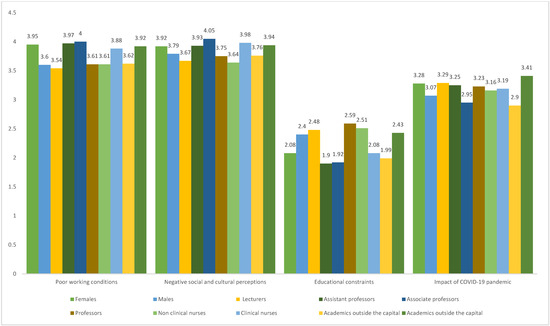
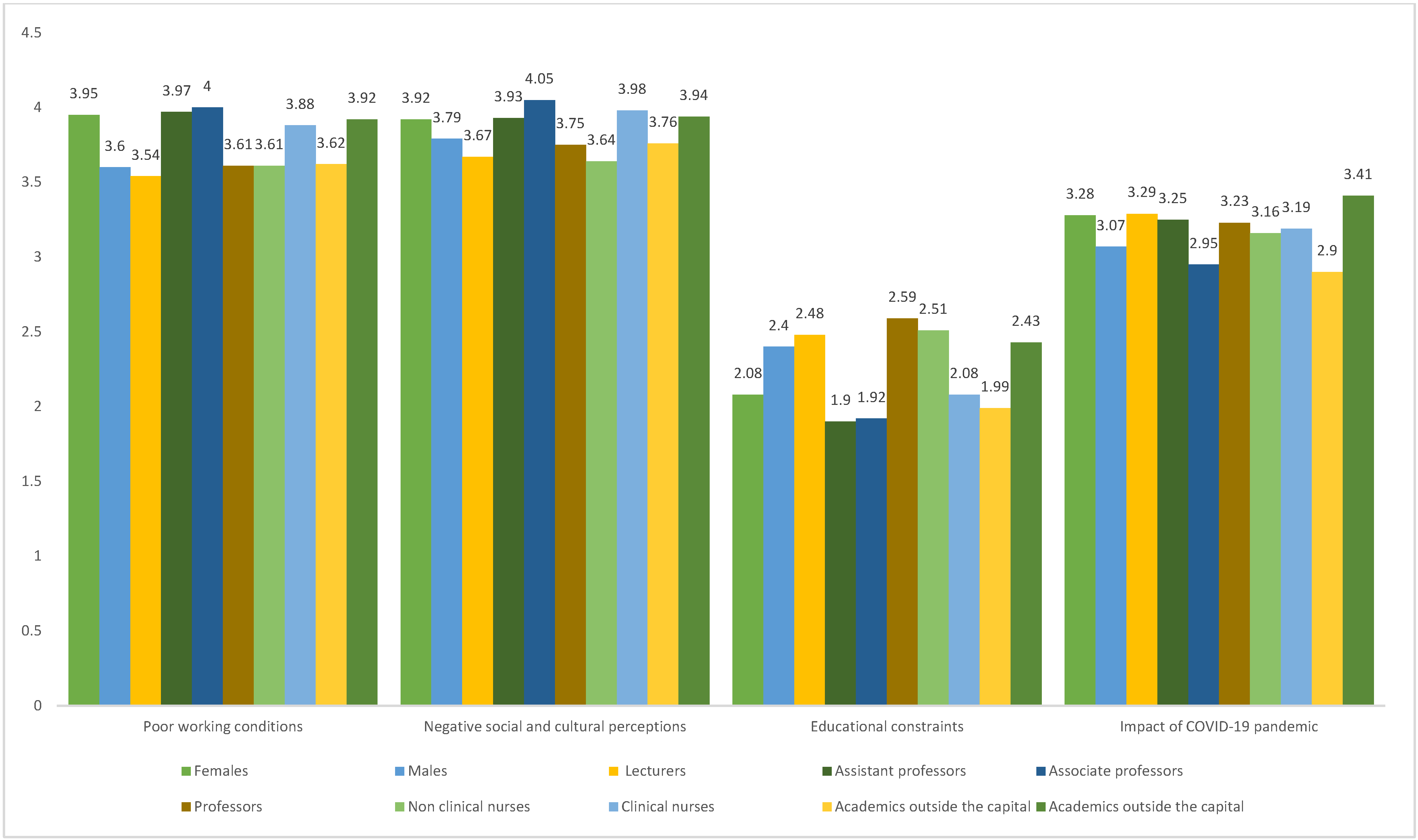
Table 3 and Figure 1 presents the association between demographic characteristics and academics’ views on factors contributing to the low interest in baccalaureate nursing education programs. Academics in nursing departments located in the capital considered the impact of the COVID-19 pandemic to be more significant compared to their counterparts working outside the capital (mean; 3.41 vs. 2.90, p-value = 0.037). Additionally, academics affiliated with nursing departments situated in the capital city perceived the impact of educational constraints on students’ career choices as more significant compared to their colleagues employed in institutions located outside the capital (mean; 2.43 vs. 1.99, p-value = 0.015). Academics without prior clinical nursing experience attributed greater importance to educational constraints as influencing factor (mean; 2.51 vs. 2.08, p-value = 0.023).
Table 3.
Association between demographic characteristics and academics’ views on factors contributing to the low interest in baccalaureate nursing education programs.
Figure 1.
Academics’ views on factors contributing to the low interest in baccalaureate nursing education programs according to different demographic groups.
3.4. Motives
Academics identified the improvement in working conditions (mean; 4.82), increase in salaries (mean; 4.75), and the provision of scholarships and financial support for students (mean; 4.19) as the most influential incentives for attracting young individuals to baccalaureate nursing education (Table 4). Informative sessions on future career opportunities in research, education, and specialized nursing fields (mean; 4.19), along with the integration of advanced technology and innovative practices into the curriculum (mean; 3.99), were also identified as potential strategies to enhance the attractiveness of nursing programs among young individuals. Finally, information campaigns delivered through school visits, practical workshops, social media platforms, and traditional media outlets were also considered potential strategies for increasing the appeal of nursing programs among young individuals.
Table 4.
Motives for attracting young individuals to nursing programs, as perceived by academics in nursing departments in Greece.
4. Discussion
This study examined the factors that discourage young individuals from enrolling in baccalaureate nursing education programs, as perceived by academic staff. Additionally, it explored potential incentives that could enhance the attractiveness of nursing education for prospective students. The findings indicate that academics identify several critical deterrents, including unfavorable working conditions, negative societal and cultural perceptions of the profession, educational limitations, and the impact of the COVID-19 pandemic. These factors collectively influence young people’s decision-making regarding a nursing career.
The inability of healthcare organizations’ leadership to ensure a healthy work environment that is supportive of nurses within the highly demanding context of nursing care has consistently been the most important factor driving nurses out of the profession. As nurses no longer perceive improvements in their working conditions, they increasingly consider leaving the profession. Studies conducted after the end of the pandemic, once the pressure on healthcare organizations has subsided, indicate that the proportion of nurses reporting an intention to leave the profession ranges from 50% to 70%, with the work environment emerging as a key determining factor [27,47,48,49]. Indeed, over time, the proportion of nurses who express an intention to leave the profession has increased substantially, representing a ticking time bomb for the very foundations of healthcare systems [50]. An important organizational factor associated with turnover intention is the salary of nursing staff. Thus, in combination with difficult working conditions and a non-supportive work environment, inadequate remuneration for nurses’ work creates a cumulative pattern of job dissatisfaction that ultimately facilitates their departure from the profession [51,52,53]. Enhancements in nurses’ working conditions and salaries were identified by respondents as two key motivating factors in the present study for the students to study nursing. The United Nations have included “Good Health and Well-Being” among the 17 Sustainable Development Goals, with one of the key prerequisites for achieving this goal being the increase in health financing and the recruitment, development, training, and retention of the health workforce in developing countries [54].
The public image of nurses and the recognition of their contribution may influence nurses’ decisions to leave the profession [55]. Although nurses were often portrayed as heroes during the COVID-19 pandemic, their image in society and in the media is still frequently shaped by stereotypes that depict them as predominantly female, low-skilled professionals with low social status, remuneration, academic qualifications and entry requirements, and limited professional autonomy [56]. According to nurses themselves, patients often lack awareness of the nursing role, frequently confusing nurses with other healthcare professionals. Also, while physicians are generally portrayed in a positive light, nurses are viewed less favorably, largely due to limited public knowledge of their qualifications and professional competencies [57]. The responsibility for improving the public image of nurses lies with nurses themselves, healthcare organizations, and policymakers [58].
Career counseling in schools regarding the nursing profession can strengthen students’ intentions to pursue nursing as a career [59]. Within the context of vocational guidance, it is essential to highlight the diverse professional opportunities available to nurses, which extend beyond hospital-based employment to include positions in primary healthcare, public health programs, research centers, and educational settings as school nurses. A highly unfavorable policy decision in the United States concerning the non-recognition of nursing as a “Professional Degree” may influence many students’ decisions to enter the nursing profession. This non-recognition is expected to reduce by 50% the amount of federal student loan funding available to nursing students. Such reduced access to this critical financial resource may serve as a significant deterrent to choosing nursing studies [60]. A common strategy adopted by many OECD countries to address their nursing workforce needs is the recruitment of foreign-trained nurses. Among OECD member states, the United Kingdom, Switzerland, New Zealand, and Australia exhibit the highest contribution of foreign-trained nurses to the growth of the nursing workforce [29].
The findings of the present study can be leveraged at multiple levels to strengthen the nursing profession. Given that students constitute the primary pipeline of the future nursing workforce, career guidance at the secondary education level can play a pivotal role. Informing students about the broad range of career opportunities available to nurses beyond hospital settings (e.g., research centers, academic careers, pharmaceutical companies), addressing potential misconceptions about the nursing profession and its public image (e.g., professional rights, participation in committees and senior organizational councils), and highlighting opportunities for postgraduate and doctoral education that provide specialized training associated with improved remuneration and career prospects are essential actions.
At the undergraduate level, universities can substantially enhance the nursing profession by upgrading curricula with a clear emphasis on clinical judgment, evidence-based practice, patient safety, quality, chronic care, and home-based/digital care while simultaneously developing specialization pathways and short certifications in critical competencies. Clinical education can also be strengthened through simulation, competency-based assessment, and structured mentorship/preceptorship programs in collaboration with clinical partners, ensuring that students acquire safe, measurable, and contemporary clinical experience. Furthermore, universities can bridge the education–labor market gap through career offices, alumni networks, transition (residency) programs, and permanent mechanisms of collaboration with hospitals and community services while concurrently promoting research and knowledge translation into practice through laboratories, student participation in projects, and the production of practice-oriented protocols and policy briefs that inform decision-making. Finally, they can enhance the prestige and social image of nursing through targeted outreach, campaigns, and events that present nurses as scientists and clinical leaders; invest in the development of educators and clinical partners (continuous professional development, joint academic–clinical appointments); and strengthen internationalization through exchanges and joint programs, thereby creating a coherent ecosystem that increases attractiveness, professional autonomy, and retention of nurses within the health system.
Ultimately, nurse retention depends on policymakers and healthcare organization leadership. For policymakers and healthcare administrators, the recommendations can be summarized as follows: legislating safe staffing ratios; establishing clear clinical career pathways (staff nurse–specialist–advanced practice–leadership) with corresponding salary recognition; funding transition programs for newly graduated nurses (residency/mentorship) and continuing education; strengthening professional autonomy; expanding nurse-led services (e.g., chronic disease management, prevention, home-based care); improving working conditions (flexible and fair scheduling, violence prevention, psychosocial support, adequate infrastructure); systematically reducing administrative burden through digitalization of documentation and supportive staff; adopting a safety culture and “just culture” with non-punitive incident reporting; and implementing a unified framework of indicators (burnout, turnover, vacancies, patient safety) to ensure data-driven decision-making and accountability.
This study has several limitations that should be acknowledged. First, although all academics from nursing departments in Greece were invited to participate, the response rate was 54.2%, which may introduce non-response bias and limit the representativeness of the sample. A recent meta-analysis found that the average response rate of online surveys such our study is 44.1% [61]. Response rates should be approximately 60% in cross-sectional studies like ours [62]. Although the response rate in our study covers the requirements, non-response bias is probable. For instance, the proportion of lecturers in our study was very low, and because they are among the most recently hired academic staff, their perspectives may differ from those of senior professors who have worked in nursing universities for many years. Second, data were collected using self-reported questionnaires, making this study susceptible to information bias. Third, the cross-sectional design precludes the establishment of causal relationships between demographic characteristics and academics’ views on factors contributing to low enrollment in baccalaureate nursing education programs. Furthermore, while the findings may reflect the Greek context, they cannot be generalized to other countries. Given that this is the first study to investigate factors influencing low enrollment in nursing programs at the university level, further research is warranted. Future studies should replicate this work in diverse international settings to enhance external validity. Additionally, exploring the perspectives of prospective students and parents could provide a more comprehensive understanding of the determinants of enrollment decisions. Longitudinal studies with larger and more representative samples are recommended to generate stronger evidence and capture temporal trends in attitudes and behaviors.
5. Conclusions
The shortage of nurses is a global phenomenon that jeopardizes the very foundations of healthcare systems. Nursing students constitute the primary pipeline supplying the nursing workforce. To our knowledge, this is the first international study to investigate academics’ perspectives on students’ reluctance to pursue nursing as a field of study. According to the participating academics, a poor nursing work environment, insufficient recognition of the nursing profession, inadequate career guidance, and the negative impact of the COVID-19 pandemic emerged as key deterrents to choosing nursing studies. Given the robust body of evidence on the factors driving nurses to leave the profession and discouraging students from entering it, timely decision-making at both policy and organizational levels regarding these issues is now crucial to reverse this trend and to secure an adequate supply of nurses.
Supplementary Materials
The following supporting information can be downloaded at: https://www.mdpi.com/article/10.3390/nursrep16020049/s1, Table S1: Factors contributing to the low interest in nursing university programs based on the perspectives of academic staff in nursing departments in Greece; Table S2: Motives for attracting young individuals to nursing programs, as perceived by academics.
Author Contributions
Conceptualization, P.G. and P.M.; methodology, P.G. and P.M.; validation, P.G.; formal analysis, P.G.; data curation, P.G.; writing—original draft preparation, P.G. and I.M.; writing—review and editing, C.T., P.M. and J.B.; visualization, P.G.; supervision, P.M. and J.B.; funding acquisition, J.B. All authors have read and agreed to the published version of the manuscript.
Funding
This publication was funded by the Ministry of Health of Greece within the framework of the HEALTH-IQ Project, which is coordinated by the World Health Organization (WHO) Athens Quality of Care and Patient Safety Office. Its contents are the sole responsibility of the authors and do not necessarily reflect the views of the Ministry of Health of Greece. The authors affiliated with the WHO are alone responsible for the views expressed in this publication and they do not necessarily represent the decisions or policies of the WHO.
Institutional Review Board Statement
The study protocol was approved by the Ethics Committee of the Faculty of Nursing, National and Kapodistrian University of Athens (approval number; 02, 16 September 2025).
Informed Consent Statement
Informed consent was obtained from all subjects involved in this study.
Data Availability Statement
The data presented in this study are available at: https://doi.org/10.6084/m9.figshare.30479528.v1 (accessed on 29 October 2025).
Public Involvement Statement
No public involvement in any aspect of this research.
Guidelines and Standards Statement
This manuscript was drafted against the Strengthening the Reporting of Observational studies in Epidemiology (STROBE) guidelines for cross-sectional studies.
Use of Artificial Intelligence
AI or AI-assisted tools were not used in drafting any aspect of this manuscript.
Conflicts of Interest
The authors declare no conflicts of interest.
Abbreviations
The following abbreviations are used in this manuscript:
| PTSD | Post-traumatic stress disorder |
| PISA | Programme for International Student Assessment |
| STROBE | Strengthening the Reporting of Observational Studies in Epidemiology |
| SD | Standard deviation |
References
- Aiken, L.H.; Sloane, D.M.; Ball, J.; Bruyneel, L.; Rafferty, A.M.; Griffiths, P. Patient Satisfaction with Hospital Care and Nurses in England: An Observational Study. BMJ Open 2021, 8, e019189. [Google Scholar] [CrossRef] [Scilit]
- Liu, X.; Zheng, J.; Liu, K.; Baggs, J.G.; Liu, J.; Wu, Y.; You, L. Hospital Nursing Organizational Factors, Nursing Care Left Undone, and Nurse Burnout as Predictors of Patient Safety: A Structural Equation Modeling Analysis. Int. J. Nurs. Stud. 2018, 86, 82–89. [Google Scholar] [CrossRef] [Scilit] [PubMed]
- Griffiths, P.; Ball, J.; Bloor, K.; Böhning, D.; Briggs, J.; Dall’Ora, C.; Iongh, A.D.; Jones, J.; Kovacs, C.; Maruotti, A.; et al. Nurse Staffing Levels, Missed Vital Signs and Mortality in Hospitals: Retrospective Longitudinal Observational Study; Health Services and Delivery Research; NIHR Journals Library: Southampton, UK, 2018. [Google Scholar]
- Aiken, L.H.; Simonetti, M.; Sloane, D.M.; Cerón, C.; Soto, P.; Bravo, D.; Galiano, A.; Behrman, J.R.; Smith, H.L.; McHugh, M.D.; et al. Hospital Nurse Staffing and Patient Outcomes in Chile: A Multilevel Cross-Sectional Study. Lancet Glob. Health 2021, 9, e1145–e1153. [Google Scholar] [CrossRef] [Scilit]
- Dall’Ora, C.; Saville, C.; Rubbo, B.; Turner, L.; Jones, J.; Griffiths, P. Nurse Staffing Levels and Patient Outcomes: A Systematic Review of Longitudinal Studies. Int. J. Nurs. Stud. 2022, 134, 104311. [Google Scholar] [CrossRef] [Scilit] [PubMed]
- Hämmig, O. Explaining Burnout and the Intention to Leave the Profession among Health Professionals–a Cross-Sectional Study in a Hospital Setting in Switzerland. BMC Health Serv. Res. 2018, 18, 785. [Google Scholar] [CrossRef] [Scilit]
- de Oliveira, D.R.; Griep, R.H.; Portela, L.F.; Rotenberg, L. Intention to Leave Profession, Psychosocial Environment and Self-Rated Health among Registered Nurses from Large Hospitals in Brazil: A Cross-Sectional Study. BMC Health Serv. Res. 2017, 17, 21. [Google Scholar] [CrossRef] [Scilit]
- Tuckett, A.; Winters-Chang, P.; Bogossian, F.; Wood, M. ‘Why Nurses Are Leaving the Profession … Lack of Support from Managers’: What Nurses from an e-Cohort Study Said. Int. J. Nurs. Pract. 2015, 21, 359–366. [Google Scholar] [CrossRef] [Scilit]
- Goodare, P. Literature Review: Why Do We Continue to Lose Our Nurses? Aust. J. Adv. Nurs. 2017, 34, 50–56. [Google Scholar] [CrossRef] [Scilit]
- Roth, C.; Wensing, M.; Breckner, A.; Mahler, C.; Krug, K.; Berger, S. Keeping Nurses in Nursing: A Qualitative Study of German Nurses’ Perceptions of Push and Pull Factors to Leave or Stay in the Profession. BMC Nurs. 2022, 21, 48. [Google Scholar] [CrossRef] [Scilit]
- Galanis, P.; Moisoglou, I.; Papathanasiou, I.V.; Malliarou, M.; Katsiroumpa, A.; Vraka, I.; Siskou, O.; Konstantakopoulou, O.; Kaitelidou, D. Association between Organizational Support and Turnover Intention in Nurses: A Systematic Review and Meta-Analysis. Healthcare 2024, 12, 291. [Google Scholar] [CrossRef] [Scilit]
- Muir, K.J.; Porat-Dahlerbruch, J.; Nikpour, J.; Leep-Lazar, K.; Lasater, K.B. Top Factors in Nurses Ending Health Care Employment Between 2018 and 2021. JAMA Netw. Open 2024, 7, e244121. [Google Scholar] [CrossRef] [Scilit]
- Aiken, L.H.; Clarke, S.P.; Sloane, D.M.; Sochalski, J.; Silber, J.H. Hospital Nurse Staffing and Patient Mortality, Nurse Burnout, and Job Dissatisfaction. JAMA 2002, 288, 1987–1993. [Google Scholar] [CrossRef] [Scilit]
- Galanis, P.; Moisoglou, I.; Katsiroumpa, A.; Gallos, P.; Kalogeropoulou, M.; Meimeti, E.; Vraka, I. Workload Increases Nurses’ Quiet Quitting, Turnover Intention, and Job Burnout: Evidence from Greece. AIMS Public Health 2025, 12, 44–55. [Google Scholar] [CrossRef] [Scilit]
- Moisoglou, I.; Katsiroumpa, A.; Konstantakopoulou, O.; Papathanasiou, I.V.; Katsapi, A.; Prasini, I.; Chatzi, M.; Galanis, P. Workplace Gaslighting Is Associated with Nurses’ Job Burnout and Turnover Intention in Greece. Healthcare 2025, 13, 1574. [Google Scholar] [CrossRef] [Scilit]
- Moloney, W.; Boxall, P.; Parsons, M.; Cheung, G. Factors Predicting Registered Nurses’ Intentions to Leave Their Organization and Profession: A Job Demands-Resources Framework. J. Adv. Nurs. 2018, 74, 864–875. [Google Scholar] [CrossRef] [Scilit]
- WHO. Nursing Workforce Grows, But Inequities Threaten Global Health Goals. Available online: https://www.who.int/news/item/12-05-2025-nursing-workforce-grows--but-inequities-threaten-global-health-goals (accessed on 28 November 2025).
- Burton, C.W.; Jenkins, D.K.; Chan, G.K.; Zellner, K.L.; Zalta, A.K. A Mixed Methods Study of Moral Distress among Frontline Nurses during the COVID-19 Pandemic. Psychol. Trauma Theory Res. Pract. Policy 2024, 16, 568–575. [Google Scholar] [CrossRef] [Scilit] [PubMed]
- Galanis, P.; Vraka, I.; Fragkou, D.; Bilali, A.; Kaitelidou, D. Nurses’ Burnout and Associated Risk Factors during the COVID-19 Pandemic: A Systematic Review and Meta-Analysis. J. Adv. Nurs. 2021, 77, 3286–3302. [Google Scholar] [CrossRef] [Scilit] [PubMed]
- Morgado-Toscano, C.; Gómez-Salgado, J.; García-Iglesias, J.J.; Fagundo-Rivera, J.; López-López, D.; Allande-Cussó, R. Levels of Anxiety and Fear among Nurses During the COVID-19 Pandemic: A Systematic Review. J. Nurs. Manag. 2023, 2023, 2191984. [Google Scholar] [CrossRef] [Scilit]
- Ghahramani, S.; Kasraei, H.; Hayati, R.; Tabrizi, R.; Marzaleh, M.A. Health Care Workers’ Mental Health in the Face of COVID-19: A Systematic Review and Meta-Analysis. Int. J. Psychiatry Clin. Pract. 2023, 27, 208–217. [Google Scholar] [CrossRef] [Scilit]
- NCSBN. NCSBN Research Projects Significant Nursing Workforce Shortages and Crisis. Available online: https://www.ncsbn.org/news/ncsbn-research-projects-significant-nursing-workforce-shortages-and-crisis (accessed on 22 November 2025).
- Ren, H.; Xue, Y.; Li, P.; Yin, X.; Xin, W.; Li, H. Prevalence of Turnover Intention among Emergency Nurses Worldwide: A Meta-Analysis. BMC Nurs. 2024, 23, 645. [Google Scholar] [CrossRef] [Scilit] [PubMed]
- Xu, G.; Zeng, X.; Wu, X. Global Prevalence of Turnover Intention among Intensive Care Nurses: A Meta-Analysis. Nurs. Crit. Care 2023, 28, 159–166. [Google Scholar] [CrossRef] [Scilit]
- Ki, J.; Choi-Kwon, S. Health Problems, Turnover Intention, and Actual Turnover among Shift Work Female Nurses: Analyzing Data from a Prospective Longitudinal Study. PLoS ONE 2022, 17, e0270958. [Google Scholar] [CrossRef] [Scilit]
- Galanis, P.; Moisoglou, I.; Malliarou, M.; Papathanasiou, I.V.; Katsiroumpa, A.; Vraka, I.; Siskou, O.; Konstantakopoulou, O.; Kaitelidou, D. Quiet Quitting among Nurses Increases Their Turnover Intention: Evidence from Greece in the Post-COVID-19 Era. Healthcare 2024, 12, 79. [Google Scholar] [CrossRef] [Scilit] [PubMed]
- Moisoglou, I.; Katsiroumpa, A.; Fradelos, E.C.; Papathanasiou, I.V.; Paralikas, T.; Prasini, I.; Rekleiti, M.; Katsapi, A.; Chatzi, M.; Galanis, P.; et al. Association between Nursing Work Environment, Burnout, and Turnover Intention: A Cross-Sectional Study in Greece. AIMS Public Health 2025, 12, 1069–1083. [Google Scholar] [CrossRef] [Scilit]
- OECD. Health at a Glance 2025; OECD: Paris, France, 2025. [Google Scholar]
- OECD. Fewer Young People Want to Become Nurses in Half of OECD Countries. Available online: https://www.oecd.org/en/publications/fewer-young-people-want-to-become-nurses-in-half-of-oecd-countries_e6612040-en.html (accessed on 22 November 2025).
- Liaw, S.y.; Wu, L.t.; Holroyd, E.; Wang, W.; Lopez, V.; Lim, S.; Chow, Y.l. Why Not Nursing? Factors Influencing Healthcare Career Choice among Singaporean Students. Int. Nurs. Rev. 2016, 63, 530–538. [Google Scholar] [CrossRef] [Scilit] [PubMed]
- Metcalfe, S.E.; Neubrander, J. Social Determinants and Educational Barriers to Successful Admission to Nursing Programs for Minority and Rural Students. J. Prof. Nurs. 2016, 32, 377–382. [Google Scholar] [CrossRef] [Scilit] [PubMed]
- Meeker, Z. Nursing No Longer Classified as a Professional Degree: What’s at Stake? Available online: https://www.nurse.com/blog/nursing-no-longer-classified-as-a-professional-degree-whats-at-stake/ (accessed on 23 November 2025).
- WHO. Nursing and Midwifery. Available online: https://www.who.int/news-room/fact-sheets/detail/nursing-and-midwifery (accessed on 19 January 2026).
- Lent, R.W.; Brown, S.D.; Hackett, G. Toward a Unifying Social Cognitive Theory of Career and Academic Interest, Choice, and Performance. J. Vocat. Behav. 1994, 45, 79–122. [Google Scholar] [CrossRef] [Scilit]
- Sheu, H.-B.; Bordon, J.J. SCCT Research in the International Context: Empirical Evidence, Future Directions, and Practical Implications. J. Career Assess. 2017, 25, 58–74. [Google Scholar] [CrossRef] [Scilit]
- Brown, S.D.; Lent, R.W. Vocational Psychology: Agency, Equity, and Well-Being. Annu. Rev. Psychol. 2016, 67, 541–565. [Google Scholar] [CrossRef] [Scilit]
- Al Maqbali, M.; Al Sinani, M.; Al-Lenjawi, B. Prevalence of Stress, Depression, Anxiety and Sleep Disturbance among Nurses during the COVID-19 Pandemic: A Systematic Review and Meta-Analysis. J. Psychosom. Res. 2021, 141, 110343. [Google Scholar] [CrossRef] [Scilit]
- von Elm, E.; Altman, D.G.; Egger, M.; Pocock, S.J.; Gøtzsche, P.C.; Vandenbroucke, J.P.; STROBE Initiative. The Strengthening the Reporting of Observational Studies in Epidemiology (STROBE) Statement: Guidelines for Reporting Observational Studies. J. Clin. Epidemiol. 2008, 61, 344–349. [Google Scholar] [CrossRef] [Scilit]
- Lai, H.-L.; Peng, T.-C.; Chang, F.-M. Factors Associated with Career Decision in Taiwanese Nursing Students: A Questionnaire Survey. Int. J. Nurs. Stud. 2006, 43, 581–588. [Google Scholar] [CrossRef] [Scilit]
- Vanhanen-Nuutinen, L.; Janhonen, S.; Maunu, M.; Laukkala, H. Changes in Finnish Nursing Students’ Nursing Orientations between Mid 1990s and Mid-2000s. Nurse Educ. Today 2012, 32, 490–496. [Google Scholar] [CrossRef] [Scilit]
- Jirwe, M.; Rudman, A. Why Choose a Career in Nursing? J. Adv. Nurs. 2012, 68, 1615–1623. [Google Scholar] [CrossRef] [Scilit] [PubMed]
- Price, S.L. Becoming a Nurse: A Meta-Study of Early Professional Socialization and Career Choice in Nursing. J. Adv. Nurs. 2009, 65, 11–19. [Google Scholar] [CrossRef] [Scilit] [PubMed]
- Neilson, G.R.; McNally, J. The Negative Influence of Significant Others on High Academic Achieving School Pupils’ Choice of Nursing as a Career. Nurse Educ. Today 2013, 33, 205–209. [Google Scholar] [CrossRef] [Scilit] [PubMed]
- Neilson, G.R.; Lauder, W. What Do High Academic Achieving School Pupils Really Think about a Career in Nursing: Analysis of the Narrative from Paradigmatic Case Interviews. Nurse Educ. Today 2008, 28, 680–690. [Google Scholar] [CrossRef] [Scilit]
- Georgieva, D.; Hristova, I.; Koleva, G.; Konstantinova, D. Analysis of the Reasons for the Decreased Interest of Prospective Students in the Nursing Profession. Open Nurs. J. 2025, 19, e18744346378075. [Google Scholar] [CrossRef] [Scilit]
- World Medical Association. World Medical Association Declaration of Helsinki: Ethical Principles for Medical Research Involving Human Subjects. JAMA 2013, 310, 2191–2194. [Google Scholar] [CrossRef] [Scilit]
- Boudreau, C.; Rhéaume, A. Impact of the Work Environment on Nurse Outcomes: A Mediation Analysis. West. J. Nurs. Res. 2024, 46, 210–218. [Google Scholar] [CrossRef] [Scilit]
- Gusar, I.; Šijan, D.; Sorić, T.; Šare, S.; Županović, M.; Ljubičić, M. Predictors of Croatian Nurses’ Turnover Intention: A Cross-Sectional Study. Health Policy 2025, 151, 105198. [Google Scholar] [CrossRef] [Scilit]
- Park, J.E.; Song, M.R. Effects of Emergency Nurses’ Experiences of Violence, Resilience, and Nursing Work Environment on Turnover Intention: A Cross-Sectional Survey. J. Emerg. Nurs. 2023, 49, 461–469. [Google Scholar] [CrossRef] [Scilit] [PubMed]
- Labrague, L.j.; De los Santos, J.a.a.; Falguera, C.c.; Nwafor, C.e.; Galabay, J.r.; Rosales, R.a.; Firmo, C.n. Predictors of Nurses’ Turnover Intention at One and Five Years’ Time. Int. Nurs. Rev. 2020, 67, 191–198. [Google Scholar] [CrossRef] [Scilit]
- Akinyemi, B.; George, B.; Ogundele, A. Relationship between Job Satisfaction, Pay, Affective Commitment and Turnover Intention among Registered Nurses in Nigeria. Glob. J. Health Sci. 2022, 14, 37. [Google Scholar] [CrossRef] [Scilit]
- Boateng, A.B.; Opoku, D.A.; Ayisi-Boateng, N.K.; Sulemana, A.; Mohammed, A.; Osarfo, J.; Hogarh, J.N. Factors Influencing Turnover Intention among Nurses and Midwives in Ghana. Nurs. Res. Pract. 2022, 2022, 4299702. [Google Scholar] [CrossRef] [Scilit]
- Cao, J.; Jia, Z.; Zhu, C.; Li, Z.; Liu, H.; Li, F.; Li, J. Nurses’ Turnover Intention and Associated Factors in General Hospitals in China: A Cross-Sectional Study. J. Nurs. Manag. 2021, 29, 1613–1622. [Google Scholar] [CrossRef] [Scilit]
- UNDP. Sustainable Development Goals|United Nations Development Programme. Available online: https://www.undp.org/sustainable-development-goals (accessed on 28 November 2025).
- Elstad, J.I.; Vabø, M. Lack of Recognition at the Societal Level Heightens Turnover Considerations among Nordic Eldercare Workers: A Quantitative Analysis of Survey Data. BMC Health Serv. Res. 2021, 21, 747. [Google Scholar] [CrossRef] [Scilit]
- Teresa-Morales, C.; Rodríguez-Pérez, M.; Araujo-Hernández, M.; Feria-Ramírez, C. Current Stereotypes Associated with Nursing and Nursing Professionals: An Integrative Review. Int. J. Environ. Res. Public Health 2022, 19, 7640. [Google Scholar] [CrossRef] [Scilit]
- López-Verdugo, M.; Ponce-Blandón, J.A.; López-Narbona, F.J.; Romero-Castillo, R.; Guerra-Martín, M.D. Social Image of Nursing. An Integrative Review about a Yet Unknown Profession. Nurs. Rep. 2021, 11, 460–474. [Google Scholar] [CrossRef] [Scilit] [PubMed]
- Moghbeli, G.; Gardashkhani, S.; Soheili, A. Public Image of Nursing: An Integrative Review of Challenges and Solutions. BMC Nurs. 2025, 24, 573. [Google Scholar] [CrossRef] [Scilit] [PubMed]
- Yilmaz, A.A.; Ilce, A.; Can Cicek, S.; Yuzden, G.E.; Yigit, U. The Effect of a Career Activity on the Students’ Perception of the Nursing Profession and Their Career Plan: A Single-Group Experimental Study. Nurse Educ. Today 2016, 39, 176–180. [Google Scholar] [CrossRef] [Scilit] [PubMed]
- Perez, K. Nursing is not a ‘Professional Degree’ Amidst Student Loan Changes. Available online: https://www.usatoday.com/story/news/nation/2025/11/21/what-considered-professional-degree-explained/87396245007/ (accessed on 23 November 2025).
- Wu, M.-J.; Zhao, K.; Fils-Aime, F. Response Rates of Online Surveys in Published Research: A Meta-Analysis. Comput. Hum. Behav. Rep. 2022, 7, 100206. [Google Scholar] [CrossRef] [Scilit]
- Fincham, J.E. Response Rates and Responsiveness for Surveys, Standards, and the Journal. Am. J. Pharm. Educ. 2008, 72, 43. [Google Scholar] [CrossRef] [Scilit] [PubMed]

Disclaimer/Publisher’s Note: The statements, opinions and data contained in all publications are solely those of the individual author(s) and contributor(s) and not of MDPI and/or the editor(s). MDPI and/or the editor(s) disclaim responsibility for any injury to people or property resulting from any ideas, methods, instructions or products referred to in the content. |
© 2026 by the authors. Licensee MDPI, Basel, Switzerland. This article is an open access article distributed under the terms and conditions of the Creative Commons Attribution (CC BY) license.