


Abstract
The paper is focused on the analysis of the key aspects of sustainability projects, namely advanced risk management and project knowledge. These aspects are recommended to the attention of institutions and project managers when designing and executing new projects simultaneously with quality and project status management. The aim of the paper is to point out the critical factors that have recently affected the success of sustainability projects, which is also its contribution. Empirical research focused on the identification of the application level of the post-project phases in project management in the Czech Republic in 2016 and 2017 was performed. The research was performed as qualitative research employing observation and inquiry methods in the form of a controlled semistructured interview. The research identified 21 most common reasons for not executing post-project phases. Ensuring good and efficient progress of post-project phases, in particular by the means of post-implementation system analysis and compilation of a set of improvement suggestions for subsequent project management, forms the practical background for application of knowledge management and project management principles. A case study focused on the application of fuzzy logic in project risk assessment has been elaborated. In practice, current project management requires the application of advanced risk analysis methods that will replace the simple risk values estimated by calculations of separate risk components.
1. Introduction
Sustainable development represents one of the key issues in preserving human society on our planet. A UNESCO study defined 17 sustainable development goals [1]. The execution of these goals cannot be left to chance and one cannot rely on the goals being achieved by unprompted development. Also, it is impossible to rely on an intervention by an extraordinary human being under whose management the goals would be successfully achieved and sustainable development would be set.
It is project management that seems to be the effective and efficient way to achieve sustainable development goals; therefore, it is very meritable and important that in the Special Issue, the Sustainability journal editorial board concentrated on the subject of sustainable development realization by means of quality project management, stating that the role of project management is essential for achieving sustainability goals.
The paper discusses two aspects in relation to sustainability projects. These aspects are recommended to the attention of institutions and project managers when designing and executing new projects. They are, namely:
- Advanced risk management of sustainability development projects.
- Utilization of knowledge management by employing post-project phases in the project life cycle.
The aim of the paper is to point out the critical factors that have recently affected the success of sustainability projects. Most sustainability development projects have ambitious goals that can be very beneficial to the sustainable development of human society. For this reason, it is important that the probability of their success is high. Their failures mean not only considerable financial losses of the project stakeholders, but also undermine the whole sustainable development movement, and what is more, may have adverse effects on any future attempts to raise money for sustainable development. Thus, the paper points out that continuous project design and management quality require attention through knowledge management in order to increase the probability of sustainability project success. Moreover, the paper aims to demonstrate the procedures and methods to manage these critical factors of sustainable development projects successfully.
2. Literature Review
Application of project management to sustainable development projects is not a new idea. A number of steps to achieve partial goals leading to sustainable development have already been implemented as projects [2,3]. However, the issue of improving efficiency and effectiveness of the projects in the new millennium needs to be addressed. Research and analyses show numerous errors and drawbacks of the current projects, including those related to sustainable development projects [4]. Therefore, certain groups of scientists have focused on research of advanced methods related to the issues of project success evaluation, project risk assessment, project status assessment [5], and future project development prediction [6,7], and so on. These are the key areas where many errors occur. A possible solution to minimize these problems are general efforts to apply risk management [8] and knowledge management [9] principles more effectively. Successful project execution absolutely requires continuous project status assessment, taking successful achievement of the target status into account. A comparison may be made to well-structured projects, for example, in construction or engineering, where well-structured methods of project status assessment can be used [10]. For this reason, soft methods are applied in sustainability projects to assess the project status in milestones which with unprofessional and superficial attitude, may result in inaccurate and unrealistic project status assessment [11].
The classic approach to project risks, “A Guide to the Project Management Body of Knowledge” (PMBOK® Guide), considers risk as a product of risk occurrence probability and the financial risk impact within the project [12]. Since in many cases, it is difficult to determine the risk probability value directly and to calculate the risk impact value, alternative methods of expressing the values are used [13,14].
A number of authors deal with research in project risk management in their works (see Table 1).

Table 1.
Literature review of project risk (Source: processed by the author using quoted literature).
The application of the RIPRAN™ method (RIsk PRoject Analysis) [21] extended by the fuzzy approach of the risk evaluation in both the components of “probability” and “impact on the project” and then the quantification of the overall risk value is the contribution of the paper in the area of sustainability risk management project.
A number of authors deal with managing project knowledge in their research works (see Table 2).
Table 2.
Literature review of project knowledge models (Source: processed by the author using quoted literature).
The emphasizing of the importance of post-project phase application in sustainability projects is the contribution of the paper in the area of knowledge management. One of the reasons is that sustainability projects are usually implemented in widely diversified project teams (not only in one company). The knowledge management principles play an important role in management of these projects.
3. Materials and Methods
The findings of general management theory and other managerial disciplines, in particular project and knowledge management, were used in the elaboration of the paper. Moreover, findings of system sciences and system applications were used [25].
In the stage of analysis of the current status of the discussed issues, the method of relevant data secondary analysis was employed, which represented the process of obtaining and processing secondary data, where new information was gained by analysing the original data and information. The inputs included mostly the study of scientific articles published in scientific journals and conference collections (see Section 2).
The primary data were obtained by applying empirical research focused on identifying the level of post-project phase application in project management in the Czech Republic in 2016 and 2017. The respondents were the participants in project management courses from companies operating in the Czech Republic. These were both company courses and public courses open to business people from all over the country. The total number of respondents was 150. The courses on project design and management covered the knowledge defined in the International Project Management Association (IPMA) competence baseline for level D. The participants were members of staff of small and medium-size businesses from various industrial fields (most frequently construction, engineering, the electrical industry, the power industry, and IT), since large companies are usually owned by foreign parent companies that organize their own internal education courses of project management and usually do not send their employees to external courses. Two-thirds of the respondents were project team leaders (PTL), and the rest were members of staff participating in business projects as project team members. There were no heads of project management offices among the course participants.
The research was performed as qualitative research employing observation and inquiry methods in the form of a controlled semistructured interview. The controlled interviews took the form of targeted personal meetings with the respondents. They were experts from selected companies in the roles of project managers or project team members. The collected data were then processed and assessed using the comparative method and content analysis. It was applied to the analysis, classification, and study of primary data.
The following research questions were delineated:
- Is it possible that implementation of the principles of knowledge management through post-project phases contribute to improving the management of sustainability projects?
- What are the reasons for ignoring post-project phases?
- Is it possible that fuzzy approach application improves the risk evaluation process of sustainability projects?
The method of modelling was used in the case study for project risk assessment. Here, a model means a simplified depiction of reality used as a basis for modelling the characteristics significant in terms of the analysed phenomenon. The expert model of project risk evaluation was realized using the fuzzy sets and fuzzy logic apparatus.
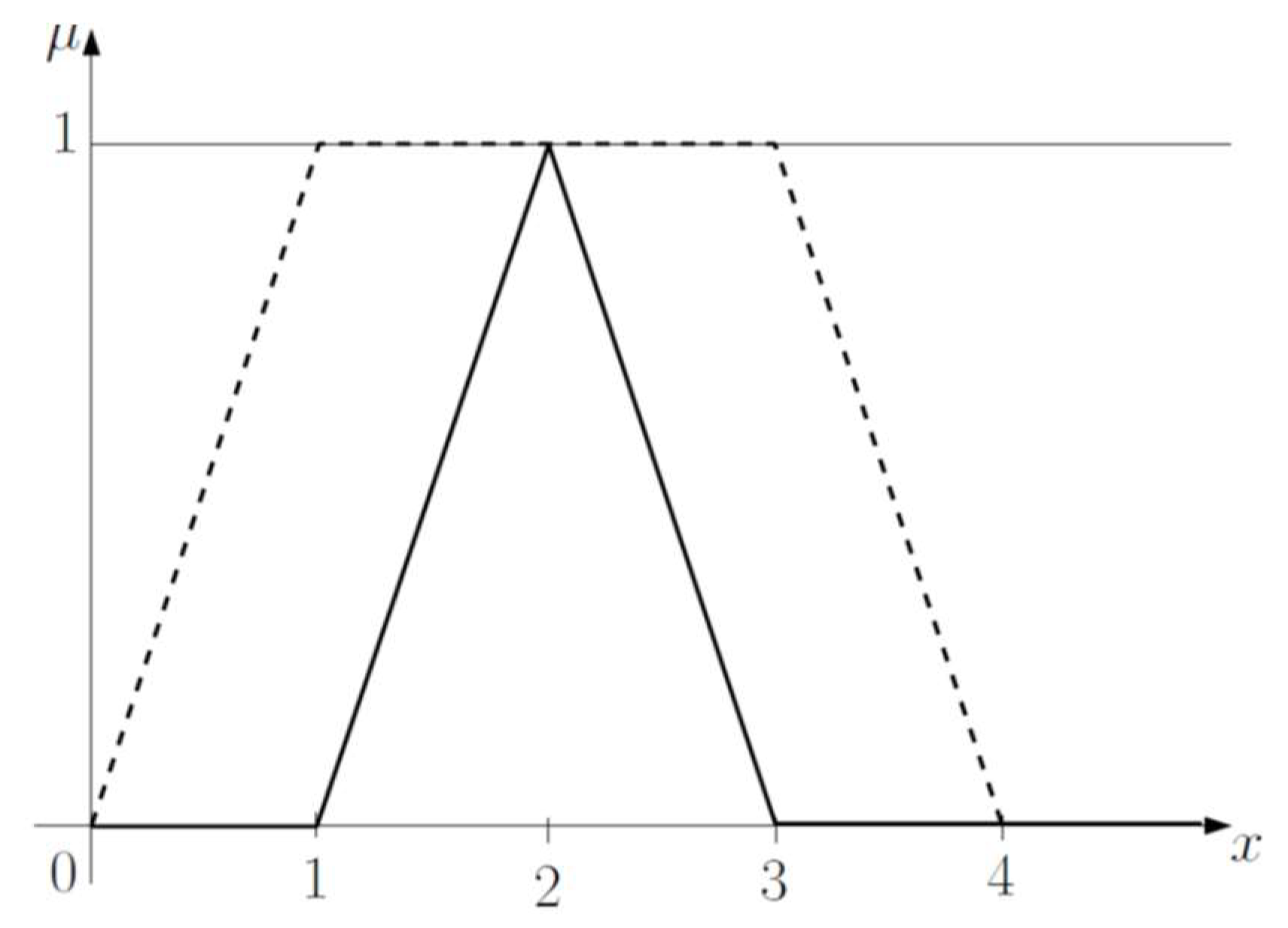
A fuzzy set (defined by Lotfi A. Zadeh in 1965 [26]) is usually expressed in terms of its membership function which maps domain elements () with their respective degrees of belonging in the interval (see Figure 1).
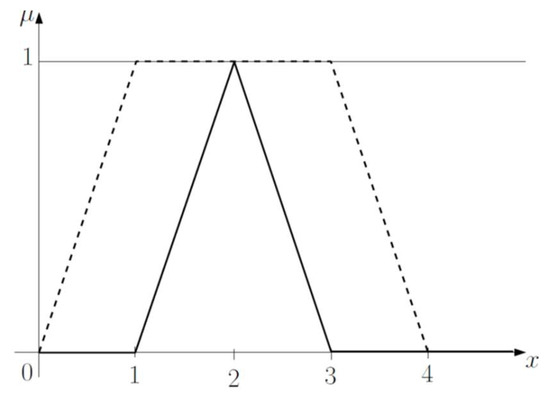
Figure 1.
Trapezoidal and triangular membership function.
A support of a fuzzy set is the classical set
A core of a fuzzy set is the classical set
A height of a fuzzy set is the number
Example: If a fuzzy set is “about 2” (see the triangular membership function in Figure 1), then , and .
Fuzzy logic is an approach to computing based on the “degrees of truth” described using fuzzy set theory [27,28,29]. The computing of fuzzy logic [30] includes three basic processes [31]:
- Fuzzification: translate input into truth values. Input variables are assigned degrees of membership in various classes.
- Fuzzy inference: compute output truth values. Inputs are applied to a set of “if–then” control rules.
- Defuzzification: transfer truth values into output. Fuzzy outputs are combined into discrete values needed to drive the control mechanism.
4. Results
4.1. Knowledge Management: Post-Project Phases
The empirical research results showed fatal drawbacks in the investigated area. Generally, the level of application of post-project phases is very low in the Czech environment. This phase is not performed at all in the majority of cases. The following table comprehensively presents the key reasons, according to the respondents (see Table 3).
Table 3.
The most common reasons why companies fail to process post-project phases of projects (source: processed by the author).
4.2. Risk Management: Fuzzy Risk Quantification
The advantage of the fuzzy set is its ability to work with vague terms which are typical for daily use in project management. The current approach, for example, in the field of risk engineering, applied either numerical values of probability and impact or worked with classical sharp jurisdiction of these values into certain sets. It was not appropriate for many applications and did not correspond to the actual perception of risk [32].
The case study is focused on the application of fuzzy logic for the evaluation of project risk based on the RIPRAN™ method. Branislav Lacko is the author of the RIPRAN™ method. He was a finalist of the 2016 Federation European Risk Manager Association award in innovation method categories. The RIPRAN™ method is a trade mark no. 283536 registered by the Industrial Property Office, Prague. It is recommended for project risk analysis according to the IPMA competence baseline (ICB) international standard in the Czech Republic.
The RIPRAN™ method does not represent a difficult approach to project risk analysis. It is the methodological arrangement of the individual activities in the risk analysis of the project systematically, so that nothing important is forgotten, and suitably documented for the needs of the project risk register. It is not necessary to start with a risk evaluation using the fuzzy approach in the current version of the method. This is possible to be postponed until the project team decides that the use of the fuzzy approach is suitable. The main contribution of this extended version of the RIPRAN™ method is the possibility to quantify the individual components of “probability” and “impact on the project” using vague fuzzy values and then the quantification of the overall risk value. The total benefit of this fuzzy approach compared with simple estimates of overall risk by the traditional approach is considerable. This “cheap or inexpensive” intuition (as shows practice) is, on the contrary, very expensive in the view of the impact of poor quality intuitive estimates and intuitive approaches to project risk analysis.
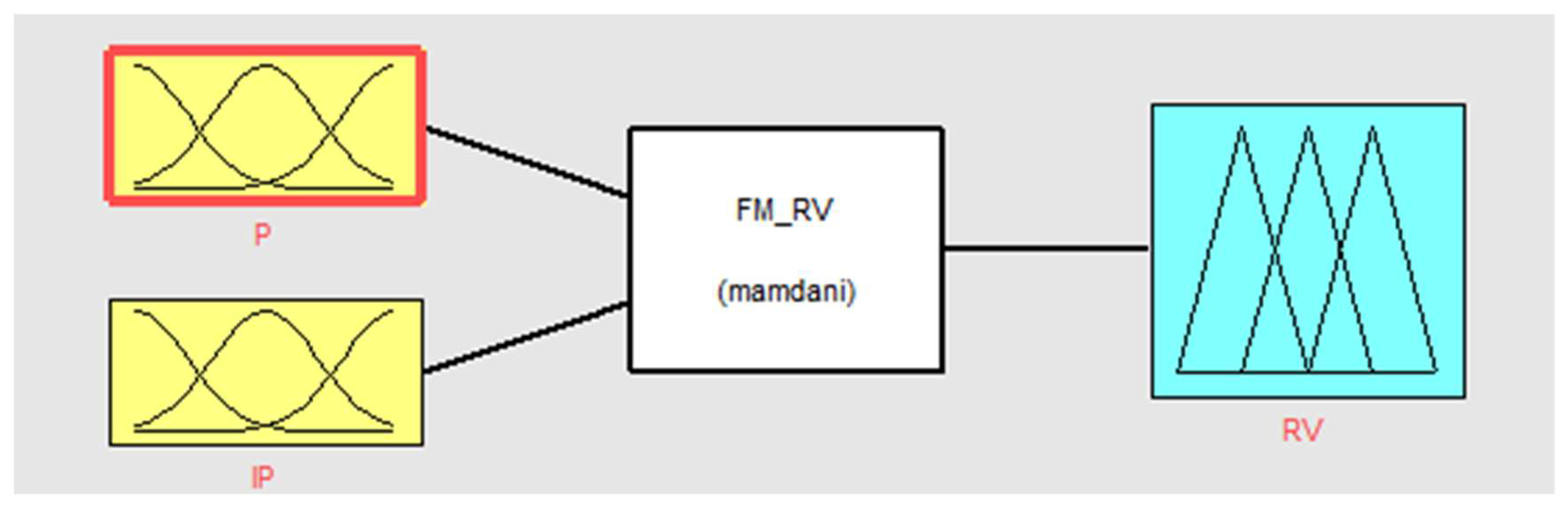
The fuzzy logic toolbox in Matlab was used for the fuzzy model creation. The fuzzy model of risk value evaluation (FM_RV) consists of two input variables (P—Probability, IP—Impact on the Project), one rule block, and one output variable (RV—Risk Value) (see Figure 2).
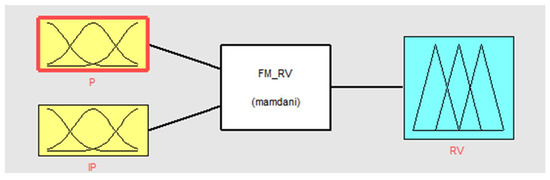
Figure 2.
The fuzzy model diagram (FM_RV). P: probability, IP: impact on the project, RV: risk value.
The fuzzy logic deduction method was used for obtaining outputs based on inputs (see fuzzy rules below). Mamdani’s fuzzy inference method was used, because the system is described only roughly using the natural language: knowledge is unstructured or little structured. The fuzzy set defined by the membership function is the output of the inference process. This type of output is sufficient for interpretation of the risk value in project management.
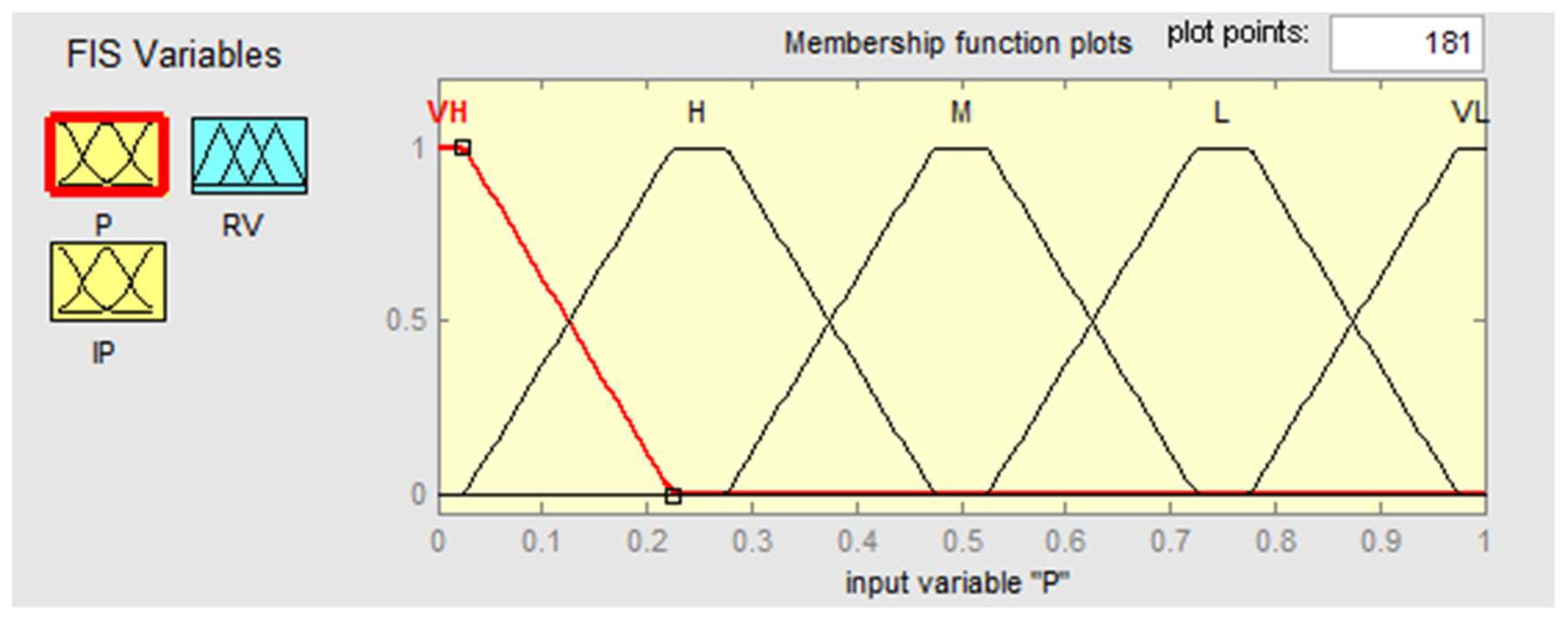
Figure 3 shows the input variable P with five linguistic fuzzy values: VH—very high, H—high, M—middle, L—low, and VL—very low. The membership function of type Π (trapmf) and range [0; 1] was used to create the fuzzy model. The input variable IP has the same parameters.
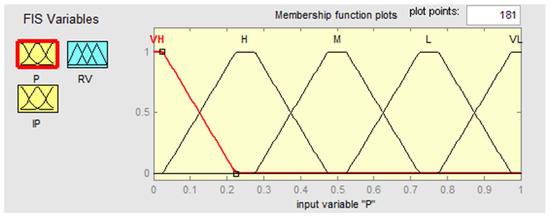
Figure 3.
The linguistic input variable P with linguistic fuzzy values VH, H, M, L, and VL. FIS: fuzzy inference system.
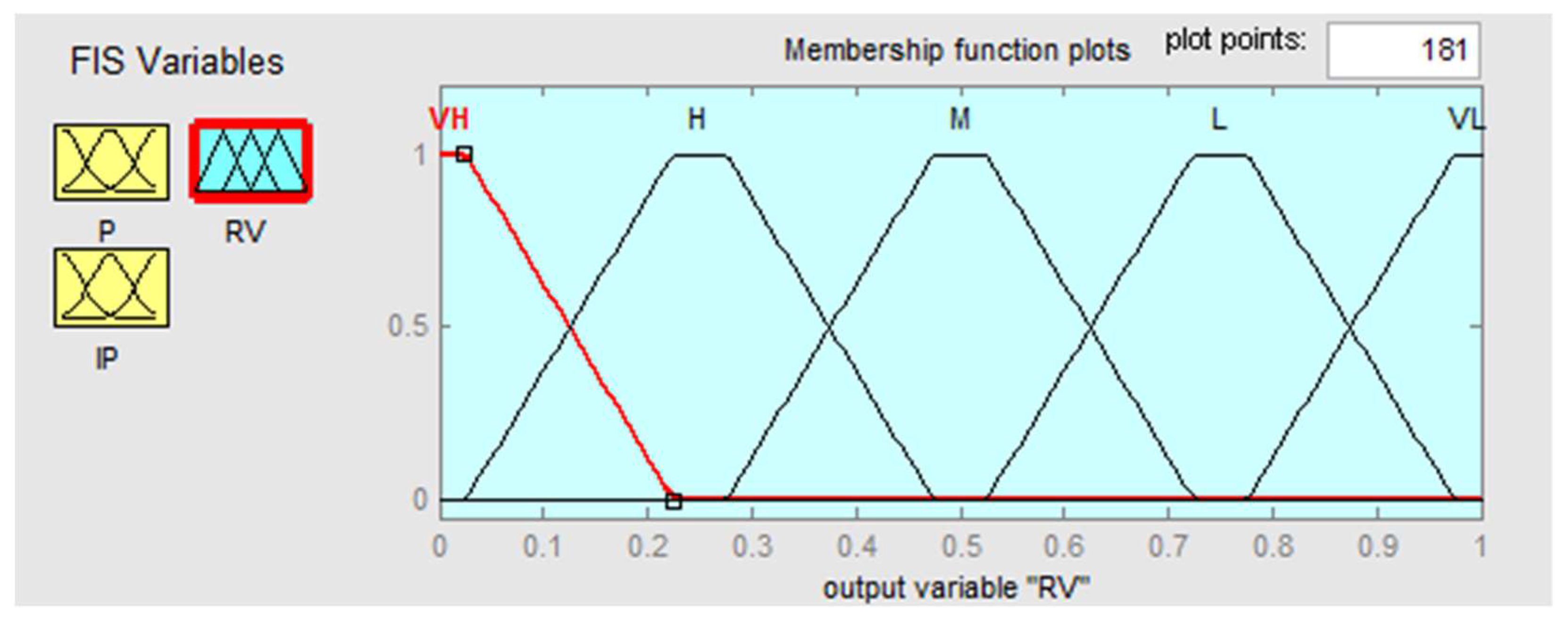
Figure 4 shows the output variable RV with five linguistic fuzzy values: VH—very high, H—high, M—middle, L—low, and VL—very low. The membership function of type Π (trapmf) and range [0; 1] was used to create the fuzzy model.
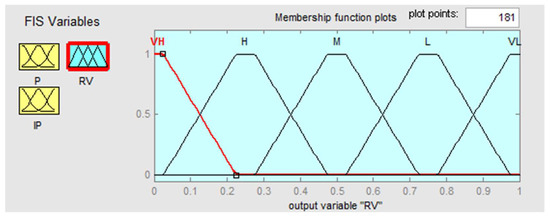
Figure 4.
The linguistic output variable RV with linguistic fuzzy values VH, H, M, L, and V.
The expressing of the membership functions depends both on the subject (how deep is our experience) and on the context (where is the problem solution). That is the reason why the membership functions are expressed neutrally according to the generally applicable rules (metarules) in the first phase.
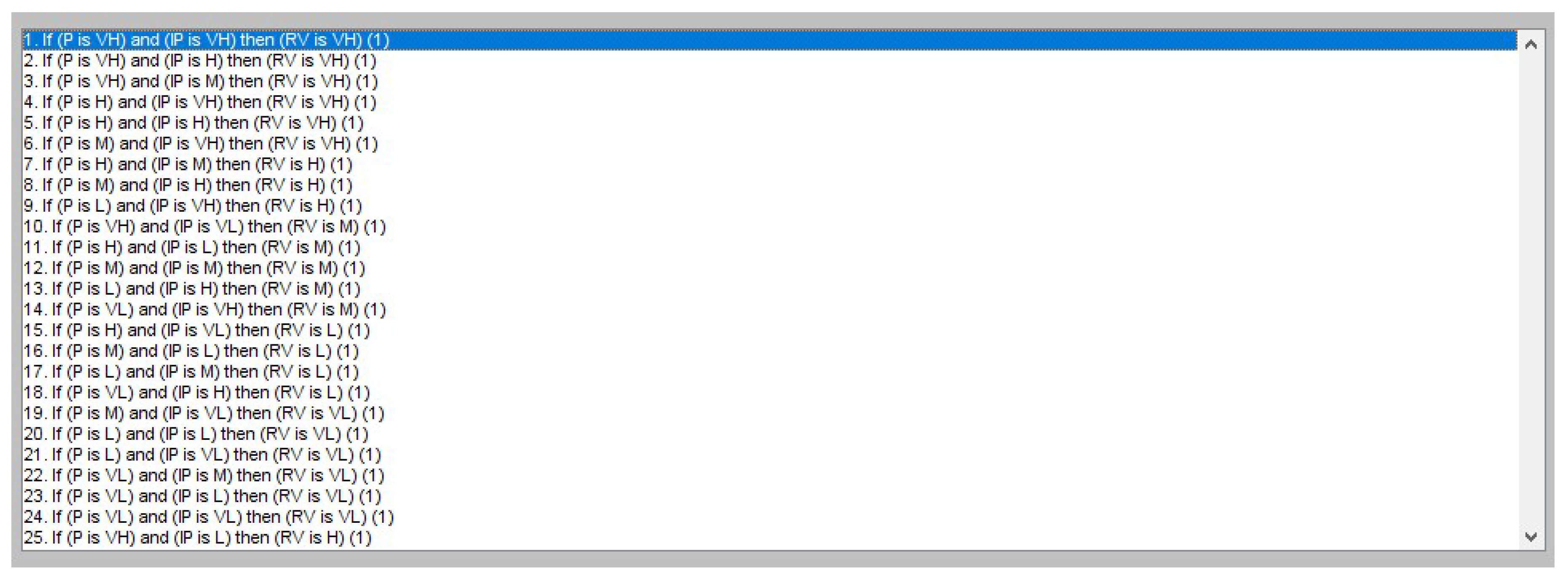
One rule, “if–then”, expresses expert knowledge of the relationship existing between the basic components of the risk (“probability”, “impact on the project”) and the risk value. There are 25 rules in the fuzzy system. These rules represent the knowledge base, which describes the behaviour of the system. The antecedent includes all real combinations of linguistic values of input variables. The consequent includes evaluations for all combinations, that is, the assignment of the linguistic values to output variables. The listing of a combination of 25 rules of the system is based on the following distribution (see Table 4).
Table 4.
The listing of a combination of fuzzy rules (source: processed by the author).
Figure 5 presents an antecedent (column and row) and a consequent (intersection of a column and a row) of the fuzzy rule. There are 25 fuzzy rules (metarules). These rules can be changed or defined for a specific project.
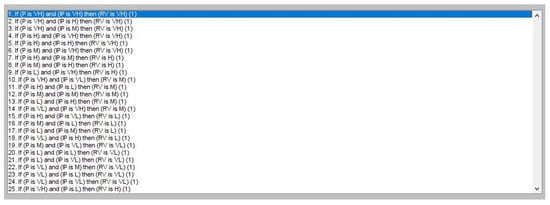
Figure 5.
Rule block and rules.
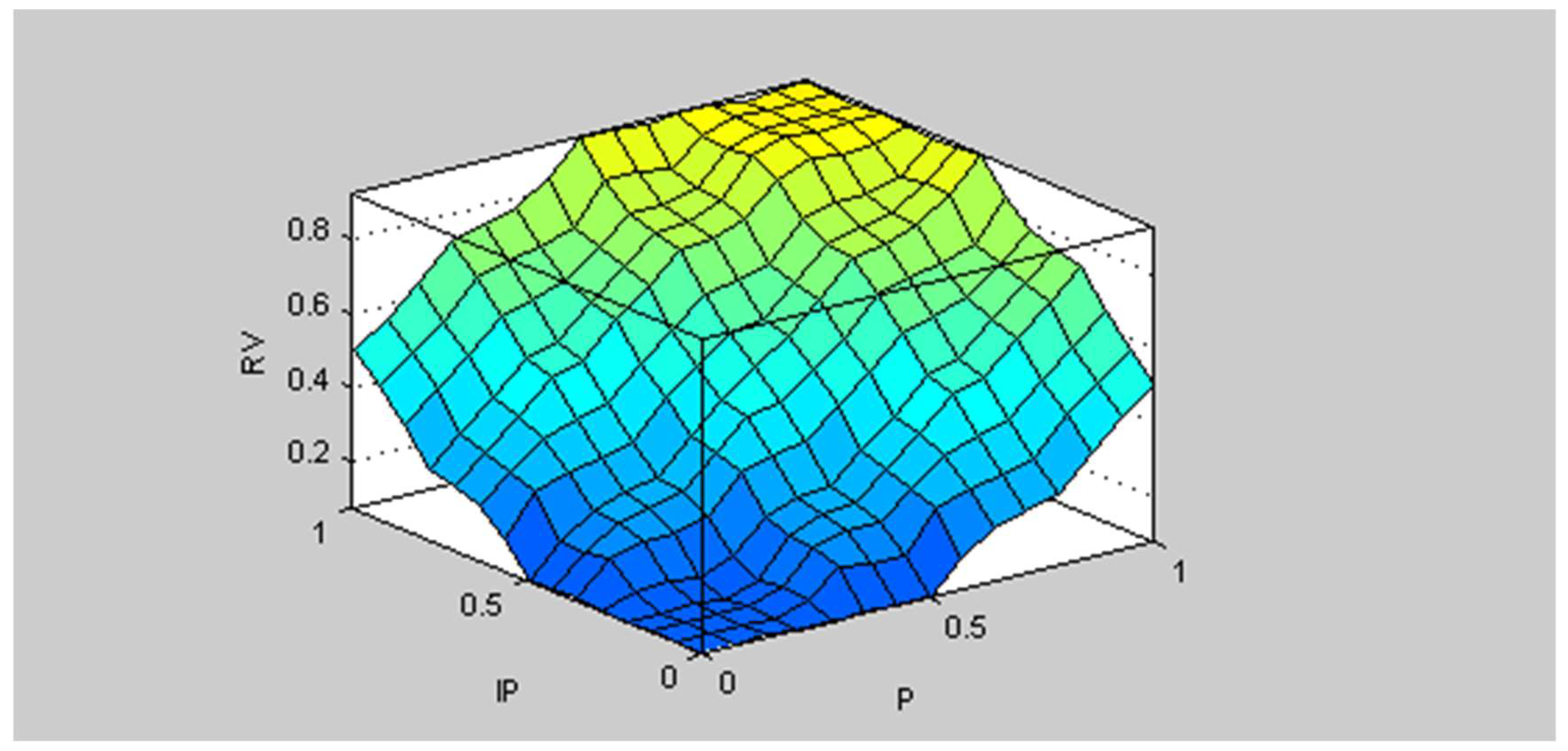
Figure 6 shows the dependence between input and output variables. It is a function of RV = f (P, IP). The coordinates [0; 0] represent the following situation: If the input variables P and IP are very high, then the output variable RV is very high. The coordinates [1; 1] represent the following situation: If the input variables P and IP are very low, then the output variable RV is very low.
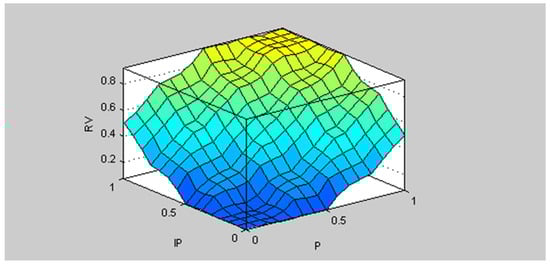
Figure 6.
Surface - dependencies between input and output variables.
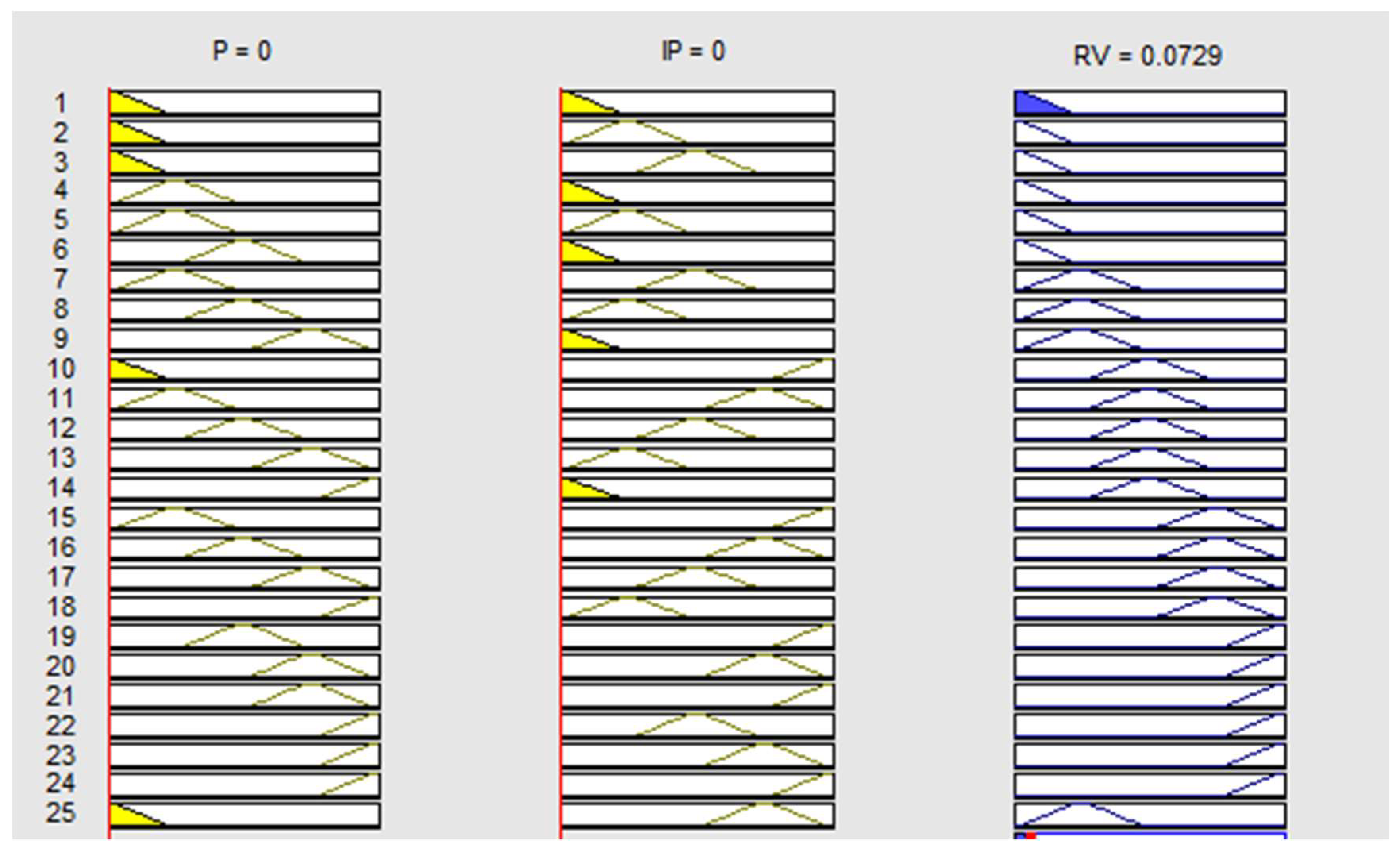
Figure 7 presents the project risk evaluation for a concrete project. The values of input variables P = 0 and IP = 0 give the value of output variable RV = 0.0729 (see the first rule in Figure 7). This situation interprets that the total risk of the project is very high. The fuzzy model was verified in this manner. The results match the requirement, so the fuzzy model can generally be regarded as functional.
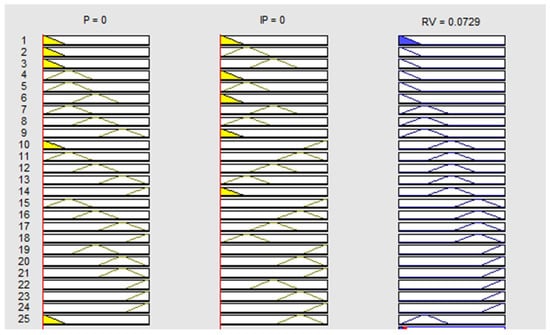
Figure 7.
The evaluation of total project risk of a concrete project.
The created fuzzy model is necessarily tuned to set up the inputs to known values, evaluate the results, and change or add the rules. It is necessary to work with real data of the project for this process. Based on the real data, the parameters of the fuzzy model must be set. The model can be used in practice if the validation shows that the model provides accurate results.
This approach of risk management of the sustainability project is generally applicable and does not have any specific limitations. It assumes that the project team bases its work on past project experiences. These experiences must be applied methodologically according to the authors’ described procedures. For use in a concrete company, it is necessary to prepare specific real data according to the results of the post-project analyses. These results reflect the experiences of already implemented projects and their documentation. This information serves as a reference for the risk analysis currently underway.
5. Discussion
The necessity to ensure sustainability project success in the current complicated times of a VUCA world [33] requires the project team members and project managers to improve continuously from one project to another. This can be realized if the principles of knowledge management are applied in project management. In practice, this requires ensuring good and efficient progress of post-project phases, in particular by means of post-implementation system analysis and compilation of a set of proposals for the improved management of subsequent projects. Through post-implementation analysis (post-project phase implementation), the necessary knowledge can be gained, which can be used later in correct knowledge management.
The paper shows to sustainability project managers and project team members what new and sophisticated methods should be used in order to achieve a high level of probability of successful project completion with the expected benefits. It lists particular advanced methods for areas crucial for success: RIPRAN™ for risk analysis, replacing a simple estimate of the total risk value by a calculation of gradually separated risk components (threat probability, scenario probability, sum of values of all partial impacts); post-project phases for accumulation of gained project knowledge; and fuzzy sets for improvement of quantitative assessment of not only risks, but also deadlines, costs, and the achieved project quality. The contribution of the paper lies in the fact that these procedures do not require any significant additional financing, but improvements can be achieved in particular by coherent technical and organizational processes applied to the work of the project teams, preparation, organization, and project execution. The original contribution of the paper is the list of the established causes impeding the quality performance of post-project phases, as targeted elimination of these causes may follow from these findings. An innovative contribution is the system concept of risk management and knowledge management in the project management of sustainability projects. Nowadays, the practice is usually such that these approaches are applied in isolation, without any interrelations; or even in some sustainability projects, are ignored.
Workers engaged in industry are confronted with the need to comply with high production quality on a daily basis, either by applying the total quality management (TQM) principles through the ISO 9000 Quality Management Systems set of standards or the Six Sigma movement. The requirements to conform to these high-quality principles have logically generated requirements to comply with the high-quality principles also in areas such as nonproduction and sustainability project management, referred to jointly as project management and quality of project.
Increased attention needs to be paid to the selection of members of the sustainability project teams. Very often, project managers are appointed to head the project teams as professionals in project management methodology who, however, do not understand and do not identify with the notion of sustainable development and their motivation to solve complex issues within these projects is low. On the other hand, enthusiastic advocates of sustainable development principles know nothing about professional project management, according to international standards. The international standard ISO 21500 (“Guidance on project management”) defines basic principles and basic concepts of project management and recommends structuring the project into individual phases. It defines the content for theses phases [34]. The international standard ISO 31000 (“Risk management”) unifies the terminology of risk management. It explains the basic principles, approaches, and procedures of risk management. It presents the risk analysis techniques [35]. The international standard ISO 10006 (“Quality management—Guidelines for quality management in projects”) defines and characterizes nine processes that are necessary to ensure project quality management according to TQM principles [36].
The approach described in the fuzzy set application enables the fuzzy approach to be applied not only to risks, but to put together a method of complex project status assessment in terms of deadlines, costs, risks, and quality, which would improve the quality and success of sustainability projects [13]. The fuzzy approach application creates conditions for building a knowledge base that would become the basis for creating an expert system of assessing the risks of sustainability projects.
It is a fact that the RIPRAN™ method is positively evaluated and successfully used by approximately 13 important companies in the Czech Republic. It is also taught at 10 universities (14 faculties) in the Czech Republic nowadays.
Future research will focus on elaborating procedures for risk evaluation through the fuzzy approach in the context of the RIPRAN™ method. The aim will be to apply the principal functionality of the fuzzy model for the use of a concrete company or selected sector (mechanical engineering, IT, etc.), including a methodology of implementation. The first phase of the research is planned to realise selected mechanical engineering projects at our university in cooperation with Industry Cluster 4.0.
A necessary prerequisite for the tuning of a fuzzy model is the experience and knowledge gained from realised projects in the past. These are possibly obtained using the post-project phases in the context of knowledge management. The obtained knowledge base will be also able to generate input data of the model (fuzzy rules, membership functions) using the adaptive neuro-fuzzy inference system (ANFIS).
6. Conclusions
To conclude, it needs to be emphasized that projects as complex as sustainable development projects require the application of a system approach and system dynamics as products of system thinking [37]. It seems astounding that the ISO 21500 international standard, although having been issued for international project management including the management of sustainable development projects to follow its respective principles, is not taken into account as needed and is not paid sufficient attention. Instead, sustainable development projects are executed intuitively and based on local and national customary procedures, which often impede efficient problem solving within the sustainable development projects [38].
The analysis of the behaviour of current project workers—both project managers and project team members [39]—shows that these workers fail to perform knowledge transfer and accumulation of their own accord in the course of the projects and within the companies and institutions where the projects take place and are managed. Therefore, all sustainable development project stakeholders need to be recommended to support and organize knowledge management explicitly.
To manage knowledge means not only to ensure its storage and accumulation, evaluation, and further utilization, but also to organize and require continuous education of those who propose the sustainability projects and manage their execution. In particular, the analysis of causes obstructing experience sharing and accumulation has to be recommended and the established causes need to be purposefully eliminated.
Both processes, that is, knowledge and education management, need to be recommended as processes for creating learning organizations [40].
It might be debatable whether all of the recommendations mentioned in the paper can be realised, when a wide range of companies and institutions usually participate in sustainable development projects. The authors believe that the sustainable development goals that all the project stakeholders should become aware of may act as the synergic effect that should unite the efforts of all to coordinate the required endeavours.
Author Contributions
R.D. and B.L. designed the conceptual framework of the article and performed the experiments (primary research, results, discussion, recommendations).
Acknowledgments
This paper was supported by grant FP-S-18-5524 “Information and Knowledge Management in the age of Industry 4.0” of the Internal Grant Agency at the Brno University of Technology.
Conflicts of Interest
The authors declare no conflict of interest.
References
- Nilsson, M.; Griggs, D.; Visbeck, M. Policy: Map the interactions between Sustainable Development Goals. Nat. News 2016, 534, 320. [Google Scholar] [CrossRef] [PubMed]
- Sustainability Projects for United States | Sustainable Measures. Available online: http://www.sustainablemeasures.com/projects/Sus/Sustainability/5 (accessed on 20 March 2018).
- Yu, M.; Zhu, F.; Yang, X.; Wang, L.; Sun, X. Integrating Sustainability into Construction Engineering Projects: Perspective of Sustainable Project Planning. Sustainability 2018, 10, 784. [Google Scholar] [CrossRef]
- Hardy-Vallee, B. The Cost of Bad Project Management. Business Journals, 7 February 2012. [Google Scholar]
- Lacko, B. Evaluation of Software Projects with Mta; Vsb-Tech University Ostrava: Ostrava, Czech Republic, 2012; ISBN 978-80-248-2669-1. [Google Scholar]
- Doležal, J. Prediction in Project Using Markov Chains. Available online: https://www.vutbr.cz/studenti/zav-prace?zp_id=34323 (accessed on 15 March 2018).
- Šviráková, E. Methods for Project Tracking in Creative Environment. Acta Inform. Pragensia 2017, 6, 32–59. [Google Scholar] [CrossRef]
- Rasheed, S.; Wang, C.; Lucena, B. Risk Leveling in Program Environments—A Structured Approach for Program Risk Management. Sustainability 2015, 7, 5896–5919. [Google Scholar] [CrossRef]
- Nguyen, L.H.; Watanabe, T. The Impact of Project Organizational Culture on the Performance of Construction Projects. Sustainability 2017, 9, 781. [Google Scholar] [CrossRef]
- Relich, M. A computational intelligence approach to predicting new product success. In Proceedings of the 11th International Conference on Strategic Management and Its Support by Information Systems, Uherske Hradiste, Czech Republic, 21–22 May 2015; pp. 142–150. [Google Scholar]
- Naeni, L.M.; Shadrokh, S.; Salehipour, A. A fuzzy approach for the earned value management. Int. J. Proj. Manag. 2011, 29, 764–772. [Google Scholar] [CrossRef]
- Schwalbe, K. Řízení projektů v IT: Kompletní průvodce; Vyd. 1; Computer Press: Brno, Czech Republic, 2011; ISBN 978-80-251-2882-4. [Google Scholar]
- McManus, J. Risk Management in Software Development Projects; Routledge: Abingdon, UK, 2012; ISBN 978-1-136-36791-5. [Google Scholar]
- Boehm, B.W. Software Risk Management: Principles and Practices. Nasirzadeh 1991, 8, 32–41. [Google Scholar] [CrossRef]
- Rudnik, K.; Deptula, A.M. System with probabilistic fuzzy knowledge base and parametric inference operators in risk assessment of innovative projects. Expert Syst. Appl. 2015, 42, 6365–6379. [Google Scholar] [CrossRef]
- Nasirzadeh, F.; Khanzadi, M.; Rezaie, M. Dynamic modeling of the quantitative risk allocation in construction projects. Int. J. Proj. Manag. 2014, 32, 442–451. [Google Scholar] [CrossRef]
- Liu, Z.-C.; Ye, Y. Models for comprehensive evaluating modeling of investment project risk with trapezoid fuzzy linguistic information. J. Intell. Fuzzy Syst. 2015, 28, 151–156. [Google Scholar] [CrossRef]
- Rodriguez, A.; Ortega, F.; Concepcion, R. A method for the evaluation of risk in IT projects. Expert Syst. Appl. 2016, 45, 273–285. [Google Scholar] [CrossRef]
- Zwikael, O.; Pathak, R.D.; Singh, G.; Ahmed, S. The moderating effect of risk on the relationship between planning and success. Int. J. Proj. Manag. 2014, 32, 435–441. [Google Scholar] [CrossRef]
- Doskocil, R.; Skapa, S.; Olsova, P. Success Evaluation Model for Project Management. E M Ekon. Manag. 2016, 19, 167–185. [Google Scholar] [CrossRef]
- RIPRAN—Metoda pro analýzu projektových rizik. Available online: http://ripran.eu/ (accessed on 30 January 2018).
- Ginevičius, T.; Kaklauskas, A.; Kazokaitis, P. Knowledge model for integrated construction project management. Bus. Theory Pract. 2011, 12, 162–174. [Google Scholar] [CrossRef]
- Matthies, B.; Coners, A. Double-loop learning in project environments: An implementation approach. Expert Syst. Appl. 2018, 96, 330–346. [Google Scholar] [CrossRef]
- Zhang, J.; Li, H.; Wang, S.H.-M. Analysis and Potential Application of the Maturity of Growth Management in the Developing Construction Industry of a Province of China: A Case Study. Sustainability 2017, 9, 143. [Google Scholar] [CrossRef]
- Janicek, P. Systems Conception of Problem-Solving. In Engineering Mechanics 2017; Acad Sci Czech Republic, Inst Thermomechanics: Prague, Czech Republic, 2017; pp. 402–405. ISBN 978-80-214-5497-2. [Google Scholar]
- Zadeh, L.A. Fuzzy sets. Inf. Control 1965, 8, 338–353. [Google Scholar] [CrossRef]
- Chen, S.-H.; Kaboudan, M.; Du, Y.-R. The Oxford Handbook of Computational Economics and Finance; Oxford University Press: Oxford, UK, 2018; ISBN 978-0-19-984437-1. [Google Scholar]
- Meyer, A.; Zimmermann, H.-J. Applications of Fuzzy Technology in Business Intelligence. Int. J. Comput. Commun. Control 2011, 6, 428–441. [Google Scholar] [CrossRef]
- Tripathy, B.K.; Sooraj, T.R.; Mohanty, R.K. A New Approach to Fuzzy Soft Set Theory and Its Application in Decision Making. In Computational Intelligence in Data Mining, Cidm, Vol 2; Behera, H.S., Mohapatra, D.P., Eds.; Springer-Verlag Berlin: Berlin, Germany, 2016; Volume 411, pp. 305–313. ISBN 978-81-322-2731-1. [Google Scholar]
- Zadeh, L.A. Fuzzy logic as the logic of natural languages. In Analysis and Design of Intelligent Systems Using Soft Computing Techniques; Melin, P., Castillo, O., Ramirez, E.G., Kacprzyk, J., Pedrycz, W., Eds.; Springer-Verlag Berlin: Berlin, Germany, 2007; Volume 41, pp. 1–2. ISBN 978-3-540-72431-5. [Google Scholar]
- Dostál, P. Advanced Decision Making in Business and Public Services, 1st ed.; Akademické nakladatelství CERM: Brno, Czech Republic, 2011; ISBN 978-80-7204-747-5. [Google Scholar]
- Doskočil, R. An evaluation of total project risk based on fuzzy logic. Bus. Theory Pract. 2016, 15, 23–31. [Google Scholar] [CrossRef]
- Fassinger, R.E.; Shullman, S.L.; Buki, L.P. Future Shock: Counseling Psychology in a VUCA World. Couns. Psychol. 2017, 45, 1048–1058. [Google Scholar] [CrossRef]
- Zandhuis, A. ISO21500: Guidance on Project Management—A Pocket Guide; Van Haren Publishing: Zaltbommel, The Netherlands, 2013; p. 51. [Google Scholar]
- Cooper, D.; Bosnich, P.; Grey, S.; Purdy, G.; Raymond, G.; Walker, P.; Wood, M. Project Risk Management Guidelines: Managing Risk with ISO 31000 and IEC 62198; Wiley: Hoboken, NJ, USA, 2014. [Google Scholar]
- ISO 10006:2017—Quality Management—Guidelines for Quality Management in Projects. Available online: https://www.iso.org/standard/70376.html (accessed on 20 April 2018).
- Kerzner, H.R. Project Management: A Systems Approach to Planning, Scheduling, and Controlling; John Wiley & Sons: Hoboken, NJ, USA, 2017; ISBN 978-1-119-16535-4. [Google Scholar]
- Ariely, D. The Upside of Irrationality: The Unexpected Benefits of Defying Logic at Work and at Home; HarperCollins: London, UK, 2010; ISBN 978-0-00-735479-5. [Google Scholar]
- McCrindle, M.; Wolfinger, E. The ABC of XYZ: Understanding the Global Generations; University of New South Wales Press: Sydney, Australia; London, UK, 2010; ISBN 978-1-74223-035-1. [Google Scholar]
- Simonin, B.L. The Importance of Collaborative Know-How: An Empirical Test of the Learning Organization. Acad. Manag. J. 1997, 40, 1150–1174. [Google Scholar] [CrossRef]
© 2018 by the authors. Licensee MDPI, Basel, Switzerland. This article is an open access article distributed under the terms and conditions of the Creative Commons Attribution (CC BY) license (http://creativecommons.org/licenses/by/4.0/).